Rade et al. World Journal of Pharmaceutical Research
RP-HPLC METHOD DEVELOPMENT AND VALIDATION FOR THE
ESTIMATION OF NILOTINIB IN BULK AND TABLET DOSAGES
FORM
*Aakanksha Rade, Khushabu Patil, Tejaswini Thorat, Pragati Patil and Dipti Shinde
SES’s Arunamai College of Pharmacy, Mamurabad, Jalgaon.
ABSTRACT
A simple and reproducible method was developed for nilotinib by Reverse Phase High Performance Liquid Chromatography (RP-HPLC). nilotinib was separated on C18 column [4.6x250mm, particle size 5μm] at the UV detection of 250nm. Methanol, Acetonitrile,
Water (0.1%) was used as a mobile phase with various ratios and flow rates, eventually 30:20:50 v/v Methanol, Acetonitrile, Water (0.1%) was being set with the flow rate of 1.0mL/min. The statistical validation parameters such as linearity, accuracy, precision, inter-day and intra-day variation were checked, further the limit of detection and limit of quantification of nilotinib concentrations were found to be within the limits. Recovery and assay studies of nilotinib were within 99 to 102% indicating that the proposed method can be adoptable for quality control analysis of nilotinib.
KEYWORDS: Nilotinib, HPLC, Wavelength, Linearity, Assay.
INTRODUCTION
Nilotinib, 4- methyl- N –[) 4 Methyl- 1H imidazole- 1-yl-)- 5(trifluromethyl) phenyl]- 3-[(4- pyridine- 3-yl pyrimidin- 2-yl) amino] benzamide. It is an anti cancer drug. Nilotinib, in the form of the hydrochloride monohydrate salt, is a small molecule tyrosine kinase inhibitior approved for the treatment of imatinib resistant chronic mylogenous leukemia. Several analysis of Nilotinib such as an indirect as chromatographic, spectro-photometric survey revealed that no stability indicating RP-HPLC method is reported for determination of nilotinib in bulk drug and tablet dosage form.[1,2] The main objective of the proposed work was to develop a simple, accurate, precise and sensitive RP-HPLC method for the estimation
Volume 8, Issue 11, 1286-1294. Research Article ISSN 2277– 7105
Article Received on 09 August 2019,
Revised on 19 Sept. 2019, Accepted on 29 Sept. 2019,
DOI: 10.20959/wjpr201911-15910
*Corresponding Author
Aakanksha Rade
SES’s Arunamai College of
Pharmacy, Mamurabad,
of nilotinib in bulk drug and tablet. The method was further optimized and validated in accordance with guidelines suggested by International Conference on Harmonization (ICH).[3]
NILOTINIB
MATERIAL AND METHODS
Quantitative HPLC was performed on a high performance liquid chromatography-Younglin HPLC system connected with PDA Detector 2998 and Empower 2 Software. The drug analysis data were acquired and processed using Empower 2 software running under Windows XP on a Pentium PC and Thermohypersil BDS C
18 column of dimension [4.6x250mm, particle size 5μm]. In addition an analytical balance (DENVER 0.1mg
sensitivity), Digital pH meter (Equiptronics pH 5-10), a sonicator (Unichrome associates UCA 701) were used in this study.
Standards and chemicals used
Pharmaceutical grade nilotinib was kindly supplied as a gift sample by Ujwal pharmaceuticals, Pune. Methanol and Acetonitrile were of HPLC grade and Purchased from Jinendra Scientifics, Jalgaon. Water HPLC grade was obtained from a Milli-QRO water purification system. Nilotinib tablets available in the market as Tasigna tablet of Million Health Pharmaceutical, Chennai, India.
Preparation of mobile phase
The combination of mobile phase is Methanol: Acetonitrile: Water (30:20:50) v/v and filtered through 0.45μ membrane filter and degassed by sonication.
Preparation of standard solution
µgm/ml of nilotinib and filtered through 0.45µm membrane filter. Then the dilutions are made.
Preparation of stock solution
Weigh accurately 12.87 mg of nilotinib and taken in a 100 ml standard flask. The volume was made up to 10 ml with the mobile phase and sonicated for 10 min. It consists of 1000 μg/ml of Nilotinib and filtered through 0.45 μm membrane filter.
Quantification of nilotinib
Twenty tablets were finely powdered and an accurately weighed sample of powdered tablets equivalent to nilotinib (400 mg) were transferred to a 100 ml volumetric flask and dissolved in Mobile Phase. The solution was shaken well and allowed to stand for 10 min with intermittent sonication to ensure complete solubility of drug. The contents were made up to the mark with Mobile Phase and filtered through a 0.45μ membrane filter. From the filtrate, dilution was made in a 100 ml volumetric flask to get 12.87 µgm of nilotinib. The peak area measurements were done by injecting the sample for three times and the amount of nilotinib was calculated.
Chromatographic condition
For chromatographic analysis
Thermo Hypersil BDS C18 column [4.6x250mm, particle size 5μm] was used. The solvent
system was a mixture of Methanol: Acetonitrile : Water (30:20:50) v/v. It was filtered under vacuum from 0.45 membrane filter and degassed in ultrasonic bath for 15 min before passing through the instrument. The flow rate was 1.0 ml/min. UV detection was carried out at 250nm.
Method Validation
Linearity
To establish linearity, the stock solutions were prepared (1000 μg/ml) of nilotinib using mobile phase as the solvent, again from the stock solution further dilutions were made to yield solutions in the concentration range of 1000 μg/ml of nilotinib. 1.0 ml of each solution
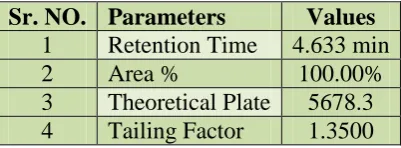
Table no. 1: System Suitability Parameters.
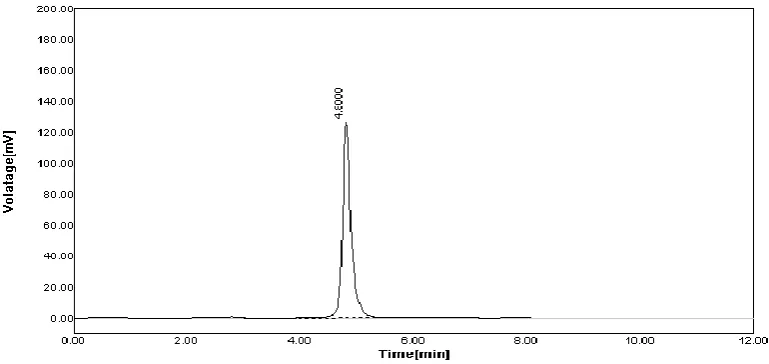
Sr. NO. Parameters Values 1 Retention Time 4.633 min
2 Area % 100.00%
3 Theoretical Plate 5678.3 4 Tailing Factor 1.3500
Precision
Precision study of sample Nilotinib was carried out by estimating corresponding responses 6 times on the day for the 100% target conc. The percent relative standerd deviation (%RSD) is calculated which is within the acceptable criteria of not more then 2.0 in table 3.
Repeatability
Repeatability is the closeness of agreement between mutually independent test result obtain with the same method on identical test material on the same laboratory by the same operator using the same equipment within short interval of time in table 4.
Accuracy
The accuracy is the closeness of agreement between the true value and test result. Accuracy was determine by means of recovery experiments, by addition of active drug to placebo formations. It was calculated from the test result as the percentage of the analyte recorved by the assay.
Robustness
The robustness is evaluated by the analysis of Nilotinib under different experimental condition such as making small change in flow rate, λ max & mobile phase conc.
Ruggedness
The ruggedness was calculated by using two different analysts. An appropriate conc. 30µg/ml of nilotinib was analyzed and conc. was determine.
LOD & LOQ
Limit of detection (LOD) and limit of quantification (LOQ) were calculated as 0.0718 ∂/S and 0.2176∂/S, respectively as per ICH guidelines, where ∂ is the standared deviation of the
RESULT AND DISCUSSION
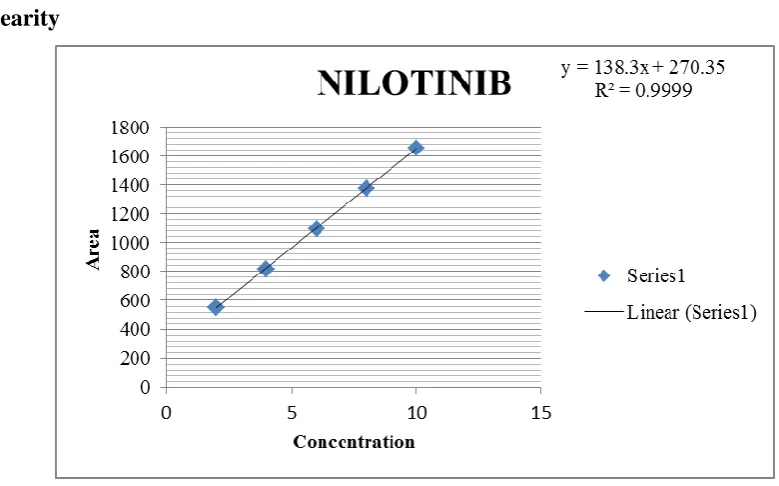
[image:5.595.90.480.91.334.2]Linearity
Fig no. 1: Linearity graph of Nilotinib.
Table no. 2: Linearity of Nilotinib.
Sr No. Conc Area-I Area-II Mean SD % RSD 1 2 552.46 550.69 551.575 1.25 0.23 2 4 817.35 821.94 819.645 3.25 0.40 3 6 1098.86 1103.56 1101.21 3.32 0.30 4 8 1375.83 1380.9 1378.365 3.59 0.26 5 10 1656.21 1661.34 1658.775 3.63 0.22
Precision
The precision of an analytical method is the closeness of replicate result obtained from Analysis of the same homogeneous sample. To study precision, three replicate standard Solution of Nilotinib (150 µgm/ml) were prepared and analyzed using the proposed Method. The percent relative standard deviation (%RSD) for peak responses was Calculated and it was found to be which is well within the acceptance criteria of not more than 2.0%. Result of system precision studies are shown in table no.3.
Table no. 3: Precision of Nilotinib.
Sr No. Conc. % RSD
INTRADAY INTERDAY
1 2 0.64 1.19
2 6 0.61 0.62
[image:5.595.185.417.672.744.2]Repeatability
Repeatability was ascertained by getting the sample analyzed by different analyst and Carrying out analysis for number of times. The results are shown in table no.4.
Table no. 4: Repeatability of Nilotinib.
Sr.
No Conc. Area I II Mean
AMT Found
% Amt
Found SD %RSD
1 5 1368.12 1381.74 1370.82 1373.56 7.97 99.63 7.21 0.53
Accuracy
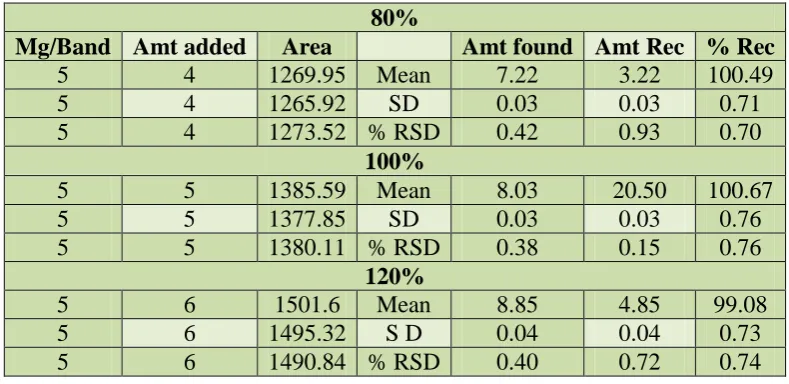
[image:6.595.100.495.362.554.2]Accuracy of the method was tested by carrying out recovery studies at different Spiked levels. The estimation was carried out as describe earlier. At each level, Three determination were performed and result obtained. The amount recovered and the values of percent were calculated, result are shown in table no.5.
Table no. 5: Accuracy of Nilotinib.
80%
Mg/Band Amt added Area Amt found Amt Rec % Rec
5 4 1269.95 Mean 7.22 3.22 100.49
5 4 1265.92 SD 0.03 0.03 0.71
5 4 1273.52 % RSD 0.42 0.93 0.70
100%
5 5 1385.59 Mean 8.03 20.50 100.67
5 5 1377.85 SD 0.03 0.03 0.76
5 5 1380.11 % RSD 0.38 0.15 0.76
120%
5 6 1501.6 Mean 8.85 4.85 99.08
5 6 1495.32 S D 0.04 0.04 0.73
5 6 1490.84 % RSD 0.40 0.72 0.74
Ruggedness
The ruggedness was calculated by using two different analysts. An appropriate concentration 30 μg/ml of nilotinib was analyzed and concentration was determined.
Table no. 6: Ruggedness of Nilotinib.
Sr No. Conc Area II III Mean Amt
Found
% Amt.
Found SD
Robustness
The robustness of the method was assessed by altering the some experimental conditions such as, by changing the flow rate from 0.6 to 1.0 ml/min, wavelength and volume of the mobile phase.
Table No. 7: Robustness of nilotinib.
Parameters Nilotinib
Flow rate(ml/min) 0.98 1.02
% RSD 0.17 0.29
Wavelength 249 251
%RSD 0.70 0.61
Mobile Phase 19+19+52 31+21+48
%RSD 0.46 0.38
LOD and LOQ
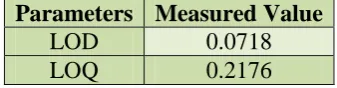
Limit of detection (LOD) and limit of quantification (LOQ) were calculated as 0.302 ∂/S and 1.009∂/S, respectively as per ICH guidelines, where ∂ is the standard deviation of the
[image:7.595.157.444.187.292.2]response (y-intercept) and S is the slope of the calibration plot in table no 8 as follows.
Table No. 8: LOD and LOQ of Nilotinib.
Parameters Measured Value
LOD 0.0718
LOQ 0.2176
Assay for Formulation of Nilotinib
The validated method was applied for the determination of nilotinib in commercially available Tasigna tablets. The results of the assay (n=6) undertaken yielded 99.13% (%RSD = 0.37%) of label claim nilotinib. The mean retention time of nilotinib was 4.633 min. The results of the assay indicate that the method is selective for the analysis of nilotinib without interference from the excipients used to formulate and produce these tablets.
Table no 9: Assay for Formulation.
Drugs Labelled amount % Lable claim
Amount taken(mg)
Amount found for assay
(μg/mL) (mg) %
[image:7.595.213.382.422.466.2]Fig No. 2: Optimized Chromatogam of Niotinib.
CONCLUSION
A validated RP-HPLC method was developed for the determination of Nilotinib. In the bulk and pharmaceutical dosage form. The method was validated for Linearity, precision, accuracy, ruggedness, robustness, LOD, LOQ, Repeatability The proposed RP-HPLC method can be successfully applied for the routine Control analysis of Nilotinib along with their dosage form.
ACKNOWLEDGEMENT
The authors would like to thanks our principal, beloved parents and all my well wishers, one and all who have helped me directly and indirectly in completing this project work.
LIST OF ABBREVATIONS
SR.NO ABBREVATIONS
1 RP-HPLC- Reverse phase high performance liquid chromatography 2 HPLC- High Performance liquid chromatography
3 UV- Ultra violet
4 PDA- Photodiode Array 5 LOD- Limit of detection 6 LOQ- Limit of quantitation 7 RSD- Relative standard deviation 8 SD- Standard deviation
LIST OF TABLES
TABLE NO NAMES
1 System Suitability Parameter 2 Linearity of Nilotinib
3 Precision of Nilotinib 4 Repetability of Nilotinib 5 Accuracy of Nilotinib 6 Ruggedness of Nilotinib 7 Robustness of Nilotinib 8 LOD and LOQ
9 Assay for Formulation
LIST OF FIGURES
FIGURES NAMES
Figure 1 Structure
Figure 2 Linearity Graph of Nilotinib
Figure 3 Optimize chromatogram of nilotinib
REFERENCES
1. Lankheet, Nienke AG, et al. "Method development and validation for the quantification of dasatinib, erlotinib, gefitinib, imatinib, lapatinib, nilotinib, sorafenib and sunitinib in human plasma by liquid chromatography coupled with tandem mass spectrometry." Biomedical chromatography, 2013; 27.4: 466-476.
2. Kralj, Eva, et al. "Simultaneous measurement of imatinib, nilotinib and dasatinib in dried blood spot by ultra high performance liquid chromatography tandem mass spectrometry." Journal of Chromatography B, 2012; 903: 150-156.
3. Harika, Myneni, and G. S. Kumar. "Development and validation of method for the determination of Nilotinib by RP-HPLC in bulk and pharmaceutical dosage forms." Int.
Res. J. Pharmacy, 2012; 3: 161-164.
4. Narayudu Yandamuri Comparative Study Of New Trends in HPLC: A Review International Journal of Pharmaceutica Science Review & Research Int. J. Pharm. Sci. Rev. Res., 2013; 23(2): 52-57.
5. L. Satyanarayan, S. V. Naidu, M. Narsimha Rao, Readdy Suma Latha., The estimation of nilotinib in capsule dosage form by RP-HPLC – Asian Journal of Pharmaceutical Analysis, 2011; 1(4): 100-102.