SEPARATION AND OPTIMIZATION OF PHENOLIC COMPONENT
FROM ANACARDIUM OCCIDENTALES TESTA BY SOLVENT
EXTRACTION METHOD
Lenin Kumar B*, Lokeswari N1 and Sri Rami Reddy D2
*Research Scholar, Department of Biotechnology, Dr. B.R.Ambedkar University, Etcherla,
Srikakulam Dist., AndhraPradesh, India.
1Assistant Professor, Department of Biotechnology, Dr. B.R.Ambedkar University, Etcherla,
Srikakulam Dist., AndhraPradesh, India.
2Professor, Centre for Biotechnology, Department of Chemical Engineering, Andhra
University, AndhraPradesh, India.
ABSTRACT
The aim of this study was to investigate tannins by using a process for
utilizing the waste raw material (Anacardium occidentales L. testa)
into a useful substance. Tannins are the fourth most abundant plant
constituent after cellulose, hemicelluloses and lignin. For separation of
tannins, water was used as solvent. Optimization parameters time,
temperature and particle size was studied for optimum extraction of
tannins from cashew waste testa. During the experiment samples were
stored in the absence of heat in a dark container. Moisture content of
the samples was estimated.
KEYWORDS: Anacardium occidentales L., solvent, optimization, tannins and testa.
INTRODUCTION
Tannins are naturally occurring polyphenolic compounds with varying molecular weights that
occur naturally in the plant kingdom.( Esmaeil Zakipour-Molkabadi et.al. 2013) These
phenolic compounds differ from others by having the ability to precipitate proteins from
solutions. In the plant kingdom these tannins are found in leaves, bark and wood. Tannins are
considered to be the plants secondary metabolic products because they play no direct role in Article Received on
23 October 2014,
Revised on 16 Nov 2014, Accepted on 07 Dec 2014
*Correspondence for
Author
Lenin Kumar B
Research Scholar,
Department of
Biotechnology, Dr.
B.R.Ambedkar
University, Etcherla,
Srikakulam Dist.,
AndhraPradesh, India.
the plants metabolism. After lignin, tannins are the second most abundant group of plant
phenolics.
The existence of tannins in the leaves of 46 different species of fodder trees and stated that
generally tree leaves and browse contain both types of tannins (hydrolysable and condensed)
( Kumar and Vaithiyanathan 1990). The main families of dicotyledons, which contain tannins
include Aceraceae, Actinidiaceae, Anacardiaceae, Bixaceae, Burseraceae, Combretaceae,
Dipterocarpaceae, Ericaceae, Grossulariaceae and Myricaceae while those of
monocotyledons include Najadaceae and Typhaceae.( Joseck Olukusi Alwala et.al. 2014).
Tannins are present in large number of feed and forages. The formation of complexes of
tannins with nutrients, such as carbohydrates, proteins and minerals, has negative effects on
their utilization.( Hina Iqbal and Ashima Kapoor. 2012). The present works describes the
extraction of hydrolysable tannins from waste testa.
MATERIALS AND METHODS
Substrate: Anacardium occidentale L. (Cashew testa) was collected from the cashew industries in Palasa (Srikakulam District, Andhra Pradesh) and Visakhapatnam
(Visakhapatnam District, Andhra Pradesh) and placed in cold and dark containers.
Extraction of tannins: Testa of the Anacardium occidentalis was used for the extraction of tannins. Testa were dried and milled using ball mill to get the particle size below 5.0 mm.
Water is preferred as solvent in view of its high saturation limit of the dissolved solids,
inherent safety and ease of separation. Water should be soft and should not be contain iron.
Braemer’s test: For the identification of tannins present, to 2ml of aqueous extract 2ml of
5% FeCl3 was added. Formation of yellow brown or greenish black precipitate indicates that tannins are present (Jigna and Sumitra. 2007.,Rajyalaxmi M.R. and Sindhu A. 2011., Manjula
et.al. 2013).
Effect of time: For achieving maximum degree of tannin extraction, the effect of time was studied by varying the time period between 15 min to 50 min.
Effect of Particle size
The effect of particle size of the tannin resource cashew testa was studied by varying the
particle size between 0.2 mm to 5.0 mm.
RESULTS AND DISCUSSION
Samples were analysis before extraction of polyphenolic component, contents present in the
sample were moisture content 35% - 39%, tannins 28% - 35%, soluble non- tans 15% - 10%,
pH of standard tan liquor from testa 3.5, colour dark black or brown. After drying the sample
moisture content was estimated 7% - 8%.
To determine optimal operational conditions, an experimental survey was conducted for
extracting tannin materials from Anacardium occidentale testa (0.5 particle size) with 5%
(w/v) water – immiscible solvent. Braemers’s test was performed for the aqueous extract.
Yellow brown of greenish black colour precipitate was formed and tannins present in the test
sample were confirmed. The percentage of extracted tanning materials from samples was
measured by varying the following factors: time, temperature and particle size.
Effect of Time: The effect of time on tannin extraction was studied by varying time periods between 15- 50 min. with 0.5mm particle size substrate at 35ºC.
Table1: Effect of time on tannin extraction
Time period (min.) Tannin (mg/ml)
15 3.72
20 3.81
25 3.94
30 4.10
40 4.72
45 4.32
50 3.91
The optimum time period for maximum tannin extraction was 40 min. Extraction of tannins
has increased with increase in time up to 40 minutes, with further increase in time decreased
tannins content.
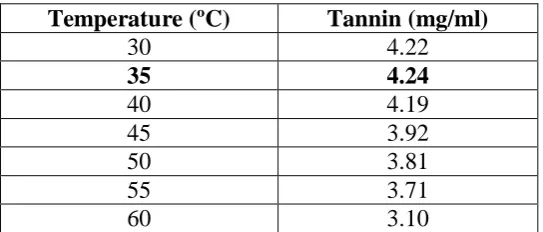
Table 2: Effect of temperature on tannin extraction.
Temperature (ºC) Tannin (mg/ml)
30 4.22
35 4.24
40 4.19
45 3.92
50 3.81
55 3.71
60 3.10
Temperature 35 ºC was optimum for extraction of 4.24mg/ml of tannin. Increasing
temperature decreases concentration of tannin and it promotes hydrolysis and unwanted
extraction of hemicelluloses and cellulose materials.
3. Effect of particle size: Effect of particle size on tannin extraction was carried out by using substrate of different particle sizes (0.2mm, 0.5mm, 1.0mm, 3.0mm and 5.0mm) at 35ºC for
40 min. to determine the effect of particle size on testa tannin extraction for achieving high
extraction efficiency.
Table 3: Effect of particle size on tannin extraction
Particle size (mm) Tannin (mg/ml)
Fine powder 3.10
0.2 3.81
0.5 4.86
1.0 4.73
3.0 4.32
5.0 4.27
Fine powder substrate gives less tannin extract. The particle size 0.5mm substrate gives high
tannin content. As the particle size decreases, more surface area will be available for tannin
extraction and increase in tannin extraction was obtained. Optimum particle size is found to
be 0.5mm (Table 3).
Madhunisha et.al. 2013 studied 300-1400µm average particle size of guava leaves. Lokeswari
and Sujatha . 2011 reported optimum particle size 0.5mm for extraction of tannins from Divi
Divi pods. This is similar to present obtained results.
However, from grinding energy and product purification cost points of view, fine grinding is
REFERENCES
1. Esmaeil Zakipour-Molkabadi, Zohreh Hamidi-Esfahani, Mohammad Ali Sahari and
Mohammad Hosein Azizi. 2013. A New Native Source of Tannase Producer, Penicillium
sp. EZ-ZH190:Characterization of the Enzyme. Iranian Journal of Biotechnology, 2013;
11(4): 244-50.
2. Hina Iqbal and Ashima Kapoor. 2012. Culture Conditions for the Production of Tannase
from Trichoderma harzianum MTCC 10841. Intr. Jrnl. of Sci. and Tech, 2012; 1(11):
584 -595.
3. Joseck Olukusi Alwala, Francis Ndilu Kiema and Wycliffe Wanzala. 2014.
Determination of tannin concentrations in African indigenous vegetables, grains and
cassava roots from Emuhaya district, western Kenya. Americal jrnl. of nutri. and food sci,
2014; 1(1): 1-8.
4. Jigna P and Sumitra VC. 2007. In vitro antimicrobial activity and phytochemical analysis
of some Indian medicinal plant. Turk. J. Biol. 2007; 31: 53-58
5. Kumar R. and Vaithiyanathan S. 1990. Occurrence, nutritional significance and effect on
animal productivity of tannins in tree leaves. Animal Feed Science and Technology.
1990; 30: 21-38.
6. Lokeswari N and Sujatha P. 2011. Isolation of tannins from Caesalpina coriaria and effect
of physical parameters. Intr. research Jrnl. of pharmacy. 2011; 2(2): 146 -152.
7. Madhunisha G.V, Dhasarathan P and Sankaranarayanan S. 2013. Production and
optimization of thermostable tannase from Aspergillus niger using agricultural residues.
Global J. of Engg. & Appl. Sciences. 2013; 3(2): 88-92.
8. Manjula K.T, J.M.Sasi Kumar and V.K.Gopalakrishnan. 2013. The phytochemical
screening and profiling of biochemical parameters in different parts of Pandanus
unipapillatus Dennst. In South India. World Jrnl. of pharmac. Research. 2013; 2(4):
878-889.
9. Rajyalaxmi M.R. and Sindhu A. 2011. Preliminary phytochemical screening and
antioxidant activity of an ayurvedic formulation: Balarishtam. Intr. Jrnl. of research in