Military governments and economic development : A case
study of Nigeria from 1960-2000.
RICHARDS, Darlington Chikwem.
Available from Sheffield Hallam University Research Archive (SHURA) at:
http://shura.shu.ac.uk/20275/
This document is the author deposited version. You are advised to consult the publisher's version if you wish to cite from it.
Published version
RICHARDS, Darlington Chikwem. (2001). Military governments and economic development : A case study of Nigeria from 1960-2000. Doctoral, Sheffield Hallam University (United Kingdom)..
Copyright and re-use policy
Fines are charged at 50p per hour
2 2 AUG 2003
ProQuest Number: 10700920
All rights reserved
INFORMATION TO ALL USERS
The quality of this reproduction is dependent upon the quality of the copy submitted.
In the unlikely event that the author did not send a com plete manuscript and there are missing pages, these will be noted. Also, if material had to be removed,
a note will indicate the deletion.
uest
ProQuest 10700920
Published by ProQuest LLC(2017). Copyright of the Dissertation is held by the Author.
All rights reserved.
This work is protected against unauthorized copying under Title 17, United States C ode Microform Edition © ProQuest LLC.
ProQuest LLC.
789 East Eisenhower Parkway P.O. Box 1346
MILITARY GOVERNMENTS AND
ECONOMIC DEVELOPMENT: A CASE
STUDY OF NIGERIA FROM 1960-2000.
BY
DARLINGTON CHIKWEM RICHARDS
A THESIS SUBMITTED IN PARTIAL
FULFILMENT OF THE REQUIREMENTS OF
SHEFFIELD HALLAM UNIVERSITY FOR
THE DEGREE OF DOCTOR OF
PHILOSOPHY
MILITARY GOVERNMENTS AND ECONOMIC DEVELOPMENT
A CASE STUDY OF NIGERIA FROM 1960-2000
BY
DARLINGTON CHIKWEM RICHARDS
TABLE OF CONTENTS ii
ACKNOWLEDGEMENTS vi
LIST OF TABLES vii
ABSTRACT x
CHAPTER ONE
INTRODUCTION TO THE STUDY 12
Research Problems 12
Research Objectives 14
Methodology and Rationale 17
Limitations of the Study 18
Thesis Outline 20
Data Collection/Sources 24
CHAPTER TWO:
THE MILITARY, COUPS D’ETAT AND REGIME CHANGE IN SUB-SAHARAN AFRICA:
Introduction 26
Military Professionalism and Theoretical Role in a Nation-State 26
Legal Form and Political Reality: The Collapse of Separation of
Functions and the Emergence of the Military in the Body Polity 30
Justifying Military Intervention 34
Regional Overview and Factors in Military Intervention 37
Civilian Leadership Failure 40
Lacunae and Structural Weakness of Existing Political Institutions 42
Failure of Existing Regimes to Gain Legitimacy 45
Economic Factors Affecting Military Intervention 46
Military Factors Affecting Military Intervention 47
Military Coups and Cultural Pluralism. 49
Personal Factors Affecting Military Intervention 50
Foreign Factors Affecting Military Intervention 52
Nigeria: Military Intervention in Perspective 55
Regime Type and Discernible Difference(s) 82
Conclusion 84
Endnotes 91
CHAPTER THREE
THEORIES AND CONCEPT OF DEVELOPMENT AND RELEVANCE TO NIGERIA
Introduction 92
Concepts of Development: A General Perspective 93
Linear Stages of Growth Mode 99
Perspective on Rostow’s Linear Stages within a Regional Context 104
Theories and Patterns of Structural Change 110
Perspective on Theories and Patterns of Structural Change 113
The International-Dependence Revolution 115
Perspectives on International Dependence Revolution 121
Neo-classical Counter-Revolution Theory 123
Perspective on Neo-classical Counter-Revolution Theory 125
Conclusion: Development and The Military Institution in Nigeria 127
Endnotes 133
CHAPTER FOUR
MARKET AND ECONOMIC DEVELOPMENT UNDER COLONIAL AND FIRST REPUBLIC GOVERNMENT IN NIGERIA
Introduction 136
Country’s Pertinent Features 136
The Paternalistic State: The Colonial Economic Legacy 141
Development Planning (The Ten Year Plan) and Constitutional Reform 145
The First National Plan (1962-1968) 150
Plan Implementation and National Political Structure 153
Plan Scope and Performance 155
Evaluation of Regional Performance 161
National Performance Evaluation 166
Conclusion 172
CHAPTER FIVE
THE MILITARY AND THE CREATION OF AN ENABLING MARKET ENVIRONMENT
Introduction 173
Enterprise Development: The Role and Focus of the State 175
Prerequisites for State-Led Development 178
Public Enterprise in Nigeria: Origins, Scope and Performance 180
State Capitalism and Nigeria Development 185
Public-Private Sector Relations in Nigeria 191
The Nigeria State and Development Processes 195
The State and Economic Policy 200
Evaluating Policy Outcome 202
Conclusion 203
CHAPTER SIX
MARKET AND ECONOMIC DEVELOPMENT 1966-1975 (UNDER GENERAL YAKUBU GOWON)
Introduction 207
Emergence of the Gowon Administration 207
Managing the War Economy 210
Market/Economic Policy Initiatives Under the Second Development Plan 213
Impact of Oil Boom on Market/Economic Policy 219
Oil Boom and (Public) Expenditure 230
The Indigenization Programme— 1972/1977 233
Conclusion 237
Endnotes 241
CHAPTER SEVEN
MARKET AND ECONOMIC DEVELOPMENT: 1975-1979 (UNDER GENERALS MURTALA MOHAMMED AND OLUSEGUN OBASANJO)
Introduction 244
Market/Economic Policy Initiative Under the Third Plan 245
Market/Economic Growth and Expansion 252
Other Policy Initiatives and Implementation 256
Evaluating Policy Outcome 260
Conclusion 275
Endnotes 277
CHAPTER EIGHT
MARKET AND ECONOMIC DEVELOPMENT IN THE SECOND
REPUBLIC: 1979-1983 (UNDER PRESIDENT SHEHU ALIYU SHAGARI)
Introduction 278
Emergence of the Shagari Government 279
Market/Economic Growth and Expansion 281
Evaluating Policy Outcome 284
Reform in the Administration 290
The Collapse of the Second Republic 292
Conclusion 294
Endnotes 297
CHAPTER NINE
MARKET AND ECONOMIC DEVELOPMENT 1983-1985 (UNDER GENERAL MOHAMMADU BUHARI)
Introduction 298
Market/Economic Policy Initiatives 300
Other Policy Initiatives and Implementation 303
Evaluating Policy Outcome 307
Conclusion 309
Endnotes 312
CHAPTER TEN
Introduction 313
Market/Economic Policy Initiatives 314
Other Policy Initiatives 323
Evaluating Structural Adjustment Programme 326
Political Policy Initiatives 351
Evaluating the Economic Cost of the Political Transition Programme 356
The Babangida Legacy 360
Conclusion 364
Endnotes 368
CHAPTER ELEVEN
MARKET AND ECONOMIC DEVELOPMENT: 1993-1998 (UNDER GENERAL SANIAB ACHA)
Introduction 371
Market/Economic Policy Initiatives 372
Political Policy Initiatives 378
Evaluating Policy Outcome 380
Conclusion 381
GENERAL ABDULSALAMIABUBAKAR: 1998-1999
Introduction 382
Early Policy Initiatives 383
Conclusion 386
Endnotes 387
CHAPTER TWELVE
CONCLUSION: CONSTRAINTS ON MILITARY GOVERNMENTS’ PERFORMANCE IN NIGERIA
General Review 388
Internal Institutional Constraints on Regime Performance 403
International Constraints on Regime Performance 411
Conclusion 414
ACKNOWLEDGEMENTS
In undertaking this research, I have received tremendous help from several
individuals. Their assistance and support in no small measure contributed to the
successful completion of this research. Space constraints me to mention but a few. I
am grateful to Professors Bob Haigh for his suggestions and critical comments early
in this exercise as one of my Directors. I am also very grateful to Professor Sonny
Nwankwo who found time, amidst his busy schedule, to not only be my director of
studies while still with the University, but also continued to offer, on countless
occasions, his guidance and very useful comments and criticisms. Dr. Jim Chandler
could not have been part of this project at a more critical time. For his very personal
and involved dedication in seeing to it that this exercise was completed on schedule,
especially his critical reviews and suggestions, I am grateful.
I wish to thank in a very special way, Professor Dave Morris, without whom
this research could not have been completed. One could not have wished for a finer,
more dedicated, personable and yet extremely critical Supervisor as he went through
the chapters of this research. To Karen Barker and Liz Brearley, Course
Administrators, I say thanks very much for being very helpful every step of the way.
Words are not sufficient to express my gratitude to my family, especially to
Audrey and Ashley for the sacrifice and time I spent away and within from them in
completion of this research.
is original and that it has not been submitted in part or whole for the award of any or
other degree. I take full responsibilities for the contents of this research.
LIST OF TABLES/FIGURES
Dates of Independence of Sub-Saharan African States in Chronological order of
Attainment: 2.1 38
Changes of Government in Nigeria: 1960-1999: 2.2 56
Pre-Colonial Map of Nigeria: Fig.4.1 138
Post- Independence Map of Nigeria with States: Fig. 4.2 139
Nigeria: Selected Economic Indicators, 1913-1966: 4.1 144
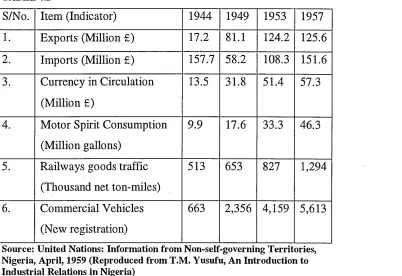
Selected Indicators of Economic of Economic Growth, Nigeria: 1944-1957: 4.2 147
Selected Economic Indicators, 1950-1960: 4.3 149
Public Capital Expenditure Performance under the First National
Development Plan, 1962-68: 4.4 162
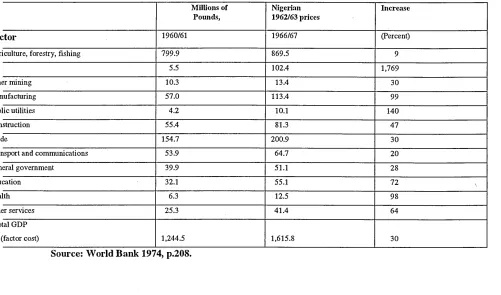
Gross Domestic Product, 1960/61 and 966/67: 4.5 166
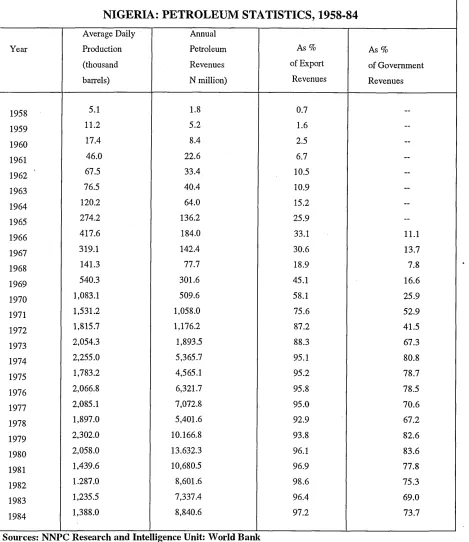
Nigeria: Petroleum Statistics, 1958-84: 6.1 221
Sectoral Composition of the Gross Domestic Product (in Percentages): 6.2 225
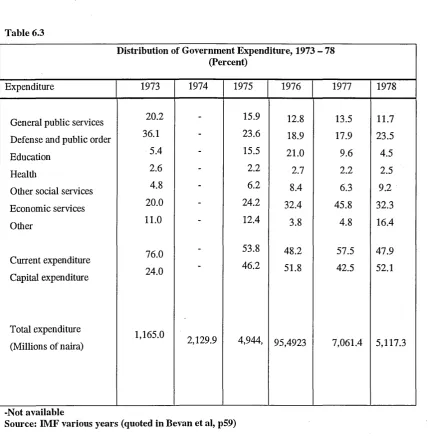
Distribution of Government Expenditure, 1973-78 (Percent): 6.3 226
Imports of Major Food Commodities 1970-84 (lOOOmtons): 6.4 229
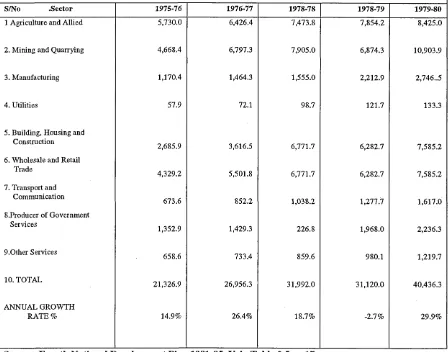
Growth of Domestic Product 1975/76-1979/80 (At Current Prices): 7.1 249
Gross Domestic Product 1975/76-1979/80 (At 1977-78 Factor Cost): 7.2 251
Persons Employed in Selected Sectors, Manufacturing Industry: 7.3 262
GDP Sectoral Growth Rates Proposed Under the Fourth Development Plan,
Sectoral Composition of the Gross Domestic Product (in Percentages): 9.2 306
Some of the Workers Retrenched by the State Government Agencies
Between 1st January and 30th September 1984: 9.3 308
Exchange Rate of the Naira vis-a-vis the International Currencies:
October 28, 1993: 10.1 324
Gross Domestic Product (GDP) By Sectors, 1981-1985 (At 1984 Constant
Factor Cost) (N million): 10.2 328
Gross Domestic Product (GDP) By Sectors, 1986-1993 (At 1984 Constant
Factor Cost) (N million): 10.3 330
Percentage Distribution of Gross Domestic Product (GDP) by Sectors
(At 1984 Constant Prices) 1981-1985:10.4 332
Percentage Distribution of Gross Domestic Product (GDP) by Sectors
(At 1984 Constant Prices) 1986-93:10.5 333
Summary of Federal Government Finances, 1985-1993:10.6 335
Summary of State Government Finances, 1985-1993: 10.7 336
Government Deficit Financing As Proportion of GDP, 1986-1993: 10.8 337
Gross Domestic Product (GDP) of Nigeria (At 1984 Constant Factor
Cost) Measured in Naira and United States Dollars, Per Capita: 10.9 339
Federal Government Expenditure on Education in Naira and US Dollars
1982-1993: 10.9B 342
Reported Cases of Selected Diseases 1987 and 1991:10.9C 343
Evaluation of the Performance of the Better Life Programme: 10.9D 347
Trends in Real Household Income: 10.9E 348
Persons Employed in Manufacturing Industry: Selected Years,
1980-91: 10.9F 349
Persons Employed in Selected Sectors: Manufacturing Industry,
1980-91:10.9G 350
(NG million): 12.1 390
Selected Social Indicators of Nigeria: Percentage of Human Resources
Development Allocation in the National Budget: 12.2 391
Central Government Per Capita Expenditures on Health in Some African
Countries, 1975-1985: 12.3 392
ABSTRACT
Through a study of the history and performance of successive military
regimes, this thesis examines the role of military governments in economic
development, particularly the creation of a market-enabling environment in Nigeria.
The key question underlying this research is: did the policies formulated and
implemented by the different military governments accelerate or decelerate economic,
and concomitantly markets developments in Nigeria? . Essentially, an evaluation of
the military governments (1966-1999), is undertaken to determine the nature of the
linkage, if any, between regimes and economic and market development policies.
Also evaluated are two civilian governments within the relevant period, and only as a
reference point to more effectively identify the military’s role in economic
development.
Regime profile outlines the scope and economic effects of policies; case
studies of the individual regimes illustrate the underlying reasons for economic
underperformance. Measured in real terms and relative to its contribution to the
welfare of the average citizen, the study shows that successive military governments’
relative economic development achievements are not commensurate with the
magnitude of resources expended. Indeed that the decades of military regimes have
not seen, in real terms, any significant improvements in the distribution of national
income and wealth. Indications also are that the military structure and its paternalistic
policy accommodation account for much of the pervasive corruption found all through
CHAPTER ONE
INTRODUCTION TO THE STUDY RESEARCH PROBLEMS
Due to the near non-existent political involvement of the military in governments
of the sub-Saharan Africa (SSA) prior to the mid-1960s intervention deluge, there was
relatively little scholarly research on the role of the military either in politics or in
economic management. That was then. However, the situation changed rather
dramatically in the decades of 1970s, 1980s and 1990s.With the dominant presence of the
military in governments in much of the region, it became apparent that the military is a
critical institution in the formulation and implementation of national political and
economic policies. Its new position and relevance have thus earned the military a new
status, entailing a political and economic role that would be different both in scope and
emphasis from that which it had traditionally performed.
It would appear that earlier inquiries into the role of the military in civil society
were limited in their scope, in that the research was more concerned with coups d’etat,
counter-coups d’etat and the reasons for the collapse of civilian regimes, than they were
with the actual functioning of the military in the implementation of political and
economic policies. This was attributable to the general assumption that military
intervention was an aberration, some sort of interregnum, thus few scholars have
attempted a detailed examination of the policy (political and economic) implications of
military intervention in Sub-Saharan Africa (SSA), and especially as it relates to outputs
and outcomes. However as time progressed, a few more scholars went beyond the now
explain military intervention (Nordlinger, 1970; Feit, 1973; and Welch, 1974), but also to
evaluate the performance of the military as a ruling group (McKinlay and Cohan 1975;
Jackman 1976; Bienen 1987; and Joseph, 1987). Some scholars have attempted to
determine the impact of party alternation on policy output and outcomes in countries of
Western and emerging Europe (Winters, 1976; Jennings, 1979; Rose, 1980; Bunce, 1981
and Garand, 1985). However, no detailed study has attempted to examine the policy
implication of military alternation in power in SSA, not the least Nigeria. This thesis,
with emphasis on economic and market development in Nigeria, is both an attempt to
remedy these lacunae, as well as compare, and where applicable, contrast policy
initiatives and performance levels under different military regimes.
The key issue underlying this research therefore, is to determine the extent to
which particular military regimes impacted on overall economic development in Nigeria.
Since military intervention in SSA is apparently the result of an inevitable need for
change, and the introduction of something other than the status quo, does the regime
change carry with it a harbinger: policy change? In other words, has military intervention
brought with it positive or negative changes in the overall structure of the system,
culminating in economic growth. Or are the political and economic structures, institutions
and environment the precursors of such changes; and are they insensitive to regime type?
Some analysts insist that regime type does have peculiar policy implications (Huntington
1968), while others think not (McKinlay and Cohen, 1975). It is the goal of this study to
explore these issues, as they relate to Nigeria, in order to determine their effects, and if
The other aim of this study is to evaluate if and why some regimes, and similar
regimes at different time periods, seem to fare better than others at coping with similar
problems, such as productivity, unemployment associated with surplus population,
inflation, migration and the threat of economic decline, among others. It is hoped that by
evaluatively juxtaposing regime response to similar problems or policy issues,
important lessons may be learned. Some of these lessons may guide policy makers in
recommending economic policy initiatives and/or alternatives that peculiarly suit the
country’s development needs and requirements. Perhaps very importantly, they may
highlight critical lessons for the whole of SSA countries as they seek a path to steer their
economies out of their prevailing crisis.
RESEARCH OBJECTIVES
Through a study of the history and performance of successive military regimes,
this thesis examines the role of military governments in economic development,
particularly the creation of a market-enabling environment in Nigeria. The key question
underlying this research is: did the policies formulated and implemented by the different
military governments accelerate or decelerate economic and concomitantly markets
developments in Nigeria? In this regard, an evaluation of the military governments
(1966-1999) is undertaken in order to determine their levels of performance. This study
also attempts an evaluation of the only two civilian governments (1960-1966 and 1979-
1983) within the period, but only as a relevant reference point to more effectively
juxtapose any identifiable military regime performance in economic development.
Essentially therefore, this study attempts to determine the nature of the linkage, if any,
examining the following:
*The nature and impetus for military intervention in sub-Saharan Africa, with
particular emphasis on Nigeria;
*The nature and concept of economic and market development in the relativity of
“leadership” definition, interpretation and usage, and its impact and relevance on the
overall well being of the citizenry;
*The role, if any, of military governments in the development of economic and
other critical sub-sectors of the market;
*The changes in regimes that are associated with shifts and emphasis on the
patterns and structure of policy formulation and implementation;
*Based on outputs and outcomes, relative to overall revenue generation, and
assuming equal revenue predisposition, whether socio-economic development in Nigeria
has been less or more effective under any particular military government; and
*The extent to which changes in regimes in Nigeria have any positive or negative
correlationships on international investment and market receptivity.
These objectives examined in the light of the effects of oil revenue (which
accounts for over 90 per cent of national foreign exchange earnings) on the national
economy and how oil production effectively provided either the incentive or disincentive
towards national policies on Agriculture, Health, Education, Industries, Public Enterprise
Sector and Foreign Investment.
The picture that emerges from this study shows that, assuming equal or relatively
equal revenue generation capacity, none of the various military regimes in Nigeria is
being of the citizenry. The difference, if any, occurred during the regimes of Generals
Gowon and Babangida, as a result of seemingly inevitable societal developments during
their tenure: civil war and Structural Adjustment Programme.
A broad regime profile outlines the scope and economic effects of policies; case
studies of the individual regimes illustrate the underlying reasons for economic
underperformance. Measured in real terms and relative to its contribution to the welfare
of the average citizen, therefore the study shows that successive military governments’
relative economic development achievements are not commensurate with the magnitude
of resources expended. Indeed, that the decades of military regimes have not seen, in real
terms, any significant improvements in the distribution of national income and wealth.
Indications also are that the military structure and paternalistic policy accommodation
account for much of the pervasive corruption found all through the regimes.
This study also highlights the roles and influences, and indeed the impact, of
multilateral institutions and international investment community sensitivities, especially
their criticality toward military regimes. Also identified is the extremely critical, but
barely noted, and hardly evaluated role of the institutional civil service in military
governments’ policy formulation and implementation. Their relevance and apparent
indispensability, on policy matters, seemingly secured by their continuity of tenure,
during each successive regime, warrants the contention that military governments’ failure
to engender significant economic development may not be unconnected with the pivotal
role of the institutional civil service, as both formulator and implementor, and should
METHODOLOGY AND RATIONALE
In order to effectively evaluate the performance of the different military regimes
in Nigeria, it is necessary that their levels of performance be compared. Two
methodological approaches will be used to evaluate the performances of the regimes:
qualitative and case studies.
Both methodologies will be employed because each makes a unique and valuable
contribution in the effort to determine the impact of the military in economic
development. The case study approach often does not, for example, allow for
generalizations but tends “to be very sensitive to human agency and social processes in
general” (Ragin, 1987, 35-51, 70). On the other hand, by allowing researchers to study
more than a handful of successive regimes, who are peculiarly secretive at both limiting
public access to information and severe at punishing breaches, the qualitative approach
allows for deeper analysis of the underlying and particular factors that make for specific
policy outputs and outcomes. Furthermore, the usefulness of the quantitative method is
heavily dependent on the reliability of available data, hence the choice of the qualitative
approach. As is the case with most countries in Africa, not the least a military regime, as
in Nigeria, data collected are often unreliable. For this reason, the validity of some of the
quantitative analyses on regime performance has been questioned. For example, the
methodology used in large cross-national studies, including those by McKinlay and
Cohan (1975) and Jackman (1976) has been criticized for their failure to consider other
important variables, such as a nation’s natural resources, infrastructure, size, or
geographical location. Instead these studies often depend, almost exclusively, on the
1977).
Commenting on the limitations of quantitative analysis on military regime
performance in Africa, Bienen (1978, 15) notes:
“There may be military characteristics, responses, orientations, and patterns of decision making that do not show up in cross-national analyses. That is, we may be able to capture some elements of military rule in Africa that are consequential, but we may not be able to see these elements in every case of African military rule, and we may not be able to see them via aggregate data such as growth rates, GNP, rate of urbanization, and literacy.”
In order to overcome such shortcomings, the qualitative and case study
approaches would be employed. It is expected that one approach should check the biases
of the other. “... By combining these two approaches, we can speak about processes,
correlations, and causes, and be more confident in drawing concrete conclusions about
the role of succession in generating policy innovation” (Bunce, 1981,39). And yet using
both methodologies raises the possibility that the results of the two dissimilar approaches
may be irreconcilable (Ragin, 1987, 70).
LIMITATIONS OF THE STUDY
This study, like studies of this genre has its limitations. Although extensive interviews
were conducted with senior military and civil servants during the periods 1998 and 1999,
there were several difficulties that had to do with the insecurity of the miltary era. Apart
from the unreliability of data, which might thus subject the cumulative finding to
question, there was also the military security environment ( research was conducted
during the notoriously abusive military dictatorships of Generals Babangida and Abacha)
which made subject respondants extremely reluctant to be interviewed, apart from the
strong insistence of anonymity. Indeed it will take some time and intensive
adequately address the kinds of research problems associated with some regions. In the
circumstance, the present work may not “prove” that specific policy outputs and
outcomes are a direct consequence of a particular regime’s economic policy initiative, but
it goes to identify policy initiatives or carry-overs that produce reasonably predictable,
but nonetheless below projected, results. Too many other variables may intervene
between regime decision-making and socio-economic outcomes in the country for this to
be possible. For example, the oil boom of the 1970s, glut of the 1980s and partial
windfall of the 1990s, all influenced and affected public policy-making in Nigeria.
Particular regime’s performance cannot therefore be explained away without these
variables impacting.
Notwithstanding, by combining these two methodologies, this study will provide
evidence that there is some causal relationship between the military regime and level of
economic development in Nigeria. The shortcomings identified above notwithstanding,
this study should also make a meaningful contribution to the literature of comparative
military regimes’ performance in Nigeria. It would also function as a guide for policy
makers within (especially the emerging civilian administrations) and international
organizations and investors who play significant roles in development and market
activities in the country and sub-region. It is also hoped that this study would yield some
significant insight in its contribution to economic and development policy articulation
and implementation.
It is believed that the experience in developing countries, including Nigeria, is the
inability of the state to fund every conceivable project, due to resource limitations. There
resources.Understandable therefore is the tendency for leaders to respond first to the
needs of their primary constituency before allocating funds to other sectors. The attempt
in this exercise is to determine whether there is any correlation or commonality between
regimes on the one hand and regime policy focus on the other, when it comes to priority
over resource allocation for projects. The expectation is that by evaluating individual
regimes and their policy preoccupation, relative to their implementation of the various
development plans, particularly the structural adjustment programme, it is possible to
discern and evaluate realizable and actual performance levels, based on opportunity cost.
THESIS OUTLINE
In the first chapter is the introduction which details the general thrust of this
research. Also introduced are the goals and underlying objectives. Also included in this
chapter are the data sources, methodology and working hypothesis.
In chapter two is the general literature on military intervention in Africa; all in an
attempt to explain why military intervention has become the most popular choice
instrument in bringing about government change in the sub-region; and especially the
circumstances leading to its occurrence in Nigeria. Also reviewed in this chapter two are
the works of some of the more prominent scholars who have studied regime performance
in Third World settings. Indeed, a preliminary review of the literature indicates that
considerable disagreement exists among scholars regarding policy consequences between
civilians and military regimes.
In chapter three, is examined the theories and concepts of development. An
evaluations of the different schools of thought reveal how they equally enhance and
relevance and practicability to the Nigerian environment is also explored.
Chapter four is a background of Nigeria’s geography, followed by the state of the
economy and development processes from early colonial administration, the first
republic, and up till the first military intervention in 1966. The focus is on how policy
initiatives, and prioritization, including at the regional levels, impacted on a rapidly
growing population in terms of income distribution, employment and migration patterns.
Following a description of capacity building and the state of the business
environment in Nigeria, chapter five deals with the structural patterns of the changing
environment of business including the legal, social, and economic impact on national
economic development.
In chapter six is examined the introduction, structure and nature of the first
military administration, its policy initiatives and implementation outcomes. Along the
same vein is articulated the implications of disproportionate budgetary allocations in
favour of military priorities, as against improvements in social and economic sub-sectors
Areas specially addressed, because of their significance and the fact that theorists
consider them intrinsically critical and indispensable, are Enterprise Development,
Agriculture, Education and Manufacturing (Meier and Stiglitz, 2001).
In chapter seven, an attempt is made to evaluate the policy initiatives and process
implementation of the second military administration, flowing directly from the inherited
policies of the first; with a view to determining whether there are any correlations or
commonalities between the two regimes. The expectation is that by evaluating regime’s
performance, relative to policy articulation and implementation, preferences if any,
Following a brief description of the emergence of the second republic, which was
relatively brief and un-cohesive in policy articulation, formulation and implementation,
chapter eight introduces the economic development thrust of the civilian administration,
especially the patrimonial orientation of its structure and institutions. This chapter also
explores the states’ (regional) party framework, which was very susceptible to a corrupt
political process and economic mismanagement, culminating in the fall of the second
republic.
Chapter nine introduces the third military administration; and focuses on the
economic and political circumstances that led to its emergence, which subsequently
informed the regime’s policies, especially its economic emergency relief initiatives. Also
discussed in this chapter are the peculiarities of the regime’s tenure and the levels of its
institutional and structural initiatives, which characterized its relatively short tenure. Also
evaluated are the regime’s policy impact, outputs and outcomes, and the managerial
inflexibilities that precipitated its demise.
Chapter ten examines the fourth military administration and the very huge
implications of its policy (economic and political) initiatives. Especially significant are
two critical components of its policy initiatives: the structural adjustment programme and
the political transition programme. Performance evaluations reveals a poorly articulated,
yet most ambitious, radical, but extremely corrupt, and grossly mismanaged
implementation process that failed to produce even a modicum of projected results.
Policy impact, outputs and outcomes, are also evaluated.
In chapter eleven is introduced what may be characterized as a default military
Government; effectively heralding the fifth military administration. Apart from reviewing
the administration’s signature economic development initiative, Vision 2010, this chapter
also evaluates the political and economic policy focus of the administration, especially
those initiatives that were deliberately structured, less for economic and market
development and more for the political self-succession of the military leadership. Also
evaluated are the policy impact, outputs and outcomes, of performance. Also discussed in
this chapter is the brief, but eventful life span of the sixth and last military regime. Its
policy initiatives and emphasis, especially the economic impact of the political transition
programme that culminated in the introduction of the popularly elected civilian
administration of president Olusegun Obasanjo.
In the final chapter, an attempt is made to draw together and analyze the findings
of the preceding chapters as they relate to regime performance and their impact on
economic development policy. More importantly, an attempt is made to provide some
explanations for the sensitivity or insensitivity of policy outputs and outcome to regime
type. In the process the impact of environmental constraints (domestic institutions and
social ethics) on the formulation and implementation of public policies are evaluated.
The other important constraint evaluated is the impact of the international environment
(economic and political) on policies. Thus the role of developed countries, the
international market place, and multilateral Institutions and donor organizations as they
impact national policy is examined. Also evaluated in this final chapter is the role of the
DATA COLLECTION/SOURCES
The collection and analysis of data (including case studies) was a significant
phase of this study. It did not only provide the evaluative source material, enabling the
tracking of ‘‘cause and effects”, it also made possible a framework for retrospective
analysis of interconnected, even if distinct, features of the various military governments,
allowing for a more critical evaluation of their concepts and notions of development. It
also enabled some evaluative generalizability for individual military regime’s concepts
and levels of performance. Most importantly, it made possible the carrying out of this
study to completion.
The bulk of the information (included in the qualitative analysis)used in this study
was derived from case studies and other related public documents, but most notably:
GOVERNMENT ANNUAL BUDGETS FROM 1960-1999; NATIONAL
DEVELOPMENT PLANS/NATIONAL ROLLING PLANS 1962-1999 (NDP/NRP);
DIGESTS OF STATISTICS PUBLISHED BY FEDERAL OFFICE OF STATISTICS;
NIGERIA ENTERPRISES PROMOTION DECREE; WHITE PAPER NATIONAL
POLICY ON EDUCATION 1963-1993; LAND USE DECREE; NIGERIA
INDUSTRIAL POLICY AND STRATEGY: GUIDELINES TO INVESTORS
(FEDERAL GOVERNMENT PRESS, LAGOS).
Government Annual Budgets from 1960-1999, National Development Plans
(covering 1st, 3rd and 4,h from 1962-1968,1970-74,1975-80 and 1981-1985
respectively) and the National Rolling Plans (1st 1990 - 1992), all provided a functional
framework for retrospective analysis of each of the military governments, and their
specific development policies and goals embodied in their annual budgets and National
Development Plans or National Rolling Plan, as applicable to each military
administration).
The NDP, and to a limited extent the NRP, functioned as the primary source, from
which government annual budgets and all other significant policy initiatives and/or
directives (for example, the Nigeria Enterprises Promotion Decree, National Policy on
Education, Industrial Policy and Strategy etc) emerge. The evaluation and assessment of
both the NDP and NRP therefore provides both a quantitative and qualitative “mirror of
understanding” in the process application. The Digest of Statistics published by the
Federal Office of Statistics functions both as the “tracker” and provider of the statistical
figures, numbers on which government heavily depend in making positive or negative
evaluations on its economic performance. And because this source is one of the main
sources (the others being the Economic and Financial Review, and Annual Report and
Statement of Accounts, complied by the Central Bank of Nigeria) the World Bank and
the IMF depend on for statistical data on Nigeria, its only prudent to rely on its
authenticity for this study. To do otherwise would essentially create inconsistencies and
CHAPTER TWO
THE MILITARY, COUPS D’ETAT AND REGIME CHANGE IN SUB-SAHARAH AFRICA
INTRODUCTION
The general belief is that the military institution is one whose only role is that of
protecting the nation-state, particularly its security needs (Huntington, 1972). It therefore
has no place in the civil administration of the country. When the military became a
dominant presence in the governance of most countries in sub-Saharan Africa, their
involvement promptly raised issues that included appropriateness, legitimacy and
relevance. But perhaps more important is whether any cultural, social, political and
economic necessities or peculiarities justify such role reversal; especially, when such
seemingly temporary engagements or interferences assume a permanent feature. It is the
aim of this chapter to explore some of the questions raised, and to determine their
possible significance.
MILITARY PROFESSIONALISM AND THEORETICAL ROLE IN A NATION STATE
There is this persistently recurring question as to the proper role and place of the
military in a nation-state. The prevailing suggestion is that an appropriate role is one
dictated by the military’s “natural” responsibilities to the state. That is one premised on
three interrelated and complementary responsibilities, anchored as it were, on mandatory
and unwavering obedience to the legally constituted democratic government, whatever its
Samuel P. Huntington:
“The military has first, a representative function, to represent the claims of military security within the state machinery. He must keep the authorities of the state informed as to what he considers necessary for the minimum military security of the state in the light of capabilities of other powers.. .second the military has an advisory function, to analyze and to report on the implications of alternative courses ofstate action from the military point of view.. .finally the military has an executive function, to implement state decisions with respect to military security, even if it is a decision which runs violently counter to his military
judgement...”(1972, 72).
This patently docile and “conventionally” ascribed role for the military vis-a-vis
the politician in a nation state may also be explained away from the traditional French
Civil Law on the matter, as reflected upon by M. Duguit. He claims, “The military must
be a passive tool in the hands of government. The latter can only fulfill its mission if it
has the military completely at its disposal, so that the government may use it as an
unconscious material force. This excludes all possibility of military leaders in any way
refusing to comply with governmental orders... The state would no longer exist if
military leaders were allowed to question its orders. The ideal armed force would be one
that government could activate simply by pressing a button” (Raoul Girardet, 1962, 121).
This contention essentially presupposes a fundamental exclusion of the military from
politics and other civil participation and its potentially discipline-eroding consequences.
In effect, a de facto, prohibition on partisan political involvement or interference by the
military.
This apparent presumptuous subordination of military power to the authority of a
legally constituted civil government lacks substantive basis both in reason and reality, for
as Samuel E. Finer points out, even though “there is a common assumption, an
unreflecting belief, that it is somehow ‘natural’ for the armed forces to obey civil
fact, ‘natural’ ” (1975, 4). Indeed the political advantages of the military in relation to the
civil structures and institutions are of overwhelming superiority and relatively efficient
manageability. Its superior peculiar features include central command, hierarchy,
discipline, intercommunication and espirit de corps and a corresponding isolation and
self-sufficiency (Finer, 1975, 6)
From Finer’s point of view therefore, the surprise really is that the military,
inspite of its superior institutional and organizational attributes, has somehow acquiesced
to this subordinate role (1975, 5). This acquiescence may be better understood from the
professional orientation of the military’s officer corps - its core and indispensable
competent component. According to some opinion, the officer, as opposed to the enlisted
man, is a specialist who is peculiarly expert at directing the application of violence under
certain prescribed conditions (Huntington, 1972, 17). His professional expertise in the
“management of violence” imposes upon him a special social responsibility to use his
professionalism solely for the benefit of the state, his client. The military profession is
therefore monopolized by the state, and the military overriding responsibility is the
military security of his client, the state (society). And because society has a continuing,
direct and general interest in the employment of this skill for the enhancement of its own
military security, the promiscuous employment of this expertise for military’s own
advantage must be prohibited, so as not to wreck the fabric of the society.
It would appear that the military functions purely from professional
motivation, unadulterated and uncorrupted by other considerations, including economic.
Clearly he does not act primarily from economic incentives. It is believed that in Western
within his profession governed by economic rewards and punishments. . .The
motivations of the officer are a technical love for his craft and the sense of social
obligation to utilize this craft for the benefit of society.. .since not regulated by economic
means, however the officer requires positive guides, spelling out his responsibilities to his
fellow officers, his subordinates, his superiors, and the state he serves. His behaviour
within the military structure is governed by a complex mass of regulations, customs, and
traditions. His behaviour in relation to society is guided by an awareness that his skill can
only be utilized for purposes approved by society through its political agent, the state”
(Huntington 1972, 15-16). Given the experience of countries in much of Sub-Saharan
Africa (SSA)— Nigeria, Ghana, Somalia, Liberia, Republic of Congo, etc — it is
doubtful whether the same is true of their military.
It is also this level of professional expertness embodied in social responsibilities
and corporate loyalty that persuades the officer to immerse himself^herself in his/her own
technical tasks - management and organization of violence - and less involved in any
policy issues that do not affect him militarily. Huntington maintains that the logical
consequence is for the officer corps to leave politics (and mechanisms of state
governance) to politicians. The officers’ own responsibility becomes increasingly
confined to representing the requirements of the military to the civilian authorities, giving
advice to them, and, finally, when so charged, executing their decisions (Huntington,
1972).
On the other hand, the existence of Nation-States and their proper functioning
within a stable civil order is the preoccupation, or raison d'etre of any civil government.
nation-state, capable of maintaining a military establishment and desiring to maintain
such an institution because of possible threats to state security. It would seem that herein
lies the mutual-dependency argument: that for their individual, independent and viable
survival, they both must rely on the support system and structure of each another. In a
manner of speaking therefore, some kind of need complementarities is to be found in the
civilian-military relationship in a modern society.
It is along the lines of this contextual inevitability or unavoidability that a
civilian-military relationship can best be appreciated, which essentially is national and
institutional security. For the military therefore, its role must be to maintain and save the
state against various external threats and internal subversion and insane strife, thus
enabling the civil government to secure and maintain stable social, economic and
political institutions that enhance societal well-being and national prosperity, manifesting
in growth and (economic) development.
LEGAL FORM AND POLITICAL REALITY: THE COLLAPSE OF SEPARATION OF FUNCTIONS AND THE EMERGENCE OF THE MILITARY
IN THE BODY POLITY.
The concept of military professionalism and its presumed attendant unwavering
obligation and obedience of non-political involvement or participation to its client, the
state, ought to as well presuppose a corresponding professionalism and unwavering
obligation and responsible accountability on the part of the politician to his client, the
. state.
There is this prevailing notion, misconstrued and misrepresented, albeit
state (civil government) are an indistinguishable and inseparable component of the state.
In other words, that the politician in civil government does not just function in a
representative capacity for his client, the state, and should therefore hold office during
“good behaviour” and at “the pleasure” of the state, but that the politician is himself the
state. And that his conducts and actions, inseparable from the state, must not be queried
when executed in the name of the state, since like the abstraction “state”, he can do no
wrong and must not therefore be subjected to possible reprimand and/or any levels of
public accountability. The military profession, on the other hand, the argument goes,
must hold “natural” obedience and responsibility to the state and, by implication, to the
politician. This seemingly unwarranted presumptuousness on the part of the civil
government is thought to be as unpersuasive as it is disingenuous.
It would appear however that between the politicians and the military, there exists
what ought rightly be professional participants in the conduct of state’s affairs; and to
whom they both owe absolute, equal and corresponding responsibilities by taking the
oath of allegiance to the Constitution. These professional participants who institutionally
wear the distinguishable structure of the political party in government, on the one hand,
and the national military establishment, on the other, must function from the primacy of
national (state) interest. They are “... to support the laws of the country. This means to
sustain, protect, and defend the institutions in force and the current form of the state”
(Finer, 1975, 26). Indeed it would appear that the military’s “natural” obedience and
loyalty is one that inures to the sovereign (state) and not the politician/party per se. This
contention also suggests that the soldier/military stands in “natural” obedience to any
authority expressed in the will of the people, through free and secret elections held at
regular intervals. For the military however, it is a duty to protect the sovereign’s (state’s)
interest, and not that of the politician or party per se. To imply otherwise, would not only
be tantamount to an unwarranted and illegal subordination of the state’s interest, even as
a farfetched proposition, its consequences are too dangerous to contemplate. General
MacArthur denounced what he believed to be in existence, “a new and heretofore
unknown and dangerous concept that the members of our armed forces owe primary
allegiance to those who temporarily exercise the authority of the Executive Branch of
Government, rather than to the country and its constitution which they are sworn to
defend”(Huntington, 1972, 353).
To imply an equally valid and relevant separation of functions between
institutions of state (namely the politician and the military) presupposes a corresponding
obligation of responsible accountability in their separate roles, which must be held
sacrosanct to the preservation of the nation-state, in whose name and on whose behalf the
different contending institutions claim to act. Simply put, it obligates that in all matters of
national relevance, to act in the best interest of the nation-state (the sovereign) and the
preservation of its corporate existence from acts or conducts which may threaten or
imminently appear to threaten its continued existence.
It is not particularly surprising therefore that almost in all cases and in all
countries where the military has intervened, it has claimed to act in the national
(sovereign) interest. The military, “see it as a duty to arbitrate or veto. They feel
authorized to exercise it when some convulsion or decision of the civil authorities seems
the armed forces are not to merge into the public authorities but to remain distinct and
outside them but with the power to intervene against them” (Finer, 1975, 31). It is this
perception that persuades the military’s seemingly self-assigned “manifest destiny” role
in countries with military intervention experiences. It is in this “assigned”, “moderator
role”, that the military in Pakistan headed by General Pervez Musharraf and in Cote
d’Ivoire headed by General Robert Guei recently, (1999) sacked the elected governments
of Presidents Nawa Sheriff and Henri Konan Bede respectively.
Although “national interest” is a usage phenomenally susceptible to all kinds of
subjective interpretation, and therefore open to gross abuse, it is the case that in the
majority of the countries with what Finer described as “low political culture” (1975, 4-6),
the military has always intervened to secure or redeem tottering social, political or
economic institutions on the verge of complete disintegration. And almost always,
especially in Sub-Saharan Africa (SSA), they have been warmly received, on intervening,
as “rescuing patriots”. For indeed, there seems to be something inexplicably uninspiring
about the political class in much of SSA, that in its unbridled public corruption and
reckless mismanagement of state (national) affairs, it seems to hold out a perpetual and
continuing invitation to the military to intervene (B.N. Ayittey, 1992, 136-139; The
Economist, May 22, 1999, 52).
It would appear however that what happens to the military after its initial
“corrective” intervention is the blatant “corruptiveness” of its tenure, as they, in the
words of Finer, “fall in love with the power that has come so easily, and to convert their
‘interim’ regimes into full-blooded rule by the army,” (1975, 32), thus unabashly
national interest preservation, which appears to be corporate self-interest and preservation
of the military and its officer corps. Few countries’ military so perfectly fit these replete
circumstances as those of the Nigerian military. With its debatable first invitation to
intervene, (Aguiyi-Ironsi, 1966; Richard Akinjide, 2000; Prince Nwafor Orizu 1997) in
the face of what seemed an imminent national disintegration in 1966. Nigeria has known
ten attempted and successful coups d’etat and counter-coups d’etat in its forty years of
independence. Twice has the military organized coups d’etat against civil
administrations, which it blamed for gross ineptitude, political intolerance, corruption and
economic mismanagement. If its stated reasons for initial intervention are anything to go
by, the number of coups d’etat and counter-coups d’etat the Nigerian military either
attempted or successfully executed against itself seems patently unreasonable and
unjustifiable. They can only be explained in purely selfish terms, and very insignificantly
on national security interest reasons. Indeed some seem rather too obvious. Some were
either due to an assumed “right” of succession (General Sani Abacha) coup in November,
1993 or to protect interests perceived to be threatened (General Ibrahim Babangida) coup
in August, 1985.
JUSTIFYING MILITARY INTERVENTION
The very debatable issue is whether, given the prescribed constitutional role of the
military as guardian of nation-state security, it has any role to play in the displacement of
erring or mindlessly corrupt elected civilian government; even a civilian government
whose actions or conducts bring the nation-state to the brink of possible disintegration. In
dealing with the reasons or rationale for military intervention anywhere in sub-Saharan
reasons(s) commonly canvassed by the various military interventionists for their
involvement. Two, rationalize whether the prevailing social, political and economic
situation in the country at the material time, justify such intervention. And three
determine whether there exists at the crucial time (of intervention) an alternative more
viable and constitutionally appropriate than direct military intervention.
Firstly, there are a few instances where the military took over power, or attempted
to take over power, purely for selfish reasons (Ghana, 1966; Sudan, 1957; Nigeria, 1985
and 1993; Cote d’Ivoire, 1999).
Pathetically, the political class in much of the developing world is anything but a
representative, and accountable stewards of the people. According to some
commentators, it has collectively shown a level of corruption and prodigality that calls
into serious question the meaning and social relevance of political leadership and socio
economic responsibility (Ayittey, 1992; Economist, May 22, 1999) In government, it
seems to have functioned from a level of mindless corruption and lawlessness that what
passes for democratic civilian government may as well be, and indeed seems, organized
social and economic mismanagement, designed solely for the vandalization and
scandalization of national economy and institutions. This sense and atmosphere of social
disorganization and imminent economic doom is usually so absolute and infectious that
the system completely breaks down. It is against this background that most countries’
failure at democratic experiment in the sub-region, and indeed Nigeria’s failure at first
and second democratic experiment, should be viewed. However, the predominant
contention has always been that extremely few exceptional circumstances justify military
The prevalent argument against intervention is that a democratically elected
civilian government traditionally has limited duration of tenure. And that a non
performing one, and especially a very corrupt one, will face the electorate in new
elections, at the end of their term and the real possibility of being voted out of office
makes military intervention unnecessary. This argument presupposes regularity and
fairness in universal suffrage in the process implementation, in which eligible electorates
express their will in a free and fair election. It is believed, and indeed The Economist
notes, that “rests upon the simple and now more or less universally accepted principle
that the government should stay in office only with the continuing consent of the people
it governs” (February 24, 2001, ppl7-18). Where this process works, without interference
and manipulation, there would be absolutely no justification for intervention. But the
states of affairs in much of the countries with military intervention experience tend to
suggest that political corruption and wanton electoral rigging hinder the regularity of this
process. That was the case in Nigeria under President Shehu Shagari in 1983 and in Cote
d’Ivoire under President Henry Konan Bede in 2000.
In the circumstances, it is not surprising that the countries of Africa, especially
sub-Saharan Africa (SSA), have seen more military intervention than they have normal
transitory electoral process. When normal democratic changes in the process become
impossible, because of corrupt and insensitive civilian governments or monarchs, military
intervention aimed at change becomes the only readily available alternative. The
frequency and rapidity of the occurrence between 1952 and 1966 gave the phenomenon
the semblance of “normal” change, akin to process transition in a regular democracy
(SUB) REGIONAL OVERVIEW AND FACTORS IN MILITARY INTERVENTION
In Africa, direct military intervention first occurred in Egypt in 1952 when
General Muhammad Naguib and his loyal officers toppled King Farouk. This was
followed by what seemed a replication exercise in Sudan in 1958 when General Ahmad
Abdal Wahab overthrew the government of Abd Allah Khalil. The general political
situation in the sub-region shortly thereafter was relatively stable and uneventful in what,
now in retrospect, seems like the uneasy calm that comes before a storm. For, in quick
succession, between 1965 and 1966, military governments became the norm rather than
the exception in much of the sub-region. The military took over in Zaire (Republic of
Congo) (November, 1965), Dahomey (Republic of Benin) (December, 1965), Upper
Volta (Burkina Faso), Central African Republic and Nigeria (January, 1966), and Ghana
(February, 1966). Crawford Young (1982), commenting on the prevalence of military
intervention in the sub-region had this to say:
“When it became apparent that political monopolies guaranteeing incumbents indefinite prolongation of their mandates were becoming the rule, disaffection flowed into new channels, particularly the military. Although initially not perceived as such, the fiend of military coup as a vehicle for ruler replacement began in Egypt in 1952, moved to Sudan (1956), occurred half-heartedly in Zaire (1960), Benin (1963) and Togo (1963), and then became an institutionalized pattern with rapid fire sequence of putsches in 1965-66 (Algeria, Zaire, Nigeria, Ghana, Central African Republic, Benin)...”
By the time Nigeria gained independence in October 1960, over eighteen (18) countries in the sub-region had also gained independence from their colonial authorities. Table 2.1 shows the list of countries in the region and the dates they attained
(Table 2.1)
Dates of Independence of Sub-Saharan African States in Chronological Order of Independence
Sudan 1 January 1956
Ghana (formerly Gold Coast) 6 March 1956
Guinea 2 October 1958
Cameroon 1 January 1960
Togo 27 April 1960
Mali 20 June 1960
Senegal 20 June 1960
Madagascar 26 June 1960
Zaire (formerly Belgian Congo) 30 June 1960
Somalia 1 July 1960
Benin (formerly Dahomey) 1 August 1960
Niger 3 August 1960
Burkina Faso (Formerly Upper Volta) 5 August 1960 Cote d’Ivoire (formerly Ivory Coast) 7 August 1960
Chad 11 August 1960
Central African Republic 13 August 1960
The Congo (People’s Republic) 15 August 1960
Gabon 17 August 1960
Nigeria 1 October 1960
Mauritania 28 November 1960
Sierra Leone 27 April 1961
Tanzania (as Tanganyika) 9 December 1961
Rwanda 1 July 1962
Burundi 1 July 1962
Uganda 9 October 1962
Zanzibar (now part of Tanzania) 10 December 1963
Kenya 12 December 1963
Malawi 6 July 1964
Zambia 24 October 1964
The Gambia 18 February 1965
Botswana 30 September 1966
Lesotho 4 October 1966
Mauritius 12 March 1968
Swaziland 6 September 1974
Equatorial Guinea 12 October 1968
Guinea-Bissau 10 September 1974
Mozambique 25 June 1975
Cape Verde 5 July 1975
The Comoros *6 July 1975
S ao Tome and Principe 12 July 1975
Angola 11 November 1975
Djibouti 25 June 1977
Seychelles 27 June 1977
Zimbabwe (formerly Rhodesia)
Source: Africa South of the Sahara, 1988, p. 79.
For the newly independent states, expectations were high and optimism was rather contagious, as the rest of the international community envisioned a bright and stable future for the rest of the sub-region. Unfortunately, the majority of these emergent democracies would subsequently perpetrate a coup culture shortly after independence. It was especially so for Nigeria. For as Yusufu (1996, 42) would comment, “...Nigeria was, within the international community, a much beloved nation on which hopes were pinned for the rise of a giant African economy and civilization...But alas! Nigeria does stand today as a ‘Giant in the Tropics’. But it appears to be more of a very sick giant, being devoured hollow from within, by the cancerous disease of uneconomic cultures, individual and social insecurity, carefree and corrupt pseudo-elitism, unfulfilled educational and technological hopes.”
The structure and composition of the military at independence for virtually all of
these newly emergent independent countries was such that the military was seen purely in
the light of its “colonial holdover” status, and was not even regarded with political
curiosity or significance. Apart from Sudan, (where there had been a coup d’etat in 1958
and where the British had indeed provided indigenous soldier military training since
1918) “... none of the sub-Saharan African states has an army capable of exerting a
political role...” (Coleman, 1960, 313-314). Ghana had only 10 per cent of its officer
corps indigenized at the time of independence in 1957. And for the Republic of Congo, at
the time of independence in 1960, there did not exist one single African officer in the
Force Publique of more than 24,000 men (Gutteridge, 1975, 6-7).
In this prevailing state of affairs therefore, the military was neither thought of nor
regarded as a threat. The thinking and general belief was that no patriotic citizen or group
could be audaciously disruptive of a prospective future, as to stop or slow the progress
and dividend which democracy and free participation was supposed to engender. It was
development of needed infrastructure and services like roads, railways, schools,
communication, electricity, pipe-borne water, etc.
In Nigeria, for example, the military was regarded with such a level of irrelevance
and inconsequentiality that nationalists like Chief Obafemi Awolowo and Dr. Nnamdi
Azikiwe contemplated a new democratic dispensation without any serious regard to the
military in what was then conceived of as the “non-militarization” of Nigeria.
It has been suggested that the military’s participatory role, even though seemingly
imposed by duty under the colonial administration, in the suppression of nationalist
independence movements, may have informed such general negative sentiment. For as
Gutteridge would observe:
“There had been a legacy of fear and distrust of soldiers in many African countries. Nationalist politicians saw them (soldiers) as agents of imperial rule suppressing political demonstrations and protecting European property. Though they had won glory by serving overseas in the two world wars, their imperial activities caused them to be regarded in some quarters as armies of occupation or at best as mercenaries in the service of foreign powers” (1975, 6).
However the circumstances and conditions for military intervention have varied widely in
the sub-region. Even then, there appears to be a recurring commonality that has been
consistent for virtually all of the countries. Examinations of these common traits are
profoundly revealing (Welch and Smith, 1974). They include: civilian leadership failure,
lacunae and structural weakness of existing political institutions, failure of existing
regimes to gain legitimacy, economic factors, military factors, cultural pluralism,
personal and foreign factors.
CIVILIAN LEADERSHIP FAILURE
A number of coups d’etat have resulted from a desire to remedy the failure of