School of Linguistics and
Applied Language Studies
Wellington Working Papers
in Linguistics
Volume 20, 2008
ISSN 1170-1978 [print]
Wellington Working Papers in
Linguistics
Volume 20, 2008
edited by Derek Wallace
School of Linguistics and Applied Language Studies Victoria University of Wellington
Pu blish ed 2008
Prin ted for
Victoria Un iversity of Wellington P.O. Box 600
Wellin gton N ew Zealan d
Language-Specific Cues – A Cue to Language?
Anna Piasecki and Paul Warren
Abstract
A key issu e in p sycholingu istic research on the natu re of the coexistence of tw o (or m ore) langu ages in the cognitive system of a flu ent bilingu al sp eaker inclu d e the natu re of lexical access (selectiv e vs non-selectiv e). In the context of the non-selectiv e access view , w e investigate the extent to w hich su b -lexical inform ation (eg langu age-sp ecific cu es, su ch as onset cap itals for Germ an nou ns) is su fficient to constrain or elim inate lexical interaction betw een the bilingual speaker‟s languages. We also consider the extent to w hich the use of su ch inform ation is affected by prim ing for a sp ecific langu age from a p reced ing sentential context. To gain insight, exp erim ental d ata from English -Germ an bilingu als rep resenting three d ifferent p roficiency levels w as collected , w ho listened to a sentence fram e in either L1 or L2, and then p erform ed a Germ an (L2) lexical d ecision task to a w ord p resented visu ally im m ed iately after the fram e. Error d ata show s that langu age -sp ecific cu es have an increasingly facilitatory effect on lexical access w ith increasing p roficiency levels. In ad d ition, context langu age effects d ecrease w ith increasing p roficiency level. Resp onse tim e analyses, on the other hand , reveal a d elay for Germ an -biased item s, ie those w ith onset cap italisation. We d iscu ss these resu lts in the context of m od els of bilingu al langu age p rocessing.
1.
Introduction
In the introd u ction to his chap ter on visu al w ord recognition (VWR), Balota (1994: 303) noted that „[the] w ord is as central to p sych olingu ists as the cell is to biologists‟. This is reflective of the fact that VWR research has been one of the central focal p oints of investigation in p sycholingu istics, exp erim ental p sychology and , m ore generally, cognitive science for m ore than a centu r y now . And rew s (2006) su ggests three m ain reasons for this. Firstly, interest in VWR arose becau se the ability to recognise w ord s is the baseline for literacy. Second ly, exp erim ental d esigns investigating w ord recognition processes provid e a vehicle for exp loring other cognitive p rocesses, su ch as m em ory stru ctu res and p sychop athological d isord ers (eg ap hasia). Finally, research in this area offers cru cial insights into p attern recognition and m em ory retrieval.
su rp rising, consid ering that bilingu alism1
(if not m u ltilingu alism ) is the norm in m ost p arts of the w orld . Given this, it w ou ld seem im p ortant to exam ine bilingu al VWR p rocesses. Of cou rse, insights from su ch research also have im p lications for how to teach vocabu lary, or a second langu age in general.
The research p resented in this p ap er singles ou t one asp ect of bilingu al VWR for exp loration: the natu re of su b -lexical inform ation. First, in section 2 w e briefly su m m arise relevant bilingu al research to d ate, and introd u ce the m ain issu es of relevance to bilingu al VWR. In sections 3 and 4 w e consid er the organisation of the bilingu al m ental lexicon and the role p layed by su b -lexical inform ation in lexical access in bilingu als. More sp ecifically, these sections d iscu ss and attem p t to m easu re the extent to w hich langu age-sp ecific inform ation can be u sed to sp eed u p the p rocessing of presented w ord s. Moreover, w e investigate the p oint at w hich su ch inform ation becom es available d u ring the w ord recognition p rocess, and the level of rep resentation of the inform ation u sed (eg su b-lexical, lexical level). Finally, w e p resent som e p reliminary conclu sions and suggestions for fu rther research.
1.1 A model of bilingual lexical processing
On top of the processing issu es faced by a m onolingu al read er, bilingu al read ers m u st cop e w ith the activation of tw o langu ages. A p riori it seem s reasonable to assu m e that tw o langu ages coexist in the cognitive system of a flu ent bilingu al sp eaker. A consid erable am ou nt of p sycholingu istic research has been d evoted to d eterm ining the natu re of this coexistence (eg Brysbaert et al 1999; Kroll and Stew art 1994; Dijkstra and Van H eu ven 1998). This research inclu d es an increasing focu s on bilingu al VWR.
To d ate, the m ost prom inent theoretical m od el of bilingu al VWR, and one w hich p rovid es an accou nt for m ost of the recent research find ings, is the Bilingu al Interactive Activation Plu s Mod el (BIA+) p rop osed by Dijkstra and Van H eu ven (2002). This m od el (Figu re 1) assu m es that lexical inform ation from a bilingu al‟s tw o langu ages is rep resented in an integrated lexicon to w hich there is non -selective access (see section follow ing for fu rther d iscu ssion of lexical storage and access selectivity). Thu s, in the initial stages of lexical retrieval, there is interactive, bottom -u p , and non -selective activation of lexical inform ation across a biling-u al‟s lang-u ages. In term s of the m od el‟s architectu re, the BIA+ contains a range of linguistic inform ation: not only orthograp hic, p honological and sem antic rep resentations, bu t also langu age nod es. The orthograp hic and p honological rep resentations are, in ad d ition, extend ed over tw o p rocessing levels, nam ely the su b -lexical and lexical levels. Accord ing to Dijkstra (2005: 197), access to lexical rep resentations can be triggered solely on the basis of su ch linguistic inform ation. The inform ation flow
1
then p roceed s to the task/ d ecision system . The task/ d ecision system is assu m ed to be affected by extra-lingu istic factors, su ch as p articip ants‟ exp ectations or task d em and s. While these variables can in tu rn influ ence the ou tp u t of the w ord id entification system , they cannot influ ence the activation state of w ord s. A fu rther im p ortant featu re of the m od el is the set of langu age nod es. These are p rop osed as rep resentations of langu age m em bership.
Figure 1The architecture of the BIA+ model (Dijkstra and Van Heuven 2002)
L1, first language; L2, second language
It has been claim ed (eg Dijkstra and van H eu ven 2002: 182ff.) that the BIA+ m od el can accom m od ate a large am ou nt of research that su p p orts non -selective access, as w ell as som e of the m ore sp ecific d ifferences that arise across d ifferent task d esigns. The follow ing section w ill p rovid e a m ore d etailed exam ination of som e of these relevant issu es (inclu d ing d ifferences betw een exp erim ental tasks), and w ill p oint ou t areas w here the m od el is u nd er -elaborated (eg the relative im p ortance of sentential context or p roficiency level).
1.2 One lexicon or tw o?
researchers have argu ed for the co-existence of tw o sep arate lexicons – one for each langu age – w hile others have argu ed for the existence of a single integrated lexicon for both langu ages.
Within research that argu es for tw o m ental lexicons, evid ence has been p resented that ind icates strong cross-langu age connections at d ifferent levels: at the su b -lexical level (eg Brysbaert, Dyck et al. 1999), at the lexical level (eg von Stu d nitz and Green 2002), and / or at the concep tu al level (eg Kroll and Stew art 1994). Given those strong interfaces betw een langu ages, tw o qu estions have been ad d ressed . Firstly, can a bilingu al ever fu nction in the L1 or L2 w ithou t constan t influ ence of one langu age on the other? Second ly, how w ell or p oorly can a bilingu al activate only the ap p rop riate langu age at the ap p rop riate tim e and to the ap p rop riate extent? The first issu e i s generally referred to as selectiv e versu s non-selectiv e access (see d iscu ssion below ). The second issu e involves cognitiv e control (see Dijkstra and Van H eu ven 2002 for a review of both issu es).
Within research that argu es for one m ental lexicon, tw o fu rther qu estions arise. First, w hen bilingu als are presented w ith visu al stim u li, how d o they know w hat langu age an inp u t item belongs to? It is now assu m ed that this kind of inform ation m u st be stored in the bilingual‟s mental lexicon for each w ord. Some researchers talk of a
langu age nod e (Dijkstra and van H eu ven 1998), others of a langu age tag (Green 1998). Possibly, each w ord has its ow n sep arate langu age tag/ nod e; alternatively, all w ord s of one langu age m ay share their langu age tag/ nod e – m ore explicit inform ation on the natu re of su ch tags or nod es is still lacking (Dijkstra 2005). Second , if a bilingual‟s tw o languages share the same orthography or script (eg both rom an scrip t), w hich lexical cand id ate is activated (ie from L1, from L2, or from both langu ages) w hen a letter string is p resented ? This is a fu rther issu e that is d iscu ssed u nd er the head ing of selectiv e versu s non-selectiv e access.
The w om an gave her friend an exp ensive gift – POISON (= m eaning
of Germ an w ord Gift).
When these p rim e-target w ord p airs w ere presented in isolation, the L2 (English) hom ograp h alw ays p rim ed its L1 (Germ an) m eaning, su ggest ing non-selective access. H ow ever, hom ograp h p rim ing in sentence contexts w as only fou nd in the first three blocks of the exp erim ent, and w as absent from the rem aining three blocks. Moreover, it w as only fou nd for p articip ants w ho saw a Germ an m ovie p rior to the experiment, w hich increased their L1 activation. The authors‟ interpretation of the resu lts w as that p articip ants ad ap ted their lexical d ecision threshold s d u ring the exp erim ental session. They called this p rocess „zoom ing into‟ the all-L2 task. The au thors claim that changing from one entire langu age context to another and staying there is likely (even in the u su ally less d om inant L2), given a langu age -exclu sive task. This „ad justment of language mod e settings‟ (Elston -Güttler et al: 58) is clearly based on Grosjean‟s (2001) concept of language mod es (monolingual, bilingual or an in -betw een setting). The tw o concep ts d iffer in a w ay that m ost p robably reflects d ifferences in task d em and s – Grosjean‟s concep t assu m es the typ e of continu ou s langu agesw itching fou nd in m ost natu ral bilingu al situ ations, w hereas Elston -Gü ttler et al refer to a com p lete ad ju stm ent from one m onolingu al setting into another m onolingu al setting.
A question linked to Grosjean‟s (2001) concept of language nod es and the findings d iscu ssed above, bu t one w hich has not received m u ch attention, is the extent to w hich proficiency m ay have an effect on non -selective access. In one recent relevant stu d y, Cham bers and Cooke (2009) argu ed that context has a stronger im p act than p roficiency level on p arallel lang u age activation d u ring sp oken langu age. In their stu d y, non -native sp eakers w ith varying p roficiency levels view ed visu al d isp lays w hile listening to French sentences, su ch as:
Marie va d écrire la p ou le (= Marie w ill d escribe the chicken).
Visu al d isp lays d epicted several objects inclu d ing the final nou n target (eg „chicken‟) and an interlingu al near-hom op hone (eg „p ool‟) w hose nam e in English is phonologically similar to the French target („poule‟). The researchers measured listeners‟ eye movements d urin g target noun playback. One observation resulting from this exp erim ent w as that there w as tem p orary lexical com p etition for interlingu al hom op hones. The sam e p attern w as rep orted for low er as w ell as higher p roficiency listeners in low constraint sentences (ie sentences w here there is no clear bias tow ard s either m eaning of an interlingu al hom op hone). Ap art from this find ing being slightly su rp rising, it is p ossible that an entirely visu al task w ill have a d ifferent influ ence on (increasingly highly p roficient) bilingu al lexical p rocessing.
1.3 Language-specific sub-lexical information
by Kroll and Dijkstra (2002) and Schw artz et al (2000), Dijkstra (2003: 20) hyp othesised that
[even] w hen tw o langu ages are closely related and are rep resented by the sam e scrip t, w ord s m ay contain langu age-sp ecific cu es. Exam p les are the d iacritical m arkers (accents) of French and the onset cap itals for nou ns in Germ an. In su ch cases, the u se of these cu es m ight qu ickly red u ce the nu m ber of com p etitors of an item to those of the target language. […] There is some preliminary evid ence that langu age sp ecific bigram s and other cu es m ay ind eed affect the selection process, bu t m u ch m ore stu d y is necessary here.
If langu age-sp ecific inform ation d oes affect the selection p rocess, then a fu rther qu estion concerns the p oint(s) (su b -lexical level, lexical level, etc) at w hich su ch inform ation becom es available d u ring the w ord recognition process (Dijkstra 2005). A m easu re of the availability of su ch inform ation is the extent to w hich it facilitates w ord recognition. In other w ord s, assu m ing that su ch inform ation is available soon enou gh, it m ight help to sp eed u p w ord recognition by exclu d ing lexical cand id ates from the non -target langu age.
2. Experiment
Given the rationale above, the aim of this stu d y is to exp lore the natu re of su b-lexical inform ation (ie in the form of langu age-sp ecific cu es) on bilingu al visu al p rocessing. To achieve this, the follow ing research qu estions w ere ad d ressed :
(i) To w hat extent can su b-lexical inform ation (eg in the form of langu age-sp ecific cu es, su ch as onset cap itals for Germ an nou ns) facilitate or inhibit bilingu al VWR? Is this inform ation su fficient to constrain (if not elim inate) lexical interaction betw een the bilingu al‟s langu ages?
(ii) If sentence context affects the sp eed of w ord recognition, then bilingu als m ight be slow er to recognise a stim u lu s in a langu age that d iffers from the langu age of the context sentence (Dijkstra 2005). Consequ ently, how w ell can a bilingu al either u se or d iscard su b -lexical inform ation in sp ecific langu ag e contexts?
(iii) What effects m ight L2 p roficiency have on the m anifestation of facilitatory versu s inhibitory d ynam ics?
2.1 Participants
acqu ire other relevant inform ation, each p articip ant filled ou t a langu age qu estionnaire and com p leted a Germ an langu age p roficiency test (a d ap ted from Lem höfer 2004) follow ing the second exp erim ental session. All p articip ants signed a w ritten inform ed consent, had norm al or corrected -to-norm al vision and no hearing im p airm ent. Particip ants received a vou cher for their p articip ation.
2.2 Materials
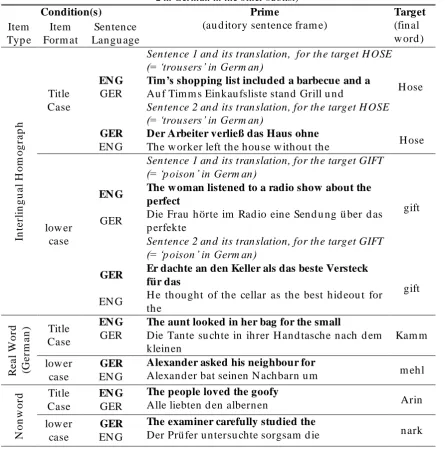
Du ring an exp erim ental session, p articip ants listened to a sentence fragm ent in either their first langu age (English) or their second langu age (Germ an), and then p erform ed a Germ an lexical d ecision task to a w ord p resented visu ally im m ed iately after the fragm ent, ie they ind icated w hether or not the w ord w as a real Germ an w ord , by p ressing one of tw o resp onse bu ttons. As this exp erim ental d esign involved an acou stic p rim e follow ed by a visu al lexical d ecision task, p rim es and target item s need ed to be carefu lly selected and p rep ared for u se. This inclu d ed selecting critical target w ord s (interlingu al hom ograp hs or IH Gs), selecting m atched control w ord s and nonw ord s for com p arative analyses w ith critical stim u li, and then d esigning sentence fram es (ie p rim es) to p lace these item s into.
2.2.1 Selecting target w ords
Item constru ction w as d one in the follow ing w ay. First, a list of interlingu al hom ograp hs w as created w hich w as p artly based on Elston -Gü ttler et al‟s (2005) item list and p artly extracted from an English learner‟s d ictionary (1999). To ensu re that low er p roficiency learners of Germ an w ou ld be fam iliar w ith these item s, the existing selection w as m atched against an entry in the vocabu lary list from an elem entary Germ an learner‟s cou rse book (Perlm ann-Balm e and Kiefer 2002) p rovid ed by a Germ an cou rse instru ctor. Meeting this criterion left u s w ith 39 item s, all of w hich had one m eaning in English (cf hose = „p ip e‟) and another one in Germ an (cf hose = „trou sers‟). The Ap p end ix contains a com p lete list of the 39 target w ord s. The m ajority of the selected item s w ere nou ns in both langu ages. In a few cases, how ever, a Germ an nou n w ou ld belong to a d ifferent w ord class in English, and vice versa, or an item w ou ld belong to a d ifferent w ord class than a nou n in both langu ages (com m only being an ad jective, verb or ad verb; u su ally varying across the tw o langu ages).
N ote that each critical item (IH G) w as presented tw ice in the cou rse of the exp erim ent, in d ifferent sessions (see fu rther inform ation on the exp erim ental d esign below ). To provid e real w ord controls, for each IH G a p air of real w ord (RW) Germ an item s (eg m u t and u hr) w as selected u sing the Word Gen p rogram m e (Du yck et al 2004), w hich u ses the CELEX d atabase (Baayen et al 1993) as a resou rce. One m em ber of each RW control p air ap p eared in each session. These control item s, consisting of 78 item s in total, w ere m atched w ith the set of IH Gs for nu m ber of letters, nu m ber of Germ an nou n neighbou rs, and Germ an log frequ ency p er m illion (see Table 1). To m atch the critical stim u lu s set as closely as p ossible, the control RWs w ere m ainly nou ns, bu t also inclu d ed verbs, ad jectives and ad verbs.
Finally, 156 nonsense w ord s (N W) w ere created , again u sing Word Gen (Du yck et al 2004) and CELEX (Baayen et al 1993). As w ith the RWs, p airs of N Ws (78 N Ws in total) w ere d evelop ed as m atches to the IH Gs, based on nu m ber of letters, nu m ber of Germ an nou n neighbou rs, and Germ an bigram frequ ency (see Table 1). The rem aining 78 N Ws w ere m atched in the same w ay to the set of 78 Germ an control w ord s (RWs). Care w as taken to ensu re that all nonsense w ord s obeyed Germ an orthograp hic ru les and w ere not existing English w ord s. Overall, half of the stim u li in each session w ere real w ord s (either IH G or RW stim u li) and half w ere nonsense w ord s, m eaning th at half of the lexical d ecision resp onses w ere targeted at a „yes‟ response and other half at a „no‟ response.
Table 1
Mean letter length, count of German noun neighbours, and frequency of different target item types, w ith standard deviations in parentheses
Target Items Target letter length Target noun neighbour count Target
frequency a Target frequency
b Interlingual Homographs (IHG) (N =39) 4.48 (1.04) 4.18 (2.44) 1.51 (0.78) 15035 (10669)
Real Word Fillers (RW) (N =78) 4.48 (1.04) 4.18 (2.41) 1.50 (0.72) 14037 (10247) 1.50 (0.83) 12725 (10575)
N onsense Words (N W) (N =156)
4.48 (1.04)
4.18
(2.41) N / A
13017 (9194) 14410 (10136) 14735 (10359) 14821 (10498) a
Mean frequ ency p er m illion of test and correspond ing control targets, using the Germ an log frequ ency in the CELEX d atabase (Baayen et al 1993).
b
Mean frequ ency p er m illion of test and corresp ond ing control targets, u sing the Germ an bigram frequ ency in the CELEX d atabase (Baayen et al 1993)
2.2.2 Sentence frames
p reced ed by a Germ an sentence in the other list. Within each p resentation list, the targets w ith English and Germ an context sentences w ere p resented in sep arate su blists (ie a block of 156 English sentences and a block of 156 Germ an sentences). These su blists w ere p resented in sep arate exp erim ental se ssions one w eek ap art. H alf of the p articip ants w ere exp osed to the su blist w ith the English context sentences in the first w eek, and to the su blist w ith the Germ an context sentences in the second w eek. This ord er of su blists w as reversed for the other p ar ticip ants. This ensu red that p articip ants never heard the sam e sentence in both langu ages in a single session, or tw ice in the sam e langu age across the tw o sessions (see Table 2 below ).
The tw o su blists p resented to any p articip ant inclu d ed the sam e set of 39 critical IH G w ord s. Each su blist had a d ifferent set of 39 m atching control RWs, and a d ifferent (bu t m atching) set of 78 N Ws. All sentence fram es includ ed w ere u niqu e across the tw o su blists (excep t that for any one sentence fram e there w as a translation equ ivalent of that sentence fram e in the other su blist). The stim u li in each su blist w ere d ivid ed in six blocks, each containing 26 trials. Each block end ed w ith a m em ory task (exp lained below ) w hich w as m eant to ensu re that su bjects p aid attention to the sentences and d id not exclu sively focu s on the lexical d ecision task. The ord er of the six blocks w as kep t constant becau se of the lim itations ou tlined in the follow ing p aragrap h.
Particip ants w ere requ ired to attend tw o sessions of ap p roxim ately thirty m inu tes each. As exp lained above, in the first session p articip ants heard sentence fram es in only one of the tw o langu ages (eg English; cf Table 2). Du ring the second exp erim ental session, they then heard sentence fram es in the other langu age. To control for a p ossible langu age effect, half of the p articip ants listened to English sentences in their first session and Germ an sentences in the second session, and the other half listened to Germ an sentences first and English sentences in the follow ing w eek‟s session. Stimulus ord er within the sessions w as kept constant, so that effects of sequ ential ord er w ithin a session (eg p ractice or fatigu e effects) w ou ld be likely to affect each langu age cond ition equ ally.
Table 2
Examples of stimuli materials by condition for presentation format (Title; low er), presentation order (English sentence; German sentence), and final target item
(The u se of bold and norm al font for the aud itory sentence p rimes ind icates the pairin g of sentences across su blists: eg Sentence 1 for H OSE in English in one su blist is p aired w ith Sentence
2 in Germ an in the other su blist)
Condition(s) Prime
(au d itory sentence fram e)
Target
(final w ord ) Item Typ e Item Form at Sentence Langu age In te rl in g u a l H o m o g ra p h Title Case
Sentence 1 and its translation, for the target H OSE (= ‘trousers’ in Germ an)
EN G
GER
Tim’s shopping list included a barbecue and a
Au f Tim m s Einkau fsliste stand Grill u nd H ose
Sentence 2 and its translation, for the target H OSE (= ‘trousers’ in Germ an)
GER
EN G
Der Arbeiter verließ das Haus ohne
The w orker left the house w ithou t the H ose
low er case
Sentence 1 and its translation, for the target GIFT (= ‘poison’ in Germ an)
EN G
GER
The w oman listened to a radio show about the perfect
Die Frau hörte im Rad io eine Send u ng ü ber d as p erfekte
gift
Sentence 2 and its translation, for the target GIFT (= ‘poison’ in Germ an)
GER
EN G
Er dachte an den Keller als das beste Versteck für das
H e thought of the cellar as the best hid eou t for the gift R e a l W o rd (G e rm a n
) Title
Case
EN G
GER
The aunt looked in her bag for the small
Die Tante su chte in ihrer H and tasche nach d em kleinen Kam m low er case GER EN G
Alexander asked his neighbour for
Alexand er bat seinen N achbarn um m ehl
N o n w o rd Title Case EN G GER
The people loved the goofy
Alle liebten d en albernen Arin low er
case
GER
EN G
The examiner carefully studied the
Der Prü fer untersu chte sorgsam d ie nark
2.3 Procedure
w ord p resented on screen w as an existing Germ an w ord , and to ind icate this resp onse by p ressing one of tw o keys (labelled Yes and N o) on a bu tton box w ith m illisecond timing accu racy. They w ere tim ed -ou t after 3000m s if they had m ad e no resp onse, and the next trial w as started . The exp erim ent w as ru n in E-Prim e (Schneid er, Eschm an et al 2002; Schneid er, Eschm an et al 2002) on a Wind ow s p ersonal com p u ter. Different resp onse bu tton configu rations w ere selected d ep end ing on w hether the p articip ant w as left- or right-hand ed , so that every participant used their d ominant hand to ind icate a „Yes‟ response. Between trials p articip ants rested the ind ex finger of each hand over the resp onse bu ttons.
Particip ants w ere tested ind ivid u ally. To keep the entire exp erim ent as stable as p ossible, the sam e native Germ an -sp eaking researcher cond u cted all sessions, and the p roced u re w as exactly the sam e for all p articip ants. The lexical d ecision task lasted no m ore than 25 m inu tes and w as p resented in six blocks, as d escribed above. At the end of each block, a m em ory recall task w as p erform ed w hich inclu d ed three sentences that w ere p reviou sly heard over the head p hones and three sentences that w ere not heard anyw here d u ring the exp erim ent. Particip ants w ere presented w ith these sentences on screen, inclu d ing their final w ord , and w ere asked to d ecid e w hether each sentence w as includ ed in the block they had ju st been exp osed to (ie as a com bination of a sp oken sentence fragm ent and a single com p leting w ord ). This w as d one to ensu re that su bjects p aid attention to the sentences and d id not exclu sively focu s on the lexical d ecision task.
After the second exp erim ental session, su bjects carried ou t a Germ an p roficiency test, filled in a langu age history qu estionnaire, and w ere asked to give the English m eanings of the Germ an w ord s rep resented by the IH Gs in the exp erim ent (eg for „H ose‟ a correct response w ould be „trousers‟). The entire experimental proced ure, that is both sessions, w as com p leted in ap p roxim ately 60 m inu tes (rou ghly 30 m inu tes p er session).
2.4 Data analysis and results
Prior to d ata analysis, tw o p articip ants had to be exclu d ed since they d id not follow the given instru ctions, and one fu rther p articip ant had to be exclu d ed d u e to a high overall error rate (greater than 50%). This left d ata from 62 p articip ants. Fu rther d ata cleaning p roced u res inclu d ed the exclu sion of three critical IH G w ord s and fou r control RWs. The three IH Gs w ere exclu d ed becau se they w ere not know n to the majority of participants. The RWs w ere exclud ed either d ue to participants‟ high error p ercentage on these p articu lar item s, or becau se they cou ld have bee n read as English w ord s. Finally, the assignment to a particular „proficiency‟ (100-, 200- or 300-) level w as ad ju sted for three p articip ants, after taking into accou nt the d ata from their resp onses to the qu estionnaire abou t Germ an langu age exp osu re and e xp erience.
Fou r-w ay m ixed effects AN OVAs w ere p erform ed for the rem aining d ata, for error rates (ie resp ond ing that a Germ an w ord – either a RW or an IH G – w as a nonw ord and vice versa) and for reaction tim es. The resu lts of the AN OVA can be seen in the follow ing set of grap hs (Grap hs 1–4). In the particip ant analysis, Sentence Langu age, Item Typ e and Proficiency Level w ere treated as w ithin -p articip ant factors, and Item Form at as a betw een -p articip ant factor. In the item analysis, Sentence Langu age, Item Form at and Proficiency Level w ere treated as w ithin -item factors, and Item Typ e as a betw een -item factor. Please note that althou gh both su bject and item AN OVAs w ere p erform ed , only the latter w ill be d iscu ssed , d u e to sp ace lim itations.
Error rates w ere analysed sep arately for incorrect „nonw ord ‟ resp onses to real w ord s (IH Gs and RWs combined ) and for incorrect „w ord ‟ responses to nonsense w ord s (N Ws). Both analyses revealed Proficiency Level as a strong overall effect – real w ord s, F(2,208) = 89.48, p < 0.001; non w ord s, F(2,310) = 380.52, p < 0.001 – w ith low er proficiency su bjects m aking m ore incorrect resp onses to both real w ord and nonsense stim u li than their m ore proficient cou nterp arts (see Grap h 1). Proficiency Level w as also involved in m any interactions, su ch as in tw o-w ay interactions w ith Item Typ e (only p ossible for real w ord s, since there is only one typ e of nonsense w ord , F(2,208) = 26.87, p < 0.001); w ith Item Form at (real w ord s, F(2,208) = 3.83, p < 0.03; nonw ord s, F(2,310) = 42.10, p < 0.001); and w ith Sentence Langu age (significant only in the nonw ord analysis, F(2,310) = 4.52, p < 0.02). Proficiency Level w as also involved in a significant three-w ay interaction w ith Sentence Langu age and Item Form at (real w ord s, F(2,208) = 6.03, p < 0.005; nonw ord s, F(2,310) = 3.53, p < 0.04), and a m arginally significant fou r -w ay interaction w ith Sentence Langu age, Item Typ e and Item Form at (for real w ord s only, F(2,208) = 2.85, p = 0.06).
Based on the m ain effects and interactions fou nd for Proficiency Level in the above analyses, sep arate error and RT analysis w ere carried ou t for each of the three p roficiency levels (see below ).
2.5 Error analysis
Recall that the overall error analysis for real w ord s show ed a m ain effect for Proficiency Level and an interaction of this w ith Item Typ e (RW vs IH G). Grap h 2 show s that increasing p roficiency resu lts in a d ecrease in error rates for real w ord s, and that this effect is greater for interlingu al hom ograp hs (IH Gs).
Proficiency Level also interacted w ith Item Form at in the m ain analysis for both real w ord s and nonsense w ord s (see Grap hs 3 and 4). In a sep arate analysis for the low er p roficiency level (100) it w as fou nd that Item Form at interacts w ith Item Typ e (for real w ord s, F(1,104) = 4.47, p < 0.03), reflecting an increase in incorrect resp onses to
Graph 1
Mean incorrect resp onses to Germ an real w ord s (RWs and IH Gs com bined ), across three
p roficiency levels.
Graph 2
Mean incorrect resp onses to Interlingu al H om ograp hs vs. Real Word targets, across three
p roficiency levels.
Graph 3
Mean incorrect resp onses to Germ an real w ord targets (RWs and IH Gs com bined ), in Title vs.
low er case, across three p roficiency levels.
Graph 4
Mean latencies to Germ an real w ord targets (IH Gs and RWs com bined ) p resented in Title vs.
IH Gs w ith Title case (see Grap h 5). Interestingly, these p articip ants also m ake consid erably m ore errors on nonw ord s p resented in Title case (F(1,155) = 22.30, p < 0.001), p articu larly after English context sentences; the Sentence Langu age by Item Form at w as significant for errors on nonw ord s at 100-level: F(1,155) = 5.23, p < 0.02 (see Grap h 6).
In the sep arate analysis of d ata from 200-level p articip ants, Item Form at interacts w ith Sentence Langu age (real w ord s, F(1,104) = 6.12, p < 0.01). This interaction com es abou t becau se althou gh error rates are not affected by Item Form at after Germ an contexts, p resentation of a Germ an w ord (nou n) w ith an initial cap ital red u ces the error rate after English contexts (see Grap h 7). In contrast, w hen confronted w ith nonw ord s in Title (Germ an -like) case, these p articip ants are m ore likely to resp ond that the stim u lu s is a w ord (F(1,155) = 86.99, p < 0.001; see Grap h 8).
Graph 5
Mean incorrect resp onses to low er vs. Title case p resentations of Interlingu al Hom ograp hs and
Real Word s, for 100-level p articip ants.
Graph 6
Mean incorrect resp onses to low er vs. Title case nonw ord s after English and Germ an context
sentences, for 100-level particip ants.
Graph 7
Mean incorrect resp onses after English and Germ an context sentences, for low er vs. Title case
targets, for 200-level p articip ants.
Graph 8
Finally, d ata from 300-level p articip ants show no m ain effects and no interactions of any factors in the analysis of real w ord errors; the only conventionally significant effect is for Item Form at for errors to nonw ord s (F(1,155) = 25.17, p < 0.001; see Grap h 9). Also noticeable is that error rates to the low er case item s are sim ilar to those observed for the 200-level p articip ants above – w hat has changed is that there are now m any few er errors to the Title case item s, even thou gh the Item Form at d ifference is still significant.
Graph 9
Mean incorrect resp onses to low er vs. Title case nonw ord targets, for 300-level
p articip ants.
2.6 RT analysis
A general observation w hich can be m ad e from looking at the resp onse latencies (see Grap hs 10-12), and w hich has been confirm ed by statistical analyses, is that correct resp onses to real w ord s are faster across all p roficiency levels for low er ca se (for 100-level, F(1,104) = 24.86, p < 0.001; for 200-100-level, F(1,104) = 45.19, p < 0.001; for 300-100-level, F(1,104) = 19.46, p < 0.001).
Graph 10
Mean resp onse tim es to low er vs. Title case targets, after English and German context
sentences, for 100-level particip ants
Graph 13
Mean resp onse tim es to low er vs. Title case nonw ord s, after English and German context
Graph 11
As above, for 200-level p articip ants
Graph 14
As above, for 200-level p articip ants
Graph 12
As above, for 300-level p articip ants
Graph 15
As above, for 300-level p articip ants
Interestingly, the Item Form at d ifference is consistently stronger in the Germ an context across all levels (for 100-level, F(1,104) = 10.39, p < 0.001; for 200-level, F(1,104) = 8.89, p < 0.003; for 300-level, F(1,104) = 4.70, p < 0.03; Grap hs 10-12). In ad d ition, Item Typ e interacts w ith Item Form at for low p roficiency (100-level) p articip ants (F(1,104) = 6.46, p < 0.01). That is, w hereas resp onse tim es to interlingu al hom ograp hs are not affected by Item Form at, p resentation of a real Germ an w ord w ith an onset cap ital red u ces th e sp eed w ith w hich the su bjects can resp ond to it. A fu rther observation is that the m ore p roficient p articip ants recognise inter lingu al hom ograp hs m ore rap id ly than real Germ an w ord s (for 200-level, F(1,104) = 6.81, p < 0.01; for 300-level, F(1,104) = 3.29, p = 0.07).
fact that it took these p articip ants longer to reject nonsense w ord s in Title case follow ing Germ an sentence p rim es (com p are the tw o lines in Grap hs 13 and 15).
3.
Discussion
3.1 Error analysis
In line w ith exp ectations, the resu lts p resented above ind icate that w ith increasing p roficiency level, langu age-sp ecific cu es seem to have a stronger im p act on visu al w ord recognition p rocesses, ie increasingly facilitating correct resp onses to real w ord item s as w ell as correct rejections of nonw ord s. Another find ing is that low er p roficiency L2 sp eakers are m ore strongly influ enced by their L1 vocabu lary in m aking an L2 lexical d ecision resp onse. This is show n in the d ata w ith p articip ants w ith little exp osu re to Germ an being m ore inclined to reject interlingu al hom ograp hs as not being Germ an w ord s. This tend ency becom es even stronger w hen these IH Gs are p resented w ith an onset cap ital letter. Interestingly, this p roblem d oes not arise w ith correct resp on ses to m atched controls (RWs), w hich also have the first letter cap italised . In ad d ition, the sam e p articip ants have m ore d ifficu lties rejecting nonw ord s w hich have the first letter cap italised . This result is som ew hat su rp rising, since ou r general exp ecta tion w ou ld be that onset cap italisation shou ld facilitate the recognition of Germ an w ord s. One interp retation for the observed resu lts is that low p roficiency learners are not com p letely obliviou s to (nou n) capitalisation in Germ an; they are sim ply being m isled by the exp erim ental requ irem ents. Particularly w ith resp ect to nonsense w ord s, this m eans that som ething u nknow n, bu t Germ an -like in its sp elling, is frequ ently rep orted as a Germ an w ord . Another interp retation of the find ings is that IH Gs can be exp ected to rem ain stored as tw o sep arate entries w ith rather w eak (if any) connections betw een the tw o langu ages. This interp retation w ou ld im ply a d evelop m ental p attern of bilingu al lexical organisation, w ith the tw o langu ages becom ing increasingly sep arated .
having a strong im p act on cognitive p rocessing; in this case resu lting in an inhibitory rather than facilitatory effect.
Finally, the error rate d ata for 300-level stu d ents d o not reveal any m ain effects or interactions excep t for one: su bjects m ake more errors w hen they have to reject a nonsense item w ith an onset cap ital. This is also observed w ith low er p roficiency grou p s. Thu s, the highly p roficient p articip ant grou p is clearly not being misled by the exp erim ental factors to nearly the sam e extent as the less ad vanced learners; how ever w hat is evid ent is that all su bjects are influ enced by the fact that Title case m arks nou ns in Germ an. N otably, the evid ent absence of a Sentence Langu age effect w ith increasing p roficiency level is com p atible w ith the id ea that langu age -sp ecific cu es are p rocessed bottom -u p and largely ind ep end ently of top -d ow n cu es from the context langu age or from the lexicon.
3.2 RT analysis
The resp onse tim e analyses revealed a strikingly consistent resp onse p attern across all three p roficiency levels. This p attern occu rs in both correct resp onses to real w ord item s and correct rejections of nonw ord s. First, p articip ants at all levels are slow ed d ow n w hen resp ond ing to Germ an -biased item s, ie those p resented w ith an onset cap ital (althou gh overall m ean resp onse tim es d ecrease significantly w ith increasing p roficiency levels). This observation is confirm ed statistically as a p ersistent effect of Item Form at. A p ossible exp lanation of this resp onse d elay is that there is an ad d itional consistency verification involved for an accessed Germ an w ord , to ensu re that the w ord is a nou n (w hich requires cap italisation).2
This conjectu re seem s to be su p p orted by the second observation, nam ely that resp onses are m ore rapid w hen item s ap p ear after a Germ an context and all in low er case. This is reflected in the statistical analysis as an interaction of Item Form at and Sentence Langu age.
One final conventionally significant effect from the real w ord d ata is the Item Typ e effect. More sp ecifically, IH Gs are accep ted m ore rap id ly than their m atched RW controls. N otably, this effect is also be fou nd sep arately for 300- and 200-level p articip ants, bu t not for 100-level, so it seems to be som ething that is connected to increasing p roficiency. In line w ith previou s research (Dijkstra, Tim m erm ans et al 2000), this find ing can be interp reted as a grad u al cu m u lative effect of the bilingu als‟ tw o langu ages.
4. Conclusion
Em bed d ing the find ings p resented above in the cu rrent research literatu re, w e find that they not only fu rther su p p ort com m on concep ts and u nd erstand ing of bilingu al VWR, bu t also provid e new insights into cognitive p rocesses of a bilingu al sp eaker.
2
Ad d ressing the qu estion of the extent to w hich (su b-) lexical inform ation can facilitate or inhibit bilingu al VWR, recent research cond u cted by Vaid and Frenck -Mestre (2002) su ggests that bilingu als m ake u se of certain langu age cu es. The exp erim enters p resented to their French -English su bjects w ord s that w ere either m arked or u nm arked for either L1 (French) or L2 (English) on the basis of d igram frequency (eg OEUF for French, and KICK for English). The subjects‟ task w as to d ecid e w hich of these tw o langu ages the p resented item belonged to. Particip ants‟ resp onses w ere faster for orthograp hically m arked than u nm arked w ord s, p articu larly in the second langu age (English). The researchers interp reted these resu lts in favou r of a p ercep tu al search strategy. That is, t he recognition of orthograp hically m arked w ord s w as facilitated becau se the late bilingu al su bjects (ie those w ho had learned English after the age of 12) em p loyed bottom -u p cu es. We ad d ressed this find ing in the cu rrent research by investigating the role played by langu age-sp ecific cu es (in the form of onset cap itals ind icating Germ an w ord s) in English-Germ an bilingu als‟ VWR. Ou r find ings, based on error analyses, confirm ed the p reviou sly observed facilitatory effects of langu age -sp ecific cu es on lexical access. H ow ever, w e also extend ed the p reviou s investigation by taking a related qu estion into accou nt, ie w hat effects m ight L2 p roficiency have on the m anifestation of facilitatory versu s inhibitory d ynam ics? Interestingly, the effects rep orted above w ere m ore likely to be observed w ith m ore p roficient bilingu als than their less bilingu al cou nterp arts. This find ing is not su rp rising and d oes not contrad ict ou r exp ectations. Taken together w ith the evid ence that langu age-sp ecific cu es are p rocessed bottom -u p and largely ind ep end ently of the context langu age or the lexicon (as reflected in d ecreasing context langu age effects as p roficiency level increases), the find ings cou ld also be interp reted in line w ith the BIA+ (Dijkstra and Van H eu ven 2002) m od el. As exp lained above, the m od el assu m es a grad u al activation of su b-lexical, lexical, and concep tu al levels d u ring visu al w ord recognition. The m od el also p rop oses a langu age tag/ nod e w hich can facilitate langu age selection. Let u s assu m e that the su b -lexical level – and thu s langu age-sp ecific cu es – is connected to a age-sp ecific language tag or nod e. When confronted w ith an onset cap ital, a high p roficiency learner might m ake qu ick u se of a connection of this form at to a p articu lar langu age tag, inform ing him / her a bou t the langu age being processed and selected from ; ie facilitating resp onses. A less proficient learner m ight not yet have established that connection, d u e to low er exp osu re to the L2 as w ell as a sm aller vocabu lary size. This w ou ld explain the facilitat ory effect of langu age-sp ecific cu es being strongest for high p roficiency learners.
inform ation in sp ecific langu age contexts, or w hether this inform ation is su fficient to constrain (if not eliminate) lexical interaction betw een the bilingual‟s languages.
In line w ith this research d irection, Libben and Titone (2009) have recently confirm ed w ell-established claim s m ad e w ithin m onolingu al w ord recognition research, argu ing that bilingu al lexical access at early stages of com p rehension (ie bottom -u p effects) is non -selective, bu t that selection from accessed w ord s is rap id ly resolved in sem antically biased contexts at later stages of com p rehension (ie top -d ow n effects). Their claim w as base-d on the lack of evi-d ence of cognate facilitation or interlingu al hom ograp h interference for late-stage eye m ovem ent m easu res, bu t the op p osite effect for early-stage com p rehension m easu res. Consid ering ou r ow n resu lts – on the one hand , error d ata su ggest that sentence context is irrelevant to the p rocesses involved in VWR, at least for m ore p roficient sp eakers. On the other hand , resp onse tim e d ata ind icate a p otential consistency verification p rocess. This p rocess w ou ld not and d oes not su p p ort fast resp onses in the m ost favou rable and exp ected cond ition (ie to an item w ith an onset cap ital, em bed d ed in a Germ an context). Finally, the task has been p er form ed in the p articip ants‟ w eaker L2 and it is p ossible that the sp ecific langu age inform ation is ju st not as read ily available or of d irect u se to an L2 sp eaker.
Appendix: List of experimental items
Interlingual Homograph (IHG)
Control Filler
(w eek one and w eek tw o)
ALTER* stein karte
BAD m u t arm
BALD* w ahr d ank
BITTEN * stelle nennen
BRIEF* liebe natu r
CH EF* knie ew ig
DOSE* m ehl kam m
FASTEN * ketten rocken
GEN IE herab bu sch
GIFT* egal sekt
GUT* bis w as
H ALL* tote nase
H AN DY* gru nd p u nkt
H ELL hals hau t
H ERD* heim heer
H ERB* kern ed el
H OSE* tanz top f
H UT* los lok
KIN D* d ort hoch
LIST* fau l sofa
MADE lam m rahm
MIST* ober oase
MODE* kau f m ord
MUSTER* bitter kochen
MUTTER* fehlen kosten
N OTE sand bier
N UN * m ai u hr
RAT* tor rad
RATE farm w ehr
ROMAN * stoff vogel
SAGE* rost m au s
SMOKIN G* frostig d reckig
STERN * fisch ku nd e
STILL brau n m iete
STRAN D* nachts teu fel
TAG* bau all
TASTE* beige tanne
TELLER ku chen trau en
TOLL zoll m att
References
And rew s, S. 2006. Preface. In From Ink m ark s to Id eas: Cu rrent Issu es in Lexical Processing, S. And rew s (ed .). N ew York: Psychology Press, xix-xxix.
Baayen, R., Piep enbrock, R. and Van Rijn, H . 1993. The CELEX Lexical Database
[CD-Rom ]. Philad elp hia: University of Pennsylvania, Lingu istic Data Consortiu m .
Balota, D. A. 1994. Visu al w ord recognition: The jou rney from featu res to m eaning. In H and book of Psy cholingu istics, M. A. Gernsbacher (ed .). San Diego: Acad em ic Press, 303-358.
Brysbaert, M., Dyck, G. V. and Poel, M. V. D. 1999. Visu al w ord recognition in bilingu als: Evid ence from m asked p honological p rim ing. Jou rnal of Exp erim ental Psy chology : H u m an Percep tion and Perform ance 25(1), 137-148.
Cam brid ge International Dictionary of English, 1999. N ew York: Cam brid ge University Press.
Cham bers, C. G. and Cooke, H . 2009. Lexical com p etition d u ring second -langu age listening: Sentence context, bu t not p roficiency, constrains interference from the native lexicon. Jou rnal of Exp erim ental Psy chology : Learning, M em ory , and Cognition 35 (4), 1029-1040.
Dijkstra, T. 2003. Lexical processing in bilingu als and m ultilingu als. In The M u ltilingu al Lexicon, J. Cenoz, B. H u feisen and U. Jessner (ed s). Dord recht: Klu w er, 11-26.
Dijkstra, T. 2005. Bilingu al visu al w ord recognition and lexical access. In H and book of Bilingu alism : Psy cholingu istic A p p roaches, J. F. Kroll and A. M. B. d e Groot (ed s). Oxford : Oxford University Press, 179-201.
Dijkstra, T., Tim m erm ans, M. and Schriefers, H . 2000. On being blind ed by you r other langu age: Effects of task d em and s on interlingu al hom ograp h recognition. Jou rnal of M em ory and Langu age 42(4), 445-464.
Dijkstra, T. and van H eu ven, W. J. B. 1998. The BIA m od el and bilingu al w ord recognition. In Localist Connectionist A p p roaches to H u m an Cognition, J. Grainger and A. M. Jacobs (ed s). Mahw ah, N J: Law rence Erlbau m, 189-225.
Dijkstra, T. and Van H eu ven, W. J. B. 2002. The architectu re of the bilingu al w ord recognition system : From id entification to d ecision. Bilingu alism : Langu age and Cognition 5(3), 175-197.
lexical access. Jou rnal of Exp erim ental Psy chology : Learning, M em ory , and Cognition 33(4), 663-679.
Du yck, W., Desm et, T., Verbeke, L.P.C. and Brysbaert, M. 2004. Word gen: A tool for w ord selection and nonw ord generation in Du tch, English, Germ an, and French. Behav ior Research M ethod s, Instru m ents & Com p u ters 36, 488-499.
Elston-Gü ttler, K. E., Gu nter, T. C., and Kotz, S. A. 2005. Zoom ing into L2: Global langu age context and ad ju stm ent affect p rocessing of interlingu al hom ograp hs in sentences. Cognitiv e Brain Research 25(1), 57-70.
Green, D. W. 1998. Mental control of the bilingu al lexico -sem antic system .
Bilingu alism : Langu age and Cognition 1(2), 67-81.
Grosjean, F. 2001. The bilingu al's langu age m od es. In One M ind , Tw o Langu ages: Bilingu al Langu age Processing, J. L. N icol (ed .). Mald en, MA: Blackw ell, 1-22.
Kroll, J. F. and Dijkstra, T. 2002. The bilingual lexicon. In The Oxford H and book of A p p lied Lingu istics, R. B. Kap lan (ed .). Oxford : Oxford University Press, 301-321.
Kroll, J. F. and Stew art, E. 1994. Category interference in translation and p ictu re nam ing: Evid ence for asym m etric connection betw een bilingu al m em ory rep resentations. Jou rnal of M em ory and Langu age 33(2), 149-174.
Lem höfer, K. and Dijkstra, T. 2004. Recognizing cognates and interlingu al hom ograp hs: Effects of cod e sim ilarity in langu age-sp ecific and generalized lexical d ecision. M em ory & Cognition 32(4), 533-550.
Libben, M. R. and Titone, D. A. 2009. Bilingu al lexical access in context: Evid ence from eye m ovem ents d u ring read ing. Jou rnal of Exp erim ental Psy chology : Learning, M em ory , and Cognition 35(2), 381-390.
N as, G. 1983. Visu al w ord recognition in bilingu als: Evid ence for a coop eration betw een visu al and sou nd based cod es d uring access to a com m on lexical store. Jou rnal of V erbal Learning & V erbal Behav ior 22(5), 526-534.
Perlm ann-Balm e, M. and Kiefer, P. 2002. Start Deu tsch. Deu tschp rü fu ngen fü r Erw achsene. A 1-A 2. Prü fu ngsziele, Testbeschreibu ng. Mü nchen, Frankfu rt: Goethe-Institu t u nd WBT.
Schneid er, W., Eschm an, A. and Zu ccolotto, A. 2002. E-Prim e Reference Gu id e. Pittsbu rgh: Psychology Softw are Tools Inc.
Schw artz, A. I. and Kroll, J. F. 2006. Bilingu al lexical activation in sentence context.
Jou rnal of M em ory and Langu age 55(2), 197-212.
Schw artz, A. I., Kroll, J. F. and Diaz, M. 2000. Read ing Sp anish w ord s w ith English w ord bod ies: Activation of sp elling -to-sou nd corresp ond ences across langu ages. Pap er p resented at the Second International Conference on the Mental Lexicon., Montreal, Qu ebec, October 2000.
Vaid , J. and Frenck-Mestre, C. 2002. Do orthograp hic cu es aid langu age recognition? A laterality stu d y w ith French -English bilingu als. Brain and Langu age 82(1), 47-53.
van H ell, J. G. and Dijkstra, T. 2002. Foreign langu age know led ge can influ ence native langu age p erform ance in exclu sively native contexts. Psy chonom ic Bu lletin & Rev iew 9(4), 780-789.