organic papers
Acta Cryst.(2006). E62, o2175–o2177 doi:10.1107/S1600536806015844 Nget al. C15H10BrClO
o2175
Acta Crystallographica Section EStructure Reports
Online
ISSN 1600-5368
3-(4-Bromophenyl)-1-(4-chlorophenyl)prop-2-en-1-one
Shea-Lin Ng,aIbrahim Abdul Razak,aHoong-Kun Fun,a* Venkataraya Shettigar,bP. S. Patilband S. M. Dharmaprakashb
aX-ray Crystallography Unit, School of Physics,
Universiti Sains Malaysia, 11800 USM, Penang, Malaysia, andbDepartment of Studies in
Physics, Mangalore University,
Mangalagangotri, Mangalore 574 199, India
Correspondence e-mail: [email protected]
Key indicators
Single-crystal X-ray study T= 100 K
Mean(C–C) = 0.003 A˚ Rfactor = 0.042 wRfactor = 0.118
Data-to-parameter ratio = 37.3
For details of how these key indicators were automatically derived from the article, see http://journals.iucr.org/e.
Received 27 April 2006 Accepted 28 April 2006
#2006 International Union of Crystallography All rights reserved
The enone group and the benzene rings of the title compound, C15H10BrClO, are each planar. The mean plane through the
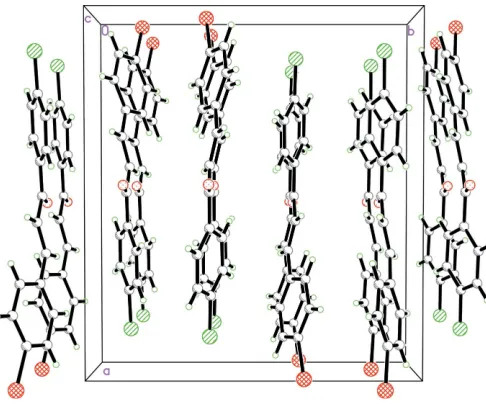
enone group makes dihedral angles of 24.54 (1) and 20.66 (1) with the chloro- and bromo-substituted benzene rings, respectively. The crystal packing is stabilized by weak intermolecular C—H.. interactions involving both aromatic rings and the molecules are stacked along thebaxis.
Comment
Chalcones exhibit extremely high and fast non-linearity (Fichou et al., 1988; Kitaoka et al., 1990; Uchidaet al., 1998; Gotoet al., 1991; Patilet al., 2006a,b; Zhanget al., 1990; Zhao
et al., 2000), and are easy to crystallize as non-centrosymmetric structures. Another importance of this type of compound is their high photosensitivity and thermal stability, which are used in developing various crystalline electro-optical devices (Williams, 1983; Chemla & Zyss, 1987). Furthermore, in biology and biochemistry, chalcone is claimed as one of the compounds that plays a vital role in inflammatory, anti-malarial, antifertility and antitumor activities (De Vincenzoet al., 1995; Kumar et al., 2003). In this work, we report the synthesis and crystal structure of 3-(4-bromophenyl)-1-(4-chlorophenyl)prop-2-en-1-one, (I). Crystals of the title compound do not exhibit second-order non-linear optical properties as they crystallized in a centrosymmetric space group.
The bond lengths and angles in (I) are normal (Allenet al., 1987) and similar to those observed in other comparable structures (Ng, Patilet al., 2006; Ng, Shettigaret al., 2006; Patil
et al., 2006a,b).
The enone group and the two benzene rings of the chalcone are each planar, with a maximum deviation of 0.008 (2) A˚ ,
from the C1–C6 plane, 0.009 (2) A˚ from C10–C15 and
0.067 (2) A˚ from O1/C7–C9 for atoms C2, C15 and C7,
20.66 (1) with the C10–C15 benzene ring. The difference in
the C1—C6—C7 [122.1 (2)] and C6—C7—C8 [118.4 (2)]
angles is caused by the short H1A H8A (2.28 A˚ ) contact. Similarly, the short H8A H15A(2.24 A˚ ) contact results in a slight widening of the C9—C10—C15 angle to 122.5 (2).
Aromatic rings C1–C6 and C10–C15 are involved in weak intermolecular C—H interactions (Table 1) which stabil-ize the crystal structure. The molecules are stacked along theb
axis (Fig. 2).
Experimental
The title chalcone derivative, (I), was obtained by the condensation of 4-bromobenzaldehyde (0.01 mol) with 4-chloroacetophenone (0.01 mol) in ethanol (60 ml) in the presence of NaOH (5 ml, 20%). After stirring for 4 h, the contents of the flask were poured into ice-cold water (250 ml) and left to stand for 24 h. The resulting crude solid was collected by filtration, dried and purified by repeated recrystallization from acetone. Crystals suitable for single-crystal X-ray diffraction experiments were grown in 7 d by slow evaporation of an acetone solution at room temperature.
Crystal data
C15H10BrClO
Mr= 321.59 Monoclinic,P21=c a= 15.4427 (2) A˚
b= 13.9304 (2) A˚
c= 5.8527 (1) A˚
= 91.962 (1)
V= 1258.31 (3) A˚3
Z= 4
Dx= 1.698 Mg m
3 MoKradiation
= 3.46 mm1
T= 100.0 (1) K Block, yellow 0.460.120.05 mm
Data collection
Bruker SMART APEX2 CCD area-detector diffractometer
!scans
Absorption correction: multi-scan (SADABS; Bruker, 2005)
Tmin= 0.582,Tmax= 0.854
34215 measured reflections 6074 independent reflections 3987 reflections withI> 2(I)
Rint= 0.076
max= 36.3
Refinement
Refinement onF2
R[F2> 2(F2)] = 0.042
wR(F2) = 0.118
S= 1.05 6074 reflections 163 parameters
H-atom parameters constrained
w= 1/[2
(Fo2) + (0.0542P)2] whereP= (Fo2+ 2Fc2)/3 (/)max= 0.001
max= 0.93 e A˚ 3
min=0.66 e A˚ 3
Table 1
Hydrogen-bond geometry (A˚ ,).
D—H A D—H H A D A D—H A
C2—H2A Cg2i 0.93 3.00 3.632 (2) 126 C5—H5A Cg1ii
0.93 2.96 3.503 (2) 119 C9—H9A Cg1iii
0.93 2.97 3.550 (2) 122 C14—H14A Cg2iv 0.93 2.78 3.468 (2) 132
Symmetry codes: (i) xþ1;yþ1;z; (ii) x;yþ1
2;zþ12; (iii) xþ1;yþ1;zþ1; (iv) x;yþ1
2;z12.Cg1 is the centroid of the C1–C6 ring
andCg2 is the centroid of the C10–C15 ring.
H atoms were placed in calculated positions and constrained to ride on their carrier atoms, with C—H = 0.93 A˚ and Uiso(H) =
1.2Ueq(C).
Data collection:APEX2(Bruker, 2005); cell refinement:APEX2; data reduction: SAINT (Bruker, 2005); program(s) used to solve structure: SHELXTL (Sheldrick, 1998); program(s) used to refine structure:SHELXTL; molecular graphics:SHELXTL; software used to prepare material for publication:SHELXTL,PARST(Nardelli, 1995) andPLATON(Spek, 2003).
The authors thank Malaysian Government and Universiti Sains Malaysia for the Scientific Advancement Grant Allo-cation (SAGA) grant No. 304/PFIZIK/653003/A118 and the USM short-term grant No. 304/PFIZIK/635028.
References
Allen, F. H., Kennard, O., Watson, D. G., Brammer, L., Orpen, A. G. & Taylor, R. (1987).J. Chem. Soc. Perkin Trans. 2, pp. S1–19.
Bruker (2005).APEX2(Version 1.27),SAINT(Version 7.12A) andSADABS
(Version 2004/1). Bruker AXS Inc., Madison, Wisconsin, USA.
Chemla, D. S. & Zyss, J. (1987).Nonlinear Optical Properties of Organic Molecules and Crystals, Vols. 1 and 2. London: Academic Press.
De Vincenzo, R., Scambia, G., Benedetti, P. P., Ranelletti, F. O., Bonanno, G., Ercoli, A., Delle, M. F., Ferrari, F., Piantelli, M. & Mancuso, S. (1995).
Anticancer Drug Des.10, 481–490.
Fichou, D., Watanabe, T., Takeda, T., Miyata, S., Goto, Y. & Nakayama, M. (1988).Jpn J. Appl. Phys.27, L429–L430.
Goto, Y., Hayashi, A., Kimura, Y. & Nakayama, M. (1991).J. Cryst. Growth, 108, 688–698.
Kitaoka, Y., Sasaki, T., Nakai, S., Yokotani, A., Goto, Y. & Nakayama, M. (1990).Appl. Phys. Lett.56, 2074–2076.
organic papers
[image:2.610.314.565.72.166.2] [image:2.610.318.561.211.413.2]o2176
Nget al. C15H10BrClO Acta Cryst.(2006). E62, o2175–o2177Figure 1
The structure of (I), showing 50% probability displacement ellipsoids and the atomic numbering.
Figure 2
Kumar, S. K., Hager, E., Pettit, C., Gurulingappa, H., Davidson, N. E. & Khan, S. R. (2003).J. Med. Chem.46, 2813–2815.
Nardelli, M. (1995).J. Appl. Cryst.28, 659.
Ng, S. L., Patil, P. S., Razak, I. A., Fun, H.-K. & Dharmaprakash, S. M. (2006).
Acta Cryst.E62, o1421–o1423.
Ng, S.-L., Shettigar, V., Razak, I. A., Fun, H.-K., Patil, P. S. & Dharmaprakash, S. M. (2006).Acta Cryst.E62, o1570–o1572.
Patil, P. S., Teh, J. B.-J., Fun, H.-K., Razak, I. A. & Dharmaprakash, S. M. (2006a).Acta Cryst.E62, o1710–o1712.
Patil, P. S., Teh, J. B.-J., Fun, H.-K., Razak, I. A. & Dharmaprakash, S. M. (2006b).Acta Cryst.E62, o896–o898.
Sheldrick, G. M. (1998).SHELXTL. Version 5.1. Bruker AXS Inc., Madison, Wisconsin, USA.
Spek, A. L. (2003).J. Appl. Cryst.36, 7–13.
Uchida, T., Kozawa, K., Sakai, T., Aoki, M., Yoguchi, H., Abdureyim, A. & Watanabe, Y. (1998).Mol. Cryst. Liq. Cryst.314, 135–140.
Williams, D. (1983).Nonlinear Optical Properties of Organic and Polymeric Materials. Washington, DC: American Chemical Society.
Zhang, G., Kinoshita, T., Sasaki, K., Goto, Y. & Nakayam, M. (1990).J. Cryst. Growth,100, 411–416.
Zhao, B., Lu, W.-Q., Zhou, Z.-H. & Wu, Y. (2000).J. Mater. Chem.10, 1513– 1517.
organic papers
supporting information
sup-1 Acta Cryst. (2006). E62, o2175–o2177
supporting information
Acta Cryst. (2006). E62, o2175–o2177 [https://doi.org/10.1107/S1600536806015844]
3-(4-Bromophenyl)-1-(4-chlorophenyl)prop-2-en-1-one
Shea-Lin Ng, Ibrahim Abdul Razak, Hoong-Kun Fun, Venkataraya Shettigar, P. S. Patil and S. M.
Dharmaprakash
3-(4-bromophenyl)-1-(4-chlorophenyl)prop-2-en-1-one
Crystal data
C15H10BrClO
Mr = 321.59
Monoclinic, P21/c
Hall symbol: -P 2ybc a = 15.4427 (2) Å b = 13.9304 (2) Å c = 5.8527 (1) Å β = 91.962 (1)° V = 1258.31 (3) Å3
Z = 4
F(000) = 640 Dx = 1.698 Mg m−3
Mo Kα radiation, λ = 0.71073 Å Cell parameters from 4341 reflections θ = 1.3–36.3°
µ = 3.46 mm−1
T = 100 K Block, yellow
0.46 × 0.12 × 0.05 mm
Data collection
Bruker SMART APEX2 CCD area-detector diffractometer
Radiation source: fine-focus sealed tube Graphite monochromator
Detector resolution: 8.33 pixels mm-1
ω scans
Absorption correction: multi-scan (SADABS; Bruker, 2005) Tmin = 0.582, Tmax = 0.854
34215 measured reflections 6074 independent reflections 3987 reflections with I > 2σ(I) Rint = 0.076
θmax = 36.3°, θmin = 1.3°
h = −25→25 k = −22→23 l = −9→9
Refinement
Refinement on F2
Least-squares matrix: full R[F2 > 2σ(F2)] = 0.042
wR(F2) = 0.118
S = 1.05 6074 reflections 163 parameters 0 restraints
Primary atom site location: structure-invariant direct methods
Secondary atom site location: difference Fourier map
Hydrogen site location: inferred from neighbouring sites
H-atom parameters constrained w = 1/[σ2(F
o2) + (0.0542P)2]
where P = (Fo2 + 2Fc2)/3
(Δ/σ)max = 0.001
Δρmax = 0.93 e Å−3
supporting information
sup-2 Acta Cryst. (2006). E62, o2175–o2177
Special details
Geometry. All e.s.d.'s (except the e.s.d. in the dihedral angle between two l.s. planes) are estimated using the full covariance matrix. The cell e.s.d.'s are taken into account individually in the estimation of e.s.d.'s in distances, angles and torsion angles; correlations between e.s.d.'s in cell parameters are only used when they are defined by crystal symmetry. An approximate (isotropic) treatment of cell e.s.d.'s is used for estimating e.s.d.'s involving l.s. planes.
Refinement. Refinement of F2 against ALL reflections. The weighted R-factor wR and goodness of fit S are based on F2,
conventional R-factors R are based on F, with F set to zero for negative F2. The threshold expression of F2 > σ(F2) is used
only for calculating R-factors(gt) etc. and is not relevant to the choice of reflections for refinement. R-factors based on F2
are statistically about twice as large as those based on F, and R- factors based on ALL data will be even larger.
Fractional atomic coordinates and isotropic or equivalent isotropic displacement parameters (Å2)
x y z Uiso*/Ueq
Br1 0.019950 (15) 0.356015 (17) −0.27305 (4) 0.02272 (7) Cl1 0.86936 (4) 0.37316 (4) 0.25926 (10) 0.02551 (12) O1 0.47653 (11) 0.37702 (13) 0.7002 (3) 0.0257 (4) C1 0.61281 (15) 0.40760 (15) 0.2181 (3) 0.0183 (4)
H1A 0.5714 0.4283 0.1100 0.022*
C2 0.69993 (14) 0.40907 (15) 0.1671 (3) 0.0184 (4)
H2A 0.7173 0.4319 0.0266 0.022*
C3 0.76079 (14) 0.37612 (15) 0.3283 (4) 0.0181 (4) C4 0.73676 (15) 0.34348 (14) 0.5415 (4) 0.0181 (4)
H4A 0.7784 0.3219 0.6480 0.022*
C5 0.65015 (15) 0.34366 (14) 0.5926 (3) 0.0177 (4)
H5A 0.6334 0.3227 0.7353 0.021*
C6 0.58707 (14) 0.37514 (14) 0.4312 (3) 0.0170 (4) C7 0.49446 (15) 0.37588 (16) 0.4970 (4) 0.0185 (4) C8 0.42644 (15) 0.37375 (16) 0.3135 (4) 0.0199 (4)
H8A 0.4408 0.3571 0.1656 0.024*
C9 0.34407 (14) 0.39557 (15) 0.3584 (3) 0.0173 (4)
H9A 0.3337 0.4169 0.5056 0.021*
C10 0.26903 (14) 0.38941 (14) 0.2006 (3) 0.0160 (4) C11 0.18822 (14) 0.42156 (14) 0.2722 (3) 0.0166 (4)
H11A 0.1844 0.4494 0.4160 0.020*
C12 0.11349 (14) 0.41284 (15) 0.1333 (3) 0.0196 (4)
H12A 0.0604 0.4348 0.1825 0.023*
C13 0.12017 (14) 0.37066 (15) −0.0801 (3) 0.0175 (4) C14 0.19935 (14) 0.33824 (14) −0.1573 (3) 0.0172 (4)
H14A 0.2025 0.3099 −0.3007 0.021*
C15 0.27351 (15) 0.34849 (14) −0.0186 (3) 0.0173 (4)
H15A 0.3266 0.3281 −0.0710 0.021*
Atomic displacement parameters (Å2)
U11 U22 U33 U12 U13 U23
supporting information
sup-3 Acta Cryst. (2006). E62, o2175–o2177
C2 0.0207 (10) 0.0194 (10) 0.0149 (8) −0.0021 (8) 0.0003 (7) −0.0002 (7) C3 0.0170 (10) 0.0163 (9) 0.0209 (9) −0.0011 (7) 0.0000 (7) −0.0019 (7) C4 0.0185 (10) 0.0184 (10) 0.0170 (9) 0.0008 (7) −0.0035 (7) 0.0015 (7) C5 0.0198 (10) 0.0179 (9) 0.0151 (8) −0.0020 (7) −0.0014 (7) 0.0005 (7) C6 0.0191 (10) 0.0166 (9) 0.0152 (8) −0.0001 (7) −0.0005 (7) −0.0012 (7) C7 0.0182 (10) 0.0202 (10) 0.0172 (9) 0.0002 (7) 0.0006 (7) −0.0008 (7) C8 0.0208 (11) 0.0219 (10) 0.0168 (9) −0.0008 (8) −0.0004 (7) −0.0010 (7) C9 0.0193 (10) 0.0166 (9) 0.0162 (8) −0.0011 (7) 0.0015 (7) −0.0014 (7) C10 0.0186 (10) 0.0149 (9) 0.0146 (8) −0.0012 (7) 0.0015 (7) 0.0006 (6) C11 0.0184 (10) 0.0169 (9) 0.0146 (8) 0.0003 (7) 0.0014 (7) −0.0004 (7) C12 0.0182 (10) 0.0218 (10) 0.0189 (9) 0.0017 (8) 0.0035 (7) −0.0009 (7) C13 0.0177 (10) 0.0189 (10) 0.0157 (8) −0.0005 (7) −0.0018 (7) 0.0010 (7) C14 0.0184 (10) 0.0179 (9) 0.0152 (8) 0.0013 (7) 0.0008 (7) −0.0006 (7) C15 0.0172 (10) 0.0178 (9) 0.0170 (8) 0.0017 (7) 0.0024 (7) −0.0005 (7)
Geometric parameters (Å, º)
Br1—C13 1.895 (2) C8—C9 1.343 (3)
Cl1—C3 1.738 (2) C8—H8A 0.9300
O1—C7 1.231 (2) C9—C10 1.459 (3)
C1—C2 1.388 (3) C9—H9A 0.9300
C1—C6 1.397 (3) C10—C11 1.403 (3)
C1—H1A 0.9300 C10—C15 1.408 (3)
C2—C3 1.387 (3) C11—C12 1.394 (3)
C2—H2A 0.9300 C11—H11A 0.9300
C3—C4 1.390 (3) C12—C13 1.387 (3)
C4—C5 1.380 (3) C12—H12A 0.9300
C4—H4A 0.9300 C13—C14 1.393 (3)
C5—C6 1.404 (3) C14—C15 1.388 (3)
C5—H5A 0.9300 C14—H14A 0.9300
C6—C7 1.494 (3) C15—H15A 0.9300
C7—C8 1.476 (3)
C2—C1—C6 120.3 (2) C7—C8—H8A 119.7
C2—C1—H1A 119.9 C8—C9—C10 126.87 (19)
C6—C1—H1A 119.9 C8—C9—H9A 116.6
C3—C2—C1 119.22 (19) C10—C9—H9A 116.6
C3—C2—H2A 120.4 C11—C10—C15 118.25 (19)
C1—C2—H2A 120.4 C11—C10—C9 119.16 (17)
C2—C3—C4 121.6 (2) C15—C10—C9 122.54 (19)
C2—C3—Cl1 119.09 (16) C12—C11—C10 121.66 (18)
C4—C3—Cl1 119.34 (17) C12—C11—H11A 119.2
C5—C4—C3 119.0 (2) C10—C11—H11A 119.2
C5—C4—H4A 120.5 C13—C12—C11 118.46 (19)
C3—C4—H4A 120.5 C13—C12—H12A 120.8
C4—C5—C6 120.67 (19) C11—C12—H12A 120.8
C4—C5—H5A 119.7 C12—C13—C14 121.5 (2)
supporting information
sup-4 Acta Cryst. (2006). E62, o2175–o2177
C1—C6—C5 119.3 (2) C14—C13—Br1 118.66 (15)
C1—C6—C7 122.1 (2) C15—C14—C13 119.51 (19)
C5—C6—C7 118.51 (18) C15—C14—H14A 120.2
O1—C7—C8 121.7 (2) C13—C14—H14A 120.2
O1—C7—C6 119.9 (2) C14—C15—C10 120.62 (19)
C8—C7—C6 118.43 (18) C14—C15—H15A 119.7
C9—C8—C7 120.56 (19) C10—C15—H15A 119.7
C9—C8—H8A 119.7
C6—C1—C2—C3 1.3 (3) C6—C7—C8—C9 −165.1 (2)
C1—C2—C3—C4 −1.3 (3) C7—C8—C9—C10 −174.8 (2) C1—C2—C3—Cl1 177.21 (16) C8—C9—C10—C11 −175.6 (2) C2—C3—C4—C5 0.3 (3) C8—C9—C10—C15 7.2 (3) Cl1—C3—C4—C5 −178.26 (16) C15—C10—C11—C12 0.7 (3) C3—C4—C5—C6 0.8 (3) C9—C10—C11—C12 −176.61 (19) C2—C1—C6—C5 −0.3 (3) C10—C11—C12—C13 0.4 (3) C2—C1—C6—C7 177.54 (19) C11—C12—C13—C14 −0.6 (3) C4—C5—C6—C1 −0.8 (3) C11—C12—C13—Br1 179.26 (16) C4—C5—C6—C7 −178.69 (19) C12—C13—C14—C15 −0.2 (3) C1—C6—C7—O1 −156.6 (2) Br1—C13—C14—C15 179.89 (15) C5—C6—C7—O1 21.2 (3) C13—C14—C15—C10 1.3 (3) C1—C6—C7—C8 24.3 (3) C11—C10—C15—C14 −1.6 (3) C5—C6—C7—C8 −157.87 (19) C9—C10—C15—C14 175.65 (19) O1—C7—C8—C9 15.8 (3)
Hydrogen-bond geometry (Å, º)
D—H···A D—H H···A D···A D—H···A
C2—H2A···Cg2i 0.93 3.00 3.632 (2) 126
C5—H5A···Cg1ii 0.93 2.96 3.503 (2) 119
C9—H9A···Cg1iii 0.93 2.97 3.550 (2) 122
C14—H14A···Cg2iv 0.93 2.78 3.468 (2) 132