Cloud adoption decision support for SMEs Using
Analytical Hierarchy Process (AHP)
ROBERT WILSON, Berlin Mano, KHAZAEI, Babak and HIRSCH, Laurence
<http://orcid.org/0000-0002-3589-9816>
Available from Sheffield Hallam University Research Archive (SHURA) at:
http://shura.shu.ac.uk/14776/
This document is the author deposited version. You are advised to consult the
publisher's version if you wish to cite from it.
Published version
ROBERT WILSON, Berlin Mano, KHAZAEI, Babak and HIRSCH, Laurence (2016).
Cloud adoption decision support for SMEs Using Analytical Hierarchy Process
(AHP). In: 2016 IEEE 4th Workshop on Advances in Information, Electronic and
Electrical Engineering (AIEEE), Vilnius, Lithuania, 10-12 November 2016. (In Press)
Copyright and re-use policy
See
http://shura.shu.ac.uk/information.html
Sheffield Hallam University Research Archive
Cloud adoption decision support for SMEs Using
Analytical Hierarchy Process (AHP)
Berlin Mano Robert Wilson, Babak Khazaei, Laurence Hirsch Faculty of ACES,
Sheffield Hallam University, Sheffield, United Kingdom
Abstract—For a successful cloud adoption, decision makers need to consider numerous aspects before deciding to adopt cloud infrastructure. In this paper, we propose a framework to support cloud adoption decisions for SMEs in Tamil Nadu (India) using the established principles of Analytical Hierarchy Process (AHP). This study is focused on SMEs in Tamil Nadu, one of the constituent states of the Indian Union. This paper reports on the findings of applying AHP to real data collected from decision makers and demonstrates its usefulness as a decision support tool for SMEs in Tamil Nadu.
Keywords—cloud adoption; Small and Medium Enterprises (SMEs); Analytical hierarchy process (AHP);Case study;
I. INTRODUCTION
In India, the SME sector is home to industries as diverse as textiles, auto ancillary, electronic assemblies, agro based companies, tanneries, food processing to name a few [3]. The use of Information and Communication Technologies (ICT) by SMEs has provided numerous benefits to businesses and Innovation in ICT has enabled SMEs to compete with larger enterprises [1]. Cloud computing is one such innovation which has attracted businesses and governments across the world due to the features it offers to improve performance and service delivery. Cloud computing is still in its infancy in India and the level of cloud adoption among SMEs is relatively low when compared with developed countries [8]. Indian SMEs are traditionally late adopters when it comes to adopting a new technology. The main reason behind this is the lack of awareness, management's resistance to change, lack of capital and lack of skilled labour [4]. Some of the benefits of cloud computing makes more sense for SMEs as SME would have faster time to market and can have access to highly scalable technologies with no upfront capital investment [1].
Cloud adoption decision involves multiple criteria, (technical, economic, organisational and strategic) which needs to be compared with the available possible alternatives using available information [7]. This makes cloud adoption a challenging task and the main reason for CIO's being very cautious is adopting the new technology. Recent research studies in cloud adoption have moved towards developing a decision model for cloud adoption. The main aim of a decision support tool is to help and aid decision makers (DMs) make decisions for a particular problem effectively. Studies targeting SME population have identified lack of awareness of the benefits of cloud adoption, security and privacy issues, risks
involved in cloud adoption as a major inhibitor for the adoption of cloud among SMEs in developing economies [8]. To leverage the benefits of cloud computing, DMs must know the right type of workload to migrate to the right type of cloud hosted by the right vendor. This is the major driver for research toward developing a decision model for cloud adoption [7].
This study is focused on SMEs in Tamil Nadu, one of the constituent states of the Indian Union. Tamil Nadu accounts for 689,000 registered SMEs which is the largest in the whole of the Indian Union [3]. In this paper, we present a framework and methodology to support cloud adoption decisions based on the established principles of Analytical Hierarch Process (AHP). We will show the application of the AHP model by evaluating the data collected from DMs belonging to SMEs in Tamil Nadu. The structure of this paper is as follows. The AHP method used in this study is described in section II. Section III details the methodology employed in this research. Section IV presents the research outcomes and Section V will discuss the conclusion, limitations and future directions of the research.
II. ANALYTICAL HIERARCHY PROCESS
Analytical Hierarchy Process (AHP) is a practical and effective method used for solving a wide variety of Multi-criteria decision making problems. AHP was introduced by Thomas L. Saaty in 1980 [9], AHP organises the basic rationality by decomposing the problem into smaller constituent parts [5]. By breaking the decision problem, AHP enables decision maker to focus on limited number of criteria at a time. AHP also enables decision maker to compare both qualitative and quantitative criteria. There are three phases in AHP: defining the decision problem, structuring the hierarchy and finally evaluating the components in the hierarchy. AHP is a multi-level hierarchical model with the goal of the system in the top, criteria and sub-criteria in the middle and the alternatives in the bottom of the hierarchy [5] as shown in Figure 1.
Fig. 1. AHP Hierarchy [5]
The scale of relative importance used in AHP according to [6] is showed in Table I.
TABLE I. SCALE OF RELATIVE IMPORTANCE USED IN AHP[6]
Intensity of importance on an absolute scale
Definition Explanation
1
Equal importance Two activities contribute equally to the objective
3
Moderate importance of one over another
Experience and judgment favor one activity over another
5
Essential or strong importance
Experience and judgment favor one activity over another
7
Very strong importance An activity is strongly favored over another and its dominance is demonstrated in practice
9
Extreme importance The evidence favoring one activity over another is of the highest order of affirmation
Reciprocals If activity i has one of the above non zero numbers assigned to it when compared with activity j, then j has the reciprocal value when compared with i
The pairwise comparisons performed by the decision maker are constructed as an n x n matrix. Consider matrix = [ ], where expresses the relative importance of over
. In pairwise comparison matrix if the decision maker indicates the preference as 9, it indicates the criteria is extremely important than the other. 1/9 indicates that the criterion is extremely less important than the other. Once the pairwise comparison matrix is constructed the best alternative can be identified by obtaining the priority vector.
The most popular method to estimate the priority vector is the method proposed by Saaty himself called the Eigenvalue method. Consider a pairwise comparison matrix A,
= 1
1 1 ⋱
(1)
According to the Eigenvalue method, the priority vector is calculated as the eigenvector of A and the maximum eigenvalue of A. is calculated by solving the system = , ∑ = 1 [9]. The next step in AHP is to calculate the Consistency index (CI) to check for inconsistencies in pairwise comparisons. The consistency index (CI) is calculated using the following formula [9].
= − / − 1 (2)
where n is the number of compared elements. Once (2) is calculated, Consistency ratio (CR) can be calculated by using the formula [9],
= / (3)
where RI is the random index which can be obtained from the following table.
TABLE II. RANDOM CONSISTENCY INDEX (RI) FOR DIFFERENT VALUES OF N [6]
Matrix size (n) 1 2 3 4 5 6 7 8
RI 0 0 0.58 0.90 1.12 1.24 1.32 1.41
If the consistency ratio (CR) is less than 0.1, it means the calculated priorities are consistent. If the CR is larger than 0.1, re-evaluation is required which usually will need the whole pairwise comparison checked by the decision maker.
III. RESEARCH METHODOLOGY
[image:3.595.29.287.56.178.2]A. Definition of criteria
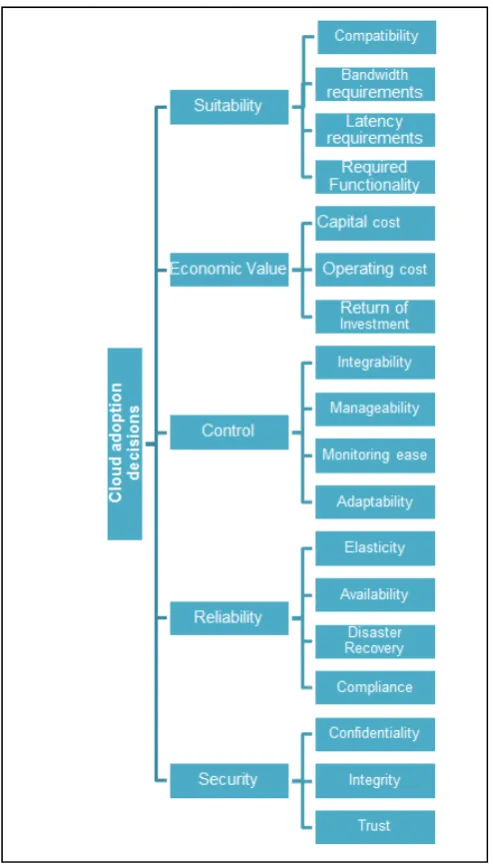
[image:4.595.297.548.131.363.2]Framework by Saripalli and Pingali, [7] using Multi attribute decision making used six attributes for cloud adoption. Though the working is different as they have adopted a different method to determine the best alternative, the criteria used are directly relevant and similar to the findings of the study. Therefore we have used five of the same criteria to form the middle layer of the AHP hierarchy. They are namely; Suitability (C1), Economic Value (C2), Control (C3), Reliability (C4) and Security (C5). The AHP hierarchy with criteria and sub-criteria for cloud adoption is shown in Figure 2.
Fig. 2. AHP Hierarchy for cloud adoption
B. Definition of alternatives
Decision making involves decision maker deciding the best alternative among available alternatives by considering all the different factors (criteria). Table III shows the alternatives considered for the AHP hierarchy. The alternatives used in
this are based on [7]. A cloud adoption decision for any IT infrastructure can be only made in the context of a specific workload [7]. The pairwise comparisons will not meaningful if the decision maker does not know the type of workload they want to migrate to the cloud environment.
TABLE III. DEFINITION OF CLOUD ADOPTION ALTERNATIVES
Alternative Description
Virtualisation/ Server consolidation (A1)
Virtualise to consolidate servers or server consolidation on blades/racks
SaaS implementation
(A2)
Adapt a Software as a Service (SaaS) implementation
PaaS implementation
(A3)
Adapt a Platform as a service (PaaS) implementation. Development and testing platforms on demand on a public or private cloud
IaaS implementation
(A4)
Virtual machines and storage hosted on cloud environment. Infrastructure as a Service (IaaS)
Server colocation (A5) Outsourcing server hosting to a third party provider
C. Data collection
To illustrate the usefulness of the AHP model, we use the case study method with DMs from two different SMEs operating from Tamil Nadu. Both the participating SME DMs belonged to the IT sector. The DMs completed the study considering a specific workload according to the requirement of their business. Participant 1 wanted to determine the best alternative for a Legacy web application not built for cloud (W1). Participant 2 wanted to identify the best development and testing environment for building applications (W2). The working and objective of the study was clearly explained to the DMs. Pairwise comparisons were captured using a quantitative questionnaire and the comparisons were measured using a 5 point Likert scale (1, 3, 5, 7, and 9). The Likert scale measure was used to construct the decision matrix. The decision matrix was then used to identify the priority vector. Inconsistencies were resolved by reevaluating the pairwise comparisons.
D. Calculating the criteria weights
[image:4.595.35.282.195.628.2]TABLE IV. PAIRWISE COMPARISON MATRIX
C1 C2 C3 C4 C5
C1 1 1/5 3 3 3
C2 5 1 5 5 5
C3 1/3 1/5 1 1/3 1
C4 1/3 1/5 3 1 1
C5 1/3 1/3 1 1 1
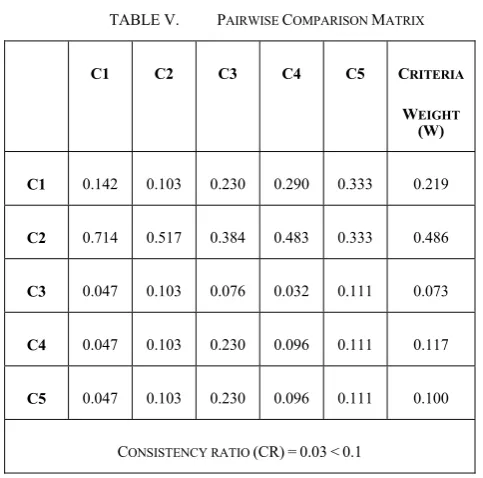
[image:5.595.29.271.270.509.2]Table V shows the normalised elements and the criteria weights for W1.
TABLE V. PAIRWISE COMPARISON MATRIX
C1 C2 C3 C4 C5 CRITERIA
WEIGHT
(W)
C1 0.142 0.103 0.230 0.290 0.333 0.219
C2 0.714 0.517 0.384 0.483 0.333 0.486
C3 0.047 0.103 0.076 0.032 0.111 0.073
C4 0.047 0.103 0.230 0.096 0.111 0.117
C5 0.047 0.103 0.230 0.096 0.111 0.100
CONSISTENCY RATIO (CR)=0.03<0.1
Similarly, criteria weight is calculated for W2. The criteria weight for W1, W2 and CR are shown in Table VI. Using the same method, the weights for each of the sub criteria is also calculated.
TABLE VI. CRITERIA WEIGHTS (W1,W2)
C1 C2 C3 C4 C5 CR
W1 0.219 0.486 0.073 0.117 0.100 0.03
W2 0.268 0.311 0.119 0.119 0.181 0.06
E. Calcualting the priority vector
Table VII shows the comparison matrix and the priorities when comparing the alternatives against C1 for W1. The same process is repeated to identify the priorities for C2, C3, C4 and C5. Complete calculations for these cases are not included for brevity.
TABLE VII. PAIRWISE COMPARISON MATRIX
A1 A2 A3 A4 A5 PRIORITIES
A1 1 1/7 1/5 1/3 1 0.050
A2 7 1 5 7 9 0.562
A3 5 1/5 1 3 7 0.231
A4 3 1/7 1/3 1 3 0.108
A5 1 1/9 1/7 1/3 1 0.0446
CONSISTENCY RATIO (CR)=0.05<0.1
Thus obtained priorities are constructed as 5 x 5 matrixes known as the Final rating matrix. To obtain the overall priority vector, the transpose of the final ratings matrix is multiplied with the criteria weight shown in Table VI. The alternative with the best performance score is identified as the best alternative. Table VIII shows the summed-up final result for W1 and W2.
TABLE VIII. FINAL PRIORITY RANKING
A1 A2 A3 A4 A5
W1 0.083 0.492 0.213 0.121 0.089
W2 0.184 0.085 0.472 0.225 0.031
IV. RESULTS AND DISCUSSION
Through AHP analysis, criteria weights and priorities of each element in the AHP hierarchy (goal, criteria and sub-criteria) has been determined. As presented in Table VIII, the alternative with the highest priority (shown in bold) is suggested as the best alternative for the decision maker. Participant 1 wanted to identify a suitable cloud adoption model for their workload W1 (Legacy web application not built for cloud). Through AHP analysis, SaaS implementation is identified as the best alternative as it obtained the highest priority ratio of 49.2%. The second best alternative is PaaS implementation with priority ratio of 21.3% and IaaS implementation for the workload is identified as the third best alternative with a priority ratio of 12.1%.
(W2) for DM 2. PaaS implementation is identified as the best alternative with the highest priority ratio of 47.2% followed by IaaS implementation with a priority ratio of 22.5%. For both the cases, economic value, suitability and reliability were the importance criteria as they had gained the highest criteria weight.
V. CONCLUSION
In this research work, we have illustrated the usefulness of AHP in the context of data obtained from SMEs in Tamil Nadu who are interested in adopting cloud infrastructure for their business. We have also shown how to use AHP to support cloud adoption decisions for SMEs in Tamil Nadu. For both the case studies, Suitability of the cloud infrastructure to existing IT infrastructure is identified as the most important criteria by DMs. Economic value of the cloud infrastructure (capital cost, operating cost and return of investment) is identified as the second important criteria when making the decision to adopt cloud infrastructure. The results presented in this paper shows that AHP method can be used to determine the best alternative for a specific workload. The major limitation of this study is the small number of samples used to determine the relative importance of the criteria. We are currently working on the technical implementation of the proposed model as a web based Decision Support System (DSS). Once the DSS is developed into a web application, it will be given to a bigger sample of DMs for evaluation and feedback. The feedback gathered from the users will help to
make improvements to the DSS and make it more relevant to SMEs in Tamil Nadu.
This research is part of an ongoing research approved by Sheffield Hallam University.
REFERENCES
[1] Y. Alshamaila, S. Papagiannidis and F. Li, '"Cloud computing adoption by SMEs in the north east of England: A multi-perspective framework,"Journal of Enterprise Information Management, vol. 26, no. 3, pp. 250-27, 2013.
[2] C. Colicchio, C. Giovanoli and G.G. Stella, '"A Cloud Readiness Assessment Framework for Enterprise Content Management and Social Software (E-Collaboration) in Small and Medium Sized Enterprises,", pp. 177-183, 2015.
[3] V. dhevika, '"A study on customer value of shampoo in tiruchirappalli district with special reference to college students,"2015.
[4] E.K. Iyer, N. Pandey, P.S. Lamba and T. Panda, '"Decision variables influencing Cloud adoption by SME sector: A Conjoint Analysis Mapping,"2013.
[5] T.L. Saaty, '"The analytic network process,", 2006.
[6] T.L. Saaty, '"How to make a decision: the analytic hierarchy process,"Eur.J.Oper.Res., vol. 48, no. 1, pp. 9-26, 1990.
[7] P. Saripalli and G. Pingali, '"MADMAC: Multiple attribute decision methodology for adoption of clouds,", pp. 316-323, 2011.
[8] B.M.R. Wilson, B. Khazaei and L. Hirsch, '"Enablers and Barriers of Cloud Adoption among Small and Medium Enterprises in Tamil Nadu,", pp. 140-145, 2015.
![TABLE I. SCALE OF RELATIVE IMPORTANCE USED IN AHP [6]](https://thumb-us.123doks.com/thumbv2/123dok_us/720282.576068/3.595.368.483.54.103/table-i-scale-relative-importance-used-ahp.webp)