CLARK, Tony <http://orcid.org/0000-0003-3167-0739>
Available from Sheffield Hallam University Research Archive (SHURA) at:
http://shura.shu.ac.uk/11944/
This document is the author deposited version. You are advised to consult the
publisher's version if you wish to cite from it.
Published version
CLARK, Tony (2009). A MOP based DSL for testing java programs using OCL.
Electronic Communications of the EASST, 24.
Copyright and re-use policy
See
http://shura.shu.ac.uk/information.html
Volume 24 (2009)
OCL 09: The Pragmatics of OCL and Other Textual
Specification Languages
A MOP Based DSL for Testing Java Programs using OCL
Tony Clark
15 pages
Volume Editors: J. Cabot, J. Chimiak-Opoka, M. Gogolla, F. Jouault, A. Knapp Managing Editors: Tiziana Margaria, Julia Padberg, Gabriele Taentzer
A MOP Based DSL for Testing Java Programs using OCL
Tony Clark
Thames Valley University, St Mary’s Road, Ealing, UK,[email protected] http://itcentre.tvu.ac.uk/~clark/
Abstract: OCL is used to specify systems by defining pre and post-conditions for
class operations. Typically, the conditions refer to properties and operations that are defined in a model. When the model is implemented, various implementation deci-sions are made regarding properties and operations that cause the OCL conditions to be inconsistent with the implementation. This paper defines a domain specific lan-guage (DSL) for testing and shows how a meta-object-protocol for OCL can be used to dynamically run tests written in the DSL against different Java implementations of the same model.
Keywords:OCL, meta-object protocol, domain-specific language, testing.
1
Introduction
The Object-Constraint Language (OCL) is used to specify the behaviour of system operations in terms of pre and post-conditions that are defined for a UML class model. Once specified, the sys-tem is implemented. The implementation involves making many technology decisions relating to partitioning, structure, messaging mechanisms, object instantiation, distribution, persistence etc.
The system tests are derived from the original model. Ideally it should be possible to run the original OCL pre and post-conditions against the implementation. However, OCL does not provide a definition ofhowto connect to a system implementation. Furthermore, the OCL
con-straints are defined against the original model which is different, due to technology decisions, to the implemented system.
In order to make use of a model involving OCL pre and post-conditions in system testing two key issues must be addressed: there must be a mechanism for linking the model with an implementation; and, there must be a mechanism for bridging the difference between the original model and the implementation.
Our hypothesis is that the language used to express tests in terms of OCL pre and post-conditions will depend on the approach taken to testing, therefore it is appropriate to embed OCL within adomain specific languagefor testing whose semantics provides the required test
executions and reporting. Furthermore, it is proposed that a meta-object protocolused as the
basis for OCL within the DSL is a suitable mechanism for bridging the difference between the original model and the implementation.
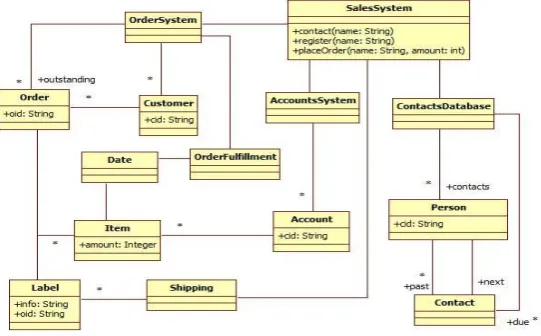
meta-Figure 1: A Sales System
object protocol(MOP) [17] allows the execution mechansism of a language to be controlled by
the programmer. A further contribution is to define the XMF MOP that controls how OCL can be linked to Java, thereby bridging the implementation issue.
This paper is structured as follows: section2describes a simple model that will be used as a case study; section3describes the key features of the XMF platform that are used to implement the DSL and the MOP; section4defines a testing DSL and gives examples in terms of the case study; section5describes how the DSL is implemented; section6describes how the MOP can be used to bridge the implementation gap; finally section7analyses the approach and describes related systems.
2
A Model and its Java Application
Fugure 1 shows a model of a sales system (taken from [9]) that consists of components for recording contacts, registering customers, placing orders and delivering orders. The idea is that sales representatives make contact with prospective customers who subsequently register with the system. Once registered a customer can place orders for items and the orders are subsequently shipped.
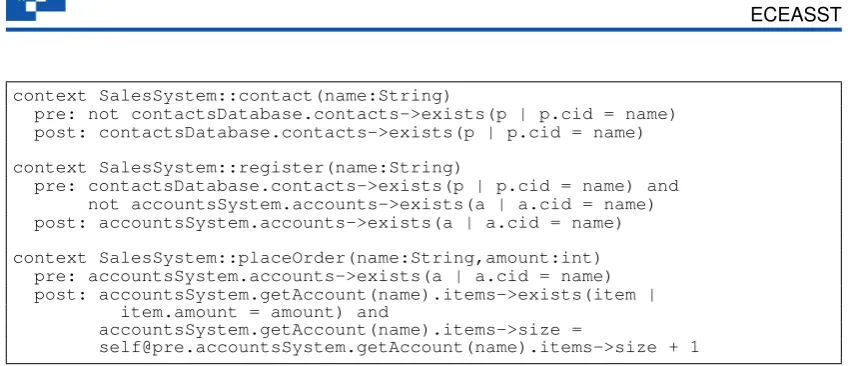
Consider the operationscontact,registerandplaceOrderdefined on the class SalesSystem. Each operation can be specified using OCL pre and post-conditions as shown
in figure2: a contact should not be made twice and causes a change in the contacts database; a contact must be made before a customer can register; an order extends a customer’s account with a new item.
The operation specifications given in figure2are correct with respect to the model in figure
[image:4.595.163.434.157.325.2]context SalesSystem::contact(name:String)
pre: not contactsDatabase.contacts->exists(p | p.cid = name) post: contactsDatabase.contacts->exists(p | p.cid = name)
context SalesSystem::register(name:String)
pre: contactsDatabase.contacts->exists(p | p.cid = name) and not accountsSystem.accounts->exists(a | a.cid = name) post: accountsSystem.accounts->exists(a | a.cid = name)
context SalesSystem::placeOrder(name:String,amount:int) pre: accountsSystem.accounts->exists(a | a.cid = name) post: accountsSystem.getAccount(name).items->exists(item |
item.amount = amount) and
accountsSystem.getAccount(name).items->size =
[image:5.595.85.511.109.292.2][email protected](name).items->size + 1
Figure 2: Sales System Operation Specifications
example, in Java, associations with multiplicities greater than 1 may be implemented as vectors or arrays or some associations may be viewed as derived.
3
XMF Features
This paper proposes that OCL should be embedded into a DSL testing language on an application specific basis and that a MOP should be used to map from a model to the system implementation in order that the OCL pre and post-conditions can be run against the implementation. This paper shows how this can be achieved using the XMF platform. This section reviews the key features of XMF that will be used; the features are explained in terms of a simple Library example.
XMF is an engine that provides a collection of features that support language design. XMF provides an object-oriented language based on an imperative version of OCL. For example, the following is a pair of class definitions for a library containing a collection of books:
context Root @Class Book
@Attribute name : String end end
context Root @Class Library
@Attribute books : Seq(Book) end end
Top-level named elements are added to a name-space using thecontextkeyword. In the
ex-ample above, bothBookandLibraryare added to the global name-spaceRoot. Language
features in XMF are preceded by@followed by the name of asyntax classthat defines the
con-crete and abstract syntax representations for the feature. XMF provides many built-in language features, such asClassandAttributeabove, and allows users to define their own. In this
paper we will define two new language features that support testing Java methods.
Nested named elements can be defined inside the containing name-space or can be added using context. An operation is a named element that can be added to a class (which is a
context Library
@Operation addBook(b:Book):Library self.books := books->including(b) end
TheaddBookoperation uses the OCLincludingoperation to add the supplied book to the
value of the attributebooks.
Everything in XMF has a type that describes the structure and behaviour of its instances. Classes have types which aremeta-classes. For example, suppose that the classBook is
redefined to keep track of all its instances:
context Root
@Class InstanceManager extends Class
@Attribute allInstances : Set(Element) end @Operation new()
let object = super()
in self.allInstances := allInstances->including(object); object
end end end
context Root @Class Book
@Attribute name : String end end
Asyntax classintroduces a new language feature by defining a grammar that processes concrete
syntax. Once defined, the new language feature F can occur in any XMF program using the
reference@F .... The syntax class is responsible for synthesizing abstract syntax that uses
existing language features and OCL. For example, it would be convenient to construct a library by just listing the names of the books initially on the shelves:
context Library @Grammar
Library ::= names = Name* ’end’ {
names->iterate(n exp = [| Library() |] | [| <exp>.addBook(Book(<n.lift()>)) |]) }.
end
A grammar consists of a collection of named rules, one of which must have the name of the syntax class: this is the starting non-terminal. A library consists of a sequence of names, bound to the rule variablenamesfollowed by the terminal’end’. The synthesizing action within{and }creates an abstract syntax tree that constructs a library and populates it with books. The names
of the books are supplied in the language feature; aniterateexpression is used to process the
names and transform them into calls ofaddBook. XMF provides quasi-quotes ([|and|]) and
drop-quotes (<and>) for syntaxtemplateswhere quasi-quotes construct abstract syntax trees
using concrete syntax and drop-quotes provide template holes. The operationlift is defined
for any XMF value and returns an expression that, when executed at run-time, reconstructs the value. Therefore the following library:
@Library book1 book2 end
is transformed to:
XMF providescode walkersthat can be used to translate source code. A walker is a class that is
supplied with an instance of a given class and then traverses the structure calling operations on the sub-components. A code walker defines operations for all the OCL language features. For example, suppose that large libraries are to be defined and that it is much more efficient to set thebooksattribute of a library rather than make many calls toaddBook. A walker might be
defined:
context Root
@Class ReplaceAddBook extends OCLWalker @Operation walkSend(target,name,args) if isNestedAddBook(target,name,args)
then [| <target>.books := <getBookExps(args)> |] else super(target,name,args)
end end end
where isNestedAddBook returns true when the supplied arguments are a chained call of addBook, and wheregetBookExps transforms a collection of nestedaddBookcalls to a
sequence expression containing the book expressions. Using the code walker, the library feature is translated to:
Library().books := Seq{Book("book1"),Book("book2")}
Finally, XMF provides an interface to Java where compiled Java classes can be manipulated as ordinary XMF classes. For example, suppose that the Book class was implemented in Java in a package calledlibrarythen the Java class can be loaded:
Book ::= xmf.javaClass("library.Book")
after which, subject to a suitable Java constructor, the Java class can be instantiated and used just like a normal XMF class. When XMF performs an operation (object creation, slot access, slot update and method invocation) on an instance of such a class then the XMF VM makes use of a user definedmeta-object protocol(MOP) written in Java that defines how to handle the
operation. A default MOP that performs the obvious operation is supplied and used by default. It is useful to be able to extend the Java classes that are loaded into XMF. The meta-class
JavaClassis provided that allows an XMF class towrapa Java class and add new attributes
and operations to it. Consider a situation where the classesLibraryandBookare both
imple-mented in Java, then:
context Root
@Class Library metaclass JavaClass JavaDescriptor("library.Library") @Operation hasBook(name:String):Boolean
books->exists(b | b.name = name) end
end
Instantiating the class defined above creates an instance of the Java class named in the
JavaDescriptor. Methods and fields defined by the Java class are available within XMF.
The operationhasBookshows how an existing Java class in this caselibrary.Library)
context SalesSystem
@MSpec successfulContact[contact](name)
pre not contactsDatabase.contacts->exists(p | p.cid = name) do run
post contactsDatabase.contacts->exists(p | p.cid = name) end
context SalesSystem
@MSpec successfulRegister[register](name)
pre contactsDatabase.contacts->exists(p | p.cid = name) and not accountsSystem.accounts->exists(a | a.cid = name) do run
post accountsSystem.accounts->exists(a | a.cid = name) end
context SalesSystem
@MSpec successfulPlaceOrder[placeOrder](name,amount) pre accountsSystem.accounts->exists(a | a.cid = name) do run
post accountsSystem.getAccount(name).items->exists(item | item.amount = amount) and
accountsSystem.getAccount(name).items->size =
[image:8.595.86.506.112.351.2]preSelf.accountsSystem.getAccount(name).items->size + 1 end
Figure 3: Sales System Specifications
4
A Testing Language
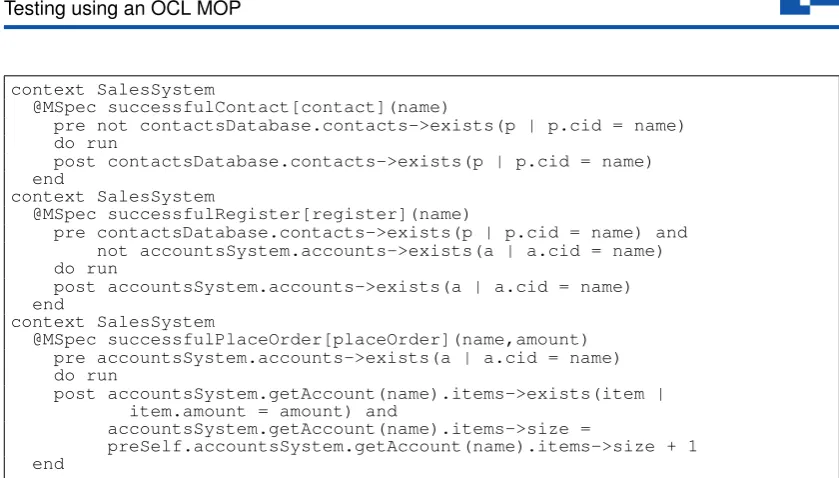
Given a sales system defined in Java, our aim is to specify methods in terms of pre and post-conditions and to define test scenarios as sequences of method calls. These can be attached to the appropriate Java classes by defining a new language feature. Each of the Java classes are defined in XMF using the meta-classJavaClass. The language feature for method specification is:
@MSpec <name> [<method-name>] (<args>) pre <pre-condition>
do <body>
post <post-condition> end
where name is the name of the specification (a given Java method may have more than one
specification), method-nameis the name of the specified Java method,args are the names
of arguments to the Java method, pre-condition and post-condition are OCL
ex-pressions, bodyis an XMF command. The semantics of a method specification is that if the
pre-condition is true then the body is performed and the post-condition is expected to be true. The body may reference the special variable run which causes the Java method to be called
with the supplied arguments. The post-condition may referencepreSelfwhich is the state of
the receiver of the Java messagebeforethe body is performed. The OCL constraints defined in
section2 are shown, written in the DSL, in figure3. A scenario language feature just lists the steps in the scenario:
context SalesSystem @Test test1
5
Language Implementation
The testing language features described in section4are defined as syntax classes in XMF. The method specification feature is defined in section5.1and the testing scenario feature is defined in section5.2.
5.1 Method Specifications
A method specification is added as a new operation to an instance ofJavaClass. The pre and
post-conditions are expressed in OCL and are checked respectively before and after the body of performed. The result of calling a method specification depends on whether the pre and post-conditions are satisfied. Firstly, the pre-condition is checked, if that fails then the specification returns. Otherwise, the body of performed and the post-condition is checked. The rest of this section describes the implementation of the language feature in detail.
The structure of theMSpecclass is defined as follows:
context Root
@Class MSpec extends XOCL::Sugar @Attribute name : String end @Attribute opName : String end @Attribute args : Seq(String) end @Attribute pre : OCL end
@Attribute body : Performable end @Attribute post : OCL end
@Constructor(name,opName,args,pre,body,post) ! end @Operation body()
Subst([| self.send(<opName.lift()>,args) |]).walk(body) end
end
Note that thepre andpostattributes are of typeOCL while the body is anyPerformable
action. MSpecextends the classXOCL::Sugarwhich means that the class must provide an
operationdesugarthat is used by the XMF parser to synthesize abstract syntax. Therefore,
instead of returning abstraction syntax from the grammar rules, the actions simply create an instance ofMSpecand leave the synthesize work todesugar.
The operationbodyis defined to replace all occurrences of the variablerunwith a call to the
Java method. The code walkerSubstis initialized with an expression and then walks the body
of the method specification. Its definition is as follows:
context Root
@Class Subst extends Walkers::Code::OCLWalker @Attribute new : OCL end
@Constructor(new) end
@Operation walkVar(line,name,arg) if name = "run"
then new
else super(line,name,arg) end
end end
The grammar for theMSpeclanguage feature is defined below:
context MSpec
@Grammar extends OCL::OCL.grammar
p = Pre d = Do q = Post ’end’ { MSpec(n,o,as,p,d,q) }. MArgs ::= ’(’ as = CNames ’)’ {as}.
CNames ::= n = Name ns = (’,’ Name)* { Seq{n|ns} } | { Seq{} }. Pre ::= ’pre’ Exp.
Do ::= ’do’ Command. Post ::= ’post’ Exp. end
Notice that the MSpec grammar extends the XMF-supplied grammar for OCL. XMF allows
grammars to be extended and therefore all the rules from the parent are included in the child. TheOCLgrammar provides the rule namedExpthat parses and synthesizes OCL expressions.
Thedesugaroperation is responsible for returning abstract syntax that implements a method
specification. The implementation is just an operation with the method specification name. No-tice thatdesugaris an operation that returns anoperation definition expression. The arguments
of the operation expression.argsis equivalent to the Javaargs...varargs feature:
context MSpec
@Operation desugar()
[| @Operation <name> (.args)
<0.to(args->size-1)->iterate(i x = self.desugarBody() | [| let <args->at(i)> = args->at(<i.lift()>)
in <x> end |])> end |]
end
The body of the operation is code that binds the names of the arguments to the appropriate element of theargsrun-time argument. The names are indexed usingatat compile-time and
the values are indexed at run-time.
The body of the specification operation is produced bydesugarBody:
context MSpec
@Operation desugarBody()
[| let preSelf = self.deepCopy() in if <pre>
then
let result = <self.body()> in if <post>
then CallSucceeds(result,<opName.lift()>,args) else PostFails(<opName.lift()>,args)
end end
else PreFails(<opName.lift()>,args) end
end |] end
The body binds a run-time variablepreSelfto a deep copy of the receiver. The implementation
ofdeepCopy(not shown) is implemented on a case-by-case basis by extending the underlying
Java class from within XMF. The variable preSelf is used in the post-condition where the
values of the fields in the current state of the receiver can be compared to those before the body was performed. There can be three outcomes each of which is an instance of a different class:
PreFailsdescribed the situation where the pre-condition fails; PostFails describes the
situation where the post-condition fails; and, inCallSucceedsboth conditions are satisfied
5.2 Test Scripts
Test scripts are sequences of calls. A call is just a name and argumemts:
context Root @Class Call
@Attribute name : String end
@Attribute args : Seq(Performable) end @Constructor(name,args) ! end
@Operation desugar()
[| self.send(<name.lift()>,<args->iterate(arg x = [| Seq{} |] | [| <x> + Seq{<arg>} |])>)|]
end end
When a call is translated to abstract syntax usingdesugar, the resulting expression sends a
message toself containing a sequence of arguments. The argument sequence is constructed
usingiteratewhich chains together singleton sequences for each argument (expression).
TheTestlanguage feature is defined below:
context Root
@Class Test extends XOCL::Sugar @Attribute name : String end @Attribute calls : Seq(Call) end @Constructor(name,calls) ! end @Grammar extends OCL::OCL.grammar
Test ::= n = Name cs = Call* ’end’ { Test(n,cs) }. Call ::= n = Name ’(’ as = TestArgs ’)’ { Call(n,as) }. TestArgs ::= e = Exp es = (’,’ Exp)* { Seq{e | es} }. end
@Operation desugar() [| @Operation <name> ()
<calls->reverse->iterate(call x = [| Seq{} |] | [| @Case <call.desugar()> of
CallSucceeds(result,name,args) do
Seq{CallSucceeds(result,name,args) | <x>} end
PreFails(name,args) do Seq{PreFails(name,args)} end
PostFails(name,args) do Seq{PostFails(name,args)} end
end |])> end |]
end end
The definition ofdesugarabove uses aCaseexpression to dispatch on the result of calling
each method specification. It builds a sequence expression that will terminate if any of the pre or post-conditions fail to be satisfied. The result of a test scenario is a sequence of method specification outcomes which are either all instances ofCallSucceedsor terminate with a PostFailsorPreFails.
6
A Meta-Object Protocol
classes to be manipulated from XMF. The interface supports the creation of new instances, field access and update, and method invocation. The example has assumed that field references and method invocation in OCL maps directly onto the equivalent in Java. However, this is not al-ways practical, since implementation choices translate properties and associations in a model and implement them in a variety of ways.
The Eclipse Modelling Framework (EMF) [2] is used to represent and manipulate models in Java. An EMF implementation of a model uses factories to create instances of objects and references fields using accessor and updater methods. This is a particular implementation choice compared to, say, using class constructors and direct field reference.
A meta-object protocol (MOP) can be used to make key execution features extensible. The key features for an object-oriented system are: object creation; field access; field update; method invocation. The MOP is implemented using a meta-class and a Java class. The defaults are
JavaClass andForeignObjectMOP. This section describes the key features of the
stan-dard MOP and shows how it can be extended.
6.1 A Standard MOP
A class is instantiated by applying it to initialization arguments. The behaviour for applying a class is defined by the meta-class:
context Java
@Class JavaClass extends Class
@Attribute descriptor : JavaDescriptor (?,!) end end
The meta-classJavaClassdefined above extends the basic XMFClasswith a descriptor that
names a Java class in the file system. When a descriptor is supplied in the definition of a class with meta-classJavaClassthe operationaddDescriptoris used to process the descriptor:
context JavaClass
@Operation addDescriptor(d:JavaDescriptor) xmf.foreignTypeMapping().put(d.type(),self); xmf.foreignMOPMapping().put(d.type(),d.mopName()); self.setDescriptor(d)
end
The operationaddDescriptoruses the operationsforeignTypeMappingand
foreignMOPMapping in the system object xmf to inform the XMF virtual machine that
instances of the XMF class are to be associated with instances of the Java class referenced in the descriptor, and to inform the machine of the MOP for the class.
When a class is applied to arguments in XMF it is instantiated. All meta-classes must imple-ment an operationinvokethat describes how to instantiate the receiver:
context JavaClass
@Operation invoke(target,args)
let class = xmf.javaClass(descriptor.type()) in if class = null
then self.error("Cannot find Java class " + descriptor.type()) else class.invoke(target,args)
public class ForeignObjectMOP {
public void dot(Machine machine, int object, int name) { ForeignObject f = machine.getForeignObject(object);
String string = machine.valueToString(machine.symbolName(name)); int value = XJ.getSlot(machine, f.getObject(), string);
if (value == -1)
machine.sendSlotMissing(object, name); else machine.pushStack(value);
}
public void send(Machine machine, int target, int message, int args) { if (!handleByXOCL(machine, target, message, args))
if (!handleByJava(machine, target, message, args)) noOperationFound(machine, target, message, args);
}
public boolean hasSlot(Machine machine, int foreignObj, int name) { ForeignObject f = machine.getForeignObject(foreignObj);
String string = machine.valueToString(machine.symbolName(name)); return XJ.hasSlot(f.getObject(), string);
}
public void set(Machine machine, int obj, int name, int value) { ForeignObject f = machine.getForeignObject(obj);
String string = machine.valueToString(machine.symbolName(name)); if(XJ.setSlot(machine, f.getObject(), string, value) == -1)
machine.sendSlotMissing(obj, name,value); else machine.pushStack(obj);
[image:13.595.86.507.115.398.2]} }
Figure 4: A Basic Java MOP
When aJavaClassis invoked it uses thejavaClassoperator to load the Java class named
in the descriptor and then sends it an invokemessage. The VM knows that invoking a Java
class causes it to be instantiated via a suitable constructor. TheforeignMOPMapping
oper-ation associates a Java class with a MOP. The MOP is an instance of the XMF supplied class
ForeignObjectMOP(the default) or one of its sub-classes. The basic features of the default
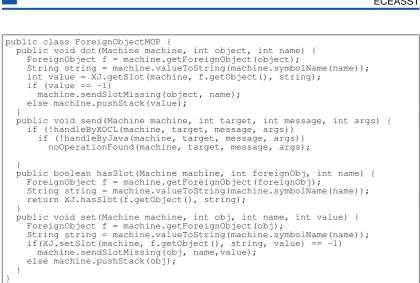
MOP are shown in figure 4: the method dot implements field reference; send implements
message passing;hasSlottests whether an object has a slot; and, setsets the value. When
the VM attempts to perform one of the standard operations on a foreign object it looks up the MOP for the object and invokes the appropriate method.
The XMF VM is a value of type Machine and represents Java objects as values of type ForeignObject. The XMF libraryXJusesjava.lang.reflectto implement type
con-version back and forth between XMF values and Java values and also implements basic access to Java values. Notice in the definition ofsendwe have omitted the definition ofhandleByXOCL
andhandleByJavawhich use basic machine andXJdefined primitives to perform message
passing (returning true and pushing the return value if successful).
6.2 ECore MOP
context Java
@Class EMFClass extends JavaClass @Operation invoke(target,args)
let factory = self.getFactory() then package = self.getPackage() then
class = package.send("get" + name,Seq{}) then object = factory.create(class);
constructor =
@Find(c,self.allConstructors()) when c.names->size = args->size else null
end
in if constructor <> null then
@For name,value in constructor.names,args do object.set(name,value)
[image:14.595.89.508.130.350.2]end end; object end end end
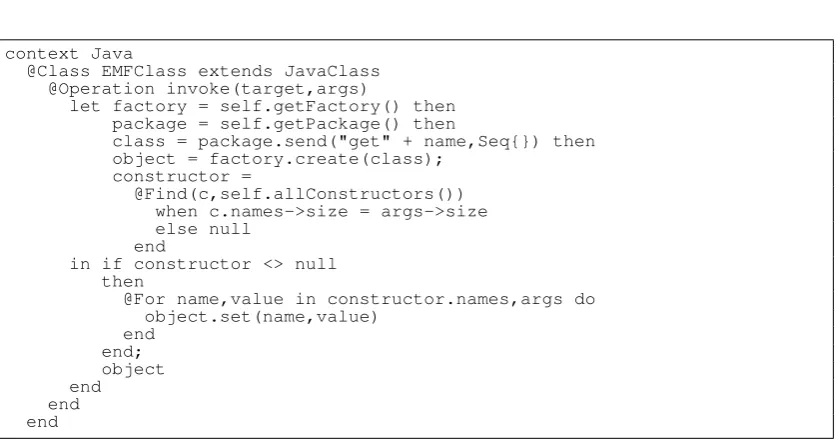
Figure 5: The EMFClass meta-class
with respect to a factory and field access must use feature descriptors. This section shows how the basic MOP is extended to support Ecore.
Figure5shows how JavaClassis extended to support Ecore instantiation. The invoke
operation is modified to use a specialization ofJavaDescriptorthat references the
appro-priate factory and containing package. The package is interrogated for the class to be instantiated and the factory is supplied with the class to produce a new object. Since Ecore factories do not support constructors (but XMF classes do), the fields are set based on the names defined in the appropriate constructor.
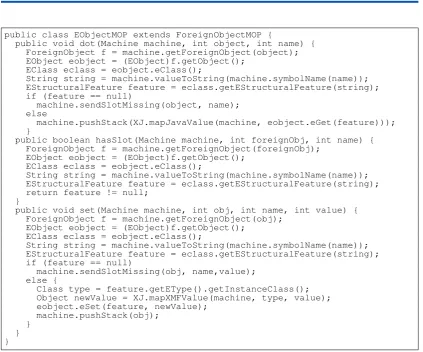
Figure6shows the specialization ofForeignObjectMOP to support Ecore field access.
There is no difference between EObjectMOP message passing and ForeignObjectMOP
message passing. In all cases, field access and update is performed with respect to feature de-scriptors.
7
Analysis and Review
A number of OCL interpreters exist, for example [11] and the Dresden toolkit
(http://dresden-ocl.sourceforge.net/index.php). Where these systems
ad-dress the variations in SUT implementation strategies, they do not use a MOP. Several tools and approaches exist for model based testing including AGEDIS [13], [3] and [19] however, none ad-dress the issue of associating OCL with an implementation. OCL is also used to validatemodels
[4] and to describe the behaviour of platform independent models [16] where the implementation issue does not arise.
public class EObjectMOP extends ForeignObjectMOP {
public void dot(Machine machine, int object, int name) { ForeignObject f = machine.getForeignObject(object); EObject eobject = (EObject)f.getObject();
EClass eclass = eobject.eClass();
String string = machine.valueToString(machine.symbolName(name)); EStructuralFeature feature = eclass.getEStructuralFeature(string); if (feature == null)
machine.sendSlotMissing(object, name); else
machine.pushStack(XJ.mapJavaValue(machine, eobject.eGet(feature))); }
public boolean hasSlot(Machine machine, int foreignObj, int name) { ForeignObject f = machine.getForeignObject(foreignObj);
EObject eobject = (EObject)f.getObject(); EClass eclass = eobject.eClass();
String string = machine.valueToString(machine.symbolName(name)); EStructuralFeature feature = eclass.getEStructuralFeature(string); return feature != null;
}
public void set(Machine machine, int obj, int name, int value) { ForeignObject f = machine.getForeignObject(obj);
EObject eobject = (EObject)f.getObject(); EClass eclass = eobject.eClass();
String string = machine.valueToString(machine.symbolName(name)); EStructuralFeature feature = eclass.getEStructuralFeature(string); if (feature == null)
machine.sendSlotMissing(obj, name,value); else {
Class type = feature.getEType().getInstanceClass(); Object newValue = XJ.mapXMFValue(machine, type, value); eobject.eSet(feature, newValue);
machine.pushStack(obj); }
[image:15.595.87.511.122.474.2]} }
Figure 6: ECore MOP
are used to produce code; the approach described here allows the user to interact with the system under test (SUT) via the XMF interpreter without a separate compilation step.
Whether code is generated or the OCL is interpreted directly, the problem of taking imple-mentation issues into account that differ from the model remains; the novel approach described here involves the use of a MOP to drive an interpretation engine for OCL, the same approach could be used to drive a transformation engine.
An earlier version of this work was presented as an invited talk at an ASTRANet workshop [5], as a tutorial [6] and in [7], where OCL expressions are expressed using both textual and graphical formats. This paper extends that work by addressing the issue of the implementation mapping.
MOPs were used in the definition of Smalltalk and the original description of how to imple-ment a MOP is given in [17]. Code generation techniques using a MOP are described in [15] where the OpenC++ compiler is extended to allow tests to be inserted into code.
been defined that support testing, for example [12] which is not based on OCL and the language reported in [10] which is based on OCL but does not use a MOP to link to the implementation. JUnit can be viewed as a DSL for testing Java programs and can be used in conjunction with OCL engines. The work described in this paper is more flexibile through the use of MOPs and the meta-interface of Java.
References
[1] Xmf version 2.2, 2008. http://itcentre.tvu.ac.uk/˜clark/downloads.html.
[2] Eclipse modelling framework, 2009. http://www.eclipse.org/modeling/emf/.
[3] D. Arnold, J.-P. Corriveau, and V. Radonjic. Open framework for conformance testing via scenarios. InOOPSLA ’07: Companion to the 22nd ACM SIGPLAN conference on Object oriented programming systems and applications companion, pages 775–776, New York,
NY, USA, 2007. ACM.
[4] E. G. Aydal, R. Paige, and J. Woodcock. Observations for assertion-based scenarios in the context of model validation and extension to test case generation. Software Testing Verification and Validation Workshop, IEEE International Conference on, 0:11–20, 2008.
[5] T. Clark. Iswim for testing - a model driven approach. Invited Talk, Feb 2007. Presentation available at http://itcentre.tvu.ac.uk/˜clark/Presentations/ISWIM For Testing.pdf.
[6] T. Clark. A domain specific language for testing. Tutorial, Feb 2008. Tutorial available at http://itcentre.tvu.ac.uk/˜clark/XMF/.
[7] T. Clark. Model based functional testing using pattern directed filmstrips. InProceedings of the 4th International Workshop on the Automation of Software Test. IEEE Computer
Society, 2009.
[8] T. Clark, P. Sammut, and J. S. Willans. Beyond annotations: A proposal for extensible java (xj). InSCAM, pages 229–238, 2008.
[9] D. F. D’Souza and A. C. Wills. Objects, components, and frameworks with UML: the catalysis approach. Addison-Wesley Longman Publishing Co., Inc., Boston, MA, USA,
1999.
[10] M. Felderer, R. Breu, J. Chimiak-Opoka, M. Breu, and F. Shupp. Concepts for model-based requirements testing of service oriented systems. InSoftware Engineering, 2009.
[11] M. Gogolla, F. Büttner, and M. Richters. Use: A uml-based specification environment for validating uml and ocl. Sci. Comput. Program., 69(1-3):27–34, 2007.
[13] A. Hartman and K. Nagin. The agedis tools for model based testing. SIGSOFT Softw. Eng. Notes, 29(4):129–132, 2004.
[14] F. Heidenreich, C. Wende, and B. Demuth. A framework for generating query language code from ocl invariants. ECEASST, 9, 2008.
[15] C. Hobatr and B. A. Malloy. Using ocl-queries for debugging c++. In ICSE ’01: Pro-ceedings of the 23rd International Conference on Software Engineering, pages 839–840,
Washington, DC, USA, 2001. IEEE Computer Society.
[16] P. Kelsen, E. Pulvermueller, and C. Glodt. A declarative executable language based on ocl for specifying the behavior of platform-independent models, 2007.
[17] G. Kiczales. The Art of the Metaobject Protocol. The MIT Press, July 1991.
[18] D. S. Kolovos, R. F. Paige, and F. Polack. Aligning ocl with domain-specific languages to support instance-level model queries. ECEASST, 5, 2006.
[19] A. Pretschner and J. Philipps. Methodological issues in model-based testing. In Model-Based Testing of Reactive Systems, pages 281–291, 2004.