successfully engaging international students in the
teaching, learning & assessment process
BREESE, Richard, EYRE, Graham and COGILL, Peter
Available from Sheffield Hallam University Research Archive (SHURA) at:
http://shura.shu.ac.uk/5255/
This document is the author deposited version. You are advised to consult the publisher's version if you wish to cite from it.
Published version
BREESE, Richard, EYRE, Graham and COGILL, Peter (2012). Change management - practising what we teach: successfully engaging international
students in the teaching, learning & assessment process. Student Engagement and Experience Journal, 1 (1), 1-14.
Copyright and re-use policy
See http://shura.shu.ac.uk/information.html
Breese, R., Eyre, G. and Cogill, P. (2012) Change Management - Practising what we Teach: Issues in Engaging International Students in Learning, Teaching, & Assessment. Student Engagement and Experience Journal, 1(1). Available at: http://research.shu.ac.uk/SEEJ/index.php/seej/article/view/35/Breese
Case Study
Change Management - Practising what we
Teach: Issues in Engaging International
Students in Learning, Teaching, &
Assessment
Richard Breese
1, Graham Eyre
2and Peter Cogill
21Sheffield Business School, Sheffield Hallam University, Howard Street, Sheffield, S1 1WB
2Faculty of Arts, Computing, Engineering and Science
Correspondence should be addressed to Richard Breese, [email protected]
Copyright © 2012 Richard Breese, Graham Eyre and Peter Cogill. This is an open access journal article distributed under the Creative Commons Attribution License, which permits the
unrestricted use, distribution, and reproduction in any medium, provided the original work is properly cited.
Abstract
In this article we review processes of change in a module whose subject matter is change management. The module attracts mainly international students, and has suffered from uneven student engagement and performance. We will recount how a Teaching Enhancement and Student Success (TESS) project was used to inform our attempts to improve engagement and
performance. Bearing in mind the origins of action research as part of Kurt Lewin‟s approach to planned change, we will use the four different elements of Lewin‟s work to reflect on the challenges we have been grappling with. The article will highlight different approaches to action research, which are linked to different aspirations as to the scope of change.
Introduction
This article is concerned with a Masters level module entitled „Change Management and Systems Implementation‟, which the authors teach on, for the Computing Department,
Faculty of Arts, Computing, Engineering and Science (ACES) at Sheffield Hallam University (SHU). The students are all on IT professional courses, and this module provides them with
ISSN (online) 2047-9476
management training to complement their technical IT skills. The make-up of the student group has changed hugely over recent years, giving rise to some major learning, teaching and assessment (LTA) challenges.
After outlining the nature of the LTA challenges, the article explores how change models as taught in the module have influenced the approach taken to try to improve student engagement and results. We will outline how a TESS project was used to inform the
approach to achieving change. The article will then reflect on Kurt Lewin‟s theories on change management to help understand the issues involved in achieving change. Contrasting pedagogic action research with other perspectives on action research, we will explore the opportunities and constraints affecting our own efforts for change, and their wider
implications.
There is a substantial literature on the internationalisation of higher education and the cultural integration of international students (see, for example, Jones, 2010). There is also much written about the issues faced by international students in higher education in
participating fully in the curriculum (see, for example, Carroll and Ryan, 2005; Kettle, 2011; Nield and Thom, 2009). This article is mainly focussed on the issue of international students engaging with the services provided by the university (i.e. lectures, seminars, formative assessment, advice and support), as they relate to an individual module of study, an area which falls in between the general cultural issues facing international students and the interaction between lecturer and student in the classroom.
The Change Management and Systems Implementation (CMSI) module
The aim of the CMSI module is to explore how the implementation of information systems is inextricably bound up with organisational change, and hence learn how such change can be managed to achieve organisational goals. The module starts with some background on organisations and their strategies, before looking in detail at planned and emergent models of change, and the human side of change management. The main assessment mechanism has been a written assignment in which students reflect on their learning over the duration of the module as to why change management is important for IT professionals in the twenty-first century.
CMSI was run for many years in the late 1990s and early 2000s as a module for a mix of full-time and part-time students, mainly from the UK, who had much relevant work
experience, mostly coming from management positions in the IT industry. As demand from this source waned during the 2000s there was a rapid increase in students from outside the EU, coming to Sheffield Hallam University for full-time IT courses. Most of these students come from the Indian Sub-Continent.
cannot keep up with payments on their fees. Some students are more comfortable with the technical IT parts of their courses than the modules on study skills and management.
In the late 2000s the numbers on the module grew, such that in 2008/9 and 2009/10 there were about 100 students taking it, of whom over 90% were from outside the EU. Some of them were taking the module in their first semester of study at SHU. While there were some students committed from the outset to attending lectures and seminars, doing further study outside these sessions and preparing for assessment, a significant number of students were attending irregularly or not at all over the early part of the module. Some of these students hoped to make up for this by engaging with the module later on in its delivery, while others continued to be absent throughout. Often the poorly-engaged were students who were the least well equipped to succeed in their studies, because of language difficulties and a wide gulf between the approaches to learning they had experienced in their home country,
compared to those used in the UK (Nield and Thom, 2009). The result was that, while student surveys (generally completed only by the engaged students) suggested that the module was deemed useful and interesting, many students either failed the module or were caught plagiarising and/or colluding with other students.
Changes to learning, teaching and assessment to encourage engagement
The module team recognised the need for changes to the module from 2008/9 onwards, and introduced new elements to the content of the module specifically designed to raise
awareness of the changes required of the students if they were to participate successfully in the module. One of the activities we introduced, in the first seminar, was to get all the students to list the changes they were facing in their current studies, encouraging them to see how managing change was something they were themselves doing at a personal level. For the overseas students, this brought out not only the changes in learning styles, with the emphasis on self-directed learning, applying theory to practical examples and the extensive use of electronic learning environments, but also practical changes, such as adjusting to the cold weather and language difficulties. Thus we covered the range of different types of shock which international students face – culture shock, language shock and academic shock (Ryan, 2005B).
We also introduced formative exercises which contributed to the change management curriculum, and also tested the ability of the students to reference correctly and avoid
unintentional plagiarism, to reinforce the sessions undertaken by the Faculty during student induction. In this way, we tried to make explicit and transparent the changes in learning styles expected of the students (Ladd and Ruby, 1999), and the specific requirements in terms of academic writing (Schmitt, 2005)
depended upon building up knowledge over time as each week‟s themes built on the content previously delivered. Without the power to make attendance compulsory, we had to rely on other, less direct mechanisms to encourage engagement.
Despite these and other changes, the lack of engagement of a significant proportion of students continued in 2009/10, and the inability of a large number of students to reference correctly, despite the measures that had been taken, laid them open to academic conduct procedures for suspected plagiarism on the final assignment. The module team realised that we needed to understand the reasons for poor engagement and results better. To put together a package of changes to address the problems we needed to draw on the expertise available across the ACES Faculty, engaging with a wider range of stakeholders than hitherto. In order to do this, an application for funding was made under the TESS programme in 2010, which was successful.
The TESS project, ‘Enhancing the International Student Experience’
It was felt that the TESS project should start without preconceptions as to the issues leading to the problems with student engagement, so an inductive approach seemed the most
appropriate (Gill and Johnson, 2002). The module team decided to manage the project themselves, feeling that they had the in-depth knowledge of the module and the researcher skills necessary to carry out this work. Inevitably our own experiences in delivering the module influenced our approach to the research, but as far as possible we sought to utilise appropriate research tools and approaches to gain relevant information, which might, or might not correspond with our prior assumptions. The project involved:
a) interviewing international students individually using unstructured and semi-structured interviews in order to understand their actions and motivations whilst studying the CMSI module. This included a range of students – two of them deemed academically strong, who had not been involved in plagiarism, as well as a cross section of those students who were found guilty of cheating allegations (six students) giving a total of eight students overall.
b) Unstructured conversations and/or semi-structured interviews with senior academics and administrators in the Faculty,
specialists in LTA, and
advisers working with international students across the university.
Many of the conclusions reached from the TESS Project confirmed the views of the module team, but there were some additional points as well. The project reinforced our view that international students vary tremendously in their capabilities and levels of commitment. Students were divided into four different groups, based on their willingness and capability to study and their financial position while at the university. The first group consists of capable students with good academic credentials and the willingness and ability to fully engage with both the academic process and SHU-style learning, teaching and assessment. The second group consists of committed students who have the willingness and capability to engage academically, but struggle to do well as they lack the language skills and/or work experience to do so. Both these groups consist of students who typically finance themselves but are coping with the financial pressures involved. They are likely to be working part-time whilst studying, but they put their learning first. The third group contains students who were originally committed in their intentions to study and learn, but run up large debts in order to come to the UK. They may or may not also have language difficulties, but they typically lack work experience and their main challenge becomes earning money in order to pay back their loans. Sometimes, the financial problems are so severe that the students are excluded from the university for a time because they fail to keep up with their fee instalments. Many of these students are also weak academically, so having missed a high proportion of lectures and seminars they may take the risk of cheating in assignments as they feel that they will
otherwise fail the module. A few students fall into a fourth group, who register and enrol, but then do not attend lectures and seminars, making no real effort to engage with the academic process. This group may have financial problems, but may also find the freedoms offered in the UK educational system difficult to handle in a responsible way. These students are the most likely to cheat on any assignment.
Students who are guilty of plagiarism sometimes do so inadvertently, because they lack academic skills, but in some cases the plagiarism is deliberate. The influence of „seniors‟, who have taken the module in previous years plays a pivotal role, and there are clearly versions of past assignments in circulation. The students who attended the research symposium were outspoken in condemning what was happening and urged the Faculty to take strong action.
Not all modules involving international students share the same problems. In
particular, lecturers teaching the more technical modules reported better student engagement than those involving understanding and synthesising management concepts.
Some specific measures were proposed to improve student engagement, which colleagues suggested had been successful elsewhere, such as:
record lectures and put them on Blackboard, for students to revisit;
change the pattern of assessment, so it is shorter and more frequent, and;
continue to revise the module content to reflect the practical systems implementation bias of current students.
At the Faculty and Departmental levels, it was identified that there is a need to use best practice from other parts of the university and beyond, and take measures such as:
managing the culture change for students coming to study in the UK better; improve academic induction;
review recruitment practices, seeking to ensure that all students who are accepted for a Masters‟ level place at the university have the academic capabilities for study at this level, and;
encourage a consistent approach across all departments and faculties to the issues of plagiarism and collusion.
Module delivery in 2010/11 and beyond
The TESS Project contributed to a number of changes in module delivery in 2010/11, including:
introducing a short viva as part of the assessment for the summative individual reflective assignment;
replacing the formative group presentation with a series of individual exercises, designed to test understanding of the module over its duration;
audio annotated powerpoint presentation recordings, which were then made available on the module VLE site;
slightly less emphasis on theory and more practical content related to IT;
using every opportunity to communicate to students the importance of attendance at lectures/seminars, and rigorous monitoring of student attendance;
introduction of marks for the personal blog, as a further incentive to build up the reflective diary, as source material for the final individual assignment, and;
The results from the changes made to the module for 2010/11 were mixed. While maintaining the strict approach to citation and referencing, the percentage of students taken through academic conduct procedures was reduced to around 17%, and the failure rate for students who had not plagiarised was very low. The percentage taken through academic conduct procedures was still regarded as too high, but the students concerned were almost all ones whose attendance had been poor, and who had posted few, if any blogs over the duration of the module.
One change which seemed particularly effective was the introduction of the short viva for the individual assignment. Most students were able to demonstrate a good understanding of what they had written, and those that couldn‟t tended to be the minority who had
plagiarised. However, the viva took up additional staff time, and created pressure in terms of meeting deadlines for marking.
In preparing for delivery in 2011/12, there was a major debate within the module team, also involving senior managers in the Computing Department, about the mode of assessment. It was eventually decided to replace the individual assignment with a final exam, based on the concerns that even 17% of students going through academic conduct procedures was too high. It was also felt that assessment by exam would fit with the prior expectations of overseas students.
The exam has been set up as „semi-open book‟, with the only documentation being available to the students being the CMSI blog. Students still gain marks from their blog entries, with each week where there is a valid blog entry accruing one percentage mark, up to a maximum of 10%. Therefore there is a huge incentive to blog regularly. At the Faculty level, a further change introduced for the 2011/12 academic year has been to run the „Study Skills for Professionals‟ module as a two week block for new students at the beginning of the semester, rather than as a „long and thin‟ module alongside others, thereby giving students a good grounding in generic study skills from the outset. Despite these measures, the pattern of previous years for a significant minority of students to engage poorly with the module has continued. Thus, about 15% of the 2011/12 students did not enter any blogs over the course of the module, despite every encouragement to do so, and the incentives offered.
Kurt Lewin and planned change
In the CMSI module we refer back to the work of Kurt Lewin, as a forefather of planned change, in his pioneering work on changing the behaviour of social groups to resolve conflict (Burnes, 2009, 341). Lewin‟s approach incorporated four integrated elements – field theory, group dynamics, action research and the three step model (Burnes, 2009, 332). This
association with Lewin‟s work can help us in reflecting on our own approach to change management in the module. It can also help us in reflecting on our TESS project, making links to the literature on action research and its use in pedagogical contexts.
Lewin recognised the complex relationship between culture and education, and contrasted the structures of education in Germany and America, as expressions of national cultures (Lewin, 1936). In the CMSI module, it is possible to see how various factors identified by Lewin in a totally different context are relevant to the attempts to change behaviour. Factors such as the degree of homogeneity within the group, group size and how people behave in different situations (Lewin, 1936), are crucial to the group dynamics of the CMSI students.
As has been indicated previously, there are huge differences between the students taking the CMSI module in the degree of engagement with the module. Some of the students impress us with their commitment to develop higher level learning skills, and interest in „deep learning‟ (Kember, 2000). When these students have been asked what might make their compatriots more committed to their studies, the answer, as expressed in both the TESS project symposium and in CMSI seminars, is that the tutors need to „put the fear of God into them‟. Thus, not only are there differences in levels of academic engagement amongst the CMSI students, but also tensions between them regarding university policy on this matter.
The other crucial aspect of group dynamics is the obvious point that each academic year there is a new cohort of students taking the module. This means that at the module level there is no opportunity to work on changing behaviours over a significant period, and the window of opportunity in identifying students not engaging and trying to influence their behaviour is very time-constrained. It also means that what might work well one year will not necessarily do so with a different cohort of students the following year (Ryan, 2005a, 93). Action Research
The group characteristics of the CMSI students influence the potential for action research as part of a change process. The original examples of action research by Lewin and his
followers were mainly in community relations and in industry, and involved the research centres he had set up being invited in to work collaboratively on social problems and management issues (Marrow, 1969). Since then, action research has developed in a number of different ways, such that there is “no „short answer‟ to the question „What is action research‟” (Reason and Bradbury, 2006, 1).
One of the ways in which approaches to action research differ is in the relationship between practitioners and researchers. For those working in the field of management studies, it is often assumed that action research involves a „client‟ in the form of the business or other organisation, and participants from that organisation work with researcher(s) from outside the organisation in a collaborative way (see for example, Gill and Johnson, 2002, 77-95). Other branches of action research also draw sharp contrasts between researchers and practitioners. For example, Friedman indicates that in action science, “the difference between researchers and practitioners is that the former are „explicit‟ theoreticians, whereas the latter are „tacit‟ theoreticians” (Friedman, 2006, 133).
this “tendency to de-emphasize the role of the external researcher and to stress the value of groups of practitioners carrying out their own enquiries into their own situation”. Thus, a recent text suggests that, “..the fundamental purpose of pedagogical action research is to systematically investigate one‟s own teaching/learning facilitation practice with the dual aim of modifying practice and contributing to theoretical knowledge” (Norton, 2008, xv-xvi).
In applying for and undertaking the TESS project, the CMSI module team were seeking to address a learning, teaching and assessment problem, rather than undertake an action research project. However, insofar as what we did had some characteristics associated with action research, our approach followed the pedagogical action research model, rather than the client/researcher model.
We have identified three main constraints on the effectiveness of the pedagogic action research model in this context. The first is the difficulty in engaging the students whose disengagement is the main reason for the need for the TESS project in the first place. While the enthusiastic, engaged students were prepared to participate in the research process, those who did not attend for lectures and seminars were difficult to involve in the research. As a consequence, the evidence for the reasons why they do not engage is mainly anecdotal.
The second constraint on the effectiveness of pedagogic action research lies in the relationship with the academic cycle. Lewin‟s concept of action research was that it
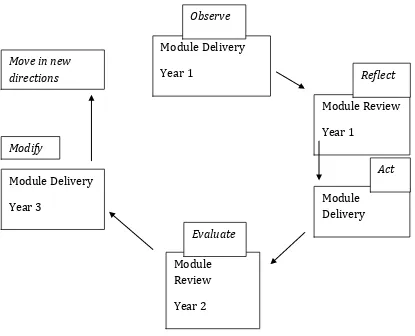
Figure 1 Action Reflection Cycle (in italics) and the annual academic cycle
Comparing our approach in the TESS project with the action reflection cycle in Figure 1, there was a heavy emphasis on the „reflect‟ part of the process, in order to come up with a package of changes to be made in the „act‟ part of the cycle. This can be attributed to the TESS project being focused on a single academic year, rather than a longer time span. It meant that the latter elements of the action reflection cycle were given less attention.
The third constraint was that the pedagogic action research model is focussed on the self and does not incorporate all the wider influences on the module. This issue can be explained by considering the third element of Lewin‟s approach to planned change, Field Theory.
Field Theory
The Force Field can be used at the level of the module as a whole, to identify the driving and restraining forces upon it. As pedagogic action research is focussed on self-reflection, it does not necessarily focus on the variety of different factors which might affect the Force Field, some of which might be outside the remit of the research framework. This is in contrast to the client/researcher branch of action research, where the client is usually in a position of high influence within the organisation. In the TESS project, an effort was made to involve
Module Delivery
Year 1
Module Review
Year 1
Module Delivery
Year 2
Observe
Reflect
Act
Module Review
Year 2
Evaluate
Module Delivery
Year 3
key managers in the research symposium, and an attempt was made to incorporate all the forces impacting on the module into the debate. However, the degree of influence which the initiators of the TESS project have over the forces for change was very limited in key areas, such as the international recruitment practices of the university.
Force Field Analysis is also used at the level of the forces affecting the individual student. In the preceding section we identified how difficult it is to obtain evidence on the reasons why the disengaged students act as they do. This means that the relative significance of the driving and restraining forces cannot be identified with any certainty, and the extent to which there are common, or different, factors for different students is unknown. One factor which is evident is that financial difficulties often figure amongst the reasons for
disengagement. On a practical level, some students are periodically disengaged because they are in debt to the university and hence have restricted access to university facilities. This factor is, obviously, one over which the module team have no influence.
Three-step model of change
While Lewin‟s three-step model of change (Unfreezing, Moving, Refreezing) has often been criticised as too simplistic (see, for example, Kanter et al., 1992), Burnes concludes that “it still has much to commend it as an approach to changing the behaviour of individuals and groups” (2009, 341). However, we have seen through our use of the other elements of Lewin‟s approach to change that we face many difficulties in „unfreezing‟ the behaviour of those disengaged from the CMSI module. These difficulties stem from the huge differences in levels of engagement in the student group, the difficulty in finding out the key factors as to what makes the disengaged students disengaged, the intractable nature of some of the
problems, such as student debt, and the change in the student cohort each time the module is delivered. In considering how to unfreeze behaviour it is important to recognise that the CMSI module does not operate in isolation, and student support officers, together with other course and module leaders, have a key role to play. However, from the CMSI module
perspective, the scope for concerted action is constrained by the small window of opportunity to identify and seek to engage the poor attenders.
As well as difficulties in unfreezing behaviour at the individual level, there are also issues with the „refreezing‟ stage at the level of the module. In terms of Lewin‟s three-step model of change, any changes made need to be „refrozen‟ in module delivery (Burnes, 2009). There can be dangers in constant change in organisations, and a balance is needed between change and continuity (Coulson-Thomas, 1998). However, it is unrealistic to expect that change can be avoided, even from one academic cycle to the next. There will be many pressures for change from the external environment and internal policy development. The changes which take place will be subject to a number of different influences, not all of which will be directly related to the action research process.
were only given a single academic year to achieve results, before it was decided to replace the assignment with an exam.
Conclusions – practising what we preach?
We have reviewed the changes in the CMSI module over the last three years, and considered the challenges in improving the involvement of students who are disengaged from the module. Using the four elements of Kurt Lewin‟s approach to planned change, we have demonstrated some of the constraints on change management, which has helped to explain why the problems have been reduced, but not solved.
In the CMSI module we contrast models of planned and emergent change. We suggest to the students that organisations often claim that change occurs through a planned approach, where the problem is diagnosed and the changes required are jointly designed and
implemented by the participants, to reach a new stable state (Burnes, 2009, 347). Along with Burnes (2009, 366), we then suggest to the students that the reality in most organisations is that many changes are emergent – arising as a continuous, contested process, responding to a constantly changing external environment.
Our attempts to improve engagement in the CMSI module reflect this tension between planned and emergent models of change. While the TESS project was part of an attempt to take a planned, coordinated approach to address the challenges facing the module, there are severe constraints on the effectiveness of the planned change process to improve engagement on the module. Key decisions affecting student engagement, such as the one to move to assessment by exam, have been dictated by wider policies and pressures, and the TESS project has been only one of many influences upon the module. Therefore, change in the CMSI module might be said to be an exemplar of the way that we suggest change usually happens in the „real world‟.
By analysing our attempts at change management using the four elements of Lewin‟s approach to planned change we can see areas which we will need to concentrate on in our further efforts to improve engagement in the module. For example, there is a need to find a way to get a better understanding of the reasons why there are a significant number of
students in every cohort who are poor attenders. We will need to think through carefully how to involve students in action research, given the diversity of the student group. Regarding the pattern of change, no matter how sophisticated the planned change process there will always be aspects of module delivery which are uncertain and unpredictable, and change will be a mixture of the planned and the emergent.
References
Carroll, J. and Ryan, J. (eds) (2005) Teaching international students: improving learning for all. Birmingham, SEDA.
Coulson-Thomas, C. (1998) The relative roles and risks of change and continuity. Strategic
Change,7 (8), 449-458. CrossRef
Friedman, V. (2006) “Action Science: Creating Communities of Inquiry in Communities of Practice”. In: Reason, P. and Bradbury, H. (eds.) Handbook of Action Research. London, Sage.
Gill, J. and Johnson, P. (2002) Research Methods for Managers, 3rd ed., London, Sage. Jones, E. (ed) (2010) Internationalisation and the student voice: higher education
perspectives, New York, Routledge.
Kanter, R., Stein, B. and Jick, T. (1992) The challenge of organisational change. New York, Free Press.
Kember, D. (2000) Misconceptions about the learning approaches, motivation and study practices of Asian students. Higher Education, 40 (1), 99-121. CrossRef
Kettle, M. (2011) Academic practice as explanantory framework: reconceptualising
international student academic engagement and university teaching. Discourse: studies in the
cultural politics of education, 32 (1), 1-14.
Ladd, P. and Ruby, R., (1999) Learning styles and adjustment issues of international students,
Journal of Education for Business, 74 (6), 363-367. CrossRef
Lewin, K. (1936) Some social-psychological differences between the United States and Germany. In: Lewin G. (ed.) (1973) Resolving Social Conflicts: Selected Papers on Group
Dynamics by Kurt Lewin, London, Souvenir Press.
Lewin, K. (1946) Action Research and Minority Problems. In: Lewin G. (ed.) (1973)
Resolving Social Conflicts: Selected Papers on Group Dynamics by Kurt Lewin. London,
Souvenir Press.
Marrow, A. (1969) The Practical Theorist: The Life and Work of Kurt Lewin. New York, Teachers College Press.
McNiff, J. and Whitehead, J. (2011) All you need to know about Action Research, 2nd ed., London, Sage.
Morrison, K. (1996) Developing Reflective practice in higher degree students through a reflective journal. Studies in Higher Education, 21 (3), 317-332. CrossRef
Nield, K. and Thom, V. (2009) Chinese Learners - A Matter of Heart, Enhancing Learning in
Norton, L. (2008) Action Research in Teaching and Learning. London and New York, Routledge.
Reason, P. and Bradbury, H. (2006) Introduction: Inquiry and participation in Search of a World Worthy of Human Aspiration. In: Reason, P. and Bradbury, H. (eds.) Handbook of
Action Research. London, Sage.
Robson, C. (2002) Real world research, 2nd ed.Oxford, Blackwell
Ryan, J. (2005a) Improving teaching and learning processes for international students. In: Carroll, J. and Ryan, J. (eds) Teaching international students: improving learning for all. Birmingham, SEDA
Ryan, J. (2005b) The student experience. In: Carroll, J. and Ryan, J. (eds) Teaching
international students: improving learning for all. Birmingham, SEDA.
Schmitt, D. (2005) Writing in the international classroom. In: Carroll, J. and Ryan, J. (eds)