Memory enhances the mere exposure effect
GRIMES, Anthony and STAFFORD, TomAvailable from Sheffield Hallam University Research Archive (SHURA) at: http://shura.shu.ac.uk/22202/
This document is the author deposited version. You are advised to consult the publisher's version if you wish to cite from it.
Published version
GRIMES, Anthony and STAFFORD, Tom (2012). Memory enhances the mere exposure effect. Psychology and Marketing, 29 (12), 995-1003.
Copyright and re-use policy
See http://shura.shu.ac.uk/information.html
1
Memory enhances the Mere Exposure Effect
Tom Stafford, University of Sheffield (UK)
Anthony Grimes, University of Manchester (UK)
Abstract
The fact of having already encountered something inclines us to prefer it in the future, a
phenomenon known as the Mere Exposure Effect (MEE). There is a widely accepted
view that recognition inhibits the MEE. We contest this view, questioning the generality
of the findings upon which it is based. We present new evidence from a systematic
investigation of the moderating influence of recognition memory on the MEE, using
brand logo stimuli and methods that make our results directly applicable to marketing
practice. We show that recognition, whether correct or mistaken, enhances, rather than
inhibits, the likelihood of preference.
Introduction
The mere exposure effect (MEE; Zajonc, 1968) is that exposure to a stimulus, without
any reinforcement, tends to enhance liking of that stimulus. It is typically found after
brief, repeated exposures to an audience with low levels of attention and involvement;
conditions that often characterize our increasingly cluttered media and consumption
environments (Ha & Litman, 1997; Skinner & Stephens, 2003). Given that consumers are
often engaged in tasks that occupy attention and severely limit their engagement with
advertising (MacInnis, Moorman & Jaworski, 1991; Shapiro et al., 1997), it is potententially
of great relevance to understanding, explaining and influencing the effects of
contemporary marketing communication (Bornstein & Craver-Lemley, 2004; Grimes,
2008). Its efficacy in this domain, however, is dependent on a detailed understanding of
the factors that enhance and constrain the size of the effect.
Significant reviews of the MEE have identified recognition memory as the most
important limiting factor, considerably reducing the size of the experimental effect (see
Bornstein, 1989; Bornstein & Craver-Lemley, 2004). Historically, this claim has been
influential in the interpretation of the MEE in the marketing literature. The natural
implication is that the effect is strongest when consumers are not able to recognise items
they have been exposed to. This is contrary to traditional assumptions regarding the
importance of attention, engagement and memory in marketing communication, and
raises the spectre of 'hidden persuasion' (Packard, 1957). An early, impressive
demonstration of the MEE without conscious perception, and thus without memory, for
the exposed stimuli has reinforced the impression that exposure of which consumers are
3
of these factors, we believe, that there has been an underestimation of the importance and
ubiquity of the mere exposure effect in the marketing literature.
In this paper we wish to call into question the validity of the claim that recognition
memory diminishes the size of the MEE. Our review of the literature suggests that the
foundations for this claim are weak and that, rather than there being a consensus, the
influence of recognition memory remains an open empirical question and a central point
of contention between competing theories of mere exposure. Indeed, we contend that the
issue of how both veridical recognition and the subjective experience of memory
influence the MEE is crucial to deciding between theories of this phenomenon.
Furthermore, it is of practical importance to the effective and appropriate application of
the MEE in a marketing context. From a practitioner perspective, the question is simple:
will attention, engagement and subsequent stimulus recognition exert a positive or
negative influence on the size of the MEE in marketing communication?
Here we endeavour to provide an answer to this question by robustly examining the
moderating influence of recognition memory in conditions that more closely approximate
those of real-world environments. To be clear, it is not our intention to disentangle the
relative influence of explicit versus implicit memory in the creation of the MEE, but
rather to demonstrate that the effect is larger or smaller in the presence of recognition
memory. From an applied perspective, we believe this to be the central issue for
marketing practitioners and researchers. Whether the outcome we observe is due to the
relative strength of explicit versus implicit processing or, perhaps, their cumulative effect
essence, therefore, the purpose of this paper is to compare the extent of exposure-induced
preference (i.e. the MEE) in the presence and absence of recognition memory, with
specific regard to the incidental but supraliminal exposure of typical marketing stimuli, in
a social setting.
Literature Review and Theoretical Framework
Recognition, recollection and theories of the Mere Exposure Effect
There are a number of competing psychological theories of how the MEE arises (Berlyne,
1970; Sawyer, 1981; Zajonc, 1980; Winkielman & Cacioppo, 2001; Stang, 1975; Sawyer,
1981; Mandler et al., 1987; Bornstein & D’Agostino, 1994). These have been
characterised as 'affective' (Berlyne, 1970; Zajonc, 1980; Winkielman & Cacioppo, 2001)
and 'cognitive' explanations (Stang, 1975; Sawyer, 1981; Mandler et al., 1987; Bornstein
& D’Agostino, 1994), according the dominant kind of processing that is assumed to
underpin the MEE (Bornstein & Craver-Lemley, 2004). However, we note that it is also
possible to categorise all of these theories according to whether they posit recognition as
a facilitator (Berlyne, 1970; Stang, 1975; Sawyer, 1981; Winkielman & Cacioppo, 2001)
or inhibitor of the MEE (Zajonc, 1980; Mandler et al., 1987; Bornstein & D’Agostino,
1992 1994).
A critical distinction here, it may be argued, is the extent to which the MEE is considered
5
explicit recognition is deemed to be a hindrance to the MEE (Bornstein & D’Agostino,
1992, 1994). For example, the influential theory of perceptual fluency/attribution
(Bornstein & D'Agostino, 1992, 1994) holds that the MEE occurs because previous
exposure to a stimulus increases the ease with which it can be processed (‘perceptual
fluency’) and that, in the absence of successful recognition, this fluency is misattributed
to affect. On this basis, it is proposed that both accurate recognition and subjective
recollection (even if not correct) hinder the extent to which misattribution occurs, and
thus the size of the affect-bias. However, the assumption that the MEE is by necessity a
product of implicit processes is not universally shared by the various competing
explanations. For example, in providing support for the theory of uncertainty reduction
(Sawyer, 1981) – which has enjoyed resurgent interest and support over the past decade
(e.g. Lee, 2001b; Robinson & Elias, 2005) – Lee (1994: 271) succinctly explains it as
follows:
“If subjects have been repeatedly exposed to the stimulus, then the learning following exposure, in either conscious or nonconscious form, should result in some uncertainty reduction toward the stimulus. Furthermore, if subjects are informed as to whether or not they have seen the stimulus before, this should also reduce some of the uncertainty that may accompany the task of evaluating the stimulus” (italics added)
From this perspective, therefore, recognition may be expected to enhance the size of the
MEE. Similarly, this facilitating effect is also apparent in the hedonic fluency model
(HFM; Winkielman & Cacioppo, 2001); a theory that has recently received empirical
support over that of perceptual fluency/attribution in one of the most recent
that the processing fluency created by mere exposure always gives rise to a genuine,
positive affective reaction as it may, for example, relate to a feeling of confidence in
having appropriate knowledge to deal with the stimulus (Bless and Fiedler, 1995;
Schwarz, 1990), or a sense of achievement at having explicitly recognized and interpreted
it (Carver and Scheier, 1990; Vallacher and Nowak, 1999). Whether as hindrance or help,
therefore, the moderating influence of recognition memory is a crucial and contested
element of the various competing theories of mere exposure.
Contrasting evidence for the moderating influence of recognition memory
Against this background, marketing-based mere exposure research has supported a
number of different theories; including, for example, uncertainty reduction (Lee, 1994),
hedonic fluency (Fang et al., 2007) and perceptual fluency/attribution (Shapiro, 1999,
Lee 2002). But it is the latter of these that appears to underpin most treatments of the
MEE in the wider marketing literature (e.g. Auty & Lewis, 2004; Matthes et al., 2007;
Chatterjee, 2008; Pandelaere, Millet & den Bergh, 2010). This, we believe, stems from
the traditional dominance of this explanation in psychological research (see Butler &
Berry, 2004).
The credibility of the perceptual fluency/attribution theory is largely based on the fact
that it purports to account for the findings of a small body of work in which stimuli are
repeatedly presented below the threshold of conscious perception. In a meta-analysis of
these results (and those of nearly 200 other studies) the MEE was observed to be
7
finding that has since been interpreted as evidence that the conscious processes of
recognition memory hinder the MEE (see Bornstein & D’Agostino, 1992, 1994;
Bornstein & Craver-Lemley, 2004).
However, the validity of this interpretation, and indeed the findings themselves, may be
challenged on three grounds. Firstly, it is founded primarily on the results of Bornstein’s
(1989) meta-analysis in which the size of the MEE was found to be significantly larger
across 9 studies that had employed subliminal exposure techniques than in over 200 that
had not. Indeed, Newell & Shanks (2007:104) observe that, beyond that provided by
Bornstein & D‘Agostino (1992), “there is little direct empirical evidence to substantiate
the claim that ‘subliminal’ mere exposure effects are larger than supraliminal ones.”
Furthermore, it should be acknowledged that ‘mere exposure’ is, by its very nature,
different to subliminal exposure; the former being specifically defined by Zajonc (1968:
1) as that which is “just perceptible.” Secondly, whilst scarcely acknowledged in the
literature, it is important to note that Bornstein’s (1989) original interpretation of this
particular aspect of his meta-analysis centred upon the possibility that participants were
less likely to experience boredom and fatigue during experiments that employed a
subliminal exposure phase; factors that have since been found to limit the size of the
MEE (Bornstein et al., 1990).
Thirdly, and most strikingly perhaps, the dearth of direct empirical support for the
attenuating influence of recognition memory on the MEE may be contrasted with
emerging evidence to the contrary. Whilst there are a small number of marketing-based
1993; Shapiro & Krishnan, 2001; Fang et al., 2007), such findings are not universal. For
example, Anand, Holbrook & Stephens (1988) found that the MEE occurs only in the
presence of recognition; prompting the authors to claim that the MEE “increases with the
accuracy of recognition” (Anand et al., 1988: 390). However, whilst these studies provide
evidence for the MEE in either the presence or absence of memory, they do not constitute
a direct test of the influence that memory exerts on the size of the effect. For this, it is
necessary to look to the psychology literature. In this respect, there are a number of
comparative studies that purport to show that the MEE is strongest when accompanied by
recognition memory (Newell & Shanks, 2007; Wang & Chang, 2004; Yagi, Ikoma &
Kikuchi, 2009). Furthermore, Lee (2001b) demonstrates that not only does objective
recognition enhance affective response to previously exposed stimuli, but so too does the
subjective experience of recognition (regardless of whether this impression is correct or
not).
Finally, whilst Hansen & Wanke (2009) do not directly address the issue of whether or
not recognition memory has a multiplicative influence on effect size, their detailed study
of the degree to which the MEE is ‘driven’ by conscious and unconscious processes
appears to suggest that it should neither enhance nor diminish the magnitude of what is
essentially a non-conscious affect-bias. To some extent, therefore, this work might be
considered to give rise to a third proposition regarding the moderating influence of
recognition memory on the size of the MEE; i.e. that it is negligible. At the very least,
however, it further contributes to the emerging case against the notion that recognition
memory diminishes the MEE (Bornstein & D’Agostino, 1992; Lee, 2001a; Bornstein &
9
In summary, therefore, we contend that the direction in which explicit memory moderates
the MEE remains an open question that is of both theoretical and practical importance to
psychologists and marketers. On the assumption that any study of moderating factors
must first begin with replication of the phenomenon itself, however, we first propose that:
H1. Mere exposure to a novel brand logo will significantly enhance the rate at which it is preferred over an equivalent, non-exposed brand logo.
Following this, and on the basis of theoretical (e.g. Sawyer, 1981) and empirical (e.g.
Lee, 1994; Lee, 2001b; Wang & Chang, 2004; Newwell & Shanks, 2007) challenges to
the notion that accurate recognition inhibits the MEE (e.g. Bornstein, 1989; Bornstein &
D’Agostino, 1992, 1994) we propose that:
H2. The size of the MEE for novel brand logos will be enhanced by accurate recognition memory
Finally, in response to emerging indications that that the MEE may also be magnified by
the subjective experience of memory (Lee, 2001b; Wang & Chang, 2004), we predict
that:
Methodology
Our methodology is aligned to that of the original nonconscious mere exposure
experiments of Kunst-Wilson & Zajonc (1980); although with the major changes that a)
stimuli were exposed supraliminally, b) the exposure phase occurred over several weeks
in the lectures of an introductory psychology course at a major university, and, c) the
testing was done collectively in a lecture on the same course. At this stage, therefore, it is
perhaps useful to discuss the nature of our experimental setting and how it supports the
contribution that this study makes to the extant marketing literature.
Experimental setting
The design of the experiment allows us to take advantage of the rigor of controlled
experimental designs whilst combining them with some advantages of a naturalistic
setting. It is not that a design which is in between a fully controlled lab-based experiment
and a fully naturalistic observation study is without weaknesses, but rather that the
quasi-naturalistic design affords certain advantages of both control and generalisability that
cannot otherwise be obtained. Additionally, a great advantage of this design is that it
allows us to test a relatively large number of people and so access greater statistical
power in analysing our results.
The setting for the experiment was a routine course of weekly lectures, attended by
participants as part of the undergraduate degree programme they had chosen to pursue.
Lab-based studies of the MEE are often characterised by lone individuals processing
11
words, very different psychological conditions from those of the everyday media
environments under which we suppose the MEE operates. In the context of this study, the
main purpose is not necessarily to replicate a single, specific type of media space but
rather to more broadly approximate some of the conditions under which mere exposure to
brand logos might be expected to occur in a range of non-traditional media environments.
In this respect, the target stimuli are placed at the periphery of focally attended
information that is not consumption related, but has been selected for processing by
participants during a normal and routine aspect of their life. Furthermore, this processing
takes place in a normal social setting in which each participant is accompanied by
friends/peers and is located within an ‘audience’. Under such conditions, and depending
on the specific location of each participant and their interaction with the focal material,
variation in the duration, frequency, angle and distance of exposure might be expected
across the audience. Indeed, such variation is common in a wide range of real-world
media environments; such as cinema, public TV venues and other outdoor/ambient
advertising in crowded locations (e.g. train stations). As such, and by way of the greatly
enhanced statistical power that is afforded by a relatively large sample, this study seeks to
embrace natural variation in the nature of exposure as a context in which to test the
robustness of the MEE. Finally, and given the long-standing rejection of subliminal
advertising techniques (on the grounds of both ethics and effectiveness; see Broyles,
2006), it may be argued that mere exposure is most likely to occur as a result of brief
switches in attention and/or peripheral processing in cluttered real-world environments
replicate some of the key conditions under which mere exposure might naturally occur,
rather than to closely control for them in a contrived laboratory environment
However, whilst locating the study in the weekly lecture programme of student
participants necessarily requires the relaxation of control over some elements, we retain
control over many of the elements that are important for experimental tests of the MEE.
The “two alternative forced choice” design mimics that of the canonical experiments of
Kunst-Wilson and Zajonc (1980), allowing us to collect measures of recognition and
preference that are inclusive of both explicit and implicit memory. We retain control of
the exposure stimuli, which have not been seen before or after by the participants. Factors
such as exposure frequency, duration and delay between exposure and test are also
controlled or contained within a known range.
Participants
These were those PSY101 students, from two consecutive years, who attended the lecture
during which testing occurred. Our analysis includes only those who responded to 9 or 10
of both the memory and preference judgments, and who attended the previous lectures.
Given this there were valid responses from 230 participants. 83% of the participants were
female. The mean age was 18.81 years (SD = 2.44).
13
Stimuli
Stimuli were twenty brand logos adapted from samples provided by 3 logo design
companies. These were selected to be typical of brand-logos that might be used for
known products and services, but which would be unknown to participants. Sixty logos
were pretested for recognition in terms of perceived association with an existing brand
(‘yes’ or ‘no’) and how much participants liked them (on a 5-point scale from strongly
dislike, through a neutral point to strongly like, henceforth ‘intrinsic likeability’).
Following this, twenty logos which had zero or very low brand recognition and similarly
neutral intrinsic likeability were selected for use in the experiment (average likeabilities
for the selected logos were in the range 2.62 – 3.31, with the average likeability being
2.98 and the distribution not being significantly different from 3 - i.e. neutral). Ten were
used during the exposure phase, and then paired against the unexposed remaining ten in
the test phase. We henceforth refer to previously exposed logos as ‘targets’, and their
foils as ‘distractors’.
Procedure
The exposure phase occurred during the first three lectures of PSY101 (‘Introduction to
Psychology) on two consecutive years. In each of these lectures the logos were discretely
placed in the upper right corner of the slides (see figure 1). Each logo was seen 9 times
for an average of 117 seconds in total (standard deviation 28 seconds). No reference to
the logos was made by the tutors, who gave their lectures as normal. No students queried
[figure 1 about here]
The test phase occurred in the middle of a subsequent lecture, three days after the last
exposure. Responses were gathered from all attending students on that day using the
ComTec Audience Response system. This involves each participant pressing buttons on a
handset that wirelessly transmits their response to a centralised receiver. After some
introduction the participants were familiarised with the system and some demographic
data were collected (including questions about attendance at previous lectures). Because
all participants were viewing the same display (the lecture theatre projection screen) it
was not possible to individually randomise the order of stimulus presentation or to
randomise pairing during testing, nor was it possible to individually vary the order of the
memory and preference tests (as in Kunst-Wilson & Zajonc, 1980). Instead the memory
and preference questions were asked in two blocks, with the order counterbalanced across
the two years. In each block, participants were shown 10 pairs of logos (each containing a
target and distractor) and were required to indicate which of the two they
preferred/remembered (mirroring the 2AFC tests of Kunst-Wilson & Zajonc, 1980). In
each case, participants were asked to respond as quickly as possible on the basis of their
‘snap reaction’. Following each recognition judgment, they were also required to report
their level of confidence in its accuracy. Our dependent variable is thus mean preference
15
(exposed vs novel), stimulus recognition (recognised vs not-recognised) and recognition
confidence (sure vs half-sure vs guessing).
In each judgement block the ten targets were shown in a pseudo-random order and
randomly paired with one distractor. The distractor logos were pseudo-randomly
positioned on left and right so that the target was on each side in exactly half the cases.
The choice pair was shown until responses had been collected from the majority of
participants (less than ten seconds in all cases) and then a confidence rating was
requested. After the first block of judgements a short pause was allowed and a reminder
of the instructions was given before the remaining block. The targets were again
presented in the same pseudo-random order but using different pairings with the
distractors.
Results
A first essential step is to check for the presence of the mere exposure effect in our data.
Does exposure to the experimental stimuli make them more preferred than non-exposed
stimuli? Bonferroni-corrected T-tests show that the mean preferred proportion of
previously exposed logos was significantly above chance, for both the remember first
(mean proportion 0.58, t(122)=5.946, p<0.0001) and the preference first (mean
proportion 0.61, t(106)=9.691, p<0.0001) groups. This confirms the presence of the MEE
(and thus H1): mere exposure to novel brand logos significantly enhances affective
alternatives (Zajonc, 1968). At this point, it should also be noted that there were no
significant differences between participants who answered the remember questions first,
and those who answered preference questions first, and so for the remainder of the
analysis we group the data. Overall, the recognition rate was also above chance (mean
proportion 0.57, t(229)=6.165, p<0.0001).
The main analysis we present here differs from a standard ANOVA, so we will briefly
explain the rationale behind it. Whilst an ANOVA test might be a conventional choice of
statistical test for data like this, it is known that statistics on proportions rather than
scalars are subject to some peculiarities that diminish the power of the technique (Jaeger,
2008). A superior analysis technique for proportions is that of mixed models logistic
regression (for discussion see Jaeger, 2008 and Baayen, 2008). This technique allows us
to combine dichotomous variables (such as whether a logo was recognized or not) with
continuous variables (such as the intrinsic likeability of the logos) in predicting, for each
preference judgement made by all participants, whether the target or the distractor logo
would be chosen as preferred. If the predictor factors are significant in the model it shows
that they have a separate influence, statistically, on preference judgements. As well as
being a valid technique for use on proportions, this technique allows us to conveniently
and concurrently test the influence of multiple factors, as well as the ones of primary
theoretical interest.
In this case we are primarily interested in how recognition and recognition confidence
influence preference judgements. We also include measures of the intrinsic likability of
logos involved in the preference judgements. Although all logos in the experiment had
17
differences in intrinsic likeability that remained had an effect on preference judgements.
We therefore included in our regression model the intrinsic likeability of exposed (target)
logos and the intrinsic likeability of the non-exposed (distractor) logos in both the
preference and recognition judgements.
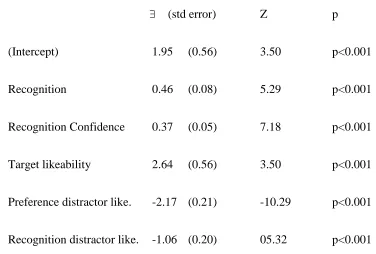
[Table 1 about here]
The results of the mixed-models logistic regression are shown in Table 1. The analysis
reveals highly significant effects of recognition on preference ((se) = 0.46 (0.08),
Z=5.29, p<0.001). Targets which were recognised were more likely to be preferred than
those which were not recognised (confirming H2). This is a crucial test of the proposed
inhibitory effect of recognition on the size of the MEE (see Bornstein, 1989; Bornstein &
Craver-Lemley, 2004). Greater recognition confidence was also highly significantly
associated with increased likelihood of preferring an item (confirming H3). Contrary to
previous proposals, then, we find that recognition memory predicts enhanced – rather
than inhibited – preference.
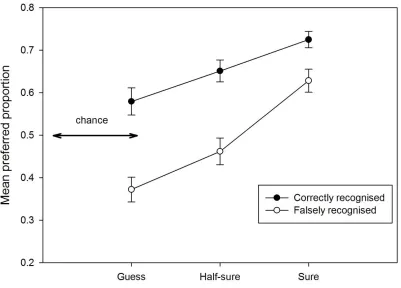
[Figure 2 about here]
It is insightful to show these results graphically, separating those logos that had been
previously exposed and were judged as remembered ('correctly recognised') from those
that had not been previously exposed but were judged as remembered ('falsely
recognised logos are shown in Figure 2. Splitting the data this way allows us to clearly
see that higher recognition confidence was associated with greater likelihood of
preference. It also shows that an effect of recognition confidence occurs regardless of
whether items have been previously seen or not. Conversely, there is an effect of
exposure on preference which is independent of recognition (since the only difference
between correctly and falsely recognised items is whether they have been exposed, and
hence are eligible to be correctly recognised).
In addition to these effects there were also significant effects of the three likeability
measures. Even though we selected our experimental logos for similar intrinsic
likeabilities, remaining differences in likeability still had significant influence over
preference judgements. Perhaps this is not surprising. For our purposes, the inclusion of
these factors in the analysis assures us that the effects of recognition and recognition
confidence are independent and not due to some non-random distribution of likeabilities
across conditions.
Limitations
As discussed above, the use of a quasi-naturalistic setting in this experiment means that
we sacrifice a degree of control over some factors; i.e. precise exposure duration,
ordering of exposure items, random selection of exposed and non-exposed items, random
ordering of questions and responding conditions. Our feeling, however, is that these
losses of control are compensated for by the high statistical power of the study and
19
it is important that we give due consideration to the possibility of increased variance
(with the accompanying loss of statistical power) or systematic bias in the results.
In this respect it is first important to stress that, although higher non-systematic variance
in our results might mean that we miss a true effect that is present, it does not lead to an
increase in the probability that any of the effects we do find are not true effects.
Furthermore, potential weaknesses in this respect are largely compensated for by the gain
in statistical power that comes from testing a large number of people. More importantly,
therefore, we might ask if the factors that our design caused us to relinquish direct control
over (in comparison to lab studies) could plausibly cause systematic errors that could be
truly responsible for the effects we found. In this respect, the most serious possibility is
that preference-bias for exposed over non-exposed items is the result of intrinsic
differences in the stimuli, rather than exposure itself. However, our pretesting of stimuli
goes some way to accounting for a potential effect of intrinsic likability, as does our
statistical analysis; which suggests that while there is an effect of intrinsic likability there
are also additional independent effects (e.g. of recognition). More fundamentally, our
investigation is concerned with the effect of recognition on preference, so systematic
differences between items would have to specifically and solely affect this relationship to
distort our results. This is hard to imagine. Similarly, it is hard to imagine how other
factors, such as the order of questions (which we could not randomize across
individuals), would systematically distort our findings on the effect of recognition on
preference (recall that we did counterbalance order of tasks and found no differences
between participants who made their preference judgments before or after those of
Discussion
In this study we demonstrate the MEE in conditions that approximate key characteristics
of the contemporary marketing environment: peripheral display of brand logos in a public
place to an audience primarily engaged in another task. Replicating the measurement
approach of Kunst-Wilson & Zajonc (1980), it is striking that previously exposed brand
logos are preferred to unexposed brand logos. Exposure enhances preference in the
presence and absence of recognition; though with greater strength in the former
condition. However, it is important to acknowledge that unexposed brand logos that are
mistakenly ‘recognised’ are preferred to unexposed brand logos that are not recognised.
This suggests that although there is an affect of exposure that is independent of
recognition, there is also an effect of recognition that is independent of exposure – in
other words, logos that were recognised, even if incorrectly, tended to be preferred. For
the purposes of this paper, however, the most important thing about this result is that
recognition enhances preference when it is associated with mere exposure, and when it is
not. Contrary to previous assumptions in the literature, therefore, recognition is not
inhibitory of the MEE, nor is it neutral.
More insight into the interaction of recognition with enhanced preference comes from the
analysis of different confidence levels of recognition. Here we can see that whether
participants were 'sure', 'half-sure', or ‘guessing’ about their memory for the logos,
recognition was associated with preference (again, whether or not such memory was
21
most confidently recognised are preferred at well above chance levels (62.8%), indicating
that for these items the fact of confident recognition outweighs the influence on
preference judgements of the fact of exposure (in this case the lack of it).
We propose that our reconceptualisation of existing theories - according to their position
on recognition as an inhibitor or facilitator of the effect - paves the way for an
understanding that is of more direct relevance to marketing than the theory-driven
division of ‘affective’ versus ‘cognitive’ accounts. In this respect, the current findings
provide direct empirical support for those explanatory theories that assume recognition to
be a facilitator of the MEE (e.g. uncertainty reduction, Sawyer, 1981) over those that do
not. In particular, and alongside those of Lee (2001b) and Wang & Chang (2004), they
add to an emerging body of evidence against the perceptual fluency/attribution account
(Bornstein & D’Agostino, 1992, 1994); and in particular the notion of a ‘correction
mechanism’ by which recognition memory serves to reduce misattribution and thus the
‘cognitive illusion’ of affect (Bornstein & Craver-Lemley, 2004). Further to this, and in
light of the fact that boredom and fatigue have also been found to constrain the MEE
(Bornstein & D’Agostino, 1990), it may be argued that the current findings lend indirect
support to Bornstein’s (1989) original interpretation that it is the reduction in these
factors, rather than the absence of recognition memory, that is responsible for magnifying
the size of the effect in subliminal mere exposure studies (see Bornstein, 1989; Willems
et al., 2010).
From a practitioner perspective, therefore, this study indicates that the positive effects of
fact, are more likely to be enhanced by this factor. On this basis, the marketing-based
MEE should be considered to be quite distinct from techniques of subliminal advertising
(in which the elimination of conscious perception and memory is paramount). By
contrast, the effects of mere exposure may be maximised by encouraging attention,
perceptual processing, encoding and retrieval during each fleeting encounter with the
stimulus. The means by which this might be achieved are well-documented in the
psychology and marketing literature, and include maximising stimulus consistency
(Tulving and Thomson, 1973; Hill et al. 1997), familiarity and saliency (see Moray,
1959; Nielson and Sarason, 1981; Kurilla and Westerman, 2008), whilst minimising
contextual interference (Kumar, 2000) and memory decay (Spear, 1978). For marketing
practitioners, therefore, this study highlights the relevance of repeated presentations of
distinctive, familiar and salient stimuli, via multiple channels and media, right up to the
point at which brand choice decisions are made. As such, it aligns the effective
application of mere exposure principles with the concepts of integrated marketing
communication (see Schultz & Kitchen, 2004), media-neutral planning (see Tapp, 2005)
and media recency (see Ephron, 1997), and provides a very different perspective of the
23
References
Anand, P., Holbrook, M. B. & Stephens, D. (1988). The formation of affective
judgments: The cognitive-affective model versus the independence hypothesis. Journal of
Consumer Research, 15, 3, 386-391
Auty, S. & Lewis, C. (2004). Exploring Children's Choice: The Reminder Effect of
Product Placement. Psychology & Marketing, 21, 9, 697-713,
Baayen, R. H. (2008). Analyzing linguistic data: A practical introduction to statistics
using R. Cambridge Univiversity Press
Berlyne, D. E. (1970). Novelty, complexity and hedonic value. Perception and
Psychophysics, 8, 279-286
Bornstein, R.F. (1989). Exposure and affect: Overview and meta-analysis of research,
1968-1987, Psychological Bulletin, 106, 265-288
Bornstein, R.F. & Craver-lemley, C. (2004). Mere exposure effect. In Cognitive Illusions:
A handbook on fallacies and biases in thinking, judgment and memory, Edited by R.F.
Pohl, pp215-233, Psychology Press: Hove
Bornstein. R.F. & D'Agostino P.R. (1992). Stimulus recognition and the mere exposure
effect. Journal of Personality and Social Psychology, 63, 545-552
Bornstein. R.F. & D'Agostino P.R. (1994). The attribution and discounting of perceptual
fluency: Preliminary tests of a perceptual fluency/attnbutional model of the mere
Bornstein, R.F., Kale A.R. & Cornell K.R. (1990). Boredom as a limiting condition on
the mere exposure effect, Journal of Personality and Social Psychology, 58, 791-800
Broyles, S.J. (2006), Subliminal Advertising and the Perpetual Popularity of Playing to
People's Paranoia, The Journal of Consumer Affairs, Vol. 40, No. 2, p. 392
Butler, L.T. & Berry, D.C. (2004). Understanding the relationship between repetition
priming and mere exposure. British Journal of Psychology, 95, 467-487
Chatterjee, P. (2008), Are unclicked ads wasted? Enduring effects of banner and pop-up
ad exposures on brand memory and attitudes, Journal of Electronic Commerce Research,
9, 1, 51-61
Dienes, Z. (2007). Subjective measures of unconscious knowledge. Progress in Brain
Research, 168, 49-64.
Ephron, E. (1997). Recency planning. Journal of Advertising Research, July-Aug, 61-65
Fang, X., Singh, S. & Ahluwalia, R. (2007). An examination of different explanations for
the mere exposure effect. Journal of Consumer Research, 34, 97-103
Grimes, Anthony (2008). Towards an integrated model of low attention advertising
effects: A perceptual-conceptual framework, European Journal of Marketing, Vol. 42
Iss: 1/2, pp.69 - 86
Ha, L. & Litman, B.R. (1997). Does advertising clutter have diminishing and negative
25
Hansen, J., & Wänke, M. (2009). Liking What’s Familiar: The Importance of
Unconscious Familiarity in the Mere-Exposure Effect. Social Cognition, 27(2), 161–182.
Hill M.E., Radtke, R. & King, M. (1997). A transfer appropriate processing view of
consumer memory. Journal of Current Issues and Research in Advertising, 19, 1, 1-21
Jaeger, T. F. (2008). Categorical data analysis: Away from ANOVAs (transformation or
not) and towards logit mixed models. Journal of Memory and Language, 59(4), 434–446.
Janiszewski, C. (1993). Preattentive mere exposure effects. Journal of Consumer
Research, 20, 3, 376-392
Kumar, A. (2000). Interference effects of contextual cues in advertisements on memory
for ad content. Journal of Consumer Psychology, 9, 3, 155-166
Kunst-Wilson, W R. & Zajonc, R. B. (1980). Affective discrimination of stimuli that
cannot be recognized. Science, 207, 557-558
Lee, A.Y. (1994). The mere exposure effect: is it a mere case of misattribution? Advances
in Consumer Research, 21, 1, 270-275
Lee (2001a)
Lee, A.Y. (2001b). The mere exposure effect: An uncertainty reduction explanation
revisited. Personality & Social Psychology Bulletin, 27, 1255-1266
Lee, A.Y. (2002). Effects of implicit memory on memory-based versus stimulus-based
Lee, M.P.Y. (2001a). Low involvement processing: Effects of stimulus exposure and
repetition on implicit memory, explicit memory and affect. Doctoral Thesis, University of
Toronto
Mandler, G., Nakamura, Y. & Van Zandt, B.S. (1987). Nonspecific effects of exposure
on stimuli that cannot be recognized. Journal of Experimental Psychology: Learning,
Memory, and Cognition, 13, 646-648
Matthes J., Schemer, C. & Wirth, W. (2007). More than meets the eye: Investigating the
hidden impact of brand placements in television magazines. International Journal of
Advertising, 26, 4, 477–503
Monahan, J. L., Murphy, S. T., & Zajonc, R. B. (2000). Subliminal mere exposure:
Specific, general, and diffuse effects. Psychological Science, 11(6), 462.
Newell, B. R. & Shanks, D. R. (2007). Recognizing what you like: Examining the
relation between the mere-exposure effect and recognition. European Journal of
Cognitive Psychology, 19, 103-118
Packard, V. (1957). The hidden persuaders. New York: David McKay
Pandelaere, M., Millet, K., & den Bergh, B. V. (2010). Madonna or Don McLean? The
effect of order of exposure on relative liking. Journal of Consumer Psychology, 20(4),
442-451. doi:10.1016/j.jcps.2010.07.003.2010.07.003
Robinson, Brent M. & Elias, Lorin J. (2005) Novel Stimuli Are Negative Stimuli:
Evidence That Negative Affect Is Reduced In The Mere Exposure Effect. Perceptual And
27
Sawyer, A.G. (1981). Repetition, cognitive responses and persuasion, in Cognitive
Responses in Persuasion, eds. Richard E. Petty. Tom M. Ostrom. and Timothy C. Brock.
Hillsdale. NJ: Erlbaum, 237-261.
Schultz, D.E. & Kitchen, P.J. (2004). Managing the changes in corporate branding and
communication: Closing and re-opening the corporate umbrella. Corporate Reputation
Review, 6, 4, 347-366
Shapiro, S. & Krishnan, S.H. (2001). Memory-based measures for assessing advertising
effects: A comparison of explicit and implicit memory effects. Journal of Advertising, 30,
3, 1-12
Shapiro, S. (1999). When an ad's influence is beyond our conscious control: Perceptual
and conceptual fluency effects caused by incidental exposure. Journal of Consumer
Research, 26, 1, 16-36
Shanks, D. R., & St. John, M. F. (1994). Characteristics of dissociable human learning
systems. Behavioral and brain sciences, 17(03), 367–395.
Skinner, H. & Stephens, P. (2003). Speaking the same language: The relevance of
neuro-linguistic programming to effective marketing communications. Journal of Marketing
Communications, 9, 177-192
Spear, N. E. (1978). The processing of memories: Forgetting and retention. Hillsdale, NJ:
Stang, D.J. (1975). Effects of 'mere exposure' on learning and affect. Journal of
Personality and Social Psychology, 31, 7-12
Tapp, A. (2005). Media neutral planning - A strategic perspective. Journal of Database
Marketing & Customer Strategy Management, 12, 2, 133-141
Tulving, E. & Thompson, D.M. (1973). Encoding specificity and retrieval processes in
episodic memory. Psychological Review, 80, 352-373
Wang, M-Y & Chang, H-C (2004). The mere exposure effect and recognition memory.
Cognition & Emotion, 18, 8, 1055-1078
Whittlesea, B.W.A. (1993). Illusions of familiarity. Journal of Experimental Psychology:
Learning, Memory & Cognition, 19, 6, 1235-1253
Willems, S., Dedonder, J., & Van der Linden, M. (2010). The Mere Exposure Effect and
Recognition Depend on the Way You Look!. Experimental Psychology (formerly
"Zeitschrift für Experimentelle Psychologie"), 57(3), 185-192.
doi:10.1027/1618-3169/a000023000023
Winkielman, P. & Cacioppo, J.T. (2001). Mind at ease puts a smile on the face:
psychophysiological evidence that processing facilitation increases positive affect,
Journal of Personality and Social Psychology, 81, 6, 989–1000
Yagi, Y., Ikoma, S., & Kikuchi, T. (2009). Attentional modulation of the mere exposure
effect. Journal of experimental psychology. Learning, memory, and cognition, 35(6),
29
Zajonc, R. B., (1968). Attitudinal effects of mere exposure. Journal of Personality and
Social Psychology Monographs, 9, 2, 2, 1- 27
Zajonc, R.B., (1980). Feeling and thinking: Preferences need no inferences. American
Table 1
Effects of recognition, recognition confidence, target and distractor likeability on
preference judgments.
(std error) Z p
(Intercept) 1.95 (0.56) 3.50 p<0.001
Recognition 0.46 (0.08) 5.29 p<0.001
Recognition Confidence 0.37 (0.05) 7.18 p<0.001
Target likeability 2.64 (0.56) 3.50 p<0.001
Preference distractor like. -2.17 (0.21) -10.29 p<0.001
33
Figure Captions
Figure 1: Example slide from one of the exposure lectures. Typical experimental
stimulus is shown placed in the top right (n.b. this is a black and white reproduction of a
colour slide and stimulus).
Figure 2: Mean preferred proportion for correctly and falsely recognized stimuli,