Evidence-informed teaching: an evaluation of progress in
England. Research Report
COLDWELL, Michael <http://orcid.org/0000-0002-7385-3077>, GREANY, Toby <http://orcid.org/0000-0003-3079-6743>, HIGGINS, Steve
<http://orcid.org/0000-0003-0314-4846>, BROWN, Chris, MAXWELL, Bronwen <http://orcid.org/0000-0002-8022-9213>, STIELL, Bernadette <http://orcid.org/0000-0001-8784-6989>, STOLL, Louise, WILLIS, Benjamin <http://orcid.org/0000-0002-4346-0459> and BURNS, Helen
Available from Sheffield Hallam University Research Archive (SHURA) at: http://shura.shu.ac.uk/16140/
This document is the author deposited version. You are advised to consult the publisher's version if you wish to cite from it.
Published version
COLDWELL, Michael, GREANY, Toby, HIGGINS, Steve, BROWN, Chris,
MAXWELL, Bronwen, STIELL, Bernadette, STOLL, Louise, WILLIS, Benjamin and BURNS, Helen (2017). Evidence-informed teaching: an evaluation of progress in England. Research Report. Project Report. London, UK, Department for Education.
Copyright and re-use policy
See http://shura.shu.ac.uk/information.html
Evidence-informed
teaching: an evaluation of
progress in England
Research report
July 2017
Mike Coldwell
1
, Toby Greany
2
, Steve Higgins
3
,
Chris Brown
2
, Bronwen Maxwell
1
, Bernadette
Stiell
1
, Louise Stoll
2
, Ben Willis
1
and Helen
Burns
3
1
Sheffield Hallam University
2
UCL Institute of Education
2
Contents
List of figures 3
List of tables 4
Executive Summary 5
Project outline and methods 5
Findings 6
Concluding messages 9
1. Introduction 10
1.1 Evaluation aims 10
1.2 Evaluation approach and questions 11
2. Methods and methodology 13
2.1 Evidence Review 13
2.2 Content Analysis 13
2.3 Qualitative strand 16
3. Findings 20
3.1 What do we know about effective use of research evidence? 20
3.2 To what extent are schools and teachers aware of, engaged with and/or using
evidence to improve practice, and in what ways? 35
3.3 What are the key influences on the awareness, engagement and use of EIT by
schools and teachers? 58
3.4 How consistent are the messages on evidence-informed teaching that come from
government and wider influencers? 62
4. Discussion and conclusions 65
4.1 Discussion of key findings 65
4.2 Conclusions and suggested policy directions 69
3
List of figures
4
List of tables
Table 2-1: Qualitative interviews - achieved sample 17
Table 2-2: Characteristics of the 15 case study schools 17
Table 3-1: Mapping research questions to methods used 20
Table 3-2: Overall findings for case study schools (%) 39
5
Executive Summary
Project outline and methods
In August 2014, The Department for Education (DfE) commissioned a two-year study to assess progress towards an evidence-informed teaching system. In this report, the term evidence-informed teaching is used to mean practice that is influenced by robust research evidence. Schools and teachers are referred to as more or less 'research-engaged'
depending on the extent to which they support and undertake evidence-informed practice, specifically teaching. Evaluating evidence-informed teaching is complex and challenging, so a pragmatic evaluation approach was agreed that included:
A continually updated evidence review including two strands: a review of key literature examining the relationship between engagement with research evidence and teaching, and interviews with leaders of seven projects that were all aimed at developing aspects of research use in England.
A content analysis, to examine the extent to which evidence-informed teaching is discussed in the public domain, of the following materials:
o a set of 75 policy documents produced by government and other policy actors; o websites of 65 teaching schools and 100 randomly chosen schools, compared
at two time points;
o social media outputs referencing evidence-informed teaching and specific outputs of known influential educational social media users.
A set of qualitative interviews in primary, secondary and special schools consisting of: o case studies of 15 schools selected to give a range of levels of engagement with
evidence-informed teaching (comprising 82 interviews overall) including
interviews with the head teacher, a middle leader and a classroom teacher in the first year of the study, and with the head teacher, CPD/research lead and the same classroom teacher in the second year;
o interviews, in the second project year, with senior leaders and teachers in five schools identified as being highly engaged with research;
o interviews, in the second year of the project, with leaders from three further schools that had previously been strongly engaged with research but appeared to have poorer outcomes than would be expected.
6
undertaken as part of the evidence review indicates that in the study we were likely to find variation in:
(1) Teachers’ needs, experience and skills.
(2) The characteristics of the school contexts in which teachers work. (3) The wider policy context.
Drawing on this framework, the findings of the study examining the school system in England are summarised below, at a number of system levels:
Teacher level: analysis of teacher interview data.
School/organisational level (school context): analysis of highly performing schools; data from interviews with school leaders; analysis of school websites.
National level (wider context): analysis of policy documents emanating from key policy actors; analysis of tweets; evidence from leader and teacher interviews.
Findings
In the main body of the paper, we separate access to research evidence, engagement with research evidence and use of research evidence as distinct areas1. We found these were
closely intertwined, so for the purposes of this summary we refer to all three elements together.
Teacher level
KEY FINDINGS: For teachers, evidence-informed teaching usually meant drawing on research evidence (directly or as translated by school leaders) to integrate and trial in their own practice, rather than directly applying research findings.
Teachers' use of research evidence was prompted by a need to solve a practical problem: for the more research-engaged teachers, research was part of the evidence base they used to achieve this.
Most teachers interviewed did not feel confident in engaging with research directly, or feel able to judge its quality, relying on senior leaders and other organisations like the Sutton Trust and the Education Endowment Foundation (EEF). The exceptions were those
1 Awareness, in this study, was defined as understanding what research evidence is; knowing how to access
research evidence; being able to judge how robust research evidence is; knowing that research evidence can help improve practice and how it does that; and knowing how to go about being ‘evidence-informed’.
7
undertaking higher level academic study. There was some evidence from the interviews that teachers were feeling better equipped to engage with research over time.
Most teachers valued research evidence. Whilst some teachers did not see the value of external research, most did, and this was influenced by:
The value placed on it by senior leaders and, crucially,
The need for such evidence to be problem- and practice-focused. Teachers trusted research evidence when it was supported by other evidence sources. Most teachers were unlikely to be convinced by research evidence on its own: they needed to have this backed up by observing impact themselves or hearing trusted colleagues discuss how it had improved their practice and outcomes for young people. External research evidence could challenge teachers' beliefs about their practice, but even in the most research-engaged schools such evidence was only seen to lead to sustained change in practice if there was time for informed debate and teachers to see the impact in practice.
Conversations about decision-making in the more research-engaged schools included questions about research, typically: ‘what does the evidence show’? Conversations about research were typically focused on practice-based problems, and how research evidence might contribute to dealing with them: the phrase ‘the evidence shows that…’ or questions like ‘what does the evidence show?’ were common in the most research-engaged schools.
There was limited evidence from this study of teachers directly importing research findings to change their practice. Rather, research more typically informed their thinking and led - at least in the more engaged schools - to experimenting, testing out and trialling new approaches in more or less systematic ways.
Organisational level
KEY FINDING: The most strongly research-engaged schools were highly effective, well-led organisations within which 'research use' meant integrating research
evidence into all aspects of their work as part of an ethos of continual improvement and reflection.
8
The most research-engaged schools started from a school priority and sought evidence to help meet this priority. This could be a school improvement priority or other problem. The most research-engaged leaders were able to synthesise the research
evidence with other forms of evidence including school data and the experiences of other teachers and schools. In the less research-engaged schools, research evidence was often seen as a lower priority than other forms of evidence. This carried a risk that their
decisions could be less effective than if they had considered all the relevant evidence.
More research-engaged schools were leading or taking part in external research projects, and focused on collaborative research within and outside the school. Less research-engaged schools tended not to do this.
Highly research-engaged schools supported evidence-informed risk-taking. They had reflective cultures, using research to inform Continuing Professional Development (CPD) and development-focused performance management. They created space to consider how this research could then inform practice. Evidence-informed risk-taking and experimentation (for example, in trying out new teaching techniques) was encouraged.
Content analysis indicated that Teaching Schools were more engaged with research evidence than other schools, and this engagement was increasing over time. There was little evidence from the interview data of increased engagement with and use of research over the relatively short time period of the study, which was perhaps to be expected as the most engaged schools noted that strong engagement with research required long term strategic commitment. However, it is worth noting that Teaching
Schools, overall, appeared - from the content analysis of school websites (see main report for detail) - to be more strongly engaged with research, and this was increasing over time. This contrasted with analysis of websites of other schools, in which they were less
research-engaged and the picture was static.
National level
KEY FINDING: Senior school leaders felt government policy needed to be strongly aligned with research evidence.
At a policy level, other policy organisations were judged to have stronger
messaging than DfE. DfE documents promoting research use for school improvement focused on awareness of research and how to use evidence in school improvement. Other policy organisations (including EEF and NFER) produced more outputs in this area,
according to the content analysis. The qualitative research indicated that teachers and school leaders were more likely to look towards the specialist organisations and
academics rather than the DfE or its agencies.
9
teachers and school leaders see current government policy as more evidence-based than in the past, although there was also contradictory evidence on this. The need to implement new government policies and meet the accountability requirements placed on schools was high in the minds of school leaders and teachers, leaving little time for research
engagement or use in many cases. Highly research-engaged leaders felt that that if these requirements were clearly aligned with research evidence then that would alleviate this problem and allow them to meet such requirements whilst ensuring practice is evidence-informed.
Concluding messages
KEY MESSAGE: School leaders' support for engagement with research is the most important driver. Whether schools are completely disengaged or highly engaged with research evidence, school leaders can make positive changes to increase engagement.
Whilst some schools are strongly engaged, many are not, and this study suggests that attention needs to be paid to each part of the school and wider education system, including research quality and accessibility; school processes, cultures and leadership; teachers' skills, motivations and knowledge; and the wider policy environment. The importance of the role of school leaders as crucial drivers of change was a central message of the study.
To facilitate system change, attention needs be paid to each of these aspects of the system. To do so, we suggest that fruitful areas that DfE should consider are:
Support continued relevant research into effective evidence-informed practice.
Consider ways of building on Teaching School leadership of evidence-informed practice in the system.
Encourage senior school leaders to support evidence-informed teaching.
Find ways to strengthen school-university partnerships, including in relation to Initial Teacher Training.
Aim to embed research evidence in the professional discourse and practice of teaching.
1. Introduction
1.1 Evaluation aims
This evaluation was commissioned by the Department for Education (DfE) in August 2014 to make an assessment of progress towards a system within which the teaching profession improves practice through the rigorous use of robust evidence.
To do so, the study had an initial set of sub-aims for the evaluation which fed into this main aim:
a) To provide an ongoing ‘continually updated’ evidence review, that drew together major external research and findings from recent pilot years as well as further activities as they developed during the course of the evaluation looking at Evidence-Based Teaching (EBT) in schools.
b) To identify gaps in evidence via the live evidence review.
c) To understand the meaning/interpretation of EBT on the ground.
d) To understand the extent to which EBT was engaged with by DfE partner organisations.
e) To monitor internal alignment of department policies and to inform the DfE’s thinking on effective policy interventions to support EBT.
The DfE's definition of evidence-based teaching, as set out in the tender document for this review, was used as the basis for the evaluation:
All teaching practice reflects both individual teaching expertise and the best and most up-to-date external evidence from systematic research.
The project team developed a more detailed definition of ‘evidence’, clarifying that this referred to forms of research evidence (for use as a prompt in the qualitative interviews, for example):
We use the term 'evidence' to mean seeking out and using: quantitative and qualitative research findings generated by external researchers; evidence reviews such as those produced by the Sutton Trust, EEF and John Hattie; external
evaluations; and/or research produced by teachers/schools that is underpinned by rigorous and systematic enquiry.
The DfE’s tender document went on to state:
11
being unfettered development, innovation must be ‘disciplined’ in that it would build on existing knowledge of what works and why.
This rationale was based on a series of core assumptions about EBT by the DfE:
The EBT policy approach assumes that EBT ultimately has a positive impact on pupil outcomes.
The EBT policy approach assumes that EBT helps and supports school and teacher autonomy.
The EBT model is not predicated on centralist command and control.
EBT will be an important tool for helping the profession become increasingly ‘self-improving’.
EBT will mean that the teaching profession will look less to the department and Ofsted for advice, and more towards the evidence and itself.
The department characterised its own actions aimed at developing EBT in terms of ‘an ongoing commitment to promote the use of evidence through encouraging incremental change in schools’, for example:
Working with an independent expert group to develop and publish a Standard for Teachers’ Professional Development, which has the importance of relevant evidence at its core2.
Supporting the emerging Chartered College of Teaching in its work around improving access to relevant and usable evidence for teachers.
Continuing to fund the Education Endowment Foundation as it expands its remit to focus on evidence in teaching more widely.
A commitment in the White Paper, Educational Excellence Everywhere3 to help
incentivise researchers (and the funders of research) to produce research that can improve practice.
The Teaching and Leadership Innovation Fund – launched in 2016 to enable what the department described as new, high-quality and high-impact CPD provision to be delivered where it is needed most, helping to extend the evidence base.
1.2 Evaluation approach and questions
The evaluation involved three approaches to data gathering:
An ongoing, continually updated evidence review including two strands: a review of key literature in the field around use of research evidence in teaching (included at
12
Appendix 1), and interviews with leaders of current projects aimed at developing aspects of EBT in England.
An analysis of the contents of policy documents, school websites and social media outputs.
Case studies of 15 schools carried out over two years, as well as interviews with leaders from a further seven schools carried out in the second year of the project.
The study design was also informed in the early stages by an initial DfE logic model for evidence-based teaching.
This report sets out findings from this two-year project, structured around the following research questions:
1. What do we know about effective use of research evidence?
2. To what extent are schools and teachers aware of, engaged with and/or using evidence to improve practice, and in what ways?
3. What are the key influences on the awareness, engagement and use of research evidence by schools and teachers?
4. How consistent are the messages on evidence-informed teaching that come from government and wider influencers?
13
2. Methods and methodology
2.1 Evidence Review
The continually updated evidence review involved two strands: a review of key literature in the field, primarily drawing on existing reviews, and interviews with leaders of current projects that were all aimed at developing aspects of EIT in England. The evidence review aimed to fulfil a number of functions:
Gather sources of evidence to establish an initial 'baseline'.
Identify gaps in this evidence base.
Inform the development of the development matrix.
Feed into the content analysis and qualitative strands.
The initial evidence review itself was completed in December 2014 and was updated with more recent studies in 2016. A summary of the key findings is listed in Section 3 below, with the full review included as Appendix 1.
In consultation with DfE, the research team also identified a number of current EIT projects so that we could interview key individuals about the progress of these ongoing projects, with the aim of developing understanding of what contributes to impact on teaching and learning. Interviews with seven leaders of ongoing projects were conducted between May and July 2015.
2.2 Content Analysis
A content analysis was conducted of three sources: policy documents, school websites and social media outputs. It is important to note that content analysis can only provide an indicator of practices and policy, since it relies on information in the public domain rather than interrogating or observing practices. Nevertheless, it provides an unobtrusive way of gathering data from a large number of sources. Additionally, it allows for comparison to reveal difference, for example between policy makers; between school types; and between schools over time.
2.2.1 Policy documents
A purposive sample of policy documents and press releases was selected from a range of educational agencies and organisations for analysis in Year 1 of the study.
Policy documents/press releases were identified through a combination of hand
14
In total, 75 documents were examined during this phase of the work. After their identification, documents were initially categorised by type of organisation (DfE, other government, non-government); type of document (report, strategy document, guidance etc.) and purpose. As part of phase one, we also considered the Carter Review of Initial Teacher Training4 Evidence Gathering: Paper 3 (Summary Report of Findings from
Review of Course Materials).
The documents were then analysed individually using a proforma and rated ‘high’, ‘medium’ or ‘low’ (or not at all) against a number of criteria, including:
Whether documents promoted awareness of what evidence comprises.
Their messaging in relation to quality of evidence that teachers might engage with.
Whether documents promoted engagement – i.e. why evidence should be used.
Whether documents promoted how evidence should/could be used in practice development.
Their messaging in relation to how impact of evidence use might be assessed.
Their messaging in relation to getting the right people involved in the EBT endeavour.
Building capacity – how documents discussed making research use a practical reality.
Their promotion of a coherent evidence use strategy: specifically their view on the role of government and local solutions in light of the self-improving school system.
Whether documents discussed strategies for effectively disseminating research.
2.2.2 School documents
A sample of school documents drawn from public websites was analysed in both years of the project, in order to give a picture of whether or not the sampled schools were
becoming more research- and evidence-engaged over time.
The schools included:
All funded Teaching Schools from cohort one5 (n=65) ‘topped up’ with the sample
from cohort two (n=36) to maximise the length of time schools had had to become ‘evidence-informed’.
A random sample of 100 schools, drawn from all primary, middle (deemed secondary and so linked to secondary), secondary and all through schools included in Edubase (in February 2015) giving a total of 20,127 schools (for the purposes of stratification we also combined all through with secondary). The
4 Carter, A (2015) Review of Initial Teacher Training
5 Cohort one Teaching Schools were designated and began work in 2011. Cohort two Teaching Schools
15
sample was first stratified by phase, giving 16 secondary schools and 84 primary schools, and then within phase by level of eligibility for free school meals.
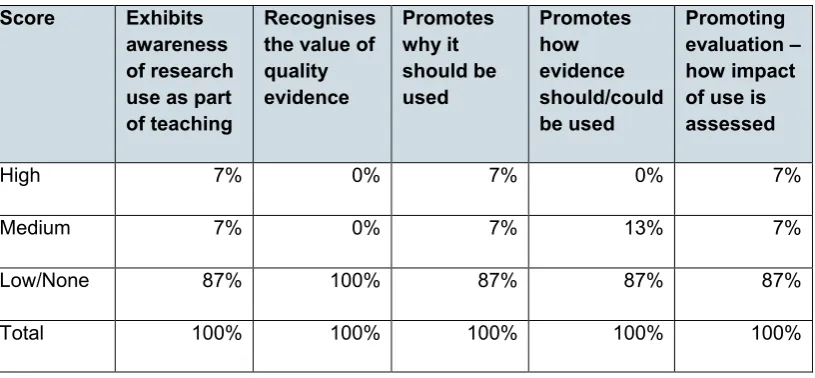
Website content and school documents that could be accessed via the selected schools’ websites were then analysed using the content analysis proforma and rated ‘high’, ‘medium’ or ‘low’ (or not at all) against a number of criteria, including:
Evidence that the school/Teaching School Alliance (TSA) is trying to promote the use of research or evidence by teachers.
Evidence that the school/Teaching School Alliance recognises the value of quality evidence or indicates it is engaged with quality evidence.
Evidence that the school/Teaching School Alliance promotes why research should be used – for example its benefits or applications.
Whether the school/Teaching school alliance promotes how evidence should/could be used – examples of activity.
Evidence that the school/Teaching School Alliance promotes evaluation – how impact of use is assessed.
2.2.3 Social media analysis
The third strand of the content analysis – undertaken in the first year of the project only - attempted an innovative approach to analysing the extent to which EIT was promoted or undertaken via social media. This considered both Twitter and the wider spectrum of social media outlets including blogs. Analysis of social media is an emerging field of research and there are difficulties in categorising some content, but it was considered valuable to undertake an analysis of EIT featuring in social media since it is clear that many teachers and school leaders are using social media to support their professional learning and to access research-related content.
Beginning with Twitter, this typically operates with individuals (employing a username beginning with ‘@’) and marking messages with a subject (denominated by a ‘#’). We therefore began our analysis by seeking out potential @s and #s that might represent UK-based Twitter users in this area and what they might be saying (achieved by pooling personal Twitter follow lists and canvassing colleagues within UCL IOE and SHU). These were analysed usingTwitonomy (twitonomy.com) to examine the tweets tweeted by these prominent individuals' @s over a six-week period (24 March 2015 to 8 May 2015).
16
Finally, we used Social Mention (socialmention.com) to look beyond Twitter, in particular to include blogs. Social Mention ‘aggregates user generated content […] into a single stream of information’ and categorises this content using pre-determined headings to provide an overall picture.
2.3 Qualitative strand
The qualitative strand comprised three elements:
15 longitudinal school case studies with the first round of data collection between March and June 2015 and the second round between April and July 2016. Data collection was undertaken through telephone interviews.
Telephone interviews with senior leaders and teachers in five schools identified as highly engaged in evidence-informed teaching, conducted between May and July 2016.
Telephone interviews with senior leaders in three counter-factual schools that had previously been highly engaged in evidence-informed practice but had not made clear progress in terms of student and/or Ofsted outcomes. These interviews were conducted in June and July 2016.
17
Table 2-1: Qualitative interviews - achieved sample
Year Source No. of schools No. of
head teachers/ senior leaders No. of teachers No. of middle leaders
No. of EIP or CPD leads
2015 case studies
15 15 15 15 N- 2016 case
studies
14 12 14 - 116
2016 highly engaged
5 5 5 - -1 2016 counter-
factual
3 4 - - -
TOTAL 23 total [15 in Y1, 22 in Y2] 36 34 15 12
2.3.1 Case studies
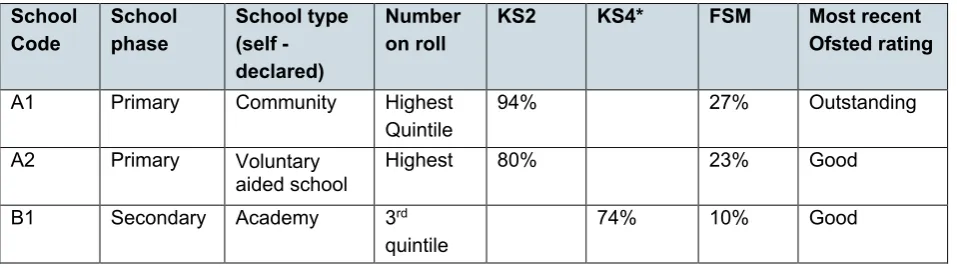
The case study sample was designed to provide variation in engagement with, and use of, evidence. Furthermore, it sought to provide variation in school phase, type, location and engagement and non-engagement in formal networks such as Teaching School Alliances and Multi-Academy Trusts. The achieved sample of schools included one infant, one junior, six primary, one all through, one special, four secondary schools and one sixth form college. A breakdown of key characteristics for each participating school is included below in Table 2-2. Generally speaking, the schools coded with letters closer to the start of the alphabet were categorised as having greater levels of engagement with research evidence.
Table 2-2: Characteristics of the 15 case study schools
School Code School phase School type (self -declared) Number on roll
KS2 KS4* FSM Most recent
Ofsted rating
A1 Primary Community Highest Quintile
94% 27% Outstanding A2 Primary Voluntary
aided school
Highest 80% 23% Good B1 Secondary Academy 3rd
quintile
74% 10% Good
6 Please note that the head teacher was also sometimes the EIP therefore the overall number of
[image:18.595.57.536.528.662.2]18 School Code School phase School type (self -declared) Number on roll
KS2 KS4* FSM Most recent
Ofsted rating
B2 Special Community Lowest No school data
65% Good B3 Secondary/
Sixth form
Community Highest 72% 42% Good C1 Infant Foundation 4th
quintile
No data 7% Outstanding C2 Primary Community Highest 100% 76% Good D1 Primary Community Lowest 79% 13% Good E1 Junior Community 2nd
quintile
85% 159% Good E2 Secondary Academy 3rd
quintile
71% 17% Good E3 All through Voluntary
aided school
Highest 85% 24% Good F1 Secondary Community Highest 67% 32% Outstanding F2 Primary Voluntary
aided school 3rd
quintile
100% 10% Good G1 Secondary Academy 4th
quintile
99% 3% Outstanding G2 Primary Community 4th
quintile
97% 5% Good
The data presented is sourced from the https://www.compare-school-performance.service.gov.uk/ website and is based on the 2014 to 2015 academic year.The Number on roll data is sourced from the Ofsted school data dashboard
(based on 2013/14 data in order to protect school anonymity and to give an indication of relative size in relation to phase).
Data were collected from a range of interviewees as indicated in Table 2-1 above. All interviews were transcribed. Following a preliminary round of coding of 12 interviews, the consistency of coding within the team was reviewed and the analytical framework revised to take account of themes emerging from the data. All interviews were then coded using the revised framework and analysis undertaken by case and by role.
2.3.2 Highly research-engaged schools
19
A request to project team members and their colleagues at UCL, IOE and SHU to complete a proforma, to identify schools that were highly-engaged.
This request led to 17 schools being put forward for suggestion.
From this list, the agreement of five schools was secured to be included in the sample, ensuring that a spread of geography and phase was represented.
As an additional quality check, every head teacher who was approached checked through the proforma to ensure the assumptions about high engagement were correct.
As indicated in Table 2-1, semi-structured telephone interviews were conducted with five head teachers, five teachers and one R&D lead.
2.3.3 Counter-factual schools
In the second year of the evaluation it was decided to interview leaders from three schools that appeared to be highly EIT-engaged but that had not made clear progress in terms of student and/or Ofsted outcomes. The aim in undertaking these additional
interviews was to act as a 'counter-factual' to help understand the circumstances under which schools that were engaged with research evidence did not see positive outcomes, by exploring the leaders’ perceptions of EIT and the ways in which it had contributed to the school’s improvement journey.
The sample of counter-factual schools was identified in a similar manner to the highly-engaged schools described above:
Team members and colleagues at UCL IOE and SHU completed a proforma, using criteria to identify schools that were highly engaged with research but where student and/or Ofsted outcomes had remained static or dropped in recent years.
From this list, three schools (two secondary and one primary) were selected to reflect a spread of geography and phase.
Semi-structured telephone interviews were undertaken with current and/or former members of staff from each school:
o CF1 – Former Deputy Head and current Head of School.
o CF2 – former Deputy Head.
o CF3 – Headteacher and Head of Teaching School.
20
3. Findings
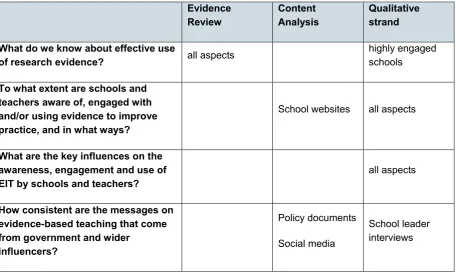
[image:21.595.64.521.158.432.2]In the rest of the report, findings are organised by the key research questions, drawing on methods as indicated in Table 3-1. Each subsection begins with a summary of findings and then presents analysis from different data strands.
Table 3-1: Mapping research questions to methods used
Evidence Review
Content Analysis
Qualitative strand
What do we know about effective use
of research evidence? all aspects
highly engaged schools
To what extent are schools and teachers aware of, engaged with and/or using evidence to improve practice, and in what ways?
School websites all aspects
What are the key influences on the awareness, engagement and use of EIT by schools and teachers?
all aspects
How consistent are the messages on evidence-based teaching that come from government and wider
influencers?
Policy documents Social media
School leader interviews
3.1 What do we know about effective use of research
evidence?
Summary
Evidence is a contested term and the relationship between research and practice is complex.
Evidence can be used in many different ways, from direct implementation to less directed 'research-inspired' behaviours.
The research-practice relationship is not one-way, highlighting the importance of developing relationships between knowledge producers and users (via
organisations and individuals bridging these links, such as universities and some system and school leaders) and the merging of boundaries between these two.
21
In this study, evidence is defined as quantitative and qualitative research findings generated by external researchers; evidence reviews - such as those produced by the Sutton Trust, EEF and John Hattie; external evaluations; and/or research produced by teachers/schools that is underpinned by rigorous and systematic enquiry.
In more highly-engaged schools:
o Evidence use was an integral part of school improvement and not an 'add-on'. External research evidence was highly valued and synthesised with other evidence, such as data and/or professional experience, to inform school and teacher practice as part of an ethos of continual improvement and reflection.
o Senior leaders were largely responsible for building awareness of research evidence, filtering and presenting evidence often via CPD. They performed this function partly because they sometimes felt teachers lacked the skills to judge the robustness of evidence.
o Engaging with research evidence was a collaborative process, integrated into CPD activity and planning meetings over a sustained period of time, involving senior leaders and research leaders using external critical friends to provide challenge.
o While external research evidence often challenged teachers' beliefs, it only led to sustained change where there was time for informed debate and teachers could see the impact in practice.
o Research evidence was used to underpin school leaders' decision-making, for example their approach to CPD, as well as pedagogical decision-making at a classroom level. Use of research evidence to support teaching and learning occurred at the whole-school level, within teams and at an individual level.
o Using research evidence was an ongoing iterative process of implementing new, or changing existing, practices and assessing impact. The importance of discussing impact findings with others was highlighted across most of the schools.
o The alignment of CPD, performance management and evidence-informed teaching was seen to be crucial; embedding research evidence took time and required consistent, strategic direction from school leaders.
3.1.1 Evidence review
The initial scoping review of the evidence review strand provided a starting point for the study. Headline findings are summarised here by way of introduction to the wider project findings, and the full review is included at Appendix 1.
22
involved. This relates in particular to the nature of the evidence and the kinds of research which support evidence use by teachers.
Evidence can be used in very different ways. This ranges from:
Seeking to replicate faithfully the behaviours or practices which were shown to be causally linked with improved outcomes, through
More interpretive re-application of research-based principles and practices seeking to achieve the intended outcomes from previous research, to
Broader, more creative research-inspired approaches.
The research-practice divide has traditionally been seen as a unidirectional model, with evidence flowing from research to practice. More recent work has identified the
importance of seeing this as a reciprocal relationship with research questions arising from practice and research knowledge being developed in professional contexts, as well as research being able to inform practice-driven concerns. Research brokerage
therefore remains an important challenge, as identifying specific and robust research which might address the needs of a particular school, teacher or pupil is challenging, even for experts in the research community. This highlights the importance of
research with a practice and professional focus, which includes an organisational dimension.
The available research about the impact of evidence-based teaching is still limited and relies mainly on descriptive accounts and opinions, often about evidence use in optimal circumstances. Caution is therefore needed in interpreting this information in terms of wider uptake. There are only a few studies which have sought to link evidence use with changes in teachers’ practice and fewer still which robustly establish a link between evidence use and improved outcomes for learners in an organisational setting. We therefore still know relatively little about the effects of evidence-based approaches on schools, teachers and pupils, and how to increase the likelihood of better outcomes for learners in particular. This indicates the potential importance of the current study, and others like it, in helping build understanding of evidence-informed practice within school contexts.
However, the knowledge base about teachers’ awareness, engagement and use of research is developing rapidly, in a similar way to other professional fields. This knowledge base also draws on research about evidence-informed decision-making in other fields, particularly medicine and health-related professions, but also increasingly in education. Wider social science knowledge about organisational and individual
behavioural change could usefully inform approaches in education in so far as educational practice aims to change behaviour, and takes place in organisational settings. This highlights the importance of relationships and processes.
23
which inevitably simplifies the complexity of interpreting and applying evidence from one educational context to another, and research which aims to find general approaches for improvement. In practice, research is rarely ‘applied’ in a linear way by teachers or schools: research implications are unlikely to be clear-cut and must be contextualised and combined with practice-based knowledge as part of a wider professional learning process. There is no consistent logic model or theory of the way or ways in which evidence-based practice might lead to more effective teaching and learning. Some assumptions about the likelihood of benefit may limit the applicability of findings from current studies. For example, benefits may be seen for some very specific groups of learners such as very young children or those struggling in a particular subject. Also, there will be differential benefits from using evidence-informed practices for different teachers and schools: the more effective a teacher or school, the less likely that ‘average’ gains will help to bring about improvement. This limits how effective evidence use is likely to be and argues for an expertise model of evidence use to improve informed decision-making by practitioners. This highlights the importance of a research focus in developing evidence-based teaching.
Strategies and structures to support the development of evidence-informed teaching need to be multi-dimensional and are likely to include features related to:
1. The nature of the research and evidence itself (its quality and wider applicability); 2. Effective communication processes (such as mediation by organisations like EEF, or
translation by senior leaders) whilst taking into account variation in teachers’ needs, experience and skills (relating to integrating research into practice); as well as 3. The characteristics of the school contexts in which they work (with some schools
more supportive of use of research evidence) so as to increase the probability of benefit from evidence for improved outcomes for learners. This highlights the
importance of understanding the wider context, which is often implicit or even hidden in the existing reviews, which seek to identify common features and patterns across contexts.
This review highlights that the messages, actions/requirements and evidence provided by government, other agencies and researchers themselves will all influence thinking and practice among schools and practitioners. Similarly, the cultures, norms and capacity of schools and the professional experience and skills of individual teachers will also be important factors.
3.1.2 Highly research evidence-engaged schools
24
as well as the organisational cultures, structures and processes that enabled and support EIT.
Orientation towards EIT
Across all the interviews of head teachers in the highly research-engaged schools there was a shared view that EIT comprises three interwoven elements underpinned
throughout by a reflective approach:
Looking outwards to external research.
Using in-school data in various forms (for example, observations of teaching and learning as well as progress/attainment data) and professional experience to identify the 'problem', consider the relevance of research evidence in relation to context and adapt research evidence to context.
Evaluation or research into the impact of practice changes made in response to research evidence on outcomes for pupils.
As one head teacher explained:
Definition of evidence-informed teaching
'evidence-informed teachingis about looking and surveying good, robust external evidence, comparing, judging, applying that with your past
experience, with your present experience and trying to marry the two with some good judgment. ….[it] is about being supported, challenged by external evidence, testing it, being a better evaluator of your own practice and being more reflective' (Head teacher)
As the quote above illustrates, and was evident across all the head teacher interviews, the role of external research was to inform, not determine, decisions about practice. This aligns with recent research into the research-practice relationship summarised in 3.1.1 above. Two of the head teachers felt particularly strongly that 'evidence-based practice' was not an appropriate term and represented a less mature position than evidence- or research-informed teaching.
Using research to inform practice
25
Broadly, the teachers in the highly-engaged schools held similar views to their head teachers on the nature of EIT and the role of research evidence. All the teachers agreed with their head teachers about the crucial importance of using research evidence to inform teaching, although both teachers and head teachers moderated this with the proviso that this was subject to critical engagement with the evidence and reflection on relevance to the school context.
The ways in which these orientations to EIT are manifested in the highly research-engaged schools are set out below.
Awareness of evidence
Awareness, in our research, was defined as:
Understanding what research evidence is.
Knowing how to access research evidence.
Being able to judge how robust research evidence is.
Knowing that research evidence can help improve practice and how it does that.
Knowing how to go about being ‘evidence-informed’.
In highly research-engaged schools, knowledge, skills and capacity in relation to awareness of research evidence were primarily vested in the senior leadership team and in those charged with leading research use in the school at senior or middle leader level where they had been appointed. Across the schools, these staff drew particularly on meta-analyses - with John Hattie's Visible Learning texts (Hattie, 2009, 2011)7 and the EEF Teaching and Learning Toolkit (undated)8 referred to by nearly all
interviewees, as well as other reviews and Sutton Trust publications9. All schools referred
to the work of academics, such as Dylan Wiliam, Carole Dweck, Rob Coe and Robin Alexander. In one school, extensive use was made of the Cambridge Primary Review evidence (Alexander and Armstrong, 2010). A wider range of sources were accessed depending on the specific area of research use, for example mathematics teaching. These included individual and cross-school case studies in the area of interest, books and journal articles.
A notable feature of all the highly research-engaged schools was the direct connections between the head teachers and leading academics, which included Dylan Wiliam, Robin Alexander and Rob Coe. All the schools also had direct research links with their local universities, for example, one school worked with a coach from their local HEI who
7 see the Visible Learning website
26
sourced research evidence to support teachers' engagement in lesson study. Senior leaders also found out about research through attending conferences where academics presented their work, as well as through a strong network of professional contacts,
including other school leaders - 'it’s about being outward facing and going out and looking for it and knowing who to ask' (Headteacher). The highly research-engaged school
leaders and research leaders also drew on social media, radio and television for links to evidence sources and some used social media as a means of sharing evidence.
In most instances, evidence searching and collation was focused on a small number of key whole-school and/or departmental priorities. In addition, in one school, the research director collated evidence across a wide range of pedagogical topics that were likely to be of use to teachers.
Senior leaders and research leaders filtered research evidence - presenting it to teachers in summaries, digests or research briefs (four schools) and via CPD sessions (all schools). In two schools, evidence was also disseminated through voluntary journal clubs or enquiry groups. In most instances, summarised information provided links to the evidence source so that teachers had the option to access the information, and either staff room libraries or the personal libraries of senior leaders were made available to teachers. Two head teachers drew attention to the need to keep repeating evidence messages.
School leaders filtering research evidence
'There are publications and websites and sometimes hard copies of things that are flagged up in staff meetings and people are obviously at liberty to pursue those when they can. But I think it would be fair to say that the leadership team generally would be doing a lot of that filtering. They would say ‘these are things that we consider to be important’. But it doesn’t always happen that way. Various people bring to the table research or evidence that they’ve come across and that helps inform things.’ (Head teacher)
27
teacher). Teachers often perceived their senior leaders and, where they were in place, research leads, as the 'go to person' to access evidence.
Senior leaders in some of the schools felt that teachers lacked the skills to judge the robustness of evidence, a view also held by some of the teachers. Judging quantitative studies was perceived to be particularly problematic. The deputy head in one school planned to work with their local HEI to develop capacity, while the head teacher in another relied on the research lead to filter evidence for robustness before it reached teachers.
Engagement with evidence
We define engagement with research as thinking that it is important to draw on research evidence to inform and improve practice, and having conversations about the evidence.
Engaging with research evidence in the highly research-engaged schools was a collaborative process, integrated into CPD activity and planning meetings over a sustained period of time. In addition, action research and lesson study were cited as important mechanisms to support engagement in some of the highly research-engaged schools, and some of the teacher interviewees described the ways in which discussion about evidence permeated more informal conversations about practice.
28
Teachers' focus on implementing rather than interrogating research evidence
'I think we have taken it as read that getting children to think about their
learning is valuable because we’re told the evidence says that and most of our talk is focused on how we do it, the actual practicalities of getting children to talk about how they learn and what their next steps are and how they feel about what they’re learning and to begin to develop curriculums that
encourage thinking …. So I think we’re more engaged with 'how do we do it', taking on face value that it’s worthwhile doing because we’re told that that’s what the EEF have found. And we, instinctively teaching it, think that it’s valuable. ' (Teacher)
Senior leaders deployed a range of approaches to engage teachers with evidence, spanning formal activity, such as leading CPD and performance management, informal one to one conversations about classroom 'problems' and practices, and 'sowing little seeds of thought about research'.
The use of CPD to stimulate teacher engagement was a key mechanism deployed in all the highly research-engaged schools. The use of Dylan Wiliam's model of teacher learning communities10 by senior leaders in one school to mediate between evidence
sources and implementing practice change is summarised below.
Use of Wiliam's model of teacher learning communities to embed research evidence into practice
'There is a very strong research base on which formative assessment is based… so the school leadership team have very clearly shared those research findings and outcomes with us. There are all sorts of papers and booklets… which we are very much encouraged to take a look at and be aware of. Also, within the structure of the teacher learning community meetings, every technique that we look at has some form of evidence-based research there to back it up and that might be cited within the
materials that we’re given or it’s discussed within the meeting. So there is a clear communication that the things that we are putting into practice have an evidence base beneath them. That’s an important part of the
communication between us and the leadership team.' (Teacher)
Reflective cultures, whole-school commitment to improvement and a premise that changes should be evidence-informed underpinned teacher engagement in the highly
29
research-engaged schools. However, as the research director in one of the schools pointed out, external research evidence often challenges teachers' beliefs and while there may be temporary change, research evidence only leads to sustained change if there is time for informed debate and teachers can see the impact in practice. Literature on research use often refers to the 'translation' of research evidence for use in practice, however within the highly research-engaged schools the process of engaging with evidence appeared to go beyond 'translation' of the evidence itself, encompassing a more complex process whereby teachers and others are engaged in challenging the evidence and its relevance to their context as well as challenging their own practices and beliefs. This process is illustrated in the description of an enquiry group meeting that was responding to a pastoral leader’s analysis of school data that had highlighted the under-attainment of boys on entry and as they progressed through the school. Prior to the meeting, the research director and school research lead had sourced and collated relevant research evidence:
Teachers' engagement with research evidence
'We had three papers and then a side of A4 that distilled the majority of the research… most people hadn’t read the papers but they had read the side of A4... in the group we just discussed was this chiming with our
experiences, with our beliefs, where actually was there a bit of us
perpetuating some gender stereotypes. We tried to get into the meat of the research… and was our school matching the bigger social picture, and if it was, was there anything we could do about… We talked about what we’d done previously as a school, what had happened in other schools. And we’ve got a follow up meeting where we’re going to talk about next steps.' (Research Director)
Engaging with evidence in all the highly research-engaged schools involved senior leaders and research leaders using external critical friends to provide challenge. Most frequently this involved their network of leading academics or their local university, supplemented by leaders in other schools who had a strong commitment to evidence-informed practice.
Use of evidence
We define use as any activity where research evidence is actively used to investigate and change practice. Awareness, engagement and use of evidence are highly
30
In the highly research-engaged schools, teachers' engagement in CPD, meetings and more informal conversation was part of an ongoing cycle of engagement and use. The ideas and principles from research discussed in CPD sessions were integrated into teachers' everyday practices. Teachers then formally or informally evaluated the impact on pupils and reflected on this with other teachers in later CPD sessions. It is important to note that interviewees generally did not refer to evidence use as a discrete process of implementing a named evidence-based programme, the exception being the use of Dylan Wiliam's CPD model in one school. Instead, even in the instances where schools were drawing on the principles of an evidence-based programme, their concern was about integrating evidence use into their leadership and teaching practices, adapting to context rather than focusing on fidelity of implementation.
Notably, all the highly research-engaged schools usedresearch evidence to
underpin school leadership decision-making and the design of school activity - for example, their approach to CPD, as well as pedagogical decision-making at a classroom level. The Research Director in one school noted that using evidence to inform school policy development also supports individual teachers to use evidence.
Use of research evidence to inform school policy
'as a senior leadership, we’re now more in a practice where if we’re looking at our homework policy that we survey the best evidence for that, we create a paper with questions and with prompts and we look at the research and then we start to determine our next steps with our new homework policy. So I think it’s CPD but it’s also decision-making through senior leadership
(Research Director)
Use of research evidence to support teaching and learning occurred at the whole-school level, within teams and at an individual level. At the whole-school level the focus was usually on implementing pedagogical strategies that were underpinned by a strong evidence base which could be applied across subjects, for example, strategies related to formative assessment and feedback, meta-cognition, peer coaching and collaborative learning and dialogic talk. Embedding evidence-informed practices in these areas was seen as a long-term process by the senior leaders, which at the time of the interviews had already spanned several years. Teams and individuals tended to use research evidence that was more directly related to curriculum planning or specific teaching and learning issues that they faced, for example, teaching fractions in one school or developing creativity in another.
The highly research-engaged schools made discerning use of evidence: they did not simply try to implement something because it had an evidence base. Leaders and teachers determined practice changes appropriate to their context through
31
Using research evidence was an ongoing iterative process of implementing new, or changing existing, practices and assessing impact. Approaches to assessing impact on pupils varied across the highly research-engaged schools, and the difficulties in doing this meaningfully were mentioned by all the teachers interviewed. Approaches to measuring impact ranged from 'noticing' changes through to systematically capturing baseline and end-point data, and in one school, using comparison to a control group. The importance of discussing impact findings with others was highlighted across most of the schools. This took place in a variety of ways, for example, reflection with colleagues in teacher learning groups, discussion with the head teacher as part of the performance management process or with colleagues on a Masters course.
In some of the highly research-engaged schools, teachers were supported to generate evidence to share within their school and beyond through undertaking action research, other forms of research or lesson study. While the head teacher in one school believed that teachers were neither positioned nor had the skills to undertake rigorous research, teachers in this school did engage in disciplined enquiry and were expected to
systematically measure impact.
Most of the highly research-engaged schools were leading, or involved in, cross-school evidence-based projects. In addition, some were engaged as participant schools in external research projects led by HEIs and two were leading EEF trials. The benefits of working with other schools in this way were summed up by the head teacher in one of these schools, who explained that it had deepened 'our understanding and our knowledge as a school' and helped the recruitment and retention of teachers as they 'feel valued and active participants in the process' and become 'ambassadors for research and evidence'.
Embedding effective EIT
In all the highly research-engaged schools evidence use was an integral part of school improvement and not an 'add-on'. The vignette below provides an example of the ways in which leadership teams orchestrated and integrated the development of evidence-informed teaching.
Vignette 1: Orchestrating evidence-informed teaching
'The leadership team [carried out] an extensive range of observations to observe lower attaining writers and interviewed the child about their
32
or whatever it is and then we also just look very deeply at our data – is it particular parts of the school? - is it certain types of child?
We present that all to the school and they’re given time via INSET days and things like this to look at all those findings and begin to discuss within their year group what that says about what’s happening in their year group [Then they] come up with priorities for themselves within their year group. So they’ll say ‘for us, what really resonates is this lack of resilience, they’re not sticking with their writing and they’ll give up very easily and maybe there’s difficulties around handwriting’. So that will be their focus.
They’ll come up with a question and they’ll try and come up with some possible solutions, what could overcome these barriers and then they’ll plan their research. That will involve them writing out quite a detailed plan which involves establishing what their base line evidence is, where the children are at the moment, and then what range of activities they’re going to carry out, how they’re going to measure the impact of those activities. They’ll spend a lot of time with the leadership team looking at the question itself, making sure that it is a good question. They’ll spend a lot of time looking at their preferred activities and evidence and making sure that it is robust.
They will then begin to carry out that research within their classrooms. It might involve them going into each other’s classrooms and doing some observations of each other, conferencing, book sampling. And then after about four or five weeks… they’ll come back together with the leadership team and we’ll do some challenging conversations around what they’ve found out so far. Then they’ll go back into the research again, maybe on a different tack perhaps depending on the findings, or they might continue to dig deeper.
Then after about eight weeks we’ll draw it all to a close. Every year group within the school is working on something to do with writing which they feel is relevant to their particular year group and then we have a large presentation where they all present their research, the evidence that they’ve come up with for it and that is critically evaluated by their colleagues as part of this
presentation. Then at the end of it we take all these findings and as the leadership team we look at what we think is strong as evidence and what is appropriate maybe for certain year groups, what is appropriate for the whole school, what’s appropriate for any particular groups of children, and that becomes part of our improvement plan for the following year.' (Head teacher)
33
Ethos of continual improvement and reflection
'For a teacher what is wonderful is the reflective stuff. Whatever they do, they do in a very reflective way, and they don't rest on their laurels they're always thinking: 'well, actually how can I make that work better?'. It creates a very restless school and it creates a very messy school sometimes, but what it does do is create a school which is constantly evolving and evolving with its own momentum, it’s not waiting for somebody to come out from outside, it’s just naturally evolving because of the way that teachers see the learning and see the teaching and see their role within that.' (Headteacher)
Leaders and teachers in the highly research-engaged schools' sample stressed the importance of using CPD and performance management to embed evidence-informed teaching. There were striking similarities in the principles and ethos that underpinned the highly research-engaged schools' approaches to CPD and performance management.
Across all the schools, CPD was research evidence-informed and provided teachers with time to discuss research evidence, analyse what was happening in their classes, develop approaches to try out and discuss what happened when those approaches were implemented.
Performance management in the highly research-engaged schools had a
developmental rather than performance focus, and engaged teachers in evidence-informed practices. Described as a 'continuous dialogue' by the head teacher in one school, performance management was usually supported through short observations focused on the practices that the teacher wanted to improve. As the head teacher in another school explained: 'I just ask a single question: how can I observe you in a way that will best help you improve your teaching?'. Risk-taking was encouraged, with targets often focusing on the process of developing practice rather than pupil attainment.
Supporting risk-taking
'So you might have a target or a discussion about raising attainment in, say, boys’ engagement in music, and then you might go and find a piece of research to support that and trial it …Even if it’s an absolute flop and it doesn’t work out at all, you’ve done the right thing by going to find out about it.' (Head teacher)
The alignment of CPD, performance management and evidence-informed teaching was seen to be crucial, as one head teacher explained:
34
'It took a bit of a long time to realise that if you want EIT to become embedded in practice, you couldn't run the two systems…, of performance management in the old judgemental way alongside the EIT. You need to move into a much more... of a dialogue, and much more of an enquiry based approach to their own development, you've got to allow people the space and the time to develop and make mistakes on occasion - you've got to make people feel OK about that and so it’s getting the culture right and when you look back and it’s so glaringly obvious… that the one thing that was holding us back was the fact that we were trying to run these two different approaches.' (Head teacher)
The quotation below from the research director in another school illustrates an approach to ensuring such coherence as well highlighting the ways in which evidence-informed school policy development supports teaching.
Embedding EIT
'What we’re always trying to do is align PM with CPD because we know that’s the only real meaningful time you have to [develop evidence-informed
teaching]... For CPD we have a whole-school target which is aligned this year for pastoral… and through that whole-school target, that’s where we try and leverage good evidence-informed practice… Then we have a departmental target, that’s been based on previous performance data of students, historical trends and also future indicators and again informed by evidence. And then the individual target… what we’re… developing CPD for next year and we’re
making that target more of an enquiry question. And we’re trying to … tie in CPD with really robust evaluation of student outcomes. So we’re trying to constantly align our PM structure with our CPD and make sure they’re all directed and evidence-informed and steered. Our policies in terms of our homework, home learning policy, our feedback policy, strategically they’re robustly evidence-informed so we know that there’ll be a kind of, a bare minimum in terms of expectation that departments implement those, so that gives another kind of structural support. (Research Director)
The approaches to CPD and PM in the highly EIT-engaged schools empowered teachers to take ownership of their teaching. Teachers referred to finding EIT 'engaging' and a support for self-directed development, while heads noted that it 'energised teachers' and 'increased intrinsic motivation'.
Embedding evidence-informed practice in the highly research-engaged schools required time and consistency:
35
'The most helpful thing in this school has been the consistency of focus that we’ve had, ‘cause these things are hard to do and you have to get better at them. So we’ve had the same focus and CPD and observations and training on the same topics for several years now and they’re all sort of inter-related. and … [we] gradually get better at it and you learn from each other.' (Teacher)
3.2 To what extent are schools and teachers aware of,
engaged with and/or using evidence to improve practice,
and in what ways?
Summary
Content analysis of school websites indicates that greater numbers of Teaching Schools were demonstrating a commitment to evidence use on their websites over time, with research evidence typically linked to school improvement and CPD and training activity.
The vast majority of randomly selected school websites displayed no engagement with research evidence. Furthermore, this picture did not change between years one and two of the study.
In relation to awareness of research evidence, analysis of the qualitative case study sample found that:
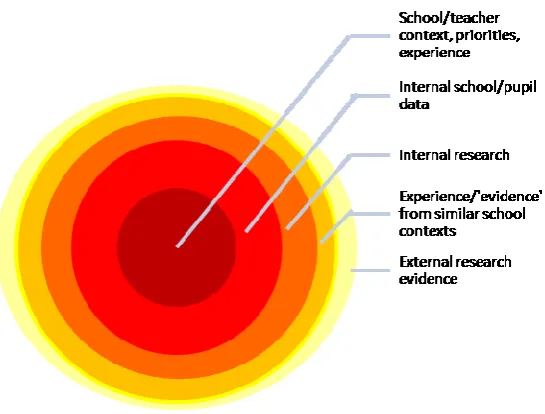
o Schools were aware of and valued different forms of 'evidence', but generally prioritised sources such as attainment/performance data and other schools' experiences above external research evidence.
o Overall, head teachers expressed a deeper understanding than other respondents, and most staff in all groups felt their understanding hadn't changed over the course of the study.
o More engaged schools in the wider sample, similarly to the most highly engaged schools, used multiple sources and sophisticated approaches to accessing research, led by the head teacher, and used multiple approaches to making research accessible for their staff.
o In both years of the study, more research-engaged schools tended to use trusted sources like EEF reports to judge robustness of research, as they felt unsure of how to judge quality.
o Learning communities and CPD helped build understanding of how evidence could improve practice in some schools.
In relation to engagement with research evidence, case study analysis found that: o Orientation towards the importance of research evidence was related
strongly to the need for such evidence to be problem- and practice-focused. o Teachers were more likely to trust research evidence when it was
36
backed up by observing impact or hearing trusted colleagues discuss how it had improved their practice and outcomes for young people.
o Where there was a formal expectation for teachers to engage with
research, this tended to relate to participation in some form of whole-school practice organised by either a senior leader or research lead.
o In some of the less research-engaged schools, being under pressure to meet expected attainment and progress targets meant that only research very clearly focused on assessed results would be considered.
o Orientations of teachers interviewed were on a continuum, from a small number of teachers against the use of research evidence; with others neutral (generally due to lack of time or not seeing the value); towards (for most teachers) being generally able to see the value but needing to be convinced by seeing its use in action; to - in a few cases - those having both access to research and seeing the value of it.
o In