Access visits using video communication
MAZUMDAR, Suvodeep <http://orcid.org/0000-0002-0748-7638>,
CIRAVEGNA, Fabio, IRESON, Neil, READ, Jennifer, SIMPSON, Emma and
CUDD, Peter
Available from Sheffield Hallam University Research Archive (SHURA) at:
http://shura.shu.ac.uk/16919/
This document is the author deposited version. You are advised to consult the
publisher's version if you wish to cite from it.
Published version
MAZUMDAR, Suvodeep, CIRAVEGNA, Fabio, IRESON, Neil, READ, Jennifer,
SIMPSON, Emma and CUDD, Peter (2017). Access visits using video
communication. In: CUDD, Peter, DE WITTE, Luc and HOOGERWERF, Evert-Jan,
(eds.) Harnessing the power of technology to improve lives. Studies in Health
Technology and Informatics, 242 (242). IOS Press, 102-110.
Copyright and re-use policy
See
http://shura.shu.ac.uk/information.html
Access Visits using Video Communication
Suvodeep MAZUMDARa,1, Fabio CIRAVEGNAa, Neil IRESONa, Jennifer READb,c, Emma SIMPSONc and Peter CUDDb
aDepartment of Computer Science, University of Sheffield, UK b
CATCH, University of Sheffield, UK
bSheffield Teaching Hospital NHS Foundation Trust, Sheffield, UK
Abstract. An online video communication system is presented that enables Occupational Therapists (OTs) assess patient homes for assistive technology needs before acute care discharge to ensure appropriate independence and recovery conditions. Explorations under multiple conditions revealed perspectives from OTs and volunteer facilitators. Preliminary key findings and insights are reported.
Keywords. Video communication, Occupational Therapy, Access Visits
1.Introduction
Occupational Therapists (OT) are trained to assess and treat patients with physical, psychological or cognitive difficulties in order to develop, recover and maintain daily living and work skills. Discharge from many acute treatment facilities requires assurance of appropriate patient safety, independence and enablement when they return home [1]. OT visits for this occurs for many patient populations and use of assistive technology in the home frequently has to be considered. The visits typically require hours of travel, as well as time in the home carefully observing and taking notes of all aspects of access such as dimensions of spaces, steps, door widths, furniture, and any requirement for assistive technology. The notes are then used to create/complete formal documentation. The visits and documentation are lengthy, disruptive and expensive processes, often requiring OTs to spend time away from patients. The study investigated how we can make the process of home visits seamless, more affordable, effective and less reliant on OTs physically travelling to patients’ homes. The exploratory study investigated how the process of home visits can be made seamless, more affordable, effective and less reliant on OTs physically travelling to patients’ homes. This paper presents the evolving online video communication system and associated service requirements that should enable practicing OTs and onsite volunteer facilitators to conduct assessments.
An application was already developed for Emergency Response [2]. Emergencies are typically highly stressful events that can potentially severely impact upon a citizen’s ability to communicate the extent of an evolving scenario on the ground. As a result, an inappropriate and inadequate response may arise due to the emergency not being communicated effectively. This application was developed to provide far greater support to Emergency Responders by enabling them to observe the surroundings of citizens via their mobile camera as a live video feed. The ability to keep expert personnel in an
1
site location to assess and survey evolving situations on the ground seemed highly appropriate to conducting ‘Access visits’. With the growing relevance of real-time video communication in daily and professional life and that there did not seem to have been an exploration of their use for access visits, it was deemed a favourable opportunity to understand how such approaches can be exploited for remote visits before conducting in service evaluations of any kind with real patients who would necessarily be at a highly sensitive time around discharge and potentially radically changed circumstances at home.
In principle, it seems obvious that a remote access visit can significantly help reduce expert time used as well as removing the travel costs. Adoption of such a system would require demonstration of real world proof of concept to attract research and development investment. This involves many questions. How open are the professionals, the patients and who ever visits the home - presumed to be a relative or friend of the patient, or, a trusted volunteer - to the principle of conducting access visits with such technology? Indeed how open are the health and care organisations to such innovations? Are their overriding ethical and data protection issues? How does the technology need to work to be useful and acceptable to the users? How do any professionals involved in its use need to change their practice? Do any/all of those involved require training and support to make it effective? The envisioned innovation required a symbiotic need to evolve the features of the technology and a protocol for operation of the associated services, underpinned by an understanding of real world users’ requirements for the technology and the associated services. Not having the answers to these questions also meant having a convincing ‘solution’. The chosen approach reflected the symbiotic need to evolve the features of the prototype technology and a protocol for operation of the associated services, underpinned by an understanding of real world users’ requirements for them. But, all as a precursor to exposing patients to a service where there would be some OT confidence of its suitability and usefulness, and indeed where evaluative criteria of performance would be studied. A collaboration of staff from the University (e.g. researchers), the Hospital (e.g. practitioners), a voluntary organisation (e.g. people used to helping to support vulnerable people in the community) and other volunteers (e.g. interested parties) was formed to conduct research preparation, service innovation and business planning associated activities. As a result, over a period of a year, several pre-clinical research explorations were conducted with the involvement of OTs, members of voluntary organisations and other volunteers using simulated proxies for the real world setting. The real world the explorations were conducted within contexts aiming to start to understand how participants interacted with the technology as well as their experiences using it. The next section presents the Home Visit technology that was developed and further extended for the OT domain. The following section presents further details about the explorations and finally we discuss key points relevant to OT use.
2.Home Visit Technology
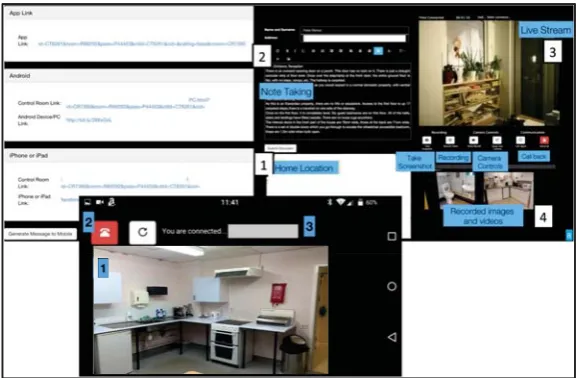
time, the web interface for the OTs is initiated by the OT logging into their accounts. This automatically creates a series of links and text based on predefined templates (Figure 1, top - left panel shows the different links being generated). The text along with the links will be delivered to a smartphone of the volunteer either via text or email.
Figure 1. (top) OT facing interface containing different sections - a live stream section that provides a live video stream as shown by the volunteer at the patient home, a note taking section for recording notes, a recorded images and videos section, location of the patient home presented on a map, and a set of controls for
the communication; (bottom) Volunteer or friends/family facing mobile interface - a communication section with disconnect and reconnect controls, a view of the mobile camera and a text message section.
Upon receiving the text from the OT, the volunteer clicks on the link which loads the smartphone’s web browser displaying the mobile interface (Figure 1, bottom). This initiates the video communication and the mobile starts transmitting a live video stream from the camera. Instructions are relayed to the volunteer via audio conversation and the volunteer performs tasks as instructed. Depending on the requirements of the access visit, the process involves the volunteer conducting simple tasks such as verification of need for AT, measuring access spaces, furniture dimensions or conducting a 360 degree sweep from the centre of the room. The process requires the volunteer to walk through different rooms in the patient’s home while the OT assesses different aspects of the living conditions, such as safety, hazards or access restrictions and the need for modifications or adaptation of the home environment such as the installation of guide rails, ramps and so on.
When finished, the OT disconnects the communication and proceeds to complete the documentation process. In this respect, the text box already contains essential information deemed necessary to record during the live communication. This process will eventually be form based, thereby prompting the OT with the necessary pre-built templates for recording observations and furniture and room dimensions.
3.The Explorations
A preliminary consultation with OTs at Sheffield Northern General Hospital served as a practitioner (real world) validation, which provided technical feedback on how the design and tool should be modified. This was based on OTs and researchers observing a live demonstration that in itself involved collaborators in operationalising the visit process. A pre-set typical task-based approach was chosen to conduct the access visit. One OT was actively involved in the communication at the Control Room, while two volunteer facilitators visited a simulated home in a remote section of the Hospital. A further OT observed the volunteer facilitators. Ten OTs observed what happened in the Control Room, interjecting advice or requests for tasks to be carried out. During this process all participants used subjective criteria to judge whether they understood what they needed to do, if they could achieve the necessary goals and anything that was a barrier or facilitator of achieving or improving the possible service.
After the visit all of the above people (i.e. members of the collaboration) came together. To provide structure to the ensuing discussions a SWOT analysis was conducted to identify potential strengths, weaknesses, opportunities and threats. While the benefits and potential of the technology in saving time and effort for OTs were clear, several issues were identified. These are grouped in two main aspects: technical and process-oriented. Technical issues mostly arose due to unstable network connection (owing to network ‘dark spots’) and hence, several reconnection attempts were necessary during the exploration. This highlighted the need for a more robust and stable system to deal with intermittent connectivity issues. Several process-oriented issues were also identified and OTs raised further concerns on privacy, confidentiality and trust of the system. While this, in a modern web application is a fairly standard process, there is a need to highlight the potential privacy risks to participants. Furthermore, IT policies and communication protocols may vary among organisations, and it is important to ensure such protocols are respected. Most importantly, the discussion helped identify differences in vocabulary between volunteers and OTs - for e.g. “ measure the door width” was interpreted literally as the width of the door itself, while it refers to measuring the access space between the door-frame (doorway width). The OTs raised a further point where the physical and cognitive needs of the volunteer to complete the tasks must be taken into consideration.
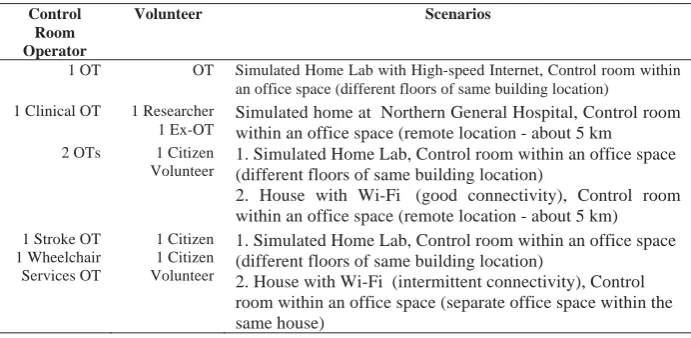
the Sheffield Northern General Hospital as used before, and two remote houses with WiFi (no more than 10 km distant). Table 1 illustrates how the various explorations were conducted.
Table 1. Escalating user exposure and proximity to real world scenarios
Control Room Operator
Volunteer Scenarios
1 OT OT Simulated Home Lab with High-speed Internet, Control room within an office space (different floors of same building location)
1 Clinical OT 1 Researcher 1 Ex-OT
Simulated home at Northern General Hospital, Control room within an office space (remote location - about 5 km
2 OTs 1 Citizen Volunteer
1. Simulated Home Lab, Control room within an office space (different floors of same building location)
2. House with Wi-Fi (good connectivity), Control room within an office space (remote location - about 5 km)
1 Stroke OT 1 Wheelchair Services OT
1 Citizen 1 Citizen Volunteer
1. Simulated Home Lab, Control room within an office space (different floors of same building location)
2. House with Wi-Fi (intermittent connectivity), Control room within an office space (separate office space within the same house)
The observed visits lasted for around two hours, with the first 15 minutes used to explain the process and the system. The access visit is then conducted, the OT professional directing from the control room and volunteer facilitator in the ‘home’. Volunteers obviously have to travel to the respective locations. Upon completion of a home visit of around 45 minutes, the researchers, the OTs and volunteers shared their subjective judgements – observations, issues and experiences. These unstructured discussions were shaped by follow-up questions and minuting what people had said and agreed, a more structured addition employed an extended SUS questionnaire [3] to address opinions on the system.
Overall, the system was highly appreciated by users and most users agreed they would like to use the system more frequently. Users also found the system easy to use and learn. Most users also felt confident using the system. However, users also noted that presence of support from a technical person would be helpful, specifically when network issues result in connection drops. Call drops also impacted on how the users felt regarding the process of making calls - they felt that there was a need to improve the process of how connections are handled during network issues. The ability to record snapshots and videos of the communication was also liked. This can speed up the process of the access visit and also provide them with the ability to revisit the stored information whenever desired. The OTs also noted that such tools can help save clinical time and speed patient discharges and hence serve as an extremely cost/time effective way of conducting access visits. It was confirmed that different OT specialists and their associated services had some differences in what they would want the facilitator to do. Presentation to wider OT audiences has shown little criticism and greater enthusiasm for the potential of the technology and associated services.
as well as facilitators would experience some stress/anxiety. This was also confirmed during the follow-up discussions and while users agreed that stable high speed network connectivity cannot be guaranteed for access visits, there is an aspect of training that is required for the OT to deal with such issues and take corrective actions such as make a phone call to reassure the volunteer about the technical difficulties. This is more relevant if volunteers are not technically proficient.
4.The Explorations
Video conferencing is a highly evolving field and its adoption in regular professional as well as personal activities has seen a rising uptake in the shape of online meetings, teleconferences and telepresence. With the increasing availability and affordability of virtual reality, video communication has taken a predominant role in connecting citizens and communities. In the field of Assistive Technology, video communication has been mostly applied to directly patient-practitioner or patient-carer setting where patients or family members interact with care providers [4] for various tasks such as face-to-face live remote consultations [5]. Video communication has also been applied in a variety of case studies such as rehabilitation [6], speech and hearing [7], dementia care [8] and music therapy [9]. In the field of OT, tele care and tele nursing [10] has also adopted video communication in rehabilitation, therapy and care [11] and teaching [12]. To our knowledge, such an approach has not been taken to conduct access visits. Preliminary findings from the user involvement explorations are highly encouraging. While conducting access visits via mobile video conferencing is an encouraging prospect, it is important to understand the restrictions, concerns and needs of the specific domains, i.e. Assistive Technology and Occupational Therapy. The use of applications such as Skype and Hangout, while being trialed in several other application areas, has several drawbacks, the primary being lack of control and access to data. Using video conferencing for surveillance and assessment in the health arena is not new [12-14], the authors’ novelty comes from application to access visits and affordability by using existing infrastructure and equipment. The simultaneous exploration of users’ requirements for both the technology and the associated services at such an early stage of innovation has some novelty. In fact, as we observed, many of the complications arise due to the involvement of human participants. The following paragraphs highlight the implications of the user explorations from a variety of perspectives.
Addressing user centered design, it can be reasonably expected that all users of the technology will not be technically proficient and hence, will need to be able to intuitively navigate various components of the system. Seamless navigation and interaction is highly essential to provide a highly engaging user experience [15,16]. As a part of the domain and the approach, this requires careful study of two types of users - OTs and volunteers. Both user communities have different technological needs and requirements. At the same time, volunteers may have different levels of technical proficiency - hence, making the task more challenging. However, this is a generic process that is essential for the development of technology and an iterative process of user centered development ensures that all requirements of user communities are taken into consideration while developing a solution.
how best to approach the (often, expected) scenarios when network issues result in call drops and disconnections. Typical ways of dealing with such scenarios is to automatically attempt to restore connection or alert the users that the connection has been dropped. This action may introduce some stress and anxiety in the users and it is important to define mechanisms within practice protocols that should be adopted to ensure a smooth handling of disconnection events. These can be a pre-user trial where users will be trained on what to expect when calls disconnect and how to manually re-attempt communication.
All participants mentioned a significant concern is the cost implication for volunteers. While in principle, mobile data allocations are gradually being made more affordable, the burden of the cost is still on the volunteers if they use their own devices. This could potentially deter users from using the technology and there is a need to investigate how to remove this barrier (either via provision of a SIMM or mobile, or just through vouchers or refunds). It is also possible a quicker remote service in exchange for bearing the data cost might be acceptable to family/friend volunteers and/or patients (as opposed to waiting for personnel to be available to physically conduct a home visit).
An important point raised by the participants was that the tasks need to be designed keeping volunteers into consideration. Several volunteers and members of the public would find some tasks extremely difficult to perform. For example, taking measurements for a visually impaired user, bending to see the nearest available set of plug points, or accessing corners and measuring out furniture. These tasks can be potentially risky for certain volunteers and is best avoided in the access visit. It is also important that the OT assesses the conditions of the surroundings of the volunteer keenly to avoid putting them at risk of injury.
The need to protect and preserve the privacy of patients is essential. Although such technology provides means for OTs to view inside the private homes of patients, it is important to ensure that the communication and stored data is maintained under strict and the latest high security protocols. This needs to be explored with patient groups and potential volunteers. Obviously as part of any practice protocol participants need to be informed of these issues and given a choice prior to the visit. However, a survey of a large population of patients and likely volunteers is warranted to estimate if taking the best precautions and explanation to those involved is sufficient, or, what further options and choices really need to be offered. For instance this may reveal the need to allow for ‘no-go’ rooms and/or that no video recording should be done.
5.Conclusions
The potential of remote access visits is significant, and all participants in our explorations sustained a desire for such technological services to be introduced, also judging that this could be an effective and economic alternative to standard access visits. At the same time they also highlighted several concerns that need addressing in any future work and evidence gathering. Pragmatically seeing the remote solution as the first option with willing patients. Embedding real world stakeholders and considerations as much as possible in this proof of concept exploration has revealed much useful design information beyond that likely in a purely laboratory and less user centred approach. Not only was the technology and understanding of operationalising the service improved by the symbiotic approach but also will inform future criteria based evaluations with patient involvement. Clearly the issues/questions raised in the Introduction need to be more fully addressed - with research evidence - in the future.The approach of remote visits is a highly generic one, and can be applied to a variety of different domains. The technology itself being developed for the Emergency Response domain, adapted to OT access visits serves as a demonstrator of its adaptability. Several domains have also expressed interest in the technology and currently discussions are ongoing on how to make the technology applicable for the other domains. Examples of such application scenarios are wheelchair services visits, patients visiting their homes or families and palliative care.
Acknowledgment
We acknowledge the EU FP7 WeSenseIt project (Grant Agreement No. 308429), the EU H2020 Seta project (Grant Agreement No. 688082) and funding received from the Higher Education Innovation Fund via the University of Sheffield’s internal impact, innovation and knowledge-exchange process.
References
[1]Clemson, L., Roland, M., & Cumming, R. (1992). Occupational Therapy Assessment of Potential Hazards in the Homes of Elderly People: an InterRater Reliability Study. Australian Occupational Therapy Journal, 39(3), 23-26.
[2]Mazumdar, S., Ciravegna, F., Ireson, N., Read, J., Simpson, E., & Cudd, P. (2016). Communicating with Citizens on the Ground: A Practical Study. International Journal of Information Systems for Crisis Response and Management (IJISCRAM), 8(2), 50-69.
[3]Brooke, J. (1996). SUS-A quick and dirty usability scale. Usability evaluation in industry, 189(194), 4-7. [4]Bashshur, R. L., Sanders, J. H., & Shannon, G. W. (Eds.). (1997). Telemedicine: Theory and practice (p.
259). Springfield, IL: Charles C. Thomas.
[5]Clark, M., & Goodwin, N. (2010). Sustaining innovation in telehealth and telecare. WSD Action Network, King's Fund.
[6]Cason, J. (2009). A pilot telerehabilitation program: Delivering early intervention services to rural families. International Journal of Telerehabilitation, 1(1), 29-38.
[7]Theodoros, D. (2011). Telepractice in speech-language pathology: The evidence, the challenges, and the future. SIG 18 Perspectives on Telepractice, 1(1), 10-21.
[8]Hori, M., Kubota, M., Ando, K., Kihara, T., Takahashi, R., & Kinoshita, A. (2009). The effect of videophone communication (with skype and webcam) for elderly patients with dementia and their caregivers. Gan to kagaku ryoho. Cancer & chemotherapy, 36, 36-38.
[10]Lemaire, E. D., Boudrias, Y., & Greene, G. (2001). Low-bandwidth, Internet-based videoconferencing for physical rehabilitation consultations. Journal of Telemedicine and Telecare, 7(2), 82-89.
[11]Masic, I., Pandza, H., Kulasin, I., Masic, Z., & Valjevac, S. (2009). Tele-education as method of medical education. Medical Archives, 63(6), 350.
[12]Winters, J. M., & Winters, J. M. (2007). Videoconferencing and telehealth technologies can provide a reliable approach to remote assessment and teaching without compromising quality. Journal of Cardiovascular Nursing, 22(1), 51-57.
[13]Sundaram, A., Gupta, M., Rathod, V., & Chandrasekaran, K. (2015, December). Remote Surveillance Robot System--A Robust Framework Using Cloud. In Nanoelectronic and Information Systems (iNIS), 2015 IEEE International Symposium on (pp. 213-218). IEEE.
[14]Virag, I., & Stoicu-Tivadar, L. (2015). A Survey of Web Based Medical Imaging Applications. Acta Electrotehnica, 56(3).
[15]Garrett, J. J. (2010). Elements of user experience, the: user-centered design for the web and beyond. Pearson Education.