An evaluation of a three-modal hand-based database to
forensic-based gender recognition
DA COSTA ABREU, Marjory <http://orcid.org/0000-0001-7461-7570> and
GONCALVE, Julliana Caroline
Available from Sheffield Hallam University Research Archive (SHURA) at:
http://shura.shu.ac.uk/25634/
This document is the author deposited version. You are advised to consult the publisher's version if you wish to cite from it.
Published version
DA COSTA ABREU, Marjory and GONCALVE, Julliana Caroline (2019). An evaluation of a three-modal hand-based database to forensic-based gender recognition. In: 19th Brazilian Symposium on Information and Computer System Security (SBSeg 2019), São Paulo, Brazil, 2-5 Sep 2019. Brazilian Computer Society (SBC), 1-6.
Copyright and re-use policy
See http://shura.shu.ac.uk/information.html
Sheffield Hallam University Research Archive
An evaluation of a three-modal hand-based database to
forensic-based gender recognition
Julliana Caroline Gonc¸alves de A.S.M, M´arjory Da Costa-Abreu1
1Federal University of Rio Grande do Norte (UFRN)
Rio Grande do Norte, BR.
[email protected], [email protected]
Abstract. In recent years, behavioural soft-biometrics have been widely used to improve biometric systems performance. Information like gender, age and eth-nicity can be obtained from more than one behavioural modality. In this paper, we propose a multimodal hand-based behavioural database for gender recog-nition. Thus, our goal in this paper is to evaluate the performance of the mul-timodal database. For this, the experiment was realised with 76 users and was collected keyboard dynamics, touchscreen dynamics and handwritten signature data. Our approach consists of compare two-modal and one-modal modalities of the biometric data with the multimodal database. Traditional and new classi-fiers were used and the statistical Kruskal-Wallis to analyse the accuracy of the databases. The results showed that the multimodal database outperforms the other databases.
1. Introduction
Biometrics refers to the use of physical and behavioural characteristics to identify a person. Characteristics like gender, age, ethnicity can provide information that helps to determine the identity. This type of biometric is labeled soft-biometrics
[Miguel-Hurtado et al. 2016]. Traditional systems that combine hard-biometrics (phys-ical characteristics) within unimodal soft-biometrics can still suffer problems like non-universal biometrics traits, or insufficient accuracy caused by noisy data. The fusion of multiple sources of biometrics helps to minimise these problems, contributing to the flexibility in user authentication and providing the search on a large biometric database computationally efficient [Jagadiswary and Saraswady 2016].
Thus, we propose a feature-level fusion of three hand-based databases (handwrit-ten signature, keyboard dynamics and touch screen dynamics) for gender recognition and analyse the accuracy of the databases by comparing the multimodal performance with three two-modal databases (keytouch, sigkey and sigtouch) and with the three single modalities.
The paper is organised as follows: Section 2 will present a background to un-derstand modalities performance in similar approaches. Section 3 will present the feature acquisition process. Section 4 will present our results for feature-level fusion by the use of classification algorithms and applying a statistical test and, finally, Section 5 will present our final remarks about this work.
2. Hand-based behavioural biometrics data: gender recognition
2.1. Keyboard Dynamics
The modality was first investigated back in the 1970’ and started with the popularisation of personal computers.
[Idrus et al. 2013] proposed a benchmark test suite using a database containing biometrics like keystroke dynamics and other soft biometrics traits. A total of 110 partic-ipated in the experiment, and 100 samples were collected per user. The Support Vector Machine was used to classify the data and gave as a result of a recognition rate ranging between 66.4% and 78.2%.
In [Tsimperidis et al. 2018], the proposed work aimed to find which of keystroke dynamics features were most proper for the gender classification task. For this, a new dataset of 117 participants was collected using information collected during the daily user’s usage of their computers. A total of 10.000 features were collected, and the clas-sifiers like Support Vector Machine, Multilayer Perceptron Neural Network and Radial Basis Function network were used. The results obtained an accuracy of over 95%.
2.2. Touch screen Dynamics
Despite the mobile devices being now more popular than the keyboard devices, this new modality still presents many challenges. The work [Buriro et al. 2016] aimed to inves-tigate the estimation of soft attributes on smart mobile devices. For this, a scheme was designed to estimate age, gender and operating-hand using time-based keystroke features collected when the user entered his/her secret PIN/password. The proposed method ob-tained 82.5% of accuracy for gender recognition.
The software and protocol proposed by [Miguel-Hurtado et al. 2016] to use swipe gesture data to predict the user’s sex was done in similar modalities such as keystroke and mouse biometrics. First, the BestFirst feature selection technique was used and then, the Naive Bayes, Logistic Regression, Support Vector Machine and Decision Tree classifica-tion algorithms. The preliminary results showed the possibility of sex recogniclassifica-tion with a 78% accuracy rate using two different swipe directions.
2.3. Online Handwritten Signature
The growing tendency to use devices to authenticate individuals justifies the works pre-sented as follows.
In [Bhattacharyya et al. 2018], a feature extraction method was used to gender discrimination. Hindi off-line handwritten signatures were considered as an input for the proposed framework which had two parts. First, features such as roundness, kurtosis, mean, standard deviation were collected. Then, the features were divided into two sets with the Euler numbers. The Support Vector Machine(SVM) and Back Propagation Neu-ral Network (BPNN) were used to classify the data. An improvement of 4.7% in gender classification was obtained in the training dataset when the Euler number is added as a feature.
were collected, and then the Minimum Redundancy Maximum Relevance (MRMR) fea-ture selection method was used. An algorithm called Global Classifier based on the uni-versal forgery idea, was used to distinguish forgeries and genuine signatures. The results obtained an Equal Error Rate (EER) of 7% for the female gender and 6.25% for the male gender.
3. Methodology
As we can see from the previous section, no work fuses keystroke, touch screen and handwritten signature focusing on gender recognition. The experiments were carried out with a Brazilian hand-based behavioural biometrics database [Da Silva et al. 2016] and consists of an online handwritten signature as well as keyboard keystroke dynamics and touch screen keystroke dynamics.
For the experiment, the data were collected from 76 individuals, being 55 male and 21 female. To collect both keyboard and touch screen data, the individuals typed the same mix of 20 common words in Brazilian Portuguese, including English cognates. The reason for choosing each word can be found in [Da Silva et al. 2016], and the list of the words in Table 1.
america jesus homem zoom
internet mouse carro selfie
coisa felicidade porque ultimo
normal pequeno case mulher
fazer primeiro video cuba
Table 1. Keystroke Dynamics Words
Sigdist VELXZERO TOTALTIME TIME3
AVXV AVPRESS YSIZE DUR2
VEL1Y PIXELCENX XSIZE DUR1
VEL2 PTD INITDIR DIST1
VEL4X HWRATION VELCOR DCHANGE
VEL5 SET PIXELCENY DUR4
VELYZERO AVYV VEL1X VEL3
VEL4Y VEL6 TIME5 DUR3
Table 2. Handwritten Signature Fea-tures
To obtain three samples of each user, we have considered three occurrences of the same digraph in different words and two or three occurrences according to the proximity of keys in the keyboard. A total of 14 digraphs were added in the keystroke database: ME, ER, RI, IC, CA, IM, IR, SE, MO, OO, DE, EL, RM and UE. From each digraph, we extracted the RP-latency feature and hold time of both keys in a physical keyboard. For the virtual keyboard were extracted RP-latency and hold time of the digraph’s second key.
The samples of the handwritten signature database were collected by asking the user to sign their full names three times. The signature features were obtained considering thexandy coordinates, the pressure of the pen and time in each point of the signature. In total, 34 features were considered to form the database. The formulas can be found in [Da Silva et al. 2016], and the features are shown in Table 2.
For analysing the impact of database fusion, we use three classifiers which is the same used in [Da Silva et al. 2016] (KNN, SVM, MLP) can be found on Weka toolkit [Hall et al. 2009], the WiSARD [Rangel et al. 2016] and LibSVM [Chang and Lin 2011]. Recent biometric recognition works [Cotta et al. 2018], [Lusquino Filho et al. 2018] in-dicated a significant performance of these algorithms.
be-tween the samples of the same group, there is statistical evidence that these samples come from the same distribution.
4. Results
Since our goal is to investigate the three-modal dataset accuracy for gender recognition, firstly, we have tested the five previously cited classifiers in seven different configurations, four combinations (sigkeytouch = handwritten signature + keyboard + touch, keytouch = keyboard + touch, sigkey = handwritten signature + keyboard and sigtouch = handwritten signature + touch) and three single modalities (keyboard, touchscreen and handwritten signature). Each classifier were executed 30 times, for all configurations and a confidence value of 95% (p-value = 0.05) was used.
Table 3 presents the average accuracy of the classifiers for the configurations.
CLASSIFIER SIGKEYTOUCH KEYTOUCH SIGKEY SIGTOUCH KEYBOARD SIGNATURE TOUCH
SVM 79.12 67.03 64.83 71.42 83.51 75.82 68.13
LibSVM 79.12 63.73 63.73 63.73 79.12 79.12 79.12
KNN 81.31 70.32 62.63 65.93 75.82 80.21 73.62
MLP 69.45 59.34 67.14 70.76 69.35 72.74 67.91
WiSARD 81.31 64.83 67.03 64.83 76.92 79.12 76.92
Table 3. Average classifiers accuracy rates in percentage for all the modalities
According to the results presented in Table 3, we can observe that excepting for keyboard, sigtouch and signature databases using MLP and SVM classifiers, the databases had lower average performance compared to sigkeytouch database, indicating that sigkey-touch database has a better accuracy of recognition.
Observing the keyboard, sigtouch and signature databases, we verify that users 108 and 109 of signature database and 13 users (44, 45, 51, 55, 56, 61, 64, 65, 81, 88, 97, 102 and 110) of touch database users may have contributed to the sigkeytouch classifier performance decrease, adding redundant data.
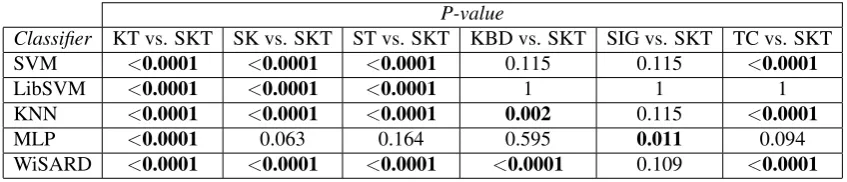
The Table 4 shows the p-value for SKT (sigkeytouch)versusthe other configura-tions (KT - keytouch, SK - sigkey, ST - sigtouch, KBD - keyboard, SIG - signature and TC - touch ).
P-value
Classifier KT vs. SKT SK vs. SKT ST vs. SKT KBD vs. SKT SIG vs. SKT TC vs. SKT
SVM <0.0001 <0.0001 <0.0001 0.115 0.115 <0.0001
LibSVM <0.0001 <0.0001 <0.0001 1 1 1
KNN <0.0001 <0.0001 <0.0001 0.002 0.115 <0.0001
MLP <0.0001 0.063 0.164 0.595 0.011 0.094
[image:5.595.86.510.577.668.2]WiSARD <0.0001 <0.0001 <0.0001 <0.0001 0.109 <0.0001
Table 4. P-value for SKT versus the other configurations
Databases
SIGKEYTOUCH KEYTOUCH SIGKEY SIGTOUCH KEYBOARD SIGNATURE TOUCH
+ 59.94% 3.33% 3.33% 26.64% 26.64% 53.28% 29.97% = 39.96% 26.94% 36.63% 36.63% 49.95% 39.96% 43.29%
[image:6.595.89.511.101.147.2]TOTAL ACCURACY 99.9% 30.27% 39.96% 63.27% 73.59% 93.24% 73.26%
Table 5. Accuracy in percentage for each database when the database accuracy was higher than the others (+), the same as the others (=) and the total accuracy in percentage for each database
For the Table 5 we can observe that for the+case the sigkeytouch and signature had the highest accuracies 59.94% and 53.28% while the databases presented the same accuracy 39.96% for the=case. However, even a similar scenario between the sigkey-touch and signature databases, the multimodal database had the highest total accuracy (99.9%).
5. Final Remarks
In this work, we analysed the impact of the multimodal hand-based database for gender recognition. For this, the multimodal database was compared with two-modal and one-modal one-modalities. We have tested five classifiers and confirmed the accuracy enhancement by applying a statistical test.
The classifiers presented a varied performance being the SVM and WiSARD the two with the best overall performance. Also, we observed that there was no significant variation among the classifier performances for the multimodal database, excepting for MLP classifier.
For the statistical test, it is possible to see that keyboard, signature and touch databases have the same accuracy or even higher than the sigkeytouch database for the =case. However, the total accuracy of the multimodal database is still higher than the others, recognising the gender in 99.9%. The feature space dimensionality increase due to the fusion of the biometric sources and the overlap reduction of the feature distributions due to the dissimilarity of individuals explain this behaviour.
We understand the importance of our work to the analyses of the impact of the three-modal biometric database for gender recognition. As future work, we aim to inves-tigate the impact of feature selection on the accuracy of the databases in order to know the influence of each modality set of features on gender recognition.
Acknowledgments
This work was supported by the Brazilian Coordination for the Improvement of Higher Education Personnel (CAPES) and by the NPAD/UFRN (High-Performance Computing Center at Federal University of Rio Grande do Norte).
References
Bewick, V., Cheek, L., and Ball, J. (2004). Statistics review 10: further nonparametric methods. Critical care, 8(3):196.
Bhattacharyya, S., Sarkar, T., et al. (2018). Euler number based feature extraction tech-nique for gender discrimination from offline hindi signature using svm & bpnn clas-sifier. In2018 Emerging Trends in Electronic Devices and Computational Techniques (EDCT), pages 1–6. IEEE.
Buriro, A., Akhtar, Z., Crispo, B., and Del Frari, F. (2016). Age, gender and operating-hand estimation on smart mobile devices. In 2016 International Conference of the Biometrics Special Interest Group (BIOSIG), pages 1–5. IEEE.
Chang, C.-C. and Lin, C.-J. (2011). Libsvm: A library for support vector machines.ACM transactions on intelligent systems and technology (TIST), 2(3):27.
Cotta, K. P., Ferreira, R. S., and Franc¸a, F. M. (2018). Weightless neural network wisard applied to online recommender systems. In2018 7th Brazilian Conference on Intelli-gent Systems (BRACIS), pages 348–353. IEEE.
Da Silva, V. R., Silva, J. C. G. d. A., and Da Costa-Abreu, M. (2016). A new Brazilian hand-based behavioural biometrics database: Data collection and analysis. InThe 7th IET International Conference on Imaging for Crime Detection and Prevention (ICDP-16), page 1.
Hall, M., Frank, E., Holmes, G., Pfahringer, B., Reutemann, P., and Witten, I. H. (2009). The weka data mining software: an update. ACM SIGKDD explorations newsletter, 11(1):10–18.
Idrus, S. Z. S., Cherrier, E., Rosenberger, C., and Bours, P. (2013). Soft biometrics database: A benchmark for keystroke dynamics biometric systems. In2013 Interna-tional Conference of the BIOSIG Special Interest Group (BIOSIG), pages 1–8. IEEE.
Jagadiswary, D. and Saraswady, D. (2016). Biometric authentication using fused multi-modal biometric. Procedia Computer Science, 85:109–116.
Lusquino Filho, L., Franc¸a, F. M., and Lima, P. M. (2018). Near-optimal facial emotion classification using a wisard-based weightless system. InESANN.
Miguel-Hurtado, O., Stevenage, S. V., Bevan, C., and Guest, R. (2016). Predicting sex as a soft-biometrics from device interaction swipe gestures. Pattern Recognition Letters, 79:44–51.
Rangel, F., Faria, F., Lima, P. M. V., and Oliveira, J. (2016). Semi-supervised classifica-tion of social textual data using wisard. ESANN. Citeseer.