THE INFLUENCE OF LEGITIMACY
ON ACCESS TO RESOURCES:
A CASE STUDY
1
The influence of legitimacy on access to resources: a case study
Erwin van der Aart
S0176516
University of Twente
Faculty of Behavioural, Management and Social Sciences
Public Administration
Master thesis
Examination Committee:
Dr. Veronica Junjan
3
Abstract
The theory of legitimacy states that individuals and organizations are more willing to share their resources with an organization that has a high legitimacy. There is not a lot of empirical research that tests this hypothesis. The research that is available almost exclusively looks at for-profit
organizations. In this thesis I take a look at how legitimacy affects access to resources for non-profit organizations via the main question: How can non-profit organizations use legitimacy for gaining access to the resources they need?
This thesis uses the legitimacy framework as defined by Suchman (1995). He subdivides legitimacy in nine subtypes of legitimacy: exchange legitimacy, influence legitimacy, dispositional legitimacy, consequential legitimacy, structural legitimacy, procedural legitimacy, personal legitimacy, comprehensibility and taken-for-grantedness. Each of these terms describes a different aspect of legitimacy.
How much each type of legitimacy affects access to resources was tested via a case study on the non-profit organization the Science Shop UT. The Science Shop UT gathers questions from small
organizations and individuals and finds students and researchers from the University of Twente who find an answer to these questions. How legitimacy affects access to resources was tested by
interviewing the researchers of the University of Twente on why they choose to work with the Science Shop UT. I then transcribed the interviews and coded them through the legitimacy framework to see which types of legitimacy had the most effect on access to resources.
After analyzing the interviews there were three types of legitimacy that seemed to affect access to resources the most in the case of the Science Shop UT: exchange legitimacy, procedural legitimacy and consequential legitimacy. The most likely strategies for maintaining or increasing these types of legitimacy for the Science Shop UT are finding stakeholders who already rate the Science Shop UT highly on these types of legitimacy and informing their stakeholders about the Science Shop UT outputs and procedures.
4
Table of contents
1. Introduction 6
1.1 Research problem 6
1.2 Research question 6
1.3 Science Shop UT 7
2 Theoretical Framework 9
2.1 Types of legitimacy 9
2.2 Legitimacy management strategies 11
2.3 Access to resources 14
2.4 Theoretical model 15
2.5 Non-profit organizations 17
3. Methodology 19
3.1 Introduction 19
3.2 Research design 19
3.3 Operationalization 20
3.4 Semi-structured interviews 21
3.5 Confidentiality 22
3.6 Methods of data analysis 22
3.7 Limitations 23
4. Research findings 24
4.1 Introduction 24
4.2 Access to resources 24
4.3 Pragmatic legitimacy 25
5
4.3.2 Influence legitimacy 26
4.3.3 Dispositional legitimacy 27
4.4 Moral legitimacy 28
4.4.1 Consequential legitimacy 28
4.4.2 Procedural legitimacy 29
4.4.3 Structural legitimacy 30
4.4.4 Personal legitimacy 30
4.5 Cognitive legitimacy 31
4.5.1 Comprehensibility 31
4.5.2 Taken-for-grantedness 31
4.6 Discussion 32
4.6.1 Difference in legitimacy between literature and reality 32 4.6.2 Effects of legitimacy on access to resources 33
5. Conclusion 35
5.1 Answering the sub questions 35
5.2 Answering the main question 37
6. Limitations & further research 39
6.1 Limitations 39
6.2 Further research 40
7. References 41
Appendix 1: Interview questions 43
6
1. Introduction
1.1 Research problem
Every organization needs certain resources in order to survive, for example: capital, materials and labor. According to the resource dependence theory (Drees & Heugens, 2013) these resources are not something an organization simply has, but instead the organization depends on its environment for access to these vital resources. Organizations from the environment however, will not simply give access to their resources to anyone. Organizational researchers have tried to study the reasons that organizations share their resources with other organizations. One of the explanations given in
scientific research comes from the theory of legitimacy (Hillman et al, 2009). The theory of legitimacy states that organizations with a high legitimacy are perceived as more desirable, meaningful and trustworthy. These perceived characteristics makes other organizations more willing to work with and share their resources with this organization (Suchman, 1995). This in turn increases the organizations chances of survival (Hillman et al, 2009).
Gaining access to vital resources through legitimacy may be extra important for non-profit
organizations since they often lack a reliable source of income. This means that they cannot directly purchase the resources they need for keeping themselves alive, instead they have to rely on others to give them access to the resources they need for free. Understanding the factors that affect their legitimacy in the eyes of their stakeholders that can provide them with the resource they need should therefore be a high priority for a non-profit organization.
1.2 Research question
In this thesis I will look at how legitimacy affects the access to resources for non-profit organizations. I choose to specifically look at a non-profit organization instead of a for-profit organization because most studies on legitimacy done before seem to implicitly or explicitly study for-profit organizations (Aldrich & Fiol, 1994; Drori & Honig, 2013; Johnson & Holub, 2003). Since very little research has been done on how legitimacy affects access to resources for non-profit organizations, research on this subject should add more to the total understanding of the relationship between legitimacy and access to resources instead of another study on for-profit organizations.
This thesis will look at how a non-profit organization can use its legitimacy in order to gain access to the resources they need. The main research question will therefore be:
How can non-profit organizations use legitimacy for gaining access to the resources they need?
To answer this question, I will first look at the literature written on this subject to answer the following sub question:
1 What is the effect of legitimacy on access to resources according to the scientific literature?
7
2 How do the different types of legitimacy actually affect the willingness of individuals to give access to their resources to an organization?
1.3 Science Shop UT
The organization that I will study to answer the research questions is the Science Shop UT. The Science Shop UT is a small organization with four employees. The goal of the Science Shop UT is to provide research to individuals and small organizations that could otherwise not afford it. This goal is based on the idea that research should be available to everyone and not just the people that have the money to pay for it. The way that the Science Shop UT works is that they get approached by an individual or organization that asks them to find someone that can research a certain question or problem for them. An employee of the Science Shop UT then assesses whether the question fits the idea behind the Science Shop UT. This means that in order for the question to be accepted it needs to come from the target audience of the Science Shop UT, which consist of non-profit organizations, individuals and municipalities. A large company with enough money to pay for the research itself, does not fit into their target audience. The question itself has to be socially relevant instead of only help the client make more money. The question also needs to be answerable via student research. This means that the question should not take too long to answer or be too complicated. It also should not by a subjective question that research cannot answer.
When an employee of the Science Shop UT thinks the question meets their criteria he will try to find a student from the University of Twente to answer this question. The reason that the Science Shop UT uses students for their research is that although they get some funding from the University of Twente, this is not enough to hire professional researchers to do the research for them. The clients themselves also do not have the money to pay for the research, which is why they came to the Science Shop UT in the first place. Students however, can usually do the research as part of their bachelor- or master thesis and are therefore willing to do the research without a form of payment. Researchers working for the University of Twente also sometimes help the Science Shop UT. This can be in the form of supervising a student, giving an opinion on a study done by someone else, give a presentation about their subject of expertise and so on.
The remainder of this thesis is build up as follows. In chapter two I will describe the theoretical framework. In this chapter I will describe what legitimacy is, the different types of legitimacy, how legitimacy can be gained and what its effect on access to resources is, according to the current scientific literature on the subject. In doing so I will answer the first sub question in chapter two. Chapter three will describe the methodology used to answer sub question two. In this chapter I will explain how I operationalize the theoretical concepts described in chapter two and how I plan to test them by using the Science Shop UT as a case study.
Chapter four will describe the results of my case study and will discuss the effects of legitimacy on access to resources for the Science Shop UT. I will also compare the results of the literature study with that of the case study to each other in this chapter.
9
2. Theoretical Framework
In order to answer the main research question it is important to first have an overview of what has already been written about legitimacy and the effect it has on access to resources. This chapter will do this by answering the first sub question:
1 What is the effect of legitimacy on access to resources according to the scientific literature?
To answer this question I will first give an overview of the different types of legitimacy and how they can be gained according to the literature on this subject. After this I will explain the current theories about how legitimacy affects access to resources for an organization. Since this thesis focuses on non-profit organizations, I will then give an overview of the differences between a non-profit organization and other types of organizations and how these differences might influence the effect of legitimacy on access to resources.
2.1 Types of legitimacy
To understand how legitimacy affects gaining access to the resources an organization needs, one first needs to understand what legitimacy is and what types of legitimacy there are. There are several definitions of legitimacy that have been used through the years. Dowling and Pfeffer (1975) describe legitimacy as ‘’congruence between the social values associated with or implied by their activities
(those of the legitimacy seeking organizations) and the norms of acceptable behavior in the larger social system of which they are a part”. Aldrich & Fiol (1994) define legitimacy by using two
definitions. The first is based on how taken for granted the organization is, which they call cognitive legitimacy. The second form is the extent to which an organization conforms to recognized principles or accepted rules and standards, which they call sociopolitical legitimacy. Suchman (1995) defines legitimacy as: “a generalized perception or assumption that the actions of an entity are desirable, proper, or appropriate within some socially constructed system of norms, values, beliefs and definitions”. Although all three of these definitions are slightly different, they have a few things in common. All three definitions emphasize the importance of the organization fitting in with the values of its environment in order to be legitimate. All three definitions also imply that legitimacy is
attributed to the organization by its environment. Although all three definitions accurately describe the concept of legitimacy, this thesis will use the definition given by Suchman (1995). The main reason for this is that Suchman (1995) subdivides legitimacy in three different types of legitimacy: pragmatic, moral and cognitive legitimacy. These three types are further subdivided in more specific types of legitimacy. This is useful for this thesis since I can try to measure the effect of each of these types of legitimacy on access to resources, instead of just measuring the effect of one broad
definition or the two given by Aldrich & Fiol (1994). It is also worth noting that although Suchman used this definition in 1995 it is still used in more recent publications (Johnson & Holub, 2003; Deephouse & Suchman, 2008; Drori & Honig, 2013) indicating the definition has some validity. In the remainder of this sub chapter I will describe the different sub types of legitimacy as described by Suchman (1995).
10 Influence legitimacy is attributed not on the basis of what the organization actually does for you, but instead on how responsive the organization is to your wishes. As long as the organization tries to do want you want, you see it as legitimate. The last type of pragmatic legitimacy is dispositional legitimacy. Organizations are not people and do not have personalities, nevertheless some
stakeholders may attribute an organization certain positive personality attributes like ‘’honest’’ and ‘’shares our values’’ or instead negative personality attributes like ‘’evil’’ or ‘’untrustworthy’’. Even though thinking an organization has a personality may be naïve, having important stakeholders think that your organization is evil will negatively impact your legitimacy (Suchman, 1995).
Moral legitimacy, just like pragmatic legitimacy is attributed on the basis of the activities of the organization. In contrast to pragmatic legitimacy however it is not based on whether the activities of the organization benefit you, but on whether the organization ‘’does the right thing’’ in general. Suchman (1995) describe four different types of moral legitimacy: consequential, procedural, structural and personal legitimacy. Consequential legitimacy is based on valuing certain
characteristics of the organizations output like mortality rates for hospitals or emissions for polluting industry. If the organization scores well on these output measures, it is seen as morally legitimate. Procedural legitimacy is somewhat opposite of consequential legitimacy, instead of looking at the output of the organization it looks at the procedures used to achieve this output. For example, instead of attributing legitimacy on the basis of mortality rates of a hospital you look at whether or not the doctors are well trained and work hygienically. This type of moral legitimacy becomes especially important if outputs are hard to measure. Structural legitimacy is similar to procedural legitimacy, but instead of looking at the procedures an organization has implemented you look at the structure an organization has. For example, you do not look at whether or not the organization checks for defects but instead on whether or not the organization has a quality control department. Just like procedural legitimacy it is easier to check than consequential legitimacy and is therefore often used to base moral legitimacy on. Personal legitimacy bases the moral legitimacy of the organization on what stakeholders think of the leader of the organization. If you do not know much about the organization itself, but you do trust the leader you may be inclined to attribute the
organization a high moral legitimacy as well. The problem with this type of legitimacy is that it can be lost quickly when the charismatic leader leaves the organization (Suchman, 1995).
11
2.2 Legitimacy management strategies
A lot has been written on how an organization can gain legitimacy. Suchman (1995) describes three different strategies an organization can follow for increasing legitimacy: conforming to the
environment, selecting amongst environments and manipulating the environment. Zimmerman & Zeitz (2002) use the same three strategies but add a fourth: creation of the environment. Brinkerhoff (2005) uses conforming to the environment and manipulating the environment just like Suchman does, but replaces selecting with informing. These different strategies and the effects they might have on the different types of legitimacy will be discussed in this chapter.
The strategy of conforming is very similar to the concept of isomorphism from the theory of institutionalism. If an organization wants to appear legitimate it can do so by adopting structures, procedures and so on, that are seen as legitimate by its environment and are used by established legitimate organizations (Brinkerhoff, 2005). There are three mechanics that influence isomorphism: coercive, mimetic and normative isomorphism. Coercive isomorphism happens when other
organizations exert pressure on an organization to adopt certain procedures. This can be informal but it can also be a new law made by the government that forces an organization to change. Mimetic isomorphism happens when organizations consciously look at other organizations for a better way of running their organization. Sometimes the environment that organizations operate in is very uncertain and an organization may not know how to cope with this uncertainty. One of the easier ways to deal with this is look at successful organizations in your organizational field and copy them.
Normative pressure is the last mechanic that influences isomorphism. Organizations in the same organizational field will most of the time have the same type of employees. Members of a certain profession will often try to define common practices in their work that everyone of their profession should follow. The members of the same profession often also have followed the same kind of education. This means that all organizations within an organizational field have the same type of employees with the same orientation which they impose on the organization (DiMaggio & Powell, 1983).
By becoming more like other organizations in its field an organization mostly increases its structural legitimacy, procedural legitimacy and its comprehensibility. Structural and procedural legitimacy are increased because the organization adopts the structures and procedures that are seen as the ‘’right’’ procedures and structures by the environment. Because these structures and procedures already exist and are accepted by the environment, it also raises the comprehensibility of the organization. Exchange and consequential legitimacy may also indirectly increase because the adopted structures and procedures make the organization more efficient. This however is not a given, the adopted structures and procedures could also make the organization less efficient and actually decrease exchange and consequential legitimacy. Managers should consider this when thinking about whether or not to adopt a certain structure or procedure. Besides changing its own organizational structure an organization can also choose to conform to the environment by
12 When an organization is unwilling or unable to conform to its environment it can try the strategy of selecting amongst environments to gain legitimacy (Suchman, 1995). This strategy entails that you do not try to please the organizations that make up your current environment, but instead try to cater to a different environment that sees your organization in its current form as legitimate. The environment in this case can either be a geographical location or a group of stakeholders. For example when Apple made the Macintosh the product seemed too playful for the formal culture of businesses. Apple instead selected homes and schools as the environment for selling its products where playfulness is seen as more legitimate. A classic example of selecting amongst geographical locations is for a new software venture to move to Silicon Valley where their business model is seen as more legitimate (Zimmerman & Zeitz, 2002). This strategy can be used to gain several types of legitimacy. Exchange legitimacy can be raised by trying to sell your product to organizations or individual consumers who actually want your product. Influence legitimacy can be increased by selecting stakeholders who have demands that are easy for you to fulfill without having to change drastically. Dispositional legitimacy will be higher when you select an environment that already associates your organization with good personality characteristics. Moral legitimacy is more difficult to raise by selecting from environments since moral standards are more or less the same across environments. An organization can choose not to provide very important or problematic goods, because of the strict procedural requirements that may be associated with it, which may be hard to meet. When an organization instead provides less important goods it needs to meet lower standards which make it easier to fulfill them. An organization can raise its comprehensibility by choosing to operate in an environment that requires certification. It may be hard to obtain this certification but once an organization does so it will be seen as more legitimate (Suchman, 1995). It is worth noting that for most organizations some of these selection strategies actually mean they will have to change their organizational structure or activities in some way, which is very similar to the conforming strategy. A reason for still using the selection strategy is that the organization can choose the environment where conforming is easiest or yields the largest legitimacy benefit (Zimmerman & Zeitz, 2002).
An organization can also increase its legitimacy by informing its stakeholders through the right communication strategies. When the organization communicates with a stakeholder, it should use the right terminology that makes the organization seem more pragmatically, morally or cognitively legitimate. This strategy is more precise than conforming. Where conforming raises a few different types of legitimacy in the eyes of the entire environment, informing can be used to raise specific types of legitimacy with specific stakeholders (Brinkerhoff, 2005). Exchange legitimacy for example can be raised by informing your stakeholders about the products or services you produce that are useful to them. As another example structural legitimacy can be raised by informing your
stakeholders about the structure of your organization. For this strategy to work however the organization does have to have something they can offer their stakeholders for increasing exchange legitimacy or have the right structural characteristics for increasing structural legitimacy otherwise this strategy backfires and actually reduces legitimacy. This strategy is probably best used to highlight the types of legitimacy the organization is strongest in and move attention away from the weaker types of legitimacy.
13 do than selecting an environment or conform to an environment but is sometimes the only way to get legitimacy, especially for new types of organizations that do not fit into existing models. Pragmatic legitimacy is the easiest form of legitimacy to manipulate because it can differ from organization to organization instead of being more or less equal amongst the entire environment. Therefore an organization can target specific organizations or individuals with product advertising to change their views about what they want to have (Suchman, 1995). What the environment sees as moral legitimate is harder to change. The best chance an organization has to do this, is by being successful. If it can do this over a large period of time the environment may come to accept the organization’s deviating structures and procedures and see them as legitimate. Even if at first only a few organizations see the new procedures and structures as legitimate and adopt them, this will create a coalition of organizations which will have a greater impact on manipulating moral legitimacy than just the one organization. Cognitive legitimacy can be manipulated over time by just existing. Since it gives other organizations the time to comprehend the new organization and after a few years it may seem like that organization with the new organizational form has always been there and they will start taken it for granted. This process however is slow and may not have a strong effect on cognitive legitimacy. This process can be amplified when more organization in that specific environment adopt the same procedures and structures just as with moral legitimacy (Suchman, 1995).
Besides the three strategies given by Suchman (1995), Zimmerman & Zeitz (2002) describe a fourth strategy: creation of the environment. According to Zimmerman & Zeitz the four strategies differ in the amount of change they make in factors external to the organization, where creation creates the most change. The creation of the environment usually happens by new organizations in a new domain. Since the new domain does not have pre-existing norms, values or models that can be conformed to, the new venture is forced to create them itself. Amazon is an example of creation of the environment. Before it existed there was no model for an online retailer. Amazon created the model for a store that had no physical location people could visit, but instead people had to buy books via the internet. This model has since been adopted by other stores and is now a legitimate business model. Creation of the environment can be used to enhance legitimacy in several different ways. When a new venture produces a new product, there are probably very few organizations that feel like they need that product. Pragmatic legitimacy can be enhanced by explaining what the product does. When the organizations see the use of the product has for them they will start seeing the new venture as more pragmatically legitimate. Moral legitimacy can be raised by creating an appreciation for the values, outputs and structure of the new venture. An example of the creation of a new value is how internet companies managed to convince their environment that the number of page visits is a more important measurement of success that profitability. Cognitive legitimacy is mostly build over time, by first building pragmatic legitimacy and moral legitimacy. This process should eventually lead to other organizations starting to comprehend the new venture and start taking it for granted.
14 structures, norms and procedures. This ensures that the organization gets the legitimation benefits of conforming where possible and only uses the more risky creation strategy where it has to.
2.3 Access to resources
As stated before Suchman (1995) defines legitimacy as: ‘’Legitimacy is a generalized perception or assumption that the actions of an entity are desirable, proper, or appropriate within some socially constructed system of norms, values, beliefs, and definitions’’. Many researchers (Aldrich & Fiol, 1994; Brinkerhoff, 2005; Drori & Honig, 2013; Zimmerman & Zeitz, 2002) state that the fact that the actions of an entity are seen as desirable, proper or appropriate leads to organizations and
individuals being more willing to give the entity access to their resources, but why is this so?
Zimmerman & Zeitz (2002) provide a possible explanation, when someone has to make a decision he always faces uncertainty about the outcome of the options he has. When dealing with this
uncertainty people often fall back on the scripts, rules, norms, values and models that have been enforced upon them by their environment. For example, an investor who has to decide whether or not to invest in an organization and cannot be certain whether the company will provide a decent return on investment, may perceive the investment as safer when the organization uses the organization model that he is used to, or in other words: is more legitimate.
Aldrich and Fiol (1994) describe a similar process. In order for an individual or organization to share its resources with an organization it has to trust that organization. When the organization has repeatedly shown itself to be reliable in the past trust may come easy, but when the organization is new or has not worked with that individual or organization before it becomes harder to trust that organization. In this case the organization has to find another way to appear more trustworthy. This is where legitimacy comes in. One of the ways that an organization can appear more trustworthy using legitimacy according to Aldrich and Fiol (1994) is by conforming to the established models used by similar organizations. Possible cooperation partners know that these models work, this will make the organization seem more legitimate in the eyes of these cooperation partners. Another way to appear more trustworthy can be via a charismatic leader. This type of leader can often convince possible cooperation partners of helping them via the use of encompassing symbolic language. Trustworthiness can also be raised via pragmatic legitimacy. Someone is more likely to give access to its resources to someone who has shown that he produced desirable outputs in the past. If the possible cooperation partner is not aware of the past outputs or when the organization is new and there are no past outputs, the organization can try to inform the possible cooperation partner about the benefits of what they can produce.
Another way of looking at how legitimacy can affect the access to resources is the idea of
illegitimacy. Meyer & Rowan (1977) propose that failure to conform to certain rules or norms can make an organization look negligent, irrational or unnecessary, which can give an organization a bad name. Other organization may not want to be associated with this type of behavior and stop providing resources to this organization. The concept of illegitimacy is also important for the distinction that Suchman (1995) makes between passive versus active support. Being seen as illegitimate may cause people to protest against you or sue you which can actually cause an
15 Ensuring active support however, where other organizations actually provide you with resources requires a higher degree of legitimacy.
When looking at the relation between access to resources and legitimacy in the current body of scientific literature one can see that most researchers agree on the idea that having a high legitimacy positively contributes to the willingness of other organizations to give you access to their resources. Actual research on how this relation works and which types of legitimacy and which strategies for gaining legitimacy affect access to resources the most however is rather sparse. The strategy that is named the most is conforming to existing organizational structures. This strategy will raise an organizations procedural and structural legitimacy by adopting the ‘’right’’ structures and procedures. It also raises an organization’s comprehensibility, because by adopting well known structures and procedures the organization becomes easier to understand. Since this is the most named strategy, one could argue that it is likely seen as the most effective in current scientific literature, however none of the literature that mentions the connection between conforming and access to resources actually provides any empirical evidence for this connection. Aldrich & Fiol (1994) also mention how having a charismatic leader could help gain access to resources. This would
suggest that personal legitimacy would be important for gaining access to resources. They (Aldrich & Fiol, 1994) also mention that access to resources can be obtained by informing the organization with the resources about what you can do for them. This would suggest that the informing strategy and exchange legitimacy are useful for gaining access to resources. Just as with the conformance strategy however no empirical evidence is provided for this.
2.4 Theoretical model
16 Willingness of
stakeholders to give organization access
to their resources Perceived legitimacy
of the organization Pragmatic legitimacy
(exchange, influence, dispositional
legitimacy)
Cognitive legitimacy (taken for grantedness, comprehensibility)
Moral legitimacy (consequential,
structural, procedural, personal
[image:17.595.73.403.70.288.2]legitimacy)
Figure 1. Effect of legitimacy on access to resources
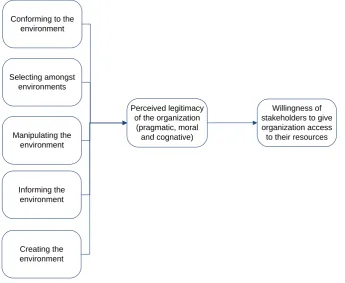
The figure above describes the influence of legitimacy in an institutional way, where single
organizations cannot really influence legitimacy. Which is the way how some authors view legitimacy (Dowling & Pfeffer, 1975; Asforth & Gibbs, 1990). Other authors (DiMaggio & Powell, 1983; Meyer & Rowan 1977) see legitimacy as a strategic resource that can be manipulated by the manager of a company (Suchman, 1995), via the strategies described in sub chapter 2.2: conforming to the environment, selecting amongst environments, manipulating the environment, informing the environment and creating the environment. This view can be summarized as showed in figure 2.
Perceived legitimacy of the organization
(pragmatic, moral and cognative)
Willingness of stakeholders to give organization access to their resources Selecting amongst
environments Conforming to the
environment
Manipulating the environment
Informing the environment
Creating the environment
[image:17.595.70.416.442.725.2]17 Figure two will be used as the theoretical basis for the rest of this thesis. The reason for this is that I write this thesis from the strategic approach to legitimacy, that subscribes to the idea that legitimacy is an operational resources that can be used to achieve your goals. The institutional approach sees legitimacy more as a force, much like institutionalization, that shapes the organization without the organization having active control over it (Suchman, 1995). Assuming that an organization has no control over its legitimacy makes the research question of this thesis unanswerable.
In chapter four I will analyze an organization to see how well the strategic approach to legitimacy applies to a real world case. I will try to look at which types of legitimacy actually seem to affect the willingness of stakeholders to give an organization access to their resources (if any) and which strategies that organization could use to increase those types of legitimacy.
2.5 Non-profit organizations
Many terms are used to describe different types of organization(non-profit, not-for-profit, partially-for-profit, partially-for-profit, public etc.) and the definitions of each of these concepts are not always clearly defined. However organization can be divided in three broad categories: non-profit, for-profit and public that cover all types of organizations (Ten Berge & Oteman, 2004; Busse & Joiner, 2008). Some people see public organizations as a subtype of non-profit organizations (Koetzier, 2012), but since there are large difference in public organizations and small non-profit organizations, for example in how they fund their activities, I place them in different categories. In this sub chapter I will briefly describe the difference between public organizations, for-profit organizations and non-profit organizations as well as give an overview of the unique challenges an non-profit organization might face regarding gaining access to resources.
The public sector consists of the government in the broadest sense of the word. In the Netherlands this would mean the government on the national, provincial and municipal level as well as the state-owned organizations that provide public services like the police and the judicial power. The public sector usually generates their resources (money) through taxation and uses these resources to provide public goods like safety or public transportation (Ten Berge & Oteman, 2004).
For-profit organizations are organizations that, provide a good or service with the end goal of making a profit. If the head of a for-profit organization thinks he can make more profit by providing another good or service he will usually do this. A for-profit organization can have other goals than just maximizing profit. It might for example, also care about sustainability or spend a part of the yearly profit on a good cause, but as long as the main goal is turning a profit it is still a for-profit
organization (Koetzier, 2012).
18 Even though non-profit organizations do not focus on making a profit they do need to generate resources to pay for their staff and the costs that they make whilst trying to achieve their primary goal. The public sector can do this via taxes and the for-profit sector via selling goods or services. A non-profit organization cannot impose a tax and they do not always have goods or services to sell. Non-profit organizations usually get their money from fundraisers, membership fees or subsidies (Ten Berge & Oteman, 2004).
The difficulty of gaining resources for a non-profit makes the question of how legitimacy affects the access to resources extra interesting for non-profit organizations. For a for-profit organization gaining passive support to prevent boycotts might be enough to gain enough resources and a public
19
3. Methodology
3.1 Introduction
This chapter will explain how I plan to research the effects of legitimacy on access to resources in a real case. This chapter will explain the research design and the operationalization of the variables.
3.2 Research design
To answer sub question two: Howdo the different types of legitimacy actually affect the willingness of individuals to give access to their resources to an organization? I will use the case study method. The reason for this is that case studies are well suited to answer exploratory type questions (Yin, 2004) like sub question two. The question itself also heavily points one in the direction of studying an actual organization. The organization that I will be studying is the Science Shop UT as described in chapter 1.3 and the researchers of the University of Twente that choose to work with the Science Shop UT. I will look at the reasons why researchers choose to work with the Science Shop UT through the theoretical framework of legitimacy. In the terminology of Yin (2004) this will be a single case study where the case being studied is the Science Shop UT. The units of observation in this study are the researchers who have worked with the Science Shop UT in some way. The reason to interview more than one researcher is to be able to see all the reasons provided by the researcher for working with the Science Shop UT. Interviewing a single researcher might show that only one specific subtype of legitimacy affects access to resources. Interviewing more than one researcher might reinforce this finding or show that different types of legitimacy affect different persons in different ways.
I will try to find out the reasons that researchers have for working with the Science Shop UT by interviewing researchers from the University of Twente who have been approached to help the Science Shop UT with one of their projects. I will ask them questions about their motives for choosing to help the Science Shop UT with their research or to not help the Science Shop UT with their
20 working with the Science Shop UT would likely be very vague. Since most of the researchers the Science Shop UT work with are from the Faculty of Behavioural, Management and Social Sciences (previously the School of Management & Governance and the Faculty of Behavioural Sciences) and only a small amount of researchers come from the other faculties I will try to make sure the majority of the researcher I interview are part of the Faculty of Behavioural, Management and Social Sciences, but also make sure to interview at least two researchers that are not from this faculty. Within The Faculty of Behavioural, Management and Social Sciences I will interview researchers from both the behavioral (psychology etc.) and management (business administration etc.) directions.
The plan of approaching researchers as described in the last paragraph did not cause much problems when I tried to approach the researchers. Almost all of the people I approached reacted positive and where willing to cooperate. Only two of the researchers that I approached did not have an interview with me. One because he was in the United States the next few weeks and another because the last time he worked with the Science Shop UT was longer ago than I first thought.
Because most researchers reacted positive to my request for an interview getting a diverse group of researchers was easier than I anticipated. Of the ten researchers I interviewed, seven came from the Faculty of Behavioural, Management & Social Sciences. Of those seven researchers five of them had an area of expertise that the others did not. The other two both had a psychology background. Of the other three researchers two came from the Faculty of Electrical Engineering, Mathematics and Computer Science and one from the Faculty of Engineering Technology.
The interviewees are also reasonably diversified in the number of years they have worked at the University of Twente, which is a factor that could influence taken-for-grantedness. One of the interviewees has worked at the University of Twente since the seventies, two since the eighties, three since the nineties and four since the early two thousands.
3.3 Operationalization
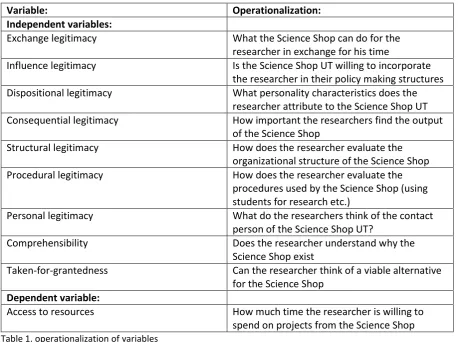
In the interviews I try to test the effect of the different types of legitimacy (the independent
21
Variable: Operationalization:
Independent variables:
Exchange legitimacy What the Science Shop can do for the researcher in exchange for his time
Influence legitimacy Is the Science Shop UT willing to incorporate the researcher in their policy making structures Dispositional legitimacy What personality characteristics does the
researcher attribute to the Science Shop UT Consequential legitimacy How important the researchers find the output
of the Science Shop
Structural legitimacy How does the researcher evaluate the organizational structure of the Science Shop Procedural legitimacy How does the researcher evaluate the
procedures used by the Science Shop (using students for research etc.)
Personal legitimacy What do the researchers think of the contact person of the Science Shop UT?
Comprehensibility Does the researcher understand why the
Science Shop exist
Taken-for-grantedness Can the researcher think of a viable alternative for the Science Shop
Dependent variable:
[image:22.595.70.529.68.410.2]Access to resources How much time the researcher is willing to spend on projects from the Science Shop Table 1. operationalization of variables
The operationalization of the independent variables are based on how Suchman (1995) defines the different types of legitimacy. I have tried to remain as true as possible to the definitions as defined by Suchman (1995), but have rephrased them to make them specifically apply to the Science Shop UT. For example, I have replaced the term “stakeholder” with researcher, since those are the
stakeholders in this specific case, and “the organization” with “the Science Shop UT”, since that is the organization that is being studied in this case. The dependent variable I have defined as how much time the researcher is willing to spend on the Science Shop UT since this is the resource the Science Shop UT wants from the researcher. One could argue that the Science Shop UT wants the expertise on a certain subject of the researchers. The problem with choosing this resource however, is that it is a rather vague resource to measure. A researcher cannot give a small amount of expertise instead of a large amount of expertise. Whereas a researcher can state that he is willing to spend an evening of time on a project or two weeks. A researcher also does not lose expertise when he gives it away to the Science Shop whereas time very much is a limited resource.
3.4 Semi-structured interviews
As stated before, the effect of the different types of legitimacy on access to resources will be obtained via semi-structured interviews. To avoid socially desirable answers or to push the
22 the organizations that use its research, or maybe the researcher will instead talk about how good or bad the procedures of the Science Shop are. This allows me to find out what the researcher finds especially important whilst still having the option of later asking follow up question based on what the interviewee did or did not mention. If one instead asks: “Do you think that it is good that the Science Shop provides free research to organizations with socially relevant research questions that otherwise could not afford it?” There is a good chance that the interviewee will answered with the socially desirable “yes”, but even if he answers “no” or gives a more detailed answer he might only be talking about this subject because of the way the question is asked, not because it is an important subject to him. This can be solved by following up the question with a question about how important his opinion is on this subject for the decisions whether or not to help the Science Shop, but this does not solve the problem of socially desirable answers.
The entire interview will consist of seven main questions with several sub questions. Whenever an interviewee brings up a relevant interesting topic that is not covered in the interview questions I will ask follow-up questions. A full overview of the research questions can be found in appendix 1.
3.5 Confidentiality
At the beginning of each interview I asked the interviewee permission to record the interview, so that I could transcribe it. None of the interviewees objected to this. In order to allow the interviewee to speak as freely as possible I explained that I would not attribute any of the things said in one of the interviews to a specific person. This measure of privacy should reduce the number of socially
desirable answers.
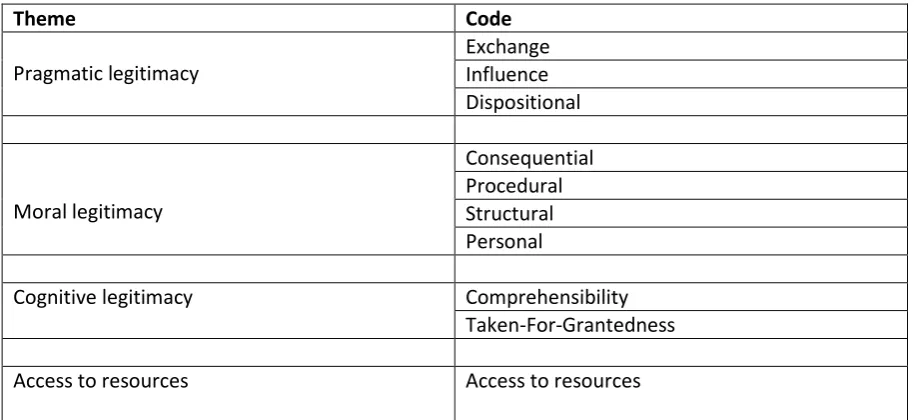
3.6 Methods of data analysis
23
Theme Code
Pragmatic legitimacy
Exchange Influence Dispositional
Moral legitimacy
Consequential Procedural Structural Personal
Cognitive legitimacy Comprehensibility
Taken-For-Grantedness
[image:24.595.70.529.69.279.2]Access to resources Access to resources
Table 2. codes
I will then use these codes to code individual sentences or even part of sentences when they fit in one of these codes. After I have coded all the interviews I will group all the pieces of text with a certain code together to be able to analyze each type of legitimacy better. The findings of this process are described in the next chapter.
3.7 Limitations
The design and methods as described in this chapter come with some limitations that one has to be aware of. First of all, since I use interviewees as my main data gathering method I measure what the interviewees say are there reasons for working with the Science Shop UT instead of their actual reasons. I have tried to minimize this limitation by avoiding socially desirable questions. I have done this by asking broad open questions and maintaining the researcher’s privacy.
Another limitation to this research design comes from the coding process. Since coding is a process of interpreting a piece of text and assigning codes to it, the interpretation process is prone to human error. This can be an error in understanding the theoretical framework and applying it correctly to the interviews or a bias towards wanting to see a certain outcome. Being aware of possible biases and understanding the different types of legitimacy should reduce this limitation.
24
4. Research findings
4.1 Introduction
In this chapter I will look at how legitimacy influences access to resources in the case study of the Science Shop UT by interpreting the research data gathered by interviewing the researchers from the University of Twente. In so doing I will answer sub question two: Howdo the different types of legitimacy actually affect the willingness of individuals to give access to their resources to an organization? This chapter will first give an overview of the access to resources given by the researchers from the University of Twente followed by a description of how the different types of legitimacy influence the access to resources. This chapter will be concluded by comparing the influence of the different types of legitimacy on access to resources to each other.
4.2 Access to resources
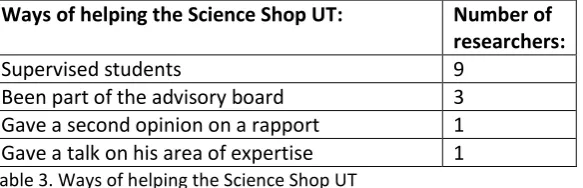
In the interviews all researchers from the University of Twente expressed that they were willing to spend time on helping the Science Shop UT with their projects. This claim is backed up by the fact that each researcher has helped the Science Shop UT in some way in the past. The most common way in which researchers have helped the Science Shop UT is by supervising students that did research for the Science Shop UT. This is an activity that does not ask much of the researcher’s time since it consist mostly of answering the student’s questions, give feedback and in the end review the final paper to see if the quality is high enough. All researchers who have helped the Science Shop UT in this way also stressed the low frequency of the times that they were asked by the Science Shop to supervise a project. The sample size of ten researchers is too small to calculate an accurate mean, but since of the ten researchers that I interviewed the person that supervised the most students only averaged one student every two years it is safe to say that the average frequency of supervising a student for the Science Shop UT is definitely lower than once a year. The combination of how often the researchers of the University of Twente do this combined with the actual amount of hours they have to spend per project means that this is not a huge drain on the researchers’ time.
A second way in which researchers help the Science Shop UT is by being on its advisory board. This is a group of people employed at the University of Twente who give advice on what the Science Shop should look like in the future. This group according to the researchers who are or were on the board should meet two to three times a year, but in practice often meets less often. This also does not require a huge amount of time of the researchers who decide to help the Science Shop UT in this way.
Another way of helping the Science Shop, which was only mentioned once, was reviewing a scientific analysis written by a third party on its scientific validity. According to the researcher in question this was a matter of a few hours of work that can be done in a single evening.
25 A final way in which a researcher can help the Science Shop UT that was touched upon in some interviews is the possibility that the researcher does the entire research himself/herself. This would be better for the Science Shop UT and its clients than that a student would do the research since the research would likely be of higher quality and would seem more trustworthy to third parties. For the researcher in question however it would be a bigger time commitment than the previous ways of helping the Science Shop UT described above. None of the researchers of the University of Twente that were interviewed or any others to my knowledge have actually done the entire research alone or together with another researcher.
Ways of helping the Science Shop UT: Number of researchers:
Supervised students 9
[image:26.595.76.368.230.324.2]Been part of the advisory board 3 Gave a second opinion on a rapport 1 Gave a talk on his area of expertise 1 Table 3. Ways of helping the Science Shop UT
4.3 Pragmatic legitimacy
Pragmatic legitimacy, as explained in chapter 2 is based on the self-interest of the one that attributes the legitimacy. In this particular case that means whether the Science Shop benefits the researcher or the University of Twente in some way. For example, whether the questions that the Science Shop UT brings to the researcher fits in the research that the researcher is currently working on. In the next three sub chapters I will describe what the researchers thought of the pragmatic legitimacy of the Science Shop UT.
4.3.1 Exchange legitimacy
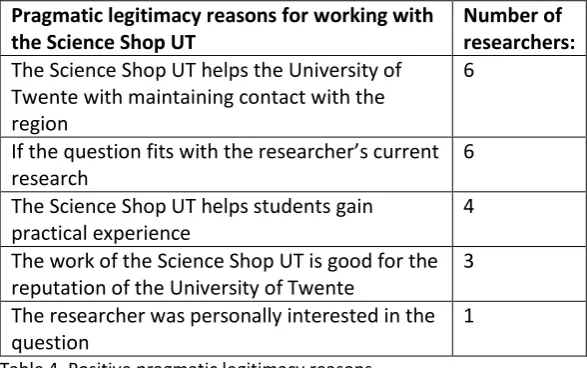
When analyzing the transcripts of the interviews exchange legitimacy was one of the most used codes to categorize the reasons given for working with the Science Shop UT. One of the most often named reasons was how the projects of the Science Shop UT could be used for the education of the students and thereby providing a direct benefit for the University of Twente. The positive effects on the education of students that were named were: it is good for students to apply their knowledge on a real case, students need subjects for their bachelor- and master theses and some studies require their students to do an internship which the Science Shop UT can help with. All these positive effects were given as reasons to help students research a Science Shop question.
There were also several reasons given for not wanting to help the Science Shop with a question. This mostly had to do with the research questions of the Science Shop being not usable as a question for a bachelor- or master thesis. Questions were said to be too “rough”, meaning not a good research question which can lead to students needing to long to transform the question into a proper
26 that he prefers to gain research questions directly from an organization without the Science Shop in between as an extra party, since this needlessly complicates things.
The researchers also named several reasons for (not) wanting to work with the Science Shop that did not focus on the benefit of the students but more on what they personally got out of it. Researchers are more willing to work on a question when the question falls into their area of interest. This effect becomes even stronger when the question fits in well with the researcher’s current research. Several researchers stated that they would be more willing to work with the Science Shop if the Science Shop would supply them with questions that fit into their current research. Another reason given for not wanting to work with the Science Shop is that it provides them with no direct benefit. There is no monetary compensation for the researcher and researchers are not judged on how much work they do for the Science Shop by their supervisor, which means that it takes time away from work that could benefit the researcher. This has become especially problematic since budget cutbacks in recent years have made it harder for researchers to get adequate research funding and they have less time to spend on other activities. Researchers also do not like it when the Science Shop takes on research questions from organizations with enough money because they feel that it competes with their own possibility of gaining funding for their research. A last reason given for refusing to help the Science Shop with specific questions is when questions are not objective research questions but when the client of the Science Shop UT is just looking for support for their political agenda.
A third group of exchange legitimacy arguments focused on the so-called “broker function” of the Science Shop UT. Several researchers suggested that the Science Shop UT provides a useful function for both the researchers and the students by making sure what the client wants researched,
transforming this in a workable question and making sure this question reaches the right researcher or study. This means that researchers get less requests from organizations that are either not fit for academic research or do not fall in their area of expertise.
The last group of exchange legitimacy arguments focused on the benefit the Science Shop UT can give the organization the researchers work for as a whole (the University of Twente). Several
researchers stated that the university has the goal or even obligation of sharing their knowledge and expertise with the surrounding area. Some researchers also described this as the valorization of their research. Answering the questions that the Science Shop UT collects can help achieve this goal. Another way the Science Shop UT can benefit the university is by enhancing its reputation in the region, which according to one researcher could provide unknown benefits in the future.
4.3.2 Influence legitimacy
Suchman (1995) describes the difference between exchange and influence legitimacy as the difference between providing direct favorable exchanges and being responsive to the constituents overall larger interests. In many cases this can be a very hard distinction to make. Suchman (1995) follows this statement up by explaining that influence legitimacy most often arises when an
organization gives its constituents a way to influence the policies of the organization by incorporating them in their policy-making structures, which as described in the methodology chapter is the
27 Science Shop UT, however no evidence was found that this increases or decreases the access to resources given by the researcher. The only researchers that mentioned the advisory board were the ones that are a member of the advisory board. These researchers seemed to be generally positive about giving the Science Shop UT access to their time. Since joining the advisory board is a voluntary choice however, it seems more likely that they joined the advisory board because they see the Science Shop UT as a legitimate organization instead of the other way around.
4.3.3 Dispositional legitimacy
Dispositional legitimacy is based on the personality characteristics a researcher attributes to the Science Shop UT. Dispositional legitimacy did not really come up whilst coding the interviews. One researcher mentioned that the Science Shop has a “poor, pro bono aura” and another that the Science Shop has a “seventies vibe”, both of which did not really seemed to influence the
researcher’s willingness to work with the Science Shop UT. The fact that dispositional legitimacy does not often come up may have something to do with that all researchers had direct contact with members of the Science Shop UT. People could be less likely to personify an organization when they know the actual people working for that organization.
Pragmatic legitimacy reasons for working with the Science Shop UT
Number of researchers:
The Science Shop UT helps the University of Twente with maintaining contact with the region
6
If the question fits with the researcher’s current research
6
The Science Shop UT helps students gain practical experience
4
The work of the Science Shop UT is good for the reputation of the University of Twente
3
The researcher was personally interested in the question
[image:28.595.71.365.382.566.2]1
28 Pragmatic legitimacy reasons for not working
with the Science Shop UT
Number of researchers:
the questions are too rough 3
If the question is not an objective research question (political in nature)
3
Other activities have priority 2 If the question could be done by a researcher for money
2
If the question does not fit in with the researchers own research
2
The Science Shop UT is an unnecessary extra organization between the non-profit
organization and the researcher
1
Doing a question for the Science Shop UT provides no (monetary) compensation
1
the questions are too big to fit in a bachelor or master thesis
[image:29.595.70.365.68.311.2]1
Table 5. Negative pragmatic legitimacy reasons
4.4 Moral legitimacy
Moral legitimacy, in contrast with exchange legitimacy, is not based on self-interested but whether or not the researcher thinks the Science Shop UT does the right thing for the society as a whole judged by the ethical standards of the researcher himself.
4.4.1 Consequential legitimacy
Consequential legitimacy in this paper is defined as what the researcher thinks of the outputs of the Science Shop UT. This is similar to exchange legitimacy, but with the difference that it focuses on all outputs. Not only the ones that are beneficial to the researcher. Due to this similarity in definition all outputs that were described in exchange legitimacy could also fall under consequential legitimacy. Since moral legitimacy is about whether the organization “does the right thing” (Suchman, 1995) the possible exceptions would be outputs that are beneficial for the researcher, but do not create any value for the larger society, for example paying the researcher to do useless or even unethical research. No examples of high exchange legitimacy, but low consequential legitimacy were found during the interviews. The similarities between exchange and consequential legitimacy are even greater in this particular case study in comparison with what one would expect in the case study of a for-profit organization, since the University of Twente is an organization that is supposed to be beneficial for the society as a whole by providing education and research. If the Science Shop UT helps the University of Twente with these outputs it automatically gains more exchange and consequential legitimacy from the viewpoint of members of the University of Twente.
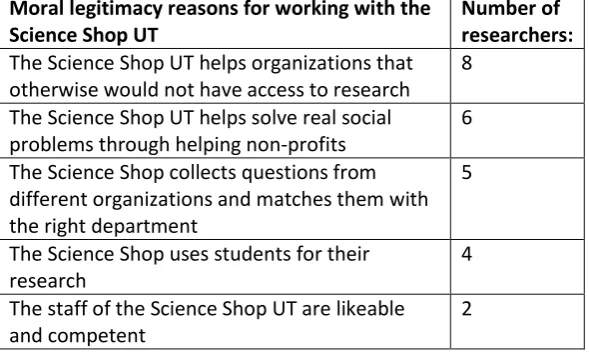
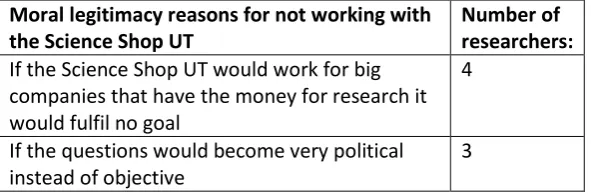
29 organization that requested the research. The researchers in question liked this even more because the Science Shop UT helps non-profit organization with socially relevant questions, but that do not have enough money to pay a commercial research institute. One of the main reasons given for not wanting to work with the Science Shop UT in the future was if they would start accepting questions from big for-profit organizations. A few researchers also specifically stated that providing research for non-profit organizations was the main reason the Science Shop UT exists. There seemed to be a strong feeling among most researchers that if the Science Shop UT would not provide research for free to non-profit organizations, these organizations would have no access to scientific research at all.
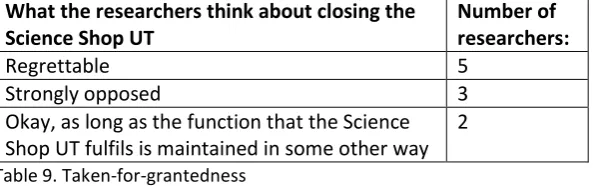
One of the most often named reasons for when it would be okay for the Science Shop to be closed is if the Science Shop would have a too low of a volume of questions each year, which suggests that consequential legitimacy also plays a role in passive support for the Science Shop UT.
4.4.2 Procedural legitimacy
Procedural legitimacy is based on what the researcher thinks of the procedures used by the Science Shop UT instead of focusing on the outputs of the Science Shop UT. According to Suchman (1995) procedural legitimacy becomes especially important when the output of an organization is hard to measure. Suchman (1995) describes procedural and consequential legitimacy as two different things and in examples like doctors who wash their hands and patient mortality rate this is clearly the case. In the case study of the Science Shop UT however, these two types of legitimacy often overlap. For example, some researchers stated that they like that the Science Shop UT uses students to do its research so that the students have a question to research for their bachelor thesis. The process of using students would fall under procedural legitimacy, whereas providing questions for bachelor theses would be consequential legitimacy.
Because of the overlap between consequential and procedural legitimacy it is no surprise that many of the procedures named by the researchers that caused the researchers to be more or less willing to work with the Science Shop share similarities to the outputs of the Science Shop described in the consequential legitimacy sub chapter. Researchers like that the Science Shop UT uses students for their research. Most of the researchers would feel less inclined to share their expertise with the Science Shop if the Science Shop would start helping for-profit companies that have the money to pay for their research or if the Science Shop would try to answer very politically colored questions instead of objective ones. Some researchers also mentioned that they like that the Science Shop collects questions, make sure that they are researchable and contact the right researcher or department.
Several of the interviewees mentioned that they like working with the Science Shop UT because it helps non-profit companies with their practical research that should be able to help the organization. The researchers however often do not know whether or not the research actually did the
30
4.4.3 Structural legitimacy
Structural legitimacy is based on what the researchers think of the organizational structure of the Science Shop UT. In the interviews there was no indication that structural legitimacy had any influence on access to resources. This may have a lot to do with the fact that the Science Shop UT is such a small organization and therefore is far less structured than a large organization with very well defined departments. The structures that the Science Shop does have, like the presence of an
advisory board, did not seem to play a role in the researchers’ decision to work with the Science Shop UT.
4.4.4 Personal legitimacy
Personal legitimacy is based on what the researchers think of Egbert van Hattem. Egbert van Hattem is the coordinator of the Science Shop UT who matches questions from clients with an appropriate student and supervisor. All of the researchers interviewed had contact with him during the time they worked with the Science Shop UT, except the ones that were approached by a student to be their supervisor and did not have much personal contact with someone from the Science Shop UT at all. Personal legitimacy did not really seem to have a strong effect on access to resources in the case of the Science Shop UT. Only two interviewees mentioned Egbert van Hattem. One described him as sympathetic and said that he likes helping Egbert van Hattem, but that whether he can help the Science Shop depends on other factors. Another researcher describes him as competent in his work, but this also does not seem to strongly influence her reason to work with the Science Shop UT. The reason that personal legitimacy does not seem to factor in access to resources that much, might be because the researchers find Egbert van Hattem competent and likeable. Suchman (1995) states that personal legitimacy can be used by a company by using an executive as a scapegoat and replacing him with a new executive as a strategy for repairing damaged legitimacy. This suggests that personal legitimacy may play a stronger role when a person is deemed to have a very low personal legitimacy. An unlikeable and incompetent leader of an organization may therefore have a stronger (negative) impact on
Moral legitimacy reasons for working with the Science Shop UT
Number of researchers:
The Science Shop UT helps organizations that otherwise would not have access to research
8
The Science Shop UT helps solve real social problems through helping non-profits
6
The Science Shop collects questions from different organizations and matches them with the right department
5
The Science Shop uses students for their research
4
The staff of the Science Shop UT are likeable and competent
[image:31.595.72.367.540.717.2]2
31
Moral legitimacy reasons for not working with the Science Shop UT
Number of researchers:
If the Science Shop UT would work for big companies that have the money for research it would fulfil no goal
4
If the questions would become very political instead of objective
[image:32.595.72.368.71.169.2]3
Table 7. Negative moral legitimacy reasons access to resources.
4.5 Cognitive legitimacy
Cognitive legitimacy is not based on an evaluation of the Science Shop UT and its usefulness for the researcher, the university or society as a whole, but instead on an understanding of the organization and a feeling that it has to be there. According to Suchman (1995) cognitive legitimacy is especially important for passive support of the organization.
4.5.1 Comprehensibility
Comprehensibility is based on whether the researcher understands why the Science Shop UT exists and whether it fits in their larger belief system. The comprehensibility of the Science Shop UT is rather high. Almost all researchers describe the role of the Science Shop UT as a way for the University of Twente to share its knowledge with the region or as fulfilling the demand for research from organizations that can otherwise not afford access to research. These functions of the Science Shop UT are often brought up as a reason why closing the Science Shop UT would be a bad thing. This indicates that a high comprehensibility does have a strong influence on passive support as described by Suchman (1995). A high comprehensibility however does not seem to be a strong reason to give the Science Shop UT access to resources compared to other types of legitimacy.
How the researchers understand the Science Shop UT:
Number of researchers:
The Science Shop UT helps the University of Twente with maintaining contact with the region
6
The Science Shop UT helps organizations that otherwise would not have access to research
8
Table 8. Comprehensibility
4.5.2 Taken-for-grantedness
Taken-for-grantedness is based on whether the researchers can think of a viable alternative to having a science shop. When an alternative is unthinkable this can be one of the strongest forms of
[image:32.595.73.368.538.636.2]