St
i
mul
at
i
ng
Wel
l
-
bei
ng
and
Per
f
or
mance
by
us
i
ng
t
he
St
r
engt
h-
Bas
ed
appr
oach:
t
he
Medi
at
i
ng
r
ol
e
of
Per
s
on-
j
ob t
University ofTwente ·Masterthesis·RoetertSteenbruggen,L.M.(Liz Maureen)
Out
of
The
Box
I
ncl
us
i
ve/
St
abl
e
Tal
ent
Out of the Box Inclusive/Stable Talent Management
Stimulating Well-being and Performance by using the Strength-Based approach: the Mediating role of Person-job fit
Author:
Name: L.M. (Liz Maureen) Roetert Steenbruggen
Supervisors:
First supervisor: Dr. J.G. (Jeroen) Meijerink Second supervisor: Dr. A.C. (Anna Christina) Bos-Nehles
In cooperation with:
Company: Royal Dutch Brewery Supervisor: Mrs. J. (Jacobijn) Boerrigter
Function: HR Business Partner Staff
University of Twente
Faculty of Behavioral Management and Social Sciences.
Master Business Administration (master track: Entrepreneurship, Innovation & Strategy)
Acknowledgements
This thesis was written for my master’s degree Business Administration at the University of Twente. I am looking back at my years as a student at the University of Twente with lots of enthusiasm. Now my masterpiece (read ‘my thesis’) is finalized, I will apply for a job where I will be really engaged in tasks that capitalize my strengths. I am looking forward to turn my talents and passion into real performance but without losing my well-being.
I could not have finalized my master’s thesis without the support and feedback from others within my environment. Therefore, I would like say thank you to some people in particular who supported me during the process. First, a special thanks goes to my first supervisor, Dr. J.G. Meijerink. After participating in the master course Global Talent Management, which inspired me about the topic talent management, we started to collaborate. Thank you for your guidance, for your creative (theoretical) ideas and for keeping a clear focus. Your critical attitude and personal way of giving advice was really helpful. Secondly, I would like to give a special thank you to my second supervisor, Dr. A.C. Bos-Nehles. Anna provided me with helpful suggestions and feedback to improve the quality of my thesis. Thank you for your interest in my work and being part of the exam committee.
Previously, as a Tour Guide I guided visitors and important relations through the Brewery. The last months, I have got the opportunity to see another point of view, namely the human being behind the organization. This is what intrigues me; how to nurture the best aspirations of a human being. I am more than grateful for having been able to do research on talent management and its further professionalization. Therefore, I would like to thank my supervisors from the participating organization, Joyce Welles, and later Jacobijn Boerrigter. They provided me with lots of ideas, gave me the opportunities to experience the real global business environment and the possibility to meet experts on talent management.
Finally, I will give all my gratitude, respect and love to my family, boyfriend, friends and peers. Thank you all for your supporting talks and trust. Enjoy reading.
Abstract
Background – Notwithstanding the fact that scholars have argued that the strength-based approach is worthwhile for further investigation, it is an under-addressed topic among both scholars as well as practitioners. More specifically, the positive phycology literature suggested that employees who perceive that they have the chance to do what they best, tend to experience a wide range of positive outcomes. Possibly, because the surpassing a focus on employee’s individual strengths that might aim at enhancing employee well-being and employee performance. Nonetheless, there is a lack of research on how the strength-based approach is related to these outcomes and through which mechanism the approach operates. This study, therefore, investigates the relationship between the strength-based approach and employee well-being and employee performance via the mediating variable person-job fit.
Purpose – This study has mainly applied the Job Demands-Resources (JD-R) theory in order to hypothesize why the key variables are related. The main research question is: “To what extent does the strength-based approach positively influence employee well-being and employee performance, and is this relationship mediated by person-job fit?”
Methodology – The data is obtained from cross-sectional sampling amongst Commercial and Staff employees working a Royal Dutch Brewery (N = 141). The proposed hypotheses are tested by the use of digital surveys. The participants rated the strength-based approach and gave their perceptions about their own well-being, performance and person-job fit.
Conclusion – The results supported a mediation model: person-job fit has a significant and partially mediating effect on the relationships between the strength-based approach and employee well-being, whereas the relationships between the strength-based approach and employee performance was fully mediated by person-job fit. Furthermore, theoretical and practical implications, along with limitations and recommendations for future research, are discussed.
“One cannot build on
weaknesses. To
achieve results, one
has to use all the
available strengths.
These are the true
opportunities”
(Drucker,
Table of Contents
1. Introduction ... 1
2. Theoretical Framework ... 4
2.1. Strength-based approach ... 4
2.2. Conceptualizing Employee Work outcomes ... 7
2.3. The Relationship between the Strength-based approach and Employee work Outcomes ... 9
2.3.1. The Strength-based approach as Job Resource ... 10
2.3.2. Job Demands-Resources theory... 10
2.3.3. Social Exchange Theory ... 12
2.3.4. Hypotheses Development ... 13
2.4. Person-job fit as Mediator between the Strength-based approach and Employee well-being and Employee performance ... 13
2.4.1. Conceptualizing Person-job fit ... 14
2.4.2. The Strength-based approach and Person-job fit ... 14
2.4.3. Person-job fit and Employee well-being ... 15
2.4.4. Person-job fit and Employee performance ... 16
2.4.5. Hypotheses Development ... 17
3. Methodology ... 19
3.1. Research design ... 19
3.2. Selection ... 19
3.3. Sample ... 20
3.3.1 Organizational context ... 20
3.4. Procedure ... 21
3.5. Measuring the Main Variables ... 22
3.5.1. Strength-based approach ... 23
3.5.2. Employee well-being ... 24
3.5.3. Employee performance ... 25
3.5.4. Person-job fit ... 26
3.5.5. Control variables ... 27
3.6. Statistical data analysis... 27
3.6.1. Common method bias ... 28
4. Results ... 29
4.1. Correlations ... 29
4.2. Testing Hypothesis ... 30
5.Discussions & Conclusion ... 34
5.1. Discussion ... 34
5.2. Theoretical implications ... 35
5.3. Practical implications ... 37
5.3.1. Recommendations for the participating organization ... 38
5.5. Conclusion ... 40
References ... 42
Appendix ... 49
Appendix I: Demographics of the Research population ... 49
Appendix II: Announcement Survey via E-mail ... 50
Appendix III: Qualtrics, Web and Phone devices ... 52
Appendix IV: Survey items and Operationalization Table ... 53
Appendix V: Control variables ... 61
Appendix VI: Factor Analysis ... 62
1
1.
1.
Introduction
The one topic that frequently emerges when talking to human resource (HR) managers is talent management (Meyers, 2015). The focus on talent management is important for an organization’s viability and competitive advantage (Gallardo-Gallardo, Dries, & González-Cruz, 2013). For the majority of organizations, talent management aims at investing in an elitist percentage of outperforming employees (e.g. exclusive talent philosophy) (Meyers, 2016). This exclusive focus narrows its view to those few people who have the capability to generate the highest return on investment (Boudreau & Ramstad, 2005). These few people are then referred to as A-players, high performers, high flyers or high potentials (Michaels, Handfield-Jones, & Axelrod, 2001). More recently, there have been calls to focus more on inclusive talent philosophy in where organizations allocate their resources equally among the entire talented workforce (Meyers & van Woerkom, 2014). This inclusive perspective draws on the “strength-based approach” described as the identification of all employees’ individual strengths and placing them in positions where they can use these strengths in an optimal way (Swailes, Downs, & Orr, 2014). However, the focus on talent management to date has been limited to empirical studies that encompass the actual application of the strength-based approach (Gallardo-Gallardo, Nijs, Dries, & Gallo, 2015). As a result, HR managers and other practitioners seem to be more inclined to promote more traditional (mainly exclusive) organizational activities (CIPD, 2012; Meyers, 2015), as long as there is no hard empirical evidence that an inclusive talent philosophy is beneficial above and beyond the exclusive variant (Gallardo-Gallardo et al., 2013). This study will respond to this call to widen the talent management playing field by contributing to a better theoretical and empirical understanding of the positive effects of the strength-based approach.
2
For instance, the focus on employee’s strengths energizes employees and makes them feel good about themselves (Quinlan, Swain, & Vella-Brodrick, 2012), fosters them to express their authentic self, and induces them to use their abilities, thereby increasing the chance that they are happier and more excited (Meyers & van Woerkom, 2014). At the same time, doing what one does best leads to increased productivity (van Woerkom & Meyers, 2015), and ultimately, organizational performance (Nijs, Gallardo-Gallardo, Dries, & Sels, 2014). As the examples demonstrate, focusing on strengths might help to achieve these dual goals of high performance in combination with well-being. Based on the Job Demands-Resources (JD-R) theory, this study intends to explain why the strength-based approach can predict employee well-being and employee performance (Bakker & Demerouti, 2014).Despite the fact that a relative small number studies have investigated the pathways through which such strengths or strength-based approaches operate (van Woerkom & Meyers, 2015), further questions are raised about how using strengths influences positive work outcomes. One reason could be that scholars missed important mediators. More attention should be paid to possible mediating variables that transmit the effect of the strength-based approach to employee work outcomes. In searching for explanations, it has been argued that the strength-based approach will help employees to better fit with the job (Meyers & van Woerkom, 2014), which in turn contribute to increased employee well-being (Choi, Tran, & Kang, 2016) and performance (Cable & DeRue, 2002). This raises further questions how in particular the strength-based approach leads to these positive work outcomes. However, there is still a conspicuous absence of existing research that examines the potential mediating role of person-job fit in this regard. To fill this void, the purpose of this present study is to examine the extent to which the strength-based approach positively relates to employee well-being and employee performance. Additionally, the secondary objective is to examine how the strength-based approach and work outcomes are related that could be explained by the person-job fit. As a result, the central research question of this study is proposed as follows:
To what extent does the strength-based approach positively influence employee well-being and employee performance and is this relationship mediated by person-job fit?
3
strength-based approach and employee work outcomes, by the transmitting effects of person-job fit that help better explain through which the approach operates. Based on the empirical work, HR managers and other practitioners will then be more convinced to support a strength-based approach above the exclusive variant. The current lack empirical evidence prevents organizations from implementing policies that can contribute to both employees’ flourishing as well as organizational flourishing.4
2.
2.
Theoretical Framework
2.1. Strength-based approach
The strength-based approach is rooted is rooted in an inclusive/stable talent philosophy, which is characterized by the belief that each and every individual employee possesses stable, positive traits, referred to as “strengths”. The approach suggests that talent is seen as an inclusive and stable entity that all employees are born with (Meyers & van Woerkom, 2014, Fig.1). First of all, the inclusive understanding of talent means that everyone has particular talents. In many other studies in the field of talent management, the concept of talent is seen as exclusive (see Fig.1). This approach was used as a justification for only approaching a few high performers (Collings & Mellahi, 2009). Instead, the inclusive focus sees the entire workforce as talented, in a way that every individual possesses certain positive qualities (Buckingham & Vosburgh, 2001). Secondly, talent as stable entity can be conceptualized as trait-like constructs (i.e., individual attitudes and/or behavior) that are stable across situation and time (Peterson & Seligman, 2004). They belong to a person, like a blood type does (Meyers & van Woerkom, 2014). As such, the strength-based approach incorporates an implicit person theory that talent sees as the entire workforce and which is supposed to be stable over time.
5
The literature on strengths is subsequently located in the “science of positive psychology” (Meyers & van Woerkom, 2014). More specifically, it incorporates an on-going understanding of how to nurture the best aspirations of human being, as in everybody (Mutrie & Faulkner, 2004). Strengths are defined here as “potentials of excellence” (Biswas-Diener, Kashdan, & Minhas, 2011, p.106) and as “a natural capability for behaving, thinking, or feeling in a way that allows optimal function and performance in the pursuit of valued outcomes” (Linley & Harrington, 2006a, p.88). Examples of strengths are creativity, kindness, prudence, gratitude and justice (Peterson & Seligman, 2004). These strengths energize people (rather than exhausting them) and the use therefore contributes to individual’s maximal flourishing (Meyers, 2016). As Drucker (1967) mentioned earlier: “The unique purpose of organizations it to make strengths productive… one cannot build on weaknesses. To achieve results, one has to use all the available strengths… These strengths are the true opportunities” (Drucker, 1967, p.60). In fact, it has been said that strengths come so natural to employees that they are neither aware nor able to describe their strengths or to describe them of their close colleagues (Rath, 2007). Due to this fact, organizations should give assistance to employees to find, and consequently to employ their strengths in positions that provide the best fit and opportunity for employees to use and refine their talents (Swailes et al., 2014). Based on the work of Meyers and van Woerkom (2014), this study highlights the importance of a deliberately design of talent management system that aims at helping employees to capitalize their strengths at work. In this regard, the three practices of the strength-based approach to talent management consist of (1) strength identification, (2) strength deployment and (3) managing around weaknesses.6
employees to create a mental representation about unconscious patters (Roberts, Spreitzer, Dutton, Quin, Heaphy, & Brianna, 2015). For example, by asking the direct working environment for feedback about positive qualities and strengths can help employees to become aware of their particular strengths (van Woerkom & de Bruijn, 2016). As such, strength identification concerns organizational activities (i.e., questionnaires or exercises) that help employees to identify individual strengths (Meyers & van Woerkom, 2014).The second practice of the strength-based approach is strength deployment. This involves organizational activities aimed at stimulating individual employees to actually “use their strengths more and refine them” (Meyers & van Woerkom, 2014, p.197). Under the strength-based approach, strength deployment has fewer distinct forms than the inclusive/developable talent philosophy (i.e., training, development opportunities), since it is assumed that strengths are enduring and not developable. However, in this approach, strength deployment practices in are based on increasing the fit between the natural talents of employees and the specific job (Buckingham & Vosburg, 2011). For instance, organizations could give assistance to employees in designing their job or career in such way that they are positioned in the place that allows them to cultivate their strengths. In this way, the fraction of time that employees can be spent on applying their strengths is maximized. Once an individual is placed in the right position, HR or talent managers can stimulate employees by coaching activities to raise their strengths with their consciousness, celebrate and refine it (Linley & Harrington, 2006b). As a consequence, employees will be more willing to fully embrace and expand on their strengths even further (van Woerkom et al. 2016a). In turn, this increases their motivation and makes them less prone to exhaustion and, eventually, to burn-outs (Meyers & van Woerkom, 2014). So, all in all, strength deployment practices help employees to literally deploy strengths, and thereby it aims to find positions that give the best fit and the most opportunities for employees to refine their talents.
7
Founder of Virgin Group wrote in his autobiography “Losing my Virginity” about the idea of working around weaknesses: “Throughout my life, I have always needed somebody as a counterbalance, to compensate for my weaknesses, and work of my strengths. Jonny and I were a good team. He knew who we should interview and why. I had the ability to persuade them to say yes, and the obstinacy never to accept no for an answer” (Branson, 2011, p.38). The main idea is to manage around weaknesses to make employees deficits less relevant, which enables employees to build more intensively on their positive strengths.These three mentioned practices of the strength-based approach to talent management are deliberately designed in such way that they jointly represent the strength-based approach (Meyers & van Woerkom, 2014). They represent a coherent talent management system (or bundle) that is interrelated and intended to achieve organizational goals (Jiang et al., 2012). For instance, the combination of these strength-based practices to talent management jointly enable organizations to achieve underlying goals, which is in this case helping employees to capitalize their strengths at work. The practices are so combined that they have a jointly and bigger effect on capitalizing strengths, than the sum of each individual practice alone (Delery, 1998; Jiang et al., 2012). This means that the above three practices are deemed more effective and synergistic once combined in a coherent and integrated system.
The positive psychology literature suggest, with regard to the dual goal of striving for increased performance without losing sight of well-being, that strength interventions such as the strength-based approach are likely to influence employee work outcomes (Murphy, 2014). Until now, this study has addressed three practices to talent management that are relevant to make up the strength-based approach. Subsequently, two outcomes are addressed that are particularly relevant to understand why the strength-based approach can have promising effects. These outcomes are employee well-being and employee performance.
2.2. Conceptualizing Employee Work outcomes
8
been divided into hedonic and eudaimonic view. Hedonic views of happiness are described as pleasant feelings, while eudaimonic views involve doing something virtuous, morally right and/or growth producing (Fisher, 2010). As such, when employees are happy with the job, it is likely that employee feel more fulfilled.The second dimension is health well-being, which goes along with the energy level during the working day. Contrastingly, health unwell-being is concerned with workload and work intensification that might lead to emotional exhaustion, need for recovery, stress and eventually burn-outs (van de Voorde et al, 2012). In this case, unwell-being might beharmful for both employee and employer because it increases the likelihood of stress and sickness. The final dimension is relationship well-being. This is characterized by employee interactions and the quality of relationships with colleagues; and the connection with managers and the organization as a whole (van de Voorde et al., 2012). More specifically, such interactions incorporate situations in where there is a helpful, pleasant and collegial work atmosphere (Grant, Christianson, & Price, 2007). This study treats employee well-being as one of the dependent variables. It will hereafter be referred to as employees’ subjective experiences at work in terms of happiness, health and relationships well-being.
In addition to employee well-being, employee performance is also treated as dependent variable. The concept of employee performance is based on the extent to which employees execute their job duties as well as job responsibilities. To describe performance, the theory of Kluemper, DeGroot and Choi (2013) is used. Kluemper and colleagues (2013) distinguished two forms of behavior: in-role behavior and extra-role behavior. The first type of behavior is in-role behavior, which regards proficiency to achieve core technical activities (Williams & Anderson, 1991). These are commonly accepted norms important for the job, for example responsibilities specified in the job description (Kluemper et al., 2013). The second type of behavior is extra-role behavior, which refers to behavior that goes beyond the call of duty and job requirements (Lee & Allen, 2002). Based on the organizational citizenship behavior (OCB) theory of Lee and Allen (2002), extra-role behavior can be explained as employees’ willingness to give time to help or assist others. To conclude, employee performance is the second dependent variable in this study, which is described as both performance in core technical activities as well as in activities that go beyond the job requirements.
Both employee well-being and employee performance could potentially be influenced by the strength-based approach. Hence, the following section builds hypotheses around the argument that the strength-based approach positively influences relevant employee work outcomes as well-being and performance in this regard.
9
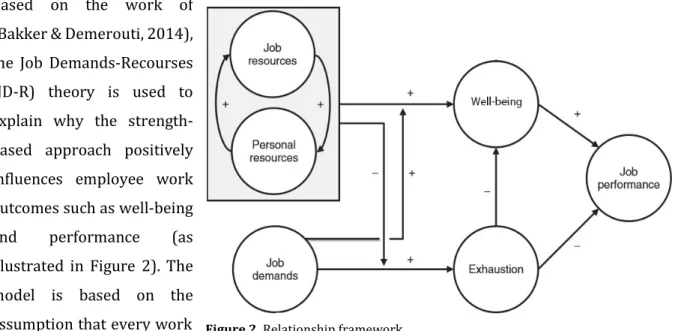
2.3. The Relationship between the Strength-based approach and Employee work Outcomes Based on the work of(Bakker & Demerouti, 2014), the Job Demands-Recourses (JD-R) theory is used to explain why the strength-based approach positively influences employee work outcomes such as well-being
and performance (as
illustrated in Figure 2). The model is based on the assumption that every work environment incorporates
occupation-specific job demands and job resources. First,job demands are aspects of the job that require physical and/or psychological efforts or skills. Hence, these demands can be seen as negative predictors for well-being and performance. For instance, examples of job demands are workload, emotional demands or work-home conflicts (Bakker & Demerouti, 2007). On the contrary, job resources refer to aspects of the job that are (1) functional in achieving goals, (2) stimulating personal growth and/or (3) effective coping with job demands (Bakker, Demerouti, & Verbeke, 2004). Job resources are intrinsically and/or extrinsically rewarding and motivating and thus positive predictors for employee well-being and performance. Examples of job resources are career opportunities, team atmosphere, supervisor support, autonomy or feedback (Bakker, Demerouti, & Verbeke, 2004). Furthermore, another type of resource that is an important predictor for motivation and well-being is personal resources. “Personal resources are positive self-evaluations that are related to resiliency. They foster employees’ ability to exercise influence over their environment” (Bakker & Demerouti, 2014, p.12). These personal resources are reciprocal with job resources over time (as shown in the grey frame, Figure 2). Hence, they have the potential to alleviate the unfavorable effects of job demands (Xanthopoulou, Bakker, Demerouti, & Schaufeli, 2009). Examples of these personal resources are self-esteem, self-efficacy, hope, optimism, authenticity and resilience (Hobfoll, 2002). In particular, the JD-R model (Figure 2) assumes that both job demands and job/personal resources may jointly (positive or negative) affect employee health, well-being and performance (Schaufeli & Taris, 2014). As such, this means that well-being depends on the balance between the job demands and the resources (i.e., job and personal). On the other hand, unwell-being and exhaustion is a result of an imbalance between those job demands and resources (Bakker & Demerouti, 2007).
10
2.3.1. The Strength-based approach as Job Resource
The strength-based approach can be seen as of job resource, because it has potential to help employees (1) to realize work-related goals, (2) to stimulate individual growth and (3) help to cope with job demands. More specifically, the strength-based approach encourages employees to apply their strengths that are in line with their abilities. In that way, employees could achieve their goals more easily in a fulfilling manner (van Woerkom & Meyers, 2015). These goals, or the manner in which these goals are reached, will potentially affect employees’ self-concordance (Vasalampi, Salmela-Aro, & Nurmi, 2009). As a consequence, self-concordance increases the likelihood that they want to invest goal-directed effort. This in turn helps employees realizing work-related goals (Sheldon & Elliot, 1999). Moreover, strengths come so natural to employees that they learn more easily when they gain the opportunity to play on their strengths. Ultimately, learning curves tend to be steeper (Peterson & Seligman, 2004). Furthermore, managing around weaknesses and applying strengths even further will make it less likely that employees experiences high levels of job demands. This is because employees who have many resources available can better mitigate the negative effects of high demands (van Woerkom, Bakker, & Nishii, 2006b). As such, the strength-based approach accepts the definition of job resources and can therefore be conceptualized as job resource.
2.3.2. Job Demands-Resources theory
11
demands, and thereby more effective in carrying out the tasks. Hence, it fosters her performance outcomes in the end (Bakker & Demerouti, 2007). Secondly, the process of strength deployment12
unique capabilities and contributions to the team as well as to the organization. This might lead to a more collegial atmosphere (Meyers & van Woerkom, 2014). Above all, since organizations treat all employees equal, the strength-based approach benefits from the so-called “mark-effect”, (Gallardo-Gallardo et al., 2013). The mark-effect increases social welfare and social atmosphere. In addition, the strength-based approach is supposed to lead to a more pleasant working environment, characterized by openness, trust and well-being (Dries, 2013). All in all, a strength-based approach emphasizes a more balanced approach; it cultivates employee strengths that are energizing, and minimize demands by managing around employee’s weaknesses. The emphasis on job resources makes employees more effective in coping with job demands, which in turn, bring job demands and job resources in balance. In the end, this leads to enhanced well-being and performance.2.3.3. Social Exchange Theory
13
2.3.4. Hypotheses Development
In support of these claims, research evidence so far corroborates the theoretical prediction that the strength-based approach positively influences employee well-being in this regard. For instance, a recent experimental study of Meyers and van Woerkom (2016) found that various employees who participated in a half-day training, aimed at detecting and deploying individual’s strengths, have felt increased levels of work-related well-being. In another study by Rath (2007), employees who participated in strength-based interventions were six times as likely to be engaged with their job if they focused their strengths. In addition, Bakker and Demerouti (2014) conducted a strength-based intervention and added that strength interventions have led to a significant increased level of happiness and reduced depressives. Van Woerkom et al. (2016b) added with their multi-level analysis that workload and/or high emotional demand experienced as well as the level of absenteeism was reduced by strength-based interventions. Furthermore, Wood, Linley, Maltby, Kashdan & Hurling (2011) found comparable results with their longitudinal research and they stated that the use of strengths have led to decreased stress levels and greater vitality over time. Based on the theoretical arguments and the research evidence on strength, the following hypothesis is formulated:
Hypothesis 1a: The strength-based approach is positively related to employee well-being.
To date, there is only a little volume of empirical research that investigated the hypothetical links between the strength-based approach and employee performance. One these few studies was conducted by van Woerkom and Meyers (2015), who revealed that strength-based psychological climate was positively related to in-role and extra-role performance and mediated by positive affect. In another study, van Woerkom et al. (2016a) found that using strengths was significantly related to self-rated performance (r = .30, p < .01). Based on the theoretical rational and empirical findings, the following is therefore expected:
Hypothesis 1b: The strength-based approach is positively related to employee performance.
2.4. Person-job fit as Mediator between the Strength-based approach and Employee well-being and Employee performance
14
employee performance. In another study by van Woerkom and Meyers (2015), for instance, it was revealed that strenght-based psychological climate was positivley related to in-role and extra-role performance, and mediated by positive affect. This study investigates the role of person-job fit as possible mediator, which is particularly relevant in understanding how the strength-based approach leads to increased employee well-being and employee performance.2.4.1. Conceptualizing Person-job fit
According to human resource literature, person-job fit can be defined as the match between an employee’s abilities and the requirements of the job on the one hand, and the desires of an employee and the attributes of a job on the other hand (Mulki, Jaramillo, & Locander, 2006). By the same token, it includes the demands-abilities perspective and the needs-supplies perspective (Edwards, 1991). First, the demands-ability perspective describes whether an employee has the knowledge, skills and abilities (KSA) to meet the demands in order to carry out the tasks of the job. Second, the needs-supplies perspective describes whether a job meets the needs of an individual in such a way that employees’ preferences are satisfied (Edwards, 1991). Within this study, the demands-abilities perspective is more suitable, since the strength-based approach focusses not directly on employees’ desires and preferences. Instead, the strength-based approach is directed at engaging employees in tasks that capitalize on their strengths and thus employees’ abilities. The demands-abilities perspective is used whereby person-job fit is seen as the extent to which employee’s KSA fit with the requirements of specific job (Mulki et al., 2006). As such, demands-ability perspective can be seen as person-job fit. Furthermore, it can be assumed that person-job fit is seen here as a balance between job demands and job resources. In other words, person-job fit refers to the extent to which job resources such as employee’s KSA are in balance with job demands such as the requirements of specific job (Mulki et al., 2006). By doing so, the following sections build again on the JD-R theory in order to explain why person-job fit influence employee well-being and employee performance.
2.4.2. The Strength-based approach and Person-job fit
15
consultant from the previous examples that has difficulties with negotiating with clients. She may go about her tasks by making small adjustments in her work, by exchanging tasks with colleagues, or by collaborating with them. This can help her to put tasks in line with their abilities (Meyers, 2016). This maximizes the opportunity for the business consultant to carry out activities that emphasize her strengths even further. According to the JD-R theory, the strength-based approach reinforces personal resources such as self-efficacy or resilience over the long term, which in turn, can help the consultant to master tasks. This helps employees to meet their job requirements and to perform the job at an acceptable level, which, in accordance to employee’s perception, increases their person-job fit. As such, the strengths-based approach increases person-job fit, because it capitalizes the employee in tasks which are aligned with strengths (or abilities).There is no empirical support from studies that investigate why the strength-based approach is related to person-job fit. It has, however, been argued that strength-based support contributes to a better congruence between an employee’s skills and the demands of the job (van Woerkom et al., 2006b). According to positive psychology literature (Buckingham & Vosburgh, 2001), it has been theoretically considered that using strengths have led to increases on the match between person’s abilities and the job. Despite that little empirical support is found, this study supposes that the strength-based approach is related to person-job fit.
2.4.3. Person-job fit and Employee well-being
16
demands, i.e. the person-job fit, has the potential to decrease emotional exhaustion and increase well-being and happiness in such a situation.In support of these claims, empirical evidence reveals that person-job fit leads to employee well-being. For example, the study of Kristof-Brown, Zimmerman and Johnson (2005) found a correlation between person-job fit and organizational commitment (r = .47), intention to quit (r = -.46) and job satisfaction (r = .56). In addition, Choi and colleagues (2016) explored the relationship between person-job fit and well-being. The researchers proved the positive relationship between person-job fit and employee well-being, which was supported (ß = .337; p < .01) (Choi et al., 2016). Similarly, using SEM analysis the study of Mulki et al. (2006) found that person-job fit is negatively related to emotional exhaustion (y = -0.43, t = -5.4), and positively related to job satisfaction (y = -.34, t = 3.7). All in all, these theoretical and empirical studies demonstrate supportive findings that person-job fit is positively related to employee well-being.
2.4.4. Person-job fit and Employee performance
Besides influencing employee well-being, person-job fit also has the potential to contribute to employee performance. To illustrate this idea, positive self-evaluations serve as personal resources, which have a stimulating role in achieving work-related goals and make employees more effective in performing the job at an acceptable level (Choi, Tran, & Kang, 2016). For example, the same business consultant from the previous examples perceives a close fit between her abilities and her job demands (Mulki et al., 2006), and as mentioned before, she might frequently experience positive experience. As a consequence, she will feel confident about her abilities, which will also generate feelings of self-efficacy (Xie & Johns, 1995). This might, in turn, contribute to individual flourishing and enables her to generate higher performance results (Meyers, 2016). In addition, these positive feelings might then motivate her to show initiative toward others (van Woerkom & Meyers, 2015). This link can be also explained by the SET, which suggest that when the business consultant has a good person-job fit, she has to offer an equally valuable service in return (Cropanzano & Mitchell, 2005). In other words, the business consultant tends to reciprocate with OCB such as assisting others, showing goodwill or protecting the organization against negative opinions (Lee & Allen, 2002). Therefore, the balance between employees’ abilities and job requirements (better referred to as person-job fit) enables employees to increase task performance and stimulates them to reimburse with OCB.
17
performance (r = 0.478, p< 0.01). Li and Hung (2010) found comparable results and showed a high correlation with person-job fit and performance. In other studies, it has been found that self-efficacy is related to in-role behaviors (Schaufeli & Taris, 2014) and significant relationship between self-efficacy and extra-role behaviors (r = 0.35, p < 0.01) (Somech & Drach-Zahavy, 2000).2.4.5. Hypotheses Development
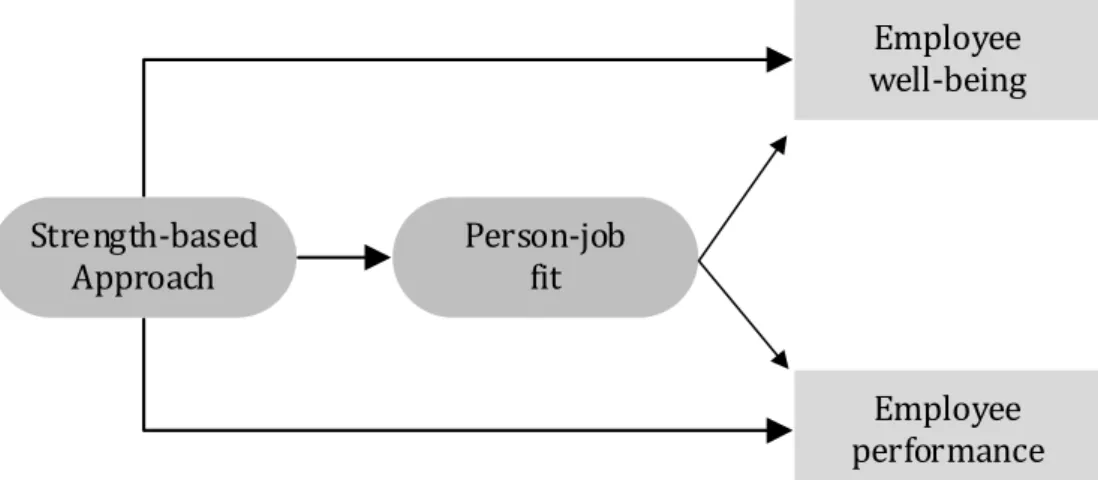
Given that employee well-being and employee performance are linked to person-job fit, and both of these outcomes are related to the strength-based approach (as reflected in Hypotheses 1a and 1b), this study argues that the strength-based approach has some potential to increase employee well-being and employee performance. However, the presence of the HRM or in this case talent management in itself does not do the work in increasing employee well-being and performance. Instead, talent management activities should help employees to better fit their job and only then, it will increase employee well-being and performance. Based on this reasoning, the present work argues that person-job fit will mediate the relationship between the strength-based approach and employee well-being and employee performance.
By building on theoretical rationale of the JD-R, it could be supposed that there are more possible mediator variable(s) besides person-job fit that offers possible explanations why the strength-based approach lead to employee work outcomes. The JD-R theory, for instance, suggests that job resources such as the strength-based approach are driven by personal resources, which in turn, have a potential to influence employee well-being and employee performance. In addition, according to the study of van Woerkom and Meyers (2015), strength interventions operate through positive affect towards employee work outcomes. So more specifically, other positive mediator variable(s) such as personal resources (Bakker & Demerouti, 2014) or positive affect (van Woerkom & Meyers, 2015) can also help to explain these focal relationships. As such, person-job fit, by default, partially mediates the relationship between the strength-based approach and employee well-being and employee performance. Therefore, the following hypotheses are given:
Hypothesis 2a: Person-job fit partially mediates the relationship between the strength-based approach and employee well-being.
18
Strength-based Approach
Employee well-being
Employee performance Person-job
fit
19
3.
3.
Methodology
3.1. Research design
The main purpose of this study was to examine (1) the extent to which the strength-based approach is related to employee well-being and employee performance and to measure (2) whether person-job fit mediates this relationship. To test to proposed hypotheses, an explanatory and quantitative research design was used. An explanatory research was chosen because it is one of the most feasible methods that help to establish a statistical/correlational relationship between variables (Saunders, Lewis, & Thornhill, 2009). The design of the research was based cross-sectional data, with one data source, which consist of a survey measuring the perceptions of employees of the Royal Dutch Brewery (Babbie, 2012). Through the use of a survey, the systematic and standardized manner of questioning allowed to target a broad variety of respondents within a relative short period of time (Saunders et al., 2009).
3.2. Selection
20
3.3. SampleIn the first place, the empirical study intends to approach the entire workforce according to the inclusive nature of this study (e.g., all employees are seen as “talent”). However, in collaboration with the responsible HR Business partners it was decided to exclude the Business Units Wholesale and Operations from the research population, because these Business Units recently participated in a survey. The demographic information (as illustrated in Appendix I) of the research population is as follows: 64.5% males, 35.5% females. With regard to the average age, 21.3% were aged 18-30 years; 29.8% were aged 31-40 years; 28.4% were aged 41-50 years; 18.4% were aged 51-60; 2.1% were aged above 61 years. Furthermore, 5.0% had earned MAVO/LBO/VMBO degree; 15.6% had earned HAVO/MBO/VWO degree; 39% had earned HBO degree; 40.4% had earned WO degree. Next to this, 7.5% had job tenure less than one year; 48% had job tenure of one to ten years; 44% had job tenure of more than ten year. Finally, the majority of the respondents worked in sales (37.6%), followed by finance (28.4%), marketing (14.9%) staff others (9.9%) and HR (9.2%). In sum, the research population consists of highly educated group in which most of them were more than five years employed. Age was equally distributed. Gender diversity, meanwhile, is not equally distributed.
3.3.1 Organizational context
21
the possibility to discuss the strength-based approach and its practices, and the possible effects it has on employee outcomes.3.4. Procedure
The online questionnaire was developed in the web-based tool “Qualtrics”. The questionnaire was initially written in Dutch and translated to English. Two native English speakers were appointed to translate the items from English to Dutch and back again to make sure that the items measure what they were intended to measure. Where possible, this study used existing scales to measure the four constructs. One new scale was developed, because there was no measure for managing around weaknesses from the construct strength-based approach. In order to verify the newly created scale, a pilot test was executed aimed at to pre-testing both the new scale and the items of the entire survey. In this way face and content validity was tested (Cooper & Schindler, 2003). This pilot version was distributed among ten employees from departments that were excluded from the research population. Existing literature was reviewed to create a new scale, after which the pilot test members were given the definition of managing around weaknesses. After developing a new scale, the pilot members were requested to classify the items. A think-aloud procedure was followed to gather data of testing the usability of the research method. The pilot test members were then asked to mention whatever comes to their mind as they read the questions of the pilot survey. This gave insights into members’ process of thinking process, and by doing so, it also offered also the opportunity to identify unclear and/or ambiguous questions. In case of unclear questions, the pilot test members were asked to clarify the problems with interpreting the questions, and alternative questions were discussed. After the pilot phase, the questions were phrased and added where necessary. For instance, the items “This organization stimulates to let colleagues with complementary strength profiles join forces such that we can complement each other unique strengths” was added in the evaluation phase. Some items were reworded in order to make them easier to read. Examples of these items were all items of relationship well-being, which belongs to the construct employee well-being. These items were reworded from question item into a statement. Furthermore, some items of managing around weaknesses of the construct strength-based approach were compound items and so they were reworded. All items of the questionnaire can be found in the Appendix IV.
22
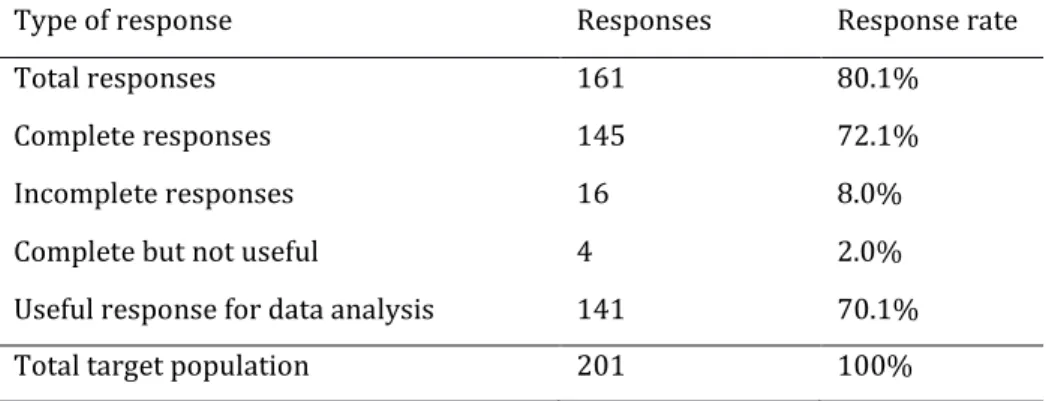
was included. The reason behind the introduction was that employees knew the researcher already and made it possible to enhance the willingness amongst the employees to complete the questionnaire. Moreover, a competition element was added, as the department with the relative highest response rate would win a dartboard. Moreover, the purpose of the research was communicated, namely: “examining the extent to which employee’s experience that the organization capitalizes their strengths and which effects it consequently has on their well-being, performance and person-job fit”. Furthermore, the opportunity was given to receive a personal report as well as a report on department level in order to make strengths and development opportunities visible. These reports could serve as input and guideline for future (career) developments. Participation was voluntary, privacy was granted, and responses were kept strictly confidential. These aspects were important in order to guarantee a feeling of trust toward the researcher. Besides, it gives the participants the opportunity to answer at their own convenience, which was essential for the self-assessment part (Babbie, 2012).One reminder was sent in the following week. Out of the 201 surveys were 161 were returned after eight working days, which formed a sufficient response rate to start with gathering the data. Sixteen questionnaires were deemed to be incomplete, because these surveys were not completely filled out by the respondent. Four questionnaires were completed but not useful, because the answers were unrealistic or incorrect (i.e., constantly answering with neutral). By checking the responses, it was decided to keep the outlying values, because the opinions of these outliers belong also to research population. This all together led to a response rate of 70.1% (Table 1).
Table 1. Response rates survey
3.5. Measuring the Main Variables
Strength-based approach, employee well-being, employee performance and person-job fit were measured with 45 items. A conceptualization was made in which each construct was defined. Based on these theoretical conceptualizations, where possible, existing measurement scales were selected that fitted best with the theoretical concepts (as reported in Appendix IV). Here in
Type of response Responses Response rate
Total responses 161 80.1%
Complete responses 145 72.1%
Incomplete responses 16 8.0%
Complete but not useful 4 2.0%
Useful response for data analysis 141 70.1%
23
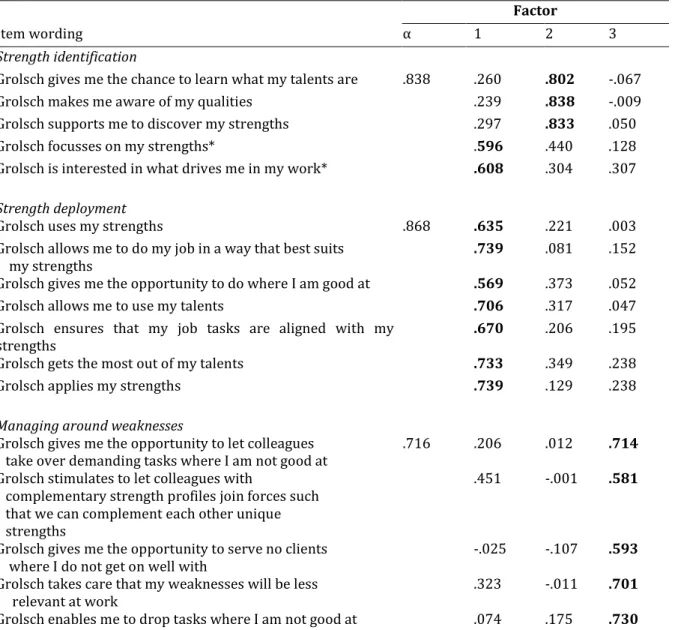
Appendix IV, an operationalization matrix is added in order to show the fit between the conceptualization and the operationalization (and the measurement scale of each selected variable/construct). Furthermore, all of the items were measured on a five-point Likert scale, ranging from 1 (“strongly disagree”) to 5 (“strongly agree”). A five-point Likert scale was used because for a number of reasons. First of all, through using five-point scales for all items made it possible to compare the constructs easily. Moreover, previous research has shown that a five-point Likert scale is readily understandable to respondents and enables them to express their perceptions (Marton-Williams, 1986). The literature suggests that five-point Likert scales are simple and easy to use for respondents (Neumann, 2016). It makes questions less confusing to interpret for them (Hayes & Hayes, 1992). The five-point Likert scales do not only decrease the “frustration level”, but they also enhance the response rate and quality of the returned surveys (Lissitz & Green, 1975).A principal component analysis (PCA) with Varimax rotation in SPSS was used for each variable. The Varimax procedure was executed because it was assumed that the factors were uncorrelated. Additionally, it enhances the interpretability of the factors. Factor analysis was performed to test whether the items that were intended to measure the constructs indeed load on the separate components (Fields, 2009). To test convergent validity, the confirmatory factor analysis (CFA) was carried out to test the degree to which the measures that should be related were indeed empirically related (Matsunaga, 2010). Besides, CFA intended to test prior ideas of underlying factors were derived from the literature. Eigenvalues greater than 1.00 and items that loaded higher than .35 on the intended factor and lower than .35 on any other were retained. Items loadings were deleted if they loaded on other factors than they were supposed to (Fields, 2009). Furthermore, a secondary FA created an item bundle in which a small group of items share the common construct (Rosenbaum, 1988). The tables in Appendix VI represent the results of the CFA, Cronbach’s alphas (α), all items, and factor loadings.
3.5.1. Strength-based approach
Based on the theoretical conceptualization of the constructs and existing studies (i.e., Meyers, 2016; van Woerkom et al., 2016a) this study followed three measurement scales for the strength-based approach. Strength identification (Meyers, 2016) and strength deployment (van Woerkom
24
phase, the items were adapted, resulting in five items that measured managing around weaknesses (for further of the explanation pilot procedure, see previous section, Section 3.2). The Cronbach’s alpha (α) of the all items of the strength-based approach was .896.Strength identification was measured with five items from the study of Meyers (2016). A sample item of the scale of Meyers (2016) was “This organization supports me to discover my strengths”.
Items were rated on a five-point Likert scale (1 = strongly disagree, 5 = strongly agree). Cronbach’s
α was .838.
Strength deployment was measured with seven items based on the study of van Woerkom et al. (2016a). A sample item was “This organization allows me the opportunity to do what I am good at”. Responses were given on a five-point Likert scale. Cronbach’s α was .868.
Managing around weaknesses was measured with a newly created six-item scale. A sample item was “This organization stimulates to letting colleagues with complementary strength profiles join forces such that they can complement each other’s unique strengths” (1 = strongly disagree, 5 = strongly agree). Cronbach’s α was .716.
In this study, all measures related to the strength-based approach (i.e., strength identification, strength deployment, managing around weaknesses) were taken together in a factor analysis in order to test whether they were convergent (as illustrated in Table 6 – Appendix VI). Together, the three factors explained 58.34% of the variance. Factor one (Eigenvalue = 6.71) was labeled as strength deployment (nine items) and explained 27.84% of the variance. The second factor (Eigenvalue = 2.15) was labeled as strength identification (three items) explained 16.73% of the variance. Finally, factor three (Eigenvalue = 1.06) was termed as managing around weaknesses (five items) and explained 13.77% of the variance. However, two items of strength identification did not load on the intended scale, but load on strength deployment (Table 6 – Appendix VI). The reason behind their divergence might be that those items asked almost the same. Instead of computing among strength identification, those two deviated items were computed among strength deployment. A second factor analysis resulted in a factor solution that all factors, as an item bundle, loaded on the same underlying factor (Eigenvalue =1.840) and which explained 61.322% of the variance (Table 7 – Appendix VI), meaning that the three measures combined measure the construct strength-based approach.
3.5.2. Employee well-being
well-25
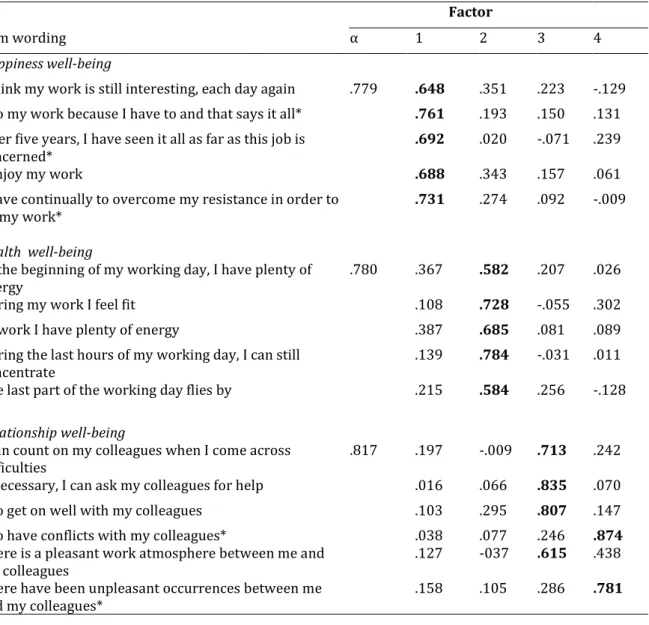
being. The three measurement scales of the Questionnaire on the Experience and Assessment of Work (“VBBA”scale; van Veldhoven, Prins, van der Laken, & Dijkstra, 2015) were used, because these scales fitted well with the conceptualization of the construct (as showed in Table 5 operationalization matrix –Appendix IV). Cronbach’s alpha α of the all items of employee well-being was .854.Happiness well-being was measured with five items (van Veldhoven, Prins, van der Laken, & Dijkstra, 2015). A sampling item was “I have to continually overcome my resistance in order to do my work”. Responses were given on a five-point Likert scale. Cronbach’s α was .779.
Health well-being was measured with five items of van Veldhoven et al. (2015). A sampling item was “During the last hours of my working day, I can still concentrate” (1 = strongly disagree, 5 = strongly agree). Cronbach’s α was .780.
Relationship well-being was measured with six items of van Veldhoven et al. (2015). A sample item was “I can count on my colleagues when you come across difficulties in my work” (1 = strongly disagree, 5 = strongly agree). Cronbach’s α was .817.
This study investigated convergent validity, by bringing all items of theoretically constructs employee well-being (i.e., happiness, health, relationship) together in a factor analysis (as illustrated in Table 8 – Appendix VI). Together, the four factors explained 63.54% of the variance. Factor one (Eigenvalue = 5.39) was labeled as happiness well-being (five items) and explained 18.37% of the variance. The second factor (Eigenvalue = 2.43) was labeled as health well-being (five items) explained 17.23% of the variance. The third factor (Eigenvalue = 1.19) was termed as relationship well-being (three items) and explained 16.30% of the variance. Finally, factor four (Eigenvalue = 1.15) had no label (two items), which explained 11.63% of the variance. These two items were negatively formulated, which could be the reason that they both loaded on a fourth factor. Empirical reasons should take priority over theoretical considerations, and by doing so, the two items representing the fourth factor had to be deleted. A second factor analysis (Table 9 – Appendix VI) resulted in an item bundle with a factor solution that all three factors loaded on one factor (Eigenvalue = 1.810) that explained 60.238% of the variance. This indicates that the three factors are convergent and together measure employee well-being.
3.5.3. Employee performance
26
(as showed in Table 5 operationalization matrix –Appendix IV). Cronbach’s alpha α of the all items of employee performance was .802.In-role job performance was measured on five-item scale of Williams and Anderson (1991). An example of a sample item was “I adequately complete assigned duties” (1 = strongly disagree, 5 = strongly agree). The Cronbach’s α was .823.
Extra-role performance (or “Organizational Citizenship behaviour”) was measured on a five-item scale adopted of (Lee & Allen, 2002). A sample five-item was “I willingly give your time to help others who have work-related problems” (1 = strongly disagree, 5 = strongly agree). Cronbach’s alpha (α) was .724.
In this study, all measures related to employee well-being (i.e., in-role, extra-role) were taken together in a factor analysis in order to test whether they were convergent (as illustrated in Table 10 – Appendix VI). Together, the two factors explained 54.53% of the variance. Factor one (Eigenvalue = 3.73) was labelled as in-role performance (five items) and explained 29.92% of the variance. The second factor (Eigenvalue = 1.73) was termed as extra-role performance (five items) explained 24.61% of the variance. A second factor analysis (Table 11 – Appendix VI) resulted in a factor solution that both factors loaded on one factor as an item bundle (Eigenvalue = 1.364), explaining 68.22% of the variance. This results represents that the items of employee performance were convergent and both factors together measure employee performance
3.5.4. Person-job fit
Based on the theoretical conceptualization of the constructs and existing studies (i.e., Mulki, Jaramillo, & Locander, 2006), one measurement scale that suits the conceptualization was used to test person-job fit as (showed in Table 5 operationalization matrix – Appendix IV). Cronbach’s α
was .873.
Person-job fit was measured with three items of Mulki et al. (2006). A sample item was “My skills and abilities perfectly match my job demands” (1 = strongly disagree, 5 = strongly agree).
27
3.5.5. Control variables
To address the possibility of confounding effects, control variables were included. There was controlled for employee age, gender, and job tenure. Employee age was added as control variable, because an employee’s performance develops with greater experience (Choi et al., 2016). Employee age was measured based on calendar age. Employees were asked to indicate their age within a given category on an ordinal scale, ranging from 1 (“18 to 30”) to 5 (“61+”). In addition, employee gender was included as control variable, because employee well-being has found to differ with gender (Keyes, Shmotkin, & Ryff, 2002). Employee gender was measured on a nominal scale by using dichotomous data (1= male, 2 = female). Furthermore, employee job tenure was included, because employees with higher job tenure may have more experience in their job (Steffens, Shemla, Wegge, & Diestel, 2014). This makes it more likely that they perform better or rate themselves higher (Choi et al., 2016). Employees were asked to indicate how long they were employed for within given categories, measured on an ordinal scale, ranging from 1 (“< 1 year”) to 5 (“> 10 years”). Apart from the theoretical reasoning, education level and department level were asked on ordinal scale for practical relevance. All control variables are included in Appendix V.
3.6. Statistical data analysis
28
the four constructs/variables of interest. For testing mediation effects, this study employed the method of Baron and Kenny (1986). These researchers pointed out that a mediation effect take place when (a) the relationship between the independent variable and the dependent variable is significant; (b) the relationship between the independent variable and the mediator is significant; and (c) the relationship between the mediator and the dependent variables is significant while holding the independent variable constant.3.6.1. Common method bias
29
4.
4.
Results
4.1. Correlations
Table 9 shows the means, standard deviations and correlations of the key variables and control variables. Out of the four key variables, employee well-being has the highest mean (4.10), while the strength-based approach has the lowest mean (3.38). A Bivariate Pearson correlation (2-tailed) was used in order to verify significant correlation between the key variables. The correlation between the strength-based approach and employee well-being was significant (r = .412, p <.01). And also the correlation between the strength-based approach and person-job fit was significant (r = .461, p <.01). There is no correlation between the strength-based approach and employee performance (r = .150, p > 05). Moreover, employee well-being and employee performance were significantly correlated (r = .394, p <.01), and employee well-being and person-job fit were significant correlated (r = .663, p <.01). Employee performance and person-person-job fit were significantly correlated (r = .293, p <.01). Most correlations were positive and none of the independent variables are highly related, indicating that multicollinearity is not a concern (Pallant, 2010). The latter is supported by the variance inflation factors (VIFs) of which were none higher than 2.14 (VIF ranged from 1.018 to 1.030).
Variables M SD 1 2 3 4 5 6
1. Employee gender 1.35 .480
2. Employee age 2.50 1.086 -.057
3. Employee job tenure 2.95 1.044 .035 .740** 4. Strength-based approach 3.38 .4710 -.038 -.067 -.154 5. Employee well-being
6. Employee performance
4.10 4.07
.3850 .3386
.027 .069
-.019 -.129
.002 .030
.412**
.150 .394**
7. Person-job fit 3.98 .6633 -.126 .005 -.036 .461** .663** .293**
30
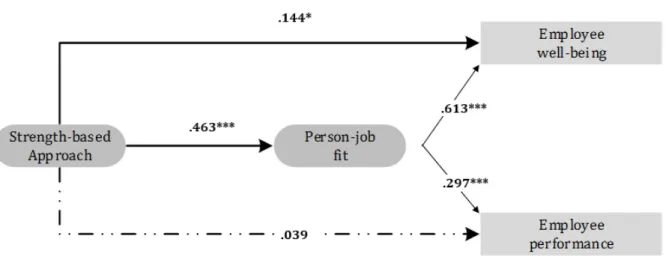
4.2. Testing HypothesisTable 3 below shows the results of the regression analyses for testing these hypotheses. By testing the hypotheses, employee’s age, gender and job tenure were accounted for. Additionally, R squared (R2) values are given. An ordinary least squares regression analysis was performed to determine two separate mediation models: (1) does person-job fit partially mediates the relationship between the strength-based approach and employee well-being, and (2) does person-job fit partially mediates the relationship between the strength-based approach and employee performance.
As a first step, this study has to show that the strength-based approach is related to employee well-being and employee performance. Therefore, Hypothesis 1a, suggests that the strength-based approach is positively related to employee well-being, and Hypotheses 1b suggest that the strength-based approach is positively related to employee performance. A simple regression analysis was executed to examine the relationship between the predicted variable and outcome variable as illustrated in Table 3. By so doing, the strength-based approach is assumed to predict employee well-being (Model 1.1) and employee performance (Model 2.1). Model 1.1 indicates that the strength-based approach is indeed significantly related to employee well-being (β = .428, p < .001). In addition, Model 2.1 shows that there is also a significant positive influence employee performance (β = .117, p < .05). Concluding that these Hypothesis 1a and Hypothesis 1b are supported.
32
Employee well-being Employee performanceVariable Person-job fit Model 1.1 Model 1.2 Model 1.3 Model 2.1 Model 2.2 Model 2.3
Employee gender -.109 .034 .106 .101 .045 .079 .077
Employee age .002 -.083 -.771 -.084 -.343** -.341** -.344**
Employee job tenure .038 .128 .077 .105 .309* .290* .298*
Strength-based approach .463*** .428*** .144* .117* .039
Person-job fit .679*** .613*** .315*** .297***
R² .226*** .155*** .438*** .450*** .056* .125*** .151***
33
34
5.
5.
Discussions & Conclusion
5.1. Discussion
The study is guided by the central research question: To what extent does the strength-based approach positively influence employee well-being and employee performance and is this relationship mediated by person-job fit? To answer the central research question, the present study executed an empirical study indented to (1) examine to what extent the strength-based approach is related to employee well-being and employee performance; and (2) to examine the potentially mediating role of person-job fit between this focal relationship.
35
5.2. Theoretical implicationsFirst and foremost, the present study answers recent calls for further empirical examination of the strength-based approach. This study has empirically examined the positive effects of the strength-based approach on employee work outcomes. In particular, it demonstrated that in particular the three practices of the strength-based approach to talent management, which consist of identifying of employees strengths, deploying strengths and managing around weaknesses, lead to positive employee work outcomes. Since empirical work on talent management and the strength-based approach in organizational context is still in its infancy, these findings have confirmed the beneficial role of inclusive strength-based talent management rooted in the field of positive psychology. Also, the empirical work on the impact of the strength-based approach has enriched the on-going discussion in the field of talent management by showing that strengths need to be considered as a real opportunity to enhance employee well-being and performance. Along a similar line, this study reasons that the strength-based approach could be more effective than traditional HRM practices to talent management (i.e., exclusive approaches). In order to advance talent management and the inclusive strength-based approach as an academic field of research, it seems imperative to explore what could be learned from the role of positive psychology.
Second, this study is related to the theoretical perspective of Meyers and van Woerkom (2014). The researchers actually regarded the theoretical construct strength-based approach as strength identification, strength deployment, managing around weaknesses and increasing person-job fit. However, this study did not study person-job fit as part of the strength-based approach to talent management, but it treated person-job fit as mediator variable, rather than a predictor. The identification of the theoretical construct strength-based approach and the role of person-job fit as mediator has opened new ways in how to design talent management systems. Now the positive effects of the strength-based approach are acknowledged, future studies will be encouraged to further analyze the individual linkages of the three practices of the strength-based approach to employee work outcomes.