FIX IT Falkenberg
Boukje de Gooijer
Faculty of Engineering Technology
SCA Hygiene Products AB
Mechanical Engineering
Production Technical department
Name student: B. M. de Gooijer (s1116754)
Study: Master Mechanical Engineering
University: University of Twente, faculty of Engineering Technology, Applied Mechanics
Preface
One obligatory part of the curriculum of the master Mechanical Engineering at the University of Twente is an internship. The main goal of the internship is to gain practical experience of an engineers’ future profession and is preferably carried out abroad. The sad part of going abroad is that one has to leave after a fixed period of time. The main goal of this report is therefore to transfer my findings to possible successors.
Table of contents
1 Introduction ... 6
1.1 Project FIX IT ... 6
1.2 Process flow of the transport package ... 6
1.3 How big is the problem? ... 9
2 Problem description ... 10
2.1 Division of the problem ... 10
2.2 Current information flow ... 12
3 Planning & methodology ... 14
3.1 Internal complaint system ... 14
3.2 Current process capability ...15
4 Results ... 18
4.1 Internal complaint system ... 18
4.2 Current process capability ... 21
5 Recommendations ... 23
5.1 SAP ... 23
5.2 Internal complaint system ... 23
5.3 Process capability ... 24
5.4 Knowledge sharing ... 24
6 References ... 25
Appendix A General information ... 26
Definitions
BCT Box Crash Test
CON Consumer Unit or primary packaging; also referred to as ‘bag’.
DOM Daily Operating Meeting
ETM European Technical Manager
IDC International Distribution Centre
QAS Quality Attribute Sheet
SAP Systems, Applications & Product; enterprise management system
SOP Standard Operating Procedure
SRU Shelf-Ready Unit; secondary packaging for consumer use.
TRP Transport Pack or secondary packaging; also referred to as ‘box’ or ‘carton’.
Summary
Project FIX IT started in April 2014 in the Hoogezand plant in the Netherlands. The main goal of the project is to optimize the supply chain of the transport package. There are three reasons (Glauner, 2014) for improving this supply chain namely safety, image/reputation and costs. The problem is divided in three areas in which different members of the project team work with. The areas of interest are design, internal handling and external transport. This report describes the findings on the internal handling of the transport package.
The current information flow of the transport package was mapped in order to define a focus area and find any available data. It was found that there is very little data available on aspects related to the quality of the transport package between production and the customer. The focus areas for improvement in internal handling are therefore chosen to be the information flow between palletizing and production and the information flow within the warehouse.
To improve the information flow between palletizing and production an internal complaint system was designed. This internal complaint system standardizes the communication between warehouse and machine operators. By coupling a complaint code to common problems data is logged when warehouse operators complain about the problem to production. Using the complaint database, problems can be related to a specific production line or shift, to start problem solving systematically. The implementation of the complaint system was paired with the use of visual control checklists. These visual control checklists display a picture and a description of the common problems, a picture of what it should look like and the corresponding defect code.
To improve the information flow within the warehouse the current databases were analyzed. It was found that many human errors are made as most of the information transfers and calculations are done manually. A start was made with setting the standards by making a calculator for choosing a palletizing program.
For successive research and improvement a number of recommendations are made. The recommendations boil down to two things: generate data and improve communication. Data generation can be reached by extending the standardization in complaint communication between the warehouses and other plants. By measuring the current process capability data must be generated as well. To improve the communication SAP should be used more efficiently and knowledge must be shared.
1 Introduction
Svenska Cellulosa Aktiebolaget, rather known as SCA, is a global hygiene and forest products company. The Falkenberg plant falls within the division Product Supply of Consumer Goods Europe. The plant produces incontinence and baby diapers.
1.1 Project FIX IT
[image:7.595.65.536.204.301.2]Project FIX IT started in April 2014 in the Hoogezand plant in the Netherlands. The main goal of the project is to optimize the supply chain of the transport package. The transport package is the carton in which the bags filled with diapers are palletized. The supply chain of the transport package can be found in Figure 1.
Figure 1 Supply chain of the transport package. Adapted from: pacproject (Glauner, 2014).
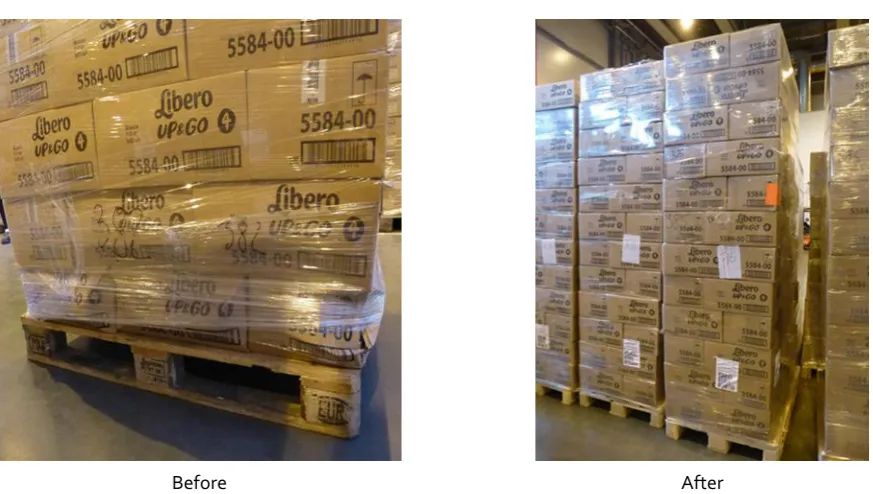
There are three reasons (Glauner, 2014) for improving the supply chain of the transport package. The safety aspect is the first. Some pallets are stacked up to a height of 2.9 m. It happens that these pallets collapse during warehouse handling. This is not a safe working environment as the total weight of such pallet can be up to 350 kg. Secondly, there is the image or reputation of the company. Hygiene products should be sold in clean and intact packaging, not containing any damage. Lastly, there is the aspect of costs. Damaged products cannot be sold and repacking brings in unnecessary extra costs. Even the slightest overlap of a carton on a pallet can cause the whole pallet to be sent back at the end of supply chain. This is due to the fact that automated order picking cannot be done with overlapping pallets. An example of a poorly and a properly stacked pallet can be found in Figure 2.
Before After
[image:7.595.70.507.430.677.2]The responsibility for the material is transferred from the supplier to SCA at the terminal. The materials are transported with a forklift truck into the raw materials warehouse for storage. When the products are needed for production they are transported from the raw materials warehouse to the pickup point for AGVs. Thereafter they are transported with an AGV to production. A general overview of the process flow from production to the customer can be found in Figure 3.
Figure 3 General process flow of a transport package. Adapted from: Markus Andersson.
More detailed process flows within production, palletizing, warehousing and external transport can be found in the following sections.
Production
1.2.1
[image:8.595.54.550.310.422.2]The process flow of the transport package within production is depicted in Figure 4.
Figure 4 Process flow of transport package within production. Adapted from: Emma Svenbrant.
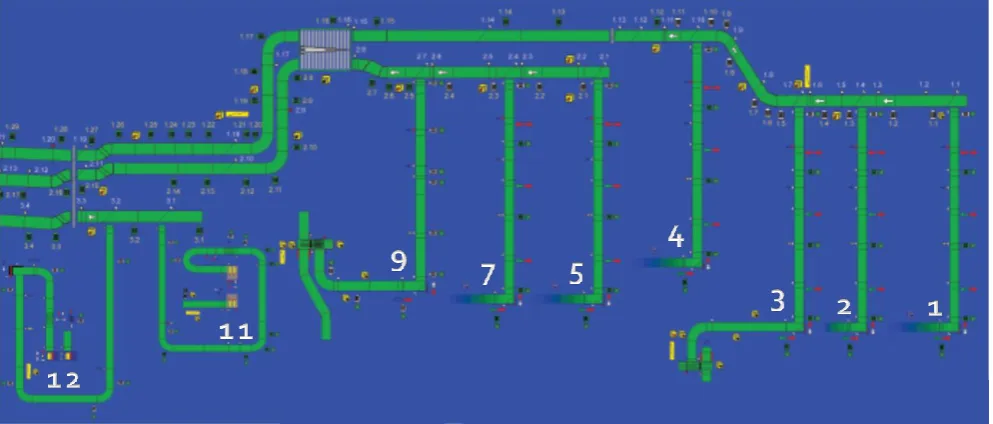
After the boxes are transported to the second floor by the elevator they are placed on a roller belt for transportation. The roller belts are depicted as the nine vertical lines in the bottom of Figure 5. The white numbers correspond with the machine numbers. The responsibility for the transport on the roller belts lies within production. The collector belts are depicted as the three horizontal lines in the top of Figure 5. Once the boxes arrive on the collector belt the responsibility is transferred to palletizing.
Production
Transport bandPalletizing
Forklift truckFinished
goods
warehouse
Forklift truck
Terminal
TruckCustomer
Folding
Filling
Gluing
[image:8.595.50.547.524.736.2]Palletizing
1.2.2
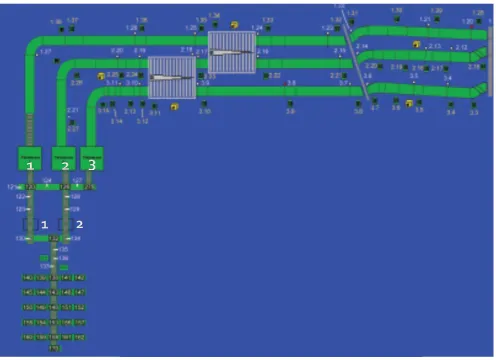
[image:9.595.51.548.124.484.2]Once the transport packages arrive on the collector belt the responsibility lies within palletization. Under normal conditions the products of machine 1, 2, 3 and 4 are palletized on palletizer 1. The products of machine 5, 7 and 9 are palletized on palletizer 2. Products of machine 11 and 12 are usually handled by palletizer 3. The two big squares in Figure 6 are called dividers. The dividers make it possible to change collector belt and subsequently palletizer. After the three palletizers there are only two wrappers.
Figure 6 Transport on the collector belt to the palletizing area.
The process of palletizing of the transport package is depicted in Figure 7. After wrapping the pallets are dated and provided with a pallet flag. A conveyor belt transports the loaded pallets to one of the ten output lanes where they can be picked up by warehouse personnel.
Figure 7 Process flow of transport package within palletizing. Adapted from: Charles El Hajj. Collector belt
Palletizing
(3 options)
Layer by layerPallet
Conveyor beltWrapping
(2 options)
[image:9.595.55.550.550.663.2]Warehousing & external transport
1.2.3
[image:10.595.47.552.153.201.2]The pallets are picked up by the warehouse personnel with a forklift truck to place them in one of the racking of the finished goods warehouse. The warehouse also serves as an international distribution center which means that finished goods of other plants are stored in the racking as well. A brief overview of the process flow is given in Figure 8. The responsibility for the products is transferred from SCA to the transport company at the terminal. The process flow stops after the pallets are placed in the truck. This is because the handling from that point depends on the destination of the goods. The shortest route possible is when the pallets are transported to an external warehouse, whereas the longest route is to customers in Asia. Depending on the destination, transport can be done by truck, train, ferry or cargo ship.
Figure 8 Process flow of transport package within warehouse and external transport. Adapted from: Markus Andersson.
1.3 How big is the problem?
It is difficult to say how big the problem is, one can only guess. A measure for the size of the problem is the number of received complaints. When a pallet with crushed or damaged boxes arrives at a customer a complaint can be made to the sending plant. An overview of the received complaints per plant can be found in Table 1.
Hoogezand Olawa Veniov Falkenberg
Crushed boxes 6 + 4 + 1 = 11 88 + 8 + 7 = 103 0 58
Others packaging 38 + 1 = 39 114 + 18 + 1 = 133 2 78
Table 1 Received complaints per plant for Baby Pants & Baby Open products from all over the world.
One must note that it differs per customer how the complaints are treated. First of all a complaint can be classified as service or product. Next to that a complaint can concern a box or a pallet. For example a collapsing pallet can cause 12 crushed boxes, but probably it is logged as one complaint. This complaint can end up being notified in production, while the root cause was in the sending warehouse. It therefore unknown if a complaint about a collapsed pallet is noted under ‘Crushed boxes’ or ‘Others packaging’. Besides differences in the way customers treat complaints, some customers do not even make a complaint at all.
Improving the supply chain of the transport package is quite a big task. Therefore section 2.1 divides the task in several focus areas. To gain more insight in the focus area of the Falkenberg plant in section 2.2 a detailed information flow of the transport package is presented. This information flow is used to find out where improvements can be made. Chapter 3 describes how improvements are going to be made. Chapter 4 will cover the results and depending on time chapter 5 will cover a different amount of recommendations.
Forklift truck
Racking
Forklift truckTerminal
2 Problem description
The objectives of project FIX IT as set by the sponsor are the following:1) Implement pack specifications and mandatory parameters 2) Design packs with relevant strength and stability requirements 3) Insure packaging suppliers follow global supplier standards
4) Activate the pack complaint system and quality assurance processes 5) Set stretch filming operation protocols
6) Standardize palletization and warehousing procedures 7) Up skill and recruit packaging technical expertise
How these objectives are going to be reached differs per plant. In a previous roll-out Libero products to Veniov in Russia were chosen as a worst case scenario. The supply chain of these specific products was analyzed to find any possible improvements. However, products shipped to Veniov are not necessarily the worst case scenario for the Falkenberg plant. Another approach can therefore be more useful in this case. As optimizing a supply chain is a big task with many different aspects and interests, the problem is divided in more bite-size pieces.
2.1 Division of the problem
Three focus areas are distinguished for the supply chain optimization. The main focus of this report will be on improving the internal handling of the transport package (section 2.1.2). However, for clarity the other focus areas and their stakeholders are described as well.
Design
2.1.1
The design of the boxes is mainly handled within: Consumer Goods Europe – Market & Business Development – European Product Assortment. Objectives to work with are 1), 2), 3) and 7). Aspects of interest can be for example board grade, box features such as handles and perforated creases, box dimensions, et cetera.
People involved
Project team:
Packaging Baby – Branded Packaging Baby – Retail
Business Process Engineer Board supplier
Board supplier
Others:
Master Data Coordinator
Internal handling
2.1.2
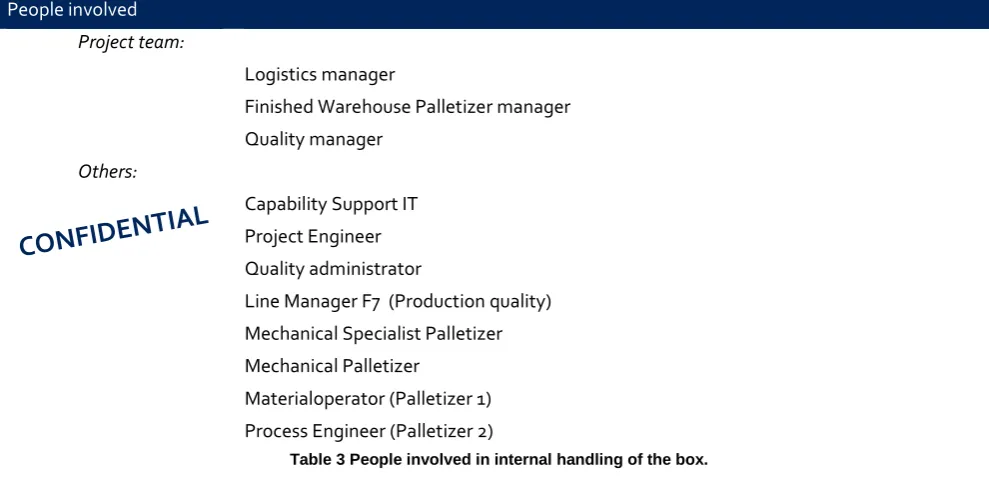
Internal handling of the transport package includes all aspects within the Falkenberg plant. As described in the introduction the process can be subdivided in production, palletizing and warehousing. Aspects of interest can be all the steps in the process flow, but as well handling of operators. The objectives to work with are 4), 5) and 6). To get more insight in the internal processes within the plant, the current information flow is presented in section 2.2.
People involved
Project team:
Logistics manager
Finished Warehouse Palletizer manager Quality manager
Others:
Capability Support IT Project Engineer
Quality administrator
Line Manager F7 (Production quality) Mechanical Specialist Palletizer Mechanical Palletizer
[image:12.595.46.541.117.363.2]Materialoperator (Palletizer 1) Process Engineer (Palletizer 2)
Table 3 People involved in internal handling of the box.
External transport
2.1.3
The conditions under transport are known to have major influence on pallet stability (Glauner, 2014). Conditions of interest can be for example encountered dynamic or static force, humidity and temperature during transport. The transport of the boxes can take from 1 day up to 3 weeks. The pallet can be handled with a fork lift up to 15 times before arriving at the customer. To design and palletize a box which is sufficient for transport more information on the transport conditions is needed. The objectives to work with are 1), 2) and 7).
People involved:
Project team
R&D Engineer
R&D Engineer
2.2 Current information flow
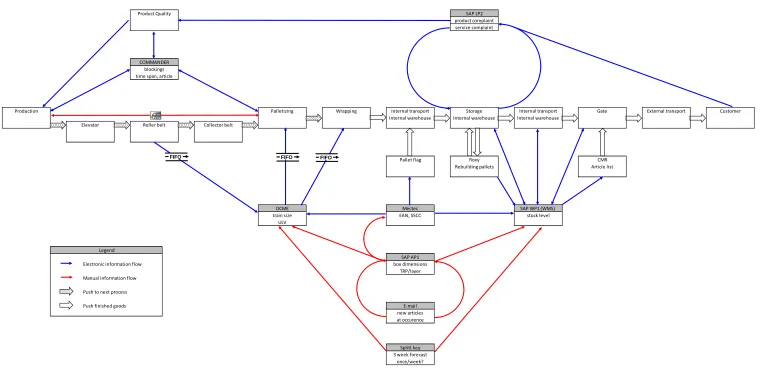
In order to improve the supply chain of the transport package, information between design, handling and transport must be shared. Currently there is very little feedback from the status of the TRP at the customer to design and handling. There is as well very little information shared between handling and design. To find out which information is available on handling the box, the current internal information flow of the transport package is mapped.
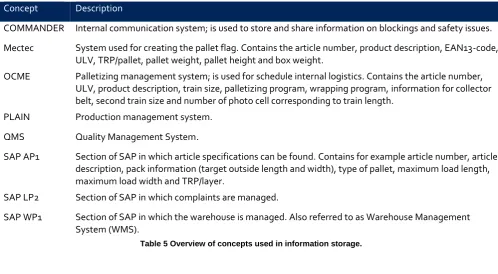
In Figure 9 on page 13 the current information flow of the transport package in presented. In this map the physical process is placed in the middle. The information flow via different programs, systems and databases is placed around it. A description of the concepts used in the information flow is given in Table 5.
The information flow is mapped in order to get insight in where and which information is stored in terms of the quality of the box and the pallet. A positive side effect of mapping the process is that it is identified who has access to which database and who is responsible for the contents.
Concept Description
COMMANDER Internal communication system; is used to store and share information on blockings and safety issues.
Mectec System used for creating the pallet flag. Contains the article number, product description, EAN13-code, ULV, TRP/pallet, pallet weight, pallet height and box weight.
OCME Palletizing management system; is used for schedule internal logistics. Contains the article number, ULV, product description, train size, palletizing program, wrapping program, information for collector belt, second train size and number of photo cell corresponding to train length.
PLAIN Production management system.
QMS Quality Management System.
SAP AP1 Section of SAP in which article specifications can be found. Contains for example article number, article description, pack information (target outside length and width), type of pallet, maximum load length, maximum load width and TRP/layer.
SAP LP2 Section of SAP in which complaints are managed.
[image:13.595.46.545.213.487.2]SAP WP1 Section of SAP in which the warehouse is managed. Also referred to as Warehouse Management System (WMS).
Figure 9 Current internal information flow of the transport package.
Current Information Flow TRP
Product Quality SAP LP2
product complaint service complaint
COMMANDER blockings time span, article
Production Palletizing Wrapping Internal transport Storage Internal transport Gate External transport Customer Internal warehouse Internal warehouse Internal warehouse
Elevator Roller belt Collector belt
Pallet flag Roxy CMR
Rebuilding pallets Article list
OCME Mectec SAP WP1 (WMS)
train size EAN, SSCC stock level ULV
Legend
SAP AP1 Electronic information flow box dimensions
TRP/layer Manual information flow
Push to next process
Push finished goods E-mail
new articles at occurence
Splitt key 3 week forecast
once/week?
3 Planning & methodology
Looking at the current information flow in Figure 9, the only available data on the transport packages comes from the service complaints. However, as said in section 1.3, this data is difficult to interpret. Before proceeding to making any adjustments, the baseline of the problem must be found. An easy way to get insight in the size and types of problems is by making use of an internal complaint system. Two types of internal complaint systems can be of interest:
- one for boxes between palletizing and production, - one for pallets between the warehouse and palletizing.
Both systems and their implementation will be treated in section 3.1. The initial focus is to develop the internal complaint system for the boxes. Besides logging the occuring problems, another way of looking at the procces is by measuring its capability. Suggestions on how and what to measure are made in section 3.2.
3.1 Internal complaint system
To checkup the quality of the boxes and pallets other plants currently make use of a so-called box and pallet check. It is a document which displays pictures of both the ‘good’ and ‘bad’ status of common problems. The document is a form of visual process control. Visual controls can help to quickly identify abnormal conditions, display standardized methods in use and display the status of all elements critical to safe and effective operations (George, Rowlands, Price, & Maxey, 2005). The use of a complaint system will go hand in hand with the use of this form of visual process controls. The box or pallet check is also referred to as quality attribute sheet or standard operating procedure (SOP) by different stakeholders. For use with the internal complaint system in addition to a picture of the ‘bad’ status a defect code is provided. In this way it is easy to address a specific code to an occurring problem. The name visual control checklist is chosen for use within the Falkenberg plant to avoid misunderstandings which document it considers. A sample of the visual control checklist made can be found in Appendix B.1. Besides providing a simple way of finding a defect code, a visual control checklist is beneficial for the awareness of quality. Every time an operator searches for a defect code on the list it gets reminded on what the box or pallet should look like.
The visual control checklist can be kept both physical and digital. Both options have their disadvantages. A physical visual control checklist is hard to keep up to date. However a digital checklist is less hands-on and can be less easily accessible. Both the complaint system and control checklists are designed in English. However, for more simple use the final system and checklist should be translated to Swedish.
Boxes: visual control & coding
3.1.1
The visual control checklist for the boxes should answer the following questions in one view:
- What does a ‘good’ box look like? Hence, what is the standard? - What does a ‘bad’ box look like? Hence, what are common problems? - What is the defect code corresponding to a box that does not look good?
In order to make the visual control checklist and coding, it must be defined what is ‘good’. This can be done by questioning different stakeholders. Stakeholders of interest are the quality department, article owners, suppliers, mechanics, line managers and machine operators. Visual control checklists used in other plants can be used as input. Pictures of boxes specified as both good and bad must be collected as a reference. By analyzing the boxes that enter the palletizing area the most common problems can be found. After this is done the problems must be sorted to present a structured way of coding the box. Any existing defect coding systems, for example the ones for customer and service complaints must be taken into account.
Pallet: visual control & coding
3.1.2
The visual control checklist for the pallet should answer the following questions in one view:
system used for these complaints must therefore be taken into account. The visual control checklist used in other plants can be again be used as a reference.
Implementation of the box complaint system
3.1.3
For successful implementation all stakeholders must be found and involved. By involving stakeholders in developing the complaint system existing knowledge can be found and used. The other way around knowledge gaps can be found as well. For example the warehouse operators must know where they can find the visual control checklist and how they should make a complaint. On the other side the machine operator should know where to find the visual control checklist as well.
What is probably even more important than sufficient knowledge is morale. The operators in both palletizing and products should actually use the complaint system. However, nobody wants to do extra work. The complaint system is therefore described as a tool to ease the communication between machine and warehouse operators. Nowadays a phone call is made to production when palletizing finds a ‘bad box’. It is often quite difficult to give an exact description of the damage. As common problems are now linked to a defect code it will be easier to communicate between palletizing and production.
The complaint system starts with a pilot on production line 7. Palletizing operators will be able to put in the complaints for all production lines, but only line 7 will actually receive the complaints. After one month the teething troubles can be overcome and the complaint system can be rolled out to the other production lines as well.
Palletizing Production Line managers
Make complaint: in DOM-rapport
call to production
Receive complaint: in DOM-rapport
call from palletizing
Receive complaint: in AVD DOM
Handle complaint Follow up complaint
Sign off complaint Sign off complaint
Table 6 Tasks & responsiblities in using the box complaint system.
Besides the people who are going to use the complaint system, there are still some tasks left behind the scene. The defect codes, visual control checklist and database must be updated and handled as well. In the current business structure the most logical place to position these tasks is within the quality department.
3.2 Current process capability
The complaint system between palletizing and production is implemented to get insight in which and how often problems occur. Doing a capability analysis is another way of looking at the production and palletizing processes. However, both the complaint database and the process capability are closely related. In order to find the current capability the existing process flow of the TRP as presented in section 1.2 is followed. The input of the process is the unfolded box, whereas the output is the stacked pallet in the warehouse.
Box
3.2.1
To start with the assumption is made that there is no damage created between the gate of the raw material warehouse and the case packer in the production line. When it comes to the case packer itself, a lot of things can go wrong. Using the complaint database, problems can hopefully be related to a specific production line or shift. This will create some insight in where to start with problem solving.
To find problems related to the successive step of palletizing the general information on the boxes used in the plant is more important. For example it must be found how many different box sizes are used and what these dimensions are. If the dimensions are know it can be checked if each article is stacked with a suitable program. The definition of a suitable program must be found as well. Another aspect of interest is if full printed boxes give more problems. The ink on the SRU packages gives them another friction coefficient which was noted to give more problems when palletizing.
Palletizing
3.2.2
The pallet is the base for the palletizing process. The dimensions of the pallet are therefore of large interest for the successive steps. To start with the height of the pallets is taken to be 150 mm. A large deviation from this height might influence the wrapping process as the wrapping does not start where it is supposed to be. The length and width of a euro pallet is taken to be 800 mm x 1200 mm. However it was noted that euro pallets are on average 795 mm x 1195 mm (Adelbäck, 2014). This might influence the alignment in the palletizer. It is therefore recommended to have palletizing patterns with a 10 mm tolerance on each side (Glauner, 2014). The recommended pattern dimensions are therefore 780 mm x 1180 mm for euro and 980 mm x 1180 mm for iso. Patterns which are outside this recommended dimensions are propable to cause overhang. When measuring the overhang of the boxes the actual dimensions of the pallet must be taken into account. Hence, the pallet size can not be taken as a reference.
The quality of the pallet itself is difficult to check. A good pallet cannot miss any stringers or deck boards, and cannot contain any loose splinters or nails. Loose nail for example impedes the horizontal alignment necessary for perfect stacking. The pallets are inserted to the palletizer as a stack. To ensure the quality of each pallet they should be handled and checked one by one.
There are 3 different palletizers. Palletizer 2 and 3 are similar, whereas palletizer 1 is completely different. Currently there are 32 different palletizing programs. Not ever program is available on every palletizer. When a new article is going to be produced it is entered in OCME and coupled to a palletizing program manually. There is no standard routine for coupling article dimensions to a program. There is no specified maximum difference between the recommened box dimensions of a palletizing program and the article dimensions. The current palletizing programs must be analyzed. It must be found if all the programs are in use, if not there might be room for some changes. To recommend any changes it must be known which parameters can be controlled in both the software and hardware
One measure to define a good palletizer or palletizing program is the relation to amount of service complaints. However, the 140 received complaints this year might be too few to find an existing relation. Another way to compare the palletizers is by using one program and article which can be run on all 3 palletizers within the same shift. In that way a testplan can be set up which rules out a few factors.
Wrapping
3.2.3
After palletizing the wrapping is applied. There are multiple wrapping programs. Each program has a version on 70% and 100% of the maximum speed. It must be found if the wrapping is applied in the right amount and if it does deliver the right tension. If possible any deviations in the applied wrapping must be related to a wrapper or a wrapping program. Some wrapping programs should combine the pallet and the load. In all the cases the wrapping should be applied up to the top load. It must be checked for each program if the wrapping starts an ends at the right heights.
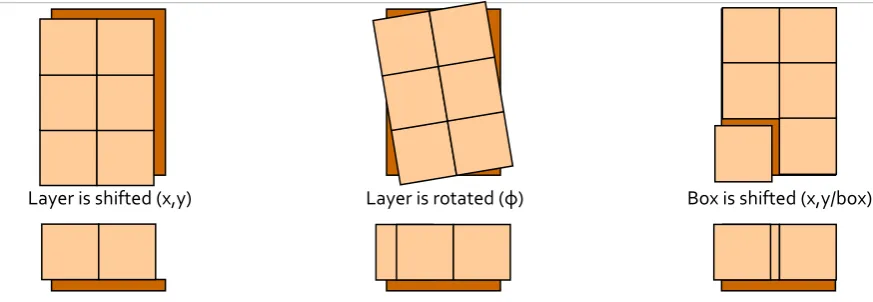
The wrapping has a big influence on the alignment of the stacked boxes. After the pallet is wrapped in the right way it settles the boxes in each layer. The misalignment of the boxes must therefore be measured after wrapping. It is very important that the boxes of the pallet are aligned as misalignment can reduce the strength of the boxes up to 45% (DS Smith Packaging, 2014). The accuracy of alignment when palletizing is therefore an important input parameter for the design of a new transport package.
Layer is shifted (x,y) Layer is rotated (φ) Box is shifted (x,y/box)
Figure 10 Different movements for misalignment in a palletized layer.
Transport
3.2.4
The transport between production and palletizing is assumed to create no damage. When something go wrong within the palletizer the whole stack of boxes can fall over. If this happends a lot of extra damage occurs. The transport between the palletizer and the wrapper looks quite dangerous. In that transport the pallets moves and makes several stops without having the wrapping applied yet. Especially when the stack is very high the top boxes can make large movements. This creates a torque on the bottom layer of boxes.
4 Results
The obtained results can be found in this section. Following the structure of the Planning & methodology first the results on the on the internal complaint system are described. Thereafter the findings on the process capability can be found in section 4.2.
4.1 Internal complaint system
To setup the defect codes for the complaint system, first the existing coding systems were examined. The existing codes considering the box can be found in Table 7.
Code Description Code Description
735 Box color rub off 760 Box not sealed correctly
741 Production code missing/not readable, box 765 Bag missing in box
[image:19.595.43.552.184.253.2]755 Box dirty 785 Crushed boxes
Table 7 Exisiting defect codes considering the box.
When the common problems were mapped it was concluded that the existing codes do not cover the specific damage. Therefore a new coding system is designed. A four digit number is taken for the internal complaint so that it is easy to distinguish from the external complaints. Making the new coding completely different from the existing coding gives room for the coding system to become a living document. Complaints can easily be added or removed to the needs of the investigation.
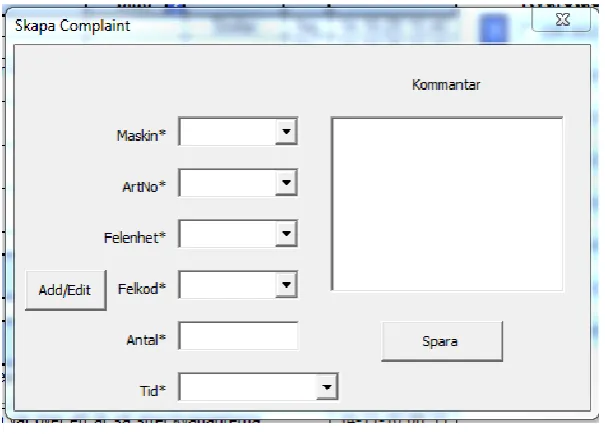
The internal complaint system will be accessible through the DOM-rapport. When a complaint is made the window as displayed in Figure 11 will pop up. The system logs the production line (Maskin), article number (ArtNo), complaint type (Felenhet), complaint code (Felkod), number of occurrences (Antal), the time (Tid) and if wanted some comments (Kommantar). When the production line is entered a coupling with PLAIN is made which makes the running article available for selection. The complaint type can be either production or palletizing. Once one of the two is entered the corresponding defect codes become available. The designed defect coding system for production is presented in section 4.1.1. The defect coding system for palletizing is presented in section 4.1.2.
Figure 11 Screenshots of the complaint entry.
[image:19.595.147.450.433.650.2]Boxes: visual control & coding
4.1.1
The common problems related to boxes found in the Falkenberg plant are presented in Table 8.
Group Code Code description Common problems
Closing 2100 Gap between box flaps Top or bottom flaps should be connected in parallel with
a target distance of 0 mm and a tolerance of <10 mm. 2101 Misaligned box flaps Top or bottom flaps can be misaligned or protruding.
There is no target or tolerance set.
2102 Box not properly closed Top flaps can be not closed, folded or overlapping.
Gluing/taping 2110 Box not properly taped Tape can be broken, misplaced or missing. Boxes can be taped together.
2111 Glue visible Glue should not be visible.
2112 Missing glue strings Glue position is defined in FGI-2215: it should not touch the bags and 4 strings should be applied.
Shape 2200 Bulgy box Bags, or diapers, are too big for the box.
2201 Perforation is broken Perforation should be intact.
2202 Box dimension out of specification Box should be dimensioned according to the article specification.
Damage 2210 Box is damaged Box contains scratches, impressions, creases, torns,
folds, crinkles or bulgdy corners.
Coding 2300
(741)
Coding is defective Coding should be readable and printed in one line. Coding should be correct:
day/month/year/factory/machine/hour/minute. For SRU boxes the placement should be according to DMS*44840. The coding should not be placed over any other pre-printed graphics.
Others 2901 Bags are misaligned Bags are tilted 90° making it hard to close and palletize
the box. 2902
(765)
Bags are missing Does this happen often? Cover under 2901?
2999 Boxes, others If other problems occur they can be specified in the
[image:20.595.43.555.76.506.2]comment. Table 8 Complaint codes for production.
[image:20.595.64.537.596.748.2]Pallet: visual control & coding
4.1.2
When it comes to the complaint system between the warehouse and palletizing the implementation is somewhat more difficult. It is not so easy for a fork lift truck driver to make a complaint as they do not have permanent access to a computer. The use of a complaint system should not be an extra task and should not cost extra time. It will be difficult to make warehouse operators more aware of a ‘good’ stacked pallet as they have to control their own work. Anyway, the coding system and visual control checklist were made to give insight in the common problems. From now on a start with the implementation can be made. The visual control checklist corresponding to the coding system (Table 9) can be found in Appendix B.2.
Group Code Code description Common problems
Boxes 3100 Turned/tilted boxes on pallet Boxes can turn or tilt during palletizing.
3101 (785)
Crushed boxes on pallet Bottom boxes can collapse under their load.
3102 Concave boxes on pallet A wrapping whichs is too thight will make the
boxes concave.
3110 Too much space between boxes The compression of the palletizing program is too little.
3120 (755)
Box is dirty Boxes are covered in dust in case of long
warehouse storage.
Pallet 3200 Pallet is defective The pallet may miss stringers or deckboard.
Protruding nails are also not allowed.
Overhang 3300 Pallet contains overhang Overhang can be created by: poor centering, poor
pallet fit, poor stacking, protruding boxes or tilting.
Wrapping 3400 Pallet contains loose wrapping film Loose wrapping can cause overhang as well. 3401 Pallet is wrapped with insufficient tension Insufficient tension cause instable pallets.
Coding 3500 Incorrect coding EAN, SSCC or other codes can be printed
incorrect.
3510 Pallet flag is missing The pallet flag is not applied.
Others 3900 No suitable palletizing program For new articles no suitable program is available sometimes.
3999 Pallets, others If other problems occur they can be specified in
[image:21.595.45.560.150.502.2]4.2 Current process capability
To start with it was checked if there were suitable programs for all the different box types specified in SAP. Based on the experience of the palletizer personel a program is considered as suitable when the difference between the recommended box dimensions and the actual dimensions is not more than 10 mm. The result of using too little or too much compression when palletizing are displayed in Figure 13.
[image:22.595.90.506.120.365.2]25 mm too little 15 mm too much
Figure 13 A box of 390 mm x 375 mm palletized with too little or too much compression.
The check for suitable programs was made by comparing the OCME database, production forecast and SAP article specifications. It was found that there was no suitable program for a number of articles. An overview of the box dimensions with suitable program can be found in Appendix A.1. Based on the program usage a recommendation was made to do some changes in the palletizing programs. Only 3 of the current palletizing programs meet the recommended tolerance of 10 mm on each side. No changes can be made to meet these tolerances as there are no other options for the boxes to be palletized.
The way of choosing a palletizing program is standardized by using a ‘calculator’. Previously the program was chosen by searching in a list with the programs sorted from 1 to 32. This caused unnecessary errors. By filling in the pallet type, number of boxes per layer, box length and box width the best program is chosen automatically. When there is no suitable program found an error pops up. The calculator makes use of a list with the dimensions of the current palletizing programs. Somebody should be responsible for keeping the calculator up to date.
[image:22.595.203.549.538.687.2]fact that nobody was responsible for keeping the document with palletizing programs up to date. Somebody should be responsible for keeping this document up to date. This can be reached by checking in the document in the digital library. The up-to-date list can be found in the library by other stakeholders, such as the business process engineers and can subsequently be send to the article owners.
The list with palletizing programs is sorted in a different way to create a clearer overview of the available programs. The programs are sorted on number of TRPs/layer or box length instead program number. This makes it easier to find the program by hand and as well as to keep the calculator up to date.
Next to entering the program manually it was found that the warehouse personell does the calculations for the pallet height (ULV) and splitt key (number of ULVs) by hand. This causes unnecessary errors as not everybody has the knowledge to do it correclty.
5 Recommendations
Project FIX IT has not come to an end, however my internship does. As there are still lots of potential points of improvement, I would like to do some suggestions for further research in this section.
5.1 SAP
If possible I would suggest more efficient use of the SAP system. In the current structure different parts of SAP are not connected: information is transferred manually between different parts of the system. I have a strong feeling that work is done twice because different parts of SAP do not synchronize. It must be made clear which information is put in the system by whom and where it is transferred to other parts of the system. On a short-term I suggest setting-up a standard information flow for adding new articles to the system. In this way it is made clear what all involved responsibilities are and who is in charge of these. To give a practical example, during my stay it took 2 months to find out that nobody was responsible for keeping the document with palletizing patterns up to date. On a long-term perspective I recommend simplifying the information flow for adding new articles. Instead of doing all information transfers manually, the article specifications should be loaded automatically into OCME, Mectec & WMS.
Another case in which SAP can be used more efficiently is in handling complaints. Service complaints between other production sites and their warehouses are handled through SAP. There is no standard set in how and when to make a complaint. However, this feedback after transport is of great importance for improving the quality of the transport packages. I would suggest for the Palletizing Network Personal Care to set a standard in this.
5.2 Internal complaint system
If I could change something in the design of the internal complaint system I would run it through COMMANDER instead of through the DOM-rapport. The information flow of both COMMANDER and the internal complaint system is very similar. Therefore it is not very pratical to run the systems in parallel.
Figure 15 Future implementation of the complaint system.
The current internal complaint system should be extended to the internal warehouse and subsequently the external warehouse. Using the palletizing complaint system a quality check at the ternminal could be realized. In this way it can be declared that damage is not present as the pallets leave Falkenberg. Hence, the quality of a pallet is secured before it leaves a warehouse. I recommend using the same standard in both the internal as well as the external warehouse. However, the use of such complaint system is not possible with the current equipment. The use of a complaint system in the warehouse needs on board computers that can handle Excel in the fork lift trucks. In case of new equipment I would also recommend starting logging who handles a pallet. Currently there is only information available about which forklift placed the pallet in the racking. Logging who is driving the forklift makes the warehouse operator more aware of the fact that he or she has to deliver high quality pallets.
When a complaint is made to production, the machine operators should handle the complaint. To reduce the time it takes to handle a complaint a troubleshoot document could be used. The defect code could be used to point out a specific trouble shoot document. For example, if the glue is visible on a box the code 2111 could refer to a document which describes how to solve this problem. At first it could be tried to change the speed of the conveyor belt at the glue head. If the problem still occurs the glue speed can be changed.
As problems keep occuring machine operators can get frustrated when they receive a complaint and cannot solve it. Some sort of feedback must be given to palletizing that the problem could not be solved and will be followed up later. In the same manner, if the problem is solved palletizing should receive this information as well. To start with gathering data
Palletizing to
production
Internal
warehouse
5.3 Process capability
The data collection on the process capability should be continued. In section 3.2 a lot of suggestions were made which I was not able to carry out. Based on the increasing production speeds the palletizing area can be a bottleneck for production in the near future. Especially because there are up to 4 production lines connected to a palletizer, this can give quite severe problems. Currently there is very little insight in the timing of the transport, palletizer and warpper. I therefore recommend extending the start made in measuring the lead times of the palletizer.
Nowadays the pallets from palletizer 3 make 4 stops before they reach the wrapper. Two of these stops are waiting for a platform to move down and for the ring of the wrapper to go up. There should be an aim for a more continuous work flow for stacked pallets. Stopping the pallet causes a torque on the bottom layer of boxes. However, the result of these stops is not proven.
Measuring the inaccuracy of the palletizer should be carried out as well. I recommend measuring on the bottom layer of the pallet as this layer is not effected by the wrapping.The bottom layer is of special interest as it is of great importance that the sides of the these cartons are within the pallet. The sides of the carton which are outside of the pallet are likely to be damaged and cannot support the load of the stack. Measuring the overhang on the bottom layer can be done with the same contour scan as used in Hoogezand.
Based on the measurements for both the lead times and the inaccuracy, on the long term there propably will be the need for new equipment. Future palletizers should be able to handle more variation in box dimensons. The compression of a palletizing pattern should be based on the actual box dimensions.
5.4 Knowledge sharing
During the FIX IT project a so-called brief was set up to improve the communication between different stakeholders of the supply chain of the TRP. The current worklfow is a typical example of ‘over the wall engineering’. However, it was noted that still during the project there were many communication problems. In the current brief the palletizing pattern is provided as output by the board supplier. However, there is very limited freedom in choosing the patterns. The current brief is, to my opinion, designed with little practical knowledge on palletizing. The knowledge gap between the palletizing pattern on paper and program in real life should be reduced. I would therefore like to recommend a practical training for stakeholders in palletizing. I do think the brief can be an effective tool to improve the communication between different stakeholders in the design of a TRP. However, the brief itself should be setup differently and a standard workflow around it should be created.
I would recommend going on with getting more information on the external transport. There are still many undiscovered factors which can be of influence on the damage present after transport. An interesting topic is the influence of the loading direction of the pallet in combination with the pattern symmetry. What happends with the boxes after they leave the plant is still a very unexplored area. However, the information on the transport is an imporant input to design a box with sufficient strength. When there is more information available on the transport the stacking of an article can be based on its forecast. If the pallet is going to be in a warehouse for a long time or if it is transported by train right after production can give needs for different palletizing patterns. A column pattern gives strength to endure the static forces encoutered in the warehouse. Whereas an interlocked pattern gives stability to endure the dynamic forces encountered during transport. A combination of both patterns can be used as well. The wrapping can be based on the forecast as well. For example extra wrapping can be applied for futher transport or to support a lighter board grade. Again this raises the need for better communication.
6 References
Adelbäck, O. (2014, October 17). Box complaint system. (B. d. Gooijer, Interviewer)
DS Smith Packaging. (2014). The impact of misalignment. Retrieved from I:\Projects\Active\2014 Fix it\The impact of misalginment.pdf
George, M. L., Rowlands, D., Price, M., & Maxey, J. (2005). Lean Six Sigma Pocket Toolbook. New York: McGraw-Hill.
Appendix A General information
A.1 Overview of box dimensions
Box length (mm)
Box width (mm)
Program New
Program
Box length (mm)
Box width (mm)
Program New
Program
246 236 25 395 298 6
295 246 22 395 368 NO → 14
295 266 20 395 375 NO → 14
375 260 13 398 238 NO → 11
375 295 NO none 398 246 30
389 248 30 398 266 4
389 295 26 400 390 9
390 360 16 450 260 5
390 375 NO → 14 450 264 5
393 210 17 458 260 NO → 15
395 210 17 466 264 NO → 15
395 250 10 490 264 NO → 8
395 260 4 558* 398* NO → 1
395 266 4 598 266 7
[image:27.595.48.547.104.380.2]395 295 6 598* 398* 3
A.2 Overview of codes used in pallet characterization
A pallet is denoted with both a letter and a number. This combination is called a ULV. The letter denotes the type of pallet, whereas the number denotes the height of the pallet.
ULV Code SAP description General description
E EURO PALLET, E euro pallet, used in exhange
C EURO PALLET CHEP, C euro pallet, blue, used in rent
D ISO PALLET CHEP, D
ISO PALLET IPPL, P
iso pallet, blue, used in rent
S none euro pallet, heat treated
Table 11 Codes for denoting the type of pallet.
ULV code Minimum
height (mm)
Maximum height (mm)
ULV code Minimum
height (mm)
Maximum height (mm)
09 851 950 19 1851 1950
10 951 1050 20 1951 2050
11 1051 1150 21 2051 2150
12 1151 1250 22 2151 2250
13 1251 1350 23 2251 2350
14 1351 1450 24 2351 2450
15 1451 1550 25 2451 2550
16 1551 1650 26 2551 2650
17 1651 1750 27 2651 2750
[image:28.595.45.552.238.430.2]18 1751 1850 28 2751 2850