Master thesis BA: HRM
How does innovative work behaviour of employees affect their individual job performance?
University of Twente
Student: Carl Middelkoop
Student nr: s1124188
Email: [email protected]
Supervisor: Dr. Anna Bos-‐‑Nehles
Second Supervisor: Prof. Dr. Tanya Bondarouk
Date: 09-‐‑06-‐‑2016
Acknowledgements
When I started with the master of Business Administration my enthusiasm was triggered by the several interactive and educative business courses we had on the University of Twente and especially in the field of HRM this was the case. From that point, and of course with my psychological background it was clear to me I wanted to continue in the field of HR and eventually writing my master thesis for this faculty.
I would especially thank my supervisors dr. Anna Bos-‐‑Nehles and prof. dr. Tanya Bondarouk for accompanying me in my journey to succeed in writing my master thesis in the field or HR. It was a very educational journey and I am thankful for all the courses and enthusiastic way of education given by the professors in the faculty of HR.
Next to the business faculty of HR I would like to thank In Person, for making it possible to conduct my research at their company. It helped me to develop and conduct a professional research within a very busy and competitive business. I would like to thank Noortje Bellucci for helping me with making this possible.
At last, I want to thank my family and friends for guiding me and encouraging me through the difficult times I had during my master thesis. Also Charlotte Roring as my study advisor helped me perform consistently and finally succeed in writing this master thesis.
Summary
Because the business environments are becoming more and more dynamic and demanding it is important for companies to adapt and stay competitive within these changing and dynamic situations (Ramamoorthy, Flood, Slattery & Sardessai, 2005; Yuan & Woodman, 2010). The human capital consisting of employees and managers play an important role in in the contribution of performance, especially when it comes to the alignment of goals such as performance of a company (Bowen and Ostroff, 2004). Creative idea generation is an important part of innovative work behaviour of employees and can also play an important role in problem solving according to Basadur (2004).
Up until this point, it remains unclear whether or not this innovative work behaviour of employees directly leads to better performance of employees. Managers also have a high influence on the performance of their employees and helping their employees being able to deploy innovative work behaviour (De Jong & Den Hartog, 2007).
This research focuses on the relation between innovative work behaviour and individual job performance of employees, as well as the influence of line management behaviour on this relation. This research provides conclusions and implications about how to deal with this and how these constructs are related to each other.
First of all, it can be concluded that IWB of employees is positively linked to their individual job performance. Next to this, there is a negative moderating effect found between innovation supportive management behaviour and performance. This means that the higher the innovation supportive management behaviour experienced by an employee, the lower the correlation between his/her IWB and task performance. Management behaviour seems to be functioning as a compensatory construct between low innovative work behaviour of employees and individual job performance of these employees.
Table of contents
Acknowledgement P. 1
Summary p. 2
Introduction p. 4
Research goal and research question p. 7
Theoretical and practical relevance p. 8
Literature review p. 9
Method and structure p. 12
Measurement p. 14
Results p. 17
Discussion p. 20
Conclusion & shortcomings p. 22
References p. 23
Appendixes & Figures p. 27
Introduction
For over the past years, business environments have become more dynamic and for this reason are demanding more from organizations to adapt and stay competitive in these changing and dynamic environments (Ramamoorthy, Flood, Slattery & Sardessai, 2005; Yuan & Woodman, 2010). Employees can be seen as an important source by companies in gaining a sustained competitive advantage (Barney, 1991). The rapidly changing business environments leads to a higher demand and engagement in innovative behaviours of employees in order to stay competitive and succeed in these dynamic business environments (Ramamoorthy et al. 2005; Kanter, 1983; West & Farr, 1989). Many authors agree and stress the importance of innovativeness in employees since it can contribute to overall effectiveness for organizations in dynamic business environments (Van de Ven, 1986; Janssen, Van de Vliert & West 2004; Woodman, Sawyer & Griffin, 1993; Yuan & Woodman, 2010).
Innovative work behaviour (IWB) of employees could contribute to successfully operating in dynamic business environments (Kanter, 1983). According to Scott and Bruce (1994), IWB of employees is the production or adoption of useful ideas and the implementation of these ideas. This begins with the recognition and generation of ideas or solutions. According to Janssen (2000, 2004) IWB can be seen as a multi-‐‑stage process in which ideas or solutions are generated first, followed by a stage of promoting/championing this in order to get support for the idea/solution. Interestingly, when employees perceive higher job demands, they will also show higher levels of innovative work behaviour because of the intensified job demands (Bruce & West, 1994; West, 1989). According to this job demands theory, IWB is used by employees as a coping mechanism when they experience heavy workload, in order to perform better. According to Janssen (2000), high job demands will also be triggering higher IWB of employees if they feel they are rewarded by the organization for their efforts to cope with higher job demands and workload. Job demands can be defined as requirements of working fast and hard, having much work to do within little time, or it could be a heavy workload (Fox, Dwyer, & Ganster, 1993; Karasek, 1979). In order to perform well, an employee needs to deal with these job demands. According to Bruce & West (1994), a way to deal with these demands is showing a higher level of innovative work behaviour. From this can be concluded that if employees show higher IWB, their ability to solve problems and find solutions will possibly improve and this could lead to higher individual job performance as well.
Whether or not IWB has an effect on individual job performance remains unclear up until this point. According to Rosenbusch, Brinckmann & Bausch (2011), overall organizational performance can be enhanced by improving the innovativeness of an organization. This is on an organizational level, whereas this paper will focus on researching the performance of employees on an individual level. As stated by De Jong & Den Hartog (2007) one way to become more innovative as an organization is to capitalize on their employees’ ability to innovate. So, in this context employees can contribute to better organizational performance through their ability to generate ideas and use these in order to improve products, services and work processes. Several other authors also underline the importance of innovative work behaviour of employees in order to improve organizational performance (Van de Ven, 1986; Amabile, 1988; Axtell et al., 2000; Smith, 2002; Unsworth and Parker, 2003).
innovative work behaviour seems to be significantly higher as well (Yuan & Woodman, 2010). According to Janssen and Van Yperen (2004), the behaviour that influences individual job performance can be defined as follows:
“Actions specified and required by an employee’s job description and thus mandated, appraised and rewarded by the employing organization. These sets of rules and procedures make work behaviour predictable so that basic organizational tasks can be coordinated and controlled in order to achieve organizational goals” (Janssen & Van Yperen, 2004, p. 369).
theories and practices that are currently existing in companies (Janssen, 2005). When employees come up with innovative ideas/solutions, they are most likely challenging and violating the established systems of theories and preferences for habitual actions in an organization (Ford, 1996). On the one hand, if line managers are committed to the existing frameworks of thoughts and actions, innovative ideas/solutions of employees could be facing some resistance of the managers (Dougherty & Heller, 1994; Frost & Egri, 1991; Janssen, 2003; Kanter, 1988). This is the main reason that an employee who generated the idea/solution needs to get support from peers in order to build the necessary power behind it (Galbraith, 1982; Kanter, 1983, 1988). On the other hand, line managers can play an important role in helping their employees being able to deploy innovative work behaviour and by this realizing a continuous flow of innovations (De Jong & Den Hartog, 2007). Knowing this, it can be assumed that line managers play an important role with their management behaviour between the relation of IWB of employees and their individual job performance. De Jong and Den Hartog (2007) identified several behaviours of line managers that could stimulate the generation or application of innovative ideas/solutions by employees. By this they show that line managers can be stimulating their employees with the generation and implementation stage of IWB through their management behaviour. The question how this influences the effect between IWB and individual job performance of employees remains unclear.
Research goal and research question
The goal of this paper is to provide an answer to what extent individual job performance of employees is influenced by innovative work behaviour. After that, conclusions can be drawn with regard to the contribution of IWB in relation to individual job performance. Because the role of the line manager is important due to the ‘dyadic relationship’ they share with their employees, it is expected that there is an effect of line management behaviour on this relation as well. The goal of this research is to clarify the effect of IWB on individual job performance and a possible effect of management behaviour; therefore, the following research question was formulated:
To what extent does line management behaviour influence the effect of innovative work behaviour on individual job performance of employees?
Theoretical and practical relevance
This thesis will not only provide knowledge about measuring IWB in a reliable and viable way, but also providing knowledge about the effect of IWB on individual job performance. Since many of the scales to measure IWB have been conducted a long time ago, conducting a literature review and structuring the several methods and scales will gather more knowledge on how applicable these scales are in the current business environments. Especially in creating one sufficient way of measuring IWB, the contribution of this paper is of theoretical relevance. Based on this research, more conclusions can be drawn as well on how IWB is affecting individual job performance. Because IWB of employees can also be seen as behaviour to cope with job demands, such as high workload, this research will focus on clarifying performance on an individual level instead of organizational level. Next to this, this research will provide knowledge about the effect of management behaviour on the relation between IWB and individual job performance. According to the social exchange theory, managers and employees share a ‘dyadic relation’ which is the reason for taking management behaviour into account. Manager and employee need to work closely together towards achieving organizational goals and this research will provide theoretical knowledge on how management behaviour is influencing the effect of IWB of employees on their individual job performance.
Not only with this research provide theoretical knowledge, it will also have practical relevance since it focuses on the effect of innovative line management behaviour. When we know more about the relation between IWB and individual performance of employees, this gives more insight for managers of an organization how to supervise their employees. For example, if more IWB leads to more individual job performance of an employee, a manager could decide to focus on creating a stimulating environment for their employees in which IWB is optimized. Knowing the importance of using your resources at full capacity the understanding of IWB in this higher demanding business environments is highly recommended and therefore needs to be further researched to get a clear overview. When innovative work behaviour can be measured in a reliable way and the effect of this on individual job performance, more conclusions can be drawn on the managerial impact on IWB. By this, managers can focus on the alignment of the employee with the organizational goals to be innovative and stimulate IWB in order to improve individual job performance and thus better deal with the demanding environments.
Literature review
IWB, individual job performance and job demands:
when they have to deal with a psychological contract, they deal with this by improving their IWB. Janssen (2000) also states that IWB that higher IWB can in fact contribute to dealing with job demands, thereby increasing job performance of employees. They also state that IWB functions as a coping mechanism on individual level to adapt to higher job demands of employees. To underline the importance of innovation in a company in order to improve overall performance of an organization, Rosenbusch, Brinckmann & Bausch (2011) conducted a research in order to clarify the relation between innovation and performance. Empirical evidence was found that innovation can improve performance of a company. As mentioned before, managers and employees are supposed to work closely together towards implementing innovation and both try to improve overall organizational performance. That organizations can indeed benefit from innovative work behaviour is also empirically demonstrated by Campbell, Gasser and Oswald (1996). They also found a positive link between innovation specific behaviour and organizational performance. The empirical evidence found by Rosenbusch et al. (2011) and Campbell et. Al (1996) shows the relevance of researching IWB and job performance on an individual level of employees as being an important part of this process.
In the first place, concluding from all the literature we will assume that IWB has a positive effect on individual job performance of employees. The main reason is that IWB contributes to finding innovative solutions and this could improve their problem solving skills. This could be positive for the job performance of employees. The first hypothesis of this paper will be:
H1: Employee IWB has a positive effect on individual job performance.
It is important not only research performance on organizational level but as well on individual level. Before an organization can perform at an optimal level, it needs to be clear how this performance was established. It could be that for example from hundred employees only ten are having higher levels of IWB, but the other ninety employees adapt the same methods and therefore copy successful strategies of work behaviour. It could also be that all the hundred employees are at the same level of IWB without copying each other’s behaviour. It is important for managers to know how this performance is established and therefore we need to know how it relates on an individual level, not only organizational.
Management behaviour and social exchange theory:
1964). This is also underlined by Cropanza and Mitchell (2005) who state that if employers ‘take care of employees’, this will have beneficial consequences. They explain it as advantageous and fair transactions between strong relationships, and these relationships will lead to effective work behaviour and positive employee attitudes. Next to this, Settoon et al. (1996) state that social exchange can also lead to that employees will become and feel obliged to perform in ways beyond what is required according to their contract. They also state there is much variance between employees on how they engage in activities that extend beyond their contract based on research done on leader-‐‑member exchange. That the social exchange theory is very important to clarify the relation and influence of a manager is underlined by Janssen (2000). He states that employees are willing to reciprocate with innovative behaviour as a result from being fairly rewarded. From these studies can be conclude that management behaviour could have an impact on the relation between IWB and individual job performance of an employee. Because creative idea generation is important for IWB of employees, one can conclude also that managers can be very important in fostering the right environment for development of this. Alagaraja (2013) also state that the managerial paradigm in an organization is of high value because HR policies, practices and systems are designed to enhance individual and also organizational performance. Therefore, the managers and their management behaviour can be seen as an important part of the development of IWB in employees. For this reason, a moderating effect of management behaviour on the relation between IWB and job performance of employees will be tested. The hypothesis is as follows:
H2: High innovation supportive management behaviour positively moderates the relation between employee IWB and individual Job performance.
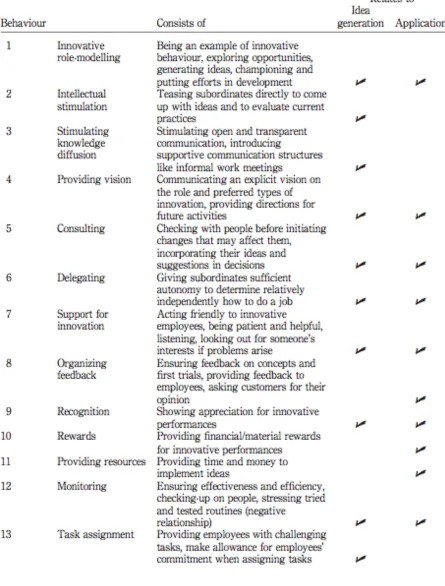
De Jong and den Hartog (2007) identified several innovative management behaviours in order to support an innovative work environment, therefore increasing IWB in employees. They identified thirteen different types of management behaviour that are supportive for innovative work behaviour of employees. Figure 2 shows all the different management behaviours identified by De Jong and den Hartogh (2007). According to them, line managers can support their employees on 2 different important aspects, idea generation and application behaviour of their employees. The second hypothesis deals with the innovation supportive management behaviour. The higher managers score on this behaviour, the more supportive their leadership behaviour is with regard to innovative work behaviour of their employees.
Method and structure of the master thesis
Research design
This research has a quantitative research approach towards answering the research question. There was multisource data collected from a case study containing employees as well as managers of a Dutch company. Before data could be acquired, an extensive literature research has been conducted in order to determine which items to use to measure IWB, performance and management behaviour. Because a lot of existing scales were used to measure IWB in the past, the goal of this was to make an overview of what has been researched and how reliable these scales are. Next to this, this research focuses on the influence of management behaviour so it was important to find scales that could be conducted on a managerial level as well as employee level. After the scales have been chosen, a questionnaire has been conducted for employees as well as their managers in order to gather quantitative data (see appendix C for the full questionnaire).
Research group selection:
For this research the service industry has been targeted in order to measure the effect of leadership on employee performance as well as innovativeness in employees. Schuler and Jackson (1987) mention that strategy of a company is not only important for developing products but also for offering services. The service industry is also operating in a rapidly changing business environment and this leads to a higher demand of innovative behaviors of employees in order to stay competitive and succeed in these dynamic business environments (Ramamoorthy et al. 2005; Kanter, 1983; West & Farr, 1989). So, the service industry is relying on a particular level of innovativeness and as mentioned before innovative work behavior (IWB) of employees contributes to successfully operating in dynamic business environments (Kanter, 1983). Because of the importance of innovativeness in employees, the service industry fits perfectly with this research and for this reason it is the selected research group.
Sample:
managing a team of coaches; these coaches are guiding people to acquire a job. Not only is the company an employment agency, it also has a hospitality and detachment department. Because the sample company is offering different kind of services and works with employees supported by different managers, this sample represents the selection group well. It is a Dutch company, so the sample doesn't represent possible cultural differences and is only applicable for other Dutch companies that offer different kind of services and in an innovative culture.
Respondent pool:
This research focused on two groups, managers and employees. The sample consisted of 18 managers and 134 employees. Some of the participated managers and employees did not complete the questionnaire and therefore couldn’t be used in this research or there will be bias. The response rate of those who fully completed the questionnaire was 16 out of 18 (89%) managers and 83 out of 134 (62%). The average age of the respondents was 32,5 (SD=8,1) years for the employees and 36,6 (SD=6.3) for the managers. From the employees, 31% was male and 69% was female. From the managers, was 53% male and 47% female. Education levels were also interesting for the general results. 46% of the employees was MBO or lower educated, 49% HBO and only 5% followed a WO education. Only 6% of the managers was MBO or lower educated, 71% was HBO educated and 23% followed a WO education.
Data collection
The data is multisource because the respondent pool consisted of both employees as well as managers. In appendix B is a full overview of the measures based on the questionnaire. In this research the unit of analysis are the employees of in person. The management data was used as a control variable as well as another source to measure management behaviour. The employees will answer questions measuring IWB, individual job performance and innovation supportive management behaviour of their managers. Next to this they will also answer questions about their age, sex, tenure, education level, LMX and innovative climate in order to use these variables as control variables. The managers will answer questions regarding their management behaviour. Next to this the managers also answer control questions about their age, sex, tenure, education level, and innovative climate.
Measurement
Employee IWB:
promotion, and three items to idea realization. Examples of items are “How often do you generate original solutions to problems?” (idea generation), “How often do you mobilize support for innovative ideas?” (idea promotion) and “How often do you systematically introduce innovative ideas into work practices?” (idea realization). All questions will be rated on 5 point Likert scales ranging from: 1=totally disagree, 2=disagree, 3=neither agree nor disagree, 4=agree, 5=totally agree. Because the scale measured three different stages of innovative work behavior, a test was done in order to measure if it had different factors. The factor analysis is shown in appendix G. There was only one factor found, which is in line with the findings of Janssen (2000). The Cronbach’s alpha of the questionnaire tested in this research was high and therefore we can conclude that the questionnaire was reliable (α = 0.92).
Employee individual job performance:
In this research individual job performance was measured by measuring task performance. Bos-‐‑ Nehles and Meijerink (2014) state that employee performance can be formulated as multidimensional and therefore only the ‘in-‐‑role’ dimension was chosen to be measured in this research. The reason for this is that focus in this research is on how the employee him or herself is performing, apart from their ‘extra-‐‑role’ performance. To measure task performance, the scale of Kluemper et al. (2013) was used. Bos-‐‑Nehles and Meijerink (2014) also used this scale and translated it into a Dutch scale with a good reliability (α = .84). This makes it acceptable to use and because it is already formulated in Dutch, this makes the chance on bias less likely because the scales don't have to be translated. The task performance scale consisted of five items, an example of one of the items is “Adequately complete assigned duties assigned”. All questions will be rated on five point Likert scales ranging from: 1=totally disagree, 2=disagree, 3=neither agree nor disagree, 4=agree, 5=totally agree. In this research the Cronbach’s alpha of the scale was high (α = 0.92).
Innovation supportive management behaviour:
questions per behaviour, it was not possible to measure every type of possible behaviour within the company. From all thirteen behaviours, seven behaviours do meet the requirements of supporting the ‘idea generation’ stage as well as the ‘application’ stage. In order to measure the different behaviours; providing vision, delegating, monitoring, role modelling, consulting, support for innovation and recognition, the Dutch questionnaire developed by de Jong (2007) was used.
The line managers’ behaviours were measured by using self-‐‑report scales to which extent they feel they are fostering innovativeness for their employees, based on the findings of De Jong and Den Hartog (2007). The employees filled in the same questions based on the Dutch scale developed by de Jong (2007). The questionnaire consisted of 27 items and an example of an item is “My leader reacts enthusiastically to my creative thoughts.”. All questions will be rated on five point Likert scales ranging from: 1=totally disagree, 2=disagree, 3=neither agree nor disagree, 4=agree, 5=totally agree. Because the scale consisted of seven different behaviours, a factor analysis was done in order to measure how many factors this questionnaire has. An oblique rotation method was used because it can be assumed that the seven behaviours are correlated. The method that has been used was the oblimin rotation. The factor analysis is shown in appendix G. The Cronbach’s alphas were high for the manager scale (α = 0.74) as well as the employee scale (α = 0.97). In this
Control variables
Data Analysis
After these questionnaires have been completed the results of the innovation supportive management behaviour and innovative climate scales of the employee and manager will be compared in order to estimate the bias of the scales. This will be done with an independent sample T-‐‑test of both scales. When this has been done the results will be analyzed with regard to moderating effects of management behaviour on employee job performance. Based on the IWB score of employees the effect on employee job performance will be measured. If there is an effect, there will be analyzed if management behaviour is positively related to this effect. If management behaviour functions as a moderator between IWB and employee performance will be researched. The data analysis will be done in SPSS with a multivariate multiple linear regression analysis because there are two independent variables.
Results
Correlation analysis
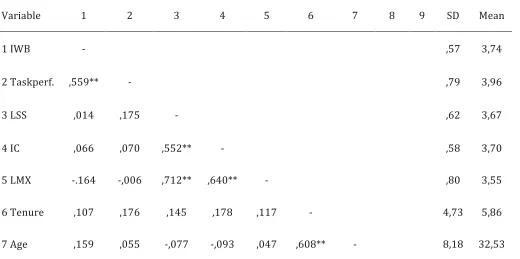
Before the hypothesis will be tested, a correlation analysis has been done. The results of this correlation analysis are shown in the table below. Task performance and Innovative work behaviour of employees is positively correlated, r = 0,559. Innovative climate is positively correlated with innovation supportive management behaviour, r = 0,552. Leader-‐‑Member exchange is correlated with both innovation supportive management behaviour (r = 0,712) as well as innovative climate (r = 0,640).
Table 1
Correlation analysis between employee variables
Variable 1 2 3 4 5 6 7 8 9 SD Mean
1 IWB -‐‑ ,57 3,74
2 Taskperf. ,559** -‐‑ ,79 3,96
3 LSS ,014 ,175 -‐‑ ,62 3,67
4 IC ,066 ,070 ,552** -‐‑ ,58 3,70
5 LMX -‐‑.164 -‐‑,006 ,712** ,640** -‐‑ ,80 3,55
6 Tenure ,107 ,176 ,145 ,178 ,117 -‐‑ 4,73 5,86
[image:18.595.65.585.509.768.2]8 EduLvl. -‐‑,121 ,009 -‐‑,013 -‐‑,057 ,045 ,104 -‐‑,173 -‐‑ ,61 2,58
9 Sex ,091 ,183 -‐‑,021 ,107 ,045 ,179 ,025 ,179 -‐‑ ,46 1,69
** p < .01
Although there was no data from the line managers to compare with the employee self-‐‑report IWB and task performance scales, there were two scales filled in by both employees as well as line managers. Innovative climate and innovation supportive management behaviour were filled in by both employees and managers, therefore the results were analysed with an independent samples T-‐‑test of both. The results are shown below in table 2 and table 3. See Appendix F for both SPSS outputs of the T-‐‑tests.
Table 2
Results of t-‐‑test and descriptive statistics for innovation supportive management
behaviour (ISMB) sorted by level
Level
95% CI for Mean
Difference
Employee
Manager
M
SD
n
M
SD
n
t
df
ISMB
3.59
0.64
75
4.05
0.22
16
-‐‑0.79, -‐‑0.14
-‐‑2.85* 89
* p < .05.
Table 3
Results of t-‐‑test and descriptive statistics for innovative climate (IC) sorted by level
Level
95% CI for Mean
Difference
Employee
Manager
M
SD
n
M
SD
n
t
df
IC
3.70
0.63
70
3.70
0.30
16
-‐‑0.32, -‐‑0.33
0.023* 84
* p < .05.
The first independent sample T-‐‑test showed that the samples were significantly different (t = -‐‑ 2.85). This showed that the score of the employees on their managers’ innovation supportive behaviour was significantly lower than the self-‐‑report score of the managers. This means that the managers have scored themselves higher than their employees did and probably are biased. The second sample T-‐‑test showed that the scores on the innovative climate score were significant similar (t = 0.023).
[image:19.595.59.574.74.136.2]Hypothesis testing:
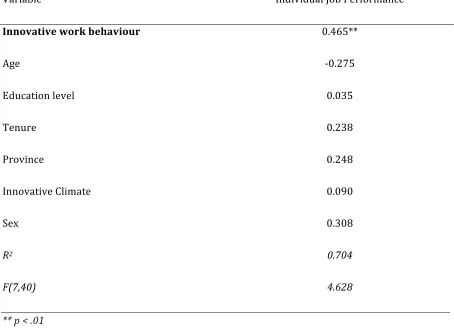
The H1 hypothesis was that IWB has a positive effect on individual job performance of employees. To analyse this, a linear regression analysis was done (See appendix D). The results were significant (b = .465, t (40) = 3.433, p < .001, R2 = .495, F (7, 40) = 4,628, p < .001). Age was used as a control variable. The results of can also be found in table 4.
Table 4
Linear regression analysis of innovative work behaviour (IWB) on individual job
performance.
Variable Individual Job Performance
Innovative work behaviour 0.465**
Age -‐‑0.275
Education level 0.035
Tenure 0.238
Province 0.248
Innovative Climate 0.090
Sex 0.308
R2 0.704
F(7,40) 4.628
** p < .01
[image:20.595.70.524.242.572.2]
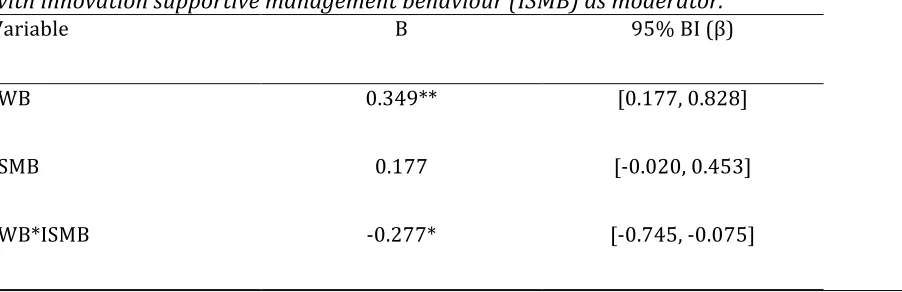
Table 5
Linear regression analysis of innovative work behaviour (IWB) on individual job performance
with innovation supportive management behaviour (ISMB) as moderator.
Variable B 95% BI (β)
IWB 0.349** [0.177, 0.828]
ISMB 0.177 [-‐‑0.020, 0.453]
IWB*ISMB -‐‑0.277* [-‐‑0.745, -‐‑0.075]
* p < .05, ** p < .01
F(3,74) = 11.521, R2=0.327
Extra analysis:
Based on the results of the interaction effect, there was done another analysis because it was a surprising result. The moderating effect that was found was with all seven management behaviours. Two of the seven management behaviours were specifically oriented towards innovative work behaviour (innovative role modelling & support for innovation) and therefore two extra interaction effects were tested but without significant effects. One with only these two behaviours and one interaction analysis with the other five (providing vision, delegating, monitoring, consulting and recognition). The goal of this extra analysis was to estimate if the effect would be different with or without the IWB oriented management behaviours. There were no significant results found (see appendix H).
Discussion
[image:21.595.74.525.106.252.2]higher demand and engagement in innovative behaviours of employees in order to stay competitive and therefore we can confirm that innovative work behaviour of employees is indeed contributing to their individual job performance. It has been found that the employee individual performance increases when their IWB is increased as well, one of the reasons could be that this IWB functions as an important factor in problem solving behaviour of employees as described by Basadur (2004). When this is the case, managers and organizations should be aware of the fact that stimulating IWB of employees can improve the individual job performance of their employees as well.
The second hypothesis deals with how line management behaviour has an effect on the relation between IWB and individual job performance. This relation was also important to test in order to get a good understanding of the concept as well as an answer to the research question. There is a negative moderation effect found in the results of management behaviour on the relation between IWB and individual job performance. This means that the higher the innovative management behaviour experienced by an employee, the lower the correlation between his/her IWB and task performance. Meaning, the higher the experienced innovative management behaviour, the less important it is how high his/her IWB is in order to score higher at task performance. At first this would seem a little strange but it has probably to do with a certain ‘level’ of innovativeness for an employee in order to do his job properly. It seems that job performance is being enhanced by at least the level of IWB from this employee but once he is supported and stimulated he/she doesn’t need high levels of IWB anymore in order to perform properly. This implies important theoretical evidence that innovativeness is indeed very important for employees in order to perform better. Whether or not this is their own behaviour or the stimulation from their managers, this does not seem to matter according to the results of this research. Based on this, we can also conclude that managers have to be aware of their employees’ innovative work behaviour. When the employee already has a high IWB, a manager should not focus on stimulating him/her, whereas an employee who is lacking innovative work behaviour could use it to be stimulated in order to perform better. As mentioned by Basadur (2004), managers can help to provide the right environment for employees in order to be as innovative as possible. It seems to all come down to that ‘problem solving’ behaviour as mentioned by Basadur (2004). From this research it can be concluded that it does not matter if this innovativeness comes from the employee or the manager, as long as it is present it will improve individual job performance of employees.
something about how IWB relates in other sectors. Another shortcoming is that the results could be biased because of self-‐‑report scales. When employees have to report their own individual job performance, a self-‐‑report bias could occur (Donaldson & Grant-‐‑ Vallone, 2002). The difference in scores between managers and employees on the managerial behaviour score also indicates that this self-‐‑report bias is definitely the case. Therefore, we must be cautious on drawing conclusions of the self-‐‑report scales from IWB. In this case the company didn’t allow to conduct employee specific scales filled in by their managers so it is a weak point of this research. For further research it is advisable to ask managers to fill in performance scales of their employees in order to avoid as much bias as possible.
Conclusion
Before discussing the hypothesis, it is important to get back to the research question which was:
To what extent does line management behaviour influence the effect of innovative work behaviour on individual job performance of employees?
The main goal of this research was to provide insights in the effect of IWB on individual job performance and relate management behaviour to this relation as well. From the results we can conclude that in fact there is a positive effect of IWB on individual job performance, which underlines the importance of IWB in employees. This means that the first hypothesis was adopted. The second hypothesis stated that the relation between IWB and individual job performance will be enhanced when managers show high innovation supportive behaviours. In fact, it was a negative moderating effect on employee performance, so the second hypothesis can be rejected. The most important conclusion drawn from this research is that IWB in employees benefits their performance. When a manager can improve the IWB of his employees he can make them perform better. When coming back to the research question, we can conclude that line management behaviour can have an influence on the employees that do not show high innovative work behaviour yet. This can improve their performance and therefore it should be a priority for managers to estimate the level of innovative work behaviour of their employees. High levels of innovation supportive behaviour will have a negative effect on employees showing a high level IWB. Providing and fostering the right environment for employees with low innovative work behaviour seems to be compensating for the effect on individual job performance in comparison to the employees that do have a high innovative work behaviour already.
References
Alagaraja, M. (2013). HRD and HRM Perspectives on Organizational Performance A Review of Literature. Human Resource Development Review, 12(2), 117-‐‑143.
Amabile, T. M. (1988). A model of creativity and innovation in organizations. Research in organizational behavior, 10(1), 123-‐‑167.
Amabile, T. M., Conti, R., Coon, H., Lazenby, J., & Herron, M. (1996). Assessing the work environment for creativity. Academy of management journal, 39(5), 1154-‐‑1184.
Axtell, C.M., Holman, D.J., Unsworth, K.L., Wall, T.D., Waterson, P.E. and Harrington, E.
(2000), “Shopfloor innovation: facilitating the suggestion and implementation of ideas”, Journal of Occupational & Organizational Psychology, Vol. 73, pp. 265-‐‑85.
Bae, J., & Lawler, J. J. (2000). Organizational and HRM strategies in Korea: Impact on firm performance in an emerging economy. The Academy of Management Journal, 43(3), 502-‐‑ 517.
Barney, J. (1991). Firm resources and sustained competitive advantage. Journal of management,
17(1), 99-‐‑120.
Basadur, M. (2004). Leading others to think innovatively together: creative leadership.
Leadership Quarterly. Vol. 15 No. 1, pp. 103-‐‑21.
Battistelli, A., Montani, F., Odoardi, C., Vandenberghe, C., & Picci, P. (2014). Employees' concerns about change and commitment to change among Italian organizations: the moderating role of innovative work behaviour. The International Journal of Human Resource Management, 25(7), 951-‐‑ 978.
Blau, P. (1964). Exchange and power in social life. New York: Wiley.
Borman, W. C., & Motowidlo, S. M. (1993). Expanding the criterion domain to include
elements of contextual performance. Personnel Selection in Organizations; San Francisco: Jossey-‐‑Bass, 71.
Bos-‐‑Nehles, A.C. and Meijerink, J.G. (2014) Implementing HRM systems. The role of mployees’ co-‐‑production behavior and HRM attributions. 9th International
Workshop on Human Resource Management, 30-‐‑31
Bowen, D. E., & Ostroff, C. (2004). Understanding HRM firm performance linkages: The role of the “strength” of the HRM system. Academy of Management Review, 29(2), 203-‐‑ 221.
Bunce, D., & West, M. (1994). Changing work environments: Innovating coping responses to occupation stress. Work and Stress, 8, 319–331.
Cappelli, P., & Neumark, D. (2001). Do “high-‐‑performance” work practices improve
establishment-‐‑ level outcomes? Industrial and Labor Relations Review, 54(4), 737-‐‑775.
innovative behaviour: a moderated path analysis of work engagement and job resources. Journal of Applied Social Psychology, 43(10), 2120-‐‑2135.
Cronbach, L. J. (1989). Construct validation after thirty years. Intelligence: Measurement,
theory, and public policy, 3, 147-‐‑171.
Cropanzano, R., & Mitchell, M. S. (2005). Social exchange theory: An interdisciplinary review. Journal of management, 31(6), 874-‐‑900.
d’Arcimoles, C. H. (1997). Human resource policies and company performance: A
quantita-‐‑ tive approach using longitudinal data. Organization Studies, 18, 857-‐‑874.
De Jong, J. P., & Den Hartog, D. N. (2007). How leaders influence employees' innovative
behaviour. European Journal of innovation management, 10(1), 41-‐‑64.
De Jong, J. P. (2007). Individual Innovation: The Connection Between Leadership and Employees’
Innovative Work Behavior.
De Jong, J.P., & Den Hartog, D. (2010). Measuring innovative work behaviour. Creativity
and Innovation Management, 19(1), 23-‐‑36.
Donaldson, S. I., & Grant-‐‑Vallone, E. J. (2002). Understanding self-‐‑report bias in organizational behavior research. Journal of Business and Psychology, 17(2), 245-‐‑260.
Dougherty, D., & Heller, T. (1994). The illegitimacy of successful product innovation in established firms. Organization Science, 5, 200–218.
Drucker, P. F. (1985). Innovation and entrepreneurship: Practice and principles. London: Heinemann.
Durst, S., Mention, A. L., & Poutanen, P. (2014). Service innovation and its impact: What do we know about?. Investigaciones Europeas de Dirección y Economía de la Empresa.
Ford, C. (1996). A theory of individual creative action in multiple social domains. Academy of Management Review, 21, 1112–1142.
Fox, M. L., Dwyer, D. J., & Ganster, D. C. (1993). EVects of stressful job demands and control on physiological and attitudinal outcomes in a hospital setting. Academy of Management Journal, 36, 289–318.
Frost, P. J., & Egri, C. P. (1991). The political process of innovation. In B. M. Staw & L. L.
Cummings (Eds.), Research in organizational behaviour (pp. 229–295). Greenwich, CT: JAI Press.
Galbraith, J. R. (1982). Designing the innovating organization. Organizational Dynamics, 10, 5–25.
Graen, G. & M. Uhl-‐‑Bien (1995), Relationship-‐‑based approach to leadership:
Development of leader-‐‑member exchange (LMX) theory of leadership over 25 years, applying a multi-‐‑level multi-‐‑domain perspective, Leadership Quarterly, 6, 219-‐‑247.
Janssen, O. (2000). Job demands, perceptions of effortreward fairness and innovative
Janssen, O. (2003). Innovative behaviour and job involvement at the price of conflict and less satisfactory relations with co-‐‑workers. Journal of Occupational and Organizational Psychology, 76, 347–364.
Janssen, O. (2004). How fairness perceptions make innovative behaviour more or less stressful. Journal of Organizational Behavior, 25(2), 201-‐‑215.
Janssen, O. (2005). The joint impact of perceived influence and supervisor
supportiveness on employee innovative behaviour. Journal of occupational and
organizational psychology, 78(4), 573-‐‑ 579.
Janssen, O., & Van Yperen, N. W. (2004) Employees’ goal orientations, the quality of
leader-‐‑member exchange, and the outcomes of job performance and job satisfaction.
Academy of Management Journal, 47: 368–384.
Janssen, O., Van de Vliert, E., & West, M. (2004) The bright and dark sides of individual
and group innovation: A special issue introduction. Journal of Organizational Behaviour, 25: 129–145.
Kanter, R. M. (1983). The Change Masters: Innovation and Entrepreneurship in the American Corporation. Touchstone Book.
Kanter, R. M. (1988). When a thousand flowers bloom: Structural, collective, and social
conditions for innovation in organizations. In B.M. Staw & L.L. Cummings (Eds.), Research in organizational behavior (pp. 169-‐‑211). Greenwich, CT: JAI Press.
Kluemper, D.H., DeGroot, T., & Choi, S. (2013). Emotion Management Ability: Predicting Task Performance, Citizenship, and Deviance. Journal of Management, 39, 878-‐‑905.
Koch, M. J., & McGrath, R. G. (1996). Improving labor productivity: Human resource man-‐‑ agement policies do matter. Strategic Management Journal, 17(5), 335-‐‑354.
Karasek, R. A. (1979). Job demands, job control and mental strain: Implications for job redesign. Administrative Science Quarterly, 24, 285–308.
Leung, K., Huang, K. L., Su, C. H., & Lu, L. (2011). Curvilinear relationships between role stress and innovative performance: Moderating effects of perceived support for
innovation. Journal of Occupational and Organizational Psychology, 84(4), 741-‐‑758.
Motowidlo, S. J., & Van Scotter, J. R. (1994). Evidence that task performance should be distinguished from contextual performance. Journal of Applied psychology, 79(4), 475.
Podsakoff, P.M. & MacKenzie, S.B. (1989). A second generation measure of organizational citizenship behavior. Indiana University.
Ramamoorthy, N., Flood, P. C., Slattery, T., & Sardessai, R. (2005). Determinants of
innovative work behaviour: Development and test of an integrated model. Creativity and Innovation Management, 14(2), 142-‐‑150.
Reichers, A. E., & Schneider, B. (1990). Climate and culture: An evolution of constructs. In B. Schneider (Eds.), Organizational climate and culture (pp. 5–39). San Francisco: Jossey-‐‑Bass.