An evaluation of an onboarding program at ZF
Friedrichshafen AG. Differences between
intended and perceived objectives.
Author: Hellen Buter
University of Twente P.O. Box 217, 7500AE EnschedeThe Netherlands
Purpose: This research aims to structure the intended objectives for onboarding
programs in relation to orientating and integrating newcomers as well as to
evaluate the perception of the newcomers regarding onboarding.
Methodology: A literature review is used to identify the intended objectives for
onboarding programs that provide the basis for the theoretical model. In-depth
interviews are conducted with newcomers from ZF Friedrichshafen AG to
evaluate the perception of newcomers regarding onboarding. Open coding is
applied to categorize the responses from the in-depth interviews in relation to the
intended objectives.
Findings: The intended objectives of onboarding programs can be modeled on an
orientation and integration continuum. The in-depth interviews showed a
perception for both orientation and integration. However, the perception does
not confirm the theoretical model where orientating newcomers is located before
integrating them.
Research limits: This research has proposed a new model, but it has not been
validated. The amount of in-depth interviews resulted in a first impression.
There is a language barrier present as the interviews are constructed in English
within a German organization.
Practical implications: ZF Friedrichshafen AG illustrates the focus on the
procedure for their onboarding program instead of the end goals. More attention
is given to orientating newcomers than integrating them.
Originality: This research has developed a model placing intended objectives in
analogy with Maslow’s hierarchy.
Acknowledgement: I thank my colleagues from UPlearning who provided insight
and expertise that greatly assisted this research.
Supervisors: Dr. Tom De Schryver
Dr. Anna Bos-Nehles
Keywords
Onboarding, Intended objectives, Perceived objectives, Orientation, Integration, ZF Friedrichshafen AG
Permission to make digital or hard copies of all or part of this work for personal or classroom use is granted without fee provided that copies are not made or distributed for profit or commercial advantage and that copies bear this notice and the full citation on the first page. To copy otherwise, or republish, to post on servers or to redistribute to lists, requires prior specific permission and/or a fee.
5th IBA Bachelor Thesis Conference, July 2nd, 2015, Enschede, The Netherlands.
1.
INTRODUCTION
Imagine you just finished your studies and got your first job opportunity at the organization you always wanted to work for. As a newcomer, you enter your new working place, you meet your new colleagues and your boss. You are placed behind your desk and they wish you a good day. So where do you start? What programs and techniques are available to you?
Organizations have a choice to implement an onboarding program as a first introduction for their newcomers. The onboarding program may include showing the newcomers which programs and techniques are available to them or provide the newcomers with a list of contacts to call when they have questions. The importance of onboarding programs is to find the best way to introduce the newcomers and develop them into productive members (Ross, Karen, Huang & Jones, 2014; Serbin & Jensen, 2013). In addition, when newcomers feel comfortable when entering the organization, this can result in increasing the retention rate (Goldschmidt & Rust, 2011; Woolforde, 2012).
The current literature describes the objectives of onboarding programs from an employer perspective and how they are being achieved. However, we do not know if new employees also perceive the objectives. Organizations implement onboarding programs for their newcomers (Fagerholm, Guinea, Borenstein & Münch, 2014; Goldschmidt & Rust, 2011). When the newcomers do not perceive the intended objectives or maybe not find the objectives useful, is the onboarding program really the right tool to use for organizations and not just a waste of effort? The theoretical relevance is to evaluate the onboarding program from the newcomers’ perspective.
This research is focused on the newcomers’ interpretation of the objectives for the onboarding program at ZF Friedrichshafen AG (ZF); more particularly in their Materials Management department. Therefore, the research question is:
“How to structure intended objectives of onboarding programs in relation to orientating and integrating newcomers?” To answer this research question, it is first important that the intended objectives from the literature are identified that are used as the basis for the theoretical model. Then a comparison can be made between the intended objectives of ZF with the literature and evaluate the perception of the newcomers. For that reason, this research has three sub questions:
• What are the intended objectives found in the literature for a successful onboarding program? • What are the intended objectives set by ZF
Friedrichshafen AG for their onboarding program? • Are the intended objectives set by ZF Friedrichshafen
AG for their onboarding program perceived by their newcomers?
In order to answer these three sub questions, the following steps will be taken. First a literature review will highlight the common intended objectives of onboarding programs. Then the intended objectives at ZF will be identified through an in-depth interview with the manager responsible for the onboarding program. Comparing the intended objectives of ZF with the literature allows us to evaluate the similarities and differences providing a first impression of ZF’s onboarding program. For question three, the interpretation of the intended objectives by newcomers will be evaluated through in-depth interviews conducted with ZF’s newcomers. The practical relevance for this research is to evaluate if new employees of ZF perceive the intended objectives and thus perceive the onboarding program as intended.
2.
DEFINITION OF ONBOARDING AND
OBJECTIVES
The word ‘boarding’ is recognized from traveling from one place to another by plane where boarding defines the process where an individual gets onto the plane. Onboarding within organizations includes a similar process where individuals travel from one place to another to get on board at their new organization they want to represent.
I use Goldschmidt and Rust (2011) definition to define an onboarding program as a formal, intentional process, initiated by a company, that welcomes new employees, let them know that they are valued members of the team, and prepare them for their role. Since the onboarding program is a formal, intentional attempt of the company, there are intended objectives identified. The intended objectives shape the onboarding program regarding its structure, learning methods and delivery (Mathews et al., 2001). The objectives are aimed to turn into deliverables after the onboarding program.
The onboarding process may involve orientating newcomers as both Danielson, Craddick, Eccles, Kwasnik and O’Sullivan (2015) as well as Goldschmidt and Rust (2011) explain where newcomers require an orientation of their new practice site to clarify their role, prepare them for their tasks and connect them with their peers. Another onboarding process described by Fagerholm et al. (2014) is that newcomers require integration through learning the new knowledge, skills and behavior to be successful at their role.
It has been shown by Ross et al. (2014) that orientating and integrating newcomers can be combined for the onboarding program. On the one hand, orientation is focused on the transition process of the newcomers through building up a relationship with the organization and on the other hand, integration is focused on learning the organizational culture, structure and procedures present at the organization.
3.
LITERATURE REVIEW
In this section I focus on the objectives of onboarding. I first summarize the objectives that have been found in the literature. I continue by trying to synthesize the literature into a framework. I found five objectives namely (1) Efficiency (Danielson et al., 2015), (2) Organizational Commitment (Solinger, Van Olffen, Roe & Hofmans, 2013), (3) Integration (Fagerholm et al., 2014), (4) Full-Functioning Member (Serbin & Jensen, 2013; Steinmacher, Silva, Gerosa & Redmiles, 2015), and (5) Smooth Transition Process (Goldschmidt & Rust, 2011; Ross et al., 2014; Woolforde, 2012). The objectives are described in more detail here.
3.1.1
Efficiency
Danielson et al. (2015) explained the need of organizations to have a structured program where newcomers are introduced to the organization and their functions. He explains that resources like streamlined placement and block scheduling can welcome multiple newcomers at the same time and thus enhances the efficiency of an onboarding program. In addition, newcomers are provided with information and tools that enhances the efficient work regarding their role (Danielson et al., 2015).
3.1.2
Organizational Commitment
person-organization fit. Resources like socialization tactics or other types of interventions may be applied to enhance organizational commitment. As a result, the onboarding program can be used to improve the organizational commitment of the newcomers (Solinger et al., 2013).
3.1.3
Integration
Another objective mentioned in the literature is integration. As Fagerholm et al. (2014) describes, the use of virtual teams and projects is more common nowadays and that requires newcomers to be integrated in the project or team. The integration is required for newcomers to be able to contribute to organizational success. Integration is accomplished by socializing the newcomers with the insiders of the project or team. Additionally, a mentor is used who stimulates the integration process by teaching the newcomers the skills, knowledge and behavior of what is expected (Fagerholm et al., 2014).
3.1.4
Full-Functioning Member
Another objective found is the development of newcomers into full-functioning members. Full-functioning members are the ones who are able to show high performance and contribute to the overall organizational success. The transformation from newcomers to full-functioning members is achieved through clearly communicating what is expected from the newcomer and providing support, tool, education and/or information (Serbin & Jensen, 2013; Steinmacher et al., 2015).
3.1.5
Smooth Transition Process
A last objective found in the literature is where onboarding programs are applied to create a smooth transition process from outsider to insider. The main resources involve a streamlined process including self-learning, networking and ongoing support (Goldschmidt & Rust, 2011; Ross et al., 2014; Woolforde, 2012). Ross et al. (2014) argues that providing enough feedback and an explanation of the organizational culture sets the tone for newcomers that additionally provide a platform to create a relationship with the organization. Woolforde (2012) argues that the importance of a structured framework of the organizational standards, policies, procedures and team members creates a smooth transition process.
3.2
Simplified Framework
I have tried to organize the intended objectives in a framework that consists of two dimensions of orientation and integration in such a way that orientation and integration can be combined (Ross et al., 2014). Orientation is defined as the process whereby the newcomers are introduced to an organization so that they develop an understanding of the organization (Goldschmidt & Rust, 2011; Woolforde, 2012). Integration is defined whereby the newcomers become a part of the organization by enabling them to work within teams located at the organization (Fagerholm et al., 2014; Solinger et al., 2013). The difference between the two dimensions is that orientation provides the knowledge and integration the procedures required for newcomers.
Integration can be located in the framework after orientation as onboarding includes but also extends well beyond orientating newcomers (Serbin & Jensen, 2013). Orientation is a necessary but insufficient condition. Integration is the final objective for onboarding programs in this framework.
The distinction between the orientation and integration phase is not strict. I believe orientation is when newcomers are still receiving new insights regarding tools, structure and/or processes. Once the newcomer does not receive any new insights, the newcomer is slowly being integrated as he/she learns how to work with the insights given. The newcomer
slowly moves away from being orientated and enters the integration phase. This transition seems to happen somewhere in between the processes of full-functioning member and efficiency. The newcomer has the equipment to perform his/her function but still needs to improve his/her efficiency. Therefore, the newcomer may still receive new insights concerning how to perform more efficient but most of the insights are given before. The orientation phase is becoming less dominant and the integration phase is becoming more dominant (Fagerholm et al., 2014; Goldschmidt & Rust, 2011; Solinger et al., 2013; Woolforde, 2012).
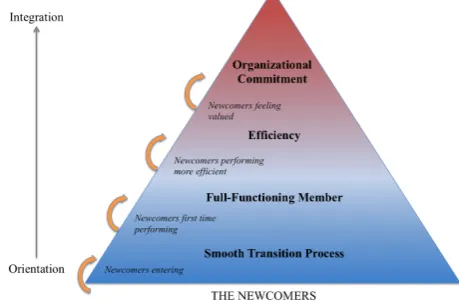
Figure 1. The onboarding intended objectives placed in relation to orientation and integration
The framework can be visualized by a pyramid structure including orientation at the bottom and integration at the top. There is a parallel with the famous Maslow’s hierarchy. Maslow’s pyramid presents the hierarchy of needs for motivation. The pyramid is structured where the most dominant human needs are located at the bottom of the pyramid. The motivation moves up the pyramid ones the most dominant needs are satisfied. The motivation moves higher up the pyramid after the second most dominant needs are satisfied and so on (Maslow, 1943; McKenzie & Tullock, 2012). I have used the framework of Maslow to organize the intended objectives of an onboarding program in a similar way. The objectives represent the needs newcomers have when getting onboard at the organization as Roa and Shah (2012) recommend trainings to link the training priorities to the needs of the participants. I assume that one priority of the onboarding program is to match the objectives with the newcomers’ needs. The intended objectives are organized regarding their importance. The most important objective will need to be satisfied before continuing to the next objective. The importance of the objectives is based on the three scenarios from Solinger et al. (2013).
The first scenario is called falling in love where the newcomer imagines him/herself at the organization. The newcomer develops expectations and prepares him/herself for the transformation. In the following scenario the newcomer is transformed from outsider to insider by adjusting to the organizational expectations and learning the functional requirements. The last scenario is where the newcomer is transformed into an organizational member and has fulfilled the expectations and functional requirements to be committed in the new organization (Solinger et al., 2013).
[image:3.595.309.539.196.349.2]The newcomers start by entering the organization. The first objective is to welcome the newcomers. The smooth transition process allows the newcomers to transform into insiders (Goldschmidt & Rust, 2011; Ross et al., 2014; Woolforde, 2012). Once the first objective is satisfied, newcomers can move up the pyramid to the following objective.
The following objective is developing the newcomers into full-functioning members. As Serbin and Jensen (2013) explain, after recruiting and hiring comes onboarding. Onboarding includes clarifying the expectations and providing ongoing support during the process (Serbin & Jensen, 2013; Steinmacher et al., 2015). The newcomers are slowly being integrated at the organization. Again, the newcomers have reached a satisfactory level of the objective before moving up the pyramid to the next objective.
The next objective is efficiency. Efficiency is related to the newcomers’ performance. For example, when someone is shown for the first time how to perform, he/she might still have many questions and doubts. Things may not go correctly at once and the overall performance may take a little longer. However, when the process is repeated, the newcomer is likely going to remember the previous mistakes made and not make them a second time. Therefore efficiency is improved through experience and practice. Onboarding programs can provide tips and tricks from previous experiences to improve the performance of the newcomers and thus efficiency. This prevents each newcomer to learn by trial and error and benefit from the experiences of others (Danielson et al., 2015). Ones the efficiency objective is satisfied, the newcomers can continue to the last objective mentioned in the pyramid namely organizational commitment. The newcomers realize the improvements he/she has made and feels the need to continue the professional development (Ross et al. 2014). The newcomer feels committed to the organization and the final objective for onboarding has been satisfied (Solinger et al., 2013).
4.
METHODOLOGY
In the following section, I will outline the procedure for the data collection in detail to justify the quality of the data and provide transparency on the way I researched. I will start with the literature review and continue with the data collection regarding the in-depth interviews.
4.1
Data Collection: Literature Review
This literature review is limited to the research of onboarding programs. Only articles are selected which are available as full papers written in English and are peer-reviewed. The main databases used are ‘Web of Science’, ‘Scopus’ and ‘Business Source Elite’ since those consist of academic journals including the peer-reviewed articles.This research started with a focus to improve the current onboarding program at ZF. The focus is on improving the program through the application of different learning techniques and therefore the literature search began with the search terms onboarding and blended learning. However, it soon appeared that this search field included two relatively broad concepts providing a large range of information. Focusing on the onboarding concept narrowed the literature search down. For that reason, blended learning was replaced by key success factors (KSFs) to find out what the KSFs are for onboarding programs. This search revealed in a long list of possible KSFs for onboarding programs but did not apply to the current onboarding program at ZF. At the end, it was decided to only focus on the term onboarding to get an understanding of the factors involved in onboarding programs.
The literature review developed an understanding what onboarding programs include but it was not clear yet how to help ZF to improve their current onboarding program. It was therefore decided to meet with a consultant from UPlearning, who is specialized in supporting organizations with their development of onboarding programs. The consultant was asked to advise this research for a direction. She explained that to start a development of an onboarding program it is important to start analyzing the intended objectives set by the organization first. Once the intended objectives are defined, the development of the onboarding program can continue by analyzing if the newcomers also perceive the intended objectives. For that reason, I decided to focus first on the evaluation of the intended objectives set by ZF for their onboarding program and continue by analyzing if the objectives are also perceived by their newcomers.
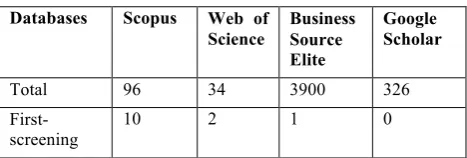
[image:4.595.310.544.278.357.2]The onboarding literature search revealed the following results: Table 1. Literature results regarding papers found per
database Databases Scopus Web of
Science Business Source Elite Google Scholar
Total 96 34 3900 326
First-screening
10 2 1 0
The articles chosen are based on a first screening made regarding its availability and the title as well as the abstract. The title and abstract have been read to select the articles that seemed to be useful for this research. The selection is based on articles that demonstrated a structure of an onboarding program and where the onboarding program has been tested in relation to its use. The first screening resulted in 13 selected articles that were evaluated one more time by a second screening. The second screening involved reading the entire articles. The articles are chosen on the fact that they describe an onboarding program and its application of resource used to achieve the intended objectives. At the end, eight useful articles have been selected for this literature review and are used to answer the first sub question by identifying the intended objectives found in the literature. The intended objectives identified provide the basis for the theoretical framework as well as for the evaluation of ZF’s onboarding program.
4.2
Data collection: Interviews
4.2.1
Sampling Technique
A non-probability sampling technique is used for selecting the onboarding group whereas a probability sampling technique is used for selecting the interviewees within the group (Babbie, 2013).
after having selected group 1 module A. A sign-up list has been developed where the newcomers could voluntarily sign-up for the in-depth interview selecting a suitable date and time. The sign-up list was shortly introduced to the newcomers at the start of the onboarding program. I was in direct contact with the manager who informed me about the date and time when I had volunteers for the in-depth interview. Three newcomers used the list to sign-up. The sign-up list can be found at appendix 9.1.1.
To increase the validity of this research, I decided to increase the number of interviewees by quota sampling. I searched for newcomers who matched the two profile criteria’s and directly asked them to participate. All three additional newcomers agreed to participate and that is how I got to a total of six newcomers participating.
4.2.2
In-Depth Interview Questions
The in-depth interviews take around 30 minutes that include 5 minutes introduction to the research followed by another 5 minutes used to ask demographic questions regarding the participant. The remaining 20 minutes are used for the interview questions related to the intended objectives. Each in-depth interview is recorded and transcribed.
There is an in-depth interview with the manager responsible for the onboarding program to identify the intended objectives of ZF for their onboarding program and thus answering the second sub question. The intended objectives identified by ZF will be compared with the intended objectives found in the literature. There are in-depth interviews with newcomers before the intended objectives of ZF are known and afterwards. The in-depth interviews before are used to evaluate the expectations newcomers have and how they have perceived the onboarding program. The in-depth interviews afterwards are used to evaluate if the newcomers have perceived the intended objectives identified by ZF and thus answers the third sub question.
The first in-depth interviews with the newcomers include the following questions:
1. How do you feel about your responsibility for personal development and growth within an organization?
2. What are the opportunities presented by ZF to continue growth for newcomers?
3. How is the communication between you and the organization regarding integrating you within the new department?
4. How was your first introduction with the onboarding program?
5. How was the procedure for the onboarding program that you have followed clarified to you?
6. How did you overcome the unclear aspects of the onboarding program, if any?
7. How was the timeline presented to you and used during the onboarding program?
8. What is the missing content regarding to your job experience? More information regarding your area of specialty or more information regarding the organization ZF?
9. Can you say something about the resemblance between the onboarding program and your job description?
10. How would you describe the information flow concerning your field of specialty within the onboarding program?
11. How were the teaching methods used during the onboarding program?
12. What is your opinion about the trainings that are currently being offered by ZF?
13. If you could wish for another training to be added to the onboarding program, what would it be?
14. What effect did the onboarding program have? 15. Is there anything more you would like to add to this
interview?
Four newcomers have answered the questions related to this in-depth interview. The in-in-depth interview starts by evaluating where the responsibility for onboarding is located. The in-depth interview continues by asking the newcomers’ opinion regarding their expectations for onboarding programs, the methods applied and how the onboarding program could be improved.
The following in-depth interview conducted involved the manager responsible for the onboarding program at ZF. The in-depth interview is used to identify the intended objectives for their program. The questions are the following:
1. Why has ZF opened up this research for their current onboarding program?
2. What are the reasons for ZF to need to change or develop their current onboarding program?
3. What are the objectives for the onboarding program? 4. Please rank the objectives from most important too
least important.
5. Why have those objectives for the onboarding program been chosen?
6. What is the importance for achieving those objectives for ZF?
7. How is the program used to achieve those objectives? 8. What tactics are applied to achieve the objectives? 9. What are the expectations towards the achievement of
the objectives?
10. For which objective(s) do you see the most difficultly to achieve it?
11. Is there anything more you would like to add to this interview?
The first two questions are intended to find the reasons why ZF is interested in the use of an onboarding program. The in-depth interview then moves on towards directly asking what the intended objectives are for their onboarding program. During the moment where the manager is answering this question, the interviewer writes down the intended objectives mentioned by the manager. This list is applied to the following question, namely question four, where the manager is asked to rank the intended objectives. In case the manager has forgotten the exact objectives he mentioned before, the list can be used to remind the manager. The in-depth interview then moves on to find out how ZF is trying to achieve their intended objectives. The in-depth interview ends by finding out where ZF sees their weakness concerning the onboarding program as a starting point for potential improvements.
Now that the intended objectives of ZF have been identified, the second in-depth interview with the newcomers can be conducted. The in-depth interview involved the following questions:
1. Which expectations did you have for the onboarding program?
2. Why did you have those expectations for the onboarding program?
3. Why are those expectations important for you? 4. The objectives placed in front of you are the intended
What is your first reaction when reading the intended objectives?
5. Please rank the objectives from 1 being the most important for you and 10 being the least important for you?
6. How has the onboarding program helped to achieve the intended objectives? For example, which tactics have been used during the onboarding program? 7. What is your opinion regarding the achievement of
the intended objectives?
8. Is there anything more you would like to add to this interview?
Two newcomers have answered the questions related to this in-depth interview. The first three questions are related to their expectations regarding the onboarding program. The expectations may provide additional objectives or other insights for the onboarding program. The last five questions ask the newcomers how they have perceived the intended objectives during the onboarding program.
The intended objectives set by ZF for their onboarding program are written down on cue cards by the interviewer. Each cue card represents one intended objective. The cue cards are used when the newcomer is asked to rank the intended objectives from what seems to be the most important objective to the least important objective. The cue cards allow the newcomer to move the intended objectives physically around showing his/her thoughts. Additional cue cards in another color are optionally offered when the newcomer wants to add missing objective(s). The ranking of the cards is documented by taking a photo of the end result and are applied with a photo protocol. The ranking is used to analyze the theoretical framework concerning the intended objectives.
4.2.3
Coding
This research follows a case-orientated analysis where in-depth interviews are performed within the organization of ZF. Open coding is used to analyze the interviews. The categories used to analyze the interview with the manager are in relation with the onboarding program. The core concept is the identification of intended objectives regarding the onboarding program (Babbie, 2013). Therefore the categories and their descriptions are the following:
o Onboarding program – reasons for performing the program
o Intended objectives – points identified that are seen as intended objectives
o Tactics – resources used in relation to the intended objectives
The categories used to analyze the in-depth interviews with the newcomers are linked to the intended objectives identified by ZF. The core concept is the newcomers’ perception regarding the intended objectives. Therefore the categories and their descriptions are the following.
o Efficiency – providing an efficient start
o Information – providing basic information and practical experiences
o Networking – developing a network
o Orientation – an overview of the Materials Management department
o Impression – other locations and divisions
o Team working – working with others across the organization
The coding and their results are organized in tables where the intended objectives stated by ZF are located on the left side and
the related responses on the right side. The responses are taken as quotes. See appendix 9.1.2 for the tables.
5.
RESULTS
I could not derive the intended objectives set by ZF for their onboarding program from a document and therefore I had to ask the manager to identify the intended objectives. The in-depth interview can be viewed in appendix 9.2.7. The current onboarding description is based on my experience of the onboarding program that I followed in July 2014. The following intended objectives have been identified.
5.1
What are ZF’s Intended Objectives for
their Onboarding Program?
The first objective she mentioned was efficiency. “The main aim is efficiency” (Interview 7, p. 6). She explained that efficiency refers to providing newcomers with everything they need to give them the efficient start within the organization. The efficient start includes knowing where to find what information. ZF therefore places high value towards providing information and has identified it as another objective for their onboarding program.
Providing information involves two parts. On the one hand, the information is simply provided to the newcomers. On the other hand, information involves building up practical experiences regarding tools, processes and systems located within the organization. The current onboarding program consists of handouts with written information for the newcomers. Additionally, the current onboarding program includes group assignments where the newcomers are forced to work with different tools, processes and systems to build up practical experience.
She continued that the efficient start also includes networking. Therefore, another objective is to stimulate networking across the organization. “It is really important for many people that you have a network” (Interview 7, p. 6). Bringing together newcomers from the different divisions and locations currently provides the opportunity for networking. Furthermore, the program consists of an evening program where the newcomers have dinner with a department leader where they are able to ask questions.
Another objective identified is giving newcomers the option to get an impression of other divisions and locations that are included within ZF. Since ZF currently has a matrix structure, the newcomers for the Materials Management department come from different divisions and thus locations. The impression provides the opportunity to learn from each other as the newcomers come from different backgrounds. Moreover, the current onboarding program consists of two modules where each module takes place at another location including a plant tour of the location.
Orientation is also an objective identified by ZF. Orientation refers to providing the newcomers with an overview of ZF’s Materials Management department. The current onboarding program creates the overview through multiple short presentations that explain the different roles and their related responsibilities.
Summing up the intended objectives for ZF’s onboarding program identified by the manager, the objectives are:
o Efficiency – providing an efficient start for their newcomers
o Information – giving the basic information needed for newcomers including building up practical experiences regarding tools, processes and systems.
o Networking – giving the contact possibilities to stimulate networking across the organization
o Orientation – providing an overview of the Materials Management department including its functions and responsibilities
o Impression – viewing the other divisions and locations
o Team working – enabling working with others across the organization
5.2
What are the Similarities and
Differences between ZF’s Intended
Objectives and the Literature?
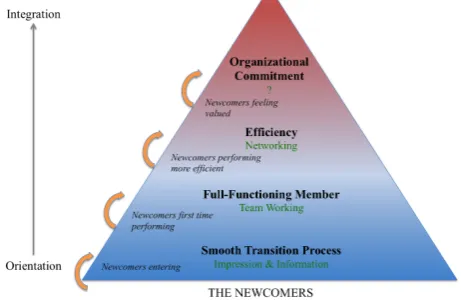
The objectives identified by ZF appear to be resources that can be used to achieve actual objectives. The ‘objectives’ information, impression, team working, and networking are resources used to achieve the actual objectives identified that are orientation and efficiency. For that reason, I will compare the results from ZF and the literature with the same pyramid where the identified resources from ZF are connected to the objectives identified by the literature.
The pyramid is structured in the same way as with the literature. Green words have been added to illustrate the resources identified by ZF in relation to their use to achieve the objective. The two actual objectives identified by ZF, namely orientation and efficiency, have not been marked green since efficiency is related to networking and orientation is related to impression and information. The resources are located in analogy to Maslow’s hierarchy where the basic resources are placed at the bottom of the pyramid. The basic resources, from the perspective of the manager, are providing information and an impression. When newcomers enter ZF, they first inform themselves and get a first impression. I have linked impression and information with the objective for achieving a smooth transition process.
Figure 2. The intended onboarding objectives for ZF in relation to orientation and integration
The next step involves preparing the newcomers for their role. For newcomers to perform means that working with other people is involved. I have placed team working as a next resource to develop newcomers into full-functioning members. Team working requires newcomers to be integrated within
teams or groups and therefore team working is placed higher up the pyramid.
The following step is to improve the efficiency related to newcomers’ performance. One way to improve the efficiency is to know the right people to ask. For example, at the beginning the newcomer might be searching for the right person and does find the right person at the end but via many detours. The efficiency is improved when the newcomer knows how to find the right person right away for the next time. With a bigger network, the chance of finding the right person is higher and therefore efficiency is improved. However, efficiency is not only based on networking and there might be other factors playing a role like the efficient use of tools and processes. At the top of the pyramid is the objective organizational commitment. However, there is no matching resource identified by ZF that could be used to achieve organizational commitment. That brings us to evaluate the differences and similarities between ZF and the literature.
First of all, ZF is identifying resources instead of objectives for their onboarding program. As ZF is focused on achieving the resources, it is missing the bigger picture that is achieving actual objectives. ZF is applying several resources to their program but not understanding why. It seems like that ZF is concentrating on the procedure concerning their onboarding program instead of the end goals.
Secondly, ZF is focusing their resources more to the lower part of the pyramid and thus orientating their newcomers more than integrating them. The importance for orientating its newcomers is also brought forward during the interview as the manager explains, “It is just that you have an overview of how ZF organization works, what tools are there that you have this overview” (Interview 7, p. 5).
A similarity between the literature and ZF is that both see the importance for efficiency. ZF provides the opportunity to develop a network to enhance the efficiency of newcomers. More resources are not provided for efficiency and thus limit ZF the improvement of efficiency by depending on networking. To sum up, the resources identified by ZF are related to orientation. Networking and team working is stimulating the newcomers to be integrated by using the insights learned to their benefits. However, newcomers still learn new people and working manners and thus continue being orientated. Therefore, there is no resource identified that is completely focusing on integrating the newcomers like socialization tactics described by Solinger et al. (2013).
5.3
How are the Intended Objectives
Perceived according to the Newcomers?
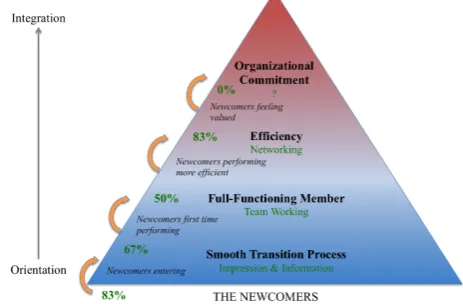
The total amount of in-depth interviews held involved six newcomers and the transcriptions can be found in appendix 9.2. The group consisted of 67% female and 33% male. The average age of the group is 26,5 years old. Most newcomers entered in the year 2014 with two exceptions. The first exception is a newcomer who has entered ZF in the year 2012 and the other in 2013. 33% of the newcomers worked in another organization before entering the organization of ZF. The Materials Management department is the first department for all the six newcomers within ZF. 50% of the newcomers realized that they have participated at an onboarding program whereas the other 50% stated that they have not. The objectives are perceived when at least 50% mentions an experience in relation to the intended objective. [image:7.595.55.286.530.680.2]explained that the first days at a new job are the worse. 75% who explained that their first days are the worse stated that the feeling of being lost caused it. The remainder 25% explained that it was the information overload that caused it. Therefore their expectations concerning onboarding programs are related to making their first days better. Some expectations are “Typical topics that I believe belong to the classical tasks of purchasing” (Interview 5, p. 5) or “What I expect is that when I ask for something that the organization also enables me” (Interview 1, p. 5).
Orientation is an intended objective set by ZF to provide an overview of the Materials Management department but have the newcomers also perceived the overview? 67% of the newcomers stated that the basic knowledge and trainings are provided during the onboarding program and that they were able to orientate themselves because of that. “The basics and the foundations were thought by the onboarding program” (Interview 1, p. 9). The other 33% of the in-depth interviews showed different opinions. One newcomer mentioned that he did not receive an overview, which would have been helpful (Interview 2). Another newcomer mentioned that he does not really understand what is meant with orientation, as orientation is the result of working together (Interview 6). Overall, it seems that the newcomers have perceived the orientation as at least 50% of the newcomers have mentioned the experience. However, there is clearly room left for improvement as the opinions differ.
As the manager explained, orientation is achieved through providing enough information and an impression of the other locations. 83% of the newcomers realized the connection where information and impression provide an orientation. However, the connection might not always be clear as the newcomer in interview 5 stated, “Impression, it belongs somehow to this point (orientation)” (p. 6).
The two roles for information, which have been described by the manager, have been realized by one of the newcomers. He explained that information consist of two parts namely information that comes from guidelines and information that comes from the team members (Interview 6).
The impression of other locations is valued between the newcomers. However, one has noted why the impression is limited to Europe. “I think it would be more interesting if people join from abroad” (Interview 2, p. 5). The resources information and impression appear to be perceived as at least 50% has experienced the resources.
The following objective in the pyramid is developing the newcomers into full-functioning members through the use of teamwork. 50% of the newcomers realized the importance of teamwork. One newcomer even explained that working without teamwork is not possible. Furthermore, he explained that with teamwork information is created and thus the need to work within teams (Interview 6). Another newcomer explained that teamwork helps to understand the information better. “To make the people better remember the information they get” (Interview 5, p. 6). As a result, teamwork is perceived but with a lower percentage compared to the previous intended objectives.
A last intended objective set by ZF is efficiency through the use of networking. 83% of the newcomers perceive the resource networking however the opinions differ. 60% share the opinion that networking is important for the job. “I think the main part is that you have to interact” (Interview 3, p. 5). The remainder 40% finds networking a process that happens but is not seen as important or necessary. “I thought more of it as a nice affect”
(Interview 5, p. 5). Consequently, networking is perceived however the opinions about its usefulness differ.
The figure below illustrates the percentages from the newcomers’ perception regarding the intended objectives. The percentage for orientation is located as second on the pyramid from bottom to top. The percentages seem to decline the higher the objectives are placed at the pyramid with the exception for efficiency. The newcomers’ perception therefore does not confirm the pyramid structure. The exception for efficiency might illustrate that a second pyramid is present on top of the pyramid of orientation.
An explanation for the declining percentages is that the orientation phase involves relatively cheap and simple resources like impression and information. Information is a resource that every organization has enough off and providing an impression of its locations nearby is something that can be achieved easily. When going higher up the pyramid, there is some struggle present as the percentages lower. Teamwork requires a proper organization of groups and assignments. Teamwork therefore requires more effort and investment to be as effected as impression and information.
Figure 3. The percentages of intended objectives perceived by the newcomers
The percentages at the pyramid decreases as going up the pyramid till the objective of efficiency. Efficiency resulted in a relatively large percentage. Nevertheless, the impression I got is that the 83% of newcomers who have experienced networking includes contradiction opinions. 40% of the newcomers explained that they do not see the importance and added value that networking brings. I strongly believe that the intentions of networking ZF had in mind to develop efficiency are not perceived in the same way according to the newcomers. All in all, it seems that the current onboarding program present at ZF is successful at orientating their newcomers but is having trouble to integrate their newcomers. It appears the ZF is having difficulty by identifying resources or tactics that can integrate their newcomers. Even though ZF seems to orientate their newcomers successfully, there is still room for improvement. The basis for an onboarding program is there but can be developed.
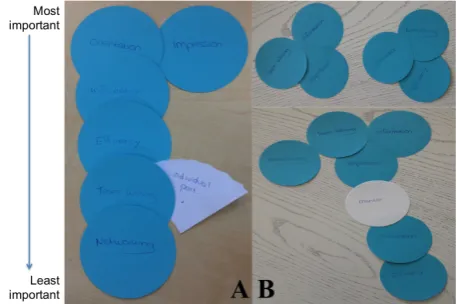
[image:8.595.308.540.307.459.2]Person A explained step by step the objectives when she ranked the objectives starting with orientation. She explained that orientation is important to order the information in your head and is followed by information. Information is provided to develop a general understanding concerning the Materials Management department where teamwork could help to process the information. Person A explained efficiency regarding the efficiency of the workshops. “If you want to keep the people motivated within a workshop you need to give them the feeling that we do it good, we do it fast, we do it efficient and we really provide an added value to you” (Interview 5, p. 6). The least important objective is networking since it is something that happens anyways. “You cannot avoid it” (Interview 5, p. 6). The objective missing is an individual part that provides the newcomer with the challenge to apply to information gained and test his/her understanding.
Figure 4. Two newcomers' perception regarding the importance of the intended objectives set by ZF
When person B was asked to rank the objectives, he created two groups. Group one, consisting of teamwork, information and impression, characterize the important objectives whereas the other group, consisting of orientation, networking and efficiency, characterizes objectives that are ‘nice to have’ but not important to him. I asked him what would he need to connect the two groups. His answer was “I just need a boss or something” (Interview 6, p. 8). Therefore, I offered him a cue card with mentor written on it. By connecting the two groups, he has moved networking higher up to the important objectives. Person A decided to put orientation as most important and networking as least important. Interesting is that person B has followed an opposite structure where networking is found as important and orientation less important. Therefore it seems like that the person A is more concentrated on orientation whereas person B is more concentrated on integration. Moreover, Person B has both actual objectives as least important and the resources used to achieve the objectives as most important. Person A has the actual objective of orientation as most important and efficiency in middle where the resources are spread around the objectives.
As person B ranked the resource networking as important, in his interview he mentioned the following “It is easier to work when you have the networking but I don’t believe it is an extremely important topic” (Interview 6, p. 7). This shows the perceived contradiction of the newcomers regarding networking. The impression I get is that there is a difference between how newcomers perceive an objective and how they value the objective. Newcomers can perceive objectives but when the objectives are not valued, are they the right objectives for the onboarding program?
I believe objectives need to be both perceived and valued for onboarding programs to be successful. In this case, person B seemed to have perceived the resource networking but does not seem to value it. ZF can increase their success rate by demonstrating the importance for networking to their newcomers. Demonstrating the importance develops an understanding for the relationship between networking and working efficient and therefore newcomers start valuing the opportunity they get to develop their network during the onboarding program.
A remark made by person A is that an individual part is missing where the newcomers are challenged to apply the new insights gained. This request can be related to the missing part of integration. Integration requires newcomers to apply the new insights gained. An individual part can provide an opportunity where newcomers receive a challenge and need to show what they can do. Such an individual moment can make the newcomers value their job and stimulate their commitment to the organization.
Lastly, as 67% state that they have perceived an orientation, 33% of them argue that the orientation was missing or not understood. I got the impression that orientation is closely related to individual preferences towards structuring information and thus orientating themselves within the organization. For example, one might require a structure of the organization on a handout whereas another might require the experience of different departments within an organization to be able to structure the organization. I therefore believe that the 33% have other expectations for being orientated within the organization. I believe ZF has provided orientation for their newcomers but can improve by providing orientation through different methods so that there is some type of orientation for each individual. For example, ZF can include both the handout and the experience of different departments to orientate their newcomers. This provides the opportunity that for each individual preference there is some type of orientation present.
6.
DISCUSSION
This research started with a practical issue on how to develop the onboarding program at ZF. The end result developed a pyramid structure where the intended objectives are ordered in relation to orientation and integration. The theoretical model combines Maslow’s hierarchy and the three scenarios from Solinger et al. (2013) to structure the intended objectives for onboarding programs.
I expected that orientation is the basis for onboarding and integration the end goal. The newcomers have perceived both dimensions but perceived orientation more (orientation 67% & teamwork 50%) than integration (efficiency 83% & integration 0%). Integration appears to be more difficult to be perceived. An explanation might be as integration requires newcomers to develop an organization identity (Solinger et al., 2013). Integration therefore requires more time and effort from both the organization and the newcomer. Orientation asks newcomers to perceive information and ongoing support whereas integration asks newcomers to use that to develop an organizational identity. Therefore, orientation seems to be more easily perceived as integration.
[image:9.595.57.286.242.394.2]dimensions orientation and integration are related to the time period the newcomers are present within the organization. The case study showed that ZF identified resources as their intended objectives. That means that ZF is more concentrated on how their onboarding program proceeds instead of concentrating the onboarding program on achieving end goals set for their newcomers. The onboarding program scored high at the orientation phase but low on the integration phase. This might be because of the lack of direction for their program.
6.1
Theoretical Implications
This research illustrates that there is a relationship between intended objectives for onboarding programs as well as the dimensions of orientation and integration. Depending on how long the newcomers are within the organization, orientation can be taken as the basis for onboarding and integration as an end goal.
6.2
Practical Implications
The practical implications concern advice to improve the onboarding program at ZF. Firstly, it is encouraged to set a direction for their onboarding program and therefore define actual objectives as end goals that newcomers are expected to achieve after having participated at the onboarding program. ZF could discuss if the intended objectives found in the literature are the right ones for their onboarding program or may need to come up with additional objectives themselves.
Secondly, the procedure of the onboarding program including the resources used to achieve the objectives can be clarified to the newcomers to develop an understanding between the resources used and the objectives. Newcomers will understand why certain things are done within the program and values the opportunity provided to them. For example, newcomers who have just entered the organization may not understand the value of a network but will regret it when not taken the opportunity that was provided during the onboarding program.
The current onboarding program is strong at orientating newcomers and weak at integrating them. It is advisable to see the two dimensions of orientation and integration separately. ZF could use their two modules to separate the two dimensions where module A is used for orientating the newcomers and module B to integrate the newcomers. Once the foundation for orientating the newcomer is placed, the onboarding program can focus on the integration phase.
As the integration phase of ZF’s onboarding program is weak, it is important to provide an opportunity for the newcomers to be integrated within the organization. Setting up an individual assignment can provide the opportunity where newcomers use their new insights learned to their benefits and present their end results. ZF can for example place the individual assignment between module A and B where each newcomer presents his/her results in module B.
6.3
Limitations
This research had conducted six in-depth interviews with newcomers to evaluate the perception of the newcomers within ZF. The six in-depth interviews provide more likely a first impression of the newcomers’ perception. Moreover, this research is limited with its focus on the onboarding program present within the Materials Management department of ZF. Other departments of ZF may present different results regarding the onboarding programs applied there.
The in-depth interviews are performed in English. The English skills from the interviewees are satisfactory but a language barrier is present. Results therefore may have been misinterpreted because of the language barrier.
During the in-depth interviews with the newcomers, blue cue cards have been used to represent the intended objectives of ZF. The intended objectives are written with blue pen on the blue cue cards. In addition, the intended objectives are written down with one word without further explanation. Therefore, the intended objectives may not have been clearly presented to the newcomers.
This research provides a framework where the intended objectives of onboarding programs are ordered in relation to orientation and integration within a pyramid. I have defined the dimensions orientation and integration myself based on previous literature. However, there is literature available that defines the dimensions of orientation and integration in more detail. In addition, the coding as well as the structure of the pyramid has not been tested within this research.
6.4
Suggestions for Future Research
The pyramid is a starting point to organize intended objectives for onboarding programs around the dimensions of orientation and integration but this framework can be extended with future research. As the data showed an increase of perception at the integration phase, it might be possible that there is a second pyramid placed on top of the pyramid that represents orientation. Future research can investigate other structures to organize intended objectives.
The photo protocol showed a difference between importance regarding orientation and integration from the newcomer’s perspective. An explanation is the time period a newcomer is present within the organization. Future research can investigate the relationship between orientation and integration as well as the time period that the newcomer is present within the organization.
A last remark I would like to make is that onboarding programs do not need to stand-alone. A possibility is considering the application of socialization tactics for onboarding programs. Socialization tactics have been applied in both the studies from Fagerholm et al. (2014) and Solinger et al. (2013) to stimulate organizational commitment and integration. Organizational commitment and integration are both found at the top of the pyramid. Socialization tactics therefore can be tested concerning its stimulation of intended objectives placed at the integration phase.
7.
CONCLUSION
In this research I aimed to structure the intended objectives for onboarding programs in relation to orientating and integrating newcomers as well as to evaluate newcomers’ perception of the onboarding program at ZF. The results show that the intended objectives of onboarding programs can be modeled on an orientation and integration continuum. Both the organization of ZF and the newcomers have shown the added value that onboarding programs offer. To conclude, do not let the newcomer stare at his/her laptop for hours but help the newcomer get onboard.
8.
REFERENCES
Babbie, E. R. (2013). The practice of social research. Belmont, CA: Wadsworth Pub. Co.
Danielson, J., Craddick, K., Eccles, D., Kwasnik, A., & O'Sullivan, T. A. (2015). A Qualitative Analysis of Common Concerns about Challenges Facing Pharmacy Experiential Education Programs. American Journal of Pharmaceutical Education, 79(1), 1-8 (article 6).
Goldschmidt, K., & Rust, D. (2011). Onboarding Advanced Practice Nurses: Development of an Orientation Program in a Cardiac Center. The Journal of Nursing Administration, 41(1), 36-40. doi:10.1097/NNA.0b013e3182002a36
Maslow, A. H. (1943). A theory of human motivation. psychological review, 50(4), 370-396. doi:10.1037/h0054346 Mathews, B. P., Ueno, A., Kekale, T., Repka, M., Pereira, Z. L., & Silva, G. (2011). Quality training: needs and evaluation-findings from a European survey. Total quality management, 12(4), 483-490. doi:10.1080/09544120120066082
McKenzie, R. B., & Tullock, G. (1975). The new world of economics: Explorations into the human experience. Homewood, IL: R.D. Irwin.
Rao, K. L. N., & Shah, H. (2012). Exploring training needs for old and new age middle managers. The journal of business perspective, 16(1), 37-43. doi:10.1177/097226291201600104 Ross, W. E., Karen, M. D., Huang, H. C., & Jones, G. H. (2014). Executive Onboarding: Ensuring the Success of the
Newly Hired Department Chair. Academic Medicine, 89(5), 728-733. doi:10.1097/ACM.0000000000000214
Serbin, K. M., & Jensen, S. (2013). Recruiting, Hiring, and Onboarding Case Managers: Communication and Setting Expectations Are Keys to Success. Professional Case
Management, 18(2), 95-97.
doi:10.1097/NCM.0b013e3182806a50
Solinger, O. N., Van Olffen, W., Roe, R. A., & Hofmans, J. (2013). On Becoming (Un)Committed: A Taxonomy and Test of Newcomer Onboarding Scenarios. Organization Science, 24(6), 1640-1661.
Steinmacher, I., Silva, M. A., Gerosa, M. A., & Redmiles, D. F. (2015). A systematic literature review on the barriers faced by newcomers to open source software projects. Information and Software Technology, 59, 67-85.
Woolforde, L. (2012). Onboarding Nurse Practitioners: A Healthcare System Approach to Interprofessional Education.
9.
APPENDIX
9.1
Data Collection: In-Depth Interviews
9.1.1
Sign-Up List
9.1.2
In-Depth Interview Results
Interview
# ZF's objectives intended
Responses newcomer
1 Expectations Organization enables me to grow 2 Expectations Networking (people from abroad) 3 Expectations No expectations
4 Expectations No expectations 5 Expectations Learn about processes 6 Expectations No expectations
Interview
# ZF's objectives intended Responses newcomer
1 Orientation The basis and foundations were thought by onboarding 2 Orientation Too much information
4 Orientation Basic knowledge is there
5 Orientation Structure in your brain, a lot of orientation 6 Orientation Orientation comes with the others
Interview #
ZF's intended objectives
Responses newcomer
1 Impression Learning other tools
2 Impression Getting to know more people from other locations, people from abroad
3 Impression
4 Impression Get to know people from other divisions 5 Impression Connected to orientation
6 Impression Understand what others do
Interview
# ZF's objectives intended
Responses newcomer
1 Information
2 Information
3 Information
4 Information Strategic V.S. Operational 5 Information Purchasing view missing 6 Information Guidelines, 2 processes
Interview
# ZF's objectives intended
Responses newcomer
1 Teamwork
2 Teamwork Work together pretty closely
3 Teamwork
4 Teamwork
5 Teamwork Lots of topics involving teamwork, understand information better 6 Teamwork Provides/creates information, happens by itself, not possible without
Interview
# ZF's objectives intended Responses newcomer
1 Networking
2 Networking 1st step = daily task, 2nd step = networking 3 Networking Main part is interacting
4 Networking Networking is done 5 Networking Not important/necessary 6 Networking Nice to have
9.2
In-Depth Interview Transcripts
9.2.1
Interview 1
WELCOME
Dear participant,this research, the new employees entering the department MM. This is also known as the onboarding process for newcomers. A definition for onboarding used in this study is the one from Serbin and Jensen (2013) who state “The onboarding phase is all about communication and expectations, providing clear and thorough information about the job and the organization, while also providing education, tools, and support to help case managers be successful”.
Currently, the MM department is divided into three teams namely the Supplier Development (Lieferanten Management), Purchasing (Einkauf Production), and Logistics (SCM). The current onboarding concepts consist of three parties namely the participants, the trainers, and the organization. This research is focused on the possible (miss) fits between the different perspectives regarding the onboarding concept. Therefore, all three parties are asked for an interview to discuss their perspective on the onboarding concept. For this reason, it is important to interview you to receive your perspective on the current onboarding program. Please note that the objective of this interview is concerning the onboarding concepts and topics in your field of specialty (Materials Management). It will now be explained how this interview proceeds. The total interview will take about 20-40 minutes. I would like to record the interview to not miss any comments made by you. I will also take some notes but I will not be able to note everything down and therefore the recording. I start by asking you a few facts about yourself to get to know the participant better. We will continue with the interview questions related to current onboarding programs. I would like to stress that your confidentiality is important to me and the contents of your responses will remain anonymous.
• Do you agree with this?
☒ YES ☐ NO
• Can we record this interview?
☒ YES ☐ NO
DEMOGRAPHICS
Before we move on to the interview questions, I would like to get to know the participant better. Therefore, I ask you the following:
• What is your age? 27
• What is your gender? ☒ Female ☐ Male
• What have you studied? Please write down the full name of your study. M. A. – Business Development / Supply Chain Management
• Have you worked for another organization besides ZF? ☐ Yes ☒ No
o If yes, in which organization(s)?
o If yes, in which department(s) were you working within the other organization?
• How long have you been working for ZF? 6 months
• In which division are you currently present?
☐ P ☒ T ☐ I ☐ ES ☐ Services (MA) ☐ Corporate (C-division)
• For which department are you currently working within ZF? Please fully write down the name.
SCP Dielingen (Purchasing)
• Have you changed departments within ZF? ☐ Yes ☒ No
o If yes, how often?
o If yes, from which department to where?
• Have you followed an onboarding program within ZF? ☒ Yes ☐ No
o If yes, how many? 1
o If yes, for which department(s) have you followed an onboarding program?