Original citation:
Parker, S. K., Bindl, U. K. and Strauss, Karoline. (2010) Making things happen : a model of proactive motivation. Journal of Management, Vol.36 (No.4). pp. 827-856.
Permanent WRAP url:
http://wrap.warwick.ac.uk/53066
Copyright and reuse:
The Warwick Research Archive Portal (WRAP) makes the work of researchers of the University of Warwick available open access under the following conditions. Copyright © and all moral rights to the version of the paper presented here belong to the individual author(s) and/or other copyright owners. To the extent reasonable and practicable the material made available in WRAP has been checked for eligibility before being made available.
Copies of full items can be used for personal research or study, educational, or not-for-profit purposes without prior permission or charge. Provided that the authors, title and full bibliographic details are credited, a hyperlink and/or URL is given for the original metadata page and the content is not changed in any way.
Publisher’s statement:
© Journal of Management and Sage Publications http://dx.doi.org/10.1177/0149206310363732
A note on versions:
The version presented here may differ from the published version or, version of record, if you wish to cite this item you are advised to consult the publisher’s version. Please see the ‘permanent WRAP url’ above for details on accessing the published version and note that access may require a subscription.
Making Things Happen: A Model of Proactive Motivation
Sharon K. Parker University of Western Australia
Uta K. Bindl Karoline Strauss University of Sheffield
Forthcoming in Journal of Management
Being proactive is about making things happen, anticipating and preventing problems, and seizing opportunities. It involves self-initiated efforts to bring about change in the work environment and/or oneself to achieve a different future. The authors develop existing perspectives on this topic by identifying proactivity as a goal-driven process involving both the setting of a proactive goal (proactive goal generation) and striving to achieve that proactive goal (proactive goal striving). The authors identify a range of proactive goals that individuals can pursue. These vary on two dimensions: the future they aim to bring about (achieving a better personal fit within one’s work environment, improving the organization’s internal functioning, or enhancing the organization’s strategic fit with its environment) and whether the self or situation is being changed. The authors then identify “can do,” “reason to,” and “energized to” motivational states that prompt proactive goal generation and sustain goal striving. Can do motivation arises from perceptions of self-efficacy, control, and (low) cost. Reason to motivation relates to why someone is proactive, including reasons flowing from intrinsic, integrated, and identified motivation. Energized to motivation refers to activated positive affective states that prompt proactive goal regulation. The authors suggest more distal antecedents, including individual differences (e.g., personality, values, knowledge and ability) as well as contextual variations in leadership, work design, and interpersonal climate, that influence the proactive motivational states and thereby boost or inhibit proactive goal processes. Finally, the authors summarize priorities for future research.
Keywords: proactive; motivation; self-regulation; initiative; work behavior
Corresponding author: Sharon K. Parker, University of Western Australia, Business School, 35 Stirling Highway, Crawley, Perth WA 6009, Australia
Because our team is a new team, the Process Map that we’ve got for our task is quite out of date really. It was done quite a while ago and the systems and the business have changed since then. . . . I suggested that the people that work the tasks write their own Process Map as they’re doing it and then we all get together in a room and say “this is my process, this is yours” and just re-do the whole thing.
Call center agent, energy company
Being proactive is about taking control to make things happen rather than watching things happen. It involves aspiring and striving to bring about change in the environment and/or oneself to achieve a different future (Bindl & Parker, in press-b; Grant & Ashford, 2008). Proactivity has three key attributes: It is self-starting, change oriented, and future focused. The call center agent described above has taken it on herself (self-starting) to aim to improve work processes (change the situation) to enhance effectiveness in the longer term (achieve a different future).
This example shows being proactive is meaningful at the lowest levels of organizations. Proactivity is also relevant at the highest levels: Deluga (1998) showed that U.S. presidents vary in their proactivity and that proactive presidents are rated by historians as more effective in leading the country than are passive presidents. This study concurs with wider evidence that proactivity can enhance work place performance (for a meta-analysis, see Fuller & Marler, 2009) as well as generate positive outcomes beyond work performance, such as obtaining employment (Kanfer, Wanberg, & Kantrowitz, 2001) and career satisfaction (Seibert, Kraimer, & Crant, 2001).
But where does proactivity come from? Why are some people proactive in improving their work context whereas others are more focused on actively sculpting their own careers? Can a manager enhance employees’ job proactivity? Understanding how proactivity is motivated is our focus in this article. To set the scene, we review ways of conceptualizing proactivity.
Background to Proactivity as a Concept
Traditional theories of motivation and performance, such as equity theory and goal setting theory, have tended to consider employees as passive, reactive respondents to their context. For example, early goal setting theory largely assumed that goals are given to individuals and need to be accepted by them, and expectancy theory focused on the rewards and outcomes allocated by the organization. However, there has been a growing recognition of the role that employees play in actively shaping and influencing their environment. For example, employees can set goals for themselves and create their own rewards (Crant, 2000; Frese & Fay, 2001; Grant & Ashford, 2008).
Jackson, 1997; Wrzesniewski & Dutton, 2001). Other topic areas in which employees’ active role has been acknowledged include the literatures on organizational change (e.g., Dutton & Ashford, 1993, on issue selling; Scott & Bruce, 1994, on innovation), organizational socialization (Ashford & Cummings, 1985), and career development (e.g., Rousseau, Ho, & Greenberg, 2006).
This phenomenon-oriented approach to proactivity has certainly enriched the understand-ing of these constructs. However, it has been increasunderstand-ingly recognized that there are potential commonalities in these disparate concepts. An initial approach to integration was to identify “proactive personality” as a determinant of proactive behavior across many different domains. Bateman and Crant (1993: 105) defined a proactive person as someone with a “relatively stable behavioral tendency” to initiate change in the environment. This personality-based approach assumes proactive individuals are proactive across multiple contexts and over time, regardless of the contingencies of a situation. Much research has shown how proactive personality is associated with positive outcomes across many domains, such as job performance (Thompson, 2005), career success (Seibert et al., 2001), and charismatic leadership (Crant & Bateman, 2000).
A further development has been to recognize that there are likely common motivational processes across different types of proactive behavior, beyond proactive personality as a driver (Crant, 2000; Frese & Fay, 2001; Grant & Ashford, 2008; Parker & Collins, in press). Parker, Williams, and Turner (2006: 636) suggested that “despite different labels and theo-retical underpinnings, concepts that relate to individual-level proactive behavior typically focus on self-initiated and future-oriented action that aims to change and improve the situa-tion or oneself.” Building on this definisitua-tion, as well as on Frese and colleagues’ descripsitua-tion of personal initiative as an action sequence (Frese & Fay, 2001), Grant and Ashford (2008) suggested that proactivity is not a unique set of behaviors, such as particular feedback seeking behaviors, but rather is most usefully considered as a process involving anticipating, planning, and striving to have an impact. As such, proactivity is not purely extrarole, as some have suggested, but all tasks can be carried out in a more or less proactive way: “The key criterion for identifying proactive behavior is not whether it is in-role or extra-role, but rather whether the employee anticipates, plans for, and attempts to create a future outcome that has an impact on the self or environment” (Grant & Ashford, 2008: 9). Griffin et al. (2007) similarly argued that team-oriented behaviors such as helping and organization-oriented behaviors such as loyalty can be carried out more or less proactively.
Thus, in moving on from considering a proliferation of proactive concepts across many domains, a consensus has begun to emerge that proactivity is a future-focused, change-oriented way of behaving, or a process. In this article, we further develop this perspective by identifying proactivity as a goal-driven process involving both setting a proactive goal (pro-active goal generation) and striving to achieve that pro(pro-active goal (pro(pro-active goal striving). We identify a range of proactive goals that individuals can pursue. We then identify “can do,” “reason to,” and “energized to” motivational states as prompting proactive goal generation and goal striving within particular domains. We use this model to discuss more distal antecedents of proactive behavior. Finally, we identify future research directions, based on the model and extending beyond it.
Proactivity as Goal-Driven Action
1964). We recognize evidence that individuals’ goals are hierarchically organized into two broad systems (Kanfer & Ackerman, 1989): Individuals anticipate desired future states or outcomes and develop strategies to reach those goals (goal generation) and then mobilize and monitor their day-to-day behaviors to attain their goals (goal striving).
Proactive Goal Generation
Goal generation processes are those by which an individual allocates his or her time or energy across behaviors or tasks, including selecting goals and planning activities to achieve them (Locke & Latham, 1990). Goal generation processes occur prior to task engagement, creating a “road map for action” (Chen & Kanfer, 2006).
Proactive goal generation involves envisioning and planning, under one’s own volition, the goal to bring about a new and different future by changing the self and/or the environment. Thus, proactive goal generation is self-initiated: The individual acts on his or her own volition rather than as the result of a specification or direction given by someone else. The degree of self-initiation varies from initiating one’s own end (e.g., coming up with a new work goal) to accepting a specified end but initiating the means (e.g., introducing a new product as requested but in a way that uses one’s initiative; Grant & Ashford, 2008). This self-initiation both signals and expresses psychological ownership of the change target (Wagner, Parker, & Christianson, 2003).
Proactive goal generation involves at least two processes: envisioning and planning (Bindl & Parker, 2009; also see Frese & Fay, 2001; Grant & Ashford, 2008, who identified related processes). Envisioning involves perceiving a current or future problem or opportunity, and imagining a different future that can be achieved by actively addressing this problem or opportunity. Envisioning involves anticipating future outcomes and mentally representing and imagining a person, situation, or event at some forward point in time (Grant & Ashford, 2008). Although there are many future states that an individual might envisage, an empirical study by Parker and Collins (in press) identified three higher order categories of individual-level proactive behavior at work. Each varies in the future the individual is aiming to create.
The first category is proactive person–environment (PE) fit behavior, which encompasses proactive goals to achieve a better fit between one’s own attributes and those of the internal work environment. For example, to achieve demand–abilities fit (when individuals have the knowledge, skills, and other resources demanded by the environment), individuals can actively gather information about their performance or engage in proactive feedback seeking (Ashford & Black, 1996). Likewise, individuals can proactively achieve supplies–values fit (when the environment supplies the attributes desired by an individual) by actively negotiat-ing changes in their job so that it better fits their skills, abilities, and preferences, or job-role negotiation (Ashford & Black, 1996).
Proactive work behavior, the second category, involves proactive goals to improve the internal organizational environment (Parker & Collins, in press). Taking charge to improve work methods (Morrison & Phelps, 1999) and proactive problem solving (Parker, Williams, et al., 2006) are example behaviors in this category. Griffin et al. (2007) identified three types of proactive work behavior: improving one’s individual tasks (e.g., introducing more efficient work methods), improving one’s tasks as a team member (e.g., making suggestions to improve team working), and improving one’s tasks as a member of the organization (e.g., participating in projects to improve organization-wide practices).
(Parker & Collins, in press), in which employees proactively survey the fit between the organization and its environment, are example behaviors.
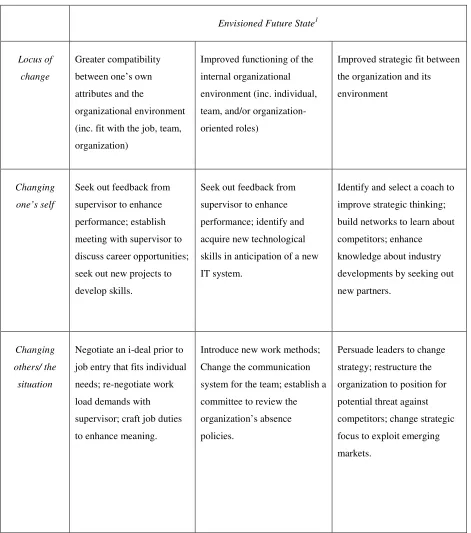
Having envisioned a different future, the process of planning involves the individual deciding on which actions to take to achieve it (Bindl & Parker, 2009). In broad terms, we suggest the envisioned future can be achieved by changing the self, such as the individual developing his or her new skills, building new networks, and acquiring more information, or by changing the situation, such as revising work methods, influencing his or her peers, or persuading a leader to change strategic direction. In many situations, the plans for achieving the envisioned future state will involve changing both the self and the situation. In Table 1, we show illustrative proactive goals that arise from considering both what it is the individual aims to achieve (the envisioned future) and how the individual plans to bring about that future outcome (the locus of change).
Proactive Goal Striving
Drawing on Kanfer and Ackerman (1989), we define proactive goal striving as the behav-ioral and psychological mechanisms by which individuals purposively seek to accomplish proactive goals. Generating a proactive goal without striving is not proactive per se, as it does not produce an impact on oneself or the environment.
Bindl and Parker (2009) identified enacting and reflecting as two key elements of proactive goal striving. Enacting is the overt action individuals engage in to achieve their proactive goal. In the case of an employee wishing to improve a process, enacting might involve persuading colleagues about the advantages of the strived-for change and finding new ways of moving forward in the face of obstacles. Not all enacted action will appear proactive, especially in isolation. For example, in taking charge to improve the way a team works, an individual might consciously withhold his or her view to allow other team members to speak.
--- INSERT TABLE 1 ABOUT HERE ---
Likewise, an individual might adapt to a problematic situation in the short term while building alliances to change the situation in the longer term. In this vein, Berg, Wrzesniewski, and Dutton (in press) argued that proactive job crafting both requires and triggers adaptive behavior, such as adjusting one’s expectations.
Effective self-regulation is important when enacting proactive goals, such as keeping focused on the task rather than being distracted by off-task demands. Bringing about change is often challenging and likely involves a need to persist (Frese & Fay, 2001)—often more so than task-compliant or reactive action does (Sheldon & Elliot, 1999). As we discuss shortly, proactive action often stems out of personally held beliefs about what is important, or a strong ownership, which likely creates the resilience for persisting. At the same time, the greater engagement of the self also suggests potentially stronger emotions, and therefore emotional regulation is likely to be very important when pursuing self-set goals (Kanfer & Kantrowitz, 2002).
with an action if they believe they are satisfactorily progressing toward their goal (Carver & Scheier, 1998).
--- INSERT FIGURE 1 ABOUT HERE ---
Given that achieving proactive goals is often highly ambiguous, intensive reflecting processes are likely to facilitate judgments as to whether a proactive goal should be maintained or modified (Gollwitzer, 1990). In sum, individuals generate and strive for a range of proactive goals that vary both in the future they are trying to achieve through change and the locus of change (self or situation) for achieving that future. As we depict in Figure 1, these proactive goal processes will lead to a different future and change to the extent that individuals engage in both proactive goal generation and goal striving (Path A). In addition, attributes of the goals generated and the quality of the striving process will influence the extent to which change is achieved (Path B). For example, theory and evidence suggest that proactive goals will be more likely to result in effective striving, and hence achievement of the goal, if they are specific and challenging (Locke & Latham, 1990), are learning focused rather than solely performance oriented (Dweck, 1986), and include subgoals and planning (Chen & Gogus, 2008). Likewise, the more that striving to achieve a proactive goal involves effective self-regulation, such as dealing with emotions associated with setbacks and engagement in appropriate reflection, the more likely that proactive goals will continue to be pursued rather than abandoned. Importantly, we have thus far not considered where the impetus for setting and striving for a proactive goal in a particular domain comes from. It is to this we now turn.
Proactive Motivation States
Why does one individual decide to take the risk of implementing a new work method whereas another individual instead focuses on actively shaping his or her career path within the organization? The fact that an individual might pursue proactive goals to achieve one future-oriented outcome but not another shows it is insufficient to focus on personality as the sole motivator of proactive action. One needs to understand the individual’s motivational state in the corresponding context and in relation to the envisioned future. It is therefore important to consider proactive motivation states that are more proximal to goals and action. It is these states that drive goal generation and striving (Figure 1, Path C), and it is largely through these states that more distal influences—personality and other individual differences (Path E), the work context (Path F), and the interaction of individual differences and context (Path ExF)—have their influence.
In the proactivity literature, most attention has been given to what we refer to as “can do” and “reason to” motivational states (e.g., Parker, Williams, et al., 2006). The can do state maps onto theories focused on expectancy, such as self-efficacy theory and control theory, in which the main question is, “Can I do this?”; the reason to state maps onto theories based on why people engage or valence (e.g., Do I want to do this? Why should I act?), such as theories concerned with self-determination, flow, interest, and goal orientation. Some theories recognize both. For example, expectancy-value theories (e.g., Eccles et al., 1983) propose ways in which both expectations of success (can do) and subjective task value (reason to) influence goals. We next review evidence that proactive goal regulation is influenced by can do and reason to motivational states (Figure 1, Path C). We then discuss the role of affect and propose an “energized to” pathway.
Can do motivation includes self-efficacy perceptions (Can I do it?), control appraisals and attributions (e.g., How feasible is it?), and the perceived costs of action (e.g., How risky is it?).
Drawing on self-regulation theory, scholars have proposed that setting a proactive goal is likely to involve a deliberate decision process in which the individual assesses the likely outcomes of his or her behaviors (Morrison & Phelps, 1999; Parker, Williams, et al., 2006). A belief that one can be successful in a particular domain, or high self-efficacy, is likely to be especially important in proactive goal generation because being proactive entails quite a high potential psychological risk to the individual. Using one’s personal initiative and taking charge to improve work methods, for example, involve changing the situation, which can often be met by resistance and skepticism from others. Likewise, active feedback seeking involves risks to individuals’ ego and perceived image (Ashford, Blatt, and VandeWalle, 2003). Individuals therefore need to feel confident they can both initiate proactive goals and deal with their consequences before they act. Self-efficacy has also been shown to enhance persistence and increase individuals’ willingness to overcome obstacles (Bandura, 1997), both of which have been suggested as important for successful proactive action (Frese & Fay, 2001).
In support of this reasoning, meta-analytic studies show that job-search self-efficacy is positively linked with proactive job search (Kanfer et al., 2001). Similarly, judgments of the perceived capability to go over and beyond the prescribed job tasks (“role-breadth self-efficacy”; Parker, 1998) predict proactive behaviors such as the suggestion of improvements (Axtell, Holman, Unsworth, Wall, & Waterson, 2000) and proactive problem solving and idea implementation (Parker, Williams, et al., 2006). General perceptions of self-efficacy have also been shown to be positively related to taking charge (Morrison & Phelps, 1999) as well as to personal initiative (Frese, Garst, & Fay, 2007), although in a study that included both general job-related self-efficacy and role-breadth self-efficacy, Ohly and Fritz (2007) found that only the latter predicted proactive work behavior. This study supports the impor-tance of specific capability perceptions for the relevant target of impact. Furthermore, in one of the only studies to separate goal generation from goal striving, Bindl and Parker (2009) found that role-breadth self-efficacy uniquely predicted each of proactive envisioning, plan-ning, enacting, and reflecting, which concurs with the wider motivation literature that shows self-efficacy enhances both goal generation and striving (Bandura, 1997).
of Table 1) than for proactive action that mostly focuses on changing aspects of oneself (left-hand side of Table 1).
The perceived cost of behavior is also relevant to can do motivation (Eccles & Wigfield, 2002). Perceived costs refer to the negative aspects of engaging in the task, such as fear of failure (or success) and the lost opportunities of focusing on this action rather than on another. Aspinwall (2005) suggested that individuals will not engage in proactive coping if they perceive the effort involved as too costly in terms of time, money, energy, or other resources relative to the gain they may provide. Kanfer and Ackerman (1989) argued that goal striving, such as staying on track, requires attentional resources that are finite. Thus, individuals might judge the costs of proactive action as too high, thereby failing to set proac-tive goals, or they might set off to achieve a proacproac-tive goal but realize that the costs involved are too high and revise their goals accordingly.
One would expect that the perceived costs of proactive action will depend on the scope of the envisioned future outcome (e.g., the number of people involved) and whether the primary focus of change is the self or the situation. Considering Table 1, for proactive goals in the top left-hand corner that involve changing the self to achieve better fit within one’s environment, the perceived costs will likely revolve around self-oriented concerns, such as the threat to one’s ego of making mistakes. For example, individuals’ motives to protect or enhance their ego and avoid threats to their image influence the extent and nature of proactive feedback seeking (Ashford, Blatt, & VandeWalle, 2003). In contrast, potential costs associated with setting out to restructure the organization to enhance strategic fit (bottom right-hand side of Figure 1) likely involve not only image- and ego-oriented concerns but also other-oriented, or prosocial, concerns about the possible wasted time and effort of many individuals or even threatened job security if the wrong action is taken.
Reason To Motivation
Although can do theories are important, these theories do not deal with why individuals select or persist with particular proactive goals. People might feel able to improve work methods, for example, but have no compelling reason to do so. Individuals therefore need to want to be proactive or see value associated with being proactive to change a particular target. When goals are imposed or prescribed via some external regulation, there is already a reason to carry out the goal—it is expected or necessary. For self-initiated goals, however, the reason to element cannot be taken for granted. As Griffin et al. (2007) suggested, proac-tive work behavior is often most important in “weak” situations (Mischel & Shoda, 1995) in which individuals have high levels of discretion, goals are not tightly specified, the means for achieving them are uncertain, and attainment is not clearly linked to rewards. Under such circumstances there needs to be a strong internal force driving the potentially risky behavior of proactivity. Moreover, temporal construal theory suggests that the desirability of future goals (the “why” of an action) is a stronger determinant than feasibility (the “how” of an action) when goals are in the longer term rather than the near term (Liberman & Trope, 1998). The why aspects of an action are more abstract, high level, and related to meaning than are how aspects and hence are more resistant to change as well as more robust (Wegener, Vallacher, Kiersted, & Dizadjii, 1986). Thus, reason to motivation might be more important in proactive goal processes than can do states, particularly for very long-term oriented proactive goals.
judgments in driving proactive processes in our model, but we also go beyond this theory and identify additional reason to pathways. We draw on self-determination theory (Deci & Ryan, 2000) because, by definition, proactive behavior is autonomous (self-initiated) rather than externally regulated by contingencies outside the person. As self-determination theory proposes, different types of autonomous motivation can drive proactive goal processes, as we elaborate next.
First, individuals will be more likely to set and strive for proactive goals when they find their tasks enjoyable, intrinsically interesting, or a source of flow. Self-determination theory proposes that humans are motivated to maintain an optimum level of stimulation and thus have basic needs for competence, autonomy, and relatedness. Being proactive can increase challenge, thereby fulfilling individuals’ basic needs for competence and autonomy. An example of proactivity generated by intrinsic motivation is individuals who voluntarily, often in their own time, engage in the development of new open-source software because they find it intellectually stimulating (Lakhani & Wolf, 2003). In a related vein, proactivity can be motivated by the experience of flow, which is when an individual narrows his or her focus to an activity in which he or she feels immersed, forgetting time, tiredness, and everything but the activity (Csikszentmihalyi, 1988). Because challenge needs to be relatively high before flow is possible (Massimini & Carli, 1988), individuals need increasingly greater challenge to experience flow. The desire for flow can therefore prompt proactive action, such as crafting a job to take on more difficult tasks, or striking an i-deal with a supervisor to get involved in new, challenging projects (Rousseau et al., 2006).
Individuals also pursue proactive goals even if they are not especially enjoyable or intrin-sically motivating. Self-determination theory proposes a process of internalization or integra-tion in which the individual “takes in” a value, contingency, or regulaintegra-tion (internalizaintegra-tion) or transforms that regulation into his or her own so that it subsequently emanates from the self (integration). The most autonomous form of extrinsic motivation is integrated regulation in which “people have a full sense that the behavior is an integral part of who they are, that it emanates from their sense of self and is thus self-determined” (Gagné & Deci, 2005: 335). Thus, a second reason to set and strive for proactive goals is to fulfill important life goals or express values that are central to the self. For example, individuals with a “calling” are those for whom work is seen as inseparable from life, who work not for money or career advance-ment alone but for fulfilladvance-ment and because the work is seen as socially valuable (Wrzesniewski, McCauley, Rozin, & Schwartz, 1997). Those with a calling are proposed to engage in active job crafting (Wrzesniewski & Dutton, 2001) because of their high investment in the work. According to the self-concordance model (Sheldon & Elliot, 1999), goals consistent with individuals’ core values and interests are associated with enhanced goal striving. Thus, the more the envisioned future is central to one’s identity or values, the more one will be motivated to bring about that future. For example, if one’s identity is tightly bound up in one’s team or organization, one will feel ownership for improving that team or organization (Gagné & Deci, 2005) and therefore will be likely to set proactive work goals or proactive strategic goals. In contrast, if one has an extremely strong career identity, one is likely to pursue proactive career management or PE fit goals.
that future work selves pertaining to individuals’ careers motivated greater proactive career-oriented behaviors.
A further autonomous form of motivation is “identified regulation,” in which an individual consciously values the behavioral goal or regulation such that the action is accepted or owned as personally important. Identified regulation is similar to the utility judgment in expectancy theory as well as to the instrumental motive in the feedback seeking literature (Ashford et al., 2003). Thus, a third reason that individuals will pursue proactive goals is because they recog-nize that change toward the envisioned future outcome is important, for themselves and/or for others. For example, the more that an individual perceives that feedback will be diagnostically useful to achieving his or her goals, the more he or she engages in feedback seeking (Ashford et al., 2003). As a further example, a nurse might identify a way to help speed up the discharge of a patient, not because this is an enjoyable task (intrinsic motivation) nor because this is fundamental to his or her identity as a carer (integrated motivation) but because he or she accepts the importance of patient flow for the effective functioning of the hospital (identified motivation).
Significantly, in addition to the nurse understanding the importance of the goal, he or she must accept personal responsibility for the goal. It is not enough to believe that proactive action is important, however, to then consider that the action is “someone else’s job.” Relevant to this perspective is the concept of flexible role orientation (Parker et al., 1997), in which individuals report ownership and feel responsibility for problems and goals beyond their immediate tasks. Parker and Ohly (2008) suggested that flexible role orientation can be seen as indicative of the process of internalization in which individuals “take on” external values and regulatory structures. Individuals with flexible role orientations define their role broadly and thus experience a sense of accountability for broader goals beyond completing their core tasks. Evidence suggests individuals with a flexible role orientation are indeed more likely to engage in proactive work behavior (Parker, Williams, et al., 2006). Related concepts, such as felt responsibility for change (Fuller, Marler, & Hester, 2006; Morrison & Phelps, 1999), also reflect employees’ internalization of values relevant to change and, as such, predict proactive work behavior (Fuller et al., 2006).
Autonomous motivation, including intrinsic, integrated, and identified forms, thus provides reasons to pursue change to achieve a different future. As to which motivational form is most powerful, Koestner and Losier (2002) showed that intrinsic motivation resulted in better performance when tasks were interesting but that autonomous extrinsic motivation (identified or integrated) yielded better performance when the tasks were not so interesting yet were important and required discipline or determination, as is likely to be the case for much proactive goal striving. As we discuss later, it might be that more than one “reason to,” or multiple motivation forms, provides a flexible motivation base sufficient to stimulate proactive goals and to see them through.
Energized To Motivation
In addition to the “cold” motivational states of can do and reason to, “hot” affect-related motivational states can affect proactive behavior. Core affect refers to momentary, elemen-tary feelings that combine both valence and activation (Russell, 2003). Later, when we dis-cuss distal antecedents, we consider how affect can influence proactivity indirectly, via can do and reason to states. Here, we focus on the more direct mechanisms by which positive affect can affect the setting of and striving for proactive goals.
momentary action–thought repertoires (Fredrickson, 1998; Isen, 1999). Positive affect promotes the setting of more challenging goals (Ilies & Judge, 2005) and helps individuals engage with a more problematic future (Oettingen, Mayer, Thorpe, Janetzke, & Lorenz, 2005). For all these reasons, positive affect should enhance the likelihood that individuals set proactive goals. Core affect also potentially promotes more effective proactive goal striving. The cognitive broadening and flexibility that come with positive affect (for a review, see Isen, 1999) bode well for more creative ways of dealing with problems that can arise during proactive goal striving. For example, positive affect raises the chance that people will pursue win–win outcomes to problem solving because they are better able to see possibilities, think innovatively, and flexibly reason about trade-offs (Carnevale & Isen, 1986). Likewise, positive affect can influence goal revision during proactive goal regulation by increasing openness to feedback (Gervey, Igou, & Trope, 2005). In support of these theoretical arguments for the role of affect in proactive goal generation, Bindl and Parker (2009) found that individuals’ average positive affect was especially important in predicting employees’ envisioning of proactive work goals. In support of an affect pathway more generally, Fritz and Sonnentag (2009) showed that positive affect promotes taking charge behaviors that day as well as on the following day. Similarly, Ashforth, Sluss, and Saks (2007) reported a positive association between positive affectivity and proactive PE fit behaviors such as information seeking, feedback seeking, job-change negotiation, and networking.
It has further been suggested (Bindl & Parker, in press-a) that activated positive affect, such as feeling enthusiastic, is more important for stimulating proactive action than is inactivated positive affect, such as feeling contented. A high degree of activation increases the amount of effort put into a behavior by increasing the experience of energy (Brehm, 1999). In contrast, evidence suggests that feelings of contentment tend to be associated with inactivity and reflection (Frijda, 1986). For this reason, we identify “energized to” as the key direct affect pathway influencing proactive goal generation and striving across a range of proactive goals. Preliminary evidence supports this thesis in relation to proactive work behavior (Parker, 2007). We later discuss how inactivated positive affect and activated negative affect might also have a role to play.
Summary and Moderating Influences
Thus far we have assumed that if an individual is motivated to be proactive, then he or she will set and pursue proactive goals. However, aspects of the work context can intervene to prevent individuals high in can do, reason to, and energized to motivations from being proactive (Figure 1, Path D). One of the most important inhibitors of proactive work behavior is a lack of job control. Situations low in job control leave little scope for individual antecedents to influence behavior (Mischel & Shoda, 1995). For example, Binnewies, Sonnentag, and Mojza (2009) found a stronger relationship between feeling recovered in the morning and engaging in proactive behavior during the day for employees with a high level of job control than for those with low control. Low job control appears to stifle employees’ proactivity, regardless of their level of recovery.
A further situational factor has been shown to influence whether and how motivational states lead to proactive behaviors. McAllister, Kamdar, Morrison, and Turban (2007) showed individuals are more likely to take charge when they not only are high in role-breadth self-efficacy but also perceive their organization as high in procedural justice. Individuals are thus more likely to be proactive if they perceive proactive behaviors as a part of their roles (high role-breadth self-efficacy) and as such do not view these behaviors as too risky to engage in. This positive effect is further enhanced by individuals’ seeking to reciprocate fair treatment by the organization (high procedural fairness). In addition to these contextual factors influencing whether motivation translates into goal-oriented action (Figure 1, Path D), the work context can enhance or reduce proactive action through affecting motivation (Figure 1, Path F), as we elaborate next.
Distal Antecedents of Proactive Goal Processes
Consistent with prior research (Frese & Fay, 2001; Parker, Williams, et al., 2006), we discuss how distal antecedents can affect proactive action via motivational states (Figure 1, Paths E, F, ExF). Distal antecedents include individuals’ personality, values, knowledge, skill, and abilities as well as job design, leadership, and social processes. Where research exists, we describe how distal antecedents vary according to the envisioned future and the locus of change of the proactive goal. We thus distinguish between general antecedents (see Figure 1) that have been shown to influence most types of proactive behavior and specific antecedents that have primarily been associated with one or a few types of proactive behavior.
Individual Differences in Personality and Values
The question of whether proactive personality is the most important trait for all domains of proactivity, however, needs further attention. Studies have typically examined proactive personality as the sole trait, without controlling for other correlated traits. In an exception to this trend, Parker and Collins (in press) found that although there were significant zero-order correlations between proactive personality and proactive PE fit behaviors such as career initiative, job-role negotiation, and proactive feedback seeking, when considered alongside other traits proactive personality was less important for these behaviors. Instead, conscien-tiousness and learning goal orientation were stronger predictors. These authors explained this finding in terms of proactive personality having a strong situational-change focus, whereas the PE fit behaviors tend to involve changing the self rather than the situation. At the same time, they recognized that conscientious individuals, because of the strong “industrious element” of conscientiousness that is about being hardworking and dependable (Roberts, Chernyshenko, Stark, & Goldberg, 2005), will want to achieve a good fit within the organi-zation. Other studies have similarly found conscientiousness to predict proactive PE-fit behaviors, such as career planning (Carless & Bernath, 2007) and information seeking (Tidwell & Sias, 2005).
Beyond proactive personality and conscientiousness, which seem particularly important for situationally oriented and self-oriented proactive goals, respectively, a further relevant individual difference variable is the desire for control. Ashford and Black (1996) found individuals high in desire for control reported more networking, job-change negotiation, information seeking, and other proactive socialization tactics. The authors reasoned that in a highly uncertain situation such as job entry, individuals with a high desire for control will be active in attempting to attain greater certainty. Although this research was conducted in the context of proactive socialization, we would expect desire for control to influence other proactive goals. Control perceptions are essential for feeling self-efficacy (can do) as well as for autonomous motivation (reason to).
There is some evidence that openness to change life values provides a reason for an indi-vidual to set and to strive for proactive goals. Life values are emotion-linked beliefs that represent desirable, trans-situational goals or modes of conduct that promote these goals (Schwartz, 2008). Openness to change life values emphasizes independence of thought, which is relevant to the self-starting nature of proactivity, as well as readiness for change, which is relevant to the change-oriented nature of proactivity. For individuals with strong openness to change values, being proactive is a way of expressing these values. Moreover, according to Schwartz (2008), openness to change values is also anxiety free rather than anxiety based, which increases the resources available for proactive goal striving. Such an argument is consistent with Parker and Collins’ (2009) preliminary finding that individuals with strong openness to change values report higher levels of proactive work behavior. In a related study, psychologically conservative individuals, who favor an authoritarian way of upbringing and who are politically conservative, report lower personal initiative, perhaps because they see less reason to engage in change (Fay & Frese, 2001).
At the same time, Parker and Collins (in press) showed that those with a strong perfor-mance orientation, who prefer to gain favorable, and to avoid negative, judgments of their competence, were less likely to engage in proactive work behavior or proactive strategic behavior. For performance-oriented individuals, being proactive likely means going out of the comfort zone and engaging in behaviors with uncertain outcomes, reducing can do moti-vation. The perceived costs of being proactive in changing the situation for individuals with a high performance orientation might well be too high; negative feedback will be threatening to their ego and image, and they will be highly concerned about failure (Tuckey et al., 2002). Performance orientation, however, appears less inhibiting of PE fit proactive goals: Parker and Collins reported no significant association of performance goal orientation with feedback enquiry or career initiative. Indeed, individuals with a strong performance goal orientation reported higher engagement in feedback monitoring, which is a more covert, observational tactic of feedback seeking. Individuals with a strong performance goal orientation appear to want to manage their PE fit in indirect ways that are the least “threatening” to their ego or, in VandeWalle and Cummings’s (1997) terms, least costly for self-presentation. It thus appears that although learning goal orientation is associated with a range of proactive goals, the effects of performance goal orientation on proactivity can be negative or positive, depending on the type of proactive goal.
A further category of traits and values that predict proactivity is those concerned with future-oriented thinking (Parker & Collins, in press). Where the behaviors needed for success are uncertain, or where outcomes might have negative elements such as resistance from others, individuals require a much stronger focus on the future (Aspinwall, 2005). Consistent with this reasoning, Parker and Collins (in press) showed that employees who are high in consideration of future consequences, the extent to which one considers distant versus immediate consequences (Strathman, Gleicher, Boninger, & Edwards, 1994), reported greater proactivity. This finding particularly applied in the case of proactive strategic behavior, which requires a long time frame and, perhaps, has the most uncertain outcomes of proactivity in the workplace. Likewise, Aspinwall, Sechrist, and Jones (2005) found that optimism, a form of future-oriented thinking, predicted people’s engagement in anticipatory coping and preparation for Y2K. Interestingly, not all future-oriented thinking is relevant for proactive behavior. In an application of fantasy realization theory (Oettingen et al., 2005), Rank and Bayas (2008) found that dwelling about the future (i.e., ruminating about obstacles to future success) impaired innovative action.
In addition, personality aspects related to one’s core beliefs about the self (e.g., resilience, core self-evaluations) and those related to emotional regulation (e.g., reappraisal, rather than suppression strategies) likely help drive the goal-striving process. Positive beliefs about the self can enhance perceptions that one can deal with barriers or obstacles (enhancing can do motivation) and emotional regulation might allow the more effective management of occa-sional negative affect (enhancing reason to motivation). Consistent with this reasoning, Johnson, Kristof-Brown, Van Vianen, De Pater, and Klein (2003) showed that people with positive core self-evaluations proactively build social networks, and Kanfer et al. (2001) showed self-esteem was important for proactive job search. The role of core beliefs about the self for other proactive goals has not yet been examined.
Individual Differences in Knowledge, Skills, and Abilities
capabilities (can do motivation) and therefore set more proactive goals as well as likely think flexibly and thereby effectively manage the change process during proactive striving. Drawing on broader literature, one would also expect that experience, such as past success or failure in achieving proactive goals as well as the attributions given to these outcomes, will influence can do perceptions (e.g., via self-efficacy and perceived cost) and reason to perceptions (e.g., via anticipated positive affect).
Domain-relevant knowledge is also an important antecedent (Fay & Frese, 2001). Dutton, Ashford, O’Neill, and Lawrence (2001) identified as critical for issue selling relational knowledge (e.g., understanding “who will be affected by the issue”), normative knowledge (e.g., understanding “what kinds of meetings are considered legitimate decision forums”); and strategic knowledge (e.g., understanding “what the organization’s goals are”). Likewise, Howell and Boies (2004) found that contextual knowledge facilitated innovation champions’ framing of ideas to promote them.
Positive Affect
Affect influences can do and reason to states (Seo et al., 2004) and thereby boosts indi-viduals’ proactivity through these pathways. Positive affect influences can do pathways because it leads individuals to focus on positive outcomes of behaviors (e.g., such as via mood congruence recall effect), thereby generating higher expectancy judgments for these outcomes (Wegener & Petty, 1996) as well as higher self-efficacy (Tsai, Chen, & Liu, 2007). Moreover, positive affect promotes intrinsic motivation (reason to), which we argued above is an important driver of proactive goals. Thus, when people experience positive affect, they tend to see tasks as richer and more varied (Kraiger, Billings, & Isen, 1989) and report more intrinsic motivation (Isen & Reeve, 2005). There is also evidence that positive affect fosters the internalization of regulations (identified and integrated motivation). Isen and Reeve (2005) found that positive affect led individuals to engage in more responsible behaviors, such as completing uninteresting tasks that needed to be done. In addition, positive affect influences utility judgments during decision making (Schwarz, 1990) and leads individuals to more strongly value the positive outcomes of behaviors (Damasio, 1994).
Positive affect thus appears to enhance individuals’ beliefs that they can set and strive for proactive goals as well as their reasons to do so. As we described earlier, there is good evi-dence that positive affect predicts proactive work behavior and some types of proactive PE fit behavior, although the precise mechanisms have not yet been investigated.
Contextual Variables as Distal Antecedents of Proactivity
When it comes to the role of the context in motivating proactive goal pursuit, existing research is rather imbalanced. Relatively few studies consider how the context shapes active feedback seeking, career initiative, and other such behaviors aimed at achieving a better fit between the individual and the organization (see Ashford et al., 2003). The research on these behaviors that exists mostly focuses on the social context, including climate and leadership. Climate and leadership are also important for fostering proactivity to improve organizational functioning and strategy, but for the latter types of proactive goals, work design is also key, as we elaborate next.
this type of self-efficacy mediates the link between job enrichment and proactivity (Parker, Williams, et al., 2006). Job enrichment is also likely to influence reason to motivation. For example, enriched jobs create conditions under which individuals experience enjoyment and flow and are thus intrinsically motivated to be proactive in their work. Enriched jobs also enhance individuals’ sense of the impact and meaningfulness of their work (Grant, 2007) and promote flexible role orientations (Parker et al., 1997), both processes of internalization that then lead to integrated and identified regulation of proactivity to improve work processes. In line with these arguments, job autonomy, complexity, and control have been consistently shown to predict proactive work behaviors, including personal initiative (e.g., Frese et al., 2007; Rank, Carsten, Unger, & Spector, 2007) idea implementation (Parker, Williams, et al., 2006), and suggesting improvements (Axtell et al., 2000). Enriched jobs also promote ener-gized to states. For example, Salanova and Schaufeli (2008) found that job resources (job control, feedback, and variety) predicted personal initiative via feelings of vigor and dedica-tion. One reason, therefore, that job enrichment might be so key for proactive work behavior is that it influences can do, reason to, and energized to pathways.
Interestingly, Fuller et al. (2006) found that job autonomy did not uniquely predict felt responsibility for bringing about constructive change in work methods, which in turn pre-dicted proactive work behaviors, whereas one’s hierarchical position in the organization was important. These authors suggest that those in higher positions have greater initiated task interdependence, as well as change expectations, associated with their role. This explanation makes intuitive sense, although it is unclear why autonomy was less important in this study.
Job stressors such as time pressure and situational constraints also influence proactive work behavior, although not necessarily in the way one might expect. Conceptual research (Frese & Fay, 2001) and empirical studies (e.g., Fritz & Sonnentag, 2009; Ohly et al., 2006) suggest that stressors can prompt greater initiative to improve work methods. Drawing on control theory (Carver & Scheier, 1998), researchers have argued that stressors indicate a mismatch between a desired and an actual situation. Employees then engage in proactive behavior to decrease this discrepancy. Support for this idea also comes from the feedback seeking literature. Employees are more likely to actively seek feedback when they experience role ambiguity and contingency uncertainty (Ashford & Cummings, 1985), likely because feedback helps to reduce the associated uncertainty.
Leadership plays a role in shaping motivation for a range of proactive goals. Rank, Nelson, Allen, and Xu (in press) found transformational leadership to be positively related to follow-ers’ innovative work behaviors, and Belschak and Den Hartog (in press) reported similar positive relationships between transformational leadership and organizationally oriented proactive behavior. Consistent with evidence from the wider literature that links leadership and self-efficacy (van Knippenberg, van Knippenberg, De Cremer, & Hogg, 2004), Strauss, Griffin, and Rafferty (2009) showed that team leaders’ transformational leadership predicted followers’ role-breadth self-efficacy, which in turn predicted team member proactivity. Evidence also implicates a reason to pathway. Strauss, Griffin, and Rafferty (2009) found that senior leaders’ transformational leadership predicted employees’ organizational commitment and in turn their organizationally oriented proactivity. Vision has been identified as a key ele-ment of transformational leadership for proactivity. Vision provides a discrepancy between the ideal situation and the current situation, thereby providing a motivational force for proactive action. Griffin, Parker, and Mason (in press) found that, for followers high in role-breadth self-efficacy, vision predicted greater employee proactive work behavior over time.
willing-ness to listen as important for issue selling, and researchers have shown that a supervisor can influence individuals’ feedback seeking through reducing fears of potential image costs (see Ashford et al., 2003). However, other studies have reported no unique relationship between supportive leadership and proactive motivation or behavior (Frese, Teng, & Wijnen, 1999; Parker, Williams, et al., 2006). One explanation offered for this findings is that supportive leadership influences followers’ proactive behavior indirectly (e.g., by increasing job enrich-ment), and once these variables are accounted for, supportive leadership might have no further role (Parker, Williams, et al., 2006). Alternatively, if the leaders are passive in their personality, they might be “supportive,” but not in ways that stimulate proactivity.
Interpersonal climate and social processes, such as peers’ support of their proactive actions, can influence can do and reason to pathways. Low psychological safety or poor intra-group relations can make it seem overly risky to engage in proactive behavior—the perceived costs are too high. On the other hand, positive relationships not only generate positive affect but also can lead to internalization of team goals and, hence, to greater identified motivation. Evidence suggests that positive relationships within the work group predict voice (LePine & Van Dyne, 1998), and individuals engage in more issue selling if they have a good relation-ship with the person to whom they are selling the issue (Ashford, Rothbard, Piderit, & Dutton, 1998). Feeling supported by coworkers (Griffin et al., 2007; Kanfer et al., 2001) or supported by the organization (Ashford et al., 1998) positively relates to various proactive behaviors at work. In a study of wire makers, Parker, Williams, et al. (2006) showed that trust in coworkers was associated with a more flexible role orientation, which in turn predicted self-reported proactivity. Broader social processes, such as group norms, group goals, and normatively framed feedback, have had relatively little attention in the proactivity literature thus far. An exception is Ashford and Northcraft (1992), who showed that norms regarding how often people typically seek feedback subsequently influence the frequency of feedback seeking.
Interaction Between Individual and Contextual Antecedents of Proactivity
As depicted in Figure 1 (Path ExF), distal individual differences and situational factors interact to affect proactive work motivation and goal processes. These ways of interaction can be explained by trait activation theory (Tett & Burnett, 2003), which suggests that personality traits affect work behavior as responses to relevant, situational cues. Individuals are thus more likely to behave in a way consistent with their predisposition if the situation stimulates aspects of this predisposition. For example, task-related and organizational aspects of the job can provide cues that activate personality to influence job performance. In this vein, Fuller et al. (2006) reported that access to resources predicted voice via felt responsibility for change only for individuals with proactive personalities; there was no such relationship for those with passive personalities. Likewise, Parker and Sprigg (1999) reported that only individuals with a proactive personality responded positively (with low strain) to active jobs (high demands and high control), with the implication that enriching work might benefit only those predisposed to respond to this type of change. Similarly, in favorable situations, individuals high in proactive personality are more likely to seek feedback (Kim & Wang, 2008) and are more likely to perceive their job as satisfying (Erdogan & Bauer, 2005) than are less proactive individuals.
role for particular dispositions. Similarly, LePine and Van Dyne (1998) showed that individuals with low self-esteem are more strongly influenced by favorable situational char-acteristics, such as high levels of group autonomy, for voice behavior. Strong disposition may also compensate for a weak situation, as characterized by poor leadership. For instance, Grant and Sumanth (in press) found in a sample of fundraisers that high dispositional trust propensity and prosocial motivation were associated with higher levels of initiative at work, even if supervisors were not seen as trustworthy.
Conclusions and Ways Forward
In 2000, Crant (2000: 435) argued that proactivity “has not . . . emerged as an integrated research stream. . . . There is no single definition, theory, or measure driving this body of work.” Crant’s review helped to address this situation. We hope the current article progresses the quest for integration even further. We discuss contributions of our model, as well as ways forward, next.
Contributions of Our Model and Related Research Directions
Individuals do not just wait to be told what to do, nor do they act only when a problem occurs. Rather, they can take charge, anticipate opportunities and problems, and actively shape themselves and/or the situation to bring about a different future. We identified a range of proactive goals (Table 1) that vary in the future being envisioned and the extent to which the locus of change is the self or the situation. We also suggested proactivity requires a goal generation process, in which individuals envision and plan a different future, as well as a goal-striving process, in which individuals execute behaviors and reflect on progress. The more effectively individuals engage in goal generation (e.g., the more that the proactive goal is specific and challenging) and goal striving (e.g., the more that individuals regulate their emotions), the more likely that a different future, and change, will be achieved. Of course, a different future outcome is not automatically positive, or perceived to be so, for either the individual or the organization. As we discuss later, a range of factors can influence whether proactivity in fact leads to positive outcomes.
Our goal-oriented approach highlights the need to focus on processes other than enacting, which has thus far been the focus of proactivity research. Little attention has been given to the self-regulation process during proactivity, despite the fact that bringing about change is often a struggle, incurring resistance and setbacks. We do not know what leads individuals to discard proactive goals, what gives individuals the strength to persist during a difficult proactive goal, and whether escalation of commitment to a proactive goal occurs as a result of striving. For example, antecedent-focused emotion regulation, with its focus on reappraising a negative situation in the onset of negative emotion, should sustain proactive action, whereas response-focused emotion regulation, with its focus on suppressing negative emotions, decreases well-being and will likely lead individuals to abandon their proactive goals because of feelings of depletion (Hobfoll, 1989).
Evidence is especially compelling for the can do pathway; several studies have shown that specific forms of self-efficacy motivate specific proactive action.
There is rather less attention in existing research on the reasons why individuals are pro-active. We particularly recommend a focus on how external goals are internalized, on the role of identity, and on how multiple motivations might play out. Evidence from education suggests the combination of intrinsic regulation with identified or integrated regulation might be the most powerful: Intrinsic motivation promotes a focus on the task and results in feelings such as excitement, whereas identification facilitates a focus on the long-term significance of the action and promotes persistence (Deci & Ryan, 2000). We also know little about the combination of autonomous and controlled regulation in regard to proactivity, such as the case of a software developer who enjoys innovating (intrinsic regulation) and receives a bonus for each innovation (extrinsic regulation).
The motivational implications for proactivity of introjected regulation—a further type of controlled regulation (Deci & Ryan, 2000) that we did not discuss above—is worth attention. Introjected regulation involves individuals sanctioning their own behavior such that behavior is regulated by approval-based pressures based on guilt, anxiety, and self-esteem maintenance (Rigby, Deci, Patrick, & Ryan, 1992). Although this form of motivation comes from within, the behavior is not perceived as freely chosen and is considered to be externally regulated. The prediction from self-determination theory is clear: Introjected regulation will not motivate proactivity and could even suppress it. This speculation is consistent with the finding that a strong performance goal orientation (in which individuals have a strong emphasis on approval) is negatively linked to proactive work behaviors (Parker & Collins, in press). However, introjected regulation might in some situations promote proactivity, particularly when self-enhancement motives are concerned with enhancing the positivity of one’s self-evaluation (Leary, 2007) rather than only avoiding negative self-evaluations. For example, self-improvement motives motivate individuals to gain useful information on their performance and prompt proactive feedback seeking (Ashford et al., 2003). Thus, how self-enhancement motives operate for proactivity might depend on whether individuals are trying to avoid negative self-evaluations or rather to gain positive evaluations.
example, negative affect displayed by others—particularly anger—can create fear and exhaustion in the target of the anger as well as in uninvolved bystanders (Rupp & Spencer, 2006), thereby potentially stifling the proactivity of the target and bystanders. Finally, we suggest that anticipated affective outcomes of striving for a goal based on previous experi-ences (Baumeister, Vohs, DeWall, & Zhang, 2007) can function to either motivate or demo-tivate proactive behavior.
Having set out can do, reason to, and energized to pathways, we then proposed that more distal antecedents (individual differences, context) affect the pursuit of proactive goals via these motivational pathways. Our model will help both to develop a better understanding of why antecedents have the effects they do and to identify distal antecedents that have thus far not been considered. For example, individual differences such as need for cognition and curiosity are likely to assume a more important role than has been hitherto considered because curious, exploring-oriented individuals will see fewer costs of being proactive (can do motivation) and will be more likely to intrinsically enjoy exploring possible new futures (reason to motivation). Likewise, accountability has also been suggested to be important for proactive work behavior (Grant & Ashford, 2008), providing a clear “reason to” be proactive, although thus far this has not been investigated.
Social processes as antecedents to proactivity need further investigation, especially for proactive goals that involve changing the situation and therefore implicate interdependent others. How colleagues and leaders support or undermine proactive behavior, how individu-als are resilient (or not) to such interpersonal forces, and how proactive employees use social networks to achieve change are all pertinent questions. In addition, although there has been some linking of social processes to PE fit behaviors, little attention has been given to other contextual antecedents of these proactive goals. For example, scholars have speculated about how diversity in a team influences feedback seeking, but this speculation remains untested (see Ashford et al., 2003). We also advocate attention to reward systems. Based on findings from their meta-analysis, Deci, Koestner, and Ryan (1999) suggested that if rewards and feedback provide informational aspects, they convey self-determined competence and thereby enhance intrinsic motivation, whereas if rewards and feedback are controlling, this prompts an external perceived locus of causality and lowers intrinsic motivation. How such findings apply to proactivity is unknown.
Directions Beyond the Proposed Model
We recommend continuing to build bridges across proactivity research in the different domains, as we have done here, as well as going further to draw stronger links between proactivity and related fields such as entrepreneurship, innovation, and stress management. We also encourage researchers to continue to compare proactive behaviors to more passive forms of work behavior (e.g., Griffin et al., 2007). As an example, citizenship behaviors can be executed more or less proactively, but thus far most conceptualizations of citizenship have been rather passive (e.g., helping on request) rather than proactive (e.g., anticipating the needs of others). Studies that assess proactive citizenship acts and compare them to passive citizenship acts would be fruitful (see Choi, 2007).