Learning Users’ Interests in
a Market-Based Recommender System
?Yan Zheng Wei, Luc Moreau and Nicholas R. Jennings
Intelligence, Agents, Multimedia Group School of Electronics and Computer Science
University of Southampton, UK.
{yzw01r,L.Moreau,nrj}@ecs.soton.ac.uk
Abstract. Recommender systems are widely used to cope with the problem of information overload and, consequently, many recommendation methods have been developed. However, no one technique is best for all users in all situations. To combat this, we have previously developed a market-based recommender sys-tem that allows multiple agents (each representing a different recommendation method or system) to compete with one another to present their best recommenda-tions to the user. Our marketplace thus coordinates multiple recommender agents and ensures only the best recommendations are presented. To do this effectively, however, each agent needs to learn the users’ interests and adapt its recommend-ing behaviour accordrecommend-ingly. To this end, in this paper, we develop a reinforcement learning and Boltzmann exploration strategy that the recommender agents can use for these tasks. We then demonstrate that this strategy helps the agents to effectively obtain information about the users’ interests which, in turn, speeds up the market convergence and enables the system to rapidly highlight the best recommendations.
1
Introduction
Recommender systems have been widely advocated to help make choices among rec-ommendations from all kinds of sources [1]. Most of the existing recommender systems are primarily based on two main kinds of methods: content-based and collaborative. However, both kinds have their weaknesses: the former cannot easily recommend non-machine parsable items, whereas the later fail to accurately predict a user’s preferences when there are an insufficient number of peers. Given this, it has been argued that there is no universally best method for all users in all situations [2].
In previous work, we have shown that an information marketplace can function ef-fectively as an overarching coordinator for a multi-agent recommender system [3, 4]. In our system, the various recommendation methods, represented as agents, compete to advertise their recommendations to the user. Through this competition, only the best items are presented to the user. Essentially, our system uses a particular type of auc-tion and a corresponding reward regime to incentivise the agents to bid in a manner that is maximally consistent with the user’s preferences. Thus, good recommendations
(as judged by the user) are encouraged by receiving rewards, whereas poor ones are deterred by paying to advertise but by receiving no rewards.
While our system works effectively most of the time, an open problem from the viewpoint of the individual recommenders remains: given a set of recommendations
with different rating levels, in what order should an agent advertise them so that it can learn the user’s interests as quickly as possible, while still maximizing its revenue? To
combat this, we have developed a reinforcement learning strategy, that enables an agent to relate the user’s feedback about recommendations to its internal belief about their qualities and then to put forward those that are maximally consistent with this.
Against this background, this paper advances the state of the art in the following ways. First, a novel reinforcement learning strategy is developed to enable the agents to effectively and quickly learn the user’s interests while still making good recommenda-tions. Second, from an individual agent’s point of view, we show the strategy enables it to maximize its revenue. Third, we show that when all agents adopt this strategy, the market rapidly converges and makes good recommendations quickly and frequently.
2
A Market-Based Multi-Agent Recommender System
Different recommendation methods use different metrics and different algorithms to evaluate the items they may recommend. Thus, the internal rating of the quality of a recommendation can vary dramatically from one method to another. Here, we term this internal evaluation the method’s internal quality (INQ). However, a highINQ rec-ommendation from one method does not necessarily mean the recrec-ommendation is any more likely to better satisfy a user than a lowINQitem suggested by another. Ultimately, whether a recommendation satisfies a user can only be decided by that user. Therefore, we term the user’s evaluation of a recommendation the user’s perceived quality (UPQ).
With these concepts in
INQ pay as bid if shortlisted
The circled numbers represent the order of the market process.
source recommendations
A User
2
UPQ reward proportionally to the selected item’s
4
3 1 choose to recommend ?
Which segment should I
its quality a value of .
Other Recommender Agents
Recommendation A
I am satisfied with agent A’s UPQ recommendation and I rate
with highest price select M items
The Marketplace
segment 1INQ
segment G INQ
INQ segment ...
segment 3 INQ segment 2
Recommendationsother agents’
Recommendations shortlisted
Recommender Agent A
Fig. 1. An Agent’s Learning Problem
place, we now briefly out-line our market-based rec-ommender (as per Fig. 1). Each time when the mar-ketplace calls for a num-ber (S) of recommenda-tions, each agent submits
S recommendations and bids a price for each of them. Consequently, the marketplace ranks all items in decreasing order of price
We have shown that, to make effective recommendations, an agent needs to classify its recommendations into a number (G) ofINQ levels (segments) and be able to cor-relate these segments to theUPQs [4]. Indeed, an agent that has sufficient experience of the user’s feedback can learn the user’s interests by correlating its recommendations (and their correspondingINQsegments) to the rewards (that reflect theirUPQs). This enables a self-interested agent to consciously make recommendations from thoseINQ
segments that correspond to highUPQs so that it can best satisfy the user and, thus, gain maximal revenue. To effectively compute the agents’ revenue, we define an agent’s
im-mediate reward (made from a specific recommendation in one auction round) as the
reward it received minus the price it has paid for the advertisement. With this, the agent needs to learn how much immediate rewards, on average, it can expect for items in each
INQsegment. We term this average immediate reward for eachINQsegment an agent’s
expected revenue. Thus, an agent can maximize its revenue by frequently bidding those
recommendations from the segments with high expected revenue.
However, when an agent starts bidding, it has no information about the expected revenue for each segment. Therefore, the agent needs to interact in the marketplace by taking actions over itsGsegments to learn this information. In this context, the agent’s learning behaviour is on a “trial-and-error” basis, in which good recommendations gain rewards whereas bad ones attract a loss. This kind of trial-and-error learning behaviour is exactly what happens in Reinforcement Learning [5]. Thus, to be more concrete, an agent needs an algorithm to learn the expected revenue over each segment as quickly as possible and still maximizing revenue.
3
The Learning Strategy
This section aims to address the problem of producing the expected revenue profile over an agent’sGsegments. In detail, an agent needs to execute a set of actions (bidding on itsGsegments),(a1, a2,· · · , aG), to learn the expected revenue of each segment
(R(ai),i∈[1..G]). Specifically, an actionaithat results in its recommendation being
displayed to the user must pay some amount of credit. Then, it may or may not receive an amount of reward. We record thetthimmediate reward thataihas received asri,t
(t = 1,2,· · ·). From a statistical perspective, the expected revenue can be obtained from the mean value of the series of discrete immediate reward values, i.e.ri,t. In this
context, the Q-learning technique provides a well established way of estimating the optimality [6]. In particular, we use a standard Q-learning algorithm to estimateR(ai)
by learning the mean value of the immediate rewards:
ˆ
Qi:= (1−
1
t0+t
)·Qˆi+
1
t0+t
·ri,t , (1)
whereQˆiis the current estimate ofR(ai)(before we start learning, allQˆis are
initial-ized with a positive value) andt01+tis the learning rate that controls how much weight is given to the immediate reward as opposed to the old estimate (t0is positive and finite). Astincreases,Qˆibuilds up an average of all experiences, and converge toR(ai)[5].
best strategy for most complex problems. In reinforcement learning practice, therefore,
specific approaches tend to be developed for specific contexts. They solve the problems
in question in a reasonable and computationally tractable manner, although they are often not the absolutely optimal choice [6]. In our context, knowing how much can be expected through each action, an agent can use a probabilistic approach to select actions based on the law of effect [7]: choices that have led to good outcomes in the past are
more likely to be repeated in the future. To this end, a Boltzmann exploration strategy
fits our context well; it ensures the agent exploits higherQˆ value actions with higher probability, whereas it explores lowerQˆ value actions with lower probability [5]. The probability of taking actionaiis formally defined as:
Pai =
eQˆi/T
PG j=1 e
ˆ
Qj/T
(T >0), (2)
whereT is a system variable that controls the priority of action selection. In practice, as the agent’s experience increases and allQˆis tend to converge, the agent’s knowledge
approaches optimality. Thus,T can be decreased such that the agent chooses fewer actions with small Qˆi values (meaning trying not to lose credits) and chooses more
actions with largeQˆivalues (meaning trying to gain credits).
4
Evaluation
This section reports on the experiments to evaluate the learning strategy. We previously showed that our marketplace is capable of effectively incentivising good methods to relate theirINQs to theUPQs and this capability is independent of the specific form of the correlation between the two qualities [4]. Here, we simply assume that there are four good recommendation methods in our system and they have a linear correlation between their INQs and theUPQs. To correlate these two qualities, all agents divide theirINQrange intoG= 20equal segments.Qinitis set to 250,T = 200andt0 = 1 for all agents. The market each time calls forS = 10 recommendations. With these settings, we are going to evaluate the system according to the properties that we want the learning strategy to exhibit:
•Q-Learning Convergence to Optimality:Qˆvalues’ convergences are important
be-cause, otherwise, an agent will have no incentive to bid. To evaluate this, we arranged 300 auctions. We find that an agent’s Qˆ values always converge (as per Fig. 2) such that highINQsegments’Qˆs converge to high values and lowINQsegments’Qˆs con-verge to low values (because of the linear correlation betweenINQs and UPQs). This is because the recommendations from a segment corresponding to higherUPQs receive more immediate reward than those corresponding to lowerUPQs.
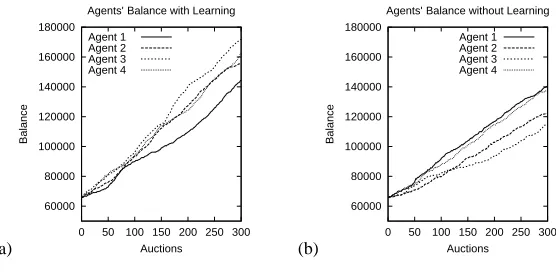
•Revenue Maximization: All recommendation methods are self-interested agents that
can make, on average, significantly greater amounts (about 43%) of credit than the latter (see Fig. 3(a) and (b)).
-50 0 50 100 150 200 250
0 50 100 150 200 250 300
Q Value
Auctions
Q Profile of a Good Recommendation Method with Positive Initial Q Value
[image:5.595.196.417.170.251.2]Q20 (INQ 0.95~1.00) Q16 (INQ 0.75~0.80) Q12 (INQ 0.55~0.60) Q8 (INQ 0.35~0.40) Q4 (INQ 0.15~0.20)
Fig. 2. Q-Learning Convergence
(a)
60000 80000 100000 120000 140000 160000 180000
0 50 100 150 200 250 300
Balance
Auctions Agents’ Balance with Learning
Agent 1 Agent 2 Agent 3 Agent 4
(b)
60000 80000 100000 120000 140000 160000 180000
0 50 100 150 200 250 300
Balance
Auctions Agents’ Balance without Learning
[image:5.595.168.446.291.427.2]Agent 1 Agent 2 Agent 3 Agent 4
Fig. 3. Recommenders’ Balance
• Quick Market Convergence: Market convergence (prices of recommendations of
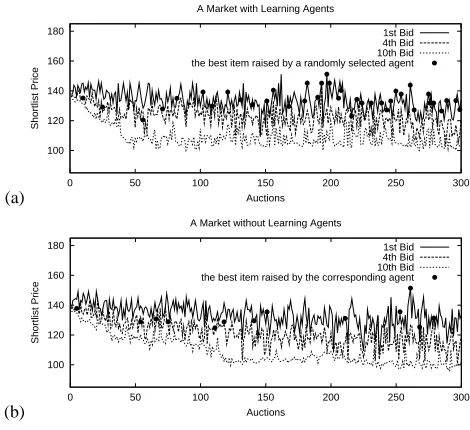
differentUPQlevels converge to different price levels) enables the agents to know what prices to bid for recommendations with certainUPQs to gain maximal revenue [3, 4]. Thus, quick market convergence let agents reach this state quickly. To evaluate this, we contrast the learning market with the non-learning one using the same settings when assessing revenue maximization. We find that the former always converges quicker than the latter. Specifically, the former (Fig. 4(a)) converges after about 40 auctions, whereas the latter (Fig. 4(b)) does after about 120 auctions. Indeed, as the learning agents’Qˆ
profiles converge, more high quality recommendations are consistently suggested (since highQˆvalues induce high probability to bid these items because of equation (2)) and this accelerates effective price iterations to chase the market convergence.
•Best Recommendation’s Identification: To evaluate the learning strategy’s ability to
(a) 100 120 140 160 180
0 50 100 150 200 250 300
Shortlist Price
Auctions A Market with Learning Agents
1st Bid 4th Bid 10th Bid the best item raised by a randomly selected agent
(b) 100 120 140 160 180
0 50 100 150 200 250 300
Shortlist Price
Auctions A Market without Learning Agents
[image:6.595.187.422.119.334.2]1st Bid 4th Bid 10th Bid the best item raised by the corresponding agent
Fig. 4. Market Convergence
converges to the first bid price of the displayed items. This means that as long as the agent chooses this particular item to bid in an auction (after the market converges), it is always displayed in the top position. However, in contrast, this phenomenon proceeds slowly in a non-learning market (see Fig. 4(b)). Additionally, a learning agent raises the best recommendation more frequently (39 times, see Fig. 4(a)), about three times as much, compared to a non-learning one (13 times, see Fig. 4(b)).
5
Discussion and Future Work
“colour” but not the “size” or the “price” of cups). Otherwise, if the user’s context related features do not overlap any of those that the learning algorithm is computing on, the recommender will fail (e.g. the user considers “colour” and the learning algo-rithm measures “size”). To overcome this problem and successfully align the features that a learning technique measures with a user’s context in all possible situations, we seek to integrate multiple recommendation methods (each with a different learning al-gorithm) into a single system and use an overarching marketplace to coordinate them. In so doing, our market-based system’s learning technique encapsulates more learners and each learner computes its recommendations based on some specific features. Thus, our approach has a larger probability of relating its features to the user’s context and so, correspondingly, has a larger opportunity to offer high quality recommendations.
To conclude, to be effective in a multi-agent recommender system (such as our market-based system), an individual agent needs to adapt its behaviour to reflect the user’s interests. However, in general, the agent initially has no knowledge about these preferences and it needs to obtain such information. But, in so doing, it needs to ensure that it continues to maximize its revenue. To this end, we have developed a reinforce-ment learning strategy that achieves this balance. Essentially, our approach enables an agent to correlate itsINQs to theUPQs and then direct the rightINQrecommendations to the right users. Specifically, through empirical evaluation, we have shown that our strategy works effectively at this task. In particular, a good recommendation method equipped with our learning strategy is capable of rapidly producing a profile of the user’s interests and maximizing its revenue. Moreover, a market in which all agents employ our learning strategy converges rapidly and identifies the best recommendations quickly and consistently. For the future, however, we need to carry out more extensive field trials with real users to determine whether the theoretical properties of the strategy do actually hold in practice.
References
1. Resnick, P., Varian, H.R.: Recommender Systems. Commun. of the ACM 40 (1997) 56–58 2. Herlocker, J., Konstan, J., Terveen, L., Riedl, J.: Evaluating collaborative filtering
recom-mender systems. ACM Trans. Information Systems 22 (2004) 5–53
3. Wei, Y.Z., Moreau, L., Jennings, N.R.: Recommender systems: A market-based design. In: Proc. 2nd International Joint Conference on Autonomous Agents and Multi Agent Systems (AAMAS03), Melbourne (2003) 600–607
4. Wei, Y.Z., Moreau, L., Jennings, N.R.: Market-based recommendations: Design, simulation and evaluation. In: Proc. 5th International Workshop on Agent-Oriented Information Systems (AOIS-2003), Melbourne (2003) 22–29
5. Mitchell, T.: Machine Learning. McGraw Hill (1997)
6. Kaelbling, L.P., Littman, M.L., Moore, A.W.: Reinforcement learning: A survey. Journal of Artificial Intelligence Research 4 (1996) 237–285
7. Thorndike, E.L.: Animal intelligence: An experimental study of the associative processes in animals. Psychological Monographs 2 (1898)
8. Shardanand, U., Maes, P.: Social information filtering: algorithms for automating “word of mouth”. In: Proc. Conf. on Human factors in computing systems. (1995) 210–217