Original Article
Expression and effects of miR-137 in
patients with erectile dysfunction
Yaochun Fan1,2*, Ruichun Fan3*, Xiong Lai1, Xiaoling Tian2, Sheng Gao2, Nan Hu4, Xiaoyan Zhang1, Shaohong Yan2, Yuhan Qin2, Wanjin Xing1, Wenrui Wang2
1School of Life Sciences of Inner Mongolia University, Hohhot, Inner Mongolia, PR China; 2Inner Mongolia
Autonomous Region Center for Disease Control and Prevention, Hohhot, Inner Mongolia, PR China; 3Inner
Mongolia Autonomous Region Children’s Hospital & Inner Mongolia Autonomous Region Obstetric and
Genecology Hospital, Hohhot, Inner Mongolia, PR China; 4Tongliao Local Disease Control Station, Tongliao, Inner
Mongolia, PR China. *Co-first authors.
Received April 29, 2019; Accepted December 3, 2019; Epub January 15, 2020; Published January 30, 2020
Abstract: Objective: We analyzed the expression of microRNA (miR)-137 in elderly patients with erectile dysfunction
(ED) and young healthy volunteers. Methods: The morphology and blood flow of the penile corpus cavernosum of all patients were analyzed via angiography. The miR-137 expression was detected by real-time fluorescent RT-PCR
in stem cell samples taken from peripheral blood. Western blot was used to detect the expression of CDK16, the
target protein of miR-137. Results: miR-137 expression was significantly higher in elderly ED patients than in young
healthy volunteers, and were negatively correlated with IIEF-5 scores. CDK16 protein expression was lower in pros-tate secretion samples of ED patients than in healthy controls. The average rate of penile blood flow was 98.83 ± 1.32 mL/min in healthy volunteers and 31.28 ± 1.75 mL/min in elderly ED patients. There were significant differ -ences in clinical signs between these groups. Conclusion: There was a close correlation between the degree of ED and miR-137 expression, which may inhibit the physiological expression of CDK16.
Keywords: Erectile dysfunction, miR-137, CDK16, expression
Introduction
During mens’ sexual activity, if they are without the ability to develop or maintain an erection
of their penis, it is defined as erectile dysfunc -tion (ED) disease, or sexual dysfunc-tion [1]. The main causes of ED are cardiovascular disease or diabetes, neurological problems (e.g.,
trau-ma from prostatectomy), hormonal insufficien -cies (e.g., hypogonadism), or drug side effects [1-4]. As for the vascular diseases cause, an epidemiological survey showed that smoking, aging, hyperlipidemia, diabetes, and hyperten-sion were major high risk factors of ED [5, 6]. Other causes of ED include cavernous nerves
injury, endocrine disorders, fibrosis of the
peni-le vasculature and corporal smooth muscpeni-le [7-9]. The most direct results of vasculogenic and neurogenic ED are loss of normal cellular function or cell death, from information in
clini-cal and etiologiclini-cal implications field.
When vascular diseases or with cavernous ner-
genes expression for cellular dysfunction or cell proliferation and differentiation. microRNAs (miRNAs) are non-coding RNAs typically ~20 nucleotides in length and transcribed by RNA polymerase II from individual miRNA genes or coding gene introns. The large number and
cells, e.g. reduce proliferation and migration activity [12, 13].
On the other side, the roles of miRNAs in the nervous system have been studied extensively, from physiology to pathology [14, 15]. Refering to health conditions related to genetic changes, as mutations happen miR-137 has a relation-ship with schizophrenia disease [16].
Regardless of the process, initiated by sexual arousal, signals are transmitted from the brain to nerves in the penis. A penile erection is the result of the hydraulic effect of blood entering and being retained in sponge-like bodies within the penis. So, if miR-137 has a function through brain, nerves or serum system, this needs to analyzed.
Furthermore, considering miR-137 is related to downstream signaling pathways, it can also directly inhibit cyclin-dependent kinase 6 (CDK6) expression and decrease expression of the downstream target protein of CD16, the
sig-nificance of which is deep-seated. miR-137 has
also been shown to induce differentiation, and inhibit the proliferation, of adult mouse neural stem cells, oligodendroma-derived stem cells, and human glioblastoma multiforme-derived stem cells [7, 9]. Researchers [17] have
identi-fied 14 target sites predicted by target scans, including testis-specific serine kinase 6
(TSS-K6).
However, no miRNAs have been reported to directly regulate ED so far through over-expres-sion, without research on its downstream sig-naling pathways.
In this study, we studied the expression of miR-137 in ED patients compared to normal healthy controls, by nucleic acid and protein detection, which might be helpful in analyzing the molecu-lar biological mechanisms of ED.
In the meantime, recently, stem cell transplan-tation via corpus cavernosum angiography sur-gery was shown to have a curative effect in an animal model of ED [18]. Thus, how to screen for useful donors has become another impor-tant issue need to be addressed. In this study, we investigated the relationship between miR-137 and ED and its effect on ED pathogene- sis, which can provide the basis data for future transplantation research.
Materials and methods
Patients
This prospective study recruited 11 ED pati- ents in January 2016. The patients were diag-nosed by the Department of Andrology, Inner Mongolia Autonomous Region Comprehensive Center for Disease Control and Prevention. We
employed a questionnaire to confirm a clear
diagnosis by two trained attending physicians. Patients ranged in age from 53 to 76 years old, with an average age of 55.6 years. Their course of ED ranged from 5 to 22 years, with an aver-age duration of 17 years according to epide- miological follow-up. The entire course of treat-ment and follow-up continued for 1 year from 2016 to 2017.
The International Index of Erectile Function 5 (IIEF-5) was used to evaluate the degree of ED. Two patients were diagnosed with a moderate degree of ED with scores ranging from 12 to 21, three patients had scores ranging from 8 to 11, and six patients had scores ranging from 5 to 7.
Including criteria: first admitted to a participat -ing Inner Mongolia Autonomous Region CDC, aged 50 years or older, clear diagnosis of ED,
and IIEF-5 score ≤ 21.
Excluding criteria: disease caused by psycho-logical factors; lack of compliance with treat-ment regimens; suffering from hypertension, diabetes, high cholesterol, heart disease; and/ or presence of blood-borne infectious diseases
including human immunodeficiency virus (HIV),
treponema pallidum (TP), and hepatitis B and C viruses.
Volunteer recruitment
Ten senior students from the College of Life Sciences of Inner Mongolia University were recruited as volunteers. The volunteers, which were used as healthy controls, were 27 years of age and had no genetic history of ED. The vol-unteers were assessed using the IIEF-5 tool to exclude ED. All volunteers and patients were assessed in the same manner and sampled at the same time.
the declaration of Helsinki, implemented by the guidelines of the World Health Organization (WHO). The research was conducted under the supervision of the ethics committee of Inner Mongolia University (No. IMUU20150301421).
Separation of vascular endothelial progenitor cells (vEPCs)
Monoclonal cells (10 mL) from each group were collected using the COBE 6.1 Spectra device (Genbro Company, Somerset, NJ, USA) on the eighth morning following abstinence from ejac-ulation for 7 days. Then, CD133+VEGFR-2+ pe- ripheral blood stem cells were separated by cell sorting reagent (Miltenyi Biotec, Germany). Em-
ploying the flow cytometry counting method,
the concentration of 2.2 × 10⁶ stem cell was used for research, which are referred to as vEPCs.
Laboratory testing
Total RNA extraction: Total RNA including mRNA and miRNA from fresh CD133 stem cells were extracted using the RNA Mini kit (Qiagen, Hilden, Germany) according to the manufactur-er’s instructions. RNA concentration and purity were measured as the absorbance (A) at 280 nm and 260 nm and samples with A260/A280 ratios ranging between 1.8 and 2.1 that were used for subsequent experiments.
Micro-array hybridization: All isolated RNA sam-ples were used to synthesize complemen- tary DNA (cDNA), and double-stranded cDNA was labeled and hybridized to the micro-array (Arraystar, Rockville, MD, USA). Following hybri- dization and washing, processed slides were scanned with the Axon GenePix 4000B micro-array scanner (Molecular Devices, Sunnyvale, CA, USA).
Reverse transcription polymerase chain reac-tion: cDNA synthesis was performed using the RT2 First Strand Kit (Takara, Japan) and real-time PCR was conducted using SYBR Green PCR Master Mix (Promega, Madison, WI, USA) with the Bio-Rad IQ5.0 system (Bio-Rad La- boratories, Hercules, CA, USA). The primers sequences were as follows: F, 5’-AAAGCAAUG- AGACUGA-3’ and R, 5’-UCUCAUUGCUUUAUA-3’.
Prostate press
A prostate press was used to stimulate the
to its proximity to the anterior rectal wall, the prostate can be stimulated from the anterior wall of the rectum or externally via the perine-um. Digital rectal examination (DRE) was per-formed to obtain an expressed prostate secre-tion specimen (EPS) for microscopy and Wes- tern blotting analyses.
SDS-PAGE and Western blot
EPSs were collected following DRE. The speci-men (1 mL) was mixed with 1 mL lysis buffer (Beyotime, China) and 1% protease inhibitor cocktail (Sigma-Aldrich, St. Louis, MO, USA), 25 mM NaF, and 1 mM Na3VO4 were added. The mixture was frozen at -80°C, thawed at room temperature four times, and centrifuged at 10,000 × g for 30 min at 4°C (Thermo Fisher
Scientific, Waltham, MA, USA). The supernatant
was collected and analyzed using 8% sodium dodecyl sulfate polyacrylamide gel electropho-resis (SDS-PAGE). Then the proteins were
trans-ferred to polyvinylidene difluoride membranes
(Millipore, Hayward, CA, USA).
Membranes were blocked with 5% bovine serum albumin-Tris-HCl buffered saline with 0.05% Tween-20 for 2 hours at 25°C follow- ed by incubating with primary mouse anti-CDK16 monoclonal antibody and secondary rabbit anti-mouse monoclonal antibody. GADPH was used as an internal standard and pro- tein bands were visualized using an enhanced chemiluminescence system (Bestbio, China). Samples from the healthy volunteers were used as a control. The relative expression level of CDK16 was calculated by measuring the gray value of the target protein in each group. Relative expression amount = target gene gray value/GADPH gray value.
Cavernosography
Cavernosography was used to evaluate venous
occlusion function and arterial inflow to the
corpus cavernosum. All operations were per-formed according to the standard operating procedures of corpus cavernosum
Two intracavernosal angio-catheters were pla- ced following local anesthesia with 1% plain
xylocaine, using 21 gauge butterfly needles.
One catheter was attached to a pressure tra- nsducer to record changes in ICP; the second catheter delivered heparinized saline through a controlled pump at the required rate. Patients were injected with vasoactive drug (prostaglan-din E1 or a combination of prostaglan(prostaglan-din E1, papaverine, and phentolamine) through one of the intracavernosal catheters.
Statistical analyses
Statistical analyses were performed using SP- SS software version 19.0 (SPSS, Inc., Chicago, IL, USA). Differences between two groups were evaluated using a one-way analysis of varian- ce. The Mann-Whitney U test was used to cal-
culate the significance of detection rates
be-tween two groups. P values below 0.05 were
considered significant.
Results
miR-137 expression higher in vEPCs
To determine the expression of miR-137 in peripheral blood stem cells and analyze its effects, we performed micro-array analyses of 96 human miRNAs. In the miRNA array,
miR-137 expression was significantly higher in
elderly ED patients group. To validate this result, we repeated the measurements using
quantitative real-time RT-PCR, with β-actin as
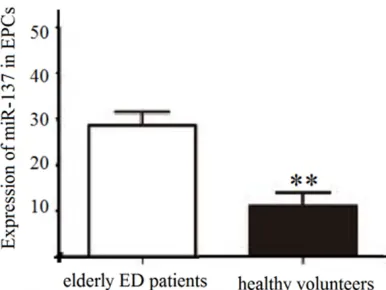
an the internal standard (P < 0.01, Figure 1). Expression levels were negatively correlated with IIEF-5 scores (Table 1). There was no
sig-nificance in the age distribution of the patient
group as 8 of the 11 patients ranged in age from 53 to 63 years.
CDK16 decreasing expression in ED patients by western blot
The western blot results were consistent with the real-time RT-PCR results. Several miR-137 target genes play important roles in human dis-eases. miR-137 has also been shown to inhibit CDK6 expression in elderly ED patients (their
gray value were 0.232 ± 0.056 vs. 0.936 ±
0.218). We found that CDK16 protein expres-sion was 75% lower in ED patients (Figure 2) compared to healthy volunteers. By T-testing, the t value was 13.452 and P < 0.001, between these groups. So, CDK16 expression was
sig-nificantly reduced in elderly patients with ED.
Penile blood flow slowly by corpus caverno -sometry
Cavernosography was used to measure the vascular pressure in the corpus cavernosum. Saline is infused under pressure into the
cor-pus cavernosum with a butterfly needle, and the flow rate needed to maintain an erection
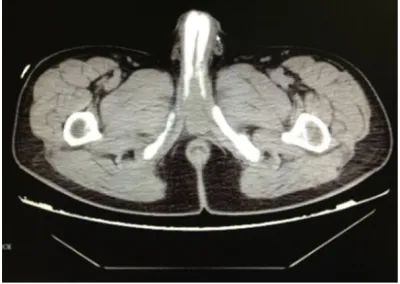
indicates the degree of venous leakage. Digital subtraction angiography (DSA) was performed and the X-ray images were acquired digitally (Figure 3). Venous leakage could not be identi
-fied in any subjects. Bilateral penile corpus cav -ernosum with symmetrical distribution; con-trast agent with evenly distribution and consis-tent density; penis with smooth edges and clear intervals.
Penile blood flow was also assessed in all sub -jects, and was almost three times higher in healthy volunteers than in ED patients (P <
0.05; 98.83 ± 1.32 mL/min vs. 31.28 ± 1.75,
respectively). Discussion
To the extent of our knowledge, this is the first
study to correlate the expression of miR-137 with ED, particularly in elderly patients. The
[image:4.612.91.284.70.215.2]erectile reflex interruption induced by cavern -ous nerve damage is a direct cause of ED. In addition, apotheosis of smooth muscle cells and endothelial cells in the corpus cavernos- um can increase the incidence of ED [19-22]. Figure 1. Expression of miR-137 in endothelial
All these aspects might result in changes of gene expression, e.g. micro-RNA.
A previous study investigated the expressions of miR-93, miR-320, and miR-16 and evaluated their role in the diagnostic value of ED [7]. It
identified there was an obvious negative corre -lation between the incidence of ED and serum levels of total testosterone, which had a posi-tive correlation with HbA1c levels regulated by these three types of miRNAs. According to this study, the expression levels of the three types of miRNAs, including miR-137, were higher in ED patients than in controls. Therefore, the miR-137 expression changes could be useful for the early diagnosis of ED.
Not only gene expression changes, but also tar-get proteins are involved in the ED disease. For example, SIRT1 inhibition regulated by miR-200a could attenuate ED in AED [8]. Following
in vitro transfection, miR-200a up-regulated SIRT1 and levels of eNOS, then down-regulated
cGMP. This study verified that there was
up-regulation of not only 200a but also miR-137 in ED patients. But it’s down-regulation effect needs more data, especially in the eNOS/NO/PKG pathway. Actually, in the pres-ent study, the expression of miR-137 was
sig-nificantly higher in elderly ED patients than in
healthy volunteers. Importantly, it was also negatively correlated with IIEF-5 scores. Protein levels of CDK16 were lower in ED patients, as
was penile blow flow rate (31.28 ± 1.75 mL/ min vs. 98.83 ± 1.32 mL/min). Thus, there was
a close correlation between ED and miR-137 expression, which could have inhibited the expression of CDK16. However, further studies are needed on miR-137 and other miRNAs involved in ED.
With aging, the expression of certain genes (e.g., miR-137) is altered to some degree. However, it is not feasible to collect specimens from the same person at different ages over the course of several decades. Thus, we com-pared 50 year old’s and 20 year old’s in differ-ent populations. We also analyzed the expres-sion and effects of miR-137 expresexpres-sion in
patients with ED in an effort to find more suit -able gene therapy options or stem cell trans-plantation treatments.
[image:5.612.90.323.109.187.2]When we performed corpus cavernosometry using DSA, we wanted to illustrate that there was not only a change in gene and protein expression, but also morphological changes in tissues and organs, pathological changes, and degenerative changes in ED patients. The re- Table 1. Relationship between miR-137 expression
levels and IIEF-5 scores in patients with different severity of erectile dysfunction
[image:5.612.89.289.318.460.2]Disease severity IIEF-5 score range n real-time fluorescenceAverage Ct value of Normal 22-25 10 40.88 Slight 12-21 2 31.57 Moderate 8-11 3 27.93 Severe 5-7 6 25.44
Figure 2. Expression of CDK16 in the two groups.
Figure 3. Corpus cavernosometry, using digital
sub-traction angiography, confirmed that elderly ED pa -tients’ penis had normal vascular structure.
sults suggest that the miR-137 gene plays an important role in ED.
There were some limitations to this study. Due to Chinese culture, patients with ED are often ashamed and will not seek help. When they do
finally see a doctor, there is often a long history
of illness. Moreover, in China, ED has not been included in the management of chronic diseas-es. Therefore, only 11 patients were included in this study. Future studies should include a larg-er numblarg-er of patients.
Acknowledgements
National Natural Science Foundation of China (Grant No. 31760667); National Natural Scien- ce Foundation of China (Grant No. 31460600); Inner Mongolia Natural Science Foundation Project (Grant No. 2019MS03027); Inner Mon- golia Natural Science Foundation Project (Grant No. 2018MS03027); Inner Mongolia Health
and Family Planning Commission Scientific
Research Project (Grant No. 201703077); Inner
Mongolia Postgraduate Scientific Innovation
Project (Grant No. B20151012604Z); Project
for Developing Young Talent in Vaccine and
Immunity of Chinese Preventive Medicine Association (Q2017A1517); Inner Mongolia Prairie Talents Rolling Support Plan (Grant No. 20160110); Inner Mongolia Natural Science Foundation Project (Grant No. 2015MS08136); Project supported by Inner Mongolia Science and Technology Innovation and Guidance Foundation (Grant No. 201605) supported this study.
Disclosure of conflict of interest
None.
Address correspondence to: Wanjin Xing, School of Life Sciences of Inner Mongolia University, No. 235 of West Road, Saihan District, Hohhot, Inner Mongolia, PR China. E-mail: [email protected]; Wenrui Wang, Inner Mongolia Autonomous Region Center for Disease Control and Prevention, No. 50 of Erdos Street, Yuquan District, Hohhot 010031, Inner Mongolia, PR China. E-mail: [email protected]
References
[1] Bayraktar Z and Atun I. Impact of physician as-sistance on the reliability of the international index of erectile function. Andrologia 2013; 45: 73-7.
[2] Abdel Aziz MT, Rezq AM, Atta HM, Fouad H, Zaahkouk AM, Ahmed HH, Sabry D and Yehia HM. Molecular signalling of a novel curcumin
derivative versus tadalafil in erectile dysfunc -tion. Andrologia 2015; 47: 616-25.
[3] Aldemir M, Okulu E, Neşelioğlu S, Erel O, Ener K and Kayıgil Ö. Evaluation of serum oxidative
and antioxidative status in patients with erec-tile dysfunction. Andrologia 2012; 44: 266-71. [4] Delgado PL, Brannan SK, Mallinckrodt CH,
Tran PV, McNamara RK, Wang F, Watkin JG and
Detke MJ. Sexual functioning assessed in 4 double-blind placebo- and paroxetine-con-trolled trials of duloxetine for major depressive disorder. J Clin Psychiatry 2005; 66: 686-692. [5] Xiong G, Li B, Wang K and Li H. Chinese herb
formulae for treatment of erectile dysfunction: a systematic review of randomised controlled clinical trials. Andrologia 2014; 246: 201-23. [6] Tsao CW, Liu CY, Cha TL, Wu ST, Chen SC and
Hsu CY. Exploration of the association between chronic periodontal disease and erectile dys-functionfrom a population-based view point. Andrologia 2015; 47: 513-8.
[7] Jiang XI, Luo Y, Zhao S, Chen Q, Jiang C, Dai Y,
Chen Y and Cao Z. Clinical significance and ex -pression of microRNA in diabetic patients with erectile dysfunction. Exp Ther Med 2015; 10: 213-218.
[8] Pan F, Qiu XF, Yu W, Zhang QP, Chen Q, Zhang CY, Chen Y, Pan LJ, Zhang AX and Dai YT. Mi-croRNA-200a is up-regulated in aged rats with erectile dysfunction and could attenuate endo-thelial function via SIRT1 inhibition. Asian J Androl 2016; 18: 74-9.
[9] Wei AY, Yang Y, He SH, Luo XG, Zhang T and Liu Y. Role of miR-145 in erectile dysfunction in diabetic rats. Nan Fang Yi Ke Da Xue Xue Bao 2011; 31: 1051-4.
[10] Amiel J, de Pontual L and Henrion-Caude A. miRNA, development and disease. Adv Genet 2012; 80: 1-36.
[11] Henrion-Caude A, Girard M and Amiel J. Mi-croRNAs in genetic disease: rethinking the dosage. Curr Gene Ther 2012; 12: 292-300. [12] Peng HY and Li HP. Regulation of miR-137
overexpressed trophoblast cells on biological functions of vascular endothelial cells. Journal of Shanghai Jiaotong University (Medical Sci-ence) 2017; 37: 1350-1356.
[13] Zhuang Y, Peng H, Mastej V and Chen W. Mi -croRNA regulation of endothelial junction pro-teins and clinical consequence. Mediators
In-flamm 2016; 2016: 5078627.
[14] Zhou S, Ding F and Gu X. Non-coding RNAs as emerging regulators of neural injury responses and regeneration. Neurosci Bull 2016; 32: 253-64.
neuronsderived from induced pluripotent stem cells and genome editing. Neurosci Bull 2015; 31: 113-27.
[16] Whalley HC, Papmeyer M, Romaniuk L, Sproo-ten E, Johnstone EC, Hall J, Lawrie SM, Evans KL, Blumberg HP, Sussmann JE and McIntosh AM. Impact of a microRNA MIR137 susceptibil-ity variant on brain function in people at high geneticrisk of schizophrenia or bipolar disor-der. Neuropsychopharmacology 2012; 37: 2720-9.
[17] Pan F, Xu J, Zhang Q, Qiu X, Yu W, Xia J, Chen T,
Pan L, Chen Y and Dai Y. Identification and characterization of the MicroRNA profile in ag -ing rats with erectile dysfunction. J Sex Med 2014; 11: 1646-56.
[18] She XL, Gao XC, Zhao GZ, Liu P and Xiong C. Used CD133+ stem cells transplantation to treat erectile dysfunction (ED) by corpus cav-ernsum angiography for animal model. Biomed Res 2017; 28: 2230-2233.
[19] Li MY, Li YX, Li GH, Li H, Lin R, Yang HW, Fang XL, Yao RJ and Ren Y. Clinical performance of
combination detection reagent kits of anti-HIV, anti-HCV, anti-TP and HBsAg. Laboratory Medi -cine and Clinic 2011; 8: 269-273.
[20] Akin Y, Gulmez H, Bozkurt A, Nuhoglu B and Usta MF. Usage of neck circumference as nov-el indicator of erectile dysfunction: a pilot study in Turkish population. Andrologia 2014; 46: 963-70.
[21] Corbeil D, Fargeas CA and Huttner WB. Rat prominin, like its mouse and human ortho-logues, is a pentaspan membrane glycopro-tein. Biochem Biophys Res Commun 2001; 285: 939-44.