THE ECONOMIC AND SOCIAL RESEARCH INSTITUTE Memorandum Series No. 162.
ECONOMIC DEVELOPMENT AFT~ 2B YEARS:
ITS SIGNIFICANCE FOR THE CURRENT CRISIS
Connell M. Fanning
November 1983 Price IR£1
Confidential: Not to be quoted
until the permission of the Author
ITS SIGNIFICANCE FOR THE CURRENT CRISIS
Connell M. Fanning
Government bureaucracies are not generally noted for innovation or
dynamism. Yet twenty-five years ago, in November 1958, an event with
far-reaching effects occurred in what is often today regarded as the bastion of
conservatism and inertia - the Department of Finance. Not surprisingly
for a government department, that event took the form of a report; but it
was a report probably like no other before and almost definitely like
none since.
That historic report was Economic Development (1) which was completed
in May 1958. It marks a milestone -perhaps the second after political
sovereignty itself - in the history of Ireland in the twentieth century.
Although not published until November 1958, after the programme for Economic
Expansion, it was the background study which launched economic planning in
Ireland. The-Second ProBramme for Economic Expansion followed in 1963
and, the’ most comprehensive of all, the Third ProBramme for Economic and
Social Development in 1969.
The period covered by these programmes was one of unprecedented social
and economic development. A long period of slow growth accompanied by a
demoralizing decline in population was replaced by a faster expansion of
output and population growth. Ireland was set on a path of modernization
that until then was stymied by a combination of cultural, political, and
economic obstacles. It need hardly be stated that an episode of such dramatic
change in demographic, social, and economic structures brought about new
But the prevading sense of isolation and dependency prevalent up to
the late 1950s was overcome in favour of a sense of confidence and rising
expectations that characterized the 1960s and early 1970s. The initiative
and opportunity to bring about this process of change was very much due to
the pressures of an economic crisis which was to a great extent the
consequence of previous government policies.
BACKGROUND
After the struggle for political sovereignty, the thrust of economic
policy was narrowly nationalist, and a self-sufficient economy was sought.
This policy was at first one of selective protection from foreign competition
rather than the establishment of new industries. The impact of the Great
Depression then led to the policy of self-sufficiency: "Domestic production
was to replace imports as far as possible and a thorough-going system of
protection was introduced" to bring this about (3).
The main policy instruments to encourage growth during this import
substitution phase were tariffs, quotas, and credit facilities. A Prices
Commission was established, to prevent monopoly pricing in the protected
markets, and a Control of Manufacturers Act was passed to ensure that
business was controlled by residents. After the War Emergency most controls
were relaxed. Grants, subsidies, and state capital expenditure for both
-3-Basically, the policy of self-reliance continued, but this insular
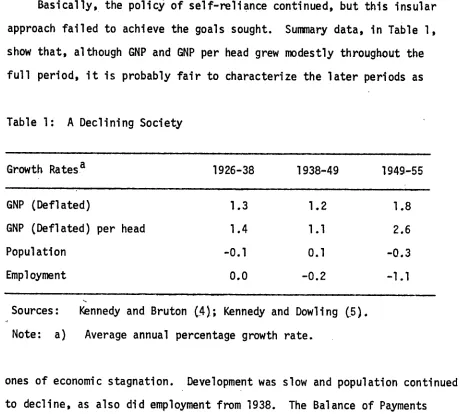
approach failed to achieve the goals sought. Summary data, in Table 1,
show that, although GNP and GNP per head grew modestly throughout the
[image:5.597.81.542.111.525.2]full period, it is probably fair to characterize the later periods as
Table 1: A Declining Society
Growth Ratesa 1926-38 1938-49 1949-55
GNP (Deflated)
GNP (Deflated) per head
Population
Employment
1.3 1.2 1.8
1.4 I.I 2.6
-0.I 0.I -0.3
0.0 -0.2 -l.l
Sources :
Note: a)
Kennedy and Bruton C4);
Kennedy
and Dowling (5).Average annual percentage growth rate.
ones of economic stagnation. Development was slow and population continued
to decline, as also did employment from 1938. The Balance of Payments
deteriorated substantially in the later period and reserves crises occurred,
particularly in 1951 and 1955-6, despite the emphasis on import substitution.
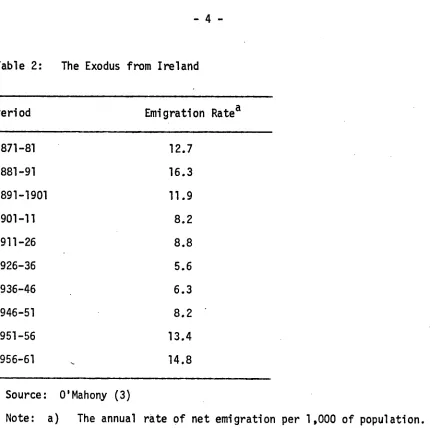
The seriousness of the situation in human terms is clearly demonstrated
by the data for emigration in Table 2. The rate of emigration once again
equalled that of 60 years previously. The consequences of mass emigration
are widespread as has been succintly stated by David O’Mahony in The
Table 2: The Exodus from Ireland
Pe ri od Emigration Ratea
1871-81 12.7
1881-91 16.3
1891-1901 11.9
1901-I 1 8.2
1911-26 8.8
1926-36 5.6
1936-46 6.3
1946-51 8.2
1951-56 13.4
1956-61 . 14.8
Source: O’Mahony (3)
Note: a) The annual rate of net emigration per 1,000 of population.
emigration it is possible - though by no means always certain - that the
more enterprising and ambitious people leave the country. Emigration
seems also to produce certain attitudes of mind and patterns of behaviour
which are prejudicial to economic development. People appear to become
mentally disorientated and to become like an uprooted or rootless people
even in their own country. This" results in a tendency to evade risk taking
and responsibility to that even the limited investment opportunities that
-5-POLICY INITIATIVE
Clearly a change in policy was imperative and a commensurate response
was forthcoming from some civil servants. The new policy initiative, made
necessary by a~ worsening economic and social crisis, occurred late in
1957 when the Secretary of the Department of Finance, T. Kenneth Whitaker,
proposed to the Minister of Finance, James Ryan ,that an attempt should
be made "to work out an integrated programme of national development for
the next five or ten years, which I believe will be critical years for
the country’s survival as an economic entity" (1). The first stage of
this process was the preparation of Economic Deyelopment primarily by the
Secretary of the Department. This was then followed by the government
policy document, Programme fOr Economic Expansion (6).
The policy emphasis shifted towards outward looking policies accompanied
by a move from the deflationary policies of the 1950s to more expansionary
fiscal policies during the 1960s. Higher domestic growth was now sought
from higher demand, especially of industrial exports, together with a
more active industrial development programme of fiscal incentives and
attraction of foreign capital. While it is easy to characterise the
change in policy it should be recognized that bringing it about, and
implementing it effectively, involved overcoming major political,
ad-ministrative, and social obstacles.
Although many other persons were involved, and indeed many elements of
the policy were already put in place by preceding governments, Sean Lemass
as Prime Minister and T.K. Whitaker, Secretary of the Department of Finance,
is little doubt that their political and administrative skills were crucial
in establishing the new perspective. Such a change in policy is invariably
based on a grand scheme or ’vision’ of the economy which identifies the
key relationships involved in generating the desired outcome and, most
importantly, succeeds in re-orientating general attitudes.
MAIN THEMES~
The main themes are worth outlining because, as will be apparent, they
still provide after quarter of a centur), the overall framework for government
economic policy towards employment.
Employment policy was based on the view that increased, employment, and
the move towards ’full employment’, is primarily determined by the rate of
growth of output. Therefore the emphasis of policy was on increasing the
rate of growth of output. Three aspects were emphasised in Economic
Develop-ment and reiterated in all the succeeding economic programmes.
First,it is growth of demand which brings about expansion of output.
High and growing demand would both ensure the full utilization of existing
capital capacity and provide the impetus to increasing such capacity. This
would then be translated into expanding employment. As was stated in the
report, "the initial advance has rarely been the result of capital expenditure;
it has far more commonly followed the expansion of markets, especially
foreign markets". Since falling population had brought about a declining
home market, therefore exports were identified as the cricual source of
demand. They were, as stated in the Second Programme, the "key to national
-7-Second, capacity expansion to meet the increased or expected increases
in demand, was to be facilitated by government policies which emphasised
the manufacturing sector and the role of foreign enterprise and investment.
The latter was necessary because resource constraints made it necessary
to acquire foreign savings, equipment and technology, and management and
entrepreneurial skills. The instruments of this policy are much the same
as those which are still in operation today and included exports profits
tax relief, capital grants and subsidies,.and direct promotion activities.
Third, competitiveness was essential if exports were to be the key
component of demand and the driving force in the process of economic growth.
The world trading environment was increasingly becoming one of trade
liberal-ization. Ireland would have to survive against the keen pressures of
foreign competition not only from Europe and North America but also,as it
turned out,from the dynamic newly industrialising countries of Japan,
and later Taiwan, S. Korea and others.
According to the (first).Programme this means "in particular, that
wage standards must be realistic, having regard to the level of productivity
in this country and the need for ensuring competitive costs per unit of
output". This, as stated in the Second Programme, was the "essential
condition of growth and it must govern our whole approach to programming".
It became the dominant theme of government policy pronouncements and is
still the central piece of government strategy in the face of the current
OUTCOME
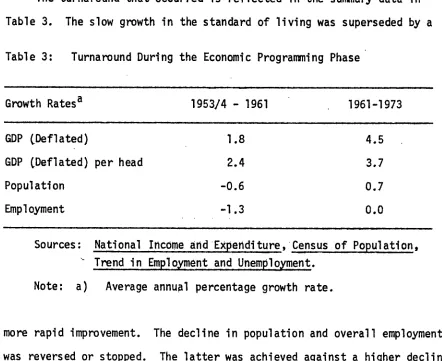
[image:10.597.93.535.152.513.2]The turnaround that occurred is reflected in the summary data in
Table 3. The slow growth in the standard of living was superseded by a
Table 3: Turnaround During the Economic Programming Phase
Growth Ratesa 1953/4 - 1961 1961-1973
GDP (.Deflated) 1.8 4.5
GDP (Deflated) per head 2.4 3.7
Population -0.6 0.7
Employment -I.3 0.0
Sources: National Income and Expenditure, Census of Population,
"- Trend in Employment and Unemployment.
Note: a) Average annual percentage growth rate.
more rapid improvement. The decline in population and overall employment
was reversed or stopped. The latter was achieved against a higher decline
in agricultural employment (-3.1% as compared to -2.3% in the earlier
period).
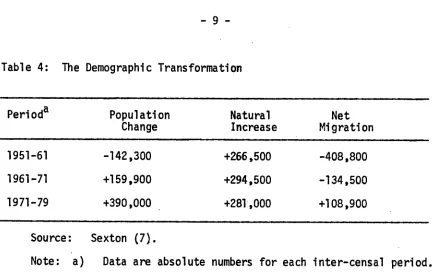
The increased rate of economic activity had a major social impact:
the emigration drain was slowed, and at a later stage reversed, and
population increased’significantly (Table 4). The contrast between a
society afflicted by massive emigration and one freed from that debilitating
-9-Table 4: The Demographic Transformation
Perioda Popul ati on Natural Net
Change Increase Mi grati on
1951-61 -142,300 +266,500 -408,800
1961-71 +159,900 +294,500 -134,500
1971-79 +390,000 +281,000 +I08,900
Source: Sexton {7).
Note: a) Data are absolute numbers for each inter-censal period.
optimism and an expectation that we can make it in the ’big world around
us.’ To what extent Economic Development and the succeeding programmes
for economic expansion contributed to this is a matter which is, as yet,
little analysed and is still an open question. Some of the current
difficulties may be due, as has sometimes been claimed, to the working
out of the logic of the view put forward in Economic Development and the
policies following from that analysis. That is still an unexplored issue.
But twent~,-five years is a lon9 time to expect the relevance of a study
and the efficacj/, of its
proposals
to hold b asicall~ unchanged. Whateverthe ultimate Verdict on it, and the whole programming era, it must be
credited with a pivotal role in bringing about a significant change in
/
attitudes. There can be little doubt that at the very least it was
impor-tant in restoring confidence in the economy and our society. Nor should
it be forgotten just how much hope and direction it provided at a time
when it seemed that the situation was hopeless and when, was there apparently
[image:11.599.88.520.48.328.2]CURRENT CRISIS
But today Ireland is once again faced with apparently intractable
economic difficulties. Production and the standard of living are growing
slowly or declining. The employment situation is once again of crisis
proportions. Virtually half our population is under 25 years of age.
Only the present lack of destinations seems to prevent the resumption
of large scale emigration. Indeed reaIpolitik prognosticators urge that we
must ’prepare’ our children for emigration. The public finance debacle has
returned us to a phase of severely deflationary domestic policies at a
time when world demandis stagnant. Any improvement in the balance of
payments position is largely the impact of the recession. As in the 1950s,
we are in the midst of an overall policy crisis.
Once again there is a sense of doom and gloom overtaking us; there
is a feeling of things being out of control, of our inability to respond
to the challenges of the times, and of a loss of leadership. We scan
the horizons for hopeful signs, but we find only confusion, taxes, and
hesitant recoveries in distant lands that may eventually trickle our way.
So we talk ourselves into the ground or around in circles.
In the midst of all this the real significance of Economic Development
should be recalled. The ’winds of change’ blew from a source generally
not recognised today as the harbinger of innovation: government bureaucrats
and political representatives. Nor was this an accident; it is rarely
otherwise with major policy changes in contemporary democracies. It is
in the government-administration nexus that innovative programmes are
actually developed: the combination of public-interest and self-interest
shapes the vision of progress, makes it operational, and navigates it through
II
-The ’academic’ analysts of society are often put in the position of
having to find, or are expected to already have, the answers to our
pressing social issues. Probably more often they put themselves on the
spot and offer themselves as founts of ultimate wisdom and definitive
answers. The real situation is otherwise, and they are roundly castigated
or they beat their breasts in welters of mea cuIpa.
Economists, sociologists, and so on, do not generally in their
capacity as social scientists bring about new initiatives or devise major
programmes. They provide the tools - special concepts, identification of
relationships - that are necessary for defining a problem, analysing it,
and developing strategies to resolve it. But the actual policies must
be devised in government departments and similar agencies by the
inter-action of administrators and political representatives.
This was the case with Economic Development. Economists had provided
theoretical and empirical analysis, but the major policy chan~ie came from
the government bureaucracy and the political domain.
Twenty-five years ago the Secretary of the Department of Finance,
together with his collaborators, overcame the policy paralysis of their
time. They responded to that crisis with imagination and initiative.
The urgent puzzle today is whether it will occur again. And, if it is
not likely to occur because of bureaucratic schlerosis, we must then
ask: what needs to be done and what can be done to bring it about,
The Irish economy is like the car on a roller-coaster at a fun-fair,
and at present we’re pointing down: the worry is how far, and how fast,
and for how long? And the question to be addressed is: what must we do to
Notes
I. Ireland. Economic Development. Stationery Office, Dublin, 1958
o
o
Damien Hannan. Ireland’s new social and moral dilemmas. New Society:
291-293, 18 November 1982.
David O’Mahony. The Irish E.con.om~" An Introductory Description.
Cork University Press, Cork, 1962, 2nd Edition 1967.
.
Kieran A. Kennedy and Richard Bruton. The Irish Economy. Economic and
Financial Series No. I0. EEC, Brussels, 1975.
.
Kieran A. Kennedy and Brendan R. Dowling. Economic Growth in Ireland:
The Experience Since 1947. Gill and MacMillan, Dublin, 1975.
Be Ireland. p_~oBramme for Economic Expansion.
Dublin, 1958.
Stati on~ry Offi ce,
.
J.J. Sexton. The Changing Labour Force. In ESRI. The Irish Economy
and Society in the 1980s: 42-79. Economic and Social Research Institute,