Original Article
Efficacy of different regimens for
treatment of idiopathic membranous nephropathy
Wei Wang, Rui Zhu, Wanwan Gao, Wenjuan Cheng, Xingyuan Shi
Hemopurification Center, Huaihe Hospital of Henan University, Kaifeng, Henan, China
Received May 20, 2018; Accepted October 30, 2018; Epub February 15, 2019; Published February 28, 2019
Abstract: treatment regimens for idiopathic membranous nephropathy (IMN) are heavily debated. To date, a con-sensus on first-line treatment has not been reached. This study aimed to explore the optimal treatment for IMN pa-tients by comparing the efficacy and safety of five treatment methods. Records of 107 papa-tients with IMN proved by renal biopsy in our hospital from January 2004 to January 2016 were retrospectively reviewed. Twenty-two patients received oral prednisone combined with oral cyclophosphamide (group A); 20 patients were treated with oral pred-nisone combined with intravenous cyclophosphamide (group B). The modified Ponticelli protocol was administered to 19 patients (group C); 21 patients received oral prednisone and intravenous cyclosporine A (group D); 25 patients received oral prednisone combined with oral tacrolimus (group E). Efficacy evaluated by the multilevel model analy-sis showed that the no remission (NR) rate of female patients with normal lipid values, who had received regimen E was remarkably lower than that in other regimens (compared to group E, A: OR=2.250, χ2=5.044, P=0.025; B:
OR=2.063, χ2=4.001, P=0.045; C: OR=2.286, χ2=4.947, P=0.026; D: OR=1.160, χ2=0.159, P=0.048, respectively).
We observed no significant differences in the incidence of adverse events and relapse rate among the five groups (P>0.05). Immunosuppressive treatment with tacrolimus and prednisone seems to be more effective and well toler-ated by patients with IMN.
Keywords: Efficacy, idiopathic membranous nephropathy, nephrotic syndrome, safety, tacrolimus
Introduction
Membranous nephropathy is a type of autoim-mune glomerular disease mediated by autoan-tibodies, and is the leading cause of nephrotic syndrome. The mortality associated with idio-pathic membranous nephropathy (IMN) is one per million population. Adults aged 40-50 years are at higher risk and the sex ratio (male: female) is approximately 2:1. The classic opti-cal microscope feature of IMN is basement membrane diffuse thickening with spike forma-tion. Immunofluorescence shows particle-like deposition of IgG and C3 mainly along the capil-lary wall. Electron microscope characteristics include basement membrane thickening and epithelial foot process fusion [1].
A variety of causes lead to the occurrence of membranous nephropathy, such as lupus ne- phritis, hepatitis B virus-associated nephritis, drugs, and tumor-associated nephropathy. Th- ese etiologies lead to secondary membranous
pro-teinuria and remarkably improve long-term re- nal function, but most immunosuppressants have significant side effects which greatly limit their clinical application [5]. Accordingly, the combination of glucocorticoids with immuno-suppressive therapy in IMN became an area of new research. A multicenter randomized con-trolled trial of methylprednisolone plus chlo-rambucil versus methylprednisolone plus cyclo-phosphamide in the treatment of IMN sug- gested that the total remission rate with meth-ylprednisolone and chlorambucil was 82% and with methylprednisolone and cyclophospha-mide was 93%, and the recurrence rates were 30.5% and 25%, respectively. It was concluded that both regimens were proved to be effective on IMN, but the cyclophosphamide group had slighter adverse effects compared with the ch- lorambucil group [6]. In 2010, Goumenos and colleagues evaluated the efficacy of cyclospo-rin A alone or combined with corticosteroids in patients with IMN. That study suggested that low-dose cyclosporin A combined with or with-out corticosteroids can lead to induced remis-sion and well-preserved renal function [7]. In recent years, tacrolimus, which was widely used to prevent graft rejection in post-renal transplantation, has been applied to the treat-ment of IMN [8, 9]. Tacrolimus exerts immuno-suppressive effects mainly by interfering with the calcium ion signaling pathway to inhibit the dephosphorylation and proliferation of T lym-phocytes. A randomized controlled study from China displayed significantly greater improve-ments in remission and a better treatment tol-erance in the tacrolimus group compared with the cyclophosphamide group [10]. Another pro-spective analysis of tacrolimus suggested that it has the potential to be a novel therapeutic option for patients with IMN [11].
An increasing amount of clinical research has indicated that a satisfactory curative effect was observed in IMN patients treated by glucocorti-coids combined with immunosuppressive age- nts. Nevertheless, the standard or unified first-line therapy approach for IMN still remains controversial. Besides this, the severe adverse effects of immunosuppressants cannot be ig- nored. Given the current uncertainties in the management of IMN, it is crucial for us to ex-plore the optimal treatment of IMN. Therefore, we aimed to explore the optimal treatment for
IMN patients by comparing the efficacy and safety of five treatment methods.
Material and methods
Subjects
In this retrospective study, 107 patients were recruited from January 2004 to January 2016 in our hospital. Inclusion criteria included: (1) patients histopathologically diagnosed with IMN; (2) all were followed up for at least one year with complete clinical data; (3) those patients had persistent proteinuria did meet the diagnostic criteria for nephrotic syndrome (>3.5 g/d). Exclusion criteria were: (1) second-ary membranous nephropathy caused by sys-temic lupus erythematosus, hepatitis B and hepatitis C virus, cancer, drugs, or poisons (2) medication history of corticosteroids and im- munosuppressants; (3) patients who terminat-ed or changterminat-ed the treatment arbitrarily. Grouping
routine-ly given supportive therapy consisting of anti- coagulant, calcium agents, hypotensive drugs and other symptomatic treatment.
Observation indicators
Clinical parameters were obtained by review of subjects’ records including gender, age and comorbidities. laboratory measurements inclu- ding serum creatinine, serum albumin, blood glucose, serum lipid, liver function and renal function were performed at 3, 6 and 12 mon- ths. The outcomes which were measured by CR, PR, NR, and adverse effects were evaluat-ed at 3, 6 and 12 months.
Criteria of clinical efficacy
Complete remission (CR) was defined as pro-teinuria level of <0.3 g/24 h with normal renal function (serum creatinine ≤140 μmol/l), and serum albumin ≥35 g/l. Partial remission (PR)
was defined as a daily proteinuria of 0.3-3.5 g, or at least 50% initial proteinuria level with unchanged or improved renal function. No response (NR) did not meet the above criteria for remission. Relapse was defined as an in- crease in proteinuria to ≥3.5 g/day for at least 2 weeks after a period of CR or PR, and failure to recover even after pathogenic causes (e.g. exertion, infection) were removed.
Multi-level model
Given that our study involves follow-up and repeated measurement, data information can-not be fully elucidated by simply merging data from different time points. As our study does not belong to a randomized controlled trial, multi-level model analysis is preferable to tradi-tional variance analysis in processing non-treatment factors among groups. In addition, this model can effectively control these influ-encing factors by introducing gender, age, dis-Table 1. Baseline characteristics of patients (_x ± s)
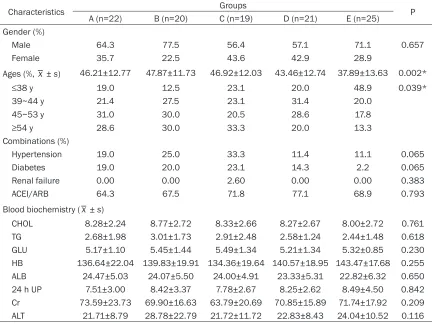
Characteristics Groups P
A (n=22) B (n=20) C (n=19) D (n=21) E (n=25) Gender (%)
Male 64.3 77.5 56.4 57.1 71.1 0.657
Female 35.7 22.5 43.6 42.9 28.9
Ages (%, _x ± s) 46.21±12.77 47.87±11.73 46.92±12.03 43.46±12.74 37.89±13.63 0.002*
≤38 y 19.0 12.5 23.1 20.0 48.9 0.039*
39~44 y 21.4 27.5 23.1 31.4 20.0
45~53 y 31.0 30.0 20.5 28.6 17.8
≥54 y 28.6 30.0 33.3 20.0 13.3
Combinations (%)
Hypertension 19.0 25.0 33.3 11.4 11.1 0.065
Diabetes 19.0 20.0 23.1 14.3 2.2 0.065
Renal failure 0.00 0.00 2.60 0.00 0.00 0.383
ACEI/ARB 64.3 67.5 71.8 77.1 68.9 0.793
Blood biochemistry (_x ± s)
CHOL 8.28±2.24 8.77±2.72 8.33±2.66 8.27±2.67 8.00±2.72 0.761
TG 2.68±1.98 3.01±1.73 2.91±2.48 2.58±1.24 2.44±1.48 0.618
GLU 5.17±1.10 5.45±1.44 5.49±1.34 5.21±1.34 5.32±0.85 0.230
[image:3.612.90.525.91.416.2]ease history and biochemical indicators as covariates. We set the curative effects at differ-ent follow-up time points as level 1 (i) and the study subjects as level 2 (j). The model formula
[image:4.612.89.371.97.649.2]the 5 groups (P>0.05). However, significant dif-ferences were observed in age among the 5 groups: the age of patients in group E (TAC) was lower than that in other groups (P<0.05) (Table Table 2. Main parameters of patients in 5 groups during follow-up
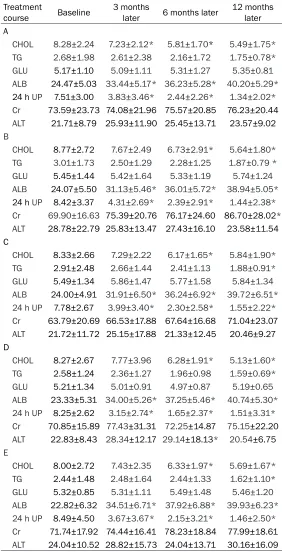
period (_x ± s)
Treatment
course Baseline 3 months later 6 months later 12 months later
A
CHOL 8.28±2.24 7.23±2.12* 5.81±1.70* 5.49±1.75* TG 2.68±1.98 2.61±2.38 2.16±1.72 1.75±0.78* GLU 5.17±1.10 5.09±1.11 5.31±1.27 5.35±0.81 ALB 24.47±5.03 33.44±5.17* 36.23±5.28* 40.20±5.29*
24 h UP 7.51±3.00 3.83±3.46* 2.44±2.26* 1.34±2.02*
Cr 73.59±23.73 74.08±21.96 75.57±20.85 76.23±20.44
ALT 21.71±8.79 25.93±11.90 25.45±13.71 23.57±9.02
B
CHOL 8.77±2.72 7.67±2.49 6.73±2.91* 5.64±1.80* TG 3.01±1.73 2.50±1.29 2.28±1.25 1.87±0.79 * GLU 5.45±1.44 5.42±1.64 5.33±1.19 5.74±1.24 ALB 24.07±5.50 31.13±5.46* 36.01±5.72* 38.94±5.05*
24 h UP 8.42±3.37 4.31±2.69* 2.39±2.91* 1.44±2.38*
Cr 69.90±16.63 75.39±20.76 76.17±24.60 86.70±28.02* ALT 28.78±22.79 25.83±13.47 27.43±16.10 23.58±11.54 C
CHOL 8.33±2.66 7.29±2.22 6.17±1.65* 5.84±1.90* TG 2.91±2.48 2.66±1.44 2.41±1.13 1.88±0.91* GLU 5.49±1.34 5.86±1.47 5.77±1.58 5.84±1.34 ALB 24.00±4.91 31.91±6.50* 36.24±6.92* 39.72±6.51* 24 h UP 7.78±2.67 3.99±3.40* 2.30±2.58* 1.55±2.22* Cr 63.79±20.69 66.53±17.88 67.64±16.68 71.04±23.07
ALT 21.72±11.72 25.15±17.88 21.33±12.45 20.46±9.27 D
CHOL 8.27±2.67 7.77±3.96 6.28±1.91* 5.13±1.60* TG 2.58±1.24 2.36±1.27 1.96±0.98 1.59±0.69* GLU 5.21±1.34 5.01±0.91 4.97±0.87 5.19±0.65 ALB 23.33±5.31 34.00±5.26* 37.25±5.46* 40.74±5.30* 24 h UP 8.25±2.62 3.15±2.74* 1.65±2.37* 1.51±3.31* Cr 70.85±15.89 77.43±31.31 72.25±14.87 75.15±22.20
ALT 22.83±8.43 28.34±12.17 29.14±18.13* 20.54±6.75
E
CHOL 8.00±2.72 7.43±2.35 6.33±1.97* 5.69±1.67* TG 2.44±1.48 2.48±1.64 2.44±1.33 1.62±1.10* GLU 5.32±0.85 5.31±1.11 5.49±1.48 5.46±1.20 ALB 22.82±6.32 34.51±6.71* 37.92±6.88* 39.93±6.23* 24 h UP 8.49±4.50 3.67±3.67* 2.15±3.21* 1.46±2.50* Cr 71.74±17.92 74.44±16.41 78.23±18.84 77.99±18.61
ALT 24.04±10.52 28.82±15.73 24.04±13.71 30.16±16.09
Note: *P<0.05 compared with baseline.
Respijk = β0 jk conijk + β1 time.01jk + β2 group.01jk + β3 x.01jk
Note: Respijk: therapeutic ef- fect; Con: intercept; x: cova- riates.
Statistical analysis
Statistical analysis and base-line description were conduct-ed in SPSS 21.0 software. Measurement data were de- scribed as the mean ± stan-dard deviation (SD) and cate-gorical variables were presen- ted as numbers and percen- tages. Intergroup difference was analyzed by paired t-test; the Kruskal-Wallis H-test was used when the data had non-normal distribution, and the Chi-square test was used for comparison of remission rates between groups. For the com-parison of the incidence of re- mission between 5 groups, mu- lti-level linear model of ranked data was established by ML- wiN2.25 software to take into account the availability of dif-ferent data points from the same study [12]. P<0.05 is considered as statistically sig- nificant.
Results
Baseline information of pa-tients
Changes of laboratory parameters
The statistical results showed that the protein-uria and cholesterol of group A was reduced at 3, 6 and 12 months compared with baseline, and the level of serum albumin had the oppo-site trend (P<0.05); whereas the changes in serum creatinine, glucose and alanine amino-transferase were not significant from baseline to 12 months (P>0.05). In group B, the levels of 24 h urinary protein and serum lipids were lower at 12 months than at baseline (P<0.05), and the level of serum albumin appeared to have an increasing trend during the follow-up period (P<0.05); in addition, an escalating tr- end can be observed in serum creatinine from baseline to 12 months (P<0.05). There were no significant differences in glucose and alanine aminotransferase levels at different time po- ints (P>0.05). In group C, both 24 h urinary pro-tein and serum lipid levels decreased from baseline to 12 months (P<0.05), serum albu-min levels were higher than those before treat-ment (p<0.05); and there were no significant differences in renal function, blood glucose level, and liver function at 3, 6, 12 months compared with the baseline (P>0.05). Similarly, in group D, urinary protein and serum lipid lev-els showed a declining trend, and serum albu-min level showed a rising trend (P<0.05). But compared with the baseline, the level of ala-nine aminotransferase significantly improved at 6 months (P<0.05). In group E, 24 h urinary protein excretion and serum lipid level signifi-cantly decreased during the treatment period (P<0.05), and serum albumin level increased after treatment (P<0.05). The aforementioned data suggest that all of these five regimens were effective for IMN patients (Table 2). Comparison of treatment efficacy
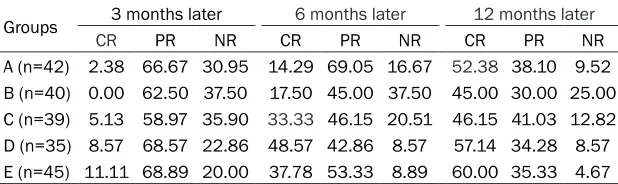
After one year of follow-up, five treatment regi-mens obtained different proportions of com-plete remission and partial remission, as sh-
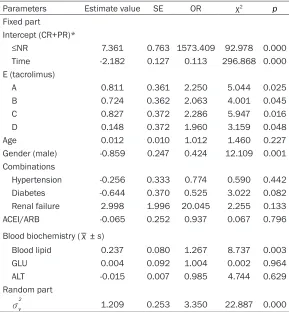
sideration of the influence of baseline para- meters including gender, age, hypertension, diabetes mellitus, renal function and history of ACEI/ARB (Table 4). When regarding group E (prednisone plus tacrolimus) as the control group, the odds ratios (OR) of non-remission in group A, B, C, D were 2.250, 2.036, 2.286 and 1.160 times, respectively, and these differenc-es were statistically significant (P<0.05). Fur- thermore, remission rates were significantly associated with gender and serum lipids level: the risk of non-remission in females was 42.4% that of males (P=0.001), and hyperlipidemia tended to increase the risk of non-remission (P=0.003). However, remission rates were not related to age, hypertension, diabetes melli- tus, renal function and history of ACEI/ARB. Comprehensive analysis indicated that predni-sone plus tacrolimus is the best treatment pro-gram for IMN. In addition, male gender and hyperlipidemia were independent risk factors for poor prognosis. See Table 5 for details. Adverse event
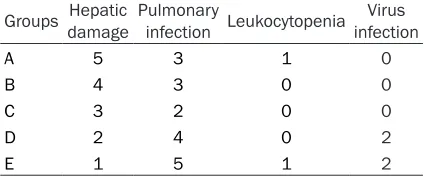
[image:5.612.91.400.85.177.2]Adverse events during the treatment period are described in Table 6. A total of 15 patients suf-fered from hepatic damage: 5 in group A, 4 in group B, 3 in group C, 2 in group D and 1 in group E. Pulmonary infection was contracted by 3 patients in group A, 3 in group B, 2 in group C, 4 in group D and 5 in group E. One case of leu-kopenia can be observed in each of groups A and E. Two viral infection events were recorded in group D and E. In the majority of patients, these complications could be controlled adjust-ing the dose of immunosuppressant and sym- ptomatic treatment, with the exception of 1 patient in group A whose treatment regimen was prematurely discontinued due to severe liver damage. As shown in Table 7, there were no significant differences in the rates of compli-cations among the 5 groups (P>0.05).
Table 3. Remission rates of 5 groups at different stages of treatment (%)
Groups 3 months later 6 months later 12 months later
CR PR NR CR PR NR CR PR NR
A (n=42) 2.38 66.67 30.95 14.29 69.05 16.67 52.38 38.10 9.52
B (n=40) 0.00 62.50 37.50 17.50 45.00 37.50 45.00 30.00 25.00
C (n=39) 5.13 58.97 35.90 33.33 46.15 20.51 46.15 41.03 12.82
D (n=35) 8.57 68.57 22.86 48.57 42.86 8.57 57.14 34.28 8.57
E (n=45) 11.11 68.89 20.00 37.78 53.33 8.89 60.00 35.33 4.67
con-Relapse rate
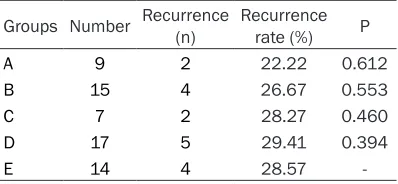
We observed the relapse rates of the five groups for 1 year by telephone and outpati- ent follow-up after the termination of the inter-vention. The number of patients in follow-up was decreased compared with the original
[image:6.612.90.531.84.243.2]Some studies have pointed out that patients with mild proteinuria who had higher spontane-ous remission rates should only be adminis-tered ACEIs, ARBs, anti-hypertensive agents, lipid-lowering drugs, anticoagulants and other supportive therapy [16]. It is worth mentioning that urinary protein levels and serum creatinine Table 4. Variable assignment of multiple level model
Variate Definition and assignment
Dependent variable
Efficacy 0 No response 1 Partial response 2 Complete response
Schemes 1 CTX po 2 CTX ivgtt 3 Ponticelli 4 Ciclosporin 5 Tacrolimus Demographic characteristic
Gender 1 Male 2 Female
Ages (years) 1 ≤38 2 39~44 3 45~53 4 ≥54
Combinations
Hypertension 0 No 1 yes
Diabetes 0 No 1 yes
Renal failure 0 No 1 yes
ACEI/ARB 0 No 1 yes
Note: po means oral, ivgtt means intravenous.
Table 5. Multivariate Analysis of 5 treatment regimens
Parameters Estimate value SE OR χ2 p
Fixed part
Intercept (CR+PR)*
≤NR 7.361 0.763 1573.409 92.978 0.000
Time -2.182 0.127 0.113 296.868 0.000
E (tacrolimus)
A 0.811 0.361 2.250 5.044 0.025
B 0.724 0.362 2.063 4.001 0.045
C 0.827 0.372 2.286 5.947 0.016
D 0.148 0.372 1.960 3.159 0.048
Age 0.012 0.010 1.012 1.460 0.227
Gender (male) -0.859 0.247 0.424 12.109 0.001 Combinations
Hypertension -0.256 0.333 0.774 0.590 0.442 Diabetes -0.644 0.370 0.525 3.022 0.082 Renal failure 2.998 1.996 20.045 2.255 0.133
ACEI/ARB -0.065 0.252 0.937 0.067 0.796
Blood biochemistry (_x ± s)
Blood lipid 0.237 0.080 1.267 8.737 0.003
GLU 0.004 0.092 1.004 0.002 0.964
ALT -0.015 0.007 0.985 4.744 0.629
Random part
v2v 1.209 0.253 3.350 22.887 0.000
Note: *CR was complete response; NR was no response; PR was partial response; P<0.05 means the statistically significant difference.
incomplete information, and other sources of attrition. The relapse rates in gr- oups A, B, C, D and E were 22.22%, 26.67%, 28.27%, 29.41% and 28.57%, respec-tively. There were no signifi-cant differences in relapse rates among the 5 groups (P>0.05) as shown in Table 8.
Discussion
[image:6.612.90.379.290.602.2]clinical practice guideline for glomerulonephri-tis developed by the Kidney Disease: improv- ing global outcomes (KDIGO) nonprofit organi-zation recommended that glucocorticoids and immunosuppressants should be administered only after meeting the following requirements: ① proteinuria persistently >4 g/d or above 50% of the baseline level without downward trend after at least 6 months of antiproteinuric treatment; ② Patients present with severe nephrotic syndrome-related clinical symptoms which may lead to disability or life threatening symptoms; ③ serum creatinine level has risen by ≥30% within 6-12 months, but GFR ≥25- 30 ml/min, and the above changes were not caused by superimposed complications [1, 17]. CTX and CSA, as classical immunosuppressive agents, play a pivotal role in therapeutic treat-ment of IMN. In order to clarify whether the administration method of CTX can affect its curative effect, we compared the remission rate, recurrence rate and side effects of oral CTX, intravenous CTX and modified Ponticelli protocol. Our study found that there were no significant differences among these groups A, B and C. In addition, Dede et al. also demon-strated that the administration route of CTX was not the key factor determining its thera-peutic effect [18]. CSA is usually used in IMN patients who are not sensitive to supportive treatment, hormone-dependent, or who have repeated recurrence [19]. However, its long-term efficacy still needs to be further investi-gated. A ten-year study from India reported that the remission rate of CTX at the end of 10 years was only 58.6%, which was far lower than previ-ously reported [20]. In recent years, a number of novel immunosuppressive agents such as TAC [21], rituximab [22], immunoglobulins [23] and mycophenolate mofetil [24] have been applied to the therapy of IMN. The calcineurin inhibitor TAC has shown promise in IMN treat-ment and may become the alternative agent for IMN patients. The mechanism of TAC in acting
on IMN was demonstrated in a previous stu- dy. TAC can markedly reduce proteinuria and promote podocyte repair by decreasing angio-poietin-like-4 [25]. Our results showed that TAC was more effective than CTX at 3 months and 12 months in IMN (CR and PR). We also found that TAC had superior potency compared to CSA. One recent study also demonstrated that TAC possessed more advantages on remission rates than CTX in treating IMN patients, espe-cially in the first 3 months (76.7% vs 59.0%, P<0.05) [26].
We compared the baseline features of the five treatment groups and found significant differ-ences in participants’ age among the five gr- oups (P<0.05). We carried out a subgroup anal-ysis based on age to exclude the confounding factor. Our data suggested that age was not rel-evant to remission rate, which was not consis-tent with the traditional viewpoint that ad- vanced age is a poor prognostic factor for IMN patients. Notably, another study recruited 171 IMN patients who were divided into different age subgroups. 90 cases (52.6%) patients <65 years, 40 cases (23.4%) patients 65-70 years old and 41cases (24%) patients >70 years were analyzed and followed up for an average of 37 months. A total of 103 patients obtained com-plete remission of proteinuria, but there were no significant differences among different age groups (P=0.831) [27]. Therefore, large sample multicenter randomized controlled trails are required to further confirm this correlation. In the present study, we also found that female gender and hypolipidemia were protective fac-tors for IMN patients, who were then prone to a better prognosis. This is consistent with previ-ous findings that the male gender, increasing age, massive proteinuria, impaired renal func-tion and certain histologic features including glomerulosclerosis, interstitial fibrosis and vas-cular disease are high risk factors for progress-ing to renal failure in IMN [28]. Patients with the above risk factors should be given active treatment. Whereas, the significant differences in age, comorbidities and blood biochemistry were not observed in our data.
[image:7.612.90.302.87.176.2]The multiple adverse effects caused by immu-nosuppressant treatment cannot be ignored, as many of them are irreversible and even life-threatening. Common complications include hepatic damage, pulmonary infection, low leu-cocyte amount and virus infection. In addition, Table 6. The occurrence of adverse events
Groups Hepatic damage Pulmonary infection Leukocytopenia infectionVirus
A 5 3 1 0
B 4 3 0 0
C 3 2 0 0
D 2 4 0 2
rare complications have been documented. It has been reported that one case of an IMN patient in Poland receiving TAC developed into Kaposi’s sarcoma [29]. In our study, although the total occurrence of side effects among the 5 groups had no significant difference, we observed that the profile of adverse effects was distinctly different. We found that liver damage and lung infection happened in all 5 groups of patients. Hepatic function of these patients was recovered through adjustment of the doses of immunosuppressants and admin-istration of hepatinica, and lung infection was controlled with antibiotics. Leukopenia tended to occur in the CTX group and the TAC group. Patients could continue the original program of treatment after symptomatic treatment. IMN patients receiving CSA and TAC had a higher occurrence of viral infection than other groups. In particular, patients taking the calcineurin inhibitors (TAC, CSA) had a higher prevalence of herpes zoster virus infection than CTX, likely due to the powerful immunosuppressive action of calcineurin inhibitors. These symptoms dis-appeared after adjusting the dose of drugs and antiviral therapy. No life-threatening side effects occurred in our observation, which may be related to our short follow-up period and small sample size. Therefore, patients receiving immunosuppressive agents should be closely monitored for the occurrence of side effects. It
However, they were limited by high attrition ra- te of follow-up and inadequate follow-up time. Similarly, a recurrence rate of 25% between 6 and 30 months was seen with CTX in a random-ized controlled trial [6]. Obviously, long-term fol-low up is needed to evaluate the efficacy and safety of TAC. In addition, re-treatment should be considered when an appropriate risk-benefit ratio exists.
In conclusion, the data from this retrospective study show that glucocorticoids combined with immunosuppressive agents are effective in the treatment of IMN. Treatment with the combina-tion of TAC and prednisolone shows higher effi-cacy and comparable tolerability, and is superi-or to CTX and CSA. Our study provides powerful evidence for selecting an optimal treatment strategy for patients with IMN. However, com-plications arising during the period of TAC ad- ministration should be closely monitored and should receive timely treatment.
Disclosure of conflict of interest
None.
Address correspondence to: Dr. Xingyuan Shi, He- mopurification Center, Huaihe Hospital of Henan University, 115 Ximen Street, Longting District, Kai- feng, Henan Province, China. Tel: +86 18623789552; E-mail: [email protected]
References
[1] Beck L, Bomback AS, Choi MJ, Holzman LB, Langford C, Mariani LH, Somers MJ, Trachtman H and Waldman M. KDOQI US commentary on the 2012 KDIGO clinical practice guideline for glomerulonephritis. Am J Kidney Dis 2013; 62: 403-41.
[image:8.612.91.357.85.176.2][2] Ponticelli C and Glassock RJ. Glomerular dis-eases: membranous nephropathy--a modern view. Clin J Am Soc Nephrol 2014; 9: 609-16. Table 7. Statistical analysis of the adverse events
Groups Number Adverse event (n) adverse event (%) Chi-squareIncidence of P
A 22 9 40.91 0.119 0.730
B 20 7 35.00 0.005 0.945
C 19 5 26.32 0.467 0.495
D 21 8 38.10 0.022 0.883
E 25 9 36.00 -
-Note: Compared with the E group.
Table 8. Relapse rate in 5 groups
Groups Number Recurrence (n) Recurrence rate (%) P
A 9 2 22.22 0.612
B 15 4 26.67 0.553
C 7 2 28.27 0.460
D 17 5 29.41 0.394
E 14 4 28.57
-Note: Compared with the E group.
is essential that early intervention is provided once related complica-tions arise [30].
[image:8.612.91.290.223.315.2][3] Chen Y, Schieppati A, Chen X, Cai G, Zamora J, Giuliano GA, Braun N and Perna A. Immuno-suppressive treatment for idiopathic membra-nous nephropathy in adults with nephrotic syn-drome. Cochrane Database Syst Rev 2014; CD004293.
[4] Cattran DC, Delmore T, Roscoe J, Cole E, Cardella C, Charron R and Ritchie S. A random-ized controlled trial of prednisone in patients with idiopathic membranous nephropathy. N Engl J Med 1989; 320: 210-5.
[5] Couser WG. Primary membranous nephropa-thy. Clin J Am Soc Nephrol 2017; 12: 983-97. [6] Ponticelli C, Altieri P, Scolari F, Passerini P,
Roc-catello D, Cesana B, Melis P, Valzorio B, Sas-delli M, Pasquali S, Pozzi C, Piccoli G, Lupo A, Segagni S, Antonucci F, Dugo M, Minari M, Sca-lia A, Pedrini L, Pisano G, Grassi C, Farina M and Bellazzi R. A randomized study comparing methylprednisolone plus chlorambucil versus methylprednisolone plus cyclophosphamide in idiopathic membranous nephropathy. J Am Soc Nephrol 1998; 9: 444-50.
[7] Kalliakmani P, Koutroulia E, Sotsiou F, Vlacho-jannis JG and Goumenos DS. Benefit and cost from the long-term use of cyclosporine-A in id-iopathic membranous nephropathy. Nephrolo-gy (Carlton) 2010; 15: 762-7.
[8] Ramachandran R, Hn HK, Kumar V, Nada R, Yadav AK, Goyal A, Kumar V, Rathi M, Jha V, Gupta KL, Sakhuja V and Kohli HS. Tacrolimus combined with corticosteroids versus modified ponticelli regimen in treatment of idiopathic membranous nephropathy: randomized con-trol trial. Nephrology (Carlton) 2016; 21: 139-46.
[9] Rojas-Rivera J, Fernandez-Juarez G, Ortiz A, Hofstra J, Gesualdo L, Tesar V, Wetzels J, Segarra A, Egido J and Praga M. A European multicentre and open-label controlled random-ized trial to evaluate the efficacy of Sequential treatment with TAcrolimus-Rituximab versus steroids plus cyclophosphamide in patients with primary membranous nephropathy: the STARMEN study. Clin Kidney J 2015; 8: 503-10.
[10] Xu J, Zhang W, Xu Y, Shen P, Ren H, Wang W, Li X, Pan X and Chen N. Tacrolimus combined with corticosteroids in idiopathic membranous nephropathy: a randomized, prospective, con-trolled trial. Contrib Nephrol 2013; 181: 152-62.
[11] Chen M, Li H, Li XY, Lu FM, Ni ZH, Xu FF, Li XW, Chen JH, Wang HY; Chinese Nephropathy Membranous Study Group. Tacrolimus com-bined with corticosteroids in treatment of ne-phrotic idiopathic membranous nephropathy: a multicenter randomized controlled trial. Am J Med Sci 2010; 339: 233-8.
[12] Biener L, Hamilton WL, Siegel M and Sullivan EM. Individual, social-normative, and policy pr- edictors of smoking cessation: a multilevel lon-gitudinal analysis. Am J Public Health 2010; 100: 547-54.
[13] Yoon HE, Shin MJ, Kim YS, Choi BS, Kim BS, Choi YJ, Kim YO, Yoon SA, Kim YS and Yang CW. Clinical impact of renal biopsy on outcomes in elderly patients with nephrotic syndrome. Ne- phron Clin Pract 2011; 117: c20-27.
[14] Brown CM, Scheven L, O’Kelly P, Dorman AM and Walshe JJ. Renal histology in the elderly: indications and outcomes. J Nephrol 2012; 25: 240-4.
[15] Verde E, Quiroga B, Rivera F and Lopez-Gomez JM. Renal biopsy in very elderly patients: data from the spanish registry of glomerulonephri-tis. Am J Nephrol 2012; 35: 230-7.
[16] Lonnbro-Widgren J, Molne J, Haraldsson B and Nystrom J. Treatment pattern in patients with idiopathic membranous nephropathy-practic-es in Sweden at the start of the millennium. Clin Kidney J 2016; 9: 227-33.
[17] Radhakrishnan J and Cattran DC. The KDIGO practice guideline on glomerulonephritis: read-ing between the (guide) lines--application to the individual patient. Kidney Int 2012; 82: 840-56.
[18] Dede F, Ayili D and Sahiner S. Effective treat-ment administration of cyclophosphamide in membranous nephropathy. J Nephrol 2008; 21: 560-5.
[19] Ponticelli C. Membranous nephropathy. J Ne- phrol 2007; 20: 268-87.
[20] Ram R, Guditi S and Kaligotla Venkata D. A 10-year follow-up of idiopathic membranous ne-phropathy patients on steroids and cyclophos-phamide: a case series. Ren Fail 2015; 37: 452-5.
[21] Horvatic I and Galesic K. Membranous glomer-ulonephritis--recent advances in pathogenesis and treatment. Lijec Vjesn 2012; 134: 328-39.
[22] Wang X, Cui Z, Zhang YM, Qu Z, Wang F, Meng LQ, Cheng XY, Liu G, Zhou FD and Zhao MH. Rituximab for non-responsive idiopathic mem-branous nephropathy in a Chinese cohort. Nephrol Dial Transplant 2017; [Epub ahead of print].
[23] Muller-Deile J, Schiffer L, Hiss M, Haller H and Schiffer M. A new rescue regimen with plasma exchange and rituximab in high-risk membra-nous glomerulonephritis. Eur J Clin Invest 2015; 45: 1260-1269.
corticoste-roids in high-risk patients with idiopathic mem-branous nephropathy: a multicenter random-ized trial. J Korean Med Sci 2018; 33: e74. [25] Peng L, Ma J, Cui R, Chen X, Wei SY, Wei QJ and
Li B. The calcineurin inhibitor tacrolimus re-duces proteinuria in membranous nephropa-thy accompanied by a decrease in angiopoi-etin-like-4. PLoS One 2014; 9: e106164. [26] Cui W, Lu X, Min X, Liu M, Guan S, Wang Y, Luo
M, Li W, Li Q, Dong W, Miao L and Luo P. Ther-apy of tacrolimus combined with corticoste-roids in idiopathic membranous nephropathy. Braz J Med Biol Res 2017; 50: e5976.
[27] Yamaguchi M, Ando M, Yamamoto R, Akiyama S, Kato S, Katsuno T, Kosugi T, Sato W, Tsuboi N, Yasuda Y, Mizuno M, Ito Y, Matsuo S and Maruyama S. Patient age and the prognosis of idiopathic membranous nephropathy. PLoS One 2014; 9: e110376.
[28] Cattran D. Management of membranous ne-phropathy: when and what for treatment. J Am Soc Nephrol 2005; 16: 1188-94.
[29] Rukasz D, Krajewska M, Augustyniak-Bartosik H, Letachowicz K, Halon A, Ekiert M, Jakuszko K, Madziarska K, Weyde W and Klinger M. Ef-fective treatment of Kaposi sarcoma with ev- erolimus in a patient with membranous glo-merulonephritis. Intern Med J 2015; 45: 230-1.