
Degree-Based Multiplicative Atom-bond
Connectivity Index of Nanostructures
Wei Gao, Muhammad Kamran Jamil, Waqas Nazeer, and Murad Amin
Abstract—There are a lot of nanomaterials and related
chemical substances synthesized in the laboratory every year, which makes the test of their performance has become a hard work. The theory of nanoscience from the perspective of graph theory provides an excellent idea, characteristics of the nanomaterials can be obtained by calculating topological indices in their corresponding molecular graphs, and have attracted the attention of scholars in the field of nanoscience. In this paper, we learn the characteristics of nanostructures from mathematical point of view. Some important nanomaterials are selected and their multiplicative atom-bond connectivity indices are determined by edge set divided trick. These theoretical results can be considered as a guideline in nanoengineering.
Index Terms—theoretical nanoscience, multiplicative
atom-bond connectivity index, nanotubes, nanotori dendrimer, nanos-tar.
I. INTRODUCTION
O
VER the years, the theoretical nanoscience has at-tracted more and more attention of scholars, the com-putational results are applied to nanoscience, biological, and pharmaceutical science fields. One of the important research branch of theoretical nanoscience can be stated as follows: the nanostructures related molecular structure is expressed by graphs, by calculating the topological index we can get the properties of the corresponding nanostructures. This technology can obtain effective results in the absence of experimental conditions, which is interested by the scholars from developing countries and regions. Gradually, as the development computing tricks, it has become an important branch in the field of theoretical nanoscience, and concerned by scientists from various fields (see Balaban [1], Munteanu et al. [2], Buscema et al. [3], Gao et al. [5], [4], Sirimulla et al. [6], Bodlaj and Batagelj [7], Nadeem and Shaker [8], Nistor and Troitsky [9], Arockiaraj et al. [10], Khakpoor and Keshe [11], and Ivanciuc [12] for more details).We only consider simple nanostructure related molecular graph (each vertex represents as an atom and each edge expresses as a chemical bond) in our paper. Let G be a molecular graph with vertex set V(G) and edge set E(G). For each vertex v, the degree d(v) of v is the number of vertices adjacent tov. A topological index can be regarded as a real functionf :G→Rwhich maps each molecular graph
Manuscript received May 30, 2017; revised August 08, 2017. The research is partially supported by NSFC (no. 11401519).
W. Gao is with the School of Information Science and Tech-nology, Yunnan Normal University, Kunming 650500, China. e-mail: [email protected].
M. K. Jamil is with Department of Mathematics, Riphah Institute of Computing and Applied Sciences (RICAS), Riphah International University, 14 Civic Center, Lahore, Pakistan. email: [email protected]
W. Nazeer is with Division of Science and Technology, University of Education, Township, Lahore, Pakistan. e-mail: [email protected]
M. Amin is with National College of Business Administration & Eco-nomics, DHA Campus, Lahore, Pakistan. e-mail: [email protected]
to a real number. In the past four decades, inspired by appli-cations from the chemical engineering, many degree-based, spectral-based or distance-based indices were introduced, such as Zagreb index, atom-bond connectivity index, Wiener index, Harary index, Szeged index, PI index, eccentric con-nectivity index, harmonic index, Zagreb index and so on. Moreover, there are several advancements on distance-based, spectral-based, degree-based indices of special nanomaterial molecular structures which can be referred to Ramane and Jummannaver [13], Zhao and Wu [14], Sardar [15], Gao and Wang [16], [17], Gao et al. [18], [47], [48], Gao and Siddiqui [21], Abdo et al. [22], Basavanagoud [23], Sunilkumar et al. [24], and Guirao and de Bustos [25].
Estrada and Torres [26] introduced a new topological index called the atom-bond connectivity index (in short, theABC index) which reflect the properties of alkanes. The atom-bond connectivity index of a molecular graphGcan be stated as
ABC(G) = X uv∈E(G)
s
d(u) +d(v)−2
d(u)d(v) .
Dehghan-Zadeh et al. [27] determined the first and second maximum values of the atom-bond connectivity index of tetracyclic graphs withnvertex. Ashrafi and Dehghan-Zadeh [28] studied the first and the second maximum values of the ABC index of cactus graphs with fixed vertex number. Goubko et al. [29] raised a counterexample for the previous conclusion. Husin et al. [30] researched the ABCindex of two families of nanostar dendrimers. Dehghan-Zadeh and Ashrafi [31] derived the ABC index of quasi-tree graphs. Dimitrov [32] proposed an efficient computation approach of trees with the smallest atom-bond connectivity index. The structural characters of trees with a minimalABCindex were considered [35], [33], [34], [36], [37].
As a variant of the ABC index, the first multiplicative atom-bond connectivity index is formulated by
ABCΠ(G) = Y
uv∈E(G) s
d(u) +d(v)−2
d(u)d(v) ,
which was defined in Kulli [38]. In Kulli’s work, he deter-mined the first multiplicative atom-bond connectivity index ofV C5C7[p, q]andHC5C7[p, q]nanotubes.
Furthermore, Kulli [39] introduced the fourth multiplica-tive atom-bond connectivity index which can be represented as
ABC4Π(G) = Y
uv∈E(G) s
S(u) +S(v)−2
S(u)S(v) ,
whereS(v) =P
uv∈E(G)d(u) for eachv∈V(G).
IAENG International Journal of Applied Mathematics, 47:4, IJAM_47_4_04
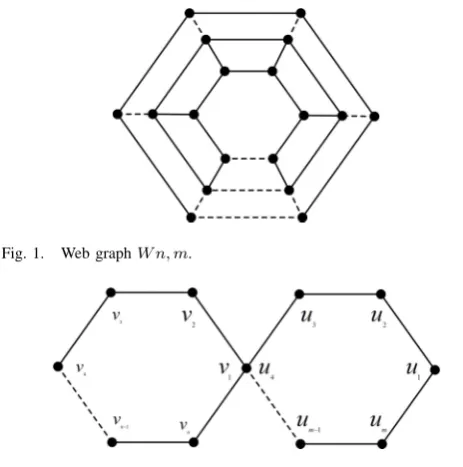
Fig. 1. Web graphW n, m.
Fig. 2. The structure ofCn,m.
A. Examples on computing of first multiplicative atom-bond connectivity index
Now, we present some of the examples about the calculat-ing process of the first multiplicative atom bond connectivity index.
Example 1. Wn = K1 ∨ Cn−1 is called wheel
graph. By simple computation, we have ABCΠ1(Wn) = (2
3)
n−1(q n
3(n−1))
n−1.
Example 2. Letnandmbe two positive integers. The web graphW(n, m)is constructed from the Cartesian product of cycle Cn and pathPm (see Figure 1 as an example).
By analyzing the structure of web graphW(n, m), ifm= 2, it easy to get
ABCΠ1(W(n, m)) = ( r
3 + 3−2 3·3 )
3n= (2 3)
3n.
Ifm≥2, then the first multiplicative atom bond connectivity index of web graphW(n, m)is
ABCΠ1(W(n, m))
= (
r
3 + 3−2 3·3 )
2n(
r
4 + 4−2 4·4 )
n(2m−5)
×(
r
3 + 4−2 3·4 )
2n
= (2 3)
2n(
√
6 4 )
n(2m−5)( r
5 12)
2n.
In the following three examples, we show the value of ABCΠ1 index for three kinds of vertex gluing graphs.
Example 3. Let Cn,m be a graph constructed from two cycles Cn and Cm with one common vertex (see Figure 2 as an example).
Using the definition of the first multiplicative atom bond connectivity index, we get
ABCΠ1(Cn,m)
= (
r
2 + 2−2 2·2 )
m+n−4( r
2 + 4−2 2·4 )
4= ( r
1 2)
n+m.
[image:2.595.314.548.513.683.2]Fig. 3. The structure ofWn,m.
Fig. 4. The structure ofK(n, m).
Example 4. Let Wn,m be a graph constructed from two wheel graphs Wn and Wm with one common vertex (see Figure 3 as an instance).
According to its graph structure analysis, we obtain
ABCΠ1(Wn,m)
= (
r
3 + 3−2 3·3 )
m+n−6( r
6 + 3−2 6·3 )
4
×(
s
(n−1) + 3−2 (n−1)·3 )
n−2( s
(m−1) + 3−2 (m−1)·3 )
m−2
× s
(n−1) + 6−2 (n−1)·6
s
(m−1) + 6−2 (m−1)·6
= (2 3)
m+n−6( r
7 18)
4(r n
3(n−1)) n−2
×(
r m
3(m−1)) m−2
s n+ 3 6(n−1)
s m+ 3 6(m−1).
Example 5. LetK(n, m)be a graph constructed from two complete graphsKn andKmwith one common vertex (see Figure 4 as an instance).
IAENG International Journal of Applied Mathematics, 47:4, IJAM_47_4_04
[image:2.595.87.264.555.650.2]By means of simple calculation, we yield
ABCΠ1(K(n, m))
= (
s
(n−1) + (n−1)−2 (n−1)·(n−1) )
(n−1)(n−2) 2
×(
s
(m−1) + (m−1)−2 (m−1)·(m−1) )
(m−1)(m−2) 2
×(
s
(m−1) + (m+n−2)−2 (m−1)·(m+n−2) )
m−1
×(
s
(n−1) + (m+n−2)−2 (n−1)·(m+n−2) )
n−1
= (
√
2n−4
n−1 )
(n−1)(n−2)
2 (
√
2m−4
m−1 )
(m−1)(m−2) 2
×(
s
2m+n−5 (m−1)(m+n−2))
m−1
×(
s
2n+m−5 (n−1)(m+n−2))
n−1 .
B. Organization of the rest paper
So far, there have been numerous theoretical results about ABC index, but on the degree-based multiplication of ABC index is also very small. As a variable of the original ABC index, degree-based multiplication ABC indices have a broad application prospect, it is worthy of further study. This motivates us to calculate some important chemical molecular structure of ABC multiplication index.
The rest of paper is organized as follows: first, we deter-mine the fourth multiplication ABC index of V-phenylenic nanotubes and nanotori; then, the first multiplication ABC index ofT U C4C8[p, q] and otherC4C8 net are considered;
next, the first multiplication ABC index of N S1[n] and
two classes of dendrimer nanostars (D1[n] and D3[n]) are
computed; at last, the first multiplication ABC index of carbon nanoconesCm[n]are calculated.
II. MAINRESULTS ANDPROOFS
In this section, we present the main results and their detail proofs. The trick to get these conclusions is followed by edge set dividing technology.
A. Fourth multiplication ABC index of V-phenylenic nan-otubes and nanotori
The aim of this section is to determine the fourth multi-plication ABC index of V-phenylenic nanotube and nanotori. The novel phenylenic and naphthylenic lattices consist of a square net embedded on the toroidal surface. As polycyclic conjugated molecules, phenylenes are composed of square and hexagons in which each 4-membered ring is adjacent to two 6-membered cycles, and no two 6-membered rings are adjacent mutually. We denote phenylenic nanotube and V-phenylenic nanotorus as V P HX[m, n] and V P HY[m, n], respectively. The representation of these two kinds of nanos-tructures are manifested in Figure 5 and Figure 6, respec-tively.
[image:3.595.309.542.51.283.2]Foregone results on V-phenylenic nanotubes and nanotori can refer to Yousefi-Azari et al. [40], Alamian et al. [41],
Fig. 5. The structure of V-phenylenic nanotubeV P HX[m, n].
Fig. 6. The structure of V-phenylenic nanotorusV P HY[m, n].
Ashrafi et al. [42], Bahrami and Yazdani [43], Ghorbani et al. [44], Moradi and Baba-Rahim [45], Farahani [46] and Gao et al. [47], [48], [49] and [50]. The main computing conclusion is formulated as follows.
Theorem 1 Letnandmbe two positive integers. The fourth multiplication ABC index of V-phenylenic nanotubes and nanotori are
ABC4Π(V P HX[m, n]) = (
1 2)
4m( 7 32)
m(5 24)
m(4 9)
9mn−9m
and
ABC4Π(V P HY[m, n]) = (
4 9)
9mn.
Proof. The proof is followed by edge set dividing approach in which the edge set is separated into several subsets according to the value ofS(u)andS(v).
By analysis the molecular structure of V-phenylenic nan-otubesV P HX[m, n], we see that its edge set can be divided
IAENG International Journal of Applied Mathematics, 47:4, IJAM_47_4_04
[image:3.595.73.277.70.310.2]into the following four parts:
• e = (u, v): S(u) = 6 andS(v) = 8, and there are 4m such edges;
• e = (u, v): S(u) = S(v) = 8, and there are 2m such edges;
• e = (u, v): S(u) = 8 andS(v) = 9, and there are 2m such edges;
• e= (u, v): S(u) = S(v) = 9, and there are 9mn−9m such edges.
In light of the definition of the fourth multiplication ABC index, we have
ABC4Π(V P HX[m, n])
= Y
uv∈E(V P HX[m,n]) r
Su+Sv−2 SuSv
= (
r
6 + 8−2 6×8 )
4m(
r
8 + 8−2 8×8 )
2m(
r
8 + 9−2 8×9 )
2m
×(
r
9 + 9−2 9×9 )
9mn−9m
= (1 2)
4m(
r
7 32)
2m(
r
5 24)
2m(4 9)
9mn−9m.
For V-phenylenic nanotori V P HY[m, n], this is a 3-regular molecular graph with d(v) = 3 for each v ∈ V(V P HY[m, n]), and thus S(v) = 9for vertexv. In view of the definition of the fourth multiplication ABC index, we get
ABC4Π(V P HY[m, n]) = ( r
9 + 9−2 9×9 )
9mn= (4 9)
9mn.
Hence, we obtain the desired results. 2
B. The first multiplication ABC index of nanostructures
The aim of this section is to yield the first multiplication ABC index of T U C4C8[p, q], where q is the number of
rows and pis the number of columns. Then we determine this topological index for its nanotubes. At last, the first multiplication ABC index ofT U C4C8[p, q] (can be seen in
Figure 7) is yielded. In this subsection, we always assume p, q∈N.
Theorem 2 Let G = T U C4C8[p, q] be the two
dimen-sional molecular lattice structure depicted in Figure 7. Then,
ABC1Π(G) = (
1 2)
3p+3q−2(2
3)
12pq−8(p+q)+4.
Proof. By analysis its structure, its edge set can be divided into three subsets:
• e= (u, v): d(u) =d(v) = 2, and there are 2p+ 2q+ 4 such edges;
• e = (u, v): d(u) = 2 and d(v) = 3, and there are4p+ 4q−8 such edges;
• e= (u, v): d(u) =d(v) = 3, and there are12pq−8(p+
q) + 4such edges.
[image:4.595.308.541.48.538.2]In term of the definition of the first multiplication ABC
Fig. 7. The structure of 2-D LatticeC4C8[4,4].
Fig. 8. The structure of 2-D graph ofC4C8[4,4]nanotube.
index, we infer
ABC1Π(G) = Y
uv∈E(G) r
du+dv−2 dudv
= (
r
2 + 2−2 2×2 )
2p+2q+4( r
2 + 3−2 2×3 )
4p+4q−8
×(
r
3 + 3−2 3×3 )
12pq−8(p+q)+4
= (
r
1 2)
2p+2q+4
(
r
1 2)
4p+4q−8
(2 3)
12pq−8(p+q)+4 .
Hence, the formula in the theorem is correct. 2 Theorem 3 Let G be the two dimensional C4C8[p, q]
nanotube described in Figure 8. Then,
ABC1Π(G) = (
1 2)
3p(2 3)
12pq−8p.
IAENG International Journal of Applied Mathematics, 47:4, IJAM_47_4_04
[image:4.595.59.294.206.332.2] [image:4.595.315.544.603.732.2]Fig. 9. The structure of 2-D graph ofC4C8[4,4]nanotorus.
Proof. Similarly, its edge set can be divided into three subsets:
• e= (u, v):d(u) =d(v) = 2, and there are2psuch edges;
• e= (u, v):d(u) = 2andd(v) = 3, and there are4psuch edges;
• e = (u, v): d(u) = d(v) = 3, and there are 12pq−8p such edges.
By virtue of the definition of the first multiplication ABC index, we deduce
ABC1Π(G) = ( r
2 + 2−2 2×2 )
2p(
r
2 + 3−2 2×3 )
4p
×(
r
3 + 3−2 3×3 )
12pq−8p
= (
r
1 2)
2p(
r
1 2)
4p(2 3)
12pq−8p.
Therefore, we verify the expected conclusion. 2 Theorem 4 Let G be the two dimensional C4C8[p, q]
nanotori described in Figure 9. Then,
ABC1Π(G) = (
2 3)
12pq.
Proof. Since C4C8[p, q] nanotori is a 3-regular molecular
graph with12pq edges. We directly get the result 2
C. The first multiplication ABC index ofN S1[n]
In this part, we raise the first multiplication ABC index of an infinite class ofN S1[n](as examples, the basic structures
of N S1[n] can be seen in Figure 10, Figure 11 and Figure
12).
Theorem 5 Letn∈Nbe the step number of growth. The
first multiplication ABC index of N S1[n] is given by
ABC1Π(N S1[n]) = √
3 2 (
r
1 2)
27·2n−9
(
r
5 12)
3.
Proof. By analysisE(N S1[n]), we have four separate
sub-sets listed as follows:
• e= (u, v): d(u) = 1 andd(v) = 4, and there one edge
Fig. 10. The molecular structure ofN S1[1].
Fig. 11. The molecular structure ofN S1[2].
Fig. 12. The molecular structure ofN S1[3].
in this subset;
• e= (u, v):d(u) =d(v) = 2, and there are9·2n+ 3such edges;
• e = (u, v): d(u) = 2 and d(v) = 3, and there are
IAENG International Journal of Applied Mathematics, 47:4, IJAM_47_4_04
[image:5.595.53.285.50.282.2]18·2n−12such edges;
• e = (u, v): d(u) = 3 andd(v) = 4, and there are three such edges.
Hence, using the definition of the first multiplication ABC index, we derive
ABC1Π(N S1[n]) =
Y
uv∈E(N S1[n]) r
du+dv−2 dudv
= (
r
1 + 4−2 1×4 )(
r
2 + 2−2 2×2 )
9·2n+3
×(
r
2 + 3−2 2×3 )
18·2n−12
(
r
3 + 4−2 3×4 )
3
=
√
3 2 (
r
1 2)
27·2n−9( r
5 12)
3.
The proof is completed. 2
D. The first multiplication ABC index of dendrimer nanos-tars D1[n]and D3[n]
Here, we discuss the first multiplication ABC index of dendrimer nanostars D1[n] and D3[n], where these two
molecular structures are widely appeared in the chemical compounds, drugs, and nanomaterials.
Theorem 6 Let n ∈ N be the number of steps of
growth, then the first multiplication ABC index of dendrimer nanostars D1[n]is stated as
ABC1Π(D1[n]) = r
2 3(
1 2)
9·2n−6
.
Proof. Its edge set can be divided into three subsets:
• e= (u, v): d(u) = 1 andd(v) = 3, and there one edge in this subset;
• e= (u, v):d(u) =d(v) = 2, and there are6·2n−2such edges;
• e = (u, v): d(u) = 2 andd(v) = 3, and there are 12·
2n−10such edges.
Hence, according to the definition of the first multiplica-tion ABC index, we get
ABC1Π(D1[n]) = Y
uv∈E(D1[n])
r
du+dv−2 dudv
= (
r
1 + 3−2 1×3 )(
r
2 + 2−2 2×2 )
6·2n−2
×(
r
2 + 3−2 2×3 )
12·2n−10
=
r
2 3(
r
1 2)
18·2n−12
.
The desired result is obtained. 2
As an instance, the molecular structure of D3[3] is
pre-sented in Figure 13.
Theorem 7 Let n ∈ N be the number of steps of growth, then the first multiplication ABC index of dendrimer nanostars D3[n]is stated as
ABC1Π(D3[n]) = ( r
2 3)
3·2n
(1 2)
18·2n−9
(2 3)
9·2n−6
.
Proof. The setE(N S3[n])can be divided into following four
parts:
[image:6.595.309.538.52.278.2]• e= (u, v):d(u) = 1andd(v) = 3, and there3·2n edges
Fig. 13. The example ofD3[n]:n= 3.
in this subset;
• e = (u, v): d(u) = d(v) = 2, and there are 12·2n−6 such edges;
• e = (u, v): d(u) = 2 and d(v) = 3, and there are 24·
2n−12such edges;
• e= (u, v):d(u) =d(v) = 3, and there are9·2n−6such edges.
Hence, using the definition of the first multiplication ABC index, we derive
ABC1Π(D3[n]) = Y
uv∈E(D3[n])
r
du+dv−2 dudv
= (
r
1 + 3−2 1×3 )
3·2n( r
2 + 2−2 2×2 )
12·2n−6
×(
r
2 + 3−2 2×3 )
24·2n−12( r
3 + 3−2 3×3 )
9·2n−6
= (
r
2 3)
3·2n
(
r
1 2)
36·2n−18
(2 3)
9·2n−6
.
We complete the proof. 2
E. The first multiplication ABC index of carbon nanocones
Now, we compute the first multiplication ABC index of carbon nanoconesCN Cm[n] =Cm[n] (see Figure 14 as an example of carbon nanocone).
Theorem 8 Letm≥3andn≥1be two positive integers, then the first multiplication ABC index of carbon nanocones Cm[n]can be expressed as
ABC1Π(Cm[n]) = (
r
1 2)
2mn+m(2 3)
m(3n2 +n)
2 .
Proof. By analysis the molecular structure of carbon nanoconesCm[n], we found that its edge set can be divided into three parts:
• e= (u, v):d(u) =d(v) = 2, and there aremsuch edges;
• e= (u, v): d(u) = 2and d(v) = 3, and there are 2mn such edges;
IAENG International Journal of Applied Mathematics, 47:4, IJAM_47_4_04
Fig. 14. The example of carbon nanoconeCm[n].
• e = (u, v): d(u) = d(v) = 3, and there are m(3n22+n) such edges.
Then, by means of the definition of the first multiplication ABC index, we derive
ABC1Π(Cm[n]) =
Y
uv∈E(Cm[n])
r
du+dv−2 dudv
= (
r
2 + 2−2 2×2 )
m(
r
2 + 3−2 2×3 )
2mn
×(
r
3 + 3−2 3×3 )
m(3n2 +n) 2
= (
r
1 2)
2mn+m(2 3)
m(3n2 +n)
2 .
Hence, we check the desired result. 2
F. The fifth multiplication ABC index ofN Anm nanotubes The eccentricity ec(u) of vertex u∈V(G) is defined as the maximum distance betweenuand any other vertex inG. Gao et al. [51] introduced the fifth multiplicative atom bond connectivity index which was stated as
ABCΠ5(G) = Y
uv∈E(G) s
ec(u) +ec(v)−2
ec(u)ec(v) .
The structure of of N Anm nanotubes was discussed by Bac et al. [52] as follows: consider them×nquadrilateral section Pmn with m ≥ 2 hexagons on the top and bottom sides and n≥2 hexagons on the lateral sides cut from the regular hexagonal lattice L. If we identify two lateral sides of Pn
m such that we identify the vertices u j
0 and ujm, for j = 0,1,2,· · ·, n, then the N An
m nanotubes are obtained. The detailed structure ofN An
mnanotubes nanotube can refer to Figure 15. In this part, we study N An
m nanotube with n=mand it’s fifth multiplication ABC index is determined. Theorem 9 The fifth multiplication ABC index of N Anm nanotubes can be expressed as follows:
Fig. 15. The structure ofN An
mnanotubes nanotube.
• Ifn≡0(mod2), then
ABC5Π(N Anm) =
n
2
Y
i=1 2n−1
Y
p=3n
2 (
r
2p−1
p2+p) 6i−3
×Y
p=n (
r
4p−1 4p2+ 2p)
3nY
p=n 4p
(2p−1)2
× Y
i=n
2+3 5n
2−1
Y
p=2n+1
(
r
2p−1
p2+p) (n
2−1)(6i−16)
× Y
i=3n+6,j∈{0,···,n
2−1}
3n−1 Y
p=5n
2 (
r
2p−1
p2+p) 6n−i.
• Ifn≡1(mod4), then
ABC5Π(N Anm)
=
√
2p−2
p
5n−1
2 ,p≡0(mod2)
Y
p=3n+1 2
(
r
2p−2
p2 )
n−1
×
n−3
2 ,i≡1(mod2)
Y
i=1
2n−2,p≡0(mod2) Y
p=3n+1 2
(
r
2p−1
p2+p) 4i
×
n−1
2 ,i≡0(mod2)
Y
i=2
2n−1,p≡1(mod2) Y
p=3n+3 2
(
r
2p−1
p2+p) 8i−2
×
5n−1
2 ,p≡0(mod2)
Y
p=2n (
r
2p−1
p2+p)
(n+3)(n+1) 2
×
5n−3
2 ,p≡1(mod2)
Y
p=2n+1
(
r
2p−1
p2+p)
n(n−1)
×
n−1 4
Y
i=1
3n−2,p≡1(mod2) Y
p=5n+1 2
(
r
2p−1
p2+p) 16i
IAENG International Journal of Applied Mathematics, 47:4, IJAM_47_4_04
[image:7.595.312.535.54.277.2]×
n−3
2 ,i≡1(mod2)
Y
i=1
3n−1,p≡0(mod2) Y
p=5n2+3
(
r
2p−1
p2+p) 4i.
• Ifn≡3(mod4), then
ABC5Π(N Anm)
= 5n+1
2 ,p≡0(mod2)
Y
p=3n2+3
(
r
2p−2
p2 )
n+1 × n+1 4 Y i=1
2n−1,p≡1(mod2) Y
p=3n2+1
(
r
2p−1
p2+p) 16i−10
×
n+1 4
Y
i=1
2n,p≡0(mod2) Y
p=3n2+3
(
r
2p−1
p2+p) 8i
×
5n−1
2 ,p≡1(mod2)
Y
p=2n+1
(
r
2p−1
p2+p)
n(n+1)
×
5n−3
2 ,p≡0(mod2)
Y
p=2n+2
(
r
2p−1
p2+p)
(n+1)(n−3) 2
×
n−3 4 ,n6=3
Y
i=1
3n−2,p≡0(mod2) Y
p=5n2+3,n6=3
(
r
2p−1
p2+p) 16i
×
n+1 4 ,n6=3
Y
i=1
3n−1,p≡0(mod2) Y
p=5n+1 2
(
r
2p−1
p2+p) 8i−4.
Proof. The whole proof can be divided into three parts according to the value of n.
Case 1.n≡0(mod2).
In this case, the edge set of N Anm nanotubes can be divided into five parts according to the value of ec(u) and ec(v):
• ec(u) = p and ec(v) = p + 1 where
p ∈ {2n− n
2,· · ·,2n −1}, and there are 6i −3 such
edges withi∈ {1,· · · ,n2};
• ec(u) = 2pandec(v) = 2p+ 1wherep=n≡0(mod2), and there are 3nsuch edges with n≡0(mod2);
• ec(u) =ec(v) = 2p+ 1 where p=n ≡0(mod2), and there are 2such edges;
• ec(u) = p and ec(v) = p + 1 where
p∈ {2n+ 1,· · ·,52n −1}, and there are (n2 −1)(3n+ 2) such edges;
• ec(u) =pandec(v) =p+1wherep∈ {5n
2,· · ·,3n−1},
and there are 6n−i such edges with i = 3n+ 6j and j∈ {0,· · ·,n2−1}.
In terms of the definition of the fifth multiplication ABC index, we have
ABC5Π(N Anm)
= Y
uv∈E(N An m)
s
ec(u) +ec(v)−2
ec(u)ec(v)
=
n
2
Y
i=1 2n−1
Y
p=3n
2 (
r
2p−1
p2+p) 6i−3
×Y
p=n (
r
4p−1 4p2+ 2p)
3nY
p=n 4p
(2p−1)2
× Y
i=n
2+3 5n
2−1
Y
p=2n+1
(
r
2p−1
p2+p) (n
2−1)(6i−16)
× Y
i=3n+6,j∈{0,···,n
2−1}
3n−1 Y
p=5n
2 (
r
2p−1
p2+p) 6n−i.
Case 2.n≡1(mod4).
In this case, the edge set of N Anm nanotubes can be divided into eight parts according to the value ofec(u)and ec(v):
• ec(u) =ec(v) = pwhere p=n ≡0(mod2), and there only one such edge;
• ec(u) = ec(v) = p where 3n2+1 < p ≤ 5n−1 2 and p≡0(mod2), and theren−1such edges;
• ec(u) =pandec(v) =p+ 1 where 3n+1
2 ≤p≤2n−2
and p ≡ 0(mod2), and there are 4i such edges with i∈ {1,· · ·,n−23} andi≡1(mod2);
• ec(u) =pandec(v) =p+ 1 where 3n2+3 ≤p≤2n−1 and p ≡ 0(mod2), and there are 8i−2 such edges with i∈ {2,· · ·,n−21} andi≡0(mod2);
• ec(u) =pandec(v) =p+ 1where2n≤p≤ 5n−1 2 and p≡0(mod2), and there are (n+3)(2n+1) such edges;
• ec(u) =pandec(v) =p+ 1 where2n+ 1≤p≤ 5n−3 2
andp≡1(mod2), and there are n2−nsuch edges; • ec(u) =pandec(v) =p+ 1 where 5n2+1 ≤p≤3n−2 and p ≡ 1(mod2), and there are 16i such edges with i∈ {1,· · ·,n−41};
• ec(u) =pandec(v) =p+ 1 where 5n2+3 ≤p≤3n−1 and p ≡ 0(mod2), and there are 4i such edges with i∈ {1,· · ·,n−23} andi≡1(mod2).
In view of the definition of the fifth multiplication ABC index, we get
ABC5Π(N Anm)
= Y
uv∈E(N An m)
s
ec(u) +ec(v)−2
ec(u)ec(v)
=
√
2p−2
p
5n−1
2 ,p≡0(mod2)
Y
p=3n+1 2
(
r
2p−2
p2 )
n−1
×
n−3
2 ,i≡1(mod2)
Y
i=1
2n−2,p≡0(mod2) Y
p=3n+1 2
(
r
2p−1
p2+p) 4i
×
n−1
2 ,i≡0(mod2)
Y
i=2
2n−1,p≡1(mod2) Y
p=3n+3 2
(
r
2p−1
p2+p) 8i−2
×
5n−1
2 ,p≡0(mod2)
Y
p=2n (
r
2p−1
p2+p)
(n+3)(n+1) 2
×
5n−3
2 ,p≡1(mod2)
Y
p=2n+1
(
r
2p−1
p2+p)
n(n−1)
×
n−1 4
Y
i=1
3n−2,p≡1(mod2) Y
p=5n+1 2
(
r
2p−1
p2+p) 16i
IAENG International Journal of Applied Mathematics, 47:4, IJAM_47_4_04
×
n−3
2 ,i≡1(mod2)
Y
i=1
3n−1,p≡0(mod2) Y
p=5n2+3
(
r
2p−1
p2+p) 4i.
Case 3.n≡3(mod4).
In this case, the edge set of N An
m nanotubes can be divided into seven parts according to the value ofec(u)and ec(v):
• ec(u) = ec(v) = p where p∈ {3n+3 2 ,· · ·,
5n+1 5 }, and
theren+ 1such edge;
• ec(u) =pandec(v) =p+ 1 where 3n2+1 ≤p≤2n−1 and p≡1(mod2), and there are16i−10 such edges with i∈ {1,· · · ,n+14 };
• ec(u) = p and ec(v) = p+ 1 where 3n2+3 ≤ p ≤ 2n and p ≡ 0(mod2), and there are 8i such edges with i∈ {1,· · · ,n+14 };
• ec(u) =pandec(v) =p+ 1 where2n+ 1≤p≤5n−1 2
andp≡1(mod2), and there aren(n+ 1) such edges;
• ec(u) =pandec(v) =p+ 1where2n+ 2≤p≤ 5n−3 2 , p ≡ 0(mod2) and n 6= 3, and there are (n+1)(2n−3) such edges withn6= 3;
• ec(u) =pandec(v) =p+ 1where 5n2+3 ≤p≤3n−2, p≡1(mod2) andn6= 3, and there are16isuch edges with i∈ {1,· · · ,n−3
4 }andn6= 3;
• ec(u) =pandec(v) =p+ 1where 5n+1
2 ≤p≤3n−1, p ≡ 0(mod2), and there are 8i − 4 such edges with i∈ {1,· · · ,n+14 }.
In light of the definition of the fifth multiplication ABC index, we infer
ABC5Π(N Anm)
= Y
uv∈E(N An m)
s
ec(u) +ec(v)−2
ec(u)ec(v)
= 5n+1
2 ,p≡0(mod2)
Y
p=3n+3 2
(
r
2p−2
p2 )
n+1
×
n+1 4
Y
i=1
2n−1,p≡1(mod2) Y
p=3n+1 2
(
r
2p−1
p2+p) 16i−10
×
n+1 4
Y
i=1
2n,p≡0(mod2) Y
p=3n+3 2
(
r
2p−1
p2+p) 8i
×
5n−1
2 ,p≡1(mod2)
Y
p=2n+1
(
r
2p−1
p2+p)
n(n+1)
×
5n−3
2 ,p≡0(mod2)
Y
p=2n+2
(
r
2p−1
p2+p)
(n+1)(n−3) 2
×
n−3 4 ,n6=3
Y
i=1
3n−2,p≡0(mod2) Y
p=5n+3 2 ,n6=3
(
r
2p−1
p2+p) 16i
×
n+1 4 ,n6=3
Y
i=1
3n−1,p≡0(mod2) Y
p=5n+1 2
(
r
2p−1
p2+p) 8i−4.
From what we have discussed in above three cases, we
deduce the desired result. 2
III. CONCLUSION
In this paper, we study the degree-based indices multi-plication ABC of several common appeared nanostructures. The exact computational formulas are presented by means of edge set dividing approach. These theoretical results in nanoscience, biology, pharmacy and other fields have a wide application prospect.
CONFLICT OFINTERESTS
The authors hereby declare that there is no conflict of interests regarding the publication of this paper.
ACKNOWLEDGMENT
The authors thank the reviewers for their constructive comments in improving the quality of this paper.
REFERENCES
[1] A. T. Balaban, “Can topological indices transmit information on prop-erties but not on structures?,” Journal of Computer-Aided Molecular Design, 2005, vol. 19, no. 9-10, pp. 651-660, 2005.
[2] C. R. Munteanu, A. L. Magalhaes, A. Duardo-Sanchez, A. Pazos, and H. Gonzalez-Diaz, “S2SNet: a tool for transforming characters and numeric sequences into star network topological indices in chemoinfor-matics, bioinforchemoinfor-matics, biomedical, and social-legal sciences,” Current Bioinformatics, vol. 8, no. 4, pp. 429-437, 2013.
[3] M. Buscema, M. Asadi-Zeydabadi, W. Lodwick, and M. Breda, “The H-0 function, a new index for detecting structural/topological complexity information in undirected graphs,” Physica A-Statistical Mechanics and Its Applications, vol. 447, pp. 355-378, 2016.
[4] W. Gao, W. F. Wang, and M. R. Farahani, “Topological indices study of molecular structure in anticancer drugs,” Journal of Chemistry, vol. 2016, http://dx.doi.org/10.1155/2016/3216327.
[5] W. Gao, W. F. Wang, M. K. Jamil, and M. R. Farahani, “Electron energy studying of molecular structures via forgotten topological index computation,” Journal of Chemistry, vol. 2016, http://dx.doi.org/10.1155/2016/1053183.
[6] S. Sirimulla, M. Lerma, and W. C. Herndon, “Prediction of partial molar volumes of amino acids and small peptides: counting atoms versus topological indices,” Journal of Chemical Information and Modeling, vol. 50, no. 1, pp. 194-204, 2010.
[7] J. Bodlaj and V. Batagelj, “Network analysis of publications on topo-logical indices from the web of science,” Molecular Informatics, vol.33, no. 8, pp. 514-535, 2014.
[8] I. Nadeem and H. Shaker, “On topological indices of tri-hexagonal boron nanotubes,” Journal of Optoelectronics and Advanced Materials, vol. 18, no. 9-10, pp. 893-898, 2016.
[9] V. Nistor and E. Troitsky, “Analysis of gauge-equivariant complexes and a topological index theorem for gauge-invariant families,” Russian Journal of Mathematical Physics, vol. 22, no. 1, pp. 74-97, 2015. [10] M. Arockiaraj, S. R. J. Kavitha, and K. Balasubramanian, “Vertex
cut method for degree and distance-based topological indices and its applications to silicate networks,” Journal of Mathematical Chemistry, vol. 54, no. 8, pp. 1728-1747, 2016.
[11] A. A. Khakpoor and B. A. Keshe, “Physical and electro-optical prop-erties of rylenes as nanostructures using topological indices method,” Journal of Nanoelectronics and Optoelectronics, vol. 11, no. 3, pp. 280-283, 2016.
[12] O. Ivanciuc, “Chemical graphs, molecular matrices and topological indices in chemoinformatics and quantitative structure-activity relation-ships,” Current Computer-Aided Drug Design, vol. 9, no. 2, pp. 153-163, 2013.
[13] H. S. Ramane and R. B. Jummannaver, “Note on forgotten topolog-ical index of chemtopolog-ical structure in drugs,” Applied Mathematics and Nonlinear Sciences, vol. 1, no. 2, pp. 369-374, 2016.
[14] B. Zhao and H. L. Wu, “Pharmacological characteristics analysis of two molecular structures,” Applied Mathematics and Nonlinear Sciences, vol. 2, no. 1, pp. 93-110, 2017.
[15] M. S. Sardar, S. Zafar, and Z. Zahid, “Computing topological indices of the line graphs of banana tree graph and firecracker graph,” Applied Mathematics and Nonlinear Sciences, vol. 2, no. 1, pp. 83-92, 2017. [16] W. Gao and W. F. Wang, “The eccentric connectivity polynomial of
two classes of nanotubes,” Chaos, Solitons and Fractals, vol. 89, pp. 290-294, 2016.
IAENG International Journal of Applied Mathematics, 47:4, IJAM_47_4_04
[17] W. Gao and W. F. Wang, “The fifth geometric arithmetic index of bridge graph and carbon nanocones,” Journal of Difference Equations and Applications, vol. 23, no. 1-2, pp. 100-109, 2017.
[18] W. Gao, L. Yan, and L. Shi, “Generalized zagreb index of polyomino chains and nanotubes,” Optoelectronics and Advanced Materials–Rapid Communications, vol. 11, no. 1-2, pp. 119-124, 2017.
[19] W. Gao, M. R. Farahani, and L. Shi, “The forgotten topological index of some drug structures,” Acta Medica Mediterranea, vol. 32, pp. 579-585, 2016.
[20] W. Gao, M. K. Siddiqui, M. Imran, M. K. Jamil, and M. R. Farahani, “Forgotten topological index of chemical structure in drugs,” Saudi Pharmaceutical Journal, vol. 24, no. 3, pp. 258-264, 2016.
[21] W. Gao and M. K. Siddiqui, “Molecular descriptors of nanotube, oxide, silicate, and triangulene networks,” Journal of Chemistry, vol. 2017, https://doi.org/10.1155/2017/6540754.
[22] H. Abdo, D. Dimitrov, and W. Gao, “On the irregularity of some molecular structures,” Canadian Journal of Chemistry, vol. 95, no. 2, pp. 174-183, 2017.
[23] B. Basavanagoud, V. R. Desai, and S. Patil, “(β, α)-Connectivity index of graphs,” Applied Mathematics and Nonlinear Sciences, vol. 2, no. 1, pp. 21-30, 2017.
[24] M. H. Sunilkumar, B. K. Bhagyashri, G. B. Ratnamma, and M. G. Vijay, “QSPR analysis of certain graph theocratical matrices and their corresponding energy,” Applied Mathematics and Nonlinear Sciences, vol. 2, no. 1, pp. 131-150, 2017.
[25] J. L. G. Guirao and M. T. de Bustos, “Dynamics of pseudo–radioactive chemical products via sampling theory,” Journal of Mathematical Chemistry, vol. 50, no. 2, pp. 374-378, 2012.
[26] E. Estrada and L. Torres, “An atom-bond connectivity index: Mod-elling the enthalpy of formation of alkanes,” Indian Journal of chem-istry, vol. 37, no. 10, pp. 849-855, 1998.
[27] T. Dehghan-Zadeh, A. R. Ashrafi, and N. Habibi, “Maximum values of atom-bond connectivity index in the class of tetracyclic graphs,” Journal of Applied Mathematics and Computing, vol. 46, pp. 285-303, 2014. [28] A. R. Ashrafi and T. Dehghan-Zadeh, “Extremal atom-bond
con-nectivity index of cactus graphs,” Communications of the Korean Mathematical Society, vol. 30, no. 3, pp. 283-295, 2015.
[29] M. Goubko, C. Magnant, P. S. Nowbandegani, and I. Gutman, “ABC index of trees with fixed number of leaves,” MATCH Communications in Mathematical and in Computer Chemistry, vol. 74, pp. 697-702, 2015.
[30] N. M. Husin, R. Hasni, and N. E. Arif, “Atom-bond connectivity and geometric arithmetic indices of dendrimer nanostars,” Australian Journal of Basic and Applied Sciences, vol. 7, no. 9, pp. 10-14, 2013. [31] T. Dehghan-Zadeh and A. R. Ashrafi, “Atom-bond connectivity index of quasi-tree graphs,” Rendiconti del Circolo Matematico di Palermo, vol. 63, pp. 347-354, 2014.
[32] D. Dimitrov, “Efficient computation of trees with minimal atom-bond connectivity index,” Applied Mathematics and Computation, vol. 224, pp. 663-670, 2013.
[33] M. B. Ahmadi, D. Dimitrov, I. Gutman, and S. A. Hosseini, “Disprov-ing a conjecture on trees with minimal atom-bond connectivity index,” MATCH Communications in Mathematical and in Computer Chemistry, vol. 72, pp. 685–698, 2014.
[34] D. Dimitrov, “On structural properties of trees with minimal atom-bond connectivity index,” Discrete Applied Mathematics, vol. 172, pp. 28–44, 2014.
[35] D. Dimitrov, “On structural properties of trees with minimal atom-bond connectivity index II: Bounds on B-1- and B-2-branches,” Discrete Applied Mathematics, vol. 204, pp. 90-116, 2016.
[36] D. Dimitrov, Z. Du, and C. M. da Fonseca, “On structural properties of trees with minimal atom-bond connectivity index III: Trees with pendent paths of length three”, Applied Mathematics and Computation, vol. 282, pp. 276–290, 2016.
[37] D. Dimitrov, B. Ikica and R. ˇSkrekovski, “Remarks on maximum atom-bond connectivity index with given graph parameters,” Discrete Applied Mathematics, vol. 222, pp. 222–226, 2017.
[38] V. R. Kulli, “Multiplicative connectivity indices of certain nanotubes,” Annals of Pure and Applied Mathematics, vol. 12, no. 2, pp. 169-176, 2016.
[39] V. R. Kulli, “Two new multiplicative atom bond connectivity indices,” Annals of Pure and Applied Mathematics, vol. 13, no. 1, pp. 1-7, 2017. [40] H. Yousefi-Azari, A. Bahrami, J. Yazdani, and A. R. Ashrafi, “PI index of V-Phenylenic nanotubes and nanotori,” Journal of Computational and Theoretical Nanoscience, vol. 4, no. 3, pp. 604-605, 2007.
[41] V. Alamian, A. Bahrami, and B. Edalatzadeh, “PI polynomial of V-phenylenic nanotubes and nanotori,” International Journal of Molecular Sciences, vol. 9, no. 3, pp. 229-234, 2008.
[42] A. R. Ashrafi, M. Ghorbani, and M. Jalali, “Computing Sadhana polynomial of V-phenylenic nanotubes and nanotori,” Indian Journal
of Chemistry Secton A-Inorganic Bio-Inorganic Physical Theoretical & Analytical Chemistry, vol. 47, no. 4, pp. 535-537, 2008.
[43] A. Bahrami and J. Yazdani, “Vertex PI index of V-phenylenic nan-otubes and nanotori,” Digest Journal of Nanomaterials and Biostruc-tures, vol. 4, no. 1, pp. 141-144, 2009.
[44] M. Ghorbani, H. Mesgarani, and S. Shakeraneh, “Computing GA index and ABC index of V-phenylenic nanotube,” Optoelectronics and Advanced Materials-Rapid Communications, vol. 5, no. 3-4, pp. 324-326, 2011.
[45] S. Moradi and S. Baba-Rahim, “The eccentric connectivity index of V-phenylenic nanotubes and nanotorus,” Fullerenes Nanotubes and Carbon Nanostructures, vol. 21, no. 4, pp. 326-332, 2013.
[46] M. R. Farahani, “Computing fourth atom-bond connectivity index of V-phenylenic nanotubes and nanotori,” Acta Chimica Slovenica, vol. 60, no. 2, pp. 429-432, 2013.
[47] W. Gao and L. Shi, “Szeged related indices of unilateral polyomino chain and unilateral hexagonal chain,” IAENG International Journal of Applied Mathematics, vol. 45, no. 2, pp. 138-150, 2015.
[48] W. Gao, L. Shi, and M. R. Farahani, “Distance-based indices for some families of dendrimer nanostars,” IAENG International Journal of Applied Mathematics, vol. 46, no. 2, pp. 168-186, 2016.
[49] W. Gao, L. L. Zhu, and Y. Guo, “Multi-dividing infinite push ontology algorithm,” Engineering Letters, vol. 23, no. 3, pp. 132-139, 2015. [50] L. L. Zhu, W. G. Tao, X. Z. Min, and W. Gao, “Theoretical
character-istics of ontology learning algorithm in multi-dividing setting,” IAENG International Journal of Computer Science, vol. 43, no. 2, pp. 184-191, 2016.
[51] W. Gao, Y. J. Chen, and W. F. Wang, “The topological variable computation for a special type of cycloalkanes,” Journal of Chemistry, vol. 2017, https://doi.org/10.1155/2017/6534758.
[52] M. Bac, J. Horvathova, M. Mokrisova, A. Semanicova, and A. Suhanyiova, “On topological indices of carbon nanotube network,” Canadian Journal of Chemistry, vol. 93, no. 10, pp. 1157-1160, 2015.
Wei Gao, male, was born in the city of Shaoxing, Zhejiang Province,
China on Feb. 13, 1981. He got two bachelor degrees on computer science from Zhejiang industrial university in 2004 and mathematics education from College of Zhejiang education in 2006. Then, he was enrolled in department of computer science and information technology, Yunnan normal university, and got Master degree there in 2009. In 2012, he got PhD degree in department of Mathematics, Soochow University, China.
He acted as lecturer in the department of information, Yunnan Normal University from July 2012 to December 2015. Now, he acts as associate professor in the department of information, Yunnan Normal University. As a researcher in computer science and mathematics, his interests are cover-ing two disciplines: Graph theory, Statistical learncover-ing theory, Information retrieval, and Artificial Intelligence.
Muhammad Kamran Jamil, is an Assistant Professor at Riphah Institute of
Computing and Applied Sciences (RICAS). He did his B.S (2005-2009) in Mathematics from University of the Punjab. He obtained the MPhil (2011-2013) degree in Mathematics from Abdus Salam School of Mathematical Sciences (ASSMS), GC University, Lahore. After completing his MPhil he also pursued his PhD (2013-2016) degree program form the same institution (ASSMS). During his PhD, he received the Pre-PhD Quality Research Award.
His area of research is graph theory. His major contribution for research is in chemical graph theory. In this area he published more than 50 research papers in international repute journals. He has attended many national and international conferences.
Waqas Nazeer, male, was born in the city Lahore-Pakistan on 20th
September 1984. He got masters degree in Mathematics from the University of the Punjab in 2007. He earned his PhD from Abdus Salam School of Mathematical Sciences in year 2012.
He worked as an assistant professor of mathematics at Lahore Leads University and currently, since September 2014, he is working as an assistant professor of mathematics at Division of Science and Technology, University of Uducation, Lahore, Pakistan. As a researcher in mathematics, his interests are Numerical analysis, Chemical Graph Theory, Functional analysis.
Murad Amin is a researcher in National College of Business Administration
& Economics, DHA Campus, Lahore, Pakistan.
![Fig. 5.The structure of V-phenylenic nanotube VPHX[ m, n ] .](https://thumb-us.123doks.com/thumbv2/123dok_us/379197.535352/3.595.73.277.70.310/fig-structure-v-phenylenic-nanotube-vphx-m-n.webp)
![Fig. 8.The structure of 2-D graph of C4C 8[ 4 , 4 ] nanotube.](https://thumb-us.123doks.com/thumbv2/123dok_us/379197.535352/4.595.308.541.48.538/fig-structure-d-graph-c-c-nanotube.webp)
![Fig. 9.The structure of 2-D graph of C4C 8[ 4 , 4 ] nanotorus.](https://thumb-us.123doks.com/thumbv2/123dok_us/379197.535352/5.595.53.285.50.282/fig-structure-d-graph-c-c-nanotorus.webp)
![Fig. 13.The example of D3[ n ] n :=3 .](https://thumb-us.123doks.com/thumbv2/123dok_us/379197.535352/6.595.309.538.52.278/fig-example-d-n-n.webp)
![Fig. 14.The example of carbon nanocone Cm[ n ] .](https://thumb-us.123doks.com/thumbv2/123dok_us/379197.535352/7.595.312.535.54.277/fig-example-carbon-nanocone-cm-n.webp)
