Analysis of a Stochastic Predator-Prey Model in
Polluted Environments
Huajuan Zhou, Meng Liu
∗Abstract—In this paper, a stochastic predator-prey popula-tions model in polluted environments is proposed and investi-gated. We first study the existence, uniqueness and boundedness of the global positive solution. Then we establish the sufficient conditions for extinction, non-persistence in the mean and weak persistence in the mean of the predator and prey populations. The threshold between weak persistence in the mean and extinction for each species is obtained. Finally, we study the global asymptotic stability of the solution. Our results reveal that the more the number of random noises, the easier the species go to extinction.
Index Terms—environmental pollution, stochastic noises, per-sistence, extinction.
I. INTRODUCTION
E
NVIRONMENTAL pollution by modern industry, a-griculture, and other human activities is one of the most important socio-ecological problems in the world today. The presence of toxicant in the environment is a great threat to the survival of the exposed living beings. This motivates scholars to analyze the survival of populations in polluted environments and to establish the persistence-extinction thresholds of the populations.In recent years, many scholars have studied the survival of populations with toxicants effect by establishing mathemat-ical models. Hallam and his colleagues did pioneering work in [1], [2], [3], where the authors studied some deterministic population systems with toxins effect and established the theoretical persistence-extinction thresholds for their models. From then on, many deterministic models in polluted envi-ronmrnts were proposed and analyzed. For example, Hallam and Ma [4], Ma et al. [5], [6], Freedman and Shukla [7], Wang and Ma [8], Buonomo et al. [9], Srinivasu [10] and He and Wang [11] proposed some single-species popula-tion models in polluted environments and established the persistence-and-extinction thresholds for their models. Liu and Ma [12] studied the persistence-and-extinction thresholds for two-species Lotka-Volterra models with toxins effect. Ma et al. [13] and Pan et al. [14] extended the threshold results in [12] to n-dimensional food chain model and n -dimensional factualistic system, respectively. Liu at al. [15],
Manuscript received 21 April, 2016; revised 12 May, 2016. This work was supported by the National Natural Science Foundation of China (Nos. 11301207), Project Funded by China Postdoctoral Science Foundation (2015M571349 and 2016T90236), Natural Science Foundation of Jiangsu Province (No. BK20130411), Natural Science Research Project of Ordinary Universities in Jiangsu Province (No. 13KJB110002), Qing Lan Project of Jiangsu Province (2014), Science and Technology Support Plan Project of Huaian (HAR2015013), Natural Science Foundation of Heilongjiang Province (No.A201420).
M. Liu is with the School of Mathematical Science, Huaiyin Normal University, Huaian 223300, PR China, and School of Mathematics and Statistics, Northeast Normal University, Changchun 130024, Peoples Re-public of China. E-mail: [email protected]
H. Zhou is with Huaiyin Normal University.
[16], Jiao et al. [17] and Li and Chen [18] considered the population models in polluted environments with pulse input of environmental toxins.
However, in the nature world the growth of population is inevitably affected by the random interference factors ([19], [20]). Thus it is important to study stochastic population models in polluted environments and to reveal the effects of random noises on the dynamics of populations. In this area, Gard did pioneering work in [21], where he first proposed a stochastic single-species model with toxins effect and investigated the dynamics of the model by supposing that the concentration of toxicant in the organism is a constant. Be-sides, Liu and Wang [22] obtained the persistence-extinction threshold for a stochastic logistic model in polluted envi-ronments. From then on, stochastic population models in in polluted environments have received great attention and have been studied extensively owing to their theoretical and practical significance (see e.g., [23]-[29]). Especially, taking into account the fact that predator-prey model is one of the most important models in biomathematics and ecology, Wang [24] has investigated the following stochastic predator-prey model in polluted environments:
dx1=x1[r10−r11C0(t)−a11x1−a12x2]dt +α1x1dB1(t),
dx2=x2[−r20−r21C0(t) +a21x1−a22x2]dt +α2x2dB2(t),
dC0(t)
dt =a1Ce(t) +d1θβ/a1−(l1+l2)C0(t),
dCe(t)
dt =−hCe(t) +u(t),
(1)
where x1(t) represents the size of the prey population at
timet; x2(t) stands for the size of the predator population
at timet;ri0>0is the growth rate of the speciesi;ri1≥0
denotes the speciesi’s dose-response parameters for toxicant concentration in the body;C0(t)represents the concentration
of toxicant in the organism at timet; aii >0 is the
intra-specific competition coefficients of speciesi;a12>0stands
for the capture rate;a21>0measures the efficiency of food
conversion; B1(t) and B2(t) are two independent standard
Brownian motions defined on a complete probability space
(Ω,F,P) with a filtration {Ft}t∈R+ satisfying the usual
conditions (i.e., it is right continuous and increasing while
F0 contains all P-null sets); αi(i = 1,2) stands for the
intensity of the random noises; Ce(t) is the concentration
of toxicant in the environment at timet;a1Ce(t)represents
the organism’s net absorption amounts of toxicant from the environment; d1θβ/a1 is the organism’s net absorption
amounts of toxicant from the food;(l1+l2)C0(t)represents
IAENG International Journal of Applied Mathematics, 46:4, IJAM_46_4_06
the reduction of poison due to the metabolism and excretion; Parameters a1, d1(≤ a1), θ, β, l1 and l2 are positive
con-stants;a1represents the per unit mass organism’s absorption
rate of toxicant from the environment; d1 stands for the
per unit mass organism’s rate of toxicant from the food;
θ represents the concentration of toxicant in the resources;
β is the per unit mass organism’s intake rate of toxicant from the food;l1andl2are the decomposition and emission
rates of the toxicant in the organism, respectively; h > 0
is the environment’s ability to clean up poison; u(t) ≤U2
represents emission rate of environmental toxicant. Wang [24] has obtained the persistence-extinction threshold for model (1).
Based on the study [24], we find some interesting prob-lems:
(Q1) Model (1) assumes that the parametersr10andr20 are
affected by independent random noises. However, in the nature world, the random noises on r10 and r20
may or may not correlate to each other ([19]). For example, rain may affect bothx1 andx2. Thus what
happens if bothr10 andr20 are affected by correlated
random noises?
(Q2) Boundedness is an important properties for population models, which was not investigated in [24]. Then when the solution of the model is bounded?
(Q3) In the study of population models, the global asymp-totic stability of the solution is one of the most inter-esting topics. However, [24] did not consider global asymptotic stability of the solution.
The aims of this paper are to study the above problems. Sup-pose that ri0 affected by n independent standard Brownian
motions, then we obtain the following stochastic model:
dx1=x1[r10−r11C0(t)−a11x1−a12x2]dt
+x1
n ∑
i=1
α1idBi(t)
dx2=x2[−r20−r21C0(t) +a21x1−a22x2]dt
+x2
n ∑
i=1
α2idBi(t)
dC0(t)
dt =a1Ce(t) +d1θβ/a1−(l1+l2)C0(t)
dCe(t)
dt =−hCe(t) +u(t)
(2)
with initial data
xi(0)>0, C0(0) =Ce(0) = 0
where α1i, α2i are constants, Bi(t), (1 ≤ i ≤ n), are
in-dependent standard Brownian motions defined on(Ω,F,P). Clearly, if α11 ̸= 0, α1i = 0, 2 ≤ i ≤ n, α21 ̸= 0 and α2i= 0,2≤i≤n, then model (2) becomes model (1).
The rest of the paper is arranged as follows. In Section 2, we show that for any given initial data, model (2) has a unique global positive solution. Then in Section 3, we establish the sufficient conditions for stochastic boundedness of the solution. We carry out the survival analysis for model (2) in Section 4. Sufficient conditions for extinction, non-persistence in the mean and weak non-persistence in the mean of the species are established. The threshold between extinction
and weak persistence in the mean is obtained for each species. Afterwards, we investigate the global asymptotic stability of model (2) in Section 5. In the last section, we give some conclusions.
II. EXISTENCE AND UNIQUENESS OF THE SOLUTION C0(t)andCe(t)are the concentrations of toxicant, hence
we must give some conditions under which 0 ≤ C0(t) < 1, 0≤Ce(t)<1. In fact, the last two equations in model
(2) are linear with respect to C0(t) andCe(t), it is easy to
obtain their explicit solutions, so we have
Lemma 1. For model (2), if 0 < a1+d1θβ/a1 < l1 + l2, U2 ≤ h, then 0 ≤ C0(t) < 1,0 ≤ Ce(t) < 1 for all
t∈R+ a.s.
From now on, we always assume that0< a1+d1θβ/a1< l1+l2, U2≤h. We concentrate on the following subsystem
of model (2):
dx1=x1[r10−r11C0(t)−a11x1−a12x2]dt
+x1
n ∑
i=1
α1idBi(t)
dx2=x2[−r20−r21C0(t) +a21x1−a22x2]dt
+x2
n ∑
i=1
α2idBi(t).
(3)
System (3) is a population model, so we should first give some conditions under which (2) has a global positive solution.
Theorem 1. For model (3), if aij >0, then for any given
positive initial value x(0) = (x1(0), x2(0)) ∈ R2+, there
exists a unique solution x(t) = (x1(t), x2(t)) to model (3)
a.s. (almost surely) and this solution does not leaveR2 + with
probability 1.a.s.
Proof: Since the coefficients of system (3) satisfy the local Lipschitz condition, so for any given initial conditions
x(0) = (x1(0), x2(0))∈R2+, there exists a unique local
sat-urated solution x(t) = (x1(t), x2(t))defined on t∈[0, τe],
whereτeis the time of the explosion ([30]). In order to prove
this is a general solution, we only need to prove τe = ∞.
Letn0>0 be sufficiently large such that all components of x(0)are on[1/n0, n0]. For every integern > n0, define the
stopping time
τn= inf{t∈[0, τe] :xi(t)≤
1
n or xi(t)≥n},
where we always set inf∅ = ∞. Obviously, τn increases
monotonically with respect ton. Letτ∞= lim
t→+∞τn, hence τ∞≤τe. Now we need to proveτ∞=∞. If it is false, we
can find a positive constantT >0 andε∈(0,1) such that
P {τ∞<∞}> ε.
Then there exists an integern1≥n0 satisfying
P {τn< T}> ε , n > n1 (4)
Define a functionV(x)which is fromR2+toR+as follows:
V(x) =a21(x1−1−lnx1) +a12(x2−1−lnx2).
IAENG International Journal of Applied Mathematics, 46:4, IJAM_46_4_06
This function is non-negative because
u−1−lnu≥0, u >0.
According to Itˆo’s formula, we can see that
dV(x(t)) =a21(x1−1)
[
[r10−r11C0(t)−a11x1
−a12x2]dt+
n ∑
i=1
α1idBi(t) ]
+ 0.5a21
n ∑
i=1 α21idt
+a12(x2−1)
[
[−r20−r21C0(t) +a21x1
−a22x2]dt+
n ∑
i=1
α2idBi(t) ]
+ 0.5a12
n ∑
i=1 α22idt
=
[
0.5a21
n ∑
i=1
a21i+ 0.5a12
n ∑
i=1
α22i−r10a21+r20a12
+a21r11C0(t) +a12r21C0(t) + [r10a21+a11a21
−a12a21−a21r11C0(t)]x1+ [−r20a12+a12a21 +a12a22−a12r21C0(t)]x2−a11a21x21−a12a22x22
]
dt
+a21(x1−1)
n ∑
i=1
a1idBi(t) +a12(x2−1)
n ∑
i=1
a2idBi(t)
=G(x)dt+a21(x1−1)
n ∑
i=1
a1idBi(t)
+a12(x2−1)
n ∑
i=1
a2idBi(t),
(5) where
G(x) = 0.5a21
n ∑
i=1
a21i+ 0.5a12
n ∑
i=1
α22i−r10a21
+r20a12+ +a21r11C0(t) +a12r21C0(t) +[r10a21+a11a21−a12a21−a21r11C0(t)]x1 +[−r20a12+a12a21+a12a22
−a12r21C0(t)]x2−a11a21x21−a12a22x22.
Obviously, there is a positive constant G1 > 0 such that G(x)< G1. Substituting this inequality into (5) gives
dV(x(t)) ≤G1dt+a21(x1−1)
n ∑
i=1
a1idBi(t)
+a12(x2−1)
n ∑
i=1
a2idBi(t).
Therefore,
∫ τn∩T
0
dV(x(t))≤
∫ τn∩T
0
G1dt
+
∫ τn∩T
0
[
a21(x1−1)
n ∑
i=1
a1idBi(t)
+a12(x2−1)
n ∑
i=1
a2idBi(t) ]
.
Taking the expectation on the both sides, we have
E(x(τn ∩
T))≤V(x(0)) +G1E(τn ∩
T)
≤V(x(0)) +G1T.
(6)
LetΩn={τn≤T}, then by (16), we have P(Ωn)≥ε.
Note that for anyω∈Ωn, there is aisuch thatxi(τn, ω) =n
or xi(τn, ω) = 1/n. Therefore, V(x(τn, ω)) does not less
than
min
{
a21(n−1−lnn), a12(n−1−lnn),
a21
(
1
n−1 + lnn
)
, a12
(
1
n−1 + lnn
)}
.
That is to say,
V(x(0)) +G1T ≥E[1Ωn(ω)V(x(τn)))]
≥εmin
{
a21(n−1−lnn), a12(n−1−lnn),
a21
(
1
n−1 + lnn
)
, a12
(
1
n−1 + lnn
)}
,
where1Ωnis the index function ofΩn. Lettingn→ ∞gives
contradictory.
∞> V(x(0)) +G1T =∞.
This completes the proof.
III. BOUNDEDNESS OF THE SOLUTION
In the previous section, we have shown that model (3) has a unique global positive solution. Now let us show that the solution is stochastically bounded.
Definition 1. Model (3) is said to be stochastically bounded, if for∀ε >0, there is a positive constantK such that
lim inf
t→+∞P{xi(t)≤K} ≥1−ε, i= 1,2.
Theorem 2. Let (x1(t), x2(t)) be a solution to (3) with
initial value (x1(0), x2(0))∈R2+. Ifa22> a21, then model
(3) is stochastically bounded.
Proof: To begin with, let us show that for any p >1, there existsGi(p)such that
E[xpi(t)]≤Gi(p), i= 1,2.
Define
V(x) =xp1,
wherep >1. Applying Itˆo’s formula leads to
dV(x) =pxp1
[
r10−r11C0(t)−a11x1−a12x2
+0.5(p−1)
n ∑
i=1 α21i
]
dt+pxp1
n ∑
i=1
α1idBi(t).
Making use of Itˆo’s formula again toetV(x)results in
d[etV(x)] =etV(x)dt+etdV(x)
=etxp
1dt+etpx
p
1
[
r10−r11C0(t)−a11x1−a12x2
+0.5(p−1)
n ∑
i=1 α21i
]
dt+petxp1
n ∑
i=1
α1idBi(t).
Taking expectations on both sides, we can obtain that
E[etxp
1] ≤x
p
1(0) +pE
∫ t
0
esxp1(s)
[
1/p+r10
+0.5p
n ∑
i=1
α21i−a11x1(s)
]
ds
≤xp1(0) +
∫ t
0
esL1(p)ds =xp1(0) +L1(p)(et−1),
IAENG International Journal of Applied Mathematics, 46:4, IJAM_46_4_06
where
L1(p) =
[
1 +pr10+ 0.5p2
n ∑
i=1 α21i
]p+1
(p+ 1)p+1ap 11
.
Thus there exists aT >0 such that
E[xp1(t)]≤1.5L1(p)
for all t > T. At the same time, an application of the continuity of E[xp1(t)] results in that there exist L˜1(p)>0
such thatE[xp1(t)]≤L˜1(p)for t≤T. Let
G1(p) = max{1.5L1(p),L˜1(p)},
then for t≥0, we have
E[xp1(t)]≤G1(p).
On the other hand, similarly, we can show that
d[etxp
2] =etx
p
2dt+etpx
p
2
[
−r20−r21C0(t)
+a21x1−a22x2+ 0.5(p−1)
n ∑
i=1 α22i
]
dt
+petxp
2
n ∑
i=1
α2idBi(t).
Taking expectations on both sides results in
E[etxp2] ≤xp2(0) +pE
∫ t
0
esxp2(s)
[
1/p+a21x1(s)
+0.5p
n ∑
i=1
α22i−a22x2(s)
]
ds
≤xp2(0) +p
∫ t
0 es
{
E
[
xp2(s)
[
1/p−a22x2(s)
+0.5p
n ∑
i=1 α22i
]]
+a21E[xp2(s)x1(s)]
}
ds
≤xp2(0) +p
∫ t
0 esE
[
xp2(s)
[
1/p−a22x2(s)
+0.5p
n ∑
i=1 α22i
]]
ds+pa21
∫ t
0 esE
[
xp2+1(s)
]
ds
+pa21 p+ 1
∫ t
0 esE
[
xp1+1(s)
]
ds
=xp2(0) +pE
∫ t
0
esxp2(s)
[
1/p+ 0.5p
n ∑
i=1 α22i
−(a22−a21)x2(s)
]
ds
+pa21 p+ 1
∫ t
0 esE
[
xp1+1(s)
]
ds
≤xp2(0) +
∫ t
0
esL2(p)ds
+pa21
p+ 1G1(p+ 1)
∫ t
0 esds
=xp2(0) +
[
L2(p) + pa21
p+ 1G1(p+ 1)
]
(et−1),
where
L2(p) =
[
1 + 0.5p2
n ∑
i=1 α22i
]p+1
(p+ 1)p+1(a
22−a21)p .
The third inequality follows from the Yong inequality: for
∀a, b∈R and∀p, q, ε > o
|a|p|b|q ≤ |a|p+q+ q p+q
[
p ε(p+q)
]p/q |b|p+q.
Thus we get
lim sup
t→+∞ E
[xp2(t)]≤L2(p) +
pa21G1(p+ 1)
p+ 1 =L3(p).
Then there exists aT >0 such that
E[xp2(t)]≤1.5L3(p)
for allt > T. There also existsL˜3(p)>0 such that E[xp2(t)]≤L˜3(p)
fort≤T. Let
G2(p) = max
{
1.5L3(p),L˜3(p)
}
,
then fort≥0, we have
E[xp2(t)]≤G2(p).
Now we are in the position to show the stochastic boundedness of model (3). For ∀ε > 0, let K =
√
max{G1(2), G2(2)}/ε, then by Chebyshev’s inequality,
we have
P {
xi(t)< K }
≤E
[
x2
i(t) ]
K2 =K− 2E[x2
i(t) ]
.
Therefore,
lim inf
t→+∞P
{
xi(t)≤K }
≤K−2Gi(2)≤ε.
This completes the proof.
Theorem 3. The solution of model (3) has the property that
lim sup
t→+∞
lnxi(t)
lnt ≤1, a.s., i= 1,2. (7)
Proof:Define
W(x) =a21x1+a12x2.
According to Itˆo’s formula, we have
etln (
a21x1+a12x2
) −ln
(
a21x1(0) +a12x2(0)
)
=
∫ t
0 es
{
lnW(x(s)) + 1 W(x(s))
[
a21x1(s)
× (
r10−r11C0(s)−a11x1(s)−a12x2(s)
)
+a12x2(s)
(
r20−r21C0(s) +a21x1−a22x2
)]}
ds
− ∫ t
0
es 2W2(x(s))
n ∑
i=1
α21ia221x21(s)ds
− ∫ t
0
es 2W2(x(s))
n ∑
i=1
α22ia212x22(s)ds
+
n ∑
i=1
Ni1(t) +
n ∑
i=1 Ni2(t),
(8) where
Ni1(t) =
∫ t
0 es
W(x(s))α1ia21x1(s)dBi(s),
IAENG International Journal of Applied Mathematics, 46:4, IJAM_46_4_06
Ni2(t) =
∫ t
0 es
W(x(s))α2ia12x2(s)dBi(s).
Let
N(t) =
n ∑
i=1
(Ni1(t) +Ni2(t)).
Clearly,N(t)is a local martingale with quadratic variation:
⟨N, N⟩=
∫ t
0 e2s
W2(x(s))
n ∑
i=1
[
α21ia221x21(s) +α22ia212x22(s)
]
ds.
It then follows from the exponential martingale inequality that
P {
sup 0≤t≤µk
[
N(t)−0.5e−µk⟨N, N⟩
]
> ρeµklnk
} ≤k−ρ,
where ρ >1 and µ >0 is arbitrary. In view of the Borel-Cantelli lemma, for almost all ω ∈ Ω, there exists a k0(ω)
such that for everyk≥k0(ω),
N(t)≤0.5e−µk⟨N(t), N(t)⟩+ρeµklnk, 0≤t≤µk.
Substituting this inequality into (8), we can observe that
etlnW(t)−lnW(0)
=
∫ t
0 es
{
lnW(x(s)) + 1 W(x(s))
[
a21x1(s)
× (
r10−r11C0(s)−a11x1(s)−a12x2(s)
)
+a12x2(s)
(
r20−r21C0(s) +a21x1−a22x2
)]}
ds
− ∫ t
0
es
2W2(x(s))
n ∑
i=1
α21ia221x21(s)ds
− ∫ t
0
es 2W2(x(s))
n ∑
i=1
α22ia212x22(s)ds
+ρeµklnk+ 0.5e−µk
∫ t
0 e2s
W2(x(s))
× n ∑
i=1
[
α21ia221x21(s) +α22ia212x22(s)
]
ds
≤ ∫ t
0 es
{
lnW(x(s)) + 1 W(x(s))
[
a21x1(s)
× (
r10−a11x1(s)
)
+a12x2(s)
(
r20−a22x2(s)
)]
− 1
2W2(x(s))
n ∑
i=1
α21ia221x21(s)(1−es−µk)
− 1
2W2(x(s))
n ∑
i=1
α22ia212x22(s)(1−es−µk)
}
ds
+ρeµklnk.
It is easy to see that for arbitrary 0≤t≤µk, there exists a constantC independent ofk such that
lnW(x) + 1 W(x)
[
a21x1
(
r10−a11x1
)
+a12x2
(
r20−a22x2
)]
− 1
2W2(x)
n ∑
i=1
α21ia221x21(1−et−µk)
− 1
2W2(x)
n ∑
i=1
α22ia212x22(1−et−µk)ds≤C.
In other words, for arbitrary0≤t≤µk, one can obtain
etln
(
a21x1(t) +a12x2(t)
)
≤C[et−1] +ρeµklnk+ ln
(
a21x1(0) +a12x2(0)
)
.
Consequently, ifµ(k−1)≤t≤µk andk≥k0(ω),then ln(a21x1(t) +a12x2)
lnt ≤e
−tln(a21x1(0) +a12x2(0)) lnt
+C[1−e −t]
lnt +
ρe−µ(k−1)eµklnk
lnt .
Lettingk→+∞results in
lim sup
t→+∞
ln(a21x1(t) +a12x2(t)) lnt ≤ρe
µ.
Lettingρ→1 andµ→0 yields the desired assertion.
IV. PERSISTENCE AND EXTINCTION
In this section we shall consider the persistence and extinction ofx1 andx2. To this end, let us introduce some
notations and recall an useful lemma. Set
y∗= lim sup
t→+∞
y(t), y∗= lim inf
t→+∞y(t),⟨y(t)⟩= 1 t
∫ t
0
y(s)ds,
∆ =a11a22+a12a21,
∆2=a21
[
r10−0.5
n ∑
i=1 α21i
] −a11
[
r20+ 0.5
n ∑
i=1 α22i
]
,
Φ =a11r21+a21r11.
Lemma 2. ([25]) Suppose that x(t) ∈ C[Ω×R+, R0+],
whereR0
+={a|a >0, a∈R}.
(i) If there exist positive numbersλ0,T and λ≥0 such that
lnx(t)≤λt−λ0
∫ t
0
x(s)ds+
n ∑
i=1
βiBi(t)
for all t ≥ T, where Bi(t)(i = 1,2) are independent
standard Brownian motions, βi(1 ≤i ≤n) are constants,
then
⟨x⟩∗≤λ/λ0, a.s.
(ii) If there exist positive numbersλ0,T andλ≥0such that
lnx(t)≥λt−λ0
∫ t
0
x(s)ds+
n ∑
i=1
βiBi(t)
for all t ≥ T, where Bi(t)(i = 1,2) are independent
standard Brownian motions, βi(1 ≤i ≤n) are constants,
then
⟨x⟩∗≥λ/λ0, a.s.
Definition 2. (i) x(t) is said to go to extinction if
lim
t→+∞x(t) = 0.
(ii)x(t)is said to be non-persistent in the mean if⟨x⟩∗= 0
(iii) x(t) is said to be weakly persistent in the mean if ⟨x⟩∗>0.
Lemma 3. For model (3), if∆2>0, then for i= 1,2,
[lnxi(t)/t]∗≤0, a.s.
IAENG International Journal of Applied Mathematics, 46:4, IJAM_46_4_06
Proof:Suppose thaty1(t)is the solution of the
follow-ing equation:
dy1=y1[r10−a11y1]dt+y1
n ∑
i=1
α1idBi(t). (9)
y2(t)is the solution of the following equation:
dy2=y2[−r20+a21y1−a22y2]dt+y2
n ∑
i=1
α2idBi(t).
(10) By the stochastic comparison theorem ([31]), we get
x1(t)≤y1(t), x2(t)≤y2(t).
Now we are in the position to prove
[lny1/t]∗≤0, [lny2/t]∗≤0.
By Lemma A.1 in [32], we have
lim
t→+∞[lny1(t)/t] = 0. (11)
Consequently,
[
lnx1(t) t
]∗
≤lim sup
t→+∞
[
lny1(t) t
]
= 0.
According to Itˆo’s formula, one can observe that
ln
[
y1(t) y1(0)
]
=
(
r10−0.5
n ∑
i=1 α21i
)
t−a11
∫ t
0
y1(s)ds
+
n ∑
i=1
α1iBi(t),
and,
ln
[
y2(t) y2(0)
]
=
(
−r20−0.5
n ∑
i=1 α22i
)
t+a21
∫ t
0
y1(s)ds
−a22
∫ t
0
y2(s)ds+
n ∑
i=1
α2iBi(t).
Hence
a21ln
[
y1(t) y1(0)
]
+a11ln
[
y2(t) y2(0)
]
= ∆2t
−a11a22
∫ t
0
y2(s)ds+a21
n ∑
i=1
α1iBi(t) +a11
n ∑
i=1 α2iBi.
(12) For arbitrarily given ε >0, by (11), we can find a positive constantT such that
a21
ln[y1(t)/y1(0)] t < ε
for t > T. Substituting this inequality into (12) gives
a11ln
[
y2(t) y2(0)
]
>(∆2−ε)t−a11a22
∫ t
0
y2(s)ds
+a21
n ∑
i=1
α1iBi(t) +a11
n ∑
i=1
α2iBi(t)
>(∆2−ε)t−a11a22
∫ t
0
y2(s)ds
+a21
n ∑
i=1
α1iBi(t).
Since ∆2>0, we can use Lemma 2, hence
⟨y2⟩∗≥ ∆2−ε
a11a22 .
By the arbitrariness ofε, we can see that
⟨y2⟩∗≥ ∆2 a11a22
.
So for arbitrarily givenε >0, we can find a positive constant
T1 such that
a11a22⟨y2(t)⟩> a11a22⟨y2(t)⟩∗−ε≥∆2−ε, t > T.
On the other hand, compute that
a21
ln[y1(t)/y1(0)] t +a11
ln[y2(t)/y2(0)] t
= ∆2−a11a22⟨y2(t)⟩+a21
n ∑
i=1
α1iBi(t)/t
+a11
n ∑
i=1
α2iBi(t)/t.
Hence
a21
ln[y1(t)/y1(0)] t +a11
ln[y2(t)/y2(0)] t
< ε+a21
n ∑
i=1
α1iBi(t)/t+a11
n ∑
i=1
α2iBi(t)/t
Taking the upper limit on both sides, we get
[lny2(t)/t]∗≤ε.
Therefore
[lny2(t)/t]∗≤0.
This completes the proof.
Theorem 4. For the prey populationsx1,
(i) if r10−0.5
n ∑
i=1
α21i−r11⟨C0⟩∗ <0, then x1(t)goes to
extinction a.s.;
(ii) Ifr10−0.5
n ∑
i=1
α21i−r11⟨C0⟩∗ = 0, then x1(t)is
non-persistent in the mean;
(iii) Ifr10−0.5
n ∑
i=1
α21i−r11⟨C0⟩∗>0, thenx1(t)is weakly
persistent in the mean a.s.
Proof:(i) According to Itˆo’s formula,
ln(x1(t)/x1(0))/t=r10−0.5
n ∑
i=1
α21i−r11⟨C0(t)⟩
−a11⟨x1(t)⟩ −a12⟨x2(t)⟩+
n ∑
i=1
α1iBi(t)/t,
(13)
ln(x2(t)/x2(0))/t=−r20−0.5
n ∑
i=1
α22i−r21⟨C0(t)⟩
+a21⟨x1(t)⟩ −a22⟨x2(t)⟩+
n ∑
i=1
α2iBi(t)/t.
(14) Taking the upper limit on the both sides of (13) gives
[lnx1(t)/t]∗=r10−0.5
n ∑
i=1
α21i−r11⟨C0⟩∗−a11⟨x1⟩∗
−a12⟨x2⟩∗<0.
Therefore lim
t→+∞x1(t) = 0 a.s.
IAENG International Journal of Applied Mathematics, 46:4, IJAM_46_4_06
(ii) For arbitrarily given ε > 0, we can find a positive constantT1>0such that
r11⟨C0(t)⟩> r11⟨C0⟩∗−ε, ∀t > T.
Substituting this inequality into (13) gives
ln(x1(t)/x1(0))/t≤r10−0.5
n ∑
i=1
α21i−r11⟨C0⟩∗+ε
−a11⟨x1(t)⟩+
n ∑
i=1
α1iBi(t)/t.
Then by Lemma 2, we get
⟨x1⟩∗≤[r10−0.5
n ∑
i=1
α21i−r11⟨C0⟩∗+ε]/a11.
By the arbitrariness ofε, one can see that
⟨x1⟩∗≤[r10−0.5
n ∑
i=1
α21i−r11⟨C0⟩∗]/a11. (15)
Notice that
r10−0.5
n ∑
i=1
α21i=r11⟨C0⟩∗
and⟨x1⟩∗≥0, therefore⟨x1⟩∗= 0, a.s.
(iii) By (13), we get
a11⟨x1⟩∗+a12⟨x2⟩∗≥r10−0.5
n ∑
i=1
α21i−r11⟨C0⟩∗>0.
That is to say⟨x1⟩∗>0 a.s. In fact, for∀ω∈ {⟨x1⟩∗= 0},
we have⟨x2(ω)⟩∗>0. Taking the upper limit on both sides
of (14), we have
[ln(x2(t, ω))/t]∗≤ −r20−0.5
n ∑
i=1
α22i−r21⟨C0⟩∗
−a22⟨x2(ω)⟩∗<0.
which is contradicted with
⟨x2(ω)⟩∗>0.
Therefore⟨x1⟩∗>0
This completes the proof.
Theorem 5. For the predator populations x2,
(i)if ∆2−Φ⟨C0⟩∗<0,then x2(t) goes to extinction a.s.;
(ii) If ∆2−Φ⟨C0⟩∗ = 0,then x2(t) is non-persistent in the
mean a.s.;
(iii) If∆2−Φ⟨C0⟩∗>0,thenx2(t)is weakly persistent a.s.
Proof: (i) Clearly, if
∆2
Φ <⟨C0⟩∗<
r10−0.5
n ∑
i=1 α21i
r11 ,
then
∆2 Φ <
r10−0.5
n ∑
i=1 α21i
r11 .
By (14) and (15), it is easy to see that
[t−1lnx2(t)]∗≤a−111[∆2−Φ⟨C0⟩∗]−a22⟨x2⟩∗<0.
That is to say, lim
t→+∞x2(t) = 0, a.s.
Ifr10−0.5
n ∑
i=1
α21i−r11⟨C0⟩∗ <0, then by Theorem 4,
we have⟨x1⟩∗= 0. Hence according to (14),
[t−1lnx2(t)]∗≤ −r20−0.5
n ∑
i=1
α22i−r21⟨C0⟩∗+a21⟨x1⟩∗
−a22⟨x2⟩∗
=−r20−0.5
n ∑
i=1
α22i−r21⟨C0⟩∗−a22⟨x2⟩∗
<0
That is to say,
lim
t→+∞x2(t) = 0, a.s.
(ii) Here we use reductio ad absurdum to prove (ii). If
⟨x2⟩∗ >0, then by Lemma 3, we get [t−1lnx2(t)]∗ = 0.
By (14), we have
−r20−0.5
n ∑
i=1
α22i−r21⟨C0⟩∗+a21⟨x1⟩∗≥a22⟨x2⟩∗≥0.
For arbitrarily given ε >0, we can find a positive constant
T >0 such that
r21⟨C0(t)⟩> r21⟨C0⟩∗−ε.
and
a21⟨x1⟩< a21⟨x1⟩∗+ε
for allt > T. Substituting this inequality into (14) gives
ln(x2(t)/x2(0))/t≤ −r20−0.5
n ∑
i=1
α22i−r21⟨C0⟩∗+ 2ε
+a21⟨x1(t)⟩∗−a22⟨x2(t)⟩+
n ∑
i=1
α2iBi(t)/t.
Then by Lemma 2, we get
⟨x2⟩∗≤
−r20−0.5
n ∑
i=1
α22i−r21⟨C0⟩∗+a21⟨x1⟩∗+ 2ε
a22
.
By the arbitrariness ofε, we have
⟨x2⟩∗≤
−r20−0.5
n ∑
i=1
α22i+a21⟨x1⟩∗−r21⟨C0⟩∗
a22
.
When (15) is used in this inequality, one can see that
⟨x2⟩∗≤ 1 a11a22
[∆2−Φ⟨C0⟩∗] = 0.
This is a contradiction, so we have⟨x2⟩∗= 0.
(iii) Clearly,
a21t−1ln(x1(t)/x1(0)) +a11t−1ln(x2(t)/x2(0)) = ∆2−Φ⟨C0(t)⟩ −∆⟨x2(t)⟩
+a21
n ∑
i=1
α1iBi(t)/t+a11
n ∑
i=1
α2iBi(t)/t.
We take upper limit on both sides of the equation. Since
∆2>0, then by Lemma 2, we have
⟨x2⟩∗≥ 1
∆[∆2−ϕ⟨C0⟩∗]>0.
IAENG International Journal of Applied Mathematics, 46:4, IJAM_46_4_06
This completes the proof.
Theorem 6. For model (2) we have
(a) For prey populationsx1, setb1=r10−0.5
n ∑
i=1 α21i.
(i) if
b1−r11
[
a1 (l1+l2)h
⟨u⟩∗+ d1θβ (l1+l2)a1
]
<0,
thenx1(t)goes to extinction a.s.;
(ii) If
b1−r11
[
a1 (l1+l2)h⟨
u⟩∗+ d1θβ (l1+l2)a1
]
= 0,
thenx1(t)is non-persistent in the mean a.s.;
(iii) If
b1−r11
[
a1 (l1+l2)h⟨
u⟩∗+ d1θβ (l1+l2)a1
]
>0,
thenx1(t)is weakly persistent in the mean a.s.
(b) For predator populationsx2,
(iv) if
∆2−Φ
[
a1 (l1+l2)h
⟨u⟩∗+ d1θβ (l1+l2)a1
]
<0,
thenx2(t)goes to extinction a.s.;
(v) If
∆2−Φ
[
a1 (l1+l2)h⟨
u⟩∗+ d1θβ (l1+l2)a1
]
= 0,
thenx2(t)is non-persistent in the mean a.s.;
(vi) If
∆2−Φ
[
a1 (l1+l2)h⟨
u⟩∗+ d1θβ (l1+l2)a1
]
>0,
thenx2(t)is weakly persistent in the mean a.s.
Remark 1.From Theorem 4,one can observe that x1 is
gong to extinction if and only if r11⟨C0⟩∗+ 0.5
n ∑
i=1 α21i >
r10;x1 is weekly persistent if and only if r11⟨C0⟩∗ +
0.5
n ∑
i=1
α21i < r10,That is to sayr10−r11⟨C0⟩∗−0.5
n ∑
i=1 α21i
is the threshold between weak persistence and extinction of x1. Similarly,from Theorem 5,we can observe that x2
is gong to extinction if and only if Φ⟨C0⟩∗ > ∆2;x2 is
weekly persistent if and only ifΦ⟨C0⟩∗<∆2.In other words, ∆2−Φ⟨C0⟩∗ is the threshold between weak persistence and
extinction of x2.
V. GLOBAL ASYMPTOTIC STABILITY
Definition 3. System (3) is said to be globally asymptotically stable if
lim
t→+∞|x11(t)−x12(t)|= limt→+∞|x21(t)−x22(t)|= 0
for any two positive solution (x11(t), x21(t)) and (x12(t), x22(t))of system (3).
Lemma 4. ([33]) Suppose that ann−dimensional stochastic processX(t)ont≥0satisfies the condition
E|X(t)−X(s)|α1 ≤c|t−s|1+α2,0≤s, t <∞
for some positive constantsα1, α2andc. Then there exists a
continuous modificationX˜(t)ofX(t)which has the property that for every θ ∈ (0, α2/α1) there is a positive random
variableh(ω)such that
P {
sup
0<|t−s|<h(ω),0≤s,t<∞
X(t)−X(s)
|t−s|θ ≤
2 1−2−θ
}
= 1
In other words, almost every sample path ofX˜(t)is locally but uniformly H¨older continuous with exponentθ.
Lemma 5. Let(x1(t), x2(t))T be a solution of (3) ont≥0.
If a22 > a21, then almost every sample path of xi(t) is
uniformly continuous,i= 1,2.
Proof: The first equation in model (3) is equivalent to the following stochastic integral equation
x1(t) =x1(0) +
∫ t
0 x1
[
r10−r11C0(t)−a11x1−a12x2
]
ds
+
∫ t
0 x1
n ∑
i=1
α1idBi(s).
Notice that
Ex1
[
r10−r11C0(t)−a11x1−a12x2
] p
=E
[ |x1|p
r10−r11C0(t)−a11x1−a12x2
p] ≤0.5E|x1|2p+ 0.5E
r10−r11C0(t)−a11x1−a12x2
2p ≤0.5
{
G1(2p) + 32p−1
[
|r10|2p+a11E|x1(t)|2p
+a12E|x2(t)|2p
]}
≤0.5
{
G1(2p) + 32p−1
[
|r10|2p+a11G1(2p) +a12G2(2p)
]}
=K2(p).
Moreover, in view of the moment inequality for stochastic integrals one can obtain that for0≤t1≤t2 andp >2,
E
∫ t2
t1
n ∑
i=1
α1ix1(s)dBi(s) p
≤np−1
n ∑
i=1 E
∫ t2
t1
α1ix1(s)dBi(s) p
≤np−1
n ∑
i=1 [α21i]p
[
p(p−1) 2
]p/2
(t2−t1)
p−2 2
∫ t2
t1
E|x1|pds
≤np−1
n ∑
i=1 [α21i]p
[
p(p−1) 2
]p/2
(t2−t1)
p
2G1(p).
Then for 0< t1< t2<∞, t2−t1≤1,1/p+ 1/q= 1, we
IAENG International Journal of Applied Mathematics, 46:4, IJAM_46_4_06
have
E(|x1(t2)−x1(t1)|p) =E
∫tt2
1
x1
[
r10−r11C0(t)
−a11x1−a12x2
]
ds+
∫ t2
t1
x1
n ∑
i=1
α1idBi(s) p
≤2p−1E
∫ t2
t1
x1
[
r10−r11C0(t)−a11x1−a12x2
]
ds
p
+ 2p−1E
∫ t2
t1
x1
n ∑
i=1
α1idBi(s) p
≤2p−1(t
2−t1)p/q
∫ t2
t1
Ex1
[
r10−r11C0(t)−a11x1
−a12x2
] pds
+2p−1np−1
n ∑
i=1 [α21i]p
[
p(p−1) 2
]p/2
(t2−t1)p/2G1(p)
≤2p−1(t
2−t1)p/q+1K2(p) +2p−1np−1
n ∑
i=1 [α21i]p
[
p(p−1) 2
]p/2
(t2−t1)p/2G1(p)
≤2p−1(t
2−t1)p/2
[
(t2−t1)p/2+ (
p(p−1) 2 )
p/2
]
K3(p)
≤2p−1(t
2−t1)p/2
[
(1 + (p(p2−1))p/2
]
K3(p),
where
K3(p) = max{K2(p), np−1
n ∑
i=1
[α21i]pG1(p)}.
Then it follows from Lemma 4 that almost every sample path ofx1(t)is locally but uniformly H¨older-continuous with
exponent θ for every θ ∈(0,p2−p2). Therefore almost every sample path of x1(t) is uniformly continuous ont ≥0. In
the same way we can demonstrate that almost every sample path of x2(t)is uniformly continuous.
Lemma 6. ([34]) Letf be a non-negative function defined onR+ such that f is integrable and is uniformly continuous.
Then lim
t→+∞f(t) = 0.
Theorem 7. If
a11−a21>0, a22−a12>0 (16)
then system (3) is globally asymptotically stable.
Proof: Define
V(t) =|lnx11(t)−lnx12(t)|+|lnx21(t)−lnx22(t)|,
thenV(t)is a continuous and positive function ont≥0. A direct calculation of the right differential d+V(t) of V(t),
and then applying Itˆo’s formula yields
d+V(t)
=sgn(x11−x12)
{[
dx11 x11 −
(dx11)2 2x2 11 ] − [ dx12 x12 −
(dx12)2 2x2
12
]}
+sgn(x21−x22)
{[
dx21 x21
−(dx21)2 2x2 21 ] − [ dx22 x22 −
(dx22)2 2x2
22
]}
=sgn(x11−x12)
{
−a11[x11−x12]−a12[x21−x22]
}
dt
+sgn(x21−x22)
{
a21[x11−x12]−a22[x21−x22]
}
dt
≤ {
−a11|x11−x12|+a12|x21−x22| −a22(t)|x21−x22|
+a21|x11−x12|
}
dt
=−
{
(a11−a21)|x11−x12|+ (a22−a12)|x21−x22|
}
dt.
Integrating both sides leads to
V(t)≤V(0)−
∫ t
0
[
(a11−a21)|x11(s)−x12(s)|
+ (a22−a12)|x21(s)−x22(s)
] ds. Consequently V(t)+ ∫ t 0 [
(a11−a21)|x11(s)−x12(s)|+(a22−a12)|x21(s)
−x22(s)
]
ds≤V(0)<∞.
It then follow fromV(t)≥0 and (16) that
|x11(t)−x12(t)| ∈L1[0,∞),|x21(t)−x22(t)| ∈L1[0,∞)
Then the desired assertion follows from Lemmas 5 and 6 immediately.
VI. NUMERICAL SIMULATIONS
In this section, let us introduced some numerical simu-lations to illustrate the main results by using the methods mentioned in [35], [36]. For the sake of simplicity, we choose
n= 2and consider the following discretization equation:
x1(k+1) =x1(k)+x(1k)
[
r10−r11C0(k∆t)−a11x (k) 1
−a12x (k) 2
]
∆t+
{
x(1k)α11ξ (k) 11
+x(1k)α21ξ (k)
21 + 0.5α11x (k) 1
(
(ξ11(k))2−1
)
+0.5α21x (k) 1 ((ξ
(k) 21 )2−1)
}√
∆t,
x2(k+1) =x2(k)+x(2k)
[
−r20−r21C0(k∆t) +a21x (k) 1
−a22x (k) 2
]
∆t+
{
x(2k)α12ξ (k) 12
+x(2k)α22ξ (k)
22 + 0.5α12x (k) 2
(
(ξ12(k))2−1
)
+0.5α22x (k) 1 ((ξ
(k) 22 )2−1)
}√
∆t,
whereξ11(k),ξ(21k),ξ12(k) andξ22(k),k= 1,2, ..., n,are Gaussian random variables. In the following figures, we always choose
r10 = 0.8, r20 = 0.1, r11 = r21 = 1, C0(t) = 0.1 + 0.05 sint,a11= 0.5,a12= 0.4,a21= 0.3,a22= 0.5.
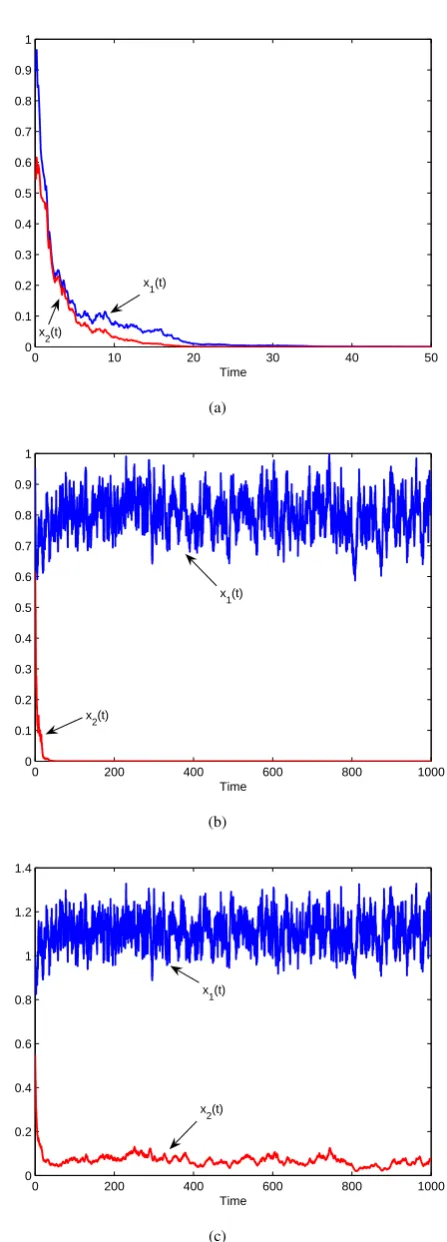
In Fig.1, we choose α211 = 0.2, α212 = 0,α212 = α222 = 0.1. Then according to Theorem 2, the model is stochastically bounded. See Fig.1.
In Fig.2, the values of parameters are the same with these in Fig.1. Then according to Theorem 3, (7) holds. See Fig.2. In Fig.3(a), we choose α221 = 1.4, then by Theorems 4 and 5, bothx1 andx2 are extinct. See Fig.3(a). In Fig.3(b),
we choose α221 = 0.4, then in view of Theorems 4 and 5, x1 is weakly persistent in the mean and x2 is extinct. See
Fig.3(b). In Fig.3(c), we chooseα221= 0.04, then according
IAENG International Journal of Applied Mathematics, 46:4, IJAM_46_4_06
to Theorems 4 and 5, bothx1 andx2 are weakly persistent
in the mean. See Fig.3(c). By comparing Fig.1 and Fig.3(a), we can see that the more the random noises, the easier the species go to extinction.
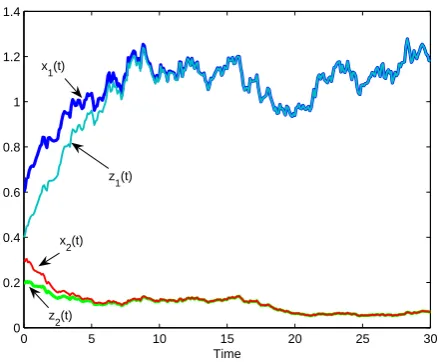
In Fig.4, the values of parameters are the same with these in Fig.1. Then according to Theorem 6, the model is globally asymptotically stable, see Fig.4.
0 200 400 600 800 1000 0
0.2 0.4 0.6 0.8 1 1.2 1.4
Time x1(t)
[image:10.595.323.547.69.691.2]x2(t)
Fig. 1: Trajectories for model (3) with α2
11 = 0.2, α221 = 0, α2
12 = α222 = 0.1. This figure shows that the model is
stochastically bounded.
0 200 400 600 800 1000 −3
−2 −1 0 1 2 3
Time ln x1(t)/ln t
[image:10.595.66.290.161.342.2]ln x2(t)/ln t
Fig. 2: Trajectories for model (3) with α2
11 = 0.2, α221 = 0,α2
12=α222= 0.1. This figure shows that (7) holds.
VII. CONCLUSIONS
In this paper, under the assumptions that r10 and r20
are affected by n independent standard Brownian motions, we have proposed and investigated a stochastic predator-prey populations model in polluted environments. We have established the existence, uniqueness and boundedness of the global positive solution. Sufficient conditions for extinction, non-persistence in the mean, weak persistence in the mean of the predator and prey populations have been established. The threshold between weak persistence in the mean and
0 10 20 30 40 50 0
0.1 0.2 0.3 0.4 0.5 0.6 0.7 0.8 0.9 1
Time x1(t)
x2(t)
(a)
0 200 400 600 800 1000 0
0.1 0.2 0.3 0.4 0.5 0.6 0.7 0.8 0.9 1
Time x1(t)
x2(t)
(b)
0 200 400 600 800 1000 0
0.2 0.4 0.6 0.8 1 1.2 1.4
Time x1(t)
x2(t)
(c)
Fig. 3: Solution of model (3). (a) shows that both x1 and x2 are extinct (α221 = 1.4); (b) shows that x1 is weakly
persistent in the mean and x2 is extinct (α221 = 0.4); (c)
shows that bothx1andx2are weakly persistent in the mean
(α2
21= 0.04).
IAENG International Journal of Applied Mathematics, 46:4, IJAM_46_4_06
[image:10.595.65.290.422.603.2]0 5 10 15 20 25 30 0
0.2 0.4 0.6 0.8 1 1.2 1.4
Time x1(t)
z1(t) x2(t)
[image:11.595.69.289.62.243.2]z2(t)
Fig. 4: Plot of two solution trajectories for model (3) with two sets of initial conditionsx1(0) = 0.6, x2(0) = 0.3 and z1(0) = 0.4, z2(0) = 0.2. This figure shows that model (1)
is globally asymptotically stable.
extinction for each species has been obtained. We have also studied the global asymptotic stability of the solution.
Our results indicate that the random interference of the prey populations x1 is neither conducive to the survival of x1 nor unfavorable tox2. However the random interference
of the predator populations x2 is only not conducive to the
survival of x2.
Our Theorems give some important and interesting bio-logical meanings. From Theorem 5 one can observe that if the two species have the same concentration of toxicant in the body, the ability for x1 to resist the toxicant is
stronger than that ofx2. Theorem 5 shows that if the average
growth rate r10 −r11⟨C0(t)⟩ of prey populations is less
than certain negative value for sufficiently large t, then both predator and prey populations are going to extinction. If the
average natural mortality rater20+ 0.5
n ∑
i=1
α22i+r21⟨C0(t)⟩
of predator populations is larger than the maximum num-ber of average ingestion rate of prey populations [r10 −
0.5
n ∑
i=1
α21i −r11⟨C0⟩]/a11, then predator populations are
going to extinction. Our results also reveal that the more the random noises, the easier the species go to extinction. So in order to conserve biological diversity, we have the following solutions:
(i) To reduce the intensity of the the random noises. (ii) To reduce the number of the random noises. (ii) To reduce the input of the toxicant.
Some interesting problems deserve further investigation. In Theorem 2 and Theorem 7, the conditions have some limitations on aij. It is interesting to study whether these
conditions can be dropped. It is also of interest to investigate other multi-species systems (see e.g. [37], [38]).
REFERENCES
[1] T. G. Hallam, C. E. Clark and R. R. Lassider, “Effects of toxicant on population: a qualitative approach I. Equilibrium environmental exposure,”Ecological Modelling, vol. 8, no.3, pp. 291-304, 1983.
[2] T. G. Hallam, C. E. Clark and G. S. Jordan, “Effects of toxicant on population: a qualitative approach II. First Order Kinetics,”Journal of Mathematical Biology, vol. 109, no. 1, pp. 411-429, 1983.
[3] T. G. Hallam and J. L. Deluna, “Effects of toxicant on populations: a qualitative approach III. Environmental and food chain pathways,”
Journal of Theoretical Biology, vol. 109, no. 3, pp. 411-429, 1984. [4] T. G. Hallam and Z. Ma, “Persistence in population models with
demographic fluctuations,”Journal of Mathematical Biology, vol. 24, no. 3, pp. 327-339, 1986.
[5] Z. Ma. B. Song and T. G. Hallam, “The threshold of survival for systems in a fluctuating environment,”Bulletin of Mathematical Biology, vol. 51, no. 3, pp. 311-323, 1989.
[6] Z. Ma, G. Cui and W. Wang, “Persistence and extinction of a population in a polluted environment,”Mathematical Biosciences, vol. 101, no. 1, pp. 75-97, 1990.
[7] H. I. Freedman and J. B. Shukla, “Models for the effect of toxicant in single-species and predator-prey systems,”Journal of Mathematical Biology, vol. 30, no. 1, pp. 15-30, 1991.
[8] W. Wang and Z. Ma, “Permanence of populations in a polluted environment,”Mathematical Biosciences, vol. 122, no. 2, pp. 235-248, 1994.
[9] B. Buonomo, A. D. Liddo and I. Sgura, “A diffusive-convective model for the dynamics of population-toxicant intentions: Some analytical and numerical results,”Mathematical Biosciences, vol. 157, no. 2, pp. 37-64, 1999.
[10] P. D. N. Srinivasu, “Control of environmental pollution to conserve a population,”Nonlinear Analysis: Real World Applications, vol. 3, no. 3, pp. 397-411, 2002.
[11] J.He and K.Wang, “The survival analysis for a population in a polluted environment,”Nonlinear Analysis: Real World Applications, vol. 10, no. 3, pp. 1555–1571, 2009.
[12] H. Liu and Z. Ma, “The threshold of survival for system of two species in a polluted environment,”Journal of Mathematical Biology, vol. 30, no. 1, pp. 49-51, 1991.
[13] Z. Ma, W. Zong and Z. Luo, “The thresholds of survival for an n-dimensional food chain model in a polluted environment,”Journal of Mathematical Analysis and Applications, vol. 210, no. 2, pp. 440-458, 1997.
[14] J. Pan, Z. Jin and Z. Ma, “Thresholds of survival for an n-dimensional Volterra mutualistic system in a polluted environment,” Journal of Mathematical Analysis and Applications, vol. 252, no. 2, pp. 519-531, 2000.
[15] B. Liu, L. Chen and Y. Zhang, “The effects of impulsive toxicant input on a population in a polluted environment,”Journal of Biological Systems, vol. 11, no. 3, pp. 265-274, 2003.
[16] B. Liu, Z. Teng and L. Chen, “The effects of impulsive toxicant input on two-species Lotka-Volterra competition system,”International Journal of Information & Systems Sciences, vol. 1, no. 2, pp. 207-220, 2005.
[17] J. Jiao, W. Long and L.Chen, “A single stage-structured population model with mature individuals in a polluted environment and pulse input of environmental toxin,”Nonlinear Analysis: Real World Applications, vol. 10, no. 5, pp. 3073-3081, 2009.
[18] Z. Li and F. Chen, “Extinction in periodic competitive stage-structured Lotka-Volterra model with the effects of toxic substances,”Journal of Computational and Applied Mathematics, vol. 231, no. 1, pp. 143-153, 2009.
[19] R. M. May, Stability and Complexity in Model Ecosystems, USA: Princeton University Press, 2001.
[20] M.Liu and K.Wang, “Dynamics of a non-autonomous stochastic Gilpin-Ayala model,”Journal of Applied Mathematics and Computing, vol. 43, no. 1-2, pp. 351-368, 2013.
[21] T.C.Gard, “Stochastic models for toxicant-stressed populations,” Bul-letin of Mathematical Biology, vol. 54, no. 5, pp. 827–837, 1992. [22] M.Liu and K.Wang, “Survival analysis of stochastic single-species
population models in polluted environments,” Ecological Modelling, vol. 220, no. 9, pp. 1347-1357, 2009.
[23] M.Liu and K.Wang, “Persistence and extinction of a stochastic single-specie model under regime switching in a polluted environment,”
Journal of Theoretical Biology, vol. 264, no. 3, pp. 934–944, 2010. [24] K.Wang,Stochastic Models in Biomathematics, Beijing: Science Press,
2010.
[25] M.Liu, K.Wang and Q.Wu, “Survival analysis of stochastic competitive models in a polluted environment and stochastic competitive exclusion principle,”Bulletin of Mathematical Biology, vol. 73, no. 9, pp. 1969-2012, 2011.
[26] M.Liu and K.Wang, “Survival analysis of a stochastic cooperation system in a polluted environment,”Journal of Biological Systems, vol. 19, no. 2, pp. 183-204, 2011.
IAENG International Journal of Applied Mathematics, 46:4, IJAM_46_4_06
[27] M.Liu and K.Wang, “Persistence and extinction of a single-species population system in a polluted environment with random perturbations and impulsive toxicant input,”Chaos, Solitons & Fractals, vol. 45, no. 12, pp. 1541-1550, 2012.
[28] M.Liu and K.Wang, “Dynamics of a non-autonomous stochastic Gilpin-Ayala model,”Journal of Applied Mathematics and Computing, vol. 43, no. 1-2, pp. 351-368, 2013.
[29] Z.Geng and M.Liu, “Analysis of stochastic Gilpin-Ayala model in polluted environments,”IAENG International Journal of Applied Math-ematics, vol. 45, no. 2, pp. 128-137, 2015.
[30] X.R.Mao, G.Marion and E.Renshaw, “Environmental Brownian noise suppresses explosions in populations dynamics,”Stochastic Processes and their Applications, vol. 97, no. 1, pp. 95-110, 2002.
[31] S.Peng and X.Zhu, “Necessary and sufficient condition for comparison theorem of 1-dimensional stochastic differential equations,”Stochastic Processes and their Applications, vol. 116, pp. 370-380, 2006. [32] C.Ji, D.Jiang and N.Shi, ‘Analysis of a predator-prey model with
modified Leslie-Gower and Holling-type II schemes with stochastic perturbation,”Journal of Mathematical Analysis and Applications, vol. 359, pp. 482-498, 2009.
[33] I.Karatzas and S.E.Shreve,Brownian Motion and Stochastic Calculus, Berlin: Springer-Verlag, 1991.
[34] I.Barbalat, “Systems dequations differentielles d’osci d’oscillations nonlineaires,”Revue Roumaine de Mathematiques Pures et Appliquees, vol. 4, no. 2, pp. 267–270, 1959.
[35] D.J.Higham, “An algorithmic introduction to numerical simulation of stochastic differential equations.”SIAM Review, vol. 43, no. 3, pp. 525– 546, 2001.
[36] F.H.Shekarabi, M. Khodabin and K. Maleknejad, “The Petrov-Galerkin method for numerical solution of stochastic Volterra integral equations”,
IAENG International Journal of Applied Mathematics, vol. 44, no. 4, pp. 170-176, 2014.
[37] D. Jana, S. Chakraborty and N. Bairagi, “Stability, nonlinear oscil-lations and bifurcation in a delay-induced predator-prey system with harvesting,”Engineering Letters, vol. 20, no. 3, pp. 238-246, 2013. [38] M.Deng, “Analysis of a stochastic competitive model with regime
switching,”IAENG International Journal of Applied Mathematics, vol. 45, no. 4, pp. 373-382, 2015.