
Collaborative Ad-hoc Applications
Paul O Connell BA BAI
A dissertation submitted to the University of Dublin, in partial fulfilment of the requirements for the degree of
Master of Science in Computer Science
Declaration
I declare that the work described in this dissertation is, except where otherwise stated, entirely my own work and has not been submitted as an exercise for a degree at this or any other university.
Signed: ___________________ Paul O Connell
Permission to lend and/or copy
I agree that Trinity College Library may lend or copy this dissertation upon request.
Signed: ___________________ Paul O Connell
Abstract
The proliferation of mobile hand-held devises and the development of ad-hoc networking technologies has opened the possibility for users of these devises to partake in collaborative applications with other mobile users. The sharing of resources and information within these groups will maximise the experience for all group members. This will require a user of the system to grant access to local resources to other users, some of whom may be semi or completely unknown. The major issue that affects the user of the collaborative ad-hoc application is how can they grant access to a user who is completely unknown to them.
People are able interact with others who are semi or completely unknown to them in many every day situations, the extent to which they interact is governed by the concept of trust. Trust is a complicated model that allows people to balance the risk of the unknown against the perceived benefits of interaction. The aim of this dissertation is to investigate if a model for trust production can be integrated into a computer access control mechanism to manage interaction with anonymous users.
A mechanism will be developed that will produce a trust value for any user based on the details of previous interactions between the two or recommendations. An dynamic trust-based access control system, which binds minimum trust levels to access right will then be used to verify if an unknown user is trusted enough to gain access to the users resources. A blackjack card game that uses a trust-based access control system to assign roles to users was implemented in java, JINI technology was used to distribute the application.
Acknowledgements
Table of Contents
1 INTRODUCTION... 1
1.1 INTRODUCTION... 1
1.2 PROPOSED SOLUTION... 2
1.3 AIMS... 2
1.4 ROADMAP... 3
1.5 SUMMARY... 3
2 LITERATURE REVIEW... 4
2.1 INTRODUCTION... 4
2.1.1 Overview ... 4
2.2 TRADITIONAL SECURITY APPROACHES... 4
2.2.1 Access Control... 5
2.2.2 Authentication Processes... 8
2.2.3 Summary ... 10
2.3 TRUST MANAGEMENT SYSTEMS... 10
2.3.1 PolicyMaker... 11
2.3.2 KeyNote ... 12
2.3.3 Summary ... 13
2.4 TRUST... 13
2.4.1 Introduction ... 14
2.4.2 Properties and Operations ... 15
2.4.3 A Framework for Trust ... 16
2.4.4 Trust Values... 18
2.4.5 Summary ... 19
2.5 REPUTATION... 19
2.5.1 Recommendations... 19
2.7 CONCLUSION... 20
3 DESIGN... 21
3.0.1 Terminology... 21
3.1 GENERAL OVERVIEW... 21
3.2.1 Service Discovery and Connection Process ... 23
3.2.2 The Request Process ... 23
3.2.3 Voting Process... 23
3.2.4 Trust-based Access Control Process ... 24
3.2.5 Group formation process... 24
3.3 DESIGN OF SYSTEM COMPONENTS... 24
3.3.1 Join Protocol Design ... 25
3.3.2 Trust-Based Access Control System Design... 26
3.3.3 GUI and Group Interaction Design... 31
3.4 SUMMARY... 33
4 IMPLEMENTATION... 34
4.1 TECHNOLOGIES... 34
4.1.1 JINI ... 34
4.1.2 XML ... 35
4.2 FRAMEWORK INTERFACE IMPLEMENTATION... 36
4.2.1 The Join Protocol Implementation ... 37
4.2.2 Graphical User Interface Implementation ... 39
4.2.3 Trust Management Interfaces... 40
4.3 TRUST BASED ACCESS CONTROL SYSTEM IMPLEMENTATION... 41
4.3.1 Dynamic Access Control Policy Object... 41
4.3.2 Trust Result Object ... 43
4.3.3 Client Trust System Implementation... 43
4.4 SAMPLE APPLICATION IMPLEMENTATION... 44
4.4.1 Trust-Based Access Control ... 45
4.4.2 Blackjack Group Formation... 46
5 EVALUATION... 50
5.1 EVALUATION OF FRAMEWORK... 50
5.1.1 The Join Protocol ... 50
5.1.2 TrustManagementInterface ... 51
5.1.3 ServiceManagerInterface ... 51
5.1.4 GUIInterface... 51
5.2.1 Trust-Based Access Control Results... 52
5.3 SUMMARY... 54
6 CONCLUSIONS ... 55
6.1 DISSERTATION REVIEW... 55
6.2 FUTURE WORK... 56
6.3 APPLICATION OF TRUST BASED ACCESS CONTROL... 56
6.3.1 Intelligent doors... 56
6.4 SUMMARY... 57
7 BIBLIOGRAPHY ... 58
8 APPENDIX ... 60
Table of Figures
FIGURE 1: AUTHORISATION PROCESS OVERVIEW... ... 5
FIGURE 2: X.509 CERTIFICATION AUTHORITY HIERARCHY... ... 8
FIGURE 3: RELATED TRUST CATEGORIES... ... 18
FIGURE 4: HIGH-LEVEL OVERVIEW OF THE MAIN PROCESSES... .. 22
FIGURE 5: THE JOIN PROTOCOL... ... ... 25
FIGURE 6: TRUST-BASED ACCESS CONTROL SYSTEM... ... 27
FIGURE 7: ACCESSING THE ROLE SPECIFIC GUI ... ... 32
FIGURE 8: IMPLEMENTATION OVERVIEW... ... 37
FIGURE 9: TMPERMISSION OBJECT... ... ... 42
FIGURE 10: TMPERMISSION VERIFYUSER() SEUDO CODE... ... 42
FIGURE 11: GENERIC ACCESS CONTROL POLICY STATEMENT [ XML FORMAT ] ... 43
FIGURE 12: TRUST RESULT XML FORMAT. ... ... 43
FIGURE 13: TRUST SYSTEM IMPLEMENTATION OVERVIEW... .... 44
FIGURE 14: BLACKJACK GROUP FORMATION OVERVIEW... ... 47
FIGURE 15: GENERIC ACCESS CONTROL STATEMENT FOR THE PLAYER ROLE... 53
FIGURE 16: THE CHANGE IN A USERS TRUST VALUE OVER A NUMBER OF SEESIONS... 54
[image:9.595.93.506.109.410.2]1 Introduction
1.1 Introduction
The information revolution has redefined the way we communicate, conduct business and disseminate knowledge. The proliferation of mobile devises and networking technologies over this period has made it easier for users of these devises to interact and share information. The technology now exists that will allow users of these mobile devices, to form into collaborative ad-hoc groups [Jensen]. Group working allows users to share knowledge, pool resources and achieve results quicker than by individual processing. The synergy achieved by group applications is possible because users of the group are prepared to share and contribute resources and information.
In traditional groupware applications access to group is control by a predefined list of members managed by an administrator. The members of the group are prepared to share their resources because they trust that the administrator of the group has already established a level of trustworthiness in the users in places in the groups access list. The key requirement for the success of the groupware application is that all the users “trust” the administrator to verify members for access. This access control system is based on the assumption that a member trusts the administrator to verify that all existing group members will behave correctly when granted access to the member’s local resources.
1.2 Proposed Solution
People use trust relationships to determine how to interact with known and unknown user every day. It enables to cooperation between people, provides a mechanism for lowering access barriers and enables complex transactions between groups of users. Without trust there would be a loss of efficiency and dynamism. Marsh quotes Golembiewski and McConkie in his thesis “Perhaps there is no single variable which so thoroughly influences interpersonal and group behaviour as does trust ” [Marsh].
Collaborative ad-hoc applications extend on groupware applications, but do not require an administrator to manage who can access the group. This new application type allows members to join groups in an ad-hoc dynamic manner. The lack of any administrator means the members of the group must manage access to the group by themselves. The members cannot rely on any third party to verify the trustworthiness of a user. The user of the collaborative ad-hoc application needs to take control of the trust formation process. The users must be provided with a mechanism that will allow them to establish a trust value for users. In order to establish a strategy for interaction with a user who’s intent is unknown, the user needs to able to answer the question “Why do I trust this user to perform this action? ”.
1.3 Aims
these two steps have been completed, a sample application will be implemented to test the behaviour of the trust model developed.
1.4 Roadmap
Chapter 2 is a literature survey it examines the existing mechanism for computer access control and the concept of trust. Chapter 3 outlines the specification and design of the system framework. Chapter 4 outlines the implementation route and the technologies used in the system. Chapter 5 presents the evaluation of the framework system and discusses the results from the sample application. Chapter 6 gives an evaluation of the thesis and contains concluding remarks on the work carried out for this dissertation. It also discusses the direction of future work in this area. A bibliography and appendix then presented.
1.5 Summary
2 Literature Review
2.1 Introduction
This chapter will introduce the various issues and concepts that are relevant to the design and implementation of the dynamic trust-based access control system. The aim is to identify the shortcomings of existing systems used for access control, and justify why a new system should be developed. The chapter will then examine the concept of trust and examine a framework for the production of trust.
2.1.1 Overview
This literature review is organized as follows. The first section starts by over viewing the operation of authentication and access control mechanisms used in traditional security. The third section discusses the trust management concept, which has been proposed as a solution for access control in large distributed systems, the PolicyMaker and Keynote trust management systems will be introduced. The fourth section introduces the concept of trust and examines the properties and operations that can be applied to it, a framework for trust production is also discussed. The fifth section discusses the use reputation and recommendations. The final section gives an overview of the topics discussed in this review and summaries the key design issues and points that should be apply to the design and implementation of the collaborative ad-hoc application framework and trust-based access control system.
2.2 Traditional Security Approaches
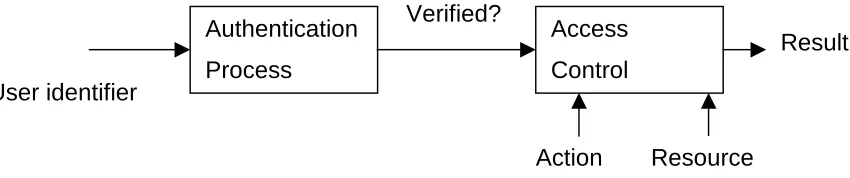
system and then assign them some level of access control to resources within that system. The question that the security system must answer is “ Does a user U have the rights to do action A on resource R? ”. A high-level view of the authorisation process can be seen below.
1. The user presents an identifier to the authentication system to be verified.
2. The access control process then checks to see if the user has access rights to the requested resource.
3. The access control process determines if the users pre-approved actions allow the user to execute the current requested action.
[image:14.595.85.510.352.441.2]4. Access to the resource is granted or denied.
Figure 1: Authorisation Process Overview
This is the basic four-step process that all security systems use. The rest of this section will focus on how the authentication and access control processes have been developed and adapted to handle large-scale distributed systems.
2.2.1 Access Control
Access control systems enforce the policy that the manager of a resource applies to parties that requests access to that resource. The policy is relevant to a specific resource and normally refers to who can have access to the resource and what type of access they can have. The flexibility of the access control mechanism in terms of how it defines who can access the resource and secondarily what actions they can then take is the key to its success.
Authentication Process
Access Control Process User identifier
Action Resource Verified?
Two different access control systems are presented in the following sections. The scalability and flexibility of the Access Control List (ACL) system and the Role Based Access Control (RBAC) system will be examined [Herzberg].
2.2.1.1 Access Control Lists
The most traditional mechanism for access control is the Access Control List. This system binds a user’s identifier directly to the action that the user is approved to perform. The administrator by inserting the binding indicates that he trusts the user to behave correctly in performing the actions.
There are a number of issues associated with the operation of access control lists. The fundamental problem relates to the flexibility of the system. Every time a new user has to be added, or a privilege granted or revoked the administrator has to directly modify the list. The ACL system does not scale well. As the number of user accessing the resource grows the administrator has a greater problem managing the file. When the administrator inserts or modifies a binding into the ACL, a statement is being made about the trustworthiness of the user. The level of trust in the user may change over time, but unless the ACL binding is changed it represent a static trust statement. When a binding is inserted into the ACL, the administrator does not state the reasons why the user is trusted to correctly perform the actions granted.
Access control lists have been used in large-scale distributed systems because the concept is familiar but there are a number of fundamental reasons why they are unsuitable to this type of application.
Access control lists do not scale well. If applied in the ad-hoc application environment where there is potential to interact with a large number of users, maintaining an individual mapping of identities to access rights is impractical.
2.2.1.2 Role Based Access Control
In the role based access control framework users are granted access to roles based on the administrator’s perception of their experience, competence, and the trustworthiness [Kuhn]. Each role in the framework has an associated set of access rights.
The system still directly maps names to roles and has the same limitation of the ACL system in this respect. The major improvement in flexibility for the administrator comes in the management of access rights of roles. When the administrator adds or removes an action right from a role the effect is immediate. He does not have to modify the privileges of every user on an individual basis as in the ACL system. In situation where there are a large number of users all having the same access rights, the role based system is highly efficient when modifications have to be made.
Another benefit of associating roles to access right is that roles tend to have overlapping responsibilities and privileges. This allows roles to inherit the rights of lower roles and create a role hierarchy. This removes the need to specify common actions repeatedly across different roles.
2.2.2 Authentication Processes
The correct identification of the requesting user is a corner stone on which most authorisation systems operate. In a small-scale system it is possible for an administrator to assign a unique identifiers to each user of the system, but this solution does not scale well. As the number users in a system increase the administrator has to assign more identifiers and commits more resources to the management of the authentication system.
Public key cryptography is used in large-scale systems to create a unique key for every user. The system guarantees authentication of a message signed using the system. We will examine two public key encryption based systems that are used for authentication in distributed systems.
2.2.2.1 Distributed Key Management
The scalability problem of having administrators managing their own list of keys lead to the development of a global key management system. The fundamental change that allowed this system to develop was that system administrators accepted a trusted third parties statement that a key belonged to a user. The trust third parties, known as Certificate Authorities (CA) create X.509 certificates, which bind a users details to a public key and includes a reference to the CA. The X.509 key system works on a global scale because it is replicated. A Certification Authority exists in each country. A Master Certification Authority connects each Certification Authority at a higher level. A X.509 certificate works across country borders because a trust chain can be created via the Master CA.
Figure 2: X.509 Certification Authority Hierarchy Master CA
CA1 CA
2 User
X
The trust chain allows a user to authenticate a X.509 certificate because via the trust chain a path can be established to some Certification Authority that has already established a valid binding between the user and there public key. The major fault with the X.509 system is the amount of user detail included in the certificate at each CA is not uniform across the whole system. A low-level CA can bind very detailed information about a user in the X.509 certificate that they give a user, but at a higher-level CA will not capture as detailed information. The Certification Authority is used to form a trust relationship, but it can never be a good enough authority for every one in a large distributed system, its credibility depletes and its recommendations increase in uncertainty as the community grows. The major issue in this system for users is credibility, as a user climbs up the hierarchy pyramid in order to find a common Certification Authority, there is greater reach and less specificity [Khare]. It also assume that every one trusts the certification authority.
2.2.2.2 Pretty Good Privacy
2.2.3 Summary
In this section we have examined the operation of some authentication and access control mechanisms. We have seen that the authorisation process assumes there is some level of trust associated with a user once this process is complete. The problem is that on closer inspection of the two processes involved in authorisation, neither takes responsibility for stating why a user is trusted.
The access control process assumes incorrectly, that if a users identity is verified correctly, then that user is trusted. This is an overuse of the functionality provided by public key cryptography. The public key cryptography system will correctly authenticate a user from a public key, but it does not provide any information that can be used to derive a level of trustworthiness in the user.
The second issue is the inflexibility of existing access control systems. The existing access control systems rely completely on the administrator to configure all new user bindings. This approach is too restrictive in a situation where new bindings will be need regularly.
2.3 Trust Management Systems
The main aim in the development of the trust management system was to produce an off-the-shelf security module that could be integrated into any application. The module allows each application to define application specific policies and credentials.
The notion of a “resource” for which the security system is designed to protect will vary widely across different distributed system. The developers recognised that the system should be able to define what a resource is within their own environment. The next step is to allow the system define access and restriction policies that apply to its resources. Policies and credentials can be modified to reflect changes in the use patterns of the system over time.
The solution that the Trust Management system proposes is to bind a set of specific keys directly to authorisation to perform a specific task, this mapping is known as a credential. The fundamental question that the trust management system now asks is “Does the set C of credentials prove that the request R complies with the local security policy P? ”. The request R, the local policy P and set of credentials C are passed to a trust management engine, which processes the request and outputs a decision whether the request and credentials provided is valid according to the local policy.
The trust management approach advocates the use of a general purpose, application independent algorithm for checking proof of compliance. Applications using the single general-purpose compliance checker in a distributed system can be confident that results from the checker are correct. This reduces the need to have each resource in a distributed system implement its own compliance checker.
2.3.1 PolicyMaker
describing a proposed trusted action. It can return a binary yes/no result or provide additional restrictions that would allow the proposed action possible.
Security policy and credentials are defines in terms of predicates, called filters that are associated with public keys. The PolicyMaker tool processes queries from applications, to determine if the public key is permitted to perform an action according to local policy. PolicyMaker recognises that complete security information may not be available locally, so allows trust to be deferred to trusted third parties which provide additional security information. The actions that the PolicyMaker tool is asked to consider are application specific.
Responsibility for authorisation is split between the PolicyMaker and the calling application, authentication by cryptographic verification of the requester is placed with the calling application. This means that the choice of signature scheme is independent of the choice to use PolicyMaker as the compliance checker. The application is also responsible for ensuring that all the credentials needed to ensure correct compliance of a request are provided in the original query to PolicyMaker [Blaze1, Blaze2].
2.3.2 KeyNote
The KeyNote tool can be considered a successor to PolicyMaker as the basic design principles were continued but extra design goals were specified, which included easier integration for applications and standardisation. KeyNote assigns more responsibility to the trust management engine, making it easier to integrate into applications. It also requires that assertions (policies and credentials) be written in a specific language, so that processing by the compliance checker proceeds more smoothly.
management engines, does not enforce policy directly it only provides advice to applications that call it [Blaze1].
2.3.3 Summary
The Trust Management System attempts to improve on the traditional security system because it rejects the use of name-key binding and pre-complied access-control matrices. The trust management system can be considered more secure because of its ability to integrate into other system means that the development of the security system can be left to experts who can guarantee that the system achieves “proof of compliance”. The risk of simple security holes being left by applications developers is reduced.
The trust management system has addressed the problems of distributed application security, difficult to authenticate users and resource definition. But it still cannot answer the fundamental question “Why is the user trusted to execute this action?”.
2.4 Trust
Trust is an important feature in the decision-making process that humans use every day. The main issue with trust is that there are many different views of it, and this has lead to problems when trying to develop a general definition for trust. There are main reasons for the multiple views of trust but two reasons stand out. First, everybody is an expert on trust, that is to say that everybody has their own brand or idea of what trust is, and how to use it. The second is more straightforward, and simply states that there are many different types of trust, reflecting different situations and contexts.
asked, “Why do you trust this person? ” it will be able to answer stating the parameters and contexts on which it has built its trust assumption about that person.
The next section will present a number of trust definitions used in different fields in an attempt to create a large picture of trust as a concept. The properties and operations that apply to trust will then be presented. A framework for modelling trust will be explained and the discussion on how to quantify trust will then happen.
2.4.1 Introduction
Researchers in a wide range of academic fields have studied a concept of trust. The definitions of trust presented hereafter illustrate the different view of trust. The aim of presenting a number of different definitions of and statements about trust is that each explains a certain aspect of trust, examining them as a group it is hoped will provide us with a more general understanding of trust.
The first definition comes from Morton Deutsch (1962).
1. an individual is presented with an ambiguous path, a path that can lead to an event perceived to be beneficial (Va+) or an event perceived to be harmful (Va-);
2. he perceives that the occurrence of Va+ and Va- is contingent on the behaviour of another person; and
3. he perceives the strength of Va- to be greater than the strength of Va+.
cost/benefit analysis. Different individuals decision to trust will differ with each individuals perception of the estimated cost (Va-) and benefit (Va+) [Marsh].
A second definition is taken from Diego Gambetta (1990).
”Trust is a particular level of the subjective probability with which an agent will perform a particular action, both before [we] can monitor such action and in a context in which it affects [our] own action”.
This definition again re-enforces the subjective nature of trust. The definition also states that trust is affected by actions that we cannot monitor. This means that in a situation where full information is not available, the quality and meaning of the information we can monitor will have a major effect on our level of trust.
Another aspect of trust relates it to the amount of information and risk that situation creates. Reagle states “Trust itself represents an evaluation of information, an analysis that requires decisions about the value of specific information in terms of several factors” [Reagle]. In a situation where full information is not available the likely hood of making an incorrect choice is increased, this leads to risk. Trust has been proposed as a mechanism for the reduction of complexity (risk) in situations. Trust is used to derive further information from the surroundings.
2.4.2 Properties and Operations
The subjective nature of trust is evident in most of the definitions presented in the last section. This property creates the single biggest problem to creating a trust production model for computer models because to parameters used for calculating trust by different people varies widely.
Cathy” is in general, not true. The statement can only be considered true if the following conditions hold.
1. Bob explicitly tells Ann that he trusts Cathy. This is an example of a recommendation.
2. Ann must trust Bob as a recommender. If Ann does not trust Bob as a recommender then she should ignore any information he passes her. 3. Ann must be allowed make a judgement on the quality of Bob’s
recommendation.
A trust statement is a context specific. On order to give a recommendation on the trustworthiness for someone the context in which the recommended trust value will be used is need. The following statement is an example of this “I trust my brother to drive a car, but not to fly a plane”.
2.4.3 A Framework for Trust
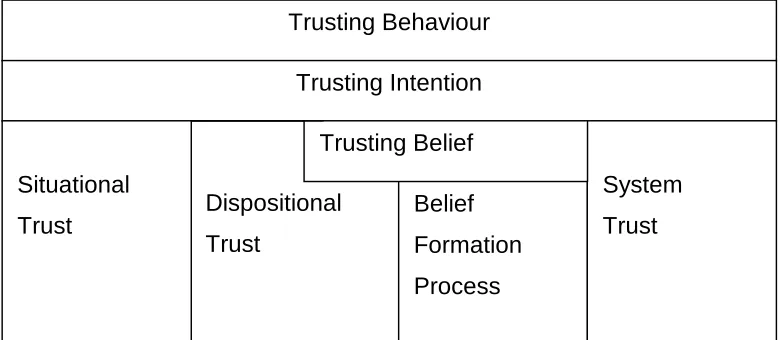
The definitions of trust that have been presented above have failed to converge and provide us with a single generic definition. Although the concept and operations of trust are well understood a framework for quantifying trust is need so that unambiguous conversation can occur. McKnight and Chervany in their working paper “The meaning of trust” [McKnight] presents a framework that classifies different aspects of trust and provides a system which shows how trust can influence behaviour.
System Trust
The extent to which, one believes that the proper impersonal structures are in place to enable one to anticipate a successful future endeavour. System trust reflects that safeguards are in place to reduce the amount of risk that user has to expose themselves too. These safeguards may be in the form of regulations, guarantees or stabilising intermediaries.
The extent to which, a person consistently trusts across a broad spectrum of situations and parties. This is an example of a cross-situational cross-personal construct. It is a general intention by a person to believe that people will behave in a certain manner and is valid over a broad spectrum of situations. This value reflects whether an individual is optimistic or pessimistic in their approach to new situations [Swarup].
Situational Trust
The extent to which, one intends to depend on another in a non-specific party in a given situation. It means that one has formed an intention to trust every time a particular situation arises, irrespective of one’s beliefs about the attributes of the other party in a situation. It
Trusting Belief
The extent to which, one party believes that another party is willing and able to act in the trusting party’s best interest. The attributes that affect the trusting belief in another include benevolence, honesty, competence and predictability. Assessing these attributes to form a belief is inherently subjective process.
Belief Formation Process
Is the process by which information and experience gathered from the environment is processed to from new trusting beliefs about parties.
Trusting Intention
The extent to which one party is willing to depend on another party in a given situation with the feeling of relative security even though negative consequences are possible. A trusting intention implies the entity has made a decision about the various risk and benefits of allow this trust
Trusting Behaviour
possible. This construct effectively describes the “act” of trusting and implies the acceptance of risk [Povey].
Figure 3: Related Trust Categories
2.4.4 Trust Values
Trust has no measurable units, but its value can be measured. Trust can therefore considered as a commodity like information or knowledge. There are problems using explicit values to represent trust because since trust is subjective the same value of trust may be associated with different levels of trust by different entities.
The use of continues values to model trust reflect the continuous nature of trust, allows for easy implementation and allows for comparison of different trust frameworks. The continuous value still leaves the problem of subjectivity for receiver of the trust information, if the framework and parameters on which the trust value is calculated is not understood.
Marsh in this thesis represents trust as a continuous variable over a range scale [-1,+1]. Marsh states that trust can have threshold values, which vary between people and situations. A person will have a positive threshold value,
Trusting Behaviour Trusting Intention
Dispositional Trust
Belief Formation Process
System Trust Trusting Belief
above which that trust another, and a negative threshold value, below which they will not trust a person.
2.4.5 Summary
The creation of six trust definitions has cleared the conceptual confusion by representing trust as a broad but coherent set of constructs. The definition of these trust types is very beneficial, it will enable parties that apply and exchange trust information to agree on what they mean, when they process trust values. Using the framework to identify the parameters on which trust is based allows the users to be specific about out trust statements. This avoids the problems associate with trust being subjective, non-transitive and context specific.
2.5 Reputation
The last section explained that a framework for trust production can produce a trust value based on the information about the users surrounding and situation. In a situation where it is not possible to gather enough information to produce a trust value about a user, it is possible to seek out the users reputation from a trust third party. This section will examine the use of reputation and recommendations.
2.5.1 Recommendations
Alfarez Adbul-Rahman et al [Abdul 1, Abdul2] discusses a decentralised trust management system based on the use of recommendations between agents in a distributed system. The concept of “social control” is used to implement a soft security approach in an open system. It is up to the good actors to identify ‘cheaters’ and propagate this information around the system.
decision specific information relating to aspects of the situation must be available. They introduce the concept of a “trust category” to represent the aspect or context in which trust is evaluated. “Trust values” are then used within each category to further distinguish different levels or amounts of trust. The system captures an agents reputation as concatenation of the name, trust category and value.
Reputation = [ Name, Trust Category, Trust Value ]
A person wishing to establish another person’s reputation sends a Recommendation Request Message to a trusted recommender. They receive a Recommendation Message back that contains a reputation.
The work in this paper is beneficial because it clarifies the protocol that is need between parties trying to exchange reputation information. It also highlights the processing that the receiver of a recommendation must do in order to extract the correct information form it. The work carried out in these papers explains how recommendation can be used and manipulated to increase the level of trust information in a distributed group but it does not attempt to explain how trust is initially produced by any of parties in the group.
2.7 Conclusion
3 Design
The aim of this dissertation is to develop and implement a dynamic trust-based access control system for the collaborative ad-hoc application environment. The aim can be split into two main task, the first is the design of a trust-based access control system for the collaborative ad-hoc application environment and the second is the design of the application framework.
The chapter will begin by giving a general overview of the collaborative ad-hoc application environment. This will identify the major processes. The requirements of each process will then be discussed. Finally the design of the components that provide the required functionality will be presented.
3.0.1 Terminology
A number of terms will be used extensively throughout this chapter to refer to the various entities. This section will explain what is meant by each of these terms. The user is the person who uses the collaborative ad-hoc system. The client refers to the computer software that is installed on the users mobile devise. The application means the software system that has collaborative ad-hoc functionality. The group refers to the members of the collaborative group.
3.1 General Overview
. 22
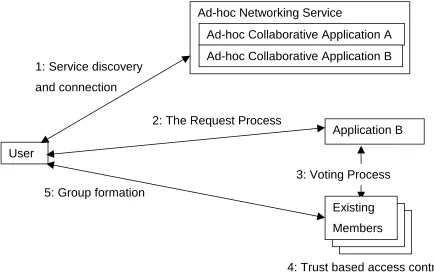
When the user is connected to the network the names and details of any ad-hoc collaborative applications that are available on that network are displayed to the client on their device. The user then selects a specific application and communicates directly with that application. This service discovery and download is shown as step 1 in figure 4. The arrows show which entities are involved at each step.
[image:31.595.89.523.415.689.2]Having discovered what roles are available for users within the application the user attempts to join the group by making a request to the application (step 2). The application will contact all existing group members and asks them if they approve the new users request to join (step 3). The individual members process the request based on the trustworthiness of the user (step 4) and return their result to the manager. The requesting user is granted or denied membership of the group based on the result of the vote. The approved user then joins the group and takes part in the collaborative application (step 5).
Figure 4: High-level overview of the main processes
5: Group formation
Ad-hoc Networking Service
Ad-hoc Collaborative Application A Ad-hoc Collaborative Application B
Application B User
1: Service discovery and connection
2: The Request Process
Existing Members 3: Voting Process Process
3.2 Requirements
The last section introduced the five major process involved in the collaborative ad-hoc application. This section examines each of these processes in more detail; the focus is to identify the requirements of each process.
3.2.1 Service Discovery and Connection Process
This process allows the client to get a list of all collaborative ad-hoc applications. This information is displayed to the user who selects which application they wish to join. The client will download a proxy that allows it to communicate with the application and initiate the join process. The technical issues associated with application discovery and proxy download are handled by the JINI Discovery and Join protocols [Sun].
3.2.2 The Request Process
The client will use this process to request the application for membership of a group. The process allows the client to make a request to the application to join the group in a particular role. The application will confirm or reject the users request to join the group in that role. If the user is successful in their request to join the group they will then register officially with the application an be included in future voting processes. The user will typically be interested in joining the group in the role with most access rights, to facilitate this the client is allowed to make multiple requests to join the group. When the application receives a request from a client to join the group in a particular role it will initiate the voting process.
3.2.3 Voting Process
are a number of different voting policies that the application can implement. Unanimous voting and majority voting are two examples of different voting policies. A unanimous voting policy requires every group member to agree on the decision. A majority policy only requires that more than half of the group to agree. At the end of a vote the requesting client is informed of the decision and so is the group. This allows a user to leave the group if they do not agree with the result. This happens when the user rejects a request to join but the overall group decides to approve the request. This provides a back-out mechanism.
3.2.4 Trust-based Access Control Process
This process is responsible for using trust to making the decision whether to accept or reject a request to join the group. The operation of this process is the main focus of attention for this dissertation. The process is executed every time the application looks for verification of a request to join the group. The client is passed the requesting users identifier and role the client must accept or reject the request. The process will calculate the requesters trust value and decide based on the local policy whether the user is trusted enough to join.
3.2.5 Group formation process
If the user is successful in there request to join the group they will be given a graphical user interface which provides all the functionality needed for the application. The application will decide how the group members will communicate. All communication between the group may be multicast or members may unicast to each other.
3.3 Design of system components
requirements identified in the last section have been integrated into the design of the components. The next section 3.3.1 discusses the design of the join protocol that allows users to form into, manage and exit groups. In the following section 3.3.2 the trust based access control design is presented. Section 3.3.3 handles the design of the components involved in the group formation and interaction.
3.3.1 Join Protocol Design
[image:34.595.123.529.469.658.2]The request and voting processes both involve interaction between the client and application, it makes there for to combine the requirements of both in the design of the join protocol. The join protocol allows users in the system to form into collaborative groups. The protocol is designed so that every member of the group gets to verify the new user and can back-out of the group at any stage. This ensures that each member has accepted the risk of letting the new user join. The protocol allows a decentralised group decision to be made on the request by a user to join. The identities of the group members are hidden from the requesting user.
Figure 5: The Join Protocol Client
Join Manager
Existing Members 4
5
3 6 2
1
Legend:
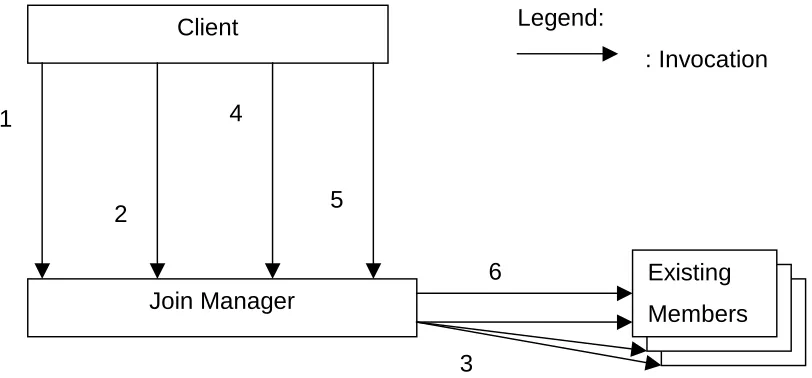
Once the user has selected an application and downloaded a service proxy, the join protocol will be initiated. The protocol involves six steps, which are labelled in figure 5 and explained below.
1. Get Roles: The client gets a list of possible roles that the application supports.
2. Request to join: The client requests to join the group in the highest role. The client will pass an identifier and the requesting role to the join manager.
3. Verify User: When the join manager receives a “request to join” from a client it will start the voting process. Each member of the group will be asked to verify the right of the user to join the group in the requested role. At the end of the vote, the application manager will inform the user of the result. If there is no group the user becomes the first member of a new group.
4. Verify Group: When the user’s request to join is accepted by the group, the client verifies the existing members. The client gets the identifiers and current roles of the existing group members. The client verifies the roles held by the existing members of the group to confirm that they pass the users own access policy. This is to ensure that there is no member of the group in a role that the client does not agree with. If the client’s request to join is rejected, they can attempt to join in a lower role.
5. Officially Join: When the user has verified the existing membership it will then officially request to join the group.
6. Inform All: All members of the group are informed that a new user has been granted access. Members can this opportunity to exit the group If they disagree with the result of the vote.
3.3.2 Trust-Based Access Control System Design
. 27
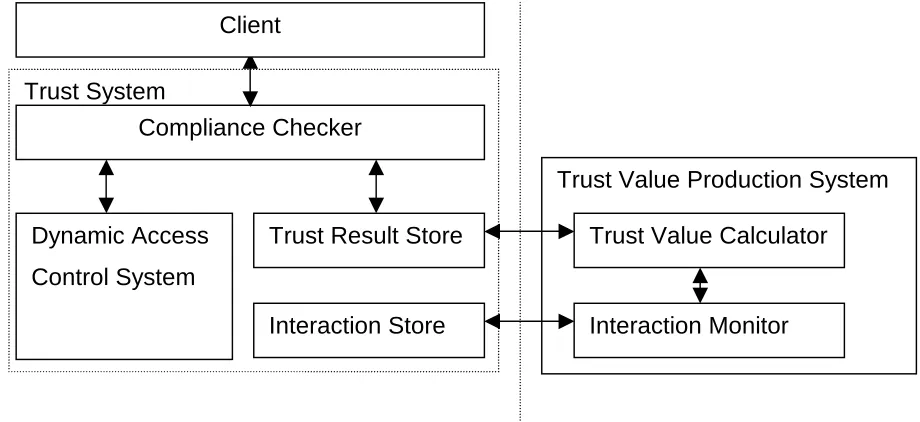
[image:36.595.82.542.149.360.2]support components to gather information, manage policies and product trust values. An overview of the system is shown in figure 6 and the design of these components is presented in this section.
Figure 6: Trust-Based Access Control System
3.3.2.1 Compliance Checker
When a client has joined a group they are expected to verify the requesting users has the rights to join the group in a specific role. The compliance checker is passed the users name and requested role and will inform the client that the request should be accepted or rejected. The compliance breaks does this in three broad steps.
1. The compliance checker gathers the access control statements that are relevant to the requesting user.
2. The checker calculates the users trust value.
3. The users trust value and requested role are compared to the access policies. If the values agree with any of access policies the client is informed to accept the users request.
Trust System
Trust Value Production System Dynamic Access
Control System
Interaction Monitor Trust Value Calculator Trust Result Store
Compliance Checker
Interaction Store
Implemented by Client Designer Implemented by the Application Designer
3.3.2.2 Dynamic Access Control System
The manageability of any access control system was identified in the literature review as being inversely related to the flexibility of the bindings used within the system, the more flexible the policy the easier it is to manage the system. We have seen that the access control list system is neither flexible nor scaleable because it binds the user’s identity directly to the right to access resources. The role based access control system has poor scalability because it still requires one policy per user but it is more flexible because it binds the user’s identity to a role this allows for easier management of the access rights per role.
The access control design used in this system achieves the requirement of dynamic access by binding a minimum trust value to the right to access a role. The statement reads, “If a user U has a trust value greater than X, then they can access role R”. By binding a trust value to the right to access a resource, one statement will apply to every potential user. This means the role owner only has to define an access statement for every resource and not every user, this greatly reduces the number of policies the user has to initially write. The access control statements are designed to assign roles because it is easier to manage resource access for large groups this way.
The user will potentially be interacting in many different collaborative applications. A single access control statement format will apply across all applications so the name of the application to which the policy applies must be included in the statement. The user can also create a specific access control statement for a specific user by including the user’s identifier in the statement. This allows the user to promote a user to a role that they would not be assigned by the general access policies.
The trust-based access control statement is must contain five piece of information.
• The identifier of the user to which the policy applies.
• The condition that must be met by the users trust value for the policy to be true.
• The trust value threshold for the policy.
• The name of the role the user will be approved for if trust value meets the condition applied.
3.3.2.3 Trust Value Production System
The trust value production system is responsible for gathering information on the interactions with other users and producing trust values for the user about those people. The trust values created by each application are context (application) specific. Therefore it is the responsibility of the application designer to develop this component. The system has two sub-components, they are the interaction monitor and trust calculator.
3.3.2.3.1 Interaction Monitor
The interaction monitor gathers and saves information about the user’s interaction with other users in the group. This information is used later by the trust calculator to produce trust values on each user. The application designers select what parameters of the interaction to monitor. The interaction monitor saves and updates the details of the user’s interactions on the user disk, the format in which this information is stored is proprietary.
3.3.2.3.2 Trust Calculator
The calculator will allow the user to customise the algorithm by changing the scaling factors used on the different parameters. This acknowledges the subjective nature of trust in that different users will rank different parameters as the most important.
The trust calculator would typically use linear equations when processing the interaction details and producing the trust result. The use of linear equations means mistakes in the calculator can be spotted and corrected easily. Users can also grasp the concept of a trust value increasing or decreasing on a linear scale as the monitored value changes.
The trust-value produced by the calculator is design to be within the range zero to one. It reflects that trust is a probability that a user will behave as expected, the higher the trust-value the more likely it is that the user will behave correctly. The trust value becomes asymptotic as it approaches one and zero, this reflects that you can never completely trust or distrust a user. The use of this range means the scaling of recommendation value is still within the range.
3.3.2.4 Trust results
When the trust calculator is executed at the end of the user’s session it will save the trust values in a generic trust result on the users device. The trust result will contain the application name, which calculated the trust value. The need to identify which application produced the trust value arises because a user may interact with another user in many different contexts. The trust values produced from any two applications have completely different meaning because they are based on different parameters and produced by different calculators. This allows the compliance checker to identify the correct trust result where there are multiple trust results for the same user.
ago the user should not believe that the user is still as trustworthy. The trust result must include four pieces of information.
• The name of the application to which the result applies. • The name of the user to which the trust-value relates. • The calculated trust value.
• The date on which the trust-value was calculated.
3.3.2.5 Trust System
The trust result store and interaction store allow the trust value production system to save and access the details on the client device. When the compliance checker and dynamic access control system are included, these four components are known as the client trust system.
3.3.3 GUI and Group Interaction Design
Once the collaborative group has formed the users will download a graphical user interface. The GUI is role specific and provides the trust-value production system to the client. The application designer will decide what communication mechanism is needed between the users of group.
3.3.3.1 GUI Design
. 32
must be downloaded every time. As mobile networking technology gets faster the delay in downloading the code will become less noticeable.
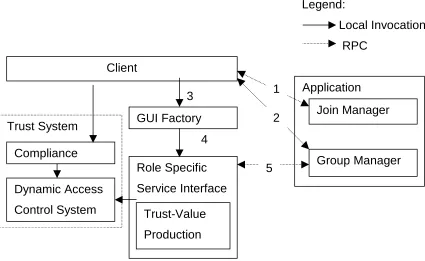
The steps involved in accessing the GUI are shown in Figure 7.
1. The client completes the join protocol and has been given a reference to the group manager.
2. The client calls on the group manager to provide a GUI object. The client downloads the GUI Factory.
3. The client makes a call to the GUI Factory passing the user’s role, a reference to the local trust system and a reference to the remote group manager.
4. The GUI Factory produces a role specific GUI for the user. When the GUI is initialised, the trust-value production system connects to the trust system. The interaction and trust result details are accessed and updated.
[image:41.595.87.512.443.704.2]5. The role specific GUI will contact the group manager.
Figure 7: Accessing the Role Specific GUI Trust System Client Application Join Manager Group Manager Role Specific Service Interface Trust-Value Production System Compliance checker Dynamic Access Control System Legend: Local Invocation RPC 4 5 3
GUI Factory 2
The application is designed to have to two management components they are the join and group manager. The functionality of the join manager does not change across different application, so designing a reusable component makes sense. The group manager provides the application specific services and so must be design from scratch for every new application.
3.3.3.2 Group Interaction
The last section described now the system is designed to allow the client to access a role specific GUI with the trust production system. This section describes now the GUI can communicate with others in the group. The application designer determines the requirement for communication between the clients. The client GUI is given a reference to the group manager when it is initialised; this allows the client GUI access to the centralised group manager. The group manager now has a reference to every client GUI and can decide how to manage this.
3.4 Summary
4 Implementation
This chapter describes the implementation of the collaborative ad-hoc application framework and a sample application. Chapter 3 described the design of the various components and in the majority of cases the programming task was fairly simple. In this chapter, the implementation of the components is described as well as some of the issues that were encountered during the implementation process.
The chapter will first introduce the technologies used in the implementation. The next section gives a high level overview and explains the interfaces that make up the framework in some detail. The last section describes the implementation of the sample application.
4.1 Technologies
The Java programming language is used for the implementation of all components in this system, it assumed that the reader is familiar with the object-oriented nature of this language. The implementation used two specialised technologies for certain components. This section gives a short introduction to both.
4.1.1 JINI
The key concept in the within the JINI architecture is that of a service. A service can be downloaded and used by any entity in the federated group. Systems provide services to the federation by publishing them on a lookup service. The lookup service is central bootstrapping service and provides the central point of contact between the system and its users. The service is added to the lookup service by a pair of protocols known as the Discovery and Join Protocol [Sun].
The users of the JINI system contact the lookup service and download the service they require. All communication with the JINI architecture uses Java Remote Method Invocation (RMI), this allows data and code to be transferred around the network between objects. The JINI architecture assumes that network for connecting devices and services is available, and that each device has a Java virtual Machine installed. For more information on JINI see Appendix 8.1. The design chapter introduced the Join Protocol used in the collaborative ad-hoc application this is in no way related to the JINI Join Protocol.
4.1.2 XML
In the design of the access control system the saving of access control policies, trust results and application interaction details on the users devise was identified as a requirement. The decision to use Extensible Mark-up Language (XML) to save information was made for a number of reasons.
The information being stored on the file was already structured so it made sense to use a format that maintains this structure. The saved files are easier to understand by people because the structure of the information is included in the file.
“Simple API” for XML (SAX) is an event-driven, serial-access mechanism that processes the document in an element-by-element fashion. This mode was used in the implementation for reading all file because it is more memory efficient.
Another factor that contributed to the choice of XML as the storage format was the possibility of exchanging the interaction details of users in commercial transactions. If the collaborative ad-hoc application system becomes popular the interaction details stored by the services will potentially become more detailed. This details information might be valuable to companies who specialise in user profiling. Storing the data in XML format makes the information more valuable.
4.2 Framework Interface Implementation
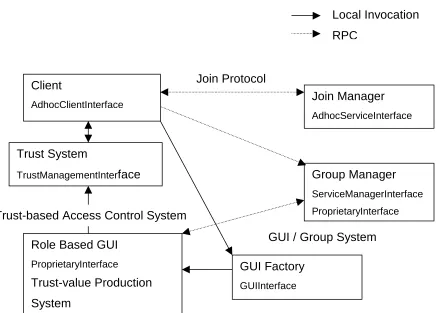
The design identified a number of components that have to interact in a standard way in all collaborative ad-hoc applications. In order to create a standard framework the interaction between the various components will be defined in different interfaces. This section will discuss the design of these interfaces; a high-level overview of the collaborative ad-hoc application framework is shown in figure 8.
Figure 8: Implementation Overview
4.2.1 The Join Protocol Implementation
The join protocol involves the join manager and client. Both implement an standard interface that allows the other to invoke remote method calls. Section 3.3.1 discussed the design of the six-step join protocol.
4.2.1.1 AdhocServiceInterface
The AdhocServiceInterface supports a number of methods. The service proxy that the application publishes on the lookup service will be of this type. The users of the ad-hoc environment will be pre-programmed to search for services of this type first.
GUI / Group System Client
AdhocClientInterface
Trust System
TrustManagementInterface
Join Manager
AdhocServiceInterface
Group Manager
ServiceManagerInterface ProprietaryInterface
GUI Factory
GUIInterface
Legend:
XXX Object Name YYY Interface Name Local Invocation RPC
Role Based GUI
ProprietaryInterface
Trust-value Production System
Join Protocol
import java.rmi.Remote;
import java.rmi.RemoteException;
public interface AdhocServiceInterface extends Remote {
public Vector getServiceRoles() throws RemoteException;
public boolean joinAsRole(PlayerDetails playerdetails, Role role) throws RemoteException;
public ServiceManagerInterface requestLogon(AdhocClientInterface adhocclientinterface, Role role, PlayerDetails playerdetails) throws RemoteException;
public void logoff(AdhocClientInterface adhocclientinterface, PlayerDetails p) throws RemoteException;
}
The first two methods in the interface represent the first two steps of the join protocol. The third method represents the fifth step, the client officially joining the group. When this step happens the client is returned an object that implements the ServiceManagerInterface.
4.2.1.2 AdhocClientInterface
The client software must implement the AdhocClientInterface. The first three methods in the AdhocClientInterface interface are involved in the join protocol. The last method allows other clients to request a recommendation on a user.
import java.rmi.Remote;
import java.rmi.RemoteException;
{
public boolean verifyPlayerForRole(PlayerDetails playerdetails, Role role) throws RemoteException;
public void informAboutNewUserRole(AdhocClientInterface adhocclientinterface, Role role, PlayerDetails playerdetails) throws RemoteException;
public void userExit(AdhocClientInterface adhocclientinterface, PlayerDetails playerdetails) throws RemoteException;
public double recommendationRequest(PlayerDetails playerdetails, String context) throws RemoteException;
}
4.2.2 Graphical User Interface Implementation
Once the client has finished the join protocol they are returned a reference to the group manager. The client will use this reference to request access to a role-based GUI from the group manager
4.2.2.1 ServiceManagerInterface
The group manager will extend this interface, this allow any client to request access to a role specific GUI. The group manager will return an object that implements the GUIInterface.
import java.rmi.Remote;
import java.rmi.RemoteException;
public interface ServiceManagerInterface extends Remote {
4.2.2.2 GUIInterface
The application developer has to provide a role based graphical user interface to the users of the system. When the user has been approved for a role in the application, the group manager will return a factory object that implements GUIInterface. The interface contains a single method that has four parameters. The client passes a reference to its local trust system and the group manager. The trust-value production component of the GUI will use the TrustManagementInterface reference to contact the client trust system. The groupmanager_reference allow the GUI to contact the group manager. The GUIFactory will cast the object to specific proprietary interface type.
import java.io.Serializable;
public interface GUIInterface extends Serializable {
public Object getUI(Object groupmanager_reference, Role role, PlayerDetails playerdetails, TrustManagementInterface trustmanagementreference);
}
4.2.3 Trust Management Interfaces
As discussed in section 3.3.2, the design of the trust-value production system stated that the two subcomponents must be allowed to save and access details to and from the client’s disk.
4.2.3.1 TrustManagementInterface
import java.io.Serializable; import java.io.File;
public interface TrustManagementInterface extends Serializable {
public File getXMLFile(String context);
public void writeXML(String context, String details);
public void addTrustManagementResult(TrustManagementResult result); }
4.3 Trust Based Access Control System Implementation
This section presents some of the issues encountered in the implementation of the trust-based access control system. The design of this system requires that the dynamic access control statements and trust result should be uniform for all users and applications.
4.3.1 Dynamic Access Control Policy Object
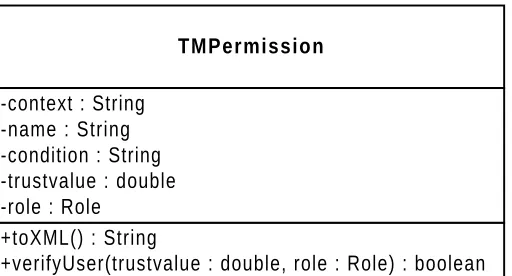
TMPermission
+toXML() : String
+verifyUser(trustvalue : double, role : Role) : boolean -context : String
[image:51.595.93.349.97.235.2]-name : String -condition : String -trustvalue : double -role : Role
Figure 9: TMPermission object
The functionality of the access control statements is implemented in the TMPermission object. This object allows the user to set and get the data held in the five data fields. The object also implements a method that verifies if a user’s trust value and requested role meet the conditions set out in the access control policy, it returns a boolean result. The suedo code for the verifyUser method is shown in Figure 10.
Figure 10: TMPermission verifyUser() seudo code.
The object supports a XML conversion function that is implemented to support the storage of the access control policy information on the client disk. An example of a generic access control policy can be seen in Figure 11.
public boolean verifyUser(double users_trustvalue, Role requested_role) {
if( (users_trustvalue>trust_threshold) && (requested_role==access_role ) ) return true;
else
Figure 11: Generic Access Control Policy Statement [ XML Format ]
4.3.2 Trust Result Object
The trust result object has four fields that can be accessed and modified. The object will also produce a XML format string for the purposes of storage, an example is shown in Figure 12.
Figure 12: Trust Result XML format.
4.3.3 Client Trust System Implementation
The client trust system designed in section 3.3.2.5 is integrated into the client software, an overview of the system is shown in figure 13. When the client software is initialised the trust result and access control files are parsed and the respective objects are stored in the trust result and policy store. When the
<permission>
<context>application_name</context> <applysto>*</applysto>
<condition>greater_than</condition> <trustvalue>0.2</trustvalue>
<role>player</role> </permission>
<result>
<applysto>liam</applysto> <context>blackjack</context>
ad-hoc client system receives a call to verify a user during the Join protocol the compliance checker is called. The compliance checker calls the trust result store and policy store to gather the relevant policies and trust results. The trust value for the user and the requested role is verified with each policy, if any of the policy indicates a match the users request is confirmed.
[image:53.595.82.439.197.489.2]
Figure 13: Trust System Implementation Overview.
4.4 Sample Application Implementation
The sample application that was implemented for demonstration of the trust-based access control systems use in the collaborative ad-hoc application was the card game blackjack. Blackjack is a popular card game in which users gamble with a dealer over the value of a set of cards. The game was chosen because the use of trust is ingrained in the way players join the game.
Trust System
Ad-hoc Client System
Compliance checker
Trust Result Store
Policy Store
XML Parser XML Parser
Trust Results XML file
AC Policy XML file
The similarity in the use of trust to assign roles to users makes it an ideal game to implement, this allow for comparison to be made between the human and the computer model of trust. In implementing the game it was hoped that the trust-based access control system developed for this dissertation would behave in a similar way to a humans.
In blackjack there are two distinct roles, one dealer role and up to five player roles. The role a user has in the game has a major impact on the willingness of other user to play with that user. The user holding the dealer role must be considered trustworthy to the other players. The trustworthiness of the user is based on three parameters, the number of times the two users have played, the number of days since the two played last and the amount of debt that exists between the two.
4.4.1 Trust-Based Access Control
After every session the interaction monitor will update the values of the monitored parameters associated with a user. These details are stored on a client device in a XML file. The TrustManagementInterface allows the interaction monitor to save the result, the format is shown here.
<details>
<name>liam</name> <sessions>2</sessions>
<lastsessiondate>8/8/2000</lastsessiondate> <debt>10</debt>
</details>
<trustmanagementconfiguration> <sessionlimit>10</sessionlimit> <lastplayedlimit>100</lastplayedlimit> <debtlimit>80</debtlimit>
</trustmanagementconfiguration>
When a trust value is required for a user, the trust level for each of the parameters is calculated, the three trust level are then multiplied to return trust value which combines the three parameters. This value is then stored as a trust result, the format is shown here.
<trustresults> <result>
<applysto>liam</applysto> <context>blackjack</context>
<lastupdate>28/8/2000</lastupdate> <trustvalue>0.1584</trustvalue> </result>
<trustresult>
4.4.2 Blackjack Group Formation
When a user has been assigned their role and successful joined the group the blackjack group formation process begins. It was stated in section 3.3.3 that the application developer determines how the users of the group will interact. In the blackjack implementation it was decided that all players are required to connect directly to the user who has the dealer role.
Figure 14: BlackJack Group Formation Overview
4.4.2.1 BlackJackManagerInterface
The BlackJackManagerInterface allows the dealer to register its proxy in a central well known location. The players can then ask the GroupManager to pass them a reference to the dealer. The interface essentially allow the users to find each other.
import java.rmi.Remote;
import java.rmi.RemoteException;
public interface BlackJackManagerInterface extends Remote {
public abstract void registerDealer(BlackJackDealerInterface blackjackdealerinterface) throws RemoteException;
public abstract void unregisterDealer() throws RemoteException;
public abstract BlackJackDealerInterface getDealerRef() throws RemoteException;
Group Manager
ServiceManagerInterface BlackJackManagerInterface
BlackJackGUIFactory
GUIInterface
BlackJackPlayerGUI
BlackJackPlayerInterface
BlackJackDealerGUI
}
4.4.2.2 BlackJackDealerInterface
The BlackJacKDealerInterface implements two methods that allow the players to join and leave the blackjack game. The remaining methods provide the basic functionality for the execution of the blackjack game.
import java.rmi.Remote;
import java.rmi.RemoteException;
public interface BlackJackDealerInterface extends Remote {
public abstract String getAlias() throws RemoteException;
public abstract void logon(BlackJackPlayerInterface blackjackplayerinterface) throws RemoteException;
public abstract void logoff(BlackJackPlayerInterface blackjackplayerinterface, int settleamount) throws RemoteException;
public abstract void hit() throws RemoteException; public abstract void stand() throws RemoteException;
public abstract void doubledown() throws RemoteException; public abstract void splitpair() throws RemoteException;
public abstract int settle(Bet bet) throws RemoteException; }
4.4.2.3 BlackJackPlayerInterface
The BlackJackPlayerInterface allow the player receive updates and commands about the game from the BlackJack dealer.
import java.rmi.RemoteException;
public interface BlackJackPlayerInterface extends Remote {
public void enableClient(boolean flag) throws RemoteException; public void updateGame(Game game) throws RemoteException; public void sendMessage(String s) throws RemoteException; public String getAlia
![Figure 11: Generic Access Control Policy Statement [ XML Format ]](https://thumb-us.123doks.com/thumbv2/123dok_us/959483.609163/52.595.103.391.88.240/figure-generic-access-control-policy-statement-xml-format.webp)