Title: Concept Analysis
Category: Research methodology series
Cronin, P – Lecturer in Nursing, Trinity College Dublin
Ryan, F – Lecturer in Nursing, Trinity College Dublin
Coughlan, M – Lecturer in Nursing, Trinity College Dublin
Name and address for correspondence:
Dr. Patricia Cronin
School of Nursing & Midwifery
Trinity College Dublin
24 D’Olier Street
Dublin 2
Ireland
[email protected]
Abstract
Background: In recent years there has been an increasing interest in concept analysis as a means of establishing conceptual clarity about phenomena of interest within healthcare disciplines. This emergence is associated primarily with the recognition that a set of well developed key concepts pertaining to a discipline’s domain of interest is an essential pre-requisite to building its scientific research base. Concept analysis focuses on concepts that are abstract and about which there is some ambiguity of meaning. Within healthcare disciplines these are mainly behavioural concepts that are concerned with understanding health and illness experiences.
Content: There are a number of approaches to concept analysis whose methods overlap in some aspects but which possess essential philosophical differences. This article examines the ontological and epistemological underpinnings of concepts and concept analysis. Methods of concept analysis that represent the various philosophical positions are presented and a critique of their limitations is offered.
Introduction
Simply stated concept analysis incorporates a method or approach by which concepts that are of interest to a discipline are examined in order to explicate their characteristics or attributes. Within each discipline, analyses tend to focus on establishing conceptual clarity about phenomena that are used in theory, research and practice. However, concept analysis is complex and has the potential to be confusing for those who are new to it. Debates abound as to the meaning of concepts, their ontological and epistemological foundations and the methods by which they should be analysed. Moreover, the literature is replete with interchangeable or synonymous use of terms such as concept analysis, concept development, delineation and clarification (Duncan et al, 2007) with the result that little clarity exists for the novice theorist or researcher.
This article attempts to elucidate the theoretical and philosophical underpinnings of the notion of concepts and subsequently concept analysis. The latter part of the paper focuses on methods of concept analysis that have been used within healthcare disciplines, particularly nursing, whilst offering a critique of their potential and limitations.
What is a concept?
Defining concepts has been a matter for philosophers since the time of Aristotle and Plato. While there is still no consensus or ‘theory of concepts’, Aristotle gave legitimacy to efforts directed at definition and analysis of concepts by establishing the process as a fundamental scientific activity. Although a detailed analysis of the philosophical debates is beyond the scope of this paper, some of the main views are presented in order to situate the discussion about concept analysis and its contribution to scientific inquiry and knowledge development.
The idea of concepts as things or entities has dominated much of the philosophical thought on the question of concepts. To some extent, this is embedded in the work of Aristotle who declared concepts to be abstractions that are composed of unchanging and essential elements or objects (Rodgers, 2000b). This view, subsequently, gained considerable sway through philosophers such as Descartes, Locke and Kant. Although their complex individual philosophies fundamentally differed, in that they disagreed as to whether concepts were innate or arose from experience, they all purported that they are mental entities that exist solely in the mind. Furthermore, rooted in their work is the implication that a relationship exists between concepts and objects.
concepts so clearly that their truth value in respect of any situation or object could be determined. This position reflects the classical theory of concepts whereby concepts generally exhibit a definitional structure that enables both resemblances and distinctions to be clarified.
This view of concepts has been the subject of considerable criticism in recent years in the fields of philosophy and psychology. Whilst the reasons for such criticisms are numerous, within healthcare science the difficulty is the existence of concepts that are not objects (e.g. social support, health, trust, adherence, distress) and the possibility that these will invoke considerably different images depending on their context. Moreover, in many instances they are not amenable to definitive measurement.
Modern developments such as the advent of dispositional theories reject the idea of strict conceptual boundaries and definitions. Wittgenstein developed the notion of family resemblance whereby family members (categories) possess some characteristics that resemble each other but not all are shared (Beckwith et al, 2008). For example, there are many comparable features that enable big cats (pantherinae – roaring cats) and small cats felinae to be categorised as belonging to the family of ‘cat’ (felidae). Equally, however, there are distinctive features such as the ‘ability to roar’, which, in this instance, demarcates one sub-family from the other.
attribute necessary to convey meaning in that situation (e.g. annoy, irritate, bother) (Risjord, 2009). For example, in everyday usage people make distinctions between apparent synonyms e.g. annoy, irritate, bother because there is an implied yet subtle difference in the meaning.
Concepts are not words but are a mental image of a phenomenon, an idea or a construct about a thing or an action (Walker and Avant, 2005). Therefore, a concept can only have pure expression in the mind of the individual and its essence cannot be truly captured in either the spoken or written word (Beckwith et al, 2008). Nonetheless, whilst the words used in language are not the concepts themselves, they are the means by which they are expressed and communicated. Therefore, in order to communicate effectively or achieve understanding there has to be some general agreement about the meaning of the concept. Moreover, within scientific disciplines where concept usage may differ from the common meaning within the wider society, there is a need for concepts to be analysed and clarified in order to ensure there some consistency of meaning and understanding.
Concept analysis
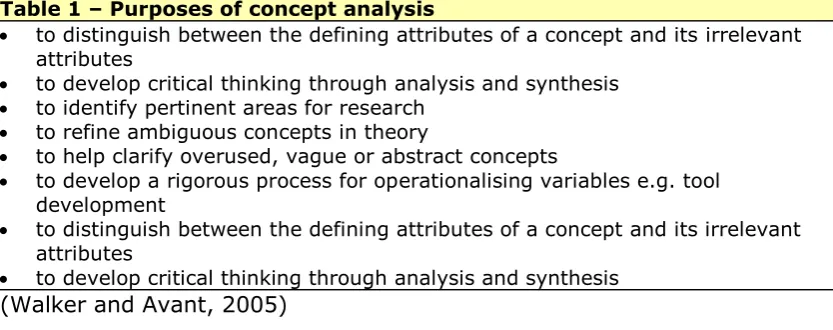
relate to their phenomena of interest and elucidate their pattern of usage, which in turn can become a precursor of theory and knowledge development to ultimately improve practice. Thus, concept analysis is concerned with boundary work that guides the discipline and forms the links between research, theory and practice (see Table 1). Underpinning this idea of boundary work is the view that without a clear conceptual foundation, the quality of research and theory construction of any discipline is weakened and its maturity compromised (Weaver and Mitcham, 2008:182).
As an example, at the end of the last century it was discerned that a limitation to the development of the knowledge base of nursing is the ambiguous use of concepts in research (Weaver and Mitcham, 2008). Because many of those in use are behavioural concepts (coping, self-care, caring, suffering, hope, trust, reassurance etc.) that are concerned with understanding health and illness experiences they are often ‘immature’. What this means is that they may be inadequately defined; they may be utilised differently from their use in other disciplines; they may conjure different images for individual members of the discipline or they may not be distinguishable from other concepts within the domain of practice. This is in contrast to ‘mature concepts’ that are well-defined and are ready for use in quantitative research, practice and theory construction (Walker and Avant, 2005). Consequently, nursing has directed it efforts at identifying means whereby concepts that are of concern to it can be developed, clarified and refined.
Methods of concept analysis
The developing field of concept analysis includes a number of approaches that, on the surface, appear similar but possess significant philosophical differences (Rodgers, 2000a). Although it is not possible within the scope of this paper to provide a definitive discussion of the various philosophical positions adopted, suffice it to say that at a basic level, these differences are rooted in the theories of concepts (entity/classical or dispositional) outlined above.
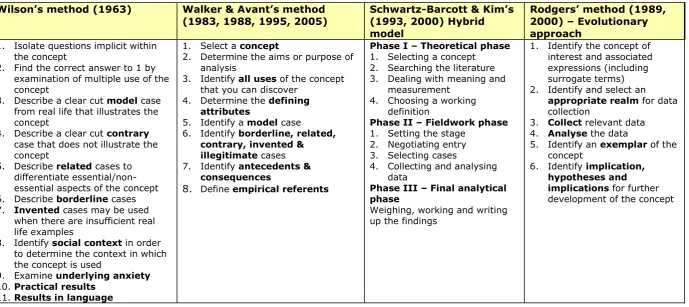
The approaches presented in Table 2 are but a selection of the numerous methods that have evolved. They are chosen because they include both entity (Wilson, 1963; Walker and Avant, 1983; 1988; 1995; 2005; Schwartz-Barcott and Kim, 2000) and dispositional (Rodgers, 1989; Rodgers and Knafl, 2000a) theories; they encompass the most popular and most cited methods (Walker and Avant, 1983; Walker and Avant, 1988; Rodgers, 1989; Walker and Avant, 1995; Rodgers and Knafl, 2000a; Walker and Avant, 2005; Rodgers, 2000a) and present an example of how concept analysis can combine theoretical and fieldwork phases (Schwartz-Barcott and Kim, 2000). For a detailed discussion of other approaches see Rodgers and Knafl (2000b).
Wilson’s (1963) method of concept analysis
analysis tool that would enable identification of the essential features of the concept under scrutiny (see Table 2). Although various commentators have subsequently determined that the Wilsonian approach lacks rigour and is directed at enhancing critical thinking as opposed to producing evidence of a scientific examination of a concept, it proved influential in the development of concept analysis frameworks within nursing (Hupcey and Penrod, 2005; Beckwith et al, 2008).
Walker and Avant’s (1983, 1988, 1995, 2005) method of concept analysis
Walker and Avant (1983; 1988; 1995; 2005) were the first to develop an 8-step model for nursing based on Wilson’s work. For them, concepts are categories of information that contain defining attributes and concept analysis is the formal, linguistic exercise that enables delineation of these defining characteristics or attributes (Walker & Avant, 2005). The process is rigorous but the outcome is always tentative given that the analysts may arrive at different attributes or the concept may evolve over time and what is ‘true’ of a concept now may not be in the future.
negative events (Skaggs and Barron, 2006) and social participation (Larivière, 2008).
Identifying all uses (physical, psychological and social) of the concept is the third step and includes accessing multiple sources such as dictionaries and thesauruses, the media, popular, historic and discipline and non-discipline specific literature. Although, this stage may generate an overwhelming amount of data, it is helpful in that it gives an indication of the range and diversity of the concept’s use. For example, the definition and understanding of the concept of ‘fatigue’ may differ considerably depending on whether one works within sport, healthcare or engineering. The important factor, at this point, is that effort is directed at exploring whether there are universal and essential attributes of ‘fatigue’ that apply regardless of the discipline. Subsequently however, some of these uses may be discarded because of the contextual differences in which it is being explored. For example, the analyst may determine that they are solely interested in ‘cancer-related fatigue’ and while the initial exploration provides good background material, the characteristics of the chosen concept may vary sufficiently to warrant focussing on this ‘type’ of fatigue.
The fourth step is to identify the attributes of the concept. Coming to the attributes is a lengthy process as it requires review and synthesis of all sources of literature. The object of the exercise is to identify the characteristics that appear repeatedly with the intention of enabling differentiation of a concept from a related or similar one (Walker and Avant, 2005).
parameters of the original concept can be more clearly distinguished. Ultimately, there should be no overlap or contradictions between the defining attributes and the model case. Should ambiguity become apparent at this stage, further revision or refinement should be undertaken (Walker and Avant, 2005)
Identifying antecedents and consequences is the penultimate step of Walker and Avant’s framework. Antecedents are those events or incidents that must be in place in order for the concept to occur and cannot be a defining attribute for the same concept. Consequences are outcomes that occur as a result of the concept. Walker and Avant (2005) suggest that antecedents and consequences are important because they can shed light on the social context in which the concept is used. As contemporary concept analyses in nursing have highlighted, antecedents and consequences can be identified that are specific to a clinical setting/context or cohort of people with the result that the analysis has more resonance. To return to the example of fatigue; the context in which it is being analysed, e.g. chronic or enduring illness, rehabilitation or cancer, is significant for defining and differentiating the influence of the situational factors. Moreover, it enables identification of outcomes (consequences) that are specific and relevant, which in turn can assist with designation of pertinent implications and recommendations for practice, research and theory development. This is exemplified in some recent analyses that have focussed on particular groups or settings including ‘preserving dignity’ in caring for older adults (Anderberg et al, 2007), and the art of developmental care in NICU (neo-natal intensive care) (Aita and Snider, 2003).
instrument development for subsequently measuring/observing the concept. Alternatively, the defining attributes may point to instruments that are already developed that may facilitate measurement/observation of the concept.
Despite the plethora of analyses undertaken using Walker and Avant’s model, a number of criticisms of the approach have been published (Rodgers and Knafl, 2000a; Hupcey and Penrod, 2005; Beckwith et al, 2008). Essentially, this is associated with the philosophical underpinnings and the notion that they have adopted the entity view of concepts. However, this contradicts Walker and Avant’s (1995:78) claim that they do not subscribe to the ‘tenets of positivism, reductionism, rigidity or a correspondence theory of truth’. Moreover, they argue that concept analysis is a reasonable and logical method that has served the development of science in many disciplines, regardless of the technique adopted.
The Hybrid model (Schwartz-Barcott & Kim, 2000)
Other Wilsonian-derived approaches to concept analysis include that developed by Schwartz-Barcott and Kim (2000) and known as the hybrid model. This model integrates theoretical analysis with empirical observation and comprises three phases, the initial theoretical phase, the fieldwork phase and the final analytical phase. A recent example is the analysis of self-management in adults newly diagnosed with epilepsy (Unger and Buelow, 2009)
concept. The literature review commenced in phase I continues during phase II and functions as a basis for data being collected in the field (Schwartz-Barcott and Kim, 2000). The final phase integrates the initial analysis with the understanding gained from the empirical phase and the process of writing up the findings. Schwartz-Barcott & Kim (2000) emphasise that the first two phases should be regarded as intertwined and recommend simultaneous data collection and literature searching and reviewing in order to maintain a questioning stance.
Rodgers’ Evolutionary method of concept analysis
Rodgers (2000a) method of concept analysis has been termed evolutionary and centres on the idea that concepts evolve in a cycle of phases: significance, use and application. Rodgers subscribes to the view that concepts are dynamic, ‘fuzzy’, context dependent and serve a pragmatic utility rather than an innate ‘truth’ (Rodgers, 2000a). Concept development is evolutionary in that it continues over time within a particular context, which may be disciplinary, cultural or theoretical. (Weaver and Mitcham, 2008:191). This notion of concept significance, usage and application across contexts and disciplines has been a key justifying factor among those who have chosen to frame their analysis using this model. For example, a recent concept analysis included the disciplinary contexts of medicine, nursing, psychology and pharmacy in order to determine if and how the conceptualisations of adherence as the concept of interest were different (Bissonnette, 2008). In another analysis Almost (2006) investigated the concept of conflict in the context of nursing work environments but the sample included literature from social sciences, management, medicine as well as nursing because conflict had been studied within these disciplines.
Nonetheless, there are some parallels with the process identified in other concept analysis methods in that the first activity (step) is always to elucidate the concept of interest and undertake some form of data collection (primarily literature based). Identification of the concept of interest is at times complicated by the interchangeable use of terminology. For example, adaptation, adjustment and accommodation are often used to describe the phenomenon of the individual’s response to chronic illness. In Rodgers’ method, these are referred to as surrogate terms and must be incorporated into the analysis.
When determining the setting and sample for data collection, the overall purpose of the analysis is fundamental. In a literature based analysis the
setting refers to the parameters of the review such as the time span, the range of disciplines to be included, whether popular and professional literature will be sourced and/or whether multiple perspectives are needed. In the event that a plethora of literature is identified, sampling strategies must be identified since it is unlikely that the entire population of literature can be sourced or managed. However, it is important to be rigorous in sampling and the processes adopted such as inclusion and exclusion criteria must be clearly explicated (Rodgers, 2000a)
The actual analysis focuses on the collection and analysis of raw data and not on the construction of ‘cases’ as is advocated in other approaches. The purpose is to identify data that is relevant to the attributes of the concept and its contextual features such as antecedents, consequences and sociocultural and temporal variations (Rodgers, 2000a). The primary outcome is to identify the cluster of attributes of the concept, which constitute what Rodgers (2000a) refers to as a ‘real’ definition rather than a nominal or dictionary definition. Explicating the contextual aspects of the concept facilitates understanding of where and when the concept is used, by whom and from what perspective.
In the evolutionary method Rodgers (2000a) recommends analysts delay the final, formal analysis until near the end of data collection. This can assist with preventing premature closure and drawing conclusions that are not verified by the rest of the data. The characteristics of the concept should emerge from the data rather than researcher looking to validate their own preconceived ideas.
Generally, analysis follows that of thematic analysis where each category of data (attributes, contextual information and references) are examined separately to identify major themes presented in the literature. This encompasses a process of continually organising and reorganising data until a comprehensive and relevant system of descriptors has been generated. Related concepts and surrogate terms are generally exempt from this part of the analysis (Rodgers, 2000a).
The identification of exemplars in some form is a common and useful part of concept analysis, the purpose of which is to provide a practical illustration of the concept in a given context. However, in some situations, the analyst may need to access additional literature and or undertake field observations to identify a clear exemplar. An important point is the outcome is not definitive and in many instances may constitute the first phase of concept development. Thus, Rodgers (2000a) recommends that the final stage of this process is about identifying implications and recommendations for practice, outlining the direction of further development of the concept and future inquiry in research and theory development.
Conclusion
within their field. However, those within the domain of healthcare are often confronted with concepts that are abstract and whose meaning is unclear or ill-defined and in order to establish disciplinary knowledge that enhances or improves practice, conceptual clarity is required.
Despite the proliferation of published concept analyses in nursing, there is a view that they have not always contributed to the knowledge base of the discipline. Some of this criticism has been associated with the failure to explicate the ontological and epistemological underpinnings guiding the analysis (Duncan et al, 2007). Others have censured concept analysis methods themselves particularly where there is no requirement to justify the choice of attributes, which leaves the reader questioning why they are included or even why others have been excluded (Risjord, 2009). Moreover, concept analysis is not an exercise for the faint-hearted. It requires rigorous sampling, data collection and analysis regardless of the framework adopted and must, ultimately be undertaken as a means of developing theory and knowledge within a discipline.
Tables
Table 1 – Purposes of concept analysis
to distinguish between the defining attributes of a concept and its irrelevant
attributes
to develop critical thinking through analysis and synthesis
to identify pertinent areas for research
to refine ambiguous concepts in theory
to help clarify overused, vague or abstract concepts
to develop a rigorous process for operationalising variables e.g. tool
development
to distinguish between the defining attributes of a concept and its irrelevant
attributes
to develop critical thinking through analysis and synthesis
Table 2 – Approaches to concept analysis
Wilson’s method (1963) Walker & Avant’s method
(1983, 1988, 1995, 2005) Schwartz-Barcott & Kim’s (1993, 2000) Hybrid model
Rodgers’ method (1989, 2000) – Evolutionary approach
1. Isolate questions implicit within the concept
2. Find the correct answer to 1 by examination of multiple use of the concept
3. Describe a clear cut model case from real life that illustrates the concept
4. Describe a clear cut contrary case that does not illustrate the concept
5. Describe related cases to differentiate essential/non-essential aspects of the concept 6. Describe borderline cases 7. Invented cases may be used
when there are insufficient real life examples
8. Identify social context in order to determine the context in which the concept is used
9. Examine underlying anxiety 10.Practical results
11.Results in language
1. Select a concept
2. Determine the aims or purpose of analysis
3. Identify all uses of the concept that you can discover
4. Determine the defining attributes
5. Identify a model case
6. Identify borderline, related, contrary, invented & illegitimate cases 7. Identify antecedents &
consequences
8. Define empirical referents
Phase I – Theoretical phase 1. Selecting a concept
2. Searching the literature 3. Dealing with meaning and
measurement 4. Choosing a working
definition
Phase II – Fieldwork phase 1. Setting the stage
2. Negotiating entry 3. Selecting cases
4. Collecting and analysing data
Phase III – Final analytical phase
Weighing, working and writing up the findings
1. Identify the concept of interest and associated expressions (including surrogate terms) 2. Identify and select an
appropriate realm for data collection
3. Collect relevant data 4. Analyse the data
5. Identify an exemplar of the concept
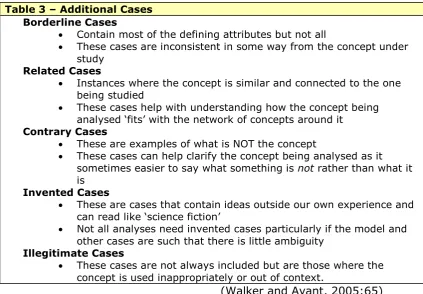
Table 3 – Additional Cases Borderline Cases
Contain most of the defining attributes but not all
These cases are inconsistent in some way from the concept under
study
Related Cases
Instances where the concept is similar and connected to the one
being studied
These cases help with understanding how the concept being
analysed ‘fits’ with the network of concepts around it
Contrary Cases
These are examples of what is NOT the concept
These cases can help clarify the concept being analysed as it
sometimes easier to say what something is not rather than what it
is
Invented Cases
These are cases that contain ideas outside our own experience and
can read like ‘science fiction’
Not all analyses need invented cases particularly if the model and
other cases are such that there is little ambiguity
Illegitimate Cases
These cases are not always included but are those where the
concept is used inappropriately or out of context.
Aita, M., Snider, L. (2003) The art of developmental care in the NICU: a concept analysis. Journal of Advanced Nursing. 41(3):223-232. Allvin, R., Berg, K., Idvall, E., Nilsson, U. (2007 ) Postoperative recovery:
a concept analysis. Journal of Advanced Nursing. 57(5):552-558. Almost, J. (2006) Conflict within nursing work environments: concept
analysis. Journal of Advanced Nursing. 53(4):444-453.
Anderberg, P., Lepp, M., Berglund, A., Segesten, K. (2007) Preserving dignity in caring for older adults: a concept analysis. Journal of Advanced Nursing. 59(6):535-643.
Beckwith, S., Dickinson, A., Kendall, S. (2008) The "con" of concept analysis. A discussion paper which explores and critiques the ontological focus, reliability and antecedents of concept analysis frameworks. . International Journal of Nursing Studies.
45(12):1831-1842.
Bissonnette, J. (2008) Adherence: a concept analysis. Journal of Advanced Nursing. 63(6):634-643.
Cronin, P., Rawlings-Anderson, K. (2004) Knowledge for Contemporary Nursing Practice. Elsevier, Edinburgh.
Duncan, C., Cloutier, J., Bailey, P. (2007) Concept analysis: the importance of differentiating the ontological focus. Journal of Advanced Nursing. 58(3):293-300.
Hupcey, J., Penrod, J. (2005) Concept analysis: examining the state of the science. Research and Theory for Nursing Practice. 19(2):197-208. Knafl, K., Deatrick, J. (2000) Knowledge Synthesis and Concept
Development in Nursing. In Rodgers, B., Knafl, K. (eds.) Concept Development in Nursing. Foundations, Techniques and Applications.
2nd ed. WB Saunders, Philadelphia: (39-54).
Kvale, S. (1996) An Introduction to Qualitative Research Interviewing. Sage, Thousand Oaks.
Larivière, N. (2008) Analysis of the concept of social participation: definitions, illustration, dimensions of activity and indicators.
Canadian Journal of Occupational Therapy. 75(2):114-127.
Risjord, M. (2009) Rethinking concept analysis. Journal of Advanced Nursing. 65(3):684-691.
Rodgers, B. (1989) Concepts, analysis and the development of nursing knowledge: the evolutionary cycle. Journal of Advanced Nursing.
14(4):330-335.
Rodgers, B. (2000a) Concept Analysis: An Evolutionary View. In Rodgers, B., Knafl, K. (eds.) Concept Development in Nursing: Foundations, Techniques and Applications. 2nd ed. WB Saunders, Philadelphia: (77-102).
Rodgers, B. (2000b) Philosophical Foundations of Concept Development. In Rodgers, B., Knafl, K. (eds.) Concept Development in Nursing: Foundations, Techniques and Applications. 2nd ed. WB Saunders, Philadelphia: (7-38).
Rodgers, B., Knafl, K. (2000a) Concept Development in Nursing. Foundations, Techniques and Applications. 2nd ed. WB Saunders, Philadelphia.
Schantz, M. (2007) Compassion: A concept analysis. Nursing Forum.
42(2):48-55.
Schwartz-Barcott, D., Kim, H. (2000) An Expansion and Elaboration of the Hybrid Model of Concept Development. In Rodgers, B., Knafl, K. (eds.) Concept Development in Nursing. Foundations, Techniques and Applications. 2nd ed. WB Saunders, Philadelphia: (129-159). Skaggs, B., Barron, C. (2006) Searching for meaning in negative events.
Journal of Advanced Nursing. 53(5):559-570.
Unger, W., Buelow, J. (2009) Hybrid concept analysis of self-management in adults newly diagnosed with epilepsy. Epilepsy and Behavior.
14(1):89-95.
Walker, L., Avant, K. (1983) Strategies for Theory Construction in Nursing. Appleton-Century-Crofts, Norwalk.
Walker, L., Avant, K. (1988) Strategies for Theory Construction in Nursing. 2nd ed. Appleton-Century-Crofts, Norwalk.
Walker, L., Avant, K. (1995) Strategies for Theory Construction in Nursing. 3rd ed. Appleton-Century-Crofts, Norwalk.
Walker, L., Avant, K. (2005) Strategies for Theory Construction in Nursing. 4th ed. Prentice Hall, New Jersey.
Weaver, K., Mitcham, C. (2008) Nursing concept analysis in North America: state of the art. Nursing Philosophy. 9(3):180-194.