TF(TRACHLORDINITROETHANE1
BY W. I,. ARGO, €$. M. JAMES AND J. I.,. DONNELLYTetrachlordinitroethane is a white, Crystalline solid, in- soluble in water, soluble in alcohol, ether, and ligroin. I n ether and ligroin it decomposes a t 60' with evolution of brown fumes. It is also very soluble in liquid Nz04 and some- what less so in carbon tetrachloride. When pure, decomposi- tion does not begin until the compound is heated about to its melting point, 142-143
".
It is probable, though not proved that the behavior in ligroin is due to a difference in reaction velocity rather than to a difference in equilibrium. Tetra- chlordinitroethane is toxic to mice a t one-sixth the concen- tration for chlorpicrin. It produces lachrymation in man a t one-eighth the concentration that chlorpicrin does. It is not stable when exploded in a three-inch shell, but would proba- bly stand up satisfactorily if dissolved in chlorpicrin.The only method of preparation described in the litera- ture is that of Kolbe2 who heated a mixture of nitrogen per- oxide and tetrachlorethylene in a sealed tube a t I IO "-1 20" for three hours. The tube was opened, the excess N204 al- lowed to boil away, and the crystals of C2C14(N02)2 collected and analyzed. Biltz3 obtained a larger yield by heatingfor the same length of time to IOO"-IIO'. We have obtained
the best results a t about 80"; but, even a t this lower tem- perature, the pressure developed in the tube is apt to cause a violent explosion except when tubes of very small cross- section are used. The danger of explosion increases very much if the nitrogen peroxide is not dried by distillation over phosphorus pentoxide, as an oxidation takes place when mois- ture is present, giving.rise to a high pressure even when the tubes are cooled in ice before being opened.
1 Published by permission of the Director of the Chemical Warfare Service.
Tetrachlordinitroethane 579
Theory
0.867 g 1.472 g 1.085 g 1.563 g 0.716 g 1.152 g
Quantitative Study of the Reaction
The nitrogen peroxide was obtained by heating lead ni- trate in a long, glass tube a t about 400°, drying the evolved gases with Pz05, and liquefying the nitrogen peroxide by means of ice and hydrochloric acid. Liquid nitrogen per- oxide was also prepared by the interaction of arsenic tri- oxide and nitric acid, and was furnished t o us by the small Scale Manufacturing Section; but this had t o be dried over phosphorus pentoxide before it would give satisfactory re- sults. The tetrachlorethylene was obtained by cracking car- bon tetrachloride.
Six small tubes of about 2 cc capacity were made by
fusing ordinary 4 mm soda-glass tubing. Into each was intro- duced known weights of N 2 0 4 and C2Cl4, so that three con- tained an excess of the former, and three an excess of the latter. I n each case the volume of the liquid was approxi- mately z/3 of the capacity of the tube.
T h e tubes were divided into pairs, and heated in the water bath. The conditions and results of the experiment are summarized in Table I.
TABLE I
Obs.
0.311 g 0.317 g 0.486 g 0.524 g
0 . 7 5 8 g 0.570 g (I) N204 excess
(2) c&14 excess (3) N204 excess
(4) CzC14 excess (5) N204 excess (6) CzC14 excess
- -
r e y
- 60 60 60 60 80 80 O
Time of heating
3 hrs. 3 hrs. 6 hrs. 6 hrs. 3 hrs. 3 hrs. Yield 35.9% 21.4% 44.8% 33.5% 79.5% 65.8%
I n every. case a considerable pressure was observed on open- ing the tubes.
5 8 0 W .
L.
Argo, E .hf.
Jamesawd
J .
L.
Downelly( I ) Contents moist
(4) Contents dry (2) Contents moist (3) Contents dry
i t is logical to assume that a diminution of pressure should result in the tube as the reaction progresses. This, as we discovered, was not the case. Nitrogen tetroxide is inter- mediate in composition between nitrous and nitric anhydride and reacts as follows with cold water:
OzN - NO2
+
HOH + HzNOz+
"0360 3 hrs. 35 cc
60 3 hrs. 2 0 cc
60 3 hrs. 40 cc
60 3 hrs. I j CC
I
If the water is heated, however, the unstable nitrous acid breaks down, giving nitric acid and nitric oxide.
3Nz04
+
2HOH ----f 4 H N 0 3+
2 N 0 ,(heated)
Thus the presence of hot water vapor in the reaction mixture will produce H N 0 3 and N O ; and an oxidation of CaC14 with the production of phosgene becomes possible. This would account for the pressure developed.
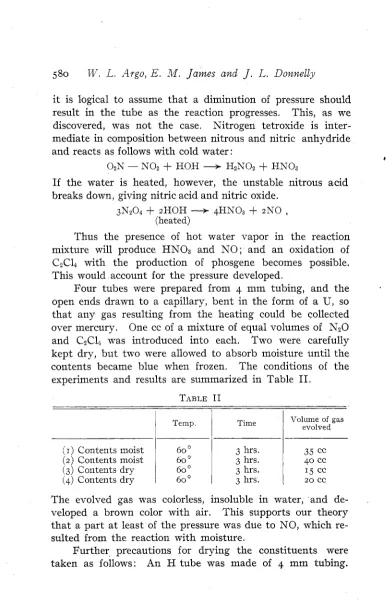
Four tubes were prepared from 4 mm tubing, and the open ends drawn to a capillary, bent in the form of a U, so that any gas resulting from the heating could be collected over mercury. One cc of a mixture of equal volumes of NzO and CZCl4 was introduced into each. Two were carefully kept dry, but two were allowed to absorb moisture until the contents became blue when frozen. The conditions of the experiments and results are summarized in Table 11.
TABLE I1
[image:3.504.61.450.34.643.2]Tetrachlordivtitroethavte 581
54.2 7 0 . I
7 9 . 7 8 7 . I 1 0 1 . 4
110.8
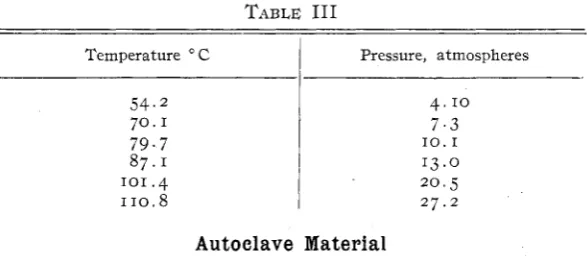
One end was blown into a small bulb, and the whole carefully dried. A little P205 was placed in the bulb and covered with equal volumes of C2C14 and NZO4, previously dried over P205. The openings in the tube were then sealed and the liquid distilled to the second arm by gently heating the bulb, and freezing thesecond arm with C 0 2 snow and ether. The connecting arm was then sealed, and the tube heated to 60' for three hours. It was cooled, opened, and the gases col- lected over mercury. About 3-5 cc of an inactive gas was evolved. This indicates that careful drying will eliminate the high presstire caused by the side reactions noted above. There remains then only the pressure of N 2 0 4 t o account for. I t s vapor pressure a t various temperatures are given in Table 111.1
TABLE I11
4 . I O
7 . 3
13.0 2 0 . 5 2 7 . 2
I O . I
Temperature C
!
Pressure, atmospheresAutoclave Material
Since no porcelain-lined autoclave was available at first, a run was made in a phosphor-bronze autoclave. Accord- ingly 175 g. N204 and 320 g. C2C14 were placed in a tall beaker within the autoclave and the whole heated to 80" for three hours. A yield of 195 g. was obtained, 40 percent of the theoretical. The interior of the autoclave was badly cor- roded and it seems probable that the low yield was due t o the nitrogen peroxide reacting with the metal.
We next attempted to use Bakelite varnish as a protec- tive coating, but even when carefully baked i t was almost completely destroyed as soon as subjected t o the N z 0 4 vapors.
[image:4.501.84.378.304.432.2]582 W .
L.
Argo, E.M .
James and J . L. DonnellyWe then tried placing the mixture of C2C14 in a large bottle, the mouth of which was loosely covered with a beaker. T h e whole was surrounded with sand and a top layer of iron filings. This method had to be abandoned on account of a very considerable loss of product by diffusion through the sand surrounding the reaction bottle.
An attempt was next made to find a metal sufficiently unaffected by N204. Small pieces of nichrome, copper, and iron wire, and spirals of copper and iron oxide were placed in tubes with N 2 0 5 and P205, and heated to 80" both in the liquid and thevapor for three hours a t 80'. The copper and copper oxide were badly attacked, and so heavy a pressure was developed that an attempt t o open the tubes resulted in their being reduced t o fragments No pressure was developed in the tubes with the nichrome, and the iron and iron oxide, The last two showed no evidence of being attacked, but the nichrome was badly pitted.
Since iron is apparently unattacked by dry N204, the following series of tests were made t o determine the resistance of various kinds of iron when heated in a mixture of CZCl4
and N204 a t 80" for three hours. The results are summarized
in Table IV.
Iron
( I ) Steel
( 2 ) Steel
(3) Wrought iron (4) Cast iron (5) Wrought iron
TABLE IV
Condition of
Mixture dry Mixture moist Mixture moist Mixture dry Mixture dry
Pressure developed
Slight Very high Very high High
Condition of metal
Unattacked
Completely destroyed Completely destroyed Badly attacked Unaffected
Tetrachlordinitroethane 583
Autoclave CaC14
badly attacked and hence t o contaminate the product with iron,
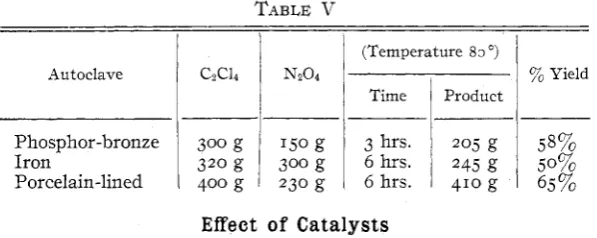
Later a porcelain-lined autoclave was obtained; but it leaked and was not satisfactory. The maximum efficiency obtained in it was 65 percent; but it is believed that this
.
could be increased very materially under more favorable conditions. I n Table V are given the yields obtained in the later runs with the three autoclaves.This autoclave was therefore abandoned.
(Temperature 83 ")
Nz04
1
% YieldTime
I
Product1 I 1 ! I-
Phosphor-bronze 3 hrs. 205 g 58%
Iron
1
::z:
1
i:z:
1
6 hrs. ~ 245 g1
50%Porcelain-lined 400g 230g 6 hrs. 410g 65%
Effeet of Catalysts
If the temperature a t which the reaction takes place could be lowered by the use of a catalyst, the difficulty in regard to material of construction would probably disappear because nitrogen peroxide makes iron passive a t ordinary temperatures.
Four sealed tubes, each containing an approximately equal amount of a mixture of dry perchlorethylene and Nz04,
were prepared containing the catalysts noted below, and al- lowed to stand a t room temperature for three days. The results are noted in Table VI.
.
TABLE VI
-
Catalyst
1
Amount producedPurified Dorsey charcoal Powdered filtcharl
ZnClz AlC&
Few white crystals Few white crystals
. . . . . .
[image:6.505.82.381.231.350.2]584 W .
L.
Argo, E .M .
James and J . L . DonnellyCatalyst
Dorsey charcoal Filtchar
No catalyst
I n no case was the amount produced equal to more than I
t o 2 percent of the theoretical.
Three more tubes were prepared, each containing ap- proximately equal amounts of N204 and C2C14, the first two with Dorsey charcoal .and filtchar, respectively, and the last without catalyst. They were heated 2 hours at 60" with
the results summarized in Table VII.
Temp. Time Wt. C1C14N204 % Yield I-
60' 2 hrs. 5-6 g 9 60' 2 hrs. 4-5 g 9
Tetrachlordilzitroethalze 5 8 5
condensation of the peroxide, this method is impracticable since so long a run would be necessary t o produce a noticeable amount of the compound.
It will be observed from the above experiment and others which have preceded it, that the reaction
only proceeds smoothly under the following conditions :
CzC14
+
KzO4 + CzC14Nz04( I ) Temperature of 80'.
( 2 ) Heating 3-6 hours.
(3) Pressure about 10-12 atmos.
(4) Excess of liquid Nz04.
The last point indicates, as does the experiment just de- scribed, that the reaction takes place mainly in the liquid and not in the gaseous phase, and in consequence the most favor- able conditions would be a small gas space, and an excess of
N204, conditions which we were unable to produce in our auto-
clave on account of the difficulty of obtaining sufficiently large amounts of dry N204.
Solubility
(See Table 111, V. P.
Of N204.)
It was found that 30 cc of dry Nz04, distilled from Pz05, will dissolve 1 5 ~ 7 g. of C2C14(N0z)2 at 0'. The solubility in
superpalite and chorpicrin was not determined quantita- tively but seemed to be of the same order.