Optimization of Electric Power Generation for
Expansion Planning and Cost-Saving Using
Decomposition Techniques: A Case of Developing
Countries
S. L. Braide, D.C. Idoniboyeobu
Abstract-This paper formulated the framework of optimization of electric power generation for expansion planning and cost saving. The inability of the power systems in developing countries to generate enough electric power has led to extra-ordinary power losses on the line due to the over load dependence thereby making the power system planning and running cost outrageous. This paper considered the application of decomposition techniques for an optimization search in order to break-down the capacity allocation (that is, the forecasted load or energy demand for twenty (20yrs) projection was determined, which served as the input data for the capacity allocation to the generating stations especially in a developing country like Nigeria, include the following capacities of generating stations:2250MW Afam power, 2350MW Sapele power and 3000MW to Egbin power as expected power to be generated from these stations). The paper examined the existing capacity of the generating stations and considered a capacity-mix combination as: (200MW, 250MW and 300MW) which served as the input data: row-element matrix while the column-element matrix need to be determined or factor-out into different number of unit combination arrangement to achieve different options for the best selection. Five optimization plans was developed with respect to five different number of unit-combination arrangement in order to have a total respective operational cost of the following: N8,176,503,40,800, N7,654,267,24,800, N7,499,530,60,800, N7,460,846,44,800 and N5,206,095,83,900. The research paper strongly identified the functional relationship between capacity and cost this shows that as capacity of the generating plant increases, the operational running cost of the power plant also increases this is being validated with two-tail test and spearman’s rank correlation coefficient with (
R
k: 0.99375) approximately +1 which shows that there is a correlation that exist between capacity and costIndex Terms: optimization planning, generation expansion, cost-saving, decomposition techniques of electric power, profit.
S. L. Braide: Department of Electrical Engineering, Rivers State University, (Nigeria), [email protected];
[email protected], +2348036660873
D.C. Idoniboyeobu: Department of Electrical Engineering, Rivers State University, Port Harcourt, Nigeria, [email protected]; +2348037120018
I INTRODUCTION
onsidering the growing demand, increasing diversities of services, and advances in generation, transmission and distribution system which are prompting industries, companies, private-sector, individuals etc.[1]. to rapidly expand and modernize their networks in order to satisfy the consumer (the end-user in terms of energy demand [2].
The main function of a power generating station is to deliver power to the targeted number of consumers. However, the electric power demands of different consumers vary in accordance with their level of activities [3]. The result of this variation in demand is that the load on the power station is never constant; rather it varies from time to time[4].
Most of the complexities of modern power plan-operation gave rise from the inherent variability of the load demand by the users. Unfortunately, electrical power cannot be stored and the power station must produce power when demanded to meet the requirements of the consumer. Similarly, the power engineers would like the alternators in the power station to run at their rated capacity for maximizing efficiency, but the demands of consumers have wide variation. This makes the control of a power generating station highly complex to solve mathematically. Power stations control and operation are done, using engineering modeling, engineering optimization by decomposition technique etc [5].
Most of these models involve optimization approach or techniques. Ideally, without large scale storage, power supply and demand must be matched at all times, therefore, optimization of electric power generation for expansion planning and cost-solving can be solved in isolation from one period to the next in a consistent and continuous programme for different look-ahead periods. This paper presented a simple decomposition technique that would strongly put into consideration of the planning programme of the load forecast-result (for energy demand) with the aim of minimizing cost and maximizing profit (optimization-plan) [6].
II BACKGROUND OF THE STUDY
Electric Power Generation Expansion Planning
Ideally, the power system planning and operation identified strongly the generation expansion planning (GEP), transmission expansion planning (TEP) and Distribution-Expansion Planning (DEP) respectively. This research work focuses mainly on generation expansion planning which is about engaging the current and the future states of a power system therefore; the information of the existing state of the system would seriously give an insight for proffering solution with good engineering decision. Evidently, this processesis aimed to decide on new plan (generation expansion) as well as upgrading existing system elements to adequately satisfy the loads requirements for the future expansion, the elements includes:
Generation facilities Substations
Transmission line/and or cables Capacitors/Reactors etc.
III MATERIALS AND METHOD
Decomposition Technique (Row-column matrix)
This is a mathematicaloperation of matrix multiplicationwhich occurs in engineering problem formulations as;
If A is a row matrix that is :
row arrangment3 , 2 , 1 a a a
Similarly,
- If B is a column matrixthat is :
3 2 1
b
b
b
column arrangement
This evidently means that,
A
a1,a2,a3
(1)
3 2 1
b
b
b
B
(2) In a similar manner, matrix [B] can also be rewritten as:
Tb b b
B 1, 2, 3 (3)
By multiplication operation by matrices operations whichcan be decompose into matrices [AB] as:
Tb
b
b
a
a
a
B
A
1,
2,
3 1,
2,
3(4)
3 2 1
3 2 1
,
,
b
b
b
a
a
a
B
A
(5)Hence, the decomposition by multiplication operation of matrix [AB] can be rewritten as:
n n
n
i i i
b
a
b
a
b
a
b
a
B
A
B
A
...
...
3 3 2 2 1 1
1
(6)
Sixteen (16) generating stations were captured in a developing country like Nigeria as a study case, while some stations are under proposed constructions for expansion processes. Specifically, forpurpose of this paper presentation three (3) generating stations were considered as case studies: Afam Power Station, Sapele power station and Egbin power generating station.
CAPACITY COMBINATION ANALYSIS
Analysis 1: Afam generating power station
Theanalysis of thispaper rely on the installed capacity.
Thermal power station
Existing capacity = 980 MW
Capacity addition due to the twenty years projection= 2250MW
Analysis2: First optimization plan Capacity combination (MW) (number of generation plant)
200
250
300
The decomposition operation becomes:
1
7
1
300
250
200
2250
MW
1 300 7 250 1
200
300 1750
200
MW
2250
Analysis 3:Determination of the input-output curve of a generating unit from heat rate curve as:
i
i i
i
i PG PG H PGF (7)
The input-output of a generating unit specifies the input energy rate, Fi
PGi
in joule/hror cost of fuel used per hour that is Ci
PGi
in N/hr as a function of the generator power output
PGi
.where:
i
i PGF : The graph of input-output curve of input-energy rate.
i
i PGH : The heat-rate in J/MWH or J/hr.
i
PG
: The output power (MW)Analysis 4: Determination of input-energy-rate Fi
PGi
, if the heat-rate-curve function can be approximated in the form:
PG
J MWH
PG PG
H i
i i
i
/
(8)
With the consideration and assumption that all the coefficient are positives.
Capacity (MW) Units
T1 7 1
To establish and obtained the expression for input-energy rate, Fi
PGi
from equation (7) and (8) respectively as:
i
i i
i
i PG PG H PGF (9)
ii i
i
PG
PG
PG
H
(10)Also, the fuel cost equation becomes:
PGi
Fi
PGi
C (11)
Similarly,
PGi
PGi Hi
PGi
Fi (12)
Now substitute Fi
PGi
into equation(11) to obtain as:
PGi
Fi
PGi
PGiHi
PGi
C (13)
Therefore, substituting Hi
PGi
equation (10) into equation (7)to obtain as:
i
i i i
i PG
PG PG PG
F
(14)
PG
PG P G
J h
Fi i
i
2 i / (15)Evidently, Equation (15) defined, the quadratic expression for input energy rate, Fi
PGi
.Analysis 5: Determination of fuel cost-equation, Ci
PGi
If the cost of fuel is N/Joule, then multiplying the fuel-input rate, Fi
PGi
by the cost of fuel per joule that is N/joule, to obtain the fuel cost asC
PGi
. Recall equation (15) as:
PG
PG PG
J h
F i i i2 / (15) Thus,
PGi
PGi PGi
J h
N J
C 2 / / (16)
orC
PGi
PGi PGi2
N/hr
Analysis 6: Cost Data Analysis of generating Capacity and fuel consumption pattern.
Determination of fuel-consumption coefficient (, , ) from heat-rate equation H
PGi
.Analysis 7:Three (3) thermal generating stations were captured: Afam, Sapelle and Egbin power generating station for Analysis.
Analysis 8: Generating plantUnits capacity combination for the power stations includes: 200MW, 250MW and 300MW represented as;
PG1,PG2andPG3
Analysis 9: The heat-rate capacity of the generating plants are:
J MWH
MWPG1 200 10 /
J MWH
MWPG2 250 9 /
J MWH
MWPG3 300 10 /
Analysis 10: Analysis for different loading, condition Generator
PG1,PG2,PG3
, percentage (%) capacity loading as: 25%, 40% and 100%.Analysis 11: Capacity Combination Analysis for Afam generating power station:
The investigation and analysis rely on installed capacity. Thermal power station
Existing capacity = 980MW
Capacity addition due to the twenty year projection = 2250MW.
Analysis 12: Expressing the heat-rate equation in terms of the threegenerators, H
PG1
: H
PG2
and H
PG3
, as:
1 1 11 1
1 PG
PG PG
H (17)
2 2 22 2
2 PG
PG PG
H (18)
3 3 33 3
3 PG
PG PG
H (19)
where,:
PG
J MWH H 1 10 /
PG
J MWHH 2 9 /
PG
J MWH H 3 10 /
loading
MWPG1 25% 562.5
loading
MWPG2 40% 562.5
loading
MWPG3 100% 2250
Analysis 13: Substituting the data into equation (17, 18 and 19) respectively:
This implies:
563 563
/
10J MWH
1
1
1 (20)900 900
/
9J MWH
2
2
2 (21)2250 2250
/
10J MWH
3
3
3 (22)Arranging the algebraic equations together as:
1 1
1 563
001776 .
0
10
(23)2 2
2 900
00111 . 0
9
(24)3 3
3 2250
00444 . 0
10 (25)
Analysis 14: - Recall the fuel–consumption coefficient (fuel – cost parameters) using determinant by matrix technique as:
, , as : = 2506.69 = 4.418 = 0.00184
Analysis 15: The capacity analysis for Afam power generating station in Nigeria as:
1
7
1
300
250
200
,
,
2 31
PG
PG
PG
1 300 7 250 1
200
Analysis 16: Implementing the optimization techniquesfor expansion planning and cost-saving as:
PGi
PGi PGi
hour or N h
i
Analysis 17: Substitute the variables, PG1,, , into
the cost function equation (16)as:
or MW PG12001200
MW PG1200
Thus,
MW or
C1 200 2506.694.4182000.00184 2002
200
2506.69 883.6 73.61 MW
C
MW
hourC1 200 3,463.89$
MW
N hourC1 200 692,778
Similarly, for capacity of generator
PG2
, given as;PG2 = 250 7 = 1759MW or
PG2 = 1750MW, α = 2506.60,
= 4.418, = 0.00184 This implies,
2 2 1750 00184 . 0 1750 418 . 4 69 . 2506 1750 MW C= 2506.69 + 7731.5 + 5635
MW
S hourC2 1750 15,873.19
MW
N hourC2 1750 3,174,638
Similarly, we can solve forPG3 as:
PG3 = 300 1 = 300MW
Hence,
PG2 =300MW, α = 2506.60,
= 4.418, = 0.00184 Evidently,
or MW C 2 300 00184 . 0 300 418 . 4 69 . 2506 300 3 = 2506.69 + 1325.4 + 165,6or
MW
hour
C3 300 3,997.69 $
MW
N hourC3 300 799,538
Analysis 18: Determination of total cost (n) of the optimization plan–1 for the capacity combination strategy analysis given as:
MW
C
C
MW
C C
n1 T1 200 1 17502 3 300
hour N 954 , 666 , 4
For 20 year - projection hours = 20 x 8760 hours = 175,200 hours
Therefore, n1 4,666,954 N hour175,200 00
8176503408 1 N
n
Repeat the same process for n1, n2, n3, n4 and n5 respectively.
IV RESULTS AND DISCUSSION
00 8176503408 cos ) 1 (
1 plan Total t N
n
00 7654267248 cos ) 2 (
2 plan Total t N
n
00 7499530608 cos ) 3 (
3 plan Total t N
n
00 7460846448 cos ) 4 (
4 plan Total t N
n
00 5206095839 cos ) 5 (
5 plan Total t N
n
Since,
n
1
n
2
n
3
n
4
n
5,
then,5222361600 2
1 n N
n
00 1547366400 3
2 n N
n
000 , 416 , 868 , 3 4
3 n N
n
00 2254750609 5
4 n N
n
1 2
2 3
3 4
4 5
5
1 n n n n n n n n n
n
or
00 2970407569 5
1 n N
n
Analysis 19:
%
100
%
5 1 2 1
n
n
n
n
saving
% 100 00 2970407569 0 5222361600 % 58 . 17 58129643 .17 00
Analysis 20:
%
.
100
%
5 1 3 2
n
n
n
n
saving
% 100 00 2970407569 0 1547366400 % 21 . 5 % 209273017 . 5 Analysis 21:
%
.
100
%
5 1 4 3
n
n
n
n
saving
% 100 00 2970407569 3868416000 % 30 . 1 % 302318254 . 1 Analysis 22:
%
.
100
%
5 1 5 4
n
n
n
n
saving
% 100 00 2970407569 00 2254750609 % 91 . 75 % 90711229 . 75 Analysis 23:
00 2254750609 3868416000 0 1547366400 0 5222361600 . 5 1 N N N n n saving Total 000 2970407569 N Check (percentage saving):
%
100
%
91
.
75
%
30
.
1
%
21
.
5
%
58
.
17
Table 1: Cost of optimal expansion plans for twenty-year look-ahead periods with optimization strategy (with plans(n1
– n5) Different optimizati on plans (n)
Capacity combination (MW)
No. of units Total cost (N) (n), CT=n = C1+C2+C3
(N) (M W) pg1 (M W) pg2 (M W) pg3
n1 = plan 1 200
MW 250 MW
300 MW
U1 =1 U2 = 7 U3 =1 N817,650,340,800
n2 = plan 2 200
MW 250 MW
300 MW
U1 =7 U2 = 1 U3 =2 N765,426,724,800
n3 = plan 3 200
MW 250 MW
300 MW
U1 =4 U2 = 1 U3 =4 N749,953,060,800
n4 = plan 4 200
MW 250 MW
300 MW
U1 =2 U2 = 5 U3 =2 N746,084,644,800
N5 = plan 5 200
MW 250 MW
300 MW
Table 2: Capacity and Cost Ranking Processes
S/No Ranked (MW) according to capacity
Rank (R1)
capacity Ranked according to cost (N)
Ranked (R2)
R-Cost
d=R1-R2 d2
1. U1 = 1200=
200
1 692,778 1.5 0.5 +0.25 U2 = 7250=
1750
15 3,174,638 15.5 0.5 +0.25 U3 = 1300=
300
3 799,538 3.5 0.5 +0.25 2. U1 = 7200=
1400
11.5 2,459,658 11 +0.5 +0.25 U2 = 1250=
250
2 745,238 2.5 0.5 +0.25 U3 = 2300=
600
5 1,163,978 4.5 +0.5 +0.25 3. U1 = 4200=
800
7 1,443,738 7.5 0.5 +0.25 U2 = 1250=
250
2 745,238 2.5 0.5 +0.25 U3 = 4300=
1200
9.5 2,091,578 9.0 +0.5 +0.25 4. U1 = 2200=
400
4.5 913,658 4.0 +0.5 +0.25 U2 = 5250=
1250
11 2,180,838 11.5 0.5 +0.25 U3 = 2300=
600
5 1,163,978 4.5 +0.5 +0.25 5. U1 =
3200=600
5 1,163,978 4.5 +0.5 +0.25 U2 = 3250=
750
6.5 1,371,038 6.0 +0.5 +0.25 U3 = 3300=
900
8.5 1,594,658 8.5 0 0
5 . 96
1
R R296.5d0 d23.5
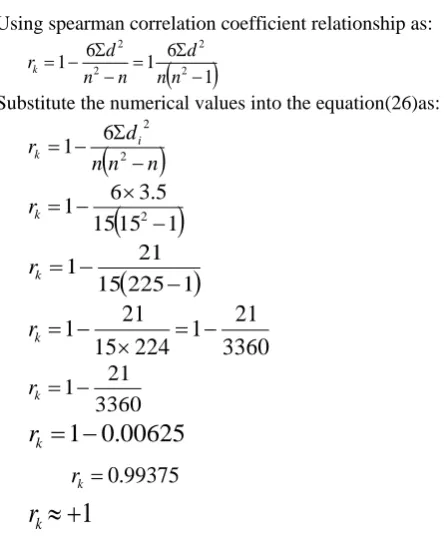
Using spearman correlation coefficient relationship as:
1
6 1 6
1 2
2 2
2
n n
d n
n d rk
Substitute the numerical values into the equation(26)as:
n n
n d
r i
k
2
2
6 1
15 1
15 5 . 3 6
1 2
k r
225 1
15 21 1
k
r
3360
21
1
224
15
21
1
k
r
3360 21 1
k r
00625
.
0
1
k
r
99375
.
0
k
r
V. CONCLUSION AND RECOMMENDATION
This paper presented an optimization of electric power generation for expansion planning and cost saving, using decomposition techniques. The techniques is highly flexible and proffer fast solution to problems and developed five optimization plans, in terms of mix-capacity combination for the selection of some generating station in Nigeria in order to search for the best capacity combination with respect to cost, thereby to derive financial benefits and cost-serving. This paper presented and formulated a decomposition techniques, which is used to analyse the breaking down processes of capacity combination in order to provide for an optimization search, with the aim of derive financial objectives through cost-function implementations.
This paper strongly rely on the analysis of load forecast results on the view to know the capacity of energy generation to be produced at different generating station, particularly in Nigeria.
Optimization of electric power generation for expansion planning and cost saving hold significant role in the future activities of every given nations, for purpose of regular power supply for effective and efficient micro and macro economic activities.
Therefore it is strongly recommended that generating capacity of a given generating station, must regularly be check for purpose of matching capacity generation and energy demand equilibrium at the receiving –end (consumers). That is mismatches as a result of violation, contingencies etc between generation of power and energy demand scenario may seriously led to system collapse. Hence, integration of mixed capacity combination set of generating unit will provide optimal options for cost saving; for purpose of deriving financial benefits.
REFERENCES
[1] Ault, G.W. & Donald, J. R. Mc, (2000). Planning for distributed generation within distributed networks in restructured electricity markets, IEEE Power Eng. Reveiwed, 30(20), 52-54.
[2] Energy Commission of Nigeria (ECN) (2003). National energy policy. Federal Republic of Nigeria, Abuja.
[3] Adenikinju, A (2005). Analysis of the cost of infrastructure failures in a developing economy the case of electricity sector in Nigeria. African Economic Research Consortium (AERC) Research Paper, 1489, Nairobi. February 2005.
[4] Akinbami, J.F.K. (2001). Renewable Energy Resources and technologies in Nigeria: present situation, future prospects and policy framework. mitigation and adaptation strategies for global change. Netherlands: Kluwer Academic Publisher.
[5] Amotsuka, P.O. (2008). Sustainable agriculture in the Niger Delta Region: A case study of Fatima Community of Rivers State. A paper Presented at 2nd National Conference of Colleges of Agriculture, Environmental, Engineering and Science and Technology, Hassan Usman Katsina Polytechnic. [6] Babalola, R. (2009, November 6). 6000MW Power
target report card. Daily Trust Newspaper, 22, 94.
[7] Haffner, S., Alver Pereira, L.F., Perira, L.A., & Barreto, L. S., (2008). Multistage model for distribution expansion planning with distributed generation – Part 1: Problem formulation, IEEE Transaction Power System., 23(5), 915-923.
[8] Ibitoye F, & Adenikinju A (2007). Future demand for electricity in Nigeria. Applied energy 84(24), 100-116. [9] Ilic, M., Galiana, F., & Fink L, (1998). Power system restructuring system Economics, Kiluwei Academic Publishers.
[10] Jeremy A. Bloom (2002). Solving an electricity
1
k
capacity expansion planning problem by Generalized Benders’ decomposition.
[11] Ojinaka , I.J. (2008). Energy crisis in Nigeria, The role of natural gas, The Bullion, The publication of Central Bank of Nigeria, 22 (4), 78-97.
[12] Sambo, A.S. (2008) Matching electricity supply with demand in Nigeria. International association of energy economics, 4(3),32-36.