Dynamic Electropulsing Induced Phase Transformations
and Their Effects on Single Point Diamond Turning of
AZ91 Alloy
Duo Zhang1, S. To1*, Yaohua Zhu1*, Hao Wang1, Guoyi Tang2
1State Key Laboratory in Ultra-Precision Machining Technology, Department of Industrial and Systems Engineering, Hong Kong
Polytechnic University, Hong Kong, China; 2Gratduate School at Shenzhen, Tsinghua University, Shenzhen, China. Email: *[email protected], *[email protected]
Received November 4th,2011; revised December 9th, 2011; accepted December 23rd, 2011
ABSTRACT
The effects of dynamic electropulsing on microstructure changes and phase transformations of a rolled Mg-9Al-1Zn alloy were studied by using optical microscopy, X-ray diffraction, back-scattered scanning microscopy and transmission electron microscopy techniques. The decomposition of β phase was accelerated under dynamic electropulsing, com-pared with the conventional thermal processes.Dynamic electropulsing was less effective in affecting the phase trans-formations, but more effective in reducing residual stress than the static electropulsing. Dynamic electropulsing im-proved machinability of single point diamond turning, the mechanism of which is discussed from the point of view of dislocation dynamics.
Keywords: Electropulsing; Phase Transformations; Dislocation; Twins; Magnesium Alloy
1. Introduction
Alloy materials suffer various external stresses during their manufacturing and in subsequent service [1]. It is of significant practical importance to reduce these residual stresses. It was reported that under electropulsing treat-ment (EPT), the residual stress was reduced significantly [2-10]. There are two practical types of electropulsing: static electropulsing and dynamic electropulsing. The for-mer combines a thermal process with electropulsing. The latter is a complex thermal process, which combines si-multaneously both electropulsing and plastic deformation. In the present work, the dynamic electropulsing in-duced phase transformations and microstructural changes, and their effects on Single Point Diamond Turning (SPDT) of the AZ91 alloy are studied from the point view of dislocation dynamics.
2. Experimental Procedures
A commercial magnesium alloy AZ91 (9.1wt% Al, 0.9wt% Zn, 0.2wt% Mn, balance Mg) was used. The ingot was homogenized at 693 K for 16 hrs and subse-quently extruded into strip of 2.90 mm wide and 1.45 mm thick. The extruded strip was then rolled under elec-tropulsing. During the rolling, the strip was moving at a
speed of 2 m/min between two electrodes set at a dis-tance of 225 mm. The thicknesses of the strip specimens before and after rolling were 1.45 mm and 1.20 mm thick, respectively. A self-made electropulsing generator was continuously applied to discharge multiple positive pulses with various current parameters on the rolling material, and it took about 10s for the strip to pass through the elec-trodes. During the dynamic electropulsing, the surface temperature was measured by a contact thermocouple for each test, and the current parameters including frequency, root-mean-square current (RMS), amplitude current and duration of multiple pulses were monitored by an oscil-loscope connected with a Hall effect sensor. These are listed in Table1. A schematic illustration of the dynamic electropulsing system is shown in Figure 1.
Longitudinal cross-sections of the specimens with various frequencies of EPT were polished before being examined under an electron microscope. A Hitachi- S4800 ultra-high resolution field emission scanning elec-tron microscope was used in a back-scattered elecelec-tron mode (BSEM) for examination of the microstructure of the specimens. The polished specimens were etched with a commercial solution [9] before the metallographic ob-servation using an Olympus GX51Inverted Microscope. An X-ray diffraction examination was performed with an X-ray diffractometer (Bruker D8 Advance), using nickel-
Table 1. Operation parameters of the electropulsing.
No. Frequency (Hz) Duration (μs) RMS (A) Amplitude (A/mm2) Temperature (K)
EPT 1 Non-EPT 293
EPT 2 126 70 52.00 211.2 316
EPT 3 204 70 63.05 237.6 349
EPT 4 265 70 89.53 256.5 359
EPT 5 309 70 100.19 271.6 390
ν=2m/min
Uncoiling unit Recoiling unit Cathode
Contactor Anode
Contactor
Electropulsing generator
L=120mm
Contact thermocouple
ν=2m/min
AZ91 Strip
Figure 1. A schematic view of dynamic electropulsing proc-ess.
filtered Cu Kα radiation. The range of diffraction was
selected from 25˚ to 65˚ (2θ). The scanning speed was 1 degree/min. An examination of TEM was carried out using a JEOL 2010 transmission electron microscope. A Gatan 691 Precision Ion Polishing System (PIPS) was used in the preparation of a thin film of the alloy for TEM examination.
After EPT, SPDT was performed on a two-axis com-puter numerically controlled (CNC) precision single point diamond turning machine (OptoForm 30 SPDT machine), and a face turning model of SPDT was used. The machining parameters are listed in Table 2. A force transducer Kistler 9252A was mounted with a pre-loaded force under the tool shank. A 14-bit multifunctional data acquisition (DAQ) card PCI-6132 (National Instrument) was configured on a PC workstation to record the data of the cutting force.
3. Results and Discussion
3.1. Electropulsing Induced Phase
Transformations and Microstructure Changes
Figure 2 shows the X-ray diffractograms of the as-rolled (non-EPT) specimen and the dynamic EPT specimens. The non-EPT specimen consisted of mainly two phases,
Table 2. Operating parameters of face turning in SPDT.
EPT Sample Non-EPT 126 Hz 204 Hz 265 Hz 309 Hz
Spindle speed (RPM) 8000
Feed (mm/min) 20
Depth of Cut (μm) 20
Figure 2. XRD patterns for specimens under various fre-quencies of electropulsing.
α-Mg phase and a β-phase (Mg17Al12). When the
fre-quency of electropulsing increased to 204 Hz, the XRD intensity of βphase reduced. Upon further increasing the frequency to 309 Hz, the XRD intensity of βphase fur-ther reduced. That implies the decomposition of β phase was accelerated when the frequency of electropulsing increased during dynamic electropulsing.
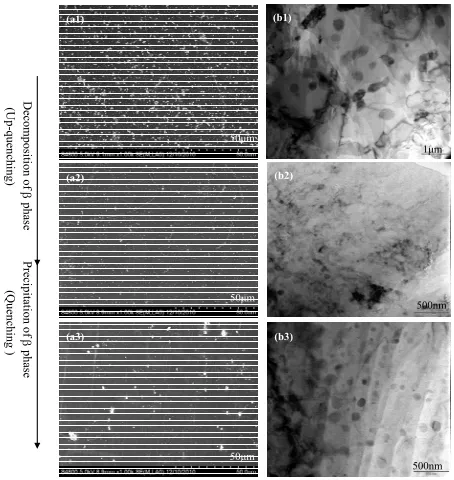
The BSEM images and TEM bright field images of specimens under various frequencies of dynamic EPT are shown in Figure 3. The matrix was α-Mg phase, while the precipitates were the β-phase (Mg17Al12). For the as
rolled specimen, numerous precipitates of β-phase can be found in Figure 3(a1); as the frequency of dynamic elec-tropulsing increased to 204 Hz, the amounts of β-phase precipitates decreased as shown in Figure 3(a2). When the frequency of electropulsing was increased to 309 Hz, even fewer precipitates could be observed, as shown in
Figure 3(a3). TEM bright field images of these speci-mens confirmed the same microstructure changes as shown in Figures 3(b1), (b2) and (b3). As the frequency of electropulsing increased, the amounts of precipitates marked by the white arrows decreased significantly, meaning that the decomposition of β phase occurred si-multaneously. Both the SEM results and TEM observa-tions were in good agreement with the XRD patterns, which are shown in Figure 2.
D
ecomposit
ion o
f
phase i
n a
w
ay of
U
p-que
nc
hi
ng
(a1)
(a2)
(a3)
50μm
50μm
50μm (b1)
(b2)
(b3)
1μm 1μm
[image:3.595.64.281.394.651.2]500nm
Figure 3. BSEM images of specimens: (a1) Non-EPT; (a2) 204 Hz-EPT; (a3) 309 Hz-EPT and TEM bright field images of specimens: (b1) Non-EPT; (b2) 204 Hz-EPT; (b3) 309 Hz-EPT, showing β phase precipitates changes with various frequencies of dynamic electropulsing.
α
β
(a)
(b1)
(c1)
(b2)
(c2)
500nm
500nm 500nm
Figure 4. TEM images of specimens after 204 Hz EPT: (a) Bright field image; (b2) Dark field image of
1010
reflec- tion together with (b1) diffraction pattern from B = 1213 of the αphase; (c2) Dark field image of (110) reflection to- gether with (c1) diffraction pattern from B = 111 of the
β phase.
in Figure 4(a). Together with the indexed SADPs shown in Figures 4(b1) and (c1), the dark field images reflected from 1213
1010 of the hcp α phase, and 111 (110) the bcc phases are shown in Figures 4(b2) and(c2), respectively. The lattice parameters of the phase are
a = 3.22 Å, c = 5.23 Å and c/a = 1.624; the lattice pa-rameters of the β phase is a = 10.690 Å.
For comparison, the AZ91 strips were statically elec-tropulsing-treated under various parameters. The BSEM images and TEM bright field images of the static EPT specimens are shown in Figure 4. It was reported that with increasing frequency of electropulsing [12], de-composition (in a way of up-quenching) and precipitation (in a way of quenching) of phase were tremendously accelerated sequentially, shown in Figure 5. While in the dynamic EPT specimens, only the decomposition of β
phase by a way of up-quenching occurred, as shown in
Figure 3. The decomposition of phase occurred after static 105 Hz-EPT for 10 s, while that completed after dynamic 309 Hz-EPT for 10 s. A higher frequency of electropulsing was needed in order to complete the de-composition of βphase in the same duration of electro-pulsing in the dynamic EPT alloy specimens.
It has been reported that for the decomposition to complete under conventional thermal process of the AZ91 strips, 10 hours of ageing in the range of 663 K was required [11]. This implies that electropulsing tre-mendously accelerated the phase transformations of the
Decomposi
tion of
phas
e
Preci
pi
tat
ion
of
phase
(Up-quen
chi
ng)
(Q
uenchi
ng
)
(b1)
(b2)
(b3)
1μm
500nm
500nm
(a1)
(a2)
(a3)
50μm
50μm
[image:3.595.310.537.440.680.2]50μm
AZ91 alloy at a relatively lower temperature within only a few seconds.
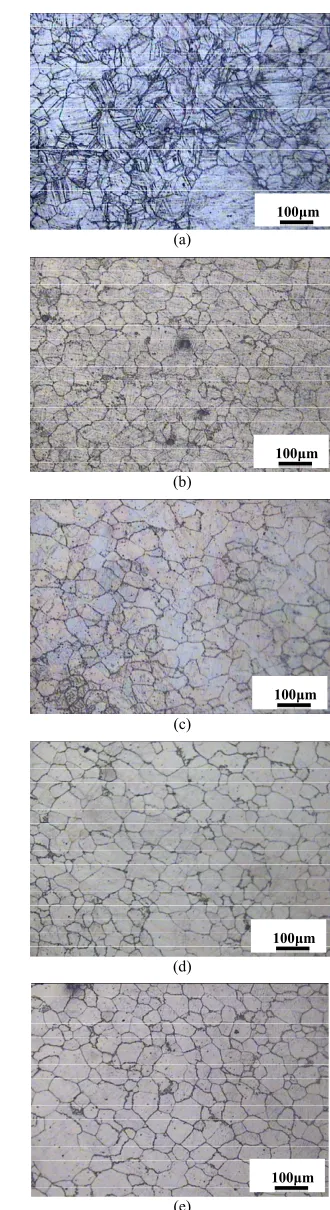
The optical micrographs of the non-EPT and the dy-namic EPT specimens with various frequencies are shown in Figure 6. For the non-EPT specimen, plenty of deformation twins were observed inside the grains, as shown in Figure 6(a). When the frequency of dynamic electrouplsing increased to 126 Hz, the twins inside the grains were rarely observed, as shown in Figure 6(b). Upon further increasing the frequency to 309 Hz, a rela-tively homogeneous microstructure of equal-axed grains was obtained, as shown in Figures 6(c)-(e). This was because under the dynamic electropulsing the external stress that resulted from the plastic deformation was re-duced simultaneously, and the twins quickly vanished under the dynamic electropulsing.
In comparison, the twins microstructure decreased gradually in the static EPT specimens [12], when the frequency increased from non-EPT to 209 Hz and 253 Hz, and disappeared after the 294 Hz-EPT.
3.2. Dislocation Dynamics
The dynamic electropulsing induced dislocation evolu-tion was detected by TEM examinaevolu-tion. In the non-EPT specimen, there were plenty of dislocation arrays and nodes, which were formed during the previous rolling, as shown in Figure 3(b1). After 204 Hz-EPT of dynamic electropulsing for about 10s, dislocation arrays and nodes decreased, as shown in Figure 3(b2). When the fre-quency of electropulsing increased to 309 Hz, the amount of dislocation was further reduced, as shown in Figure 3(b3).
It is suggested that under electropulsing, electron wind formed and pushed the defects in the specimen, such as dislocations and atomic vacancies towards the grain boundaries, where accumulation and annihilation of dis-location occurred at the same time [5-8].
With increasing frequency of electropulsing, both the accumulation and the annihilation of dislocation in-creased and were in an adequate balance at the grain boundaries. Thus, the dislocation density decreased [10].
3.3. Driving Force for Dynamic Electropulsing Induced Phase Transformation
The driving force for phase transformation in the dynamic EPT alloy specimens consists mainly of three parts:
chem ep stress
G G G G
, (1)
where Gchem is the chemical Gibbs free energy, Gep the
electrpulsing induced Gibbs free energy and Gstress the
stress induced Gibbs free energy. In the present study, the electropulsing considerably accelerated the decom-
100μm (a)
100μm
(b)
100μm
(c)
100μm (d)
100μm
[image:4.595.332.497.89.694.2](e)
position of phase in a way of up-quenching, i.e. the reverse phase transformations from final stable state back to a supersaturated state, (G > 0). For the reverse trans-formation, i.e. the decomposition of phase,
ep chem stress, where Gchem appeared as
an anti-driving force. The Gep became the driving force
for the reverse transformation.
G G G G
During dynamic electropulsing new structural distor-tions, such as dislocations and vacancies were created. When electron wind passed through the specimens, part of the electropulsing induced Gibbs free energy (Gep)
was exhausted through interaction between electrons and dislocation and vacancies which were created during mechanical deformation. Accordingly, the electropulsng induced Gep for the reverse phase transformation was
reduced. In addition, during dynamic electropulsing, the rolling induced stress reduced instantaneously, and the residual stress induced Gstress in the dynamic EPT
specimen was less than that in the static rolled specimen. Therefore, the total G in the dynamic EPT specimen was smaller than that in the static EPT specimen, i.e. the dynamic electropulsing was less effective than the static electropulsing in accelerating decomposition of phase.
3.4. Changes of Machining Properties Induced by EPT
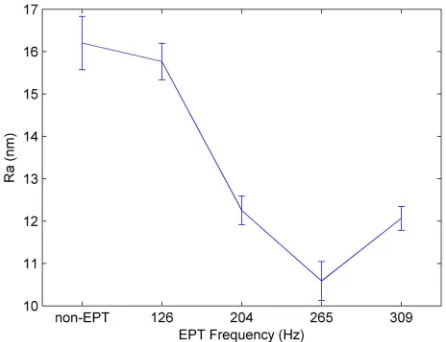
Shown in Figure 7 and Figure 8 are the SPDT cutting force and surface roughness of the non-EPT specimen and four dynamic EPT specimens, with various frequen-cies of electropulsing (126 Hz, 204 Hz, 265 Hz and 309 Hz), respectively. It can be seen that the mean cutting force decreased significantly when the frequency of elec-tropulsing increased. For the non-EPT specimen, the mean cutting force was 67.4 mN, with the surface roughness of 16.2 nm. When the frequency of electro-pulsing increased to 126 Hz, the mean cutting force de-creased to 46.2 mN, with the surface roughness of 15.8 nm; upon the frequency being further increased to 204 Hz, 26 Hz and 309 Hz, the mean cutting force decreased to 44.7 mN, 49.8 mN, and 50.7 mn, with the surface roughness of 12.3 nm, 10.6 nm and 12.1 nm, respectively. From Figure 5(b) and Figure 6, it can be seen that under dynamic electropulsing, dislocation density decreased, and large amounts of deformation twins diminished with a homogenous fine grain structure. As a result, the cut-ting force for SPDT processing decreased and surface roughness improved when the frequencies increased. The machinability of AZ91 alloy in SPDT was improved un-der dynamic electropulsing.
4. Conclusions
[image:5.595.312.536.96.273.2]In summary, it is concluded as follows:
Figure 7. Mean cutting force under various frequencies of electropulsing with depth of cut of 20 µm.
Figure 8. Surface roughness changes under different fre-quency of EPT, with depth of cut of 20 µm.
1) The β phase decomposition was considerably accel-erated by a way of up-quenching under dynamic electro-pulsing, compared with the conventional thermal proc-essing. The dynamic electropulsing was less effective than the static electropulsing in accelerating decomposi-tion of phase.
2) Under dynamic electropulsing, the twins micro-structure disappeared in the rolled alloyAZ91, and a homogeneous fine grain structure was achieved. Dynamic electropulsing was more effective in reducing residual stress than the static electropulsing.
3) Under dynamic electropulsing, the SPDT cutting force decreased and surface roughness improved. The machinability of AZ91 alloy was improved.
5. Acknowledgements
[image:5.595.312.535.313.484.2]by a grant fromthe Research Grants Council of the Hong Kong Special Administrative Region, China (Project No. PolyU 5316/09E).
REFERENCES
[1] Y. H. Zhu, “General Rule of Phase Decomposition in Zn-Al Based Alloys II—On Effect of External Stress on Phase Transformation,” Materials Transactions, Vol. 45, No. 11, 2004, pp. 3083-3097.
doi:10.2320/matertrans.45.3083
[2] O. A. Troitskii, “Electromechnical Effect in Metals,” Jour-
nal of Experimental and Theoretical Physics, Vol. 10,
1969, pp. 18-22.
[3] H. Conrade and A. F. Sprecher, “Dislocation in Solid,” Elsevier, Amsterdam, 1989, p. 497.
[4] H. Conrad, J. White, W. D. Cao, X. P. Lu and A. F. Sprecher, “Effect of Electric Current Pulses on Fatigue Characteristics of Polycrystalline Copper,” Materials Sci-
ence and Engineering: A, Vol. 145, No. 1, 1991, pp. 1-12.
doi:10.1016/0921-5093(91)90290-4
[5] D. Yang and H. Conrade, “Exploratory Study into the Effects of an Electric Field and High Current Density Electropulsing on the Plastic Deformation of TiAl,”
In-termetallics, Vol. 9, 2001, pp. 943-947.
[6] J. R. Lloyd, “Electromigration in Integrated Circuit Con-ductors,” Journal of Physics D: Applied Physics, Vol. 32, No. 17, 1999, pp. R109-R118.
doi:10.1088/0022-3727/32/17/201
[7] S. H. Xiao, J. D. Guo and S. X. Li, “The Effect of Elec-tropulsing on Dislocation Structures in [223] Coplanar Double-Slip-Oriented Fatigued Copper Single Crystals,”
Philisophycal Magazine Letters, Vol. 82, No. 11, 2002,
pp. 617-622. doi:10.1080/0950083021000030397 [8] Y. Z. Zhou, W. Zhang, J. D. Guo and G. H. He,
“Diffu-sive Phase Transformation in a Cu-Zn Alloy under Rapid Heating by Electropulsing,” Philosophycal Magazine
Letters, Vol. 84, No. 5, 2004, pp. 341-348.
doi:10.1081/09500830410001664535
[9] V. V. Stolyarov, “Deformability and Nanostructuring of TiNi Shape-Memory Alloys during Electroplastic Roll-ing,” Materials Science and Engineering: A, Vol. 503, No. 1-2, 2009, pp. 18-20. doi:10.1016/j.msea.2008.01.094 [10] Y. H. Zhu, S. To, W. B. Lee, X. M. Liu, Y. B. Jiang and
G. Y. Tang, “Effect of Dynamic Electropulsing on Mi-crostructure and Elongation of a Zn-Al Based Alloy,”
Materials Science and Engineering: A,Vol. 501, No. 1-2,
2009, pp. 125-132. doi:10.1016/j.msea.2008.09.080 [11] Y. B. Jiang, G. Y. Tang, C. H. Shek and Y. H. Zhu, “On
the Thermodynamics and Kinetics of Electropulsing In-duced Dissolution of -Mg17Al12 Phase in an Aged Mg- 9Al-1Zn Alloy,” Acta Materialia,Vol. 57, No. 16, 2009, pp. 4797-4808.
[12] D. Zhang, S. To, Y. H. Zhu, H. Wang and G. Y. Tang, “Static Electropulsing Induced Microstructural Changes and Their Effect on the Ultra-Precision Machining of Cold-Rolled AZ91 Alloy,” Metallurgical and Materials