GENETIC PARAMETERS IN MAIZE HYBRIDS ANAL
*Maicon Nardino, Ivan Ricardo Carvalho, Diego Baretta,
Vinicius Szareski, Alan Junior Pelegrin, Mauricio Ferrari, Valmor
Denise Schmidt and
Universidade Federal de Pelotas, Brazil
ARTICLE INFO ABSTRACT
Penetrance and expressivity are phenomena that interfere the trait
modify the correspondence between genotype and phenotype, difficulting the breeder's task. The aim of this study was to determine the penetrance and expressivi
mays L.): tassel length, distance from the last node of the stem to the first branch of the tassel, distance from flag leaf to the first branch of the tassel, number of branches on the main stem of the tassel, tho
different growth sites for single hybrid selection (HS). The crosses were performed in Clevelândia PR, Brazil, which afforded 25 HS, the seeds were sown in five different
experimental design was a randomized complete block design with three replications. The results reveal that the length of the tassel and the thousand
variance, indicating variable penetrance
Copyright©2016, Maicon Nardino et al. This is an open access article distributed under the Creative Commons Att use, distribution, and reproduction in any medium, provided the original work is properly cited.
INTRODUCTION
Estimates of variance components and genetic parameters are extremely important for plant breeding, because they allow inferences about the nature of trait. The variability in traits is caused by genetic differences and environment in which the plants grow (Allard, 1971; Ramalho et al., 2012
parameters allow express the magnitude of the component parts of the phenotype. The characterization of the biological variation is the basis for the work of geneticists and plant breeders where that to distinguish and understand the hereditary basis of the traits, the distinguish of two components is required: genetic and nongenetic (environmental) and the magnitude of its effects. In this context, the genetic
models had been contributed to elucidate this change, especially for quantitative traits. The efficiency and clarification of the models has brought a si
contribution to the work of plant breeders (Bueno The study of heritability is important for decision
taken as to which breeding method, according to the breeding program goal. According to Fehr (1987), the heritability i conceived in broad and narrow sense. The heritability in the
*Corresponding author: Maicon Nardino,
Universidade Federal de Pelotas, Brazil.
ISSN: 0975-833X
Article History:
Received 16th May, 2016 Received in revised form 07th June, 2016
Accepted 12th July, 2016 Published online 20th August,2016
Key words:
Heritability wide,
Genetic variance, Zea mays L.
Citation: Maicon Nardino, Ivan Ricardo Carvalho, Diego Baretta International Journal of Current Research, 8, (08), 35552
RESEARCH ARTICLE
N MAIZE HYBRIDS ANALYSIS IN DIFFERENT EN
Maicon Nardino, Ivan Ricardo Carvalho, Diego Baretta, Diego Nicolau Follmann, Tiago Olivoto,
Vinicius Szareski, Alan Junior Pelegrin, Mauricio Ferrari, Valmor AntonioKonflanz,
Denise Schmidt and Velci Queiróz de Souza
Universidade Federal de Pelotas, Brazil
ABSTRACT
Penetrance and expressivity are phenomena that interfere the trait
modify the correspondence between genotype and phenotype, difficulting the breeder's task. The aim of this study was to determine the penetrance and expressivity of following traits in cornhybrids (
L.): tassel length, distance from the last node of the stem to the first branch of the tassel, distance from flag leaf to the first branch of the tassel, number of branches on the main stem of the tassel, thousand-kernel weight and grain yield of corn as the magnitude of genetic parameters in different growth sites for single hybrid selection (HS). The crosses were performed in Clevelândia PR, Brazil, which afforded 25 HS, the seeds were sown in five different
experimental design was a randomized complete block design with three replications. The results reveal that the length of the tassel and the thousand-grain weight are the traits with high genetic variance, indicating variable penetrance and expressivity.
is an open access article distributed under the Creative Commons Attribution License, which use, distribution, and reproduction in any medium, provided the original work is properly cited.
Estimates of variance components and genetic parameters are extremely important for plant breeding, because they allow inferences about the nature of trait. The variability in traits is caused by genetic differences and environment in which the ., 2012). Estimates of parameters allow express the magnitude of the component The characterization of the biological variation is the basis for the work of geneticists and plant breeders where that to distinguish and understand the hereditary basis of the traits, the distinguish of two components d nongenetic (environmental) and the magnitude of its effects. In this context, the genetic-statistics models had been contributed to elucidate this change, especially for quantitative traits. The efficiency and clarification of the models has brought a significant contribution to the work of plant breeders (Bueno et al., 2006). The study of heritability is important for decision-practical breeding method, according to the breeding program goal. According to Fehr (1987), the heritability is conceived in broad and narrow sense. The heritability in the
broad sense is provided by the total genetic variance, including additivity, dominance and epistasis in
phenotypic variance. The heritability in the narrow sense is the proportion of additive variance in relation to phenotypic variance. The concepts of heritability are important for the analysis and identification of traits that are floating
to different environments, this because it allows us to foresee the possibility to selection, reflecting the proportion of phenotypic variation that can be inherited.
heritability of a trait is not immutable, due occur trait change regarding the proportion of genetic variation present and with the effect of the environment (Ramalho
context, one can increase the heritability estimates using population with highestgenetic variation and controlling the environmental effects through improved experimental conditions in order to reduce the environmental contribution to the total phenotypic variation.
the trait-gene relationship, it is expected that environmental factors can modify certain inheritance models, even if these factors are subtle and trivial. Most genes are expressed in fairly uniform and predictable manner, considering normal environmental conditions to which they are exposed. The expression of a gene can be significantly altered
factors and or environment. The expression of a gene refers to expression mode, generally ranging for different environmental conditions. The penetrance refers to the
International Journal of Current Research
Vol. 8, Issue, 08, pp.35552-35556, August, 2016
INTERNATIONAL
Maicon Nardino, Ivan Ricardo Carvalho, Diego Baretta et al. 2016. “Genetic parameters in maize hybrids analysis in different environments
35552-35556.
YSIS IN DIFFERENT ENVIRONMENTS
Diego Nicolau Follmann, Tiago Olivoto,
AntonioKonflanz,
Penetrance and expressivity are phenomena that interfere the trait-gene relationship and tend to modify the correspondence between genotype and phenotype, difficulting the breeder's task. The aim ty of following traits in cornhybrids (Zea
L.): tassel length, distance from the last node of the stem to the first branch of the tassel, distance from flag leaf to the first branch of the tassel, number of branches on the main stem of the kernel weight and grain yield of corn as the magnitude of genetic parameters in different growth sites for single hybrid selection (HS). The crosses were performed in Clevelândia-PR, Brazil, which afforded 25 HS, the seeds were sown in five different environments. The experimental design was a randomized complete block design with three replications. The results grain weight are the traits with high genetic
ribution License, which permits unrestricted
broad sense is provided by the total genetic variance, including additivity, dominance and epistasis in relation to the phenotypic variance. The heritability in the narrow sense is the proportion of additive variance in relation to phenotypic variance. The concepts of heritability are important for the analysis and identification of traits that are floating according to different environments, this because it allows us to foresee the possibility to selection, reflecting the proportion of phenotypic variation that can be inherited. Estimates of heritability of a trait is not immutable, due occur trait change egarding the proportion of genetic variation present and with the effect of the environment (Ramalho et al., 2012). In this context, one can increase the heritability estimates using population with highestgenetic variation and controlling the l effects through improved experimental conditions in order to reduce the environmental contribution to the total phenotypic variation. Due to the complex nature of gene relationship, it is expected that environmental nheritance models, even if these factors are subtle and trivial. Most genes are expressed in fairly uniform and predictable manner, considering normal environmental conditions to which they are exposed. The expression of a gene can be significantly altered by genetic factors and or environment. The expression of a gene refers to expression mode, generally ranging for different environmental conditions. The penetrance refers to the
INTERNATIONAL JOURNAL OF CURRENT RESEARCH
expression or non-expression of a gene. Thus, penetrance and expressivity are phenomena that mask the relative trait-gene and tend to modify the correlation between genotype and phenotype, making difficult the breeder's task, especially for traits that have incomplete penetrance and variable expressivity (Allard, 1971). In this context, we aimed to assess the penetrance and expressivity of corn traits to the magnitude of genetic parameters in identifying growth sites for the selection of superior hybrids.
MATERIALS AND METHODS
The crossing of homozygous lines was conducted in the municipality of Clevelândia - PR in the 2010/2011 growing season. The inbred lines came from the breeding program of KSP Seeds Ltd. company, based in PatoBranco, PR, Brazil. The crossings for formation of hybrids was carried out in a partial diallel, using 15 (female lines) and eight (male lines), the lines were in the ninth self-pollination generation (S9).
After completion of directed crossings, we obtained the F1's
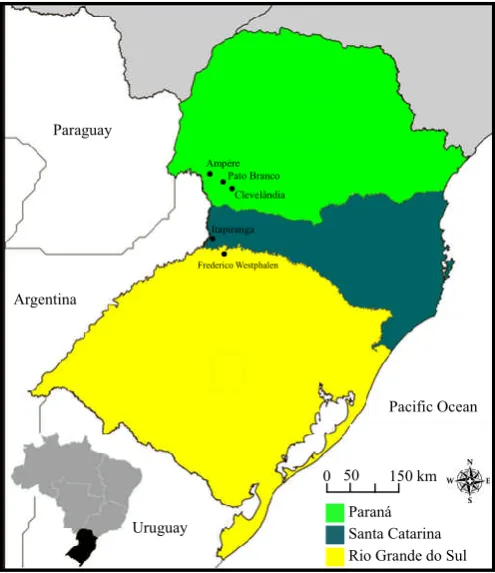
seeds that were sown in the 2011/2012 growing season. Sowing of hybrids derived from crosses was carried out in five environments of the three southern states of Brazil: Ampére, PatoBranco, and Clevelândia in Paraná state, Itapiranga in the Santa Catarina state and Frederico Westphalen in the Rio Grande do Sul state (Figure 1).
Figure 1. Geographical location of environments where the trial were conducted. You can observe the southern region of Brazil, highlighted in black on the bottom map and the three states where the trials were conducted highlighted in colors on the main map
Table 1 shows the locations of driving tests with geographical coordinates and the level of each experimental area. Also are present the classification and characteristics of climate.
Prior the installation of the trials was carried out verification and survey of potentially disruptive characteristics, thus, in all environments, a randomized complete block design with three replications per location was used in order to ensure uniformity within the block and heterogeneity between the blocks. The experimental units were composed of two 5-m long cultivar rows, spaced by 0.70 meters. The seeding rows were marked with no-tillage seeder system, after, the hybrid seeds were manually sown. Sowing was carried out according to the agricultural zoning of each site. Soil management and cultural practices were the same for the five sites obeying the phenological stages and the need for culture. After emergence
and crop establishment, we adjusted the plant density to 42 plants per experimental unit, equivalent to 60 000 plants ha-¹. The assessed traits were tassel length (TL) in
centimeters; distance from the last node of the stem to the first branch of the tassel (DLN) in centimeters; distance of the flag leaf to the first branch of the tassel (DFL) measured in the collar of flag leaf to the insertion of the first branch in the tassel, in centimeters; number of branches on the main stem of the tassel (NBT); thousand-kernel weight (TKW), measured by manual counting of 8 replicates of 100 seeds, in grams; and grain yield (GY), conducted by manual harvesting of all experimental units and extrapolated to kg ha-1Previously the analysis of genetic parameters, we verified the effects of homogeneity of variances and the data normality. After, the data were subjected to individual analysis of variance, to prove the absence of correlation among errors. Meeting the assumptions, we performed the genetic parameters estimates.
Aiming to identify the variation of the progenies, in each environment we estimate the genetic variance and heritability in the broad sense with their respective confidence intervals, as proposed by Knapp et al. (1985):
σG ²
=MST - RMS R
Were σG ²
= Genetic variance; MST =Mean square for treatments; RMS: Residual mean square and R = number of replicates each treatment.
h2= σG
²
MST/R
h2: heritability in the broad sense; σG ²
= genetic variance; MST = mean square for treatment; R = number of replicates.
CI = 1 - MST
RMS(F DF1, DF2)
CI = confidence interval to heritability of trait; DF: degrees freedom, 1 (Treatment/environment)and 2 (residual degree of freedom); F0.05:120:240= 0.7652997 e F0.95:120:240= 1.289621,
where F is the tabulated value at a specified probability level with respect to specific number of degrees of freedom of treatments (Crossings) varying inside of environments and residual.
Statistical procedures were carried out in Genes (Cruz, 2013) and SAS (SAS, 2013) softwares.
Uruguay Argentina
Paraguay
Pacific Ocean
Santa Catarina Rio Grande do Sul Paraná
150 km 0 50
Frederico Westphalen
Itapiranga Pato Branco Ampére
[image:2.595.39.287.366.653.2]RESULTS AND DISCUSSION
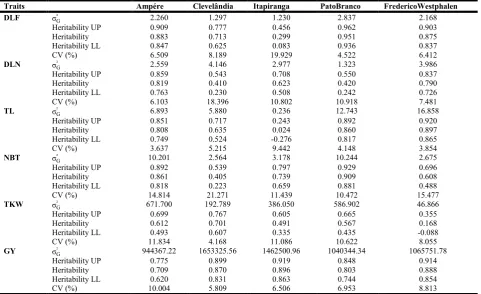
The genetic variance for the DLF trait showed variations in environments from 1.29 to 2.83 (cm) for DLN from 1.32 to 4.14 (cm) and for the TL from 0.23 to 16.85 (cm). Among these traits, the TL shows greater genetic variance among the analyzed environments. The NBT had variance from 2.56 to 10.24, however, TKW had magnitudes from 46.86 to 671.70 (g). The GY presented most genetic fluctuation between Ampere and Clevelândia, with the smaller variation in Ampere (Table 2). The determination of the genetic variation is the basis for the plant breeder's work, which aim understanding the hereditary basis of the traits. Thus, to dismember the phenotypic component in genetic and environmental components is necessary (Bueno et al., 2006). The determination of a variance component as a parameter as heritability are important in breeding programs for the
quantification of genetic variation in the number of individuals seeking future genetic gains. This point is considered the best form to allocate the necessary resources during the process of selecting a trait of interest, especially to reduce the selection time (Smalley et al., 2004).
[image:3.595.33.563.85.153.2]The different estimates for the traits reveled that the effects of growing environments provide changes in expression of the trait, where the environment is the main element for increased phenotypic variation. These oscillations between estimates of genetic varianceare attributed to the contrasting effects and environmental modifiers, influencing the physiological mechanisms and controlling the expression of the traits (Falconer, 1996; Carvalho et al., 2004). These results demand caution of breeders since the environment is not hereditary component, so the presence of phenotypic variation inflated primarily by environmental component may to implicate in the
Table 1. Location and climate characteristics of experimental areas
State City South LAT West LONG MASL Climate+ Average temperature +, * (ºC)
Annual rainfall+ (mm) Tcold Thot
Rio Grande do Sul FredericoWestphalen 27°23'80'' 53°25'26'' 480 Cfa 14.8 23.6 1881
Santa Catarina Itapiranga 27°10'10" 53°42'44" 206 Cfa 1760
Paraná Ampére 25°54'65'' 53º25'39'' 580 Cfa 1960
PatoBranco 26°13′44″ 52°40′15″ 760 Cfa 1947
Clevelândia 26°21'52'' 52°28'22'' 860 Cfb 13.4 20.0 2243
+ The climate classification is according to Alvarez et al. (2014).
* Average air temperature for the two climate classifications presented in the trial places. Thot= average air temperature in the hottest month of the year,Tcold= Average air temperature in the coldest month of the year.
Table 2. Estimates of genetic variance (σG² ), heritability in sense broad coefficients and their respective confidence intervals (Upper Limit - UP, Low Limit - LL), and coefficient of variation for six traits of F1’s hybrids maize growing in five environments
of south region of Brazil
Traits Ampére Clevelândia Itapiranga PatoBranco FredericoWestphalen
DLF σG² 2.260 1.297 1.230 2.837 2.168
Heritability UP 0.909 0.777 0.456 0.962 0.903
Heritability 0.883 0.713 0.299 0.951 0.875
Heritability LL 0.847 0.625 0.083 0.936 0.837
CV (%) 6.509 8.189 19.929 4.522 6.412
DLN σG² 2.559 4.146 2.977 1.323 3.986
Heritability UP 0.859 0.543 0.708 0.550 0.837
Heritability 0.819 0.410 0.623 0.420 0.790
Heritability LL 0.763 0.230 0.508 0.242 0.726
CV (%) 6.103 18.396 10.802 10.918 7.481
TL σG² 6.893 5.880 0.236 12.743 16.858
Heritability UP 0.851 0.717 0.243 0.892 0.920
Heritability 0.808 0.635 0.024 0.860 0.897
Heritability LL 0.749 0.524 -0.276 0.817 0.865
CV (%) 3.637 5.215 9.442 4.148 3.854
NBT σG² 10.201 2.564 3.178 10.244 2.675
Heritability UP 0.892 0.539 0.797 0.929 0.696
Heritability 0.861 0.405 0.739 0.909 0.608
Heritability LL 0.818 0.223 0.659 0.881 0.488
CV (%) 14.814 21.271 11.439 10.472 15.477
TKW σG² 671.700 192.789 386.050 586.902 46.866
Heritability UP 0.699 0.767 0.605 0.665 0.355
Heritability 0.612 0.701 0.491 0.567 0.168
Heritability LL 0.493 0.607 0.335 0.435 -0.088
CV (%) 11.834 4.168 11.086 10.622 8.055
GY σG² 944367.22 1653325.56 1462500.96 1040344.34 1065751.78
Heritability UP 0.775 0.899 0.919 0.848 0.914
Heritability 0.709 0.870 0.896 0.803 0.888
Heritability LL 0.620 0.831 0.863 0.744 0.854
CV (%) 10.004 5.809 6.506 6.953 8.813
[image:3.595.60.542.234.528.2]no-selection of superior genotypes to certain traits. Confidence intervals for the heritability in the broad sense are different from zero in Ampere, Clevelândia and PatoBranco environments for all analyzed traits. We can see that some traits shown estimates of broad heritability close to zero, such as the DLF and TL in Itapiranga environment. Heritability estimates close to zero indicate low expression of the character to the environmental conditions, and/or the need for a greater number of replications and plant sampling in the conditions of this environment. According to Pinto et al. (2000), the occurrences of low parameter estimation, indicate an increase in population sample of work. Components and heritability estimates are important parameters for breeding programs in determining the allocation of resources necessary for the selection of a trait of interest and thus increase the genetic gain using less time and resources (Smalley et al., 2004). Heritability for DLF and TL traits was high, revealing high penetrance and expressivity of the traits for Ampere, Clevelândia, PatoBranco and FredericoWestphalen, 70-95% and 63-89%, respectively, however, Itapiranga shows low heritability for these traits (29.9% and 2.24%, respectively). These estimates were lower than in other environments, demonstrating that the expressiveness of these traits is reduced in this environment condition (Hallauer et al., 2010). The mechanisms that acted in this sites, e.g., temperature, humidity and solar radiation, increased the phenotypic variance of the hybrids and thus reduced the expressiveness of the traits. Possibly, with greater plants sampling, the effects of environment would be minimized, raising the representation for this specific site. The heritability of DLN and NBT traits reveal their expressiveness by median and high estimates. Lower heritability coefficients are observed for Clevelândia (41 and 40%, respectively). Thus, we proved that the expressiveness is specific to each environment, and type of progeny (stepbrothers, brothers complete, S1, S2) of each
population, findings similar to found by Hallauer (2007). The TKW shows high variations of heritability coefficients in the five environments studied (0.16 to 0.70 for Frederico Westphalen and Clevelândia, respectively), indicating that this trait has a complex action with its expression being controlled by a larger number of genes, having greater variations in expressiveness when subjected to differing conditions, where the action of the interaction above the genotype is more impactful. This is grounded once that high heritability estimates, indicate greater stability to environmental variations and by the traits present a less complex (Hall et al., 2007). Thus, the penetrance and expressivity of the trait under stable conditions is higher. The DLF and TL traits had low expressiveness in Itapiranga and together with Frederico Westphalen for TKW, due the magnitude of heritability coefficients be lower than those other environments. For GY the heritability estimates show little variation and its values were considered high. We believe that due the heritability be obtained by the ratio between genotypic and phenotypic variance in each environment, their estimates remained high due the adequate experimental conditions, since the variation coefficients were low. Another point that can be highlighted in our results is that the main traits of interest to the breeder, as TKW and GY had high heritability estimates in Clevelândia. The driving segregant inbred lines in an environment tends to provide better aclimatation of these to certain ambient
conditions in which were selected. As breeding program KSP seed was conducted at this location, hybrids resulting from these crosses tend to have less influence of environment in Clevelândia, there for, the contribution of environmental variation in phenotypic variation is smaller, which increases the estimate of heritability, as observed in this study. The accuracy in predicting the responses of the traits is very important for achieving success in plant breeding programs, where the goal is to get reliable estimates of traits’ mean (Fritsche-Neto et al., 2012). The technologies and aggregate planning on experiments have been positively contributing to the increase of experimental accuracy in maize trials. For Pimentel Gomes (2000), this dimensionless statistics enables you to compare the accuracy of the experiments. The CV (%) of the individual analysis in each place had low to median values (Table 2), indicating good accuracy in taking the data in each environment for traits (PimentelGomes, 1985). However it is noteworthy that the CV is given by the ratio between the residual standard deviation with the percentage of general average of the trial, thus,the comparison with different trials and traits may not be suitable because of the different conditions of planning and execution of trial, and also the specific magnitudes of traits for the specie under study.
Conclusions
The tassel length and the thousand-grain weight are the traits with high genetic variance. For the yield traits, Clevelândia environment is indicated for selection due the high estimates of heritability. Itapiranga and Frederico Westphalen environments has the lowest expression for the traits tassel length, distance from the flag leaf to the first branch of the tassel and thousand-grain weight.
REFERENCES
Allard, RW.1971. Princípios do melhoramento genético das plantas. São Paulo: Ed: Edgard Blücher Ltda., pp 485. Alvares, CA., Stape, JL.,Sentelhas, PC., Moraes Gonçalves,
JL.andSparovek, G. 2013. Köppen’s climate classification map for Brazil. MeteorologischeZeitschrift, 22:711-728.doi: 10.1127/0941-2948/2013/0507.
Bueno, LCS.,Mendes, ANG. AndCarvalho, SP. 2006. Melhoramento de plantas: princípios e procedimento.2 ed. Lavras: Ed:UFLA, pp 319.
Câmara, TMM., Bento, DAV.,Alves, GF.,Santos, MF., Moreira, JUV. And Júnior, CLS. 2007. Parâmetros genéticos de caracteres relacionados à tolerância à deficiência hídrica em milho tropical. Bragantia, 66:595-603.doi: 10.1590/S0006-87052007000400009.
Carvalho, ADF., Souza, JC. And Ramalho, MAP. 2004. Capacidade de combinação de progênies parcialmente endogâmicas obtidas de híbridos comerciais de milho.
Revista Brasileira de Milho e Sorgo, 3:429-437.doi:10.18512/1980-6477/rbms.v3n3p429-437.
Cruz, CD. 2013. 2013. GENES - a software package for analysis in experimental statistics and quantitative genetics.
Acta Scientiarum. Agronomy, 35:271-276.doi: 10.4025/ actasciagron.v35i3.21251.
Falconer, DS. 1996. Introdução à genética quantitativa. 4 ed. Viçosa: Ed: UFV, pp 464.
Fehr, W.R. 1987. Principles of cultivar development. New York: Ed: MacMillan, pp 525.
Fritsche-Neto, R.,Vieira, RA.,Scapim, CA.,Miranda, VG.andRezende, LM. 2012. Updating the ranking of the coefficients of variation from maize experiments. Acta Scientiarum. Agronomy, 34: 99-101.doi:10.4025/actascia gron.v34i1.13115.
Hallauer, AR, Carena, JM. and Miranda-Filho, JB. 2010. Quantitative genetics in maize breeding. New York: Ed:
Springer, pp 500.
Hallauer, AR. 2007. History, Contribution, and Future of Quantitative Genetics in Plant Breeding: Lessons From Maize. Crop Science, 47:4-19.doi:10.2135/cropsci2007.04. 0002IPBS.
Knapp, SJ., Stroup, WW. and Ross, MW. 1985. Exact confidence intervals for heritability on a progeny mean basis. Crop Science, 25:192-194.doi:10.2135/cropsci1985. 0011183X002500010046x.
Pimentel Gomes, F. 1985. Curso de Estatística Experimental. São Paulo: Ed: USP/Esalq, pp 467.
Pimentel Gomes, F. 2000. Curso de Estatística experimental. 14 ed. Piracicaba:Ed: Livraria Nobel, pp 468.
Pinto, RMC., Neto, FPL. and Júnior, CLS. 2000. Estimativa do número apropriado de progênies S1 para a seleção
recorrente em milho. Pesquisa Agropecuária Brasileira,
35:63-73.doi:10.1590/S0100-204X2000000100009. Ramalho, M., Santos, JB., Pinto, CB., Souza, EA., Gonçalves,
FMA. And Souza, JC. 2012. Genética na Agropecuária.5 ed. Lavras: Ed: UFLA, pp565.
SAS.2013. Getting Started with the SAS® Learning Edition. Cary, NC: SAS Institute, pp81.
Smalley, MD., Daub, JL. and Hallauer, AR. 2004. Estimation of heritability in maize by parent-offspring regression.
Maydica, 49:221-229.