COMPARATIVE PERFORMANCE ANALYSIS OF
*Richards, P.N., Prinu C. Philip, Ashok, A. and
Shepherd Institute of Engineering and Technology
ARTICLE INFO ABSTRACT
Orthogonal Frequency Division Multiplexing (OFDM) is the important techniques in 4th Generation Long Term Evolution (LTE). Now the work is going on to for 5G. OFDM provides high reliability, high data rate, speed and robustness. But, there are some drawbac
efficiency of the communication system. One of the drawback is loss of Orthogonality in between the subcarriers there is intercarrier interference (ICI) and intersymbol interference (ISI) and this is over come by cyclic prefix. S
overcome loss of bandwidth and to improve the performance of BER wavelet transform is used instead of Discrete Fourier Transform (DFT) and cyclic prefix. Hence, spectrum efficiency signal is increased so as to increase the performance of BER. In the future work, Stanford University Interim (SUI) channel is replaced by AWGN channel. In SUI modeling is done in the channel to improve the performance of the signal at different pat
Copyright©2017, Richards et al. This is an open access article distributed under the Creative Commons Att distribution, and reproduction in any medium, provided the original work is properly cited.
INTRODUCTION
OFDM is a wireless access method in a vast area which will enables a non-line of sight wireless services
and Homayoun, 2006). In the frequency division multiplexing scheme channel will be seperated into different tiny sub channels. In the FDM to get a better interference between the two sub-channels guard intervals are introduced. The bandwidth in OFDM will be divided into small sub termed as sub-carriers (Louis and Michael, 2001). these sub-channels are combined together as sub
sub-carriers are the combination of data carriers and pilot carriers through a DC. The usage of data carriers is transmission of data and pilot carriers are utilised for sensing. In common the sub-carriers are modulated with normal modulation techniques such as Quadrature Amplitude Modulation and Phase Shift Keying (PSK). For every user number of sub-channels will be given and every sub
comprised of number of sub-carriers. The
carried on low data rate in every sub-carrier. For the higher data rates these parallel sub-carriers are combined in destination. These sub-carriers transmit data at less data rate and thus higher symbol time so it is more durable to mul effects. So it is more suitable for wide-area non
wireless access and in OFDM without using the guard intervals
*Corresponding author: Richards, P.N.,
Shepherd Institute of Engineering and Technology, Shuats Allahabad- 211007, India.
ISSN: 0975-833X
Article History:
Received 24th July, 2017 Received in revised form 14th August, 2017
Accepted 11th September, 2017 Published online 31st October, 2017
Citation: Richards, P.N., Prinu C. Philip, Ashok, A. and Jaiswal A. different modulation techniques”, International Journal of Current Research Key words:
OFDM, MIMO, LTE, Cyclic Prefix, ICI & ISI, Spectral Efficiency SUI channel.
RESEARCH ARTICLE
ARATIVE PERFORMANCE ANALYSIS OFDFT AND DWT BASED OF DM USING DIFFERENT
MODULATION TECHNIQUES
Richards, P.N., Prinu C. Philip, Ashok, A. and Jaiswal
Shepherd Institute of Engineering and Technology, Shuats University, Allahabad
ABSTRACT
Orthogonal Frequency Division Multiplexing (OFDM) is the important techniques in 4th Generation Long Term Evolution (LTE). Now the work is going on to for 5G. OFDM provides high reliability, high data rate, speed and robustness. But, there are some drawbac
efficiency of the communication system. One of the drawback is loss of Orthogonality in between the subcarriers there is intercarrier interference (ICI) and intersymbol interference (ISI) and this is over come by cyclic prefix. So, cyclic prefix will consume 20% of bandwidth. IN our proposed method, to overcome loss of bandwidth and to improve the performance of BER wavelet transform is used instead of Discrete Fourier Transform (DFT) and cyclic prefix. Hence, spectrum efficiency signal is increased so as to increase the performance of BER. In the future work, Stanford University Interim (SUI) channel is replaced by AWGN channel. In SUI modeling is done in the channel to improve the performance of the signal at different paths.
is an open access article distributed under the Creative Commons Attribution License, which distribution, and reproduction in any medium, provided the original work is properly cited.
OFDM is a wireless access method in a vast area which will line of sight wireless services (Madan Kumar In the frequency division multiplexing seperated into different tiny sub-channels. In the FDM to get a better interference between the
channels guard intervals are introduced. The bandwidth in OFDM will be divided into small sub-parts (Louis and Michael, 2001). Numbers of channels are combined together as sub-carriers. The carriers are the combination of data carriers and pilot carriers through a DC. The usage of data carriers is transmission of data and pilot carriers are utilised for sensing. carriers are modulated with normal modulation techniques such as Quadrature Amplitude Modulation and Phase Shift Keying (PSK). For every user channels will be given and every sub-channel is user data will be carrier. For the higher carriers are combined in carriers transmit data at less data rate and thus higher symbol time so it is more durable to multipath area non-line of sight wireless access and in OFDM without using the guard intervals
Shepherd Institute of Engineering and Technology, Shuats University,
the orthogonal sub-carriers are overlapped so it is more capable than FDM scheme. OFDM will replace the CDMA because this is also spread-spectrum expertise in which the energy produced at one specific bandwidth will
across a wide area making more to withstand the intrusion and ‘’jamming’’. MIMO (Multiple Input Multiple Output) is a latest and advanced multiple antenna technique. This is used in LTE (Kamal Kumar Sharma
2010) and ultra mobile broadband (UMB). There are some favourable advantages in MIMO those are it will provide good throughput and the transmitter and receiver will have multiple antennas which will give different outputs. In the input transmitter multiple flows are transmitted through the multiple antennas and that flow will reach to the r
through many number of ways. To the multiple receivers the different ways are reached through same flow allowing the cancelling errors using latest signal processin
differentiate among different symbols MIMO will achieves spatial multiplexing in the same frequency. The higher spectral efficiency is gained by using the MIMO. The BER is compared with the different conventional techniques like FFT OFDM for AWGN channel. The result shows that DWT OFDM methods will gives the better result compared to the
FFT-OFDM (Rohit Bodhe et al.,
Related work
OFDM: Orthogonal frequency division multiplexing (OFDM)
is one of the most commonly used communication system in
International Journal of Current Research
Vol. 9, Issue, 10, pp.59553-59557, October, 2017
Richards, P.N., Prinu C. Philip, Ashok, A. and Jaiswal A. K. 2017. “Comparative performance analysis of DFT and DWT based OF
International Journal of Current Research, 9, (10), 59553-59557.
DFT AND DWT BASED OF DM USING DIFFERENT
A. K.
, Shuats University, Allahabad- 211007, India
Orthogonal Frequency Division Multiplexing (OFDM) is the important techniques in 4th Generation Long Term Evolution (LTE). Now the work is going on to for 5G. OFDM provides high reliability, high data rate, speed and robustness. But, there are some drawbacks in OFDM to minimize the efficiency of the communication system. One of the drawback is loss of Orthogonality in between the subcarriers there is intercarrier interference (ICI) and intersymbol interference (ISI) and this is over o, cyclic prefix will consume 20% of bandwidth. IN our proposed method, to overcome loss of bandwidth and to improve the performance of BER wavelet transform is used instead of Discrete Fourier Transform (DFT) and cyclic prefix. Hence, spectrum efficiency of the signal is increased so as to increase the performance of BER. In the future work, Stanford University Interim (SUI) channel is replaced by AWGN channel. In SUI modeling is done in the channel to
ribution License, which permits unrestricted use,
carriers are overlapped so it is more capable than FDM scheme. OFDM will replace the CDMA spectrum expertise in which the energy produced at one specific bandwidth will be spread across a wide area making more to withstand the intrusion and MIMO (Multiple Input Multiple Output) is a latest and advanced multiple antenna technique. This is used in
(Kamal Kumar Sharma et al., 2013; Mika and Olav,
ultra mobile broadband (UMB). There are some favourable advantages in MIMO those are it will provide good throughput and the transmitter and receiver will have multiple antennas which will give different outputs. In the input transmitted through the multiple antennas and that flow will reach to the receiver antenna number of ways. To the multiple receivers the different ways are reached through same flow allowing the cancelling errors using latest signal processing techniques. To differentiate among different symbols MIMO will achieves spatial multiplexing in the same frequency. The higher spectral efficiency is gained by using the MIMO. The BER is compared with the different conventional techniques like
FFT-or AWGN channel. The result shows that DWT-OFDM methods will gives the better result compared to the
et al., 2012).
Orthogonal frequency division multiplexing (OFDM) is one of the most commonly used communication system in
INTERNATIONAL JOURNAL OF CURRENT RESEARCH
this generation. Because, it has large number of advantages over conventional communication techniques namely FDMA,
TDMA and CDMA. Orthogonal frequency division
[image:2.595.56.273.170.341.2]multiplexing (OFDM) communication system has better spectral efficiency, high data rate, reliable high speed data rates, high spectral efficiency, high quality service and robustness against narrow band interference, frequency selective Fading and moreover it is termed as future generation communication system because of its flexibility.
Figure 1. OFDM and its advantages over conventional communication systems
Bit Error Rate (BER)
A signal includes hundreds of symbols and every symbol should be transmitted properly on the receiver part with none degradation and distortion of the symbols. In electronics communication system, there will no longer be single signal in the medium. Every signalgets correlate with the opposite signal and gives place to distortion in the symbols. So many strategies were proposed to evaluate the overall performance of BER. As well as a few passive strategies were proposed to manipulate the error rate andboost the BER overall performance. Cyclic prefix is used inside the transmission phase to transmit all of the bits in a spectrum without any bit loss. But, cyclic prefix will devour 20% of the bandwidth. The running of cyclic prefix is increasingly more efficient. As the BER is less, it means the efficiency, records fee and velocity might be high. As the BER overall performance is greater, it approach the signal got degraded.
Intercarrier Interference (ICI)
IN OFDM every subcarrier is orthogonal with each other. Guard intervals are used to differentiate the one subcarrier from the other sub carrier. Usually, ICI is occurred only at the loss of Orthogonality of the signal due to multipath propagation of the signal in Discrete Fourier Transform (DFT) based OFDM. ICI can be seen only at different signals among different subcarriers.
Inter symbol interference (ISI)
In OFDM the information transmission can be carried out symbol by way of symbol. Before the statistics transmission the symbols are full of the complex modulated facts symbols.
When the symbols are transmitted one give up to the other stop delay unfold is introduced in time domain. Because of this the symbols are unfold out and the interference happens with consecutive OFDM symbols, this is named as inter symbol interference (ISI).Thus, ISI will occur at successive symbols of same sub-carrier.
LITERATURE REVIEW
In (Abdullah and Hussain, 2007) authors have compared the BER performance of two different transforming techniques such as Fourier-Based and Wavelet-Based OFDM for DVB-T systems. They got to know that the reliability and efficiency of DWT-OFDM is much more better than FFT-OFDM in AWGN and Rayleigh fading channels. The performance and gain of the signal in terms of energy per bit to noise ratio Eb/No was improved by about 5 dB when the system used Haar wavelet compared to FFT OFDM with a cyclic prefix (CP) of 1/4-th the total OFDM symbol period, for the same BER of 0.001. In
(Labade et al., 2014) authors used wavelet transform technique
to improve the performance and efficiency of 5G communication. In conventional OFDM Inverse Fast Fourier Transform (IFFT) and Fast Fourier Transform (FFT) is used to provide Orthogonality, but it gives up to only N points on the unit circle in Z plane. DFT does not have that much of ability to maintain the Orthogonality of the system. If the sampling frequency of the system changes slightly then it leads to interference and the system performance may gets degraded.
EXISTING METHOD
Conventional orthogonal frequency division multiplexing system model
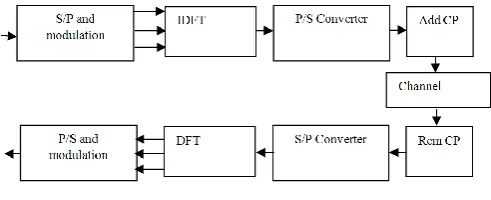
The conventional orthogonal frequency division multiplexing (OFDM) has a basis set which is orthogonal in nature which is formed by using the sinusoids of the discrete Fourier transform. In traditional orthogonal frequency division multiplexing (OFDM) approach the sinusoids of the DFT is correlated with the respective input signal and this correlation is done with the each and every sinusoidal basis function.
Figure 2. Block diagram of DFT-OFDM system
Here the sinusoids that are used to correlate with the input signal are the sub carriers of orthogonal frequency division multiplexing (OFDM) itself. Some of the essential factors inside the DFT primarily based orthogonal frequency department multiplexing (OFDM) are as follows
Once the transmitted data effectively transmitted at the
receiver side, the receiver gets the information in combined form of signals.
In order to meet the realistic requirement and to
[image:2.595.311.557.541.641.2]transform (IFFT) is advocated. The important advantage of the quick Fourier transform usage is it completes the assignment in less number of computations when as compared with conventional system.
Cyclic prefix (CP) is generally occupies around 20% of
the bandwidth way it is reproduction of selective part of image. As long because the delay spread of channel remains in the limit of the cyclic prefix there could no longer any lack of Orthogonality in the OFDM signal.
PROPOSED METHOD
In this proposed technique, Discrete Fourier Transform (DFT) is changed by way of the two transformation techniques such as Discrete Wavelet Transform (DWT) and Stationary Wavelet Transform (SWT). Because the working efficiency of SWT and DWT is more as compared to DFT. SWT has an advantage of replacing both DFT and cyclic prefix. In the first step, given information is converted into conventional coding after which observed by way of interleaving to convert the records into decimal format. These decimal symbols are then processed for modulation. To this modulated information some pilot symbols are inserted and then followed with the aid of subcarrier mapping. Next, the ensuing facts is transmitted through IDWT and ISWT, where Orthogonality is supplied to the subcarriers.
Inverse Discrete Wavelet Transform (IDWT) and ISWT are used to transform the signal from time domain to frequency area. After passing signal through the channel DWT can be accomplished and then pilot synchronization wherein the inserted pilots on the transmitter are eliminated then the
demodulation is completed. Demodulated record is
transformed to binary form and the de-interleaved and decoded to gain the authentic statistics transmitted.
ER Performance Evaluation
The performance of BER is evaluated by way of the use of MATLAB, The comparison of DFT based OFDM, Discrete Wavelet Transform (DWT) and Stationary Wavelet Transform (SWT) are received for specific modulation approach which might be used for long time evaluation (LTE) as shown in simulation outcomes. Basically some of the modulation strategies which can be utilized in LTE in addition to in this paper are QPSK, 16 QAM and sixty four QAM, 128 QAM
(Uplink and downlink). QPSK does now not convey statistics at very high speed. For the reason of simulation, signal to noise ratio (SNR) of different values are delivered via AWGN channel. Averaging for a selected cost of SNR for all the symbols is carried out and BER is obtained and same system is repeated for all of the values of SNR and final BERs are obtained. Different wavelet types daubechies2 and haar is used in wavelet based OFDM for QPSK, sixteen-QAM, 64-QAM, 128-QAM. The performance of DFT primarily based OFDM, Discrete Wavelet Transform (DWT) and Stationary Wavelet Transform (SWT) are acquired for one of a kind modulation strategy. As shown in simulation effects, the overall performance of Stationary Wavelet Transform (SWT) gives efficient consequences when as compared to Discrete Wavelet Transform (DWT) and DFT. SWT-OFDM and DWT-OFDM affords higher advantage in phrases of power when in comparison DFT-OFDM.
RESULTS
In this simulation results, the performance of BER is evaluated by comparing different transform techniques such as DFT-OFDM and DWT-DFT-OFDM and SWT-DFT-OFDM for different modulation techniques such as QPSK and QAM. These
modulation techniques are analysed under different
[image:3.595.63.535.377.550.2]constellation mapping.
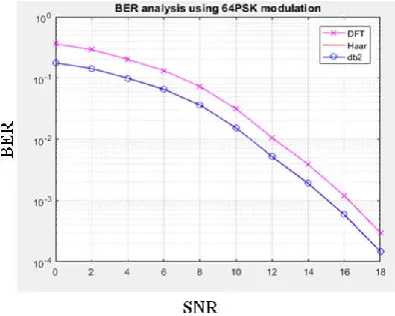
Fig. 4.1. BER vs SNR for 64 PSK modulation
[image:3.595.335.533.584.742.2]In Figure 4.1: The BER vs SNR graph is obtained for 64 PSK modulation. From the above graph, it is observed that for the increasing SNR, BER is reduced linearly.
Fig 4.2. BER vs SNR for 128 PSK modulation
[image:4.595.53.272.306.485.2]In Figure 4.2: The BER vs SNR graph is obtained for 128 PSK modulation. From the above graph, it is observed that for the increasing SNR, BER is reduced linearly.
Fig 4.3. BER vs SNR for 16 QAM modulation
In Figure 4.3: The BER vs SNR graph is obtained for 16 QAM modulation. From the above graph, it is observed that for the increasing SNR, BER is reduced linearly.
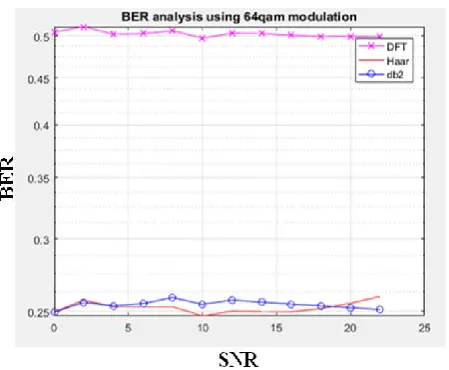
Figure 4.4. BER vs SNR FOR 64 QAM
In Figure 4.4: The BER vs SNR graph is obtained for 16 QAM modulation. From the above graph, it is observed that for the increasing SNR, BER is reduced linearly.
Conclusion and Future scope
In this paper, the performance of BER in long term evaluation is analysed at different transform techniques as well as for different modulation techniques with a specified constellation mapping. As shown in simulation results, the performance of wavelet transform is better when compared to DFT-OFDM. The spectral efficiency of wavelet transform is more with an improved BER performance. In the future work, Stanford University Interim (SUI) channel is replaced by AWGN channel. In SUI modeling is done in the channel to improve the performance of the signal at different paths.
REFERENCES
Abbas Hasan, K., M. Waleed A., N. Saad, 2010. “The performance of multiwavelets based OFDM system under different channel conditions”, Digital signal processing, Elsevier, vol. 20, no. 2, pp. 472- 482.
Abdullah, K. and Z. M. Hussain 2007. Performance of Fourier-Based and Wavelet-Fourier-Based OFDM for DVB-T Systems. Presented at Australasian Telecommunication Networks and Applications Conference, Christchurch, New Zealand. Amit Grover, Neeti Grover, 2014. “On limits of Wireless
Communications in a Fading Environment: a General Parameterization Quantifying Performance in Fading
Channel” Indonesian Journal of Electrical Engineering
and Informatics (IJEEI), Vol. 2, No. 3, pp. 125~131 ISSN:
2089-3272
Fan Wu and Mosa Ali Abu-Rgheff Mobile Communications Network Research School of Computing, Communications & Electronics University of Plymouth, Time and Frequency Synchronization Techniques for OFDM Systems operating in Gaussian and Fading Channels: A Tutorial” 2000.
Fleming Bjerge Frederiksen and Ramjee Prasad Center for Person Kommunikation, Aalborg University, Denmark ”An overview of OFDM and Related Techniques Towards
Development of Future Wireless Multimedia
Communications” 0-7803-7458-4/02/$17.@00 2002 IEEE. Gerard J. Foschini 1996. “Layered Space-Time Architecture
for Wireless Communication in a Fading Environment When Using Multi-Element Antennas” Bell Labs Technical
Journal Autumn.
Ian F.A., G. David M., R. Elias Chavarria, 2010. “The evolution to 4G cellular systems: LTE-advanced”, Physical communication, Elsevier, vol. 3, no. 4, pp. 217-244. John, A.C., 1990. “Multicarrier modulation for data
transmission: an idea whose time has come”, IEEE Communications magazine, vol. 28, no. 5, pp. 5-14. Jun, L., T. TjengThiang, F. Adachi, H. Cheng Li, 2000. “BER
performance of OFDM-MDPSK system in frequency selective rician fading and diversity reception” IEEE Transactions on Vehicular Technology, vol. 49, no. 4, pp. 1216-1225.
Kamal Kumar Sharma, Chandan Kumar, Deepak Kumar 2013.
“Long Term Evolution Protocol: An Overview”, IJCSC,
Volume 4, Number 2, pp.141- 144 ISSN-0973-7391 Labade, A. A., G. V.Lohar P. R. Dike N. N. Pachpor, 2014.
Spectral Efficiency Enhancement through Wavelet
Transform (WT) for 5G. Presented at IEEE Global Conference on Wireless Computing and Networking (GCWCN), Maharashtra, India
[image:4.595.50.275.545.730.2]Madan Kumar L., N. Homayoun, 2006. “A review of wavelets for digital wireless communication”, Wireless personal communications, Kluwer academic publishers- Plenum publishers, vol. 37, no. 3-4, pp. 387-420.
Mika, R. and T. Olav, 2010. “LTE, the radio expertise path toward 4G”, Computer communications, Elsevier, vol. 33, no. 16, pp. 1894-1906.
Pengfei Xia Georgios B. Giannakis “Design and Analysis of Transmit-Beam forming based on Limited-Rate feedback” 0-7803-8521-7/04/$20.00 © 2004 IEEE.
Performance Criterion and Code Construction IEEE
transactions on information theory, vol. 44, no. 2, march 1998.
Rajani, Jyoti Al-Falah, 2014. School Of Engineering & Technology Maharisy Dyanand University, Rohtak, India Performance Analysis Result and Simulation Result of MC-CDMA Using BPSK Modulation” IJEDR, Volume 2, Issue 1 ISSN: 2321-9939.
Rishi Choubey, Ravi Mohan, Sumit Sharma, 2013. “A survey of BER Performance of Generalized MC DS-CDMA
System” International Journal of Advanced Computer
Research (ISSN (print):2249-7277 ISSN
(online):2277-7970) Volume-3 Number-2 Issue-10.
RohitBodhe, Shirish Joshi, Satish Narkhede, 2012.
“Performance Comparison of FFT and DWT based OFDM
and Selection of Mother Wavelet for OFDM” (IJCSIT)
International Journal of Computer Science and
Information Technologies, Vol. 3 (3), 3993-3997.
Shengli Zhou, Member, IEEE, Zhengdao Wang, Member, IEEE, and Georgios B. Giannakis, Fellow, IEEE Quantifying the Power Loss When Transmit Beamforming Relies on Finite-Rate Feedback IEEE transactions on wireless communications, vol. 4, no. 4, July 2005.
Sreesudha P., M. Vijaya Lakshmi GNITS, Hyderabad, India, BER enhancement of MIMO-CDMA based on space-time block codes” DOI : 10.5121/csit.2011.1303
Vahid Tarokh, Member, IEEE, Nambi Seshadri, Senior Member, IEEE, and A. R. Calderbank, Fellow, IEEE Space–Time Codes for High Data Rate Wireless Communication:
Vivek K. Dwivedi and G. Singh, 2008. “An Efficient BER Analysis of OFDM Systems with ICI Conjugate Cancellation Method” PIERS Proceedings, Cambridge, USA, July 2-6.
Yi-Hao Peng, Ying-Chih Kuo, Gwo-Ruey Lee, Student Member, IEEE and Jyh-Horng Wen, Member, IEEE Performance “Analysis of a New ICI-Self-Cancellation-Scheme in OFDM Systems” 0098 3063/07/$20.00 © 2007 IEEE.
Yu Fu and Chi Chung K.O. “Theoretical BER Analysis of OFDM Systems with IC1 Self-Cancellation” 0-7803-7442-8/02/$17.00 0 2002 IEEE