ISSN Print: 2160-8792
DOI: 10.4236/ojog.2018.812111 Sep. 30, 2018 1102 Open Journal of Obstetrics and Gynecology
Effect of Hyoscine Butyl Bromide on the Course
of Labour
Dauda Deba Barau, Eyaofun Teddy Agida, Olatunde Onafowokan, Francis Olayemi Adebayo
*Department of Obstetrics and Gynaecology, University of Abuja Teaching Hospital, Abuja-FCT, Nigeria
Abstract
Background: Hyoscine butyl bromide (Buscopan) is being used as an agent for reducing the duration of labour. There are however conflicting results on the effect of this agent on cervical dilation. Materials and Methods: This was an open label clinical trial of one hundred and thirty two (132) pregnant women in labour. Women were grouped to receive either 20 mg of hyoscine butyl bromide intramuscularly at the onset of active phase labour or placebo “Normal saline”. The main outcome measure was to compare the duration of first stage labour in the study and control groups as well as feto-maternal outcomes. Relevant data were collected using a proforma. The data were ana-lysed using Statistical Package for Social Sciences (SPSS) version 20. Results: A total of 132 were randomised and 123 yielded for analysis. Of these 59 re-ceived hyoscine butyl bromide and 64 rere-ceived placebo. There was no signifi-cant difference in the mean duration of active labour to second stage between the drug and placebo arms (312.5 versus 305.3 minutes, respectively, P = 0.788). The feto-maternal outcomes were similar between both arms. Con-clusion: Hyoscine butyl bromide does not shorten the duration of labour in spontaneous labour. It also does not change feto-maternal outcomes.
Keywords
Hyoscine Butyl Bromide, Labour, Prolonged Labour
1. Introduction
Prolonged labour and its attendant complications contribute immensely to the high maternal morbidity and mortality recorded in the developing countries [1] [2]. Although there is a wide variation in the duration of labour, it has been found that there is an acceptable period that is considered normal. The range for the duration of normal labour is from 3 to 12 hours. Labour lasting less than 3 How to cite this paper: Barau, D.D., Agida,
E.T., Onafowokan, O. and Adebayo, F.O. (2018) Effect of Hyoscine Butyl Bromide on the Course of Labour. Open Journal of Ob-stetrics and Gynecology, 8, 1102-1108. https://doi.org/10.4236/ojog.2018.812111
Received: August 28, 2018 Accepted: September 27, 2018 Published: September 30, 2018
Copyright © 2018 by authors and Scientific Research Publishing Inc. This work is licensed under the Creative Commons Attribution International License (CC BY 4.0).
http://creativecommons.org/licenses/by/4.0/
DOI: 10.4236/ojog.2018.812111 1103 Open Journal of Obstetrics and Gynecology hours is classified as precipitate labour while that exceeding 12 hours is said to be prolonged [3] [4] [5]. Various studies conducted on the duration of labour suggested a decline in recent decades [3] [6].
The modern obstetric practice involves active management of labour with the use of partograph and cardiotocograph as the monitoring tool [6]. The aim of active management of labour is to prevent prolonged labour which is associated with increased maternal and perinatal morbidity and mortality.
Identified maternal morbidities include maternal exhaustion, electrolyte de-rangement, hypoglycaemia, obstructed labour and its sequelae such as rupture uterus, primary post partum haemorrhage and obstetric fistula. Some of the pe-rinatal complications include fetal distress, birth asphyxia, increased risk for neonatal resuscitation and admission into neonatal intensive care unit, hypoxic ischemic encephalopathy and cerebral palsy [7] [8].
Active management of labour refers to active control rather than passive ob-servation over the course of labour by the obstetric care provider. There is clear-ly documented evidence of the success of active management of labour and it has been shown to reduce the number of caesarean deliveries in institutions em-ploying the protocol [8].
The safety of active management of labour has been demonstrated by several prospective randomised clinical trials. The shorter duration of labour from ad-mission to delivery has also been constantly reported in numerous studies of women treated with the active management protocol [9].
One of the causes of prolonged labour is cervical dystocia [5]. The use of an-tispasmodic drugs to overcome cervical spasms has been documented in several randomised clinical trials [10]. Drugs such as atropine have been used and found reliable but had unpleasant side effects, for example inhibition of salivary and sweat secretions, disturbances of vision, and cardiac symptoms. This led to the synthesis of a series of quaternary ammonium derivatives of scopolamine. In clinical use, one of the most effective of these derivatives was found to be hyos-cine butyl bromide [11].
Hyoscine butyl bromide has a selective action on cervico-uterine plexus, and when administered in the face of cervical dilatation resulted in facilitated dilata-tion of the cervix and shortened the duradilata-tion of labour. In several studies it has not demonstrated unfavourable side effect on uterine contractions or on the foetus [12]. Unlike atropine, hyoscine butyl bromide does not cross the blood brain barrier; therefore it does not produce the central effects of atropine at the-rapeutic doses [13].
sub-DOI: 10.4236/ojog.2018.812111 1104 Open Journal of Obstetrics and Gynecology ject in Nigeria. Therefore, there is a need for a prospective study that may pro-vide concrete data and firm conclusion on this subject the purpose of this study is to determine the effect of hyoscine butyl bromide on labour.
2. Materials and Methods
This was a clinical trial of one hundred and thirty two women in labor at Uni-versity of Abuja Teaching Hospital, Abuja between January 1st 2017 and De-cember 31st, 2017. The study commenced after obtaining written permission from Ethical Committee of the Hospital. Women were grouped to receive either 20mg of either Hyoscine Bromide or Normal saline. The study population com-prised of all women in spontaneous labour at term that have cervical dilatation of 4 to 5 cm during the study period.
Included were all multigravida who had given consent and with; spontaneous onset of labour, singleton cephalic presenting pregnancy at term with no con-traindication for vaginal delivery.
Patients who refused consent to participate were excluded alongside those with any chronic medical or pregnancy induced illness, parturient who were administered antispasmodic medication before presentation in labour ward, rupture of membranes (more than 12 hours) and history of drug allergy.
Enrolled patients were randomly allocated to one of the two therapeutic regi-mens of 20 mg Hyoscine Bromide or Normal saline. Randomisation was per-formed using computer-generated list by means of sequentially numbered, opa-que, sealed envelopes indicating their medication. One group of patients re-ceived 20 mg Hyoscine Bromide and the other group 20 mg Normal saline. Hyoscine butyl bromide 20 mg (2 ml) or placebo (normal saline 2 ml) was given intramuscularly only when the parturient was in active phase labour with a cer-vical dilation of 4 - 5 cm.
The duration of labour was counted from the time hyoscine butyl bromide or placebo was administered. The attending Nurse or Doctor completed a form de-tailing the duration of 1st stage of labour from administration of the drug to full cervical dilatation. The 2nd stage starts from full cervical dilatation to delivery of the foetus; and the 3rd stage of labour from delivery of the foetus to the delivery of the placenta. Maternal complications, APGAR, score at 1 min and 5min were documented. Both the patient and attending Nurse or Doctor were blinded to whether its HBB or Normal saline that was served as they both appear colourless in the syringe.
The sample size was calculated using the formula [15] 22
2Z Pq
n d
= .
n = Minimum sample size; Z = Standard normal deviation set at 1.96; P =
Prevalence of prolonged labour = 4.39% [6]; q = 1.0 – P; d = Degree of precision set at 0.05; n=2 1.96 0.0439 0.9561× 20.05 0.05× ×
× ; n = 120.
DOI: 10.4236/ojog.2018.812111 1105 Open Journal of Obstetrics and Gynecology Clinical data for each participant were collected and recorded on a data sheet for analysis. Patients that had augmentation of labour were analysed while those that had emergency caesarean section and instrumental delivery were not ana-lysed. Data were analysed using Statistical Package for Social Sciences (SPSS) version 20. P-value of less or equal to 0.05 was accepted as indicating statistical significance.
3. Results
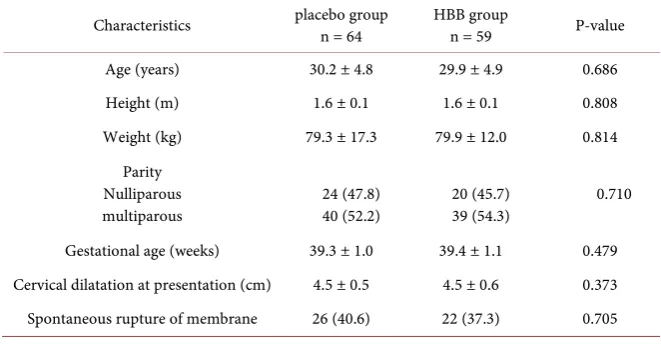
A total of one hundred and thirty two women (66 in each group) consented to the study and were grouped and evaluated. Of these, two patients from placebo and seven from hyoscine group were excluded because it became necessary for them to have abdominal birth or instrumental vaginal deliveries. Upon compar-ison of patients characteristics and initial labour assessment as shown in Table 1, the distribution with respect to age, height, weight, gestational age, cervical dilatation at presentation and spontaneous rupture of membrane were compara-ble in both groups with no significant statistically difference. This indicates that the two groups were homogenous.
Table 2 shows comparison of cases and controls regarding cervical dilatation in the first and second stage of labour. The duration of first stage labour was shorter in placebo group compared with drug group whereas second stage la-bour duration was found to be shorter in drug group compared with placebo. Hence, the mean time duration of both first and second stage labour in the con-trol group was 305 minutes, compared with 312 minutes in the drug group, representing a slight (but statistically insignificant, P = 0.788) increase of 2.3%.
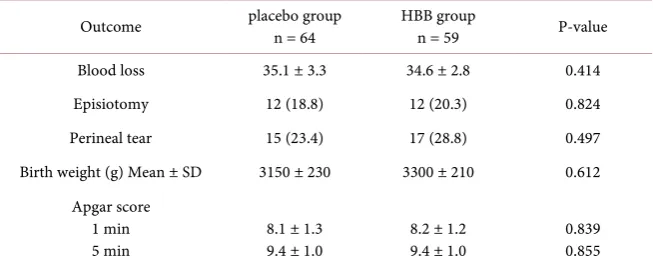
[image:4.595.208.539.556.732.2]Among the observed maternal outcomes considered in drugs and control group were blood loss, episiotomy, perineal tear as illustrated in Table 3. Al-though in both study groups indicates that no statistically difference, the blood loss were more in placebo group than drug group while the perineal tear were more in drug group compared with placebo group. Comparison of the fetal out-comes of these mothers in both groups indicates that no statistically significant
Table 1. Patient’s characteristics and initial labour assessment.
Characteristics placebo group n = 64 HBB group n = 59 P-value
Age (years) 30.2 ± 4.8 29.9 ± 4.9 0.686
Height (m) 1.6 ± 0.1 1.6 ± 0.1 0.808
Weight (kg) 79.3 ± 17.3 79.9 ± 12.0 0.814 Parity
Nulliparous
DOI: 10.4236/ojog.2018.812111 1106 Open Journal of Obstetrics and Gynecology
Table 2. Mean Duration of 1st and 2nd stages of Labour.
Stages of Labour placebo group n = 64 HBB group n = 59 P-value
First stage (minutes) 269.3 ± 135.9 279.1 ± 134.0 0.691 Second stage (minutes) 34.1 ± 18.2 33.6 ± 18.1 0.886 First + Second stage (minutes) 305.3 ± 148.9 312.5 ± 146.9 0.788
Table 3. Maternal and foetal outcome.
Outcome placebo group n = 64 HBB group n = 59 P-value
Blood loss 35.1 ± 3.3 34.6 ± 2.8 0.414
Episiotomy 12 (18.8) 12 (20.3) 0.824
Perineal tear 15 (23.4) 17 (28.8) 0.497
Birth weight (g) Mean ± SD 3150 ± 230 3300 ± 210 0.612 Apgar score
1 min
5 min 8.1 ± 1.3 9.4 ± 1.0 8.2 ± 1.2 9.4 ± 1.0 0.839 0.855
differences were seen in the APGAR Scores at minutes of one and five in both groups.
4. Discussion
The goal of obstetrics has always been a pregnancy which results in a healthy in-fant and minimally traumatized mother. The problems of prolonged labour are many. A painless and short duration is a cherished dream of every mother [16]. There has been growing attempt to shorten labour time since the process of la-bour puts great strain on the mother and her fetus. These includes; active man-agement of labour, sweeping of membranes, cervical stretching and amniotomy [17].
Also, various pharmacological agents have been found to facilitate cervical di-latation. The role of oxytocin and prostaglandins has been established world-wide. Spasmolytic drugs most especially Hyoscine butyl bromide are frequently employed to overcome cervical spasm and thus reduce duration of labour.
The characteristics and initial labour assessment of women in the study were homogenous in terms of age, height, weight, gestational age, cervical dilatation and spontaneous rupture of membrane in both groups indicating that subjects were well randomised.
[image:5.595.212.539.198.332.2]DOI: 10.4236/ojog.2018.812111 1107 Open Journal of Obstetrics and Gynecology The mean duration of labour (first and second stagelabour) was 305.3 and 312.5 minutes for placebo and hyoscine group respectively. Thus, administration of hyoscine butyl bromide in active phase labour do not led to a significant shortening of the first and second stage of labour. This finding is similar to findings of Rohwer and colleagues, Al Dohami et al. [13] [18]. These were how-ever, different from most studies such Samuels et al., where hyoscine butyl bro-mide was found to significantly shorten the duration of labour.
There was also no statistically difference in the mater no-fetal outcomes such as associated blood loss or APGAR Scores noted at first and five minutes, re-spectively. Studies by Samuels et al. and Mukaindo et al. [19] [20], also recorded similar findings in the mater no-fetal outcomes.
5. Conclusion
In conclusion, therefore, just as documented in previous studies, there appears to be no statistically significant difference in the duration of labour between the hyoscine butyl bromide group and placebo group. Also, there were no associated adverse feto-maternal outcomes.
Conflicts of Interest
The authors declare no conflicts of interest regarding the publication of this pa-per.
References
[1] Ijaiya, M.A., Aboyeji, A.P., Fakeye, O.O., Balogun, O.R., Nwachukwu, D.C. and Abiodun, M.O. (2009) Pattern of Cervical Dilatation among Parturient in Ilorin, Nigeria. Annals of African Medicine, 8, 181-184.
[2] Melah, G.S., El-Nafaty, A.U., Massa, A.A. and Audu, B.M. (2003) Obstructed La-bour: A Public Health Problem in Gombe State, Nigeria. Journal of Obstetrics and Gynaecology, 23, 369-373. https://doi.org/10.1080/01443610310001119510
[3] Campbell, S. and Lee, C. (2005) Labour. In: Lee, C., Ed., Obstetrics by Ten Teachers, 17th Edition, Hodder Arnold, London, 101-139.
[4] Ande, A.B.A. and Okpere, E.E. (2004) Prolonged Labour. In: Okpere, E., Ed., Clini-cal Obstetrics, Revised Edition, Uniben Press, Benin, 222-223.
[5] Orhue, A.A. and Otubu, J.A. (2006) Prolonged Labour. In: Agboola, A., Ed., Text Book of Obstetrics and Gynaecology for Medical Students, 2nd Edition, Heinemann Educational Books, Ibadan, 439-441.
[6] Randhawa, I., Gupta, K.B. and Kanwal, M. (1991) A Study of Prolonged Labour.
Journal of the Indian Medical Association, 89, 161-163.
[7] Hendricks, C.H., Brenner, W.E. and Kraus, G. (1970) Normal Cervical Dilatation Pattern in Late Pregnancy and Labour. American Journal of Obstetrics & Gynecol-ogy, 106, 1065-1082. https://doi.org/10.1016/S0002-9378(16)34092-3
[8] O’Driscoll, K., Stronge, J.M. and Minogue, M. (1973) Active Management of La-bour. BMJ, 3, 135-137. https://doi.org/10.1136/bmj.3.5872.135
DOI: 10.4236/ojog.2018.812111 1108 Open Journal of Obstetrics and Gynecology
[10] Hudesek, R., Nagy, J. and Unzeetig, V. (1997) The Effect of Spasmolytics on Dilata-tion of the Uterine Cervix. Ceska Gynecologie, 62, 11-14.
https://europepmc.org/abstract/med/9410414
[11] Qahtani, N.H. and Hajeri, F.A. (2011) The Effect of Hyoscine Butyl Bromide in Shortening the First Stage of Labour; A Double Blind, Randomised Controlled, Clinical Trial. Therapeutics Clinical Risk Management, 7, 495-500.
https://doi.org/10.2147/TCRM.S16415
[12] Sadler, L.C., Davidson, T. and McCowan, L.M. (2000) A Randomised Controlled Trial and Meta-Analysis of Active Management of Labour. BJOG, 7, 909-915.
https://doi.org/10.1111/j.1471-0528.2000.tb11091.x
[13] Rohwer, A.C., Khondowe, O. and Young, T. (2013) Antispamodics for Labour. Cochrane Databases of Systematic Reviews, No. 6.
[14] Ryan, J. and Heitmann, D.O. (2013) Anatomy of the Female Reproductive System. In: Decherney, A.N., Nathan, L., Laufer, N. and Roman, A.S., Eds., Current Obste-trics and Gynaecologic Diagnosis and Treatment, 11th Edition, MC Graw Hill Pub-lishers, New York, 1-37.
[15] Campell, M.J. and Machin, D.C. (1990) Comparison of Proportion. In: Medical Sta-tistics, a Common Sense Approach, John Wiley & Sons Ltd., West Sussex, 148. [16] Sreelatha, S., Vedavathy, N., Gayathri, C. and Renuka, R. (2015) A Study of the
Ef-fect of Hyoscinebutylbromide on the Duration of Labour. World Journal of Phar-maceutical Research, 10, 2485-2491.
[17] Jenkin, G. and Young, I. (2004) Mechanisms Responsible for Parturition; The Use of Experimental Models. Animal Reproduction Science, 82, 567-581.
https://doi.org/10.1016/j.anireprosci.2004.05.010
[18] Al Dohami, H.S. and Al Matari, F.I. (2002) Is Buscopan (Hyoscine N-Butylbromide) Effective in Shortening Labour? 12th Annual General Meeting of the Saudi Obstet-rics and Gynaecology Society.
[19] Samuels, L.A., Christie, L., Roberts, G.B., Fletcher, H. and Frederick, J. (2007) The Effect of Hyoscinebutylbromide on the 1st Stage of Labour in Term Pregnancies.
BJOG, 12, 1542-1544.https://doi.org/10.1111/j.1471-0528.2007.01497.x