MR of the Brain Using Fluid-Attenuated Inversion Recovery (FLAIR)
Pulse Sequences
Beatrice De Coene, 1 Joseph V. Hajnal,2 Peter Gatehouse,3 Donald B. Longmore,3 Susan J. White, 1 Angela Oatridge, 1 Jacqueline M. Pennock,2 ian R. Young,2 and Graeme M. Bydder1·4
PURPOSE: Results from conventional T2-weighted spin-echo sequences were compared with those obtained using fluid attenuated inversion recovery (FLAIR) pulse sequences in order to assess their relative merits in detecting disease. METHODS: Forty adult patients with suspected disease of the brain were examined with spin-echo sequences (TE = 20 and TE = 80), and results were compared with FLAIR sequences of several types with inversion times of 1800-3000 msec and echo times of 130-240 msec. Scans were assessed by two radiologists for lesion number,
conspicuity, and extent. RESULTS: A total of 481esions or groups of lesions were recognized with both sequences. In 22 instances, more lesions were seen with FLAIR sequences, and, in the remaining 26, equal numbers were seen. In 42 lesions, conspicuity was better with FLAIR sequences, equal in five and worse in one cystic lesion. Lesion extent was better assessed in 28 of the 48 cases with FLAIR sequences and equally well seen in the remainder. CONCLUSION: By virtue of their long echo time and relative freedom from cerebrospinal fluid artifact FLAIR sequences provide high sensitivity to a wide range of disease. The basic sequence is easy to implement but is relatively time consuming.
Index terms: Brain, magnetic resonance; Magnetic resonance, technique.
AJNR 13: 1555-1564, Nov /Dec 1992
Although heavily T2-weighted spin-echo se -quences are widely accepted as the most sensitive magnetic resonance (MR) imaging technique for
examining the brain, they have important limita-tions. With heavy T2-weighting, the cerebrospinal fluid (CSF) signal becomes greater than that of the brain and creates artifacts both from volume
averaging and fluid motion during the cardiac and respiratory cycles. These may make diagnosis of
subtle lesions difficult.
By using an inversion recovery pulse sequence with an inversion time (TI) designed to null or considerably reduce the signal from CSF but
Received April 24, 1992: revision requested June 5; revision received
July 7 and accepted July 9. 1
Department of Diagnostic Radiology, Royal Postgraduate Medical
';chool, Hammersmith Hospital, Du Cane Road, London W 12 OHS, UK. 2
Hirst Research Centre, Wembley, Middlesex HA9 7PP, UK. 3
MRI Unit, Royal Brompton Hospital: 30 Britten Street, London SW3 •1NN, UK.
''Address reprint requests to Professor G. M. Bydder, NMR Unit,.
)epartment of Diagnostic Radiology, Royal Postgraduate Medical School, iammersmith Hospital, Du Cane Road, London W 12 OHS, UK.
\JNR 13:1555-1564, Nov/Dec 1992 0195-6108/92/1306-1555 American Society of Neuroradiology
allow recovery of most of the brain magnetiz a-tion, it is possible to greatly reduce CSF artifact and then use long echo times to obtain very heavy T2-weighting.
To assess the value of this approach, we have compared results with conventional long repet i-tion time (TR) and echo time (TE) spin-echo sequences to those obtained using fluid atten
-uated inversion recovery (FLAIR) sequences in 40 adult patients with a range of brain disease.
Subjects and Methods
Permission for this study was obtained from the Re-search Ethics Committee of the Royal Postgraduate Medi-cal School.
The FLAIR pulse sequences were available in several forms:
1. The initial 180° pulse was either unselected or section selected. The unselected form was used with a mul-tisection spin echo with a stepped Tl. The section-selected form was available with the section width of the initial 180° pulse equal to that of the subsequent spin-echo data collection or with twice this value. This form had a constant Tl. Useful values of Tl for
1556 DE COENE
suppression of CSF were found to be in the range of
about 1700-3000 msec at 1 .0 T.
2. The 180° pulse was combined with single or multiple spin-echo options. The single-echo form was avail -able as a spin echo or a field echo. The multiple spin -echo forms were available either as discrete sections with two or four echoes or as composite sections modeled on the RARE pulse sequence initially d e-scribed by Hennig et al (1 ).
These were all operated at 1.0 T using 128 X 256 or 192 X 256 image matrices with a single excitation and 6-or 8-mm section thickness on a Picker HPQ Vista MR
system. TE values of 130-240 msec were employed. The
128 X 256 variable Tl form typically took 12.8 minutes for 11-17 sections and the constant Tl form with Tl equal to
2100 msec and TE equal to 160 msec took 13.6 minutes for 1 0 sections. No cardiac gating or gradient moment nulling was used.
Standard spin-echo sequences with a TR of 2500 msec (approximate) and TE of 20 and 80 msec were performed
in parallel with the FLAIR sequences using two data acqui-sitions. In one case, a TE 160 msec scan was also obtained and compared with the TE 160 FLAIR sequence. T1-weighted images (SE 500-740/20) were also performed in
selected cases with four data acquisitions. These were all obtained with a 128 X 256 matrix and 6- or 8-mm section width.
The spin-echo and FLAIR images were assessed by two independent radiologists who were blinded to the clinical diagnoses. All technically adequate studies performed since the technique was first implemented were assessed overall for lesion number, conspicuity, and size, and the results of the two radiologists were averaged. Two potential cases were excluded because of excessive motion artifact on the FLAIR and other sequences. Similar lesions (eg, periven
-tricular lesions) were assessed as a single group and an overall assessment was then made.
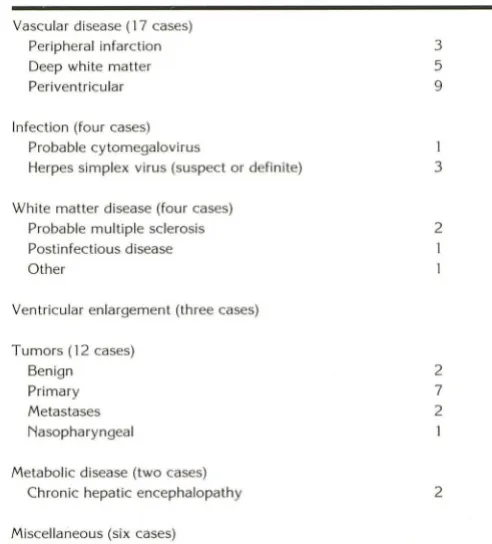
Forty patients (21 male, 19 female) of mean age 42.5 years (range 16 to 65 years) were studied. Their 48 final clinical diagnoses are summarized in Table 1.
Results
For reference, aTE 160-msec FLAIR scan from a normal volunteer is included (Fig. 1 ). The pari-etal white matter and parietopontine tract nor-mally display a high signal when a long echo time is used. Parts of the occipitothalamic radiation, as well as the corticospinal and other tracts, also display a high signal intensity. Chemical shift artifact (associated with the narrow bandwidth and long data collection (56 msec)) produced with this implementation of the FLAIR sequence is seen anteriorly in Figs. 1 B and 1
C.
Partial volume effects from nasal mucosa are seen at the inferior aspect of the frontal lobe. Slow flowing blood inAJNR: 13, November/December 1992
TABLE 1: Clinical diagnoses (48)
Vascular disease ( 17 cases) Peripheral infarction
Deep white matter Peri ventricular
Infection (four cases) Probable cytomegalovirus
Herpes simplex virus (suspect or definite)
White matter disease (four cases) Probable multiple sclerosis Postinfectious disease
Other
Ventricular enlargement (three cases)
Tumors (12 cases) Benign
Primary Metastases Nasopharyngeal
Metabolic disease (two cases)
Chronic hepatic encephalopathy
Miscellaneous (six cases)
3 5 9 1 3 2 2 7 2 2
veins and sinuses may give a very high signal intensity.
Vascular Disease (19 Cases)
Nineteen patients with clinical diagnoses of cerebrovascular disease were studied. These pa-tients were grouped into peripheral infarction, deep white matter infarction, and periventricular infarction, according to the predominant site of the lesion or lesions.
Peripheral infarction (three cases): Three cases were examined. The same number of pe-ripheral lesions were identified but conspicuity was better with the FLAIR sequences in two cases (Fig. 2) and equal in the other one. The extent of the lesions was greater in two cases and equal in the other. Additional deep white matter lesions were present in all cases.
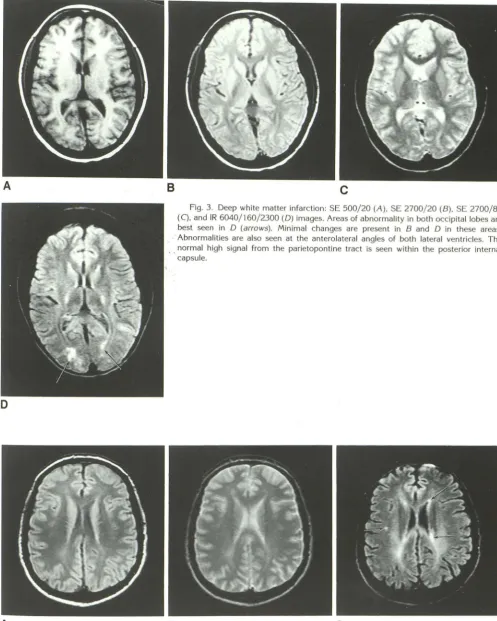
Deep white matter infarction (five cases): The number of lesions identified was greater with the FLAIR sequence in all five cases (Fig. 3). Conspi-cuity was better in four cases and lesion extent
was better demonstrated with the FLAIR
se-quence in four cases.
[image:2.614.312.558.92.364.2]AJNR: 13, November/December 1992 MR WITH FLAIR 1557
A
8
c
Fig. 1. Healthy volunteer (man aged 48 years): IR 6040/ 160/2100 scans at the level of the centrum semiovale (A), mid ventricle (B), low ventricle (C) and midbrain (D). The parietal white matter (arrows) has a higher signal than the frontal white matter in A and B. The parietopontine tracts are highlighted in C (arrows) where part of the occipit o-thalamic radiation also has a high signal. The corticospinal and parietopontine tracts are highlighted in the midbrain, as is the periaqueductal gray matter. Partial volume effect
from the ethmoid sinuses produces the high signal seen in the region of the gyrus recti. The high signal anteriorly in the frontal lobes shown in B and C and some subsequent
images is due to chemical shift artifact associated with a long data collection period of 56 msec.
D
conspicuity was greater with the FLAIR sequence. The lesion appeared more extensive with FLAIR
sequences in six cases and equal in the others.
Infection (Four Cases)
One case of cytomegalovirus infection was recognized in a patient with chronic myeloid leu-kemia after bone marrow transplantation. The diagnosis was made following identification of
cytomegalovirus in the urine and after response to antiviral therapy. She had mild sensory signs
but a very high CSF protein (1.9
G/100
mL). Multiple lesions were seen with both the conven-tional spin-echo sequences and the FLAIRse-quences, but the latter showed much more ex-tensive change (Fig. 5). The effect of the
180°
inversion pulse can be appreciated by comparingFigures 58, 5C, and 50. Increasing the echo time in a conventional spin echo from
80
msec (Fig. 58) to160
msec (Fig. 5C) increased lesioncon-trast, but the effect was largely obscured by the
high level of CSF artifact. Preceding the TE
160
-msec spin echo by an inversion pulse designed to suppress CSF in Figure 50 made it much easier to appreciate the increased lesion conspi-cuity produced by the longer echo time.
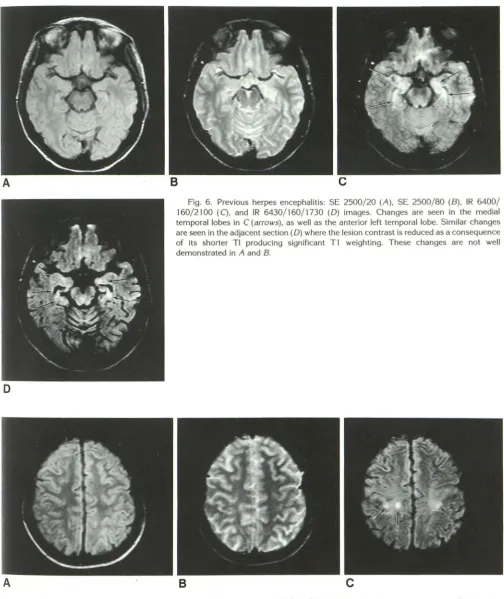
Three patients with clinically suspect or proven herpes simplex were studied. Periventricular
le-sions were seen in two cases. In another patient who presented with memory loss, changes in the
medial temporal lobes were identified only with
the FLAIR sequence (Fig. 6).
White Matter Disease (Four Cases)
A patient with a 3-year history of recurrent episodes of weakness and ataxia with some sen -sory loss displayed no abnormality in the centrum semiovale with conventional spin-echo pulse se -quences, but three lesions were seen with the
[image:3.614.61.553.85.479.2]1558 DE COENE AJNR: 13, November /December 1992
Fig. 2. Hemorrhagic infarction: SE 720/20 (A), SE 2540/20 (B), SE 2540/80 (C),
and IR 6710/160/2500 (D) images. The peripheral infarcted area has a high signal
intensity in A, but is most extensive in 0. There are additional small abnormal areas only seen in D (arrows).
was multiple sclerosis. Additional lesions were
also seen with the FLAIR sequence in one other patient with the clinical diagnosis of multiple sclerosis.
A patient with recurrent left-sided meningioma treated with surgery and radiotherapy presented with an episode of left-sided weakness that had
remitted. In addition to the postoperative
changes, focal lesions were seen at high ventric-ular level with an additional lesion shown on the
FLAIR sequence. Bilateral changes were seen in
the white matter of the occipital lobes at a lower
level. The precise etiology of her white matter
disease remains unclear at present.
Ventricular Enlargement (Three
Cases)
This was identified in three patients.
Periven-tricular changes associated with hydrocephalus
were better seen with the FLAIR sequences in
two of the three cases (Fig. 8) and extent of change was better seen in two of the three cases.
D
Tumors (72 Cases)
Benign (two cases): One meningioma and one
chordoma were studied. The lesions were well
seen with both spin-echo and FLAIR sequences, but the associated edema was better seen with
the FLAIR sequence.
Primary brain tumors (seven cases): The cys-tic components of tumors were less well seen with some versions of the FLAIR sequence (Fig. 8) but better seen with others. The differences depended on the inversion time and CSF flow phenomena as well as the version of the FLAIR sequence that was employed.
Soft-tissue components of malignant tumors were seen with greater contrast in all cases and
the signal from calcification was also lower with
the FLAIR sequence than with SE 2500/20 and
SE 2500/80 sequences. Overall conspicuity was
greater with the FLAIR sequence in four cases.
Extent was better seen in four cases.
Metastases (2 cases): Metastases were well
[image:4.613.61.562.78.450.2]AJNR: 13, November /December 1992
D
A
MR WITH FLAIR 1559
8
c
Fig. 3. Deep white matter infarction: SE 500/20 (A), SE 2700/20 (B), SE 2700/80
(C), and IR 6040/160/2300 (D) images. Areas of abnormality in both occipital lobes are
best seen in D (arrows). Minimal changes are present in B and D in these areas.
Abnormalities are also seen at the anterolateral angles of both lateral ventricles. The normal high signal from the parietopontine tract is seen within the posterior internal
··capsule.
8
c
[image:5.615.55.553.83.705.2]1560 DE COENE AJNR: 13, November /December 1992
A
B
Fig. 5. Cytomegalovirus infection: SE 2700/20 (A), SE 2700/80 (B), SE 2700/ 160 (C), and IR 6500/160/2100 (0) images. The areas of abnormality in white matter appear much more extensive in D. Comparison of Band C shows that increase in TE from 80 to 160 msec alone results in increased lesion conspicuity, but much of this is obscured through increased artifact from CSF. D illustrates the improvement that follows with the addition of CSF suppression to the TE 160 msec sequence shown in
c.
conspicuity, and extent were greater in both
cases. In the illustrated case, the diagnosis was
presumptive following a history of mental
dete-rioration, a known breast primary tumor, bone
scan and CT diagnosis of bone metastases, and
a progressive downhill course following the MR scan. No brain biopsy was performed.
The patient with a chordoma displayed a low signal in the left medulla presumably due to old hemorrhage. This was best seen with the FLAIR sequence (Fig. 1 0).
Metabolic Disease (Two Cases)
Two patients with hepatic encephalopathy
were examined. In one with known vascular
dis-ease, extensive white matter changes were
demonstrated. The other displayed periventricu
-lar change that was only seen on the FLAIR
sequence.
D
/V1iscellaneous (Six Cases)
This group included a patient with a 1 0-year history of recurrent episodes of facial weakness
with some sensory loss. The initial clinical
diag-nosis was multiple sclerosis, but this was revised
to sarcoidosis. No change was seen with spin
-echo sequences, but bilateral changes were seen in the region of the facial nerves, as well as in the
pons with the FLAIR sequences (Fig. 11).
The category included patients with dystonia,
schizophrenia, polycythemia, short-term memory
loss, and suspect brain-stem encephalitis who
showed no abnormality with either conventional spin-echo or FLAIR sequences.
Overall, 48 different lesions or groups of lesions
were identified. More lesions were seen in 22 of
[image:6.613.57.583.81.483.2]AJNR: 13, November/December 1992
A
D
MR WITH FLAIR 1561
8
c
Fig. 6. Previous herpes encephalitis: SE 2500/20 (A), SE 2500/80 (B), IR 6400/ 160/2100 (C), and IR 6430/160/1730 (0) images. Changes are seen in the medial temporal lobes in C (arrows), as well as the anterior left temporal lobe. Similar changes are seen in the adjacent section (0) where the lesion contrast is reduced as a consequence of its shorter Tl producing significant T1 weighting. These changes are not well demonstrated in A and B.
8
Fig. 7. Multiple sclerosis: SE 2540/20 (A), SE 2540/80 (B), and IR 6040/160/2100 (C) images. Lesions are seen in C(arrows) in regions where no abnormality is seen in A or B.
Conspicuity was better with the FLAIR se-quence in 42 instances, equal in five, and worse in one cystic lesion (Fig. 8). Lesion extent was
[image:7.615.53.558.75.675.2] [image:7.615.57.551.83.299.2]1562 DE COENE
Fig. 8. Probable cystic glioma: transverse SE 2540/20 (A), SE 2540/80 (B), IR
6490/160/2100 (C), and coronaiiR 7530/130/2760 (D) images. The cystic component
of the tumor has a low signal in A and a high signal in B. Its signal is intermediate in C and very low in D. The peri ventricular edema is most obvious in C and D.
A
B
AJNR: 13, November /December 1992
D
c
[image:8.617.53.562.75.732.2] [image:8.617.57.553.500.709.2]AJNR: 13, November /December 1992
Fig. 10. Chordoma after surgery: IR 7000/160/2200 image. A
dark area is seen within medulla (arrows). It is probably a con se-quence of old hemorrhage.
Lesions were identified with FLAIR sequences
as the only abnormality in patients with normal
spin-echo images in one patient with herpes sim-lex encephalitis (Fig. 6), one with probable
sar-•.::oidosis (Fig. 11), and one with chronic hepatic
encephalopathy. Additional lesions were seen in
patients with vascular disease, infective lesions,
white matter disease, and metastases.
Discussion
FLAIR sequences display high sensitivity to a
wide range of disease. The sequence is
particu-larly useful in detecting subtle changes at the
periphery of the cerebral hemispheres, around
the basal cisterns, in the brain stem, at gray white matter interfaces, and in the periventricular
re-gion. These are sites where CSF artifacts and artial volume effects between gray and white matter cause problems in diagnosis with
conven-tional T2-weighted spin-echo sequences.
Validation of the increased sensitivity shown in
this study is rendered difficult by the fact that
few patients have been to surgery, and, as a
~onsequence, histologic confirmation is lacking
. n most cases. It is also rendered difficult because eavily T2-weighted spin-echo sequences have
1itherto been regarded as the gold standard for
detecting many of the changes demonstrated in
·.his study. However, the validity of the findings
MR WITH FLAIR 1563
with the FLAIR sequences is supported by the fact that, in each case, (except for a cyst) the abnormalities shown with the conventional spin-echo sequence were also seen with the same or higher conspicuity using the FLAIR sequence. It is also possible to correlate the different findings with the two sequences by recognizing that le-sions could have been missed with conventional TE80 spin-echo sequences due to partial volume effects from CSF or gray white matter interfaces as well as the lower T2-weighting.
The signal from cystic lesions may be sup-pressed in the same way as CSF and present a quite different appearance than that found with conventional heavy T2-weighted spin-echo se-quences. Cysts may be isointense or have a very low signal intensity as shown in Fig. 8. With versions of the FLAIR sequence employing a section-selective initial 180° pulse together with a constant value of Tl, inflow of incompletely inverted CSF between the initial 180° pulse and subsequent 90° pulse may lead to increased sig-nal from CSF. This is most evident in areas of rapid CSF flow, such as at the foramen of Monro,
and can be reduced by increasing the section width of the initial 180° pulse and decreasing the value of Tl, as well as by use of presaturation pulses.
It is important to note that many white matter tracts display a high signal intensity with the long TE values used in this study rather than the low signal intensity previously described with TE val-ues of 80 msec (2). This is particularly true of the parietopontine tract, corticospinal tracts, medial lemnisci, cerebellar peduncles (except the pontine part of the middle cerebellar peduncles), the me-dial longitudinal fasciculi, and parts of the occip-itothalamic tract.
In its simplest form, the FLAIR sequence can be implemented with an unselected 180° pulse 2000-2500 msec before a multisection spin-echo set. This provides good control of CSF flow artifact, but the Tl successively increases as dif
-ferent levels are imaged, producing a changing appearance to the images. Also, only a limited number of sections have Tis in the appropriate range to show high lesion contrast with good CSF suppression .
1564 DE COENE AJNR: 13, November/December 1992
A
8
c
Fig. 11. Sarcoidosis: SE 2540/20 (A), SE 2540/80 (B), and IR 6040/160/2100 (C) images. In C, a lesion is seen in the pons (small
arrow) and bilateral lesions are seen at the junction of the pons and cerebellum in the region of the facial nerves (large arrows). No
abnormality is seen in A or B.
to the section width and making the initial sec-tion selected 180° pulse twice the width of the subsequent 90° and 180° pulses. This has been operated as an interleaved set on a routine basis. The next most complex form of the FLAIR sequence places the 180° pulse before a multi-echo spin-multi-echo that uses several phase-encoding steps after each excitation as described with the RARE sequence (1). This has been implemented
in three and four phase step versions to date (3,
4). It provides a considerable saving in time over
the conventional spin-echo set at the expense of less accurate edge definition.
Although the use of an initial inversion pulse to suppress the signal from CSF has previously
been used in MR imaging
(5-7)
, its potential value
in combination with a long value of TE for general imaging of the brain has not previously been
appreciated. It promises to be a valuable new
addition to MR, although more extensive studies
will be needed to establish its role in clinical
practice.
Acknowledgments
We are grateful to the Medical Research Council and the
Department of Health for their continued support.
References
1. Hennig J, Naureth A, Friedburgh H. RARE imaging: ·a fast imaging
method for clinical MR. Magn Reson Med 1986;3:823-833 2. Curnes JT, Burger PC, Djang WT, Boyko OS. MR imaging of compact
white matter pathologies. AJf'IR 1988;9: 1061-1068
3. Hajnal JV, De Coene B, Lewis PD, et al. High signal regions in normal white matter shown by heavily T2 weighted CSF nulled IR sequences.
J Comput Assist Tomogr 1992;16:506-513
4. Hajnal JV, Kasuboski L, De Coene B, Young JR, Bydder GM. Imaging
of the brain using pre-inversion multiecho (PRIME) pulse sequences. In: Book of abstracts. Society of Magnetic Resonance in Medicine
Eleventh Annual Meeting, Berlin 1992:1528
5. Bydder GM, Young JR. Clinical use of inversion recovery sequence. J
Comput Assist Tomogr 1985;9:659-675
6. Kwong KK, McKinstry RC, Chien D, Crawley AP, Pearlman JD, Rosen
BR. CSF-suppressed quantitative single-shot diffusion imaging. Magn Reson Med 1991;21:157-163
7. Neil JJ, Scherrer LA, Ackerman JJH. An approach to solving the
[image:10.615.62.560.88.278.2]