Fat-Suppression Failure Artifacts Simulating Pathology on
Frequency-Selective Fat-Suppression MR Images
of the Head and Neck
Yoshimi Anzai,1
'2 Robert B. Lufkin,1.3 Bradley A. Jabour,1 William N. Hanafee1
Purpose: To describe fat-suppression failure artifacts and to caution against their misinterpretation.
Method: Magnetic-susceptibility artifacts were studied in a phantom model and the results were compared to MR images obtained in clinical cases. Findings: Artifacts manifested themselves as regions of focal fat-suppression failure and appeared as bright signals without geometric distortions at magnetic-susceptibility interfaces along the static field (z) direction. The location and extent of
these artifacts were independent of either frequency or phase-encoding direction and are different from those observed in gradient-echo images. Conclusion: In representative clinical MR exams, these artifacts were identified in the high nasopharynx and low orbit and should not be misinter-preted as pathology.
Index terms: Magnetic resonance, artifacts; Magnetic resonance, fat suppression; Brain, magnetic resonance; Neck, magnetic resonance
AJNR 13:879-884, May/ June 1992
Fat-suppression magnetic resonance (MR) im-aging is a recently available technique that can distinguish the signal of fat from water and di-minish chemical shift misregistration artifacts. This technique has been applied to several areas of the body and has been found useful for the detection and delineation of pathology. Fat-suppression techniques are particularly valuable
in regions where nonfatty tissues are surrounded by fat (ie, the orbit, head and neck, and spine),
since the high signal intensity of fat can often
obscure adjacent pathologic processes.
A variety of fat-suppression techniques have
been described, including those based on
chemi-cal shift-selective presaturation pulses (1-8),
Received June 11, 1992; revision requested September 4; revision received on October 31 and accepted on December 6.
Presented at the 29th Annual Meeting of the ASNR, Washington DC, June 13, 1991.
1
Department of Radiological Sciences, University of California, Los Angeles School of Medicine, Los Angeles, CA.
2
Department of Radiology, Chiba University School of Medicine, 1-8-1 lnohana Chiba, Chiba, JAPAN 280.
3
Address reprint requests to R. Lufkin, Department of Radiological Sciences, UCLA Medical Center, 10833 Le Conte Avenue, Los Angeles, CA 90024-1721.
AJNR 13:879-884, May/June 1992 0195-6108/92/1303-0879 «:·American Society of Neuroradiology
879
phase-difference discrimination (9-13), saturation of signals from short T1-relaxation tissue
(14-16), and variation of frequency encoding gra-dients (17-18). Fat suppression with frequency-selective presaturation is a simple and valuable technique that requires minor modification of the standard multislice spin-echo technique, but no additional postprocessing. However, focal failure of fat suppression can occur with this technique, which results in high signal at the air/fat inter -faces. The main purpose of this report is to describe this artifact so that it is not misinter-preted as pathology. In this study, both specially
designed phantom and clinical studies are
presented.
Materials and Methods
All images were obtained on a 1.5-T superconducting
magnet (General Electric Medical Systems, Milwaukee, WI; 4.0 Advantage). The fat-suppression technique used in this study is achieved by means of a frequency-selective pre-saturation pulse centered on the fat resonance followed by a homospoil gradient (6-8). The presaturation pulse con-verts the bulk z-magnetization of fat into xy-magnetization, whereas the water magnetization remains along the z-axis (the physical z axis is aligned parallel to the long axis of the magnet bore in our superconducting magnet). A h om-ospoil slice-selection gradient is then applied, which de
880
magnetization of fat remains. At this point, implementation
of the usual spin-echo sequence gives only signals that
originate from the water peak. The presaturation and
hom-ospoil gradient are repeated immediately before the begin-ning of each excitation pulse of a given repetition time
(TR), insuring that no longitudinal magnetization from the
saturated fat is present. The presaturation pulse and
hom-ospoil gradient precede each slice-selective pulse in the multislice sequence.
For the phantom studies, T1-weighted SE images (600/ 20/2 (TRmsec/TEmsec/excitations)) sequences and T2-weighted SE images (2000/80/1) were obtained with fat-suppression technique in axial, coronal, and sagittal planes. Three fields of view (FOV) (16, 20, and 30 em) were tested. A 256 X 192 matrix size was used in conjunction with a standard head coil. The slice thickness was 5 mm, with a 1.5-mm gap.
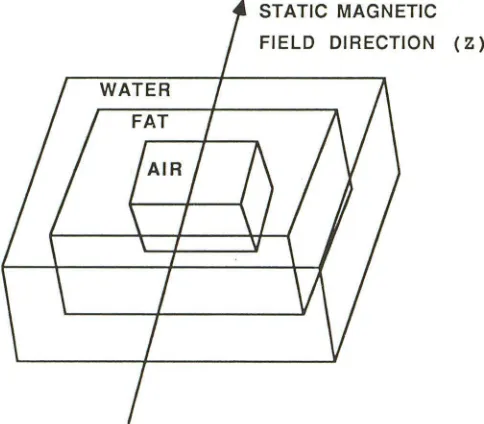
The phantom consisted of three plastic containers of
STATIC MAGNETIC
FIELD DIRECTION ( Z)
Fig. 1. Phantom used to identify susceptibility effects in fre-quency-selective fat-suppression image. The z axis is indicated
by the arrow.
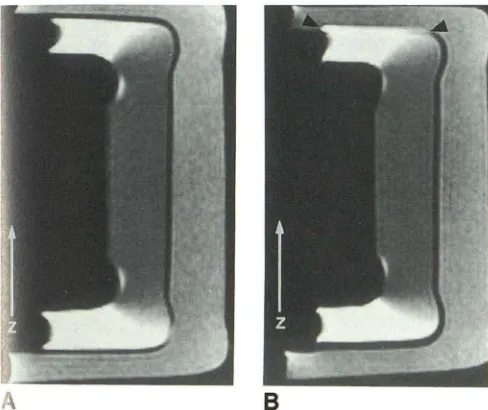
Fig. 2. Coronal images of phantom (SE
600/20); the z axis is indicated by the arrow
(z).
A, Image with fat suppression. Fat-suppression failure is identified at air /fat interfaces along the static magnetic-field di-rection (arrowheads). However, there is no significant geometric distortion.
8, Image without fat suppression.
AJNR: 13, May/June 1992
different sizes. An innermost, empty container was fixed
within the middle-sized container of vegetable oil. An out-ermost container was filled with saline. This phantom
provided air /fat and fat/water interfaces respectively (Fig.
1 ). The fact that the fat/water /air interfaces used in the
phantom are not contiguous but are actually separated by
thin layers of plastic results in a model that is not "perfect."
For the purposes of this paper, we accept this limitation as
not being unlike the clinical situations that we encounter.
In addition, MR scans of two patients with this artifact who were being examined for unrelated pathology are
included as clinical examples.
Results
Phantom images showed artifacts manifeste
as regions of fat-suppression failure at the air /fat interfaces along the static magnetic-field direction (z-direction). This occurred regardless of the im-· age acquisition plane. Fat signal at the air /fat interfaces along the xy-direction was complete! suppressed (Fig. 2). The focal fat-suppression failure was not associated with any geometric distortions. The location and extent of this artifact were independent of either phase encoding or frequency axis.
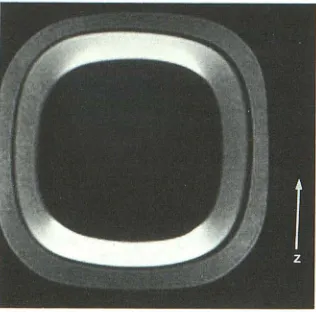
Conventional chemical shift-misregistration e r-rors were seen along fat/water interfaces along the frequency-encoded axis. They were inde -pendent of the fat-suppression failure artifacts (Fig. 3).
The fat-suppression failure artifacts were ob -served in both Tl- and T2-weighted fat-suppres -sion images to the identical extent, implying th~t they are independent of pulse-sequence timing considerations. The extent of the artifact was independent of gradient amplitude along xy-di -rection, since no significant change of the artifact was identified with varying the FOV (Fig. 4). Th.s is in distinction to the chemical shift-misregistra
[image:2.612.58.300.300.512.2] [image:2.612.232.554.568.731.2]AJNR: 13, May/June 1992
tion errors that increased as the gradient ampli-tude was lowered to produce larger FOVs. (Fig. 4). By repositioning the phantom such that one air /fat interface was in the center of the head coil and the other was at the edge of the coil along the z-direction, the artifact still appeared at the same location (Fig. 5). This result suggests that the artifact appearance is not related to the po-sition of the phantom relative to the isocenter of the magnet.
On fat-suppression MR images of the skull base, artifactual high signal was observed at the junction of well-pneumatized sphenoid sinus and bone marrow of clivus (Fig. 6). However, the signal from the fat posterior to the antrum, which
is not oriented along the z ( craniocaudal) axis
A
Fig. 3. Sagittal fat-suppressed image of phantom (SE 600/20).
1he z axis is indicated by the arrow (z). Frequency-encoding
direction is set to horizontal direction in image A, and to vertical
direction in image B. The location and extent of artifacts are
independent of frequency-encoding direction. Chemical
shift-mis-registration artifact is present at fat/water interfaces in image 8 (arrowheads).
A B c
1
z
FOV 16cm FOV 20cm
881
relative to the maxillary antrum, was well-sup-pressed. In another example of fat-suppression MR images of the orbital region, bright signal was identified in the retrobulbar space. This could be mistaken for orbital pathology (Fig. 7), but is due to the artifact at the high-susceptibility interface between air and fat. The orbital fat in this area was located above (along the z axis) the maxillary sinus. These artifacts were identified at the infe-rior aspect of orbital fat as well as the bone marrow of the skull base in cases with well-developed paranasal sinuses and large pharyngeal airway.
Discussion
In this study, phantom and clinical MR images demonstrated potentially confusing focal fat-suppression failure along the static magnetic-field direction where there are large differences in magnetic susceptibility between adjacent regions. This artifact was most troublesome in areas of the nasopharynx and orbits because of their cran-iocaudal (static magnetic-field direction) orienta-tion in superconducting magnets relative to the paranasal sinuses and nasopharynx. These focal fat-suppression failures are confusing and could simulate pathology in these regions. Our results are largely observational and this paper does not purport to develop a definitive basic understand-ing of the mechanisms of this artifact.
We hypothesize that this artifact arises from resonant-frequency shifts due to focal magnetic-field inhomogeneity at the air/tissue interfaces, which result in partial local failure of the presat-uration pulse. Magnetic-field homogeneity is dis-torted where adjacent tissues differ greatly in magnetic susceptibility, because spatial variations in magnetic susceptibility produce intrinsic mag-netic gradients in these regions. The majority of tissues in the body have a slightly negative
sus-FO V 30cm
Fig. 4. Coronal fat-suppressed images of phantom with different size of FOVs. The z axis is indicated by the arrow (z). No sig nif-icant change is identified with varying the size of FOVs. Note the chemical shift-mis -registration artifacts along the superior fat/
[image:3.615.50.294.295.500.2] [image:3.615.55.379.593.734.2]882
ceptibility and are called diamagnetic (weaken the applied magnetic field). However air has only about 1/1000 the susceptibility of most solids (19). This large difference results in air represent-ing the equivalent of a source of negative mag-netization compared with tissue. Therefore, focal magnetic-field inhomogeneity can occur due to intrinsic field gradients across the imaging voxel.
Fig. 5. Fat-suppressed image after repositioning one air/fat interface to be located in the center of the field and the other to be at the edge of the field. The artifacts still appear even if the air /fat interface is placed in the center of the field. Thus, the appearance of the artifacts appears to be independent of position relative to the isocenter of the magnet. A water bag is placed above the phantom. The z axis is indicated by the arrow (z).
Fig. 6. Clinical example of fat-suppression failure in the clivus.
A, Conventional axial Tl-weighted image of skull base.
AJNR: 13, May/June 1992
The intrinsic gradient causes shift of the actual resonant frequency of the protons in fat and results in the failure of frequency-selective pre-saturation pulses. The reason that this artifact was only observed along the static magnetic-field direction is not entirely understood, but may be related to the fact that the static magnetic field of the system is usually two to three orders of magnitude greater than magnetic-field gradients. The fat-suppression failure artifact that we are describing is different from other forms of mag-netic susceptibility artifacts that occur along the frequency-encoded or readout axis. The so called "magnetic-susceptibility artifact" is characterized by geometric distortion of the object along the frequency-encoding axis and signal loss due to rapid-spin dephasing caused by focal magnetic-field inhomogeneity (20-22). This is more pro-nounced in gradient recalled-echo images than in spin-echo images because of the lack of the 180°
refocusing pulse in the former techniques. The artifacts observed in frequency-selective fat
-suppression images were due to resonant-fre-quency shifts caused by focal magnetic-field in
-homogeneity. Focal fat-suppression failure
showed no significant change with switchino
phase- and frequency-encoding axis nor with varying the gradient amplitude. The characteris· tics of this artifact are different from so-callec
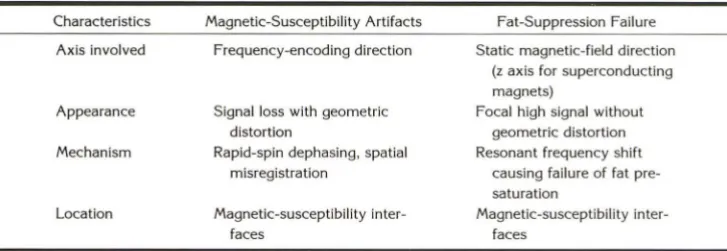
magnetic-susceptibility artifacts (Table 1). How·
B, Fat-suppressed axial Tl-weighted image show's a high signal area (arrowheads), which corresponds with a portion of the fatty
marrow of clivus overlying the airway.
C, Tl-weighted sagittal image shows that the portion of the clivus that showed high signal is located between a well-pneumatiz<d
[image:4.612.102.260.208.364.2] [image:4.612.60.563.470.668.2]AJNR: 13, May/June 1992
A
8
883
Fig. 7. Example of fat-suppression fail-ure in the orbits.
A, Axial T1-weighted fat-suppression im-age shows high signal area in the retrobulbar space (arrowhead), which is simulating or-bital pathology. This is artifact at suscepti-bility interfaces between lower part of orbital fat and upper portion of maxillary sinus.
B, Coronal image in the same patient also showing high signal (arrowheads) which is not due to the inferior rectus muscles. The z axis is indicated by the arrow (z).
TABLE 1: Characteristics of magnetic-susceptibility artifacts and fat-suppression failure
Characteristics Magnetic-Susceptibility Artifacts Fat-Suppression Failure
Axis involved Frequency-encoding direction Static magnetic-field direction (z axis for superconducting magnets)
Appearance Signal loss with geometric distortion
Focal high signal without geometric distortion Resonant frequency shift
causing failure of fat pr e-saturation
Magnetic-susceptibility inter -faces
Mechanism Rapid-spin dephasing, spatial misregistration
Location Magnetic-susceptibility inter -faces
ever, both artifacts are the result of focal
mag-netic-field inhomogeneity at bulk susceptibility
i terfaces.
Fat-suppression failure has also been seen in
areas of changing tissue geometry such as the
submental or submandibular regions with
fre-uency-selective presaturation technique. These
artifacts also occur in the craniocaudal (along the
static magnetic field) direction. Fat-suppression
failure observed in subcutaneous fat may be of
little problem in clinical diagnosis. However, these
artifacts did occur in areas of constant imaging
volume such as the nasopharynx and orbits
be-cause of their craniocaudal orientation relative to
the paranasal sinuses. Therefore, these regions
w re most troublesome and could present
diffi-culties in clinical diagnosis. Although the benefit
of contrast-enhanced fat-suppression imaging
has been reported in the head and neck region
(23), these magnetic-susceptibility artifacts could
be clinically confusing without the availability of
precontrast fat-suppression images for
compari-son. It should be remembered that all bright
lesions on enhanced scans are not necessarily associated with pathologic process. The under-standing of the geometric relationship between air and high signal regions in frequency-selective fat-suppression technique is extremely important
to prevent misdiagnosis.
Acknowledgments
The authors would like to thank Bobby Keen, Keyvan Farahani, and Julien Keesing for their generous assistance
in this project.
References
1. Maudsley AA, Hila! SK, Perman WH, Simon HE. Spatially resolved
high resolution spectroscopy by four dimensional NMR. J Magn
Reson 1983;51: 147-153
2. Bottomley PA, Foster TH, Leue WM. Chemical imaging of the brain by NMR. Lancet 1984;1:1120-1123
[image:5.614.50.390.80.279.2] [image:5.614.120.484.313.438.2]884
4. Dumoulin CL. The application of multiple-quantum technique for the
suppression of water signals in 1 H NMR spectra. J Magn Reson 1985;
64:38-46
5. Axel L, Dougherty L. Chemical shift selective magnetic resonance
imaging of multiple line spectra by selective saturation. J Magn Reson 1985;66: 189-194
6. Keller PJ, Hunter WW, Schmalbrock P. Multisection fat-water imaging with chemical shift selective presaturation. Radiology 1987; 164: 539-541
7. Frahm J, Hasse A, Hanicke W, Matthaei D, Bomsdorf H, Helzel T. Chemical shift selective MR imaging using a whole body magnet.
Radiology 1985; 156:441-444
8. Rosen BR, Wedeen V J, Brady T J. Selective saturation NMR imaging.
J Comput Assist Tomogr 1984;8:813-818
9. Dixon WT. Simple proton spectroscopic imaging. Radiology 1984;
153:189-194
10. Kunz D. Double pulse echoes: a novel approach for fat-water
sepa-ration in magnetic resonance imaging. Magn Reson Med 1986;3:
639-643
1 1. Szumowski J, Plewes DB. Separation of lipid and water MR imaging
signals by Chopper averaging in the time domain. Radiology 1987;
165:246-250
12. Yeung HN, Kormos DW. Separation of true fat and water images by
correcting magnetic field inhomogeneity in situ. Radiology 1986;
159:783-786
13. Szumowski J, Eisen JK, Vintski S, Haake PW, Plewes DB. Hybrid methods of chemical shift imaging. Magn Reson Med 1989;9:
379-388
AJNR: 13, May/ June 1992
14. Bydder GM, Young IR. MR imaging: clinical use of the inversion recovery sequence. J Comput Assist Tomogr 1985;9:659-675 15. Dwyer AJ, Frank JA, Sank VJ, Reinig JW, Hickey AM, Doppman
JL. Short Tl inversion-recovery pulse sequence: analysis and clinical
experience in cancer imaging. Radiology 1988; 168:827-836 16. Atlas SW, Grossman Rl, Hackey DB, Goldberg HI, Bilaniuk LT,
Zimmerman RA. STIR imaging of the orbit. AJR 1988; 151: 1025-1030
17. Axel L, Glover G, Pelc N. Chemical shift magnetic resonance imaging of two-line spectra by gradient reversal. Magn Reson Med 1985;2: 428-436
18. Twieg DR, McKinnon GC. Multiple output chemical shift imaging (MOCSI): a rapid method for chemical shift imaging and localized
moderate resolution NMR spectroscopy. Magn Reson Imaging 1986;
4:118
19. Joseph PM, Atlas SW. Artifacts: magnetic resonance imaging of the brain and spine. Atlas SW, ed. New York: Raven, 1991:109-113 20. Ludeke KM, Roschmann P, Tichler R. Susceptibility artifacts in NMR
imaging. Magn Reson Imaging 1985;3:329-343
21. Czervionke LF, Daniels DL, Wehrli FW, et al. Magnetic susceptibility
artifacts in gradient-recalled echo MR imaging. AJNR 1988;9:
1149-1155
22. Schick RM, Wismer GL, Davis KR. Magnetic susceptibility effects secondary to out-of-plane air in fast MR scanning AJNR 1988;9:
439-442
23. Barkes JA, Dillon WP, Chew WM. Orbit, skull base, and pharynx:
contrast enhanced fat suppression MR imaging. Radiology 1991;