Jamshid Ahmadi1 Carol Ann Miller2 Hervey D. Segall1 Sun-Hyung Park 1.3 Chi-Shing Zee 1 Ronald L. Becker4
Received August 1, 1984; accepted after revi-sion October 5, 1984.
Presented in part at the annual meeting of the American Society of Neuroradiology, San Fran-cisco, June 1983.
, Department of Radiology, Section of Neurora-diology, University of Southern California School of Medicine, Los Angeles, CA 90033. Address reprint requests to J. Ahmadi, Department of Radiology, LAC/USC Medical Center, Box 2, 1200 N. State St., Los Angeles, CA 90033.
2 Department of Pathology, Section of Neuro-pathology, University of Southern California School of Medicine, Los Angeles, CA 90033.
3 Present address: Olympia Radiology, Ltd., Olympia, WA 98506.
• Department of Radiology, Torrance Memorial Hospital, Torrance, CA 90509.
AJNR 6:389-393, May/June 1985 0195-6108/85/0603-0389
© American Roentgen Ray Society
389
CT Patterns in
Histopathologically Complex
Cavernous Hemangiomas
Computed tomographic (CT) studies were correlated with microscopic findings in 10 histologically verified cavernous hemangiomas in nine patients_ In four of the 10 lesions, two or more distinct types of cerebrovascular malformations were identified histopath-ologically. These included arteriovenous malformations, venous malformations, and telangiectasis. Such coexistence of various types of cerebrovascular malformations has been reported rarely. In each of the four combined lesions, there was evidence of recent or old hemorrhage. The CT findings were nonspecific and were similar to those seen in a variety of intracranial pathologic conditions.
Cavernous hemangiomas are relatively uncommon vascular malformations that may involve any part of the central nervous system. In some cases they are clinically quiescent and are detected at autopsy or, by chance, on a computed tomographic (CT) scan. Others cause seizures, headaches, intracranial hemor-rhage, or focal neurologic deficits [1-4). Most cases are diagnosed during the third to sixth decades of life. Identification of these malformations is clinically important because, when accessible, they can be extirpated surgically and are potentially curable [1, 2, 4). Cavernous hemangiomas are more precisely defined by CT than by skull films, radionuclide scans, or cerebral angiograms [5-12]. CT studies of cavernous hemangiomas usually define a well demarcated, hyperdense lesion that frequently contains calcifications. There is no significant mass effect and usually only a mild degree of contrast enhancement. Hypodense areas may sometimes be observed within the lesion because of cystic components [12, 13). Such a CT feature is nonspecific and may be seen in a variety of intracranial pathologic conditions including various forms of vascular malformations, granulomas, astro-cytomas, oligodendrogliomas, craniopharyngiomas, and pineal region neoplasms [14-22]. We describe 10 histologically verified cavernous hemangiomas in which detailed CT studies were correlated with histologic findings.
Subjects and Methods
390
AHMADI ET AL. AJNR:6, May/June 1985TABLE 1: Findings in Patients with Histologically Complex Cavernous Hemangiomas
Case No. Site CT
L basal ganglia Moderate enhancement;
calcification
R frontal Mild enhancement
L occipital'
2 L parietal Moderate enhancement;
calcification
3 ... ... Vermis Mild enhancement
4 L centrum semiovale Moderate enhancement;
calcification
5 .. ... Medulla oblongata Hematomat
6 .... ... R thalamus Moderate enhancement
7 L middle fossa Marked enhancement
8 . . . R frontal Mild enhancement
9 R frontal Resolving hematoma
with ring and tubular enhancementt
Note.-L = left: R = right; AVM = arteriovenous malformation . • Not biopsied.
t Enhancement could not be appreciated within the lesion itself because of hemorrhage.
Histopathologic Diagnosis Cavernous hemangioma
and AVM
Cavernous hemangioma
Cavernous hemangioma
Cavernous hemangioma Cavernous hemangioma
Cavernous hemangioma and AVM
Cavernous hemangioma Cavernous hemangioma Cavernous hemangioma
and AVM
Cavernous hemangioma;
venous malformation; telangiectasia
Hemosiderin
+
0
0
0 +
+
0
0 +
+
Specimen
Biopsy
Biopsy
Biopsy
Surgery Biopsy (mild
hemorrhage) Surgery
Biopsy (massive Surgery Surgery
Surgery
..
.
,
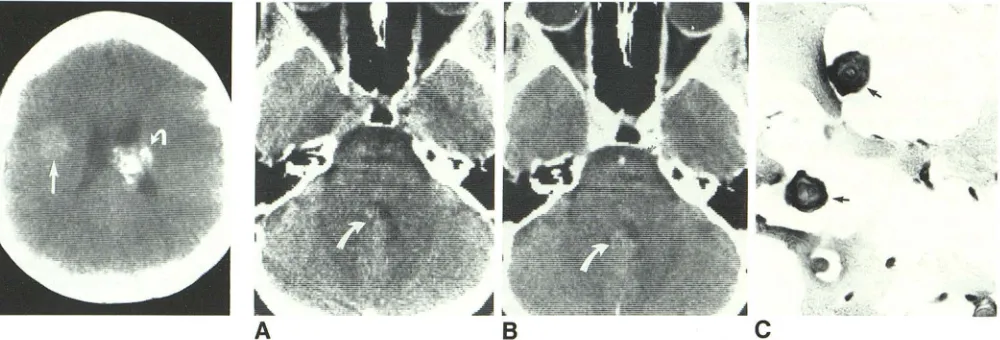
.1Fig. 1.- Postcontrast CT scan. Two cavernous hemangiomas. Lesion adja-cent to left lateral ventricle is moder-ately enhanced and reveals areas of calcification (curved arrow). Other le-sion is only minimally enhanced with no apparent calcification (straight arrow). Histologically both lesions contain cal-cification.
Fig. 2.-A, Precontrast CT scan. Area of slightly increased density (arrow) with average of 51 H. Fourth ventricle is slightly deformed. B, Postcontrast. Minimal enhancement (54 H) (arrow). C, Histology. Portion of cavernous hemangioma with thick bands of interstitial collagen. Only a few viable endothelial cells remain. Vascular channels are virtually free of blood cells. Dense intraluminar structures (calcifications) (arrows) (x640).
Results
Eleven lesions were identified by CT in nine patients (table 1). The most common presenting complaints were headaches (seven patients), seizures (four patients), and focal neurologic deficits (four patients). After brain biopsy, one patient devel-oped a mild bleed; another had a massive and fatal hemor-rhage.
Although 11 lesions were found in our nine patients, only 10 were confirmed histologically and all contained cavernous
hemangioma. Four of the 10 lesions consisted of two or more types of cerebrovascular malformation. Three manifested a complex vascular pattern that included arteriovenous malfor-mation (AVM) and cavernous hemangioma elements; the fourth involved a distinctly unusual combination of cavernous hemangioma, telangiectasis, and venous malformation. One patient had three discrete lesions, but only two were biopsied and are considered in this report.
[image:2.612.55.564.98.284.2] [image:2.612.59.559.349.519.2]throm-AJNR:6, May/June 1985 CT OF CAVERNOUS HEMANGIOMAS 391
Fig. 3.-Cavernous hemangioma simulating meningioma in 51-year-old
woman. Pre-(A) and post- (B and C) contrast CT scans. Markedly enhancing extraaxial lesion arising in parasellar region with some bony erosion (arrow).
E
Fig. 4.-A and B, Postcontrast CT scans. Intracerebral hematoma in frontal lobe with enhanCing rim in periphery. B shows a few tubular, enhancing structures in upper part of hematoma (arrow). Anteroposterior (C) and lateral (D) carotid angiograms. Vascular channels in late venous phase converge toward central vein (arrows). Except for mass effect, arterial and capillary
D
Faint capillary blush was seen on angiography. 0, Histology. Multiple thin -walled large channels lined by flattened endothelium and, in some cases, bands of collagen (x280).
F
G
phases of cerebral angiogram were normal (not shown). E-G, Three different parts of lesion. E, Multiple thin-walled channels without intervening neural
tissue, characteristic of cavernous hemangioma (x280). F, Thick-walled vessel of AVM (x65). G, Thin-walled channels of telangiectasis are separated by
[image:3.617.55.559.84.267.2] [image:3.617.54.558.332.696.2]392 AHMADI ET AL. AJNR:6. MaylJune 1985
bosed lumina. but amorphous or punctate calcifications within
the lesion were only seen by CT in three of the 1 0 lesions (fig. 1).
Microscopically, all of the complex malformations were
found to contain recent hemorrhage or deposits of
hemosi-derin. Minimal contrast enhancement (with an increase of less
than 5 H) was noted in three lesions (fig. 2), and moderate
enhancement (an increase of 10-15 H) in four lesions. In one
other patient, the enhancement was marked and involved a homogeneously enhancing cavernous hemangioma in the
middle cranial fossa that also produced bony erosion. The CT
appearance of this lesion was indistinguishable from that of a
meningioma (fig. 3). Two other patients exhibited CT evidence
of recent hemorrhage within the lesion. In one of these lesions
enhancement was not appreciated on CT studies because of
hemorrhage into the angioma, and an acute hematoma within
the medulla oblongata was later evacuated. Histologic
ex-amination of the surgical specimen revealed a vascular
mal-formation with some elements typical of cavernous
heman-gioma. In the other patient, ring enhancement around the
periphery of a frontal hematoma indicated that the hemor
-rhage was in a resolving stage. Microscopically, this surgical
specimen revealed cavernous hemangioma, venous angioma,
and telangiectasia, all coexisting within different parts of the
hematoma (fig. 4). In two other patients, the surgical speci-mens contained a combination of cavernous hemangioma
with other types of vascular malformation, which had
thick-ened vessel walls containing elastica as well as intervening
neural tissue. Foci of hemosiderin were observed in five
lesions, four of which consisted of a combination of two or
more types of vascular malformations.
Cerebral angiography showed a stain in two lesions and
mass effect in three (two of these had intracerebral
hema-toma); one patient had radiating veins draining into a cerebral
vein. In this case, these veins appeared in the late venous
phase of angiography and were considered typical for venous
angioma. No enlarged feeding vessels or rapid arteriovenous
shunting could be observed in this group of patients.
Discussion
There are several classifications for cerebrovascular
mal-formations [23-26]. The most popular one is the classification
proposed by Russell and Rubinstein [26], who separated
cerebrovascular malformations into several groups based on
their microscopic features: (1) capillary telangiectasis, (2) cav
-ernous hemangioma, (3) AVM, and (4) venous malformation.
Histologically, cavernous hemangiomas are composed of
clustered vascular channels of varying size having a wall lined
only by endothelial cells, separated by penetrating tongues of
connective tissue. No normal neural tissue intervenes. Some
vascular channels have thicker walls containing various
amounts of collagen, calcium, and hemosiderin. Cavernous
hemangiomas are accompanied by a spectrum of
histopath-ologic changes including hyaline degeneration, thrombosis,
massive or multiple regions of minor focal hemorrhage,
min-erai deposits, and collagen. These histologic changes have a
bearing on the CT appearance.
Absence of intervening normal neural tissue distinguishes
cavernous hemangioma from capillary telangiectasis. In some
cases, however, differentiation of capillary telangiectasis and cavernous hemangiomas may be difficult histologically. Tran-sitional forms containing elements of telangiectasis and cav-ernous hemangiomas or cavcav-ernous hemangiomas combined with other types of vascular malformation have been reported
rarely [26-29]. Wortzman et al. [30] recently reported a case
that could not be placed histologically within the Russell and
Rubinstein classification. This lesion was called dysplastic
vascular malformation.
Cavernous hemangiomas have also been reported in com-bination with glial neoplasms; it has been suggested that this
is probably not a chance combination [31, 32]. Cavernous
hemangiomas, despite their nonneoplastic and noncellular
proliferative nature, may grow and damage adjacent neural
tissue, resulting in gradual progression of clinical symptoms.
Enlargement of the lesion is thought to be mainly from pro-gressive dilatation of the thin-walled vascular component. This factor is to be considered in formulating a differential diagnosis
when serial CT scans show an enlarging lesion.
The occurrence of multiple types of lesion in the same patient is of special interest. It is possible that examining multiple sites in surgical samples may reveal these combined
lesions with a frequency greater than has been reported.
Occasionally, however, a vascular malformation may be com-pletely destroyed by hematoma, making its histologic identi-fication as the cause of the hemorrhage difficult. OccaSionally,
a cavernous hemangioma, particularly in the para sellar region,
may enhance markedly with an appearance similar to that seen in meningioma. Mori et al. [33] presented five cases of extradural cavernous hemangiomas in the middle cranial
fossa. Two of the patients had CT scans that showed a
high-density mass with homogeneous marked enhancement. Ishi-kawa et al. [10] and Namaguchi et al. [34] each presented cases with similar CT findings. Cerebral angiography may not help to differentiate a middle fossa cavernous hemangioma
from meningioma. Cavernous hemangiomas occurring in the
middle fossa tend to occur in middle-aged women. It is very difficult to remove these tumors totally because they tend to
be adherent to the cavernous sinus, and may also bleed
profusely.
Recently, CT-guided stereotaxic brain biopsies have been used increasingly to establish the histologic diagnosis of many intracranial lesions. The intent is to provide proper manage-ment, including the avoidance of unnecessary radiation ther-apy in certain patients [35]. However, two of our four patients undergoing brain biopsy developed intracerebral hemorrhage, mild in one case but massive in the other. It is significant that a review of the CT scans in two of these patients revealed that the lesions had moderate contrast enhancement. On the other hand, both lesions in figure 1 were biopsied without complications.
Although some CT patterns found with cavernous heman-giomas are indistinguishable in appearance from those seen
with other intracranial lesions, a correct preoperative
diagno-sis of cavernous hemangioma can often be suggested.
AJNR:6, May/June 1985 CT OF CAVERNOUS HEMANGIOMAS
393
malformation in association with cavernous hemangioma in
four patients adds a further consideration in CT-pathologic
correlation. Such complex malformations may be more
com-mon than has been reported heretofore.
REFERENCES
1. Voigt K, Yasargil MG. Cerebral cavernous hemangiomas or
cavernomas. Incidence, pathology, localization, diagnosis, c
lini-cal features and treatment. Review of the literature and report
of an unusual case. Neurochirurgia (Stuttg) 1976;19:59-68
2. Giombini S, Morello G. Cavernous angiomas of the brain. Ac
-count of fourteen personal cases and review of the literature.
Acta Neurochir (Wien) 1978;40:61-82
3. McCormick WF, Hardman JM, Boulter TR. Vascular
malforma-tions ("angiomas") of the brain, with special reference to those
occurring in the posterior fossa. J Neurosurg 1968;28: 241-251
4. Vaquero J, Leunda G, Martinez R, Brav G. Cavernomas of the
brain. Neurosurgery 1983;12: 208-21 0
5. Segall HD, Segal HL, Teal JS, Rumbaugh CL, Bergeron RT.
Calcifying cerebral cavernous hemangioma with brain scan and
angiographic findings. Neuroradiology 1974;7: 133-138
6. Bartlett JE, Kishore PRS. Intracranial cavernous angioma. AJR
1977;128:653-656
7. Savoiardo M, Passerini C. CT, angiography, and RN scans in
intracranial cavernous hemangiomas. Neuroradiology 1978;
16:256-260
8. Becker DH, Townsend JJ, Kramer RA, Newton TH. Occult
cerebrovascular malformations. A series of 18 histologically
ver-ified cases with negative angiography. Brain 1979;102:249-287
9. Galzio RJ, Zenobii M, Carbonin G, Cristuib-Grizzi L. Hemangioma
calcificans. Surg Neuro/1980;14:331-335
10. Ishikawa M, Handa H, Maritake K, Mori K, Nakano Y, Aii H.
Computed tomography of cerebral cavernous hemangiomas. J
Comput Assist Tomogr 1980;4:587-591
11. Fargueta JS, Iranzo R, Garcia M, Jorda M. Hemangioma calcifi
-cans-a benign epileptic lesion. Surg Neuro/1981;15:66-70
12. Savoiardo M, Strada L, Passerini A. Intracranial cavernous
he-mangiomas: neuroradiologic review of 36 operated cases. AJNR
1983;4:945-950.
13. Ramina R, Ingunza W, Vonotakos D. Cystic cerebral cavernous
angioma with dense calcification. J Neurosurg 1980;52:259-262
14. Kramer Ra, Wing SD. Computed tomography of angiographically
occult cerebral vascular malformations. Radiology 1977;
123: 649-652
15. Albright AL, Byrd RP, Harrison ML. Angiographically cryptic AVM presenting a pontine tumor. J Neurosurg 1980;53:846-848
16. Yeates A, Enzmann D. Cryptic vascular malformation involving
the brainstem. Radiology 1983;146:71-75
17. Foy PF, Lozada L, Shaw MD. Vascular malformation Simulating
a glioma on computed tomography. J Neurosurg 1981;54:125
-127
18. Duffner PK, Klein DM, Cohen ME. Calcification of brain stem
gliomas. Neurology (NY) 1978;28:832-834
19. Price HI, Danziger A. Computed tomography in cranial tubercu
-losis. AJR 1978;130:769-771
20. Whelan MA, Stern J. Intracranial tuberculoma. Radiology
1981;138:75-81
21. Vonofakos D, Marcus H, Hacker H. Oligodendrogliomas, CT
patterns with emphasis on features indicating malignancy. J
Comput Assist Tomogr 1979;3:783-788
22. Vaquero J, Carrillo R, Cahezado J, Leunda G, Villoria F, Bravo
G. Cavernous angiomas of the pineal region. J Neurosurg
1980;53: 833-835
23. Noran HH. Intracranial vascular tumors and malformations. Arch
Pathol Lab Med 1945;39:393-416
24. Raynor RB, Kingman AF Jr. Hemangioblastoma and vascular
malformations as one lesion. Arch Neuro/1965;12:39-48
25. McCormick WF. The pathology of vascular ("arteriovenous")
malformations. J Neurosurg 1966;24:807-816
26. Russell DS, Rubinstein LJ. Pathology of tumors of the nervous system, 3d ed. Baltimore: Williams & Wilkins, 1971:85-108
27. Roberson GH, Kase CS, Wolpow ER. Telangiectases and cav
-ernous angiomas of the brainstem: "cryptic" vascular malform
a-tions. Report of a case. Neuroradiology 1974;8:83-89
28. Diamond C, Torvik A, Amundsen P. Angiographic diagnosis of
telangiectases with cavernous angiomas of the posterior fossa.
Acta Radiol [OiagnJ (Stockh) 1976;17:281-288
29. Hirsh LF. Combined cavernous-arteriovenous malformation. Surg
Neuro/1981;16:135-139
30. Wortzman G, Sima AF, Morley TP. Cerebral dysplastic vascular
malformation: a developmental arrest. Radiology 1983;148:443
-446
31. Falconer MA, Pond DA. Temporal lobe epilepsy with personality
and behavior disorders caused by an unusual calcifying lesion. J
Neurol Neurosurg Psychiatry 1953;16:234-244
32. Fischer EG, Sotrel A, Welch K. Cerebral hemangioma with glial neoplasia (angioglioma?). Report of two cases. J Neurosurg
1982;56: 430-434
33. Mori K, Handa H, Gi H, et al. Cavernomas in the middle fossa.
Surg Neuro/1980;14:21-31
34. Namaguchi Y, Kishikawa T, Fukuy M, et al. Prolonged injection
angiography for diagnosing intracranial cavernous heman
-giomas. Radiology 1979;131 :137-138
35. Apuzzo ML, Sabshin JK. Computed tomographic guidance ster
-eotaxis in the management of intracranial mass lesion. Neuro