J. exp. Biol. (1978), 75, 95-100 With 3 figures
in Great Britain
HOW THE LOCUST DRIES ITSELF
BY HANS-JOACHIM PFLUGER* AND MALCOLM BURROWS
Department of Zoology, University of Cambridge, Downing Street, Cambridge CB2 3EJ
(Received 21 October 1977)
SUMMARY
1. All wet locusts perform a series of specific behavioural acts to rid their body of water. These acts included fluttering the wings, kicking with the hind legs and grooming the eyes and antennae.
2. Any one act can follow another, although wing fluttering, walking and hind leg kicking are closely associated. Some locusts may omit a particular movement in some sequences of drying behaviour.
3. All the movements remove water from the body presumably to allow the correct functioning of the sense organs, or to prevent evaporative cooling.
INTRODUCTION
As a consequence of swimming or walking through wet foliage, a locust inevitably gets wet. Most of the water runs off the waxy surface of the body but a few beads of water remain, particularly at the joints and on the head. How does the locust dry itself is the question addressed in this paper. There are three possible strategies that the locust might adopt. First, it might simply allow evaporation to occur. Secondly, it might move to places exposed to the wind or the sun and there be dried passively. Thirdly, it might actively perform specific movements designed to rid various parts of the body of water. In this paper we will show that the locust has a repertoire of movements that it performs when the body is wet. These include shaking the wings, kicking with the hind legs and grooming the eyes and antennae.
MATERIALS AND METHODS
Observations were made of the behaviour of 20 locusts Schistocerca gregaria renamed Schistocerca americana gregaria by Dirsh (1974), of either sex and any age from ist instar to adult. Some observations were also made on Locusta migratoria but no differences were noticed between the two species. The same locust was repeatedly made to swim and allowed to emerge from the water to dry itself during the course of a 1 h long observation period. Swimming took place in a water container measuring 420 x 720 mm and with a depth of water of 70 mm. The locust could most easily emerge from the water by climbing a 10 mm diameter cloth covered, vertical pole placed in the centre of the water container. It was upon this pole that most of the
* Present address: Fakultat fiir Biologie, Universitat, Postfach 8640, D-4800 Bielefeld 1, Federal lie of Germany.
the horizontal bench surrounding the water tank. The behaviour was either filmW or a commentary taped. All observations were at an air and water temperature of
2 0 - 2 2 ° C .
RESULTS
Climbing out of the water
When a swimming locust reaches an object it attempts to grasp that object with its legs. The co-ordinated swimming strokes of the hind legs and the swimming posture of the front and middle legs (Pfluger & Burrows, 1978) are abandoned in favour of searching movements with all legs. If the locust succeeds in grasping the object, it then endeavours to climb out of the water. When out of the water, the locust either rests for a while or walks to a suitable resting place where the drying behaviour begins. No matter where the locust emerges, the drying behaviour always follows.
The drying behaviour
The drying behaviour of both adult and larval locusts, consists of a sequence of specific behavioural acts (Fig. 1). All locusts dry themselves after swimming, but some may omit particular behavioural acts. The time taken for the drying behaviour to be completed is variable; some locusts take as little as 3 min, others as long as 10 min.
0
Fig. 1. Behavioural acts that the locusts uses to dry itself. Time is not represented in the diagram, only the sequence of events, {a-c) Adult locusts, (d) 5th instar, (e) 4th instar, (/) 2nd instar. The symbols are largely self-explanatory: for example a left hind leg indicates a kick by
Locust drying behaviour
97
Swimming
0
Tr n
obf
! I
ob
—-^«.—
0
1 »
ob
1
ob
[image:3.451.73.384.58.382.2]10 12
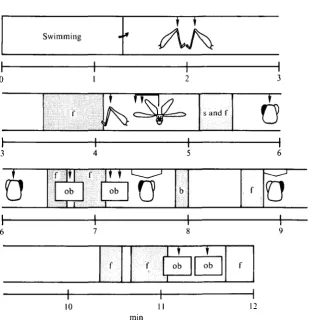
Fig. 2. The temporal sequence of behavioural acts performed by an adult locust when drying itself after a swim. The arrows indicate when the behaviour, as indicated by the same symbols as in Fig. i, begins. An open background indicates that the locust is standing still, a stippled background that it is walking forwards (f), backwards (b) or sideways (s). Other behaviour (ob) is not specified.
Observations were discontinued if one behavioural act was not followed by another within 3 min. The time spent on each act is also variable. Some acts may be repeated several times before a new act is performed. For example, an eye or an antenna may be repeatedly groomed. An illustration of the whole behavioural sequence of one adult locust is plotted against time in Fig. 2. The components of the behaviour which can be readily identified in any drying sequence are the following.
Hind leg kicking
before they kick with the other leg. Other locusts may kick with only one leg the whole drying sequence. Synchronous kicks with both hind legs were never observed.
Wing fluttering
To accomplish the drying of the wings, the locust must first adopt a special posture, particularly when standing on a horizontal surface. First the head is lowered until the mouthparts almost touch the ground and then the abdomen is raised slightly. The hind legs are moved laterally away from the body until the angle between the long axis of the body and the femur is 135° and that between the femur and tibia 900. The posture is somewhat similar to that adopted by some grasshoppers during courtship displays that require movements of the wings (Eisner, 1974). In both behaviours the posture may be necessary for stability and perhaps to prevent the locust becoming airborne. The wings are then opened to a quarter to one half of their full extent. In this position both fore and hind wings are then fluttered with the result that water is shaken off them. Normally the duration of the fluttering movements is no more than 1-2 s but can be repeated several more times at intervals of a few seconds. The longest continuous period of wing fluttering was 8 s. Recordings from the same locust made with wires implanted into the flight muscles show that the same moto-neurones are used in wing drying and in flight. The frequency of the individual wing movements is, however, lower than that in flight; usually the period between the wing movements used in drying is 80-100 ms, whereas in flight it is 50-60 ms.
Grooming the head
Water is removed from the antennae, eyes, mouthparts, hairs on the head and from other parts of the head by careful grooming with the forelegs. Each foreleg is only used to groom the ipsilateral half of the head. Usually the legs are used alternately. One locust, however, was observed to groom both antennae simultaneously with both forelegs. The antennae are groomed repeatedly until dry by pulling them through a special groove between the first and second tarsal pads of the forelegs (O'Shea, 1970). If, as often happens, the antennae become stuck together by drops of water, the grooming is then particularly intensive. The eyes and other parts of the head are cleaned by drawing the tarsal pads of the forelegs across them from the dorsal surface to the ventral.
Other behaviour
Several other behavioural acts, not as distinctive as those already described, are often part of the drying sequence. They have the same consequence, namely the expulsion of water from the parts moved.
Rotation of the hind leg about the coxal joint with the thorax often occurs. The tibia is fully flexed and the leg is protruded laterally at right angles to the long axis of the body. The spined surface of the tibia is pressed against the ground. The whole leg is then rotated about the coxal-thoracic joint several times. One or both hind legs may be rotated at any one time.
Locust drying behaviour
99
[image:5.451.45.413.48.187.2]fWP]
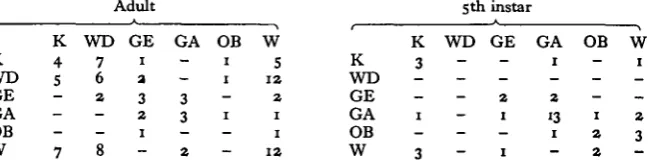
Fig. 3. Flow diagrams to indicate the dependence of one behavioural act upon the preceding one. (a) An adult male. (6) A 5th instar female. The thickness of line is a measure of the frequency. The observations from these two animals are tabulated in Table 1.
Table 1. The frequency with which a particular piece of behaviour follows another
The preceding behaviour is shown on the horizontal axis, the succeeding behaviour on the vertical one. K = kicking, WD = wing drying, GE = grooming eyes, GA = grooming antennae, OB = other behaviour, W = walking.
Adult 5th instar
K WD G E GA OB W K 4 5 -7 WD 7 6 2 -8 GE 1 a 3 a 1 _ GA -_ 3 3 a OB 1 1 -1 -_ W 5 1 2 a 1 1 i a K W D G E GA OB W K 3 _ 1 -1 WD GE -_ -_ - a - 1 -- 1 G A 1 _ a '3 1 _ OB -_ -1 a a W 1 _ _ 2 3
scraped from it leaving a wet trail. Often the body is inclined to one side so that more lateral areas of the abdomen contact the ground. Dorsal areas of the abdomen and the tympana are dried during wing fluttering.
Interspersed between these specific acts, the locust may walk around, usually forwards but also backwards or sideways. Some of the movements, such as grooming or kicking may be performed while actually on the move, but wing drying occurs only when the locust is standing still. Many locusts, particularly larvae, end the drying sequence by first peering with the head (Wallace, 1959) and then by jumping away to a new place.
Sequence of acts
[image:5.451.66.391.296.378.2]This paper attempts no more than to demonstrate that a wet locust undergoes an elaborate sequence of movements to ensure that its body is dry. We surmise that it is necessary for the locust to keep the many receptors that cover the body free of water. Active removal of water will also prevent cooling of the body that would otherwise occur during evaporative drying. The description relates to those locusts which have just been swimming and are consequently thoroughly wet. The same individual components of behaviour can, however, be elicited by spraying a locust with a fine mist of water. For example, wetting the wings evokes the wing drying behaviour; wetting a hind leg evokes a kick. This indicates that it is the consequence of being wet that can evoke the sequence of drying behaviour. In contrast, locusts that have been flying will often perform elaborate facial grooming, even though the head appendages are not apparently dirty (O'Shea, 1970).
None of the individual components that comprise the whole drying behaviour is peculiar to drying alone. The kicks made by the hind leg are the same as used in repelling an adversary, though they may not be as powerful and not directed. Grooming is the same as that which follows other behaviour. Even the wing fluttering is observed in cages of mating locusts, but its behavioural significance there can only be surmised. Thus the whole drying behaviour is made up of components used in many different contexts. The building of complex sequences of locust behaviour patterns from individual, relatively stereotyped components may thus be widespread. It is surprising that in an animal that has been the centre of so much physiological study, a new behavioural pattern should be revealed.
This work was supported by an S.R.C. grant to M.B. H.-J. P. was a European Science Exchange Programme Fellow supported by a D.F.G. grant (Pf 128/1).
REFERENCES
DIRSH, V. M. (1974). Genus Schistocerca {Acridomorpha, Insecta). The Hague: Dr W. Junk, B. V. ELSNER, N. (1974). Neural economy: bifunctional muscles and common central pattern elements in leg
and wing stridulation of the grasshopper Stenobothrus rubicundus Germ. (Orthoptera: Acrididae).
J. comp. Physiol. 89, 227-236.
HEITLER, W. J. & BURROWS, M. (1977). The locust jump. I. The motor programme. J. exp. Biol. 66,
203-219.
PFLUGER, H.-J. & BURROWS, M. (1978). Locusts use the same basic motor pattern in swimming as in jumping and kicking. J. exp. Biol. 75, 81-93.
O'SHEA, M. (1970). The antennae cleaning reflex in the desert locust, Schistocerca gregaria (Forsk). In Current and future problems of acridology, Proc. Int. Study Conf. pp. 55-59. London.