Finding a customer specific model driven development methodology
The CAPE Groep Case
COLOPHON
Title: Finding a customer specific model driven development methodology
Date: 26-7-2010
Author: P.N. van de Braak
Under supervision of:
CAPE Groep B.V. Kosteeweg 13 7447 AJ Hellendoorn
Phone: Tel. +31(0)54-8656065 Fax: +31(0)548-656512
Universiteit Twente
Business Information Technology P.O. box 217
7500 AE Enschede Phone: +31(0)53-4894995 Fax: +31(0)53-4892159
Graduation committee:
M. Iacob (University of Twente)
M. van Sinderen (University of Twente) P. Verkroost (CAPE Groep)
CONTENTS
1. Introduction ... 5
1.1 Background ... 5
1.2 Research context ... 5
1.2.1 CAPE Groep ... 5
1.2.2 Mendix ... 5
1.2.3 Market ... 6
1.3 Reason for research ... 6
1.4 Structure of report ... 7
2. Research design ... 7
2.1 Project charter ... 7
2.2 Problem statement ... 8
2.3 Research goal ... 8
2.4 Research approach ... 8
2.5 Research scope ... 8
2.6 Research questions ... 9
2.7 Structure of research ... 9
2.8 Research method... 9
3. State of the art ... 10
3.1 Software engineering ... 10
3.1.1 Origin of software engineering ... 10
3.2 Models in software engineering ... 11
3.2.1 Model transformations ... 12
3.3 Model driven development ... 13
3.3.1 History of model driven development ... 13
3.3.2 Model driven architecture ... 15
3.4 Software development methods ... 16
3.4.1 Agile development methods... 17
3.4.2 Agile and MDD ... 17
3.5 Contracts ... 17
3.5.1 Applying contracts ... 19
3.5.2 Project triangle ... 21
3.6 Risks and opportunities ... 21
3.6.1 What is risk? ... 22
3.6.2 Uncertainties and risks ... 22
3.6.3 Risk properties ... 23
3.6.4 Risk management ... 24
3.6.5 Risk management process ... 24
3.6.6 Risk identification ... 25
3.6.7 Risk prioritization ... 25
3.6.8 Risk management strategies ... 25
3.7 Project characteristics ... 26
3.7.1 CRM concepts ... 27
3.7.2 Characteristics of customers in Software engineering projects ... 27
3.7.3 Other characteristics ... 28
3.7.4 Characteristics of the customer in software contracts ... 29
3.7.5 Concluding ... 29
4. Conceptual Framework ... 33
4.1 Framework Overview ... 33
4.2 Model driven development method ... 35
4.2.1 A base model driven development method ... 35
4.2.2 Overview ... 35
4.2.3 Phases ... 36
4.2.4 Roles and responsibilities ... 40
4.2.5 Parameters of the development method ... 42
4.3 Risk identification ... 43
4.3.1 Business analyst risks ... 44
4.3.2 Tester risks ... 44
4.3.4 Location risks ... 44
4.3.5 Initial requirements risks ... 44
4.4 Customer identification ... 45
4.4.1 Conclusion ... 50
4.5 Risk determination ... 50
4.6 Risk Management ... 51
4.6.1 Business cases ... 52
4.6.2 Risk management strategies ... 52
4.6.3 Conclusion ... 53
4.7 Selecting a suitable contract ... 53
4.7.1 Agile software development contract ... 54
4.7.2 Choosing a contract type ... 55
4.7.3 Conclusion ... 56
5. Validation ... 57
5.1 Internal and external validity ... 57
5.2 Validation approach ... 57
5.2.1 Validation through illustration ... 57
5.2.2 Validation through experts ... 57
5.3 Validation process ... 57
5.4 Results ... 58
5.4.1 General results ... 58
5.4.2 In depth results ... 58
5.5 Recommendations ... Fout! Bladwijzer niet gedefinieerd. 6. Conclusion & Recommendations ... 62
Appendices ... 68
Appendix A: Software manifesto principles ... 69
Appendix B: Agile methods ... 70
Appendix C: Critical success factors in agile projects ... 72
1. INTRODUCTION
The goal of this first chapter is to create a clear picture of the context in which this research has been conducted and how it came to be. Paragraph 1.1 shortly describes the background of the problem which is then followed up by paragraph 1.2 that describes the context of the research then paragraph 1.3 will describe the reason for this research and 1.4 gives an overview of how this report is structured.
1.1 Background
Software development has been a field of discussion ever since the introduction of it. There have been many different methodologies and silver bullets that claimed to reduce risk, cost and time of the projects. For some this was true however, as technology is constantly growing, new methodologies are required to fully reap the benefits of these new technologies.
One of the new technologies that has been introduced in the past 10 years is model driven engineering. Model driven engineering has had a rough start, but the last few years it has seen large growth. Model driven engineering is the development of software based on the use of models. Spurred by the business side who require better fitting and new software, at a faster pace, programmers use models that are more easily understood by the business than programming code. Model driven engineering has proven that it can provide software much faster than a classical coding project. Practice shows that model driven engineering can not only provide software on a quicker pace but that it also allows for easy feedback to the clients making it more efficient. This however implies that it requires a different approach as the majority of the effort now is placed in the designing (modelling) of an application rather than coding it. How can this new technique be best supported by a development methodology and what influences this?
Software development methodologies can help to structure the development, making it more efficient. But customers can be a nasty barrier that has to be overtaken. Customers sometimes choose the opposite way of what is recommended and thus it requires adaptation from the developer to facilitate a successful project.
In this thesis we conduct research to finding and aligning a software development methodology with the customer that can utilize the advantages of model driven engineering.
1.2 Research context
1.2.1 CAPE Groep
This research takes place at CAPE Groep in Enschede, the Netherlands. CAPE Groep is an advisory company which operates in the domains of construction, transportation and logistics and naval construction. CAPE Groep consists of two divisions: CAPE Consulting and CAPE System Integrations.
CAPE Consulting mainly focuses its effort on advising companies during the selection of new software but it also supports companies during the implementation of software, does process optimizations and deals with project management. They position themselves between software suppliers and the customer and support the implementation from start till end.
CAPE System Integrations provides integration services ranging from board computers to ERP systems. They provide integration of existing systems with new or with old software. This is done on basis of off-the-shelve before custom made. However if no fitting solution is available on the market they also play the role of application supplier and provide their own solution. Since 2007 CAPE Groep started to build their software solutions based on the Mendix platform. Mendix is a software platform which is provided by the equally named company.
1.2.2 Mendix
restore, to improve and to correct”. Their goal is to improve business applications by making it much easier to measure, extend, integrate, build and adapt business processes.
Mendix provides a model-driven enterprise application platform that enables business analysts to build service-oriented business applications that can be integrated and adapted in many existing IT & business environment. Key benefits are increased flexibility, accelerated application delivery and reduced complexity. Mendix positions itself as a provider of a software factory. They do undertake software projects of their own but they try to keep this to a minimum.[1]
1.2.3 Market
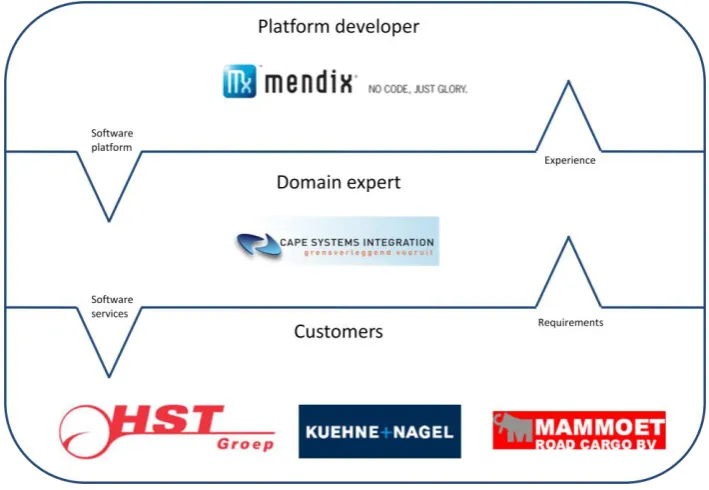
[image:6.595.120.475.267.512.2]As said earlier CAPE Groep operates in three different markets: The construction, transportation and logistics, and naval construction market. However, for this research we focus on their main market which is transportation and logistics. About 80% of all projects of CAPE Groep have their roots in the transportation and logistics market. Figure 1 shows the positions of CAPE Groep and Mendix, in the transportation and logistics market.
Figure 1: Market situation
1.3 Reason for research
A research thesis is always structured around a main problem. A problem is defined as a gap between experience and desire of a stakeholder. This means that a problem can be seen as a difference between what is desired and what is reality [2]
In 2007 CAPE Groep started with developing their own software solutions. Two example projects that will be used in this thesis are the order entry portal of HST and the Board computer portal at Mammoet Road cargo. Both projects were model driven development projects in which CAPE applied the Mendix platform and in both projects CAPE Groep experienced some lag and delay because of discordance with the customer on the form of contract. Furthermore, CAPE Groep noticed that applying the same development method with different customers lead to varying results. These varying results lead to the demand for a development methodology that could be adapted to the customer. CAPE Groep believes that if they align their development methodology better with the customers their projects will require less effort to produce the same outcome.
communication, the development method and the contract between the developer and customer influence development? And how can this be improved?
Among other things this research makes use of the practical experience derived from already finished projects at CAPE Groep. In these projects we search for occurrences where influence of the customer is exerted on CAPE Groep and the development process. However, not only the occurrence itself is important but also the causes behind it are of paramount importance, because knowing why and how a customer reacts to a certain situation allows for timely interaction and can reduce the risk of annoyance both at the side of the customer and the project developer. After all, an ounce of prevention is worth a pound of cure.
This research is conducted in the context of model driven development. 1.4 Structure of report
This report is structured around six chapters. This chapter provides a small summary of the problems that are present and tries to explain the reason for this research. Chapter two describes the structure behind this research by identifying the process that is used during the research and by clarifying the research questions. In the following chapter the theory and background information, that was required to perform this research, is fully discussed. Among others are the topics: Software development, Model driven development, Development methods, Customers in software development and Contracts. All of these topics are combined in chapter four to create the framework. This framework is validated in chapter five, which discusses the framework among several experts from CAPE Groep. Finally chapter six concludes this research with conclusions and recommendations for future research.
2. RESEARCH DESIGN
This chapter will further elaborate on the research question that is answered within this research. Paragraph 2.1 will introduce the project charter that is the charter in which this thesis will conduct its research. Then paragraph 2.2 will discuss the problem at hand, followed up by the project goal and scope. Then as last the research question will be summed up and a structure of this paper is made to show what subjects are covered in which chapter.
2.1 Project charter
According to the CHAOS research from Standish Group there are many reasons as to why software projects fail or exceed their budget, the most important being lack of executive support. However, in their top 10 they also include the formal methodology on the 8th place. They state that using a formal methodology can increase the chance of success by 16%. This shows that, although not the most important aspect, having a formal development methodology significantly increases the chance of bringing a project to a successful end[3].
As said in the introduction, a good methodology helps structuring the overall process of the project and ensures that fewer mistakes are made. Mistakes such as bad testing of software or miscommunication due to bad specification. To reduce these mistakes it is important for a software developer to make a good forecast of the situation to ensure that proper and timely intervention can be realized. This research will specifically handle the development of software using model driven technologies and look at the influence of the customer on this process.
Model driven technologies can be more flexible than classical development technologies or pure code generating technologies. The reason that they are more flexible is that they can produce results faster and enable easier and quicker communication between customer and developer.
2.2 Problem statement
Based on the project charter the following problem statement has been made:
„How can model driven software projects become more efficient by aligning development with the customer and contract type‟
2.3 Research goal
The goal of the project is to improve the efficiency of model driven development projects by aligning the customer with the contract, and the development method.
2.4 Research approach
The main research question will be validated and answering following a few steps. First a literature study will be conducted concerning model driven development. This will provide the research with its scope by defining the outer bounds.
Second the literature study will provide the definition of a software development methodology and we will identify what different development methods are applicable for model driven development.
From here on literature on customers in model driven software projects will provide us with the insights required to map the customers with the development method.
Finally a study in contracts for software projects is done so that these can be mapped between the development methods and customer types.
Combined, the above studies will provide the information needed to create a framework that allows mapping of the customers to the contract and the development method. This framework will be validated by experts from CAPE Groep.
Misalignment between customer
and the project Decrease of project efficiency
Budget overflow
Depreciation of relationship
Bad reputation Bad communication
Ambiguous project incentives (unknown/conflicting)
Inexperienced Customer Wrong or ambuigious
requirements Enforce non fitting contract
structure
Extra meetings Extra work
Figure 2: Initial problem identification
2.5 Research scope
In order to keep the project manageable within the predefined time limitations it is important to define what falls within the research but also what falls outside of the scope. We define the outer limits as follows.
This research only focuses on software development that makes use of model driven development. Although software development is discussed it is only touched to show how model driven development evolved.
2.6 Research questions
1. What types of contracts are used in the software engineering field? 2. How does the customer influence software development projects? 3. How can a development method of MDD be aligned with the customer? 4. How can the efficiency of software projects be measured?
2.7 Structure of research
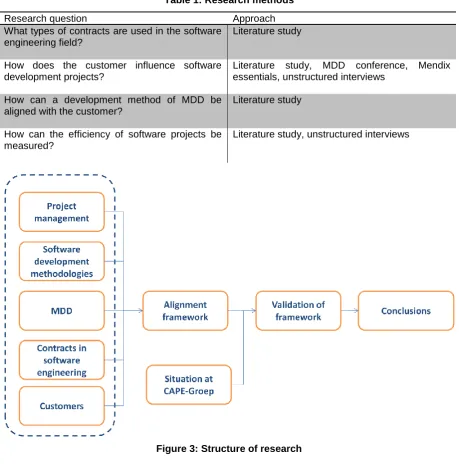
Figure 3 shows an overall structure that is required for this research to produce its outcomes according to [4].
The subjects which are contained within the dotted line are the parts that require theoretical research. The other parts are the practical parts considering the CAPE Groep Case.
2.8 Research method
[image:9.595.68.528.314.779.2]This paragraph describes which methods are used to obtain the information required to answer the research questions.
Table 1: Research methods
Research question Approach
What types of contracts are used in the software engineering field?
Literature study
How does the customer influence software development projects?
Literature study, MDD conference, Mendix essentials, unstructured interviews
How can a development method of MDD be aligned with the customer?
Literature study
How can the efficiency of software projects be measured?
Literature study, unstructured interviews
3. STATE OF THE ART
This chapter will try to give more insight in the terminology of software engineering and model driven development. It will then continue to explore the used contracts in software engineering followed up by the influence of customer on a software engineering. These insights form the foundation that is necessary to understand and support this research. The most important concepts that will be thoroughly investigated are model driven development, development methods, customer characteristics and contract types.
3.1 Software engineering
This research aims to increase the efficiency in model driven software development projects. Before we start, let us first take a look at the definition of software engineering.
According to [5] software development is the set of activities that results in software products. Software development may include research, new development, modification, reuse, re-engineering, maintenance, or any other activities that result in software products.
Software development thus not only consists of coding, but also of the planning and managing of processes that result into software products. When compared against different definitions of software engineering we find that engineering and development is actually the same thing.
The first definition of software engineering dates back from 1968, given at the first NATO conference [6]:
Software engineering is the establishment and use of sound engineering principles in order to obtain economically software that is reliable and works efficiently on real machines.
Some other definitions respectively given by [7-9] are:
Software engineering refers to the disciplined application of engineering, scientific, and mathematical principles and methods to the economical production of quality software.
(1)The application of a systematic, disciplined, quantifiable approach to the development, operation, and maintenance of software; that is, the application of engineering to software. (2) The study of approaches as in (1).
Software engineering is the establishment and use of sound engineering principles and good management practice, and the evolution of applicable tools and methods, and their use as appropriate, in order to obtain – within known but adequate resources limitations – software that is of high quality in an explicitly define sense.
These definitions use rather different words to describe the field. However, the essentials are the same. Software engineering is a practice that makes use of formal and disciplined methods to research, create, operate and maintain software. Software engineering can thus be seen as a very broad field. This is why it is so important that development methods are applied to structure its content.
3.1.1 Origin of software engineering
As stated earlier software engineering originates from 1968 when at a NATO conference the term was introduced to gain access to engineering funding. However, software was already being made long before this conference.
In the 1960‟s people started to realize that programming, which was what software engineering was all about at that time, had become too complex. Programs were becoming very large and it was increasingly difficult to debug applications. This is why new programming languages were introduced that made the code more readable, by introducing a higher abstraction level, so that errors were more easily detected and software was created faster. At the same time, more and more programmers were involved in software projects.
Software engineering reached a point at which computers were rapidly evolving but software development wasn‟t. This lead to the software crisis as it was named by Dijkstra in 1972. To head this crisis again new programming languages were introduced such as FORTRAN, COBOL and ALGOL, which tried to reduce the complexity of software projects by adding extra structure to the programming languages. But also programming methods were introduced to structure the development process and the management of resources. In 1970 Royce talks about a structured and sequential approach that introduces the phases of requirements elicitation and application design. This model would later come to be known as the waterfall model. Software development methods will be further discussed in paragraph 3.4 [11]. With the introduction of the personal computer, the field of information technology became available to the large public making it grow faster than before.
With the growing availability not only large companies were able to attract IT but also smaller companies started to use IT. With a rapidly expanding market IT was once again growing abundantly and with this abundant growth came again more complexity. A great example is the crash of the long-distance network of AT&T in the United States, which paralyzed some of the world‟s key financial and business institutions. The costs for this crash were estimated in the hundreds of millions of dollars. Yet the root cause was tracked to a C program that was missing a “break” statement – a kind of coding error which is not uncommon at all and very difficult to detect once a program surpasses a million lines of code [12].
With the growth of IT, applications became larger and larger making it harder to check for these type of errors. In the book The mythical man-month, Fred Brooks identifies two types of complexity. Essential complexity: complexity which is inseparable from the problem. A famous example of this in logistics is the travelling salesman problem. The other type of complexity is accidental complexity, which is the complexity that is a direct consequence of the resources and methods that are used to approach a problem. For example, construct a house without the use of bricks and cement or to build a bridge while only using reed.
Accidental complexity is one of the reasons why models were introduced in the world of software engineering.
3.2 Models in software engineering
Models are a very broad concept and they have been used in many engineering fields before being applied to the software engineering field. Examples that are known to most are blueprints of buildings or charts of landscapes. Over the passing ages these models have been used and have been perfected to become a reliable tool in construction and engineering. With the introduction and adaptation to model driven engineering, models start to get a more prominent role in software engineering and so now their development has started to shift as well. To understand how these models have developed and what they mean we start by looking at them from a more general perspective. After all, when applying a model driven development approach, models are used in much the same way as in other engineering disciplines [13].
A general definition of a model is given by Starfield, a model is a representation of a concept. The representation is modelled with a purpose. The model purpose is used to abstract the irrelevant detailsfrom reality [14].
This implies that models are used to model or portray only part of reality to reduce the complexity. This is supported by Seidewitz who states that a model is an abstraction (also called representation or denotation) of an object system (also called system under study) expressed in some language. Where an interpretation of a model gives the meaning of the model relative to the object system [13].
Eventhough there are many different definitions of a model all sources agree that models are used to abstract and simplify reality. Models provide abstractions of a physical system that allow engineers to reason about that system by ignoring extraneous details while focusing on the relevant ones.
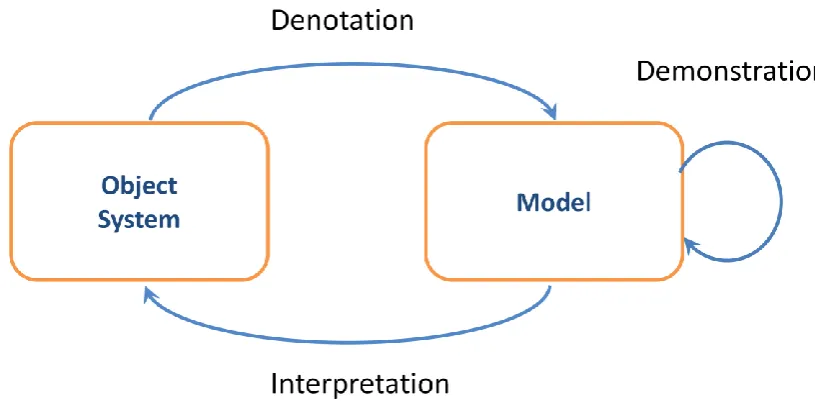
[image:12.595.68.476.146.356.2]Hughes created a graphical picture to represent this process shown in Figure 4.
Figure 4: Model denotation demonstration and interpretation
In the figure the object system is the reality that is being denoted by a model. This model can be used to calculate or to demonstrate values so that it can be updated. At any given time the model can be interpreted to update the reality that is under observation. For a more precise description of how modelling works we refer to [13].
Following the above conclusions, models are mostly used as a description of a system under study. However, in software engineering models have so far been used as a specification rather than description. For example a weather forecast that provides the current wind speeds at a given location is a descriptive model. While a model, based on the weather forecast and used to calculate the optimal route for an airplane, is a specification model. This is also true in software engineering; a class diagram specifies what the software should look like. It is more often a design rather than description. Because it requires a lot of effort to keep both the models as the code up to date, the models are often used to create a general architecture but later discarded and not used anymore. Within the class diagram example, the implementation of the class diagram depends on the interpretation of the programmer of the model. With interpretation we mean the mapping of the model‟s elements to the elements of the system under study such that we can determine the truth value of statements in the model from the system under study [13]. In other words, the interpretation of the model gives the model meaning in relation to the system under study.
If this relation is invertible then a representation of the system under study can be made, in which all statements about the system under study are true under the current mapping. These mappings form a model of the model-to-model relations and are called model transformations in model driven development.
3.2.1 Model transformations
Refactoring transformations reorganize a model based on predefined criteria. In this case the output is a revision of the original model, called the refactored model. An example could be as simple as adding prefixes to each element name in a model. These transformation are also called endogenous transformations or rephrasing transformations [16].
Model-to-model transformations convert information from one model or models to another model or set of models, typically where the flow of information is across abstraction boundaries. An example would be the conversion of a java model to an XML model. These transformation are also called exogenous transformations or translation transformations [16].
Model-to-code transformations are a form of model-to-model transformations, with the distinction that the code that is generated is not seen as model. This of course depends on the definition of a model. These transformations convert a model element into a code fragment. Model-to-code transformations can be developed for nearly any form of programming language or declarative specification. An example of model-to-code transformations would be the generation of Data Definition Language (DDL) code from a logical data model expressed as a UML class diagram [[17]].
Another distinction that can be made between the different transformations is horizontal versus vertical transformations. A horizontal transformation is a transformation where the source and target models reside at the same abstraction level. Typical examples are refactoring (an endogenous transformation) and migration (an exogenous transformation). A vertical transformation is a transformation where the source and target models reside at different abstraction levels. A typical example is the refinement of a platform independent model, e.g. a UML class diagram, to a platform specific model, e.g. java classes [18].
Summarizing, model transformations allow models to be supplemented with additional information or allow the translation of one type of model into another type of model. Model transformations can be executed manually but also automatically. These automated transformations are the strength behind model driven development or model driven engineering.
3.3 Model driven development
So far we have only described models and model transformations. Although these are the basis of model driven development it is still unclear what model driven development is and why it has such a potential.
Model driven development uses models as a basis rather than code. Even though code is also a model at some level, code is often not understandable for a lot of business people. Because of this, there exists a gap between the business analysts and the developers in traditional development. Model driven development can fill this gap so that communication between business analysts and developers runs smoother.
3.3.1 History of model driven development
Model driven development or model driven engineering is an approach to application development that uses the concepts of models and transformation to create an application based on an abstract representation.
In current software development projects tools are used to automate model transformations but this wasn‟t always the case as the concept of models is not new to the field of software engineering. Ever since the beginning of software engineering models have been used to visualize the code and to help to communicate about the code. There are tools to help clarify functionality and to provide a better overview to the programmers. Examples of these type of models were use case scenario‟s and use case diagrams. Later on with the introduction of object oriented languages came models such as the class diagram and entity relationship diagrams. However because these models were not formally linked to the code they were often incomplete or inaccurate [12].
Figure 5: From model based to model driven [21] [22]
Figure 5 shows the progress of the usage of models over time, ranging from none at all, to model based development, towards full model driven development by use of model execution.
Currently most developers either use only code or sometimes hand sketched models that have no formal link to the code. They rely solely on their code to model their application in the form of packages and classes. When displaying their application to the business they tend to form a graphical model, often done in UML, which is often translated by hand. While this method has proven itself over the past decade it can be difficult to understand key characteristics of the system as each person has a different interpretation of non-formal models.[21]
A more formal approach is when developers use the approach of code visualization. As developers create or analyze an application they often want to visualize the code through some graphical notation that aids their understanding of the code‟s structure or behaviour. With code visualization a visual application generates the graphical model based on the code. It may even be possible to manipulate the graphical model as an alternative to editing the text-based code, so that the visual rendering becomes a direct representation of the code. Some tools that are able to create these visual representations or “diagrams” are for example IBM WebSphere Studio and Borland Together. The later functionality is also called roundtrip engineering. [22]
In this thesis we are especially interested in the newest developments in model driven engineering called model execution. Rather than in the other situations the model instead of the code is now the basis of the application. From the model, code is generated that can be executed directly, by run time environments. This has a great advantage over the more classical forms of software engineering because now it becomes possible for the business side to model their requirements in a formal way and store their knowledge in the model. In a way they are programming the application, in some cases it might even be possible for the business to program an application themselves. This increases the overall development speed as less interaction between the actual programmers or technical side and the functional side is required. [15]
A different view on the development of model driven development is presented by Hailpern & Tarr. They create an analogy between Julius Caesars observation of the Gaul and the types of model driven developers. They identify three types of model driven developers the sketchers, the blueprinters and the model programmers.[20]
Blueprinters are experienced developers that draw out very detailed application designs and create an analogy between the architecture and application design. They then leave the implementation of the design up to less experienced designers.
Model programmers also support the use of modelling languages but with executable semantics. Model programmers can be best identified with roundtrip engineering and model execution. They make use of executable code either in form of a high-level programming language or by direct execution of the model. The model-programming camp is typified by the supporters of the object management group (OMG) vision of a standard called model driven architecture (MDA)[20].
3.3.2 Model driven architecture
Simplistically models are nothing more than an abstract view on something. But with this definition programming languages such as java and FORTRAN are also a model. While this is true, model driven development has a different view on models. The Model Driven Architecture guide from the Object Management Group provided a new definition for a model. The MDA guide states that a model of a system is a description or specification of that system and its environment for some certain purpose. A model is often presented as a combination of drawings and text. The text may be in a modeling language or in a natural language [18].
MDA is a standard for model driven development that was introduced by the object management group (OMG) in 2000.
It is based around three goals; portability, interoperability and reusability. To achieve these goals they make a clear distinction between three types of viewpoints: The platform specific viewpoint, platform independent viewpoint and computation independent viewpoint. These viewpoints provide an approach that separates the system from the platform on which it runs. Each of these viewpoints can contain different models that can be linked to each other with help of transformations.
The computation independent viewpoint focuses on the environment of the system, and the requirements for the system; Models created in the computation independent viewpoint are called computation independent models or sometimes domain models. These models are made in a vocabulary that is understandable to the domain experts. This plays an important role in dealing with the knowledge gap between the domain experts and the design experts.
experts of design and construction of the artefacts that together satisfy the domain requirements on the other hand.
The platform independent viewpoint focuses on the operation of a system while hiding the details necessary for a particular platform. A platform independent model shows that part of the complete specification that does not change from one platform to another. Models from this viewpoint form the bridge between the business side and the technical side. Where domain experts are able to create models for the computation independent models, technicians and implementation experts create the platform independent models. The latter are then transformed to the platform specific models by use of transformation rules. The platform independent models thus play the role of translator between the implementation and the requirements specification.
A platform independent view may use a general purpose modelling language, or a language specific to the area in which the system will be used. A common technique in creating a platform independent model (PIM) is to use a technology-neutral virtual machine e.g. the java virtual machine. A virtual machine is a set of parts and services (communications, scheduling, naming, etc.), which are defined independently of any specific platform and which are realized in platform-specific ways on different platforms.[18] In the java example, the virtual machine translates the java code to a byte code which can be read by almost any platform. A virtual machine can be seen as a platform that is running on top of a platform. Logically a java model is then specific to the java platform. However because the virtual machine itself is platform independent so is the java code i.e. A→B & B→C then A→C. [18] The platform specific viewpoint combines the platform independent viewpoint with an additional focus on the detail of the use of a specific platform by a system. For example the transformation of values stored in a model to a MYSQL database would require a different platform specific model then a transformation to a PostgreSQL database [20]. The platform specific model (PSM) thus store information how the application is stored on a targeted platform. The PSM is the most static model as it will only change when the platform changes.
In basis the separation of these viewpoints ensure that certain pieces of code are not required to be rewritten every time a new model is created. This is because the transformations are static and stay the same, unless the modelling language is unable to model something i.e. if the modeller is unable to model its needs in the model.
There are commercial tools that fully automate the transformation between the so called platform specific models and the platform independent models. They provide the user with the ability to create several CIM‟s and PIM‟s in a domain understandable environment which then translates these models to run time code via platform independent and platform specific models. Examples of these tools are Mendix and OLIVANOVA [1, 23]
3.4 Software development methods
Software development is a complex human activity which like many others has to be managed in order for it to go smoothly[24]. This is one of the reasons why software development methods were introduced in the early seventies.
Software development methods are methods that structure software projects in the sense that they provide planning, role distribution and often a format for work products. Because software projects are so diverse and are also applied in many different fields many different software development methods have been developed over the years. Examples are the waterfall method, scrum, crystal and rapid application development. Because software development methods have been developed in many different fields there is no one clear definition of what a software development method entails.
The waterfall method and evolutions of this method are often referred to as heavyweight, plan-driven or full life cycle methods. With this we mean, methods which try to specify the whole application up front [25]. Many researchers believe that these heavy weight methods are too inflexible to cope with current business environments and point out that this is the main reason why so many projects fail. They have adopted their view to newly introduced ideas about software engineering [26-27]. This group is focusing its attention to making software engineering more agile. With an increasing group of proponents and researchers, agile methods prove to be a promising technique.
3.4.1 Agile development methods
Agile development methods have coexisted next to classical development methods ever since the mid 80‟s. Qumer and Henderson offer the following definition for the agility of any entity:
„„Agility is a persistent behaviour or ability of a sensitive entity that exhibits flexibility to accommodate expected or unexpected changes rapidly, follows the shortest time span, uses economical, simple and quality instruments in a dynamic environment and applies updated prior knowledge and experience to learn from the internal and external environment.‟‟
Agility thus provides the ability to adapt to unknown changes which is exactly what was missing in the heavyweight methods. However, agile software development is more. In 2001 a small group of software practitioners wrote a manifesto on agile software development [26]. This manifesto consists of twelve principles that form the basis of agile software development and can be found in Appendix A: Software manifesto principles.
Taken together with the notion of agility and of development method, an agile software development method can be defined as [25] :
“A software development method is said to be an agile software development method when a method
is people focused, communications-oriented, flexible, (ready to adapt to expected or unexpected change at any time), speedy (encourages rapid and iterative development of the product in small releases), lean (focuses on shortening timeframe and cost and on improved quality), responsive (reacts appropriately to expected and unexpected changes), and learning (focuses on improvement
during and after product development)‟‟.
The main values of agile development are summarized by Warsta as individuals and close interactions, customer collaboration, iterative development and response to change [28].
3.4.2 Agile and MDD
Model driven development provides the user with an easy way to abstract and visualize an application. By introducing the three view separation of CIM, PIM and PSM by OMG, it becomes easier to cross the gap between the IT
3.5 Contracts
This research aims to increase efficiency of a software development projects by aligning the development method of the software with the preferences and properties of the customer. One of the most, important components that is used during the development of not just software but in any development project is the contract.
A contract can be seen as a specific job or work order, often temporary or of fixed duration and usually governed by a written agreement [29]. In software engineering contracts are usually set up in the acquisition phase of the project. They are used to setup a project organization [30]. They are required to reduce the risk of possible friction between the developer and the client(s).
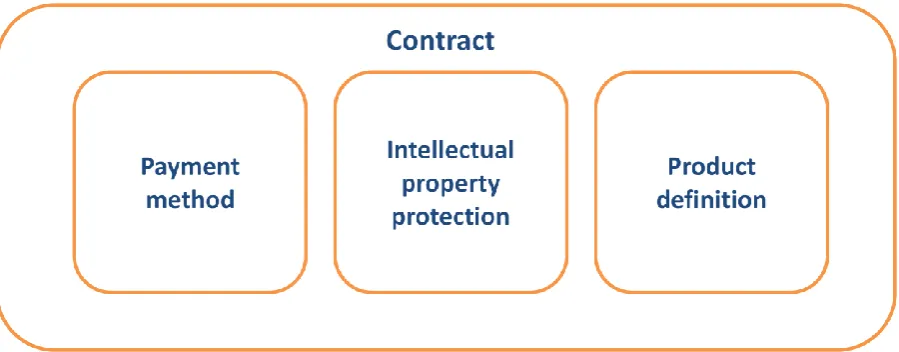
While no contract is the same, Whang concludes that the core of a contract consists of; product definition, intellectual property protection and payment structure [30].
Figure 6: abstract contract
The product definition includes the description of what is supposed to be delivered at what point during the project. Software contracts specify the product in great detail. The product definition specifies the requirements for the software but often also hardware and documentation is mentioned. The software specification mainly consists of lengthy functional specifications that define the tasks and input/output of the application. Also it often specifies boundaries like the operating system, database environments or programming language. Very often a preliminary study has already been done so that a technical design document and a full requirements document are also attached. If this hasn‟t been done the contract will also have a list of services that the developer should provide during the development like, requirements analysis, interviews, design , programming, testing, implementation, support, training etc.
As software is not a physical entity that can be exchanged between two persons there always exists a potential danger that disputes will arise over its ownership. Since the same solution (with minor tweaks) could be used for a different or even competing company. Another example of a possible danger is a trade secret that might need to be revealed to the developer who also has contact with direct competitors of the client. To avoid these kinds of disputes contracts also often specify what content can be used by whom and who owns this knowledge. This part of the contract is called the intellectual property protection.
The payment structure describes how payments should be done and when they should be made. Most contracts try to specify an amount that the software is delivered in and couple this amount to a time to be delivered for a given cost. Some examples of this itemization are software licenses or service level agreements. Payment schedules are usually tied to the development phase i.e. after the completion of a certain phase a payment has to be made for that part of the project.
These three contract components together form the contract which can also be seen as a scale of risk that determines who carries what risk. Often uncertainty is covered by a fee of money, for example, if the developer does not deliver he will have to pay a fee. Or if the customer provides a very uncertain business case it could result into a wrong delivery which as Whang states could lead to legal actions from the customer. Hence that the contract should be structured in such a way that it tries to align the incentives of the customer with those of the developer.
Often contracts are categorized by their payment method. Turner identifies five different type of contracts by their payment structure [31].
Cost plus (Time & materials)
Re-measurement based on a schedule of rates
Re-measurement based on a bill of quantities
Fixed price
However, they state that the project management body of knowledge, an ANSI norm for project management, only recognizes one type of re-measurement contract which is the re-measurement based on a schedule of rates. Which is why they only validated their theory with 3 contract types. Both of these categorizations are found to be too specific, as the difference between these contracts are not likely to influence the customer behaviour enough to realign the development method. We thus require a different categorization. Before we further abstract the types of contracts we will first elaborate and support our hypothesis above by explaining what these contracts entail with an example of a car garage.
With a cost plus contract, the garage is paid for all incurred costs plus an extra fee to ensure a profit. The agreed profit margin can be a percentage of the total costs or a fixed margin. In this example it would mean the garage owner is paid for all hours his repair crew made plus all incurred costs for materials like paint, glass or bolts and screws.
The re-measurement contract based on a schedule of rates is a contract that, as with the cost plus contract, calculates the cost afterwards but does this so on an average cost per rate. This means that hours worked by the repair crew are measured and paid for by a predefined agreed price per, hour per x amount of screws or bolts.
Re-measurement based on a bill of quantities does not differ much from the re-measurement based on a schedule of rates. However instead of calculating the price for all hours and materials, an average price is taken for the size of an activity. For example if a car needs a painting job, the price could also be calculated by an average price per square meter, no matter what paint is used. So the price is paid in square meters rather than in litres of paint.
The re-measurement based on a bill of materials is the most abstract of all three re-measurement contracts. It calculates an average price for a whole activity. For example if you take away your car to a garage, you can choose to let it have a standard up and pay an average price for this check-up based on the type of car and the size of the car.
The fixed price contract is probably the oldest contract form that is used in software engineering. It calculates a price upfront for which a definite set of requirements has to be delivered. Thus if you would like to have a dragon painted on your car it calculates upfront the price of the estimated amount of paint, the estimated amount of working hours and the estimated amount of time the painting area is in use. From this a standard price is calculated, all hours, materials and time that is spent over budget are costs and risk for the garage owner.
3.5.1 Applying contracts
From the perspective of the developer it seems that a time and materials contract would always be the best choice as it will cover any cost of efficiency decrease. If the garage owner would take twice as long to paint the car of his client it would still be paid for.
However Turner and Simister provide us with a different perspective on this as they explain using the transaction cost concept. They define the transaction cost as the cost of planning, adapting and monitoring task completion. In short the costs of managing the contractual relationship [31].
In a perfect world each contract would provide the same out-turn costs however, as Turner explains due to opportunism by the developer and human errors from the client this is not the case.
Figure 7: Transaction cost versus uncertainty of product[31]
This idea provides a way to choose a type of contract, namely the cheapest type of contract for the uncertainty of the product. However there is a flaw in this theory, it assumes that transaction costs and out-turn costs are not associated and we believe that this wrong. Different types of contract may incentivize developers differently. For example, if the garage owner had all the time in the world to paint the dragon he will most likely put more effort into beautifying the picture. Thus providing a better result.
This is why Turner extends his theory with the concept of goal alignment, stating that: “The most significant issue to consider when choosing a governance structure for the contract is the need to achieve goal alignment between the client and contractor. And to reduce the chance and benefit for opportunism by the client or contractor.” [31] To support this claim he proposes a framework that is shown in Figure 8.
Uncertainty in the process stands for uncertainty about how to solve the problem, e.g., should paint be used or can it be done with stickers. Uncertainty of the product is often seen as the responsibility of the developer.
Uncertainty in the process stands for uncertainty about what the problem is and how it can be solved, e.g., what will the dragon look like, how large should the dragon be. Uncertainty of the process is often seen as the responsibility of the customer.
There are 3 points to note:
Figure 8 is based on the goals and methods matrix from Turner. [32]
Turner states that it‟s not fair for the contractor to bear the risk of an uncertain process when applying a fixed price contract in an uncertain process. While indeed this could lead to loss of profit, the developer could also gain extra profits from this as he could find a more innovative solution for the process. As turner formulates it “The contract does not need to be fair, it just needs to be clear”. In other words as long as the developer is aware that the situation is unclear he can choose for a fixed price contract if he thinks the solution is easy.
Figure 8: Selection of contract types [31]
3.5.2 Project triangle
The Contract can also be seen as a way to govern the project storing important decisions about the 4 quadrants present in the project triangle presented in Figure 9.
Figure 9: Project triangle
The project triangle was originally introduced as a project management tool covering the three dimensions of project management; Scope, Cost and Schedule. These three dimensions together ensure a certain quality to be delivered. The quality is depicted by the surface of the triangle. Thus if a contract specifies a certain quality of a project than if one of the dimensions changes during the project for example scope, one of the others will have to change as well. In practice a rule of thumb prescribes that the customer is allowed to fix two dimensions so that the developer can determine the third.
3.6 Risks and opportunities
[image:21.595.146.455.373.607.2]avoid and cope with future conflicts. Conflicts are often the result of a risk that is present in a project. This is why in this paragraph the concept of risk is further explained.
3.6.1 What is risk?
Everyone is familiar with the famous board game called risk, but what does it mean? What is risk and how is it involved in software development.
The term risk is commonly known as an undertaking that is dangerous and could result into harm. The formal definition provided by the Webster dictionary is “expose to a chance of damage or injury”. Boehm translates this definition into a concept of risk management, namely risk exposure, also called risk impact or risk factor [33]. He continues by extracting the following risk exposure formula:
Risk exposure = chance on impact * impact on stakeholder
To translate this to our game board, what is the risk of losing an attack from South Africa to
Madagascar? First the chance on loss has to be calculated, e.g. Madagascar has two armies and is allowed to attack with one and South Africa has one defending army. This leads to a chance of loss of p= (21/36) =59%. Considering that if Madagascar loses he will lose 50% of his armies the risk
exposure is quite large, and could be even bigger if Central Africa is also threatening Madagascar. While real time issues are often not as easily specified as our example above, it is often possible to provide some estimation on the chance that a risk occurs and on the cost that the impact of the risk has. From the given example we can also conclude that a risk has a certain cause, an effect and a chance to occur. If the risk example was played by a computer who randomly decides on his moves the example would look like the following.
To further clarify how this translates to the world of software engineering some examples are provided.
What is the risk that the business owner of the customer will (effect) leave the project during its execution because of (cause) illness?
What is the risk that the project will be (effect) delayed when the project owner (cause) leaves the project team?
3.6.2 Uncertainties and risks
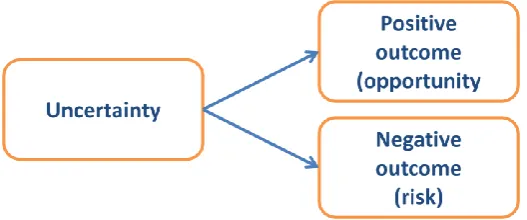
Figure 10: uncertainty causes opportunities and risks
In construction projects we also find a clear distinction between risk and opportunities. An example of an opportunity is: A project experiences delay due to an archaeological find. If during this period of delay the house prices are rising more than the rate of interest they will increase in value which increases the value of the project.
However these situations are not very predictable and cannot or should not be taken into account. Rather than counting on opportunities it is better to try to minimize the risks. In classical software engineering projects this is done in a similar way. To reduce the risks of software engineering large plans and descriptions are made and hence the name of plan driven software development. Reducing risks can also lead to an improved chance of the risk turning into an opportunity.
3.6.3 Risk properties
Risks can be categorized based on their own specific properties. These properties are important when trying to manage these risks.
Occurrence
This indicates in what period the risk could possibly occur and thus when special attention or counter measures should be taken. Sometimes these measurements have to be taken upfront in order to counter the risk. Furthermore, there are different ways that a risk can occur. For example the risk can be seasonable, meaning that it only occurs during a certain season and can thus be taken into account. The other extreme is that the risk is instant, which shows no warning upfront and so no counter measures can be taken.
Dependency
Events that carry certain risks with them are not always independent, they can be mutually dependant. In total there are three types of dependencies:
Independent risks
Mutually exclusive risks (either one of the risks can happen but never together at the same time)
Dependant risks
o Additional risks can occur as a result of implemented risk management measures. o Residual risks can occur after the implementation of risk management measures
when the risk cannot be fully countered. To get a clear picture of what risks are dependant a cause & effect diagram can be applied.
Impressionableness
This is the measure of influence that the project manager can bring to bear to the source of the risk based on the four risk management strategies: avoid, transfer, reduce and accept. These strategies will be further discussed in paragraph 3.6.8. The size of the risk determines the necessity to risk management while impressionableness determines the possibility to management.
Chance
effects of the risk. To quantify a chance Boehm suggests a three-way distribution. The table below shows this categorization of Boehm.[33]
Qualitative Quantitative Chance
Frequent P ≥ 0,7 85%
Probable 0,3 ≤ P < 0,7 50%
[image:24.595.215.404.527.714.2]Improbable P < 0,3 15%
Table 2: Example table of qualitative risks versus quantitative
Impact
Where the property chance describes the likeliness of the risk, the impact pictures the extent of the consequences of the risk in the project control concepts: time, money, scope and quality. The terms impact and chance form the basics of risk management as they determine the scope of what to manage. Risks can be influenced by chancing their chance or their impact.
3.6.4 Risk management
Risk management is part of project management methods and aims at controlling risks that could possibly occur during the project. There are many different risk management strategies that can occur at different strategic levels. In this research risk management is used to determine how the developed method should be adapted. As said in paragraph 3.4 a development method can be seen as a form of risk management as it is often used out of fear to prevent certain risks.
Risk management is not a new concept, many software developers like Boehm and Talbot have dedicated their research to software risks and their management. However, still software projects fail as new techniques such as model driven development are introduced. Furthermore, risks are often not addressed appropriately.
3.6.5 Risk management process
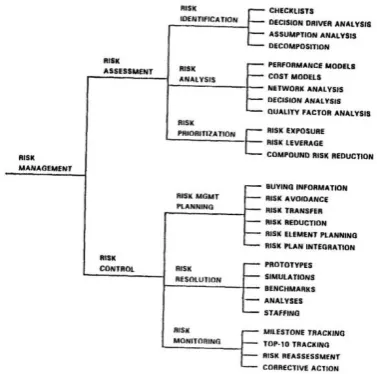
The process of risk management is a process that never ends during a project. Because a project is continuously exposed to new risks, a project manager should always be alert.[34] The goal of risk management is first that it needs to identify and analyze risks up front. This is also the most important part in our thesis. A second part which plays a lesser role is that a good risk management strategy also continues to monitor and control the risks. While risks in general will reduce over time, new risks might show up which if left uncontrolled could destroy a project. According to Boehm Risk
management is build out of 2 phases; risk assessment and risk control. Each of these phases has 3 sub phases. The whole process can be seen in Figure 11.
3.6.6 Risk identification
As said before the first task of risk management is to identify the risks that are present during a project. This is also emphasized in literature by Well-Stam, who applies the RISMAN method [35]. Risk identification is the mapping of possible risks that may occur within a project. Normally the goal of this process would be to determine all the risks that could occur during a project. There are several risk management methods that also incorporate a risk identification phase. It is not uncommon that risk identification happens multiple times during a project. Some risk identification techniques are:
Check lists
Decision driver analysis
Assumption analysis
Problem decomposition
Interviews
Swat analysis
Each of these methods can reveal risks and can thus be used to identify risks that are present in a project. However, the risk identification process as a whole is not being questioned in this research. This research focuses more on finding a development method, thus finding a way how to adept to known risks rather than identifying these risks. As turner states it, it is important to focus on the top 20% of the risks that together form 80% of the impact.
3.6.7 Risk prioritization
Another important step for our research is risk prioritization. Risk prioritization appoints a value to a given risk so that each risk can be measured relatively to all other risks. Not all risks have an equal chance or an equal impact. There are many statistic models that can be applied to calculate risks however these are left out of scope. Rather we research models that make use of relative scales.
3.6.7.1 Risk exposure
The first model is used by Boehm and uses the two variables risk exposure and risk reduction leverage. The risk exposure, explained in paragraph 3.6.1, stands for the probability that a certain impact takes place. Risk reduction leverage is a function that is defined by Risk exposure before – Risk exposure after / Risk reduction costs. With the risk reduction leverage the usefulness of a certain risk management solution can be calculated.
However this approach does have its difficulties. One difficulty is the problem of making accurate estimates of the probability and the loss or impact of a risk. Checklists that make use of a qualitative measure such as shown in Table 2 provide some help in assessing the probability, but it is clear that the probability ranges in four categories are far from accurate.[34] As said earlier statistical models might provide an outcome here, however even Boehm deems these models to difficult and states that it might just as well be simpler to use a simpler course in which an estimation between 1 and 10 is given to risk chance and impact.
3.6.7.2 100 dollar bill
Another good model that listens to a relative measure and has had many applications in science is the 100 dollar bill method. With this method the stakeholders divide a hundred points over the set of risks. The more points a risk gets the more important that risk is. If the amount of objects to be evaluated surpasses 20 then the amount of points can be increased to 1000 or 10000, so the points can be distributed more fair. However, increasing the amount of points should be done with care. Too many points will cause the stakeholder to be less accurate.[36]
3.6.8 Risk management strategies
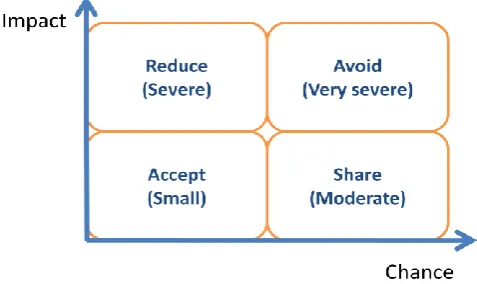
Figure 12: Risk management strategies
Avoid
Avoidance of risks is aimed at eliminating the uncertainty that is driving the risk. In order to avoid the uncertainty it first has to be known what is causing this uncertainty. The removal of a cause or breaking of the cause and effect relation takes away the possibility of the uncertainty of taking effect and thus the risk as a whole.
An indirect avoiding approach entails that the project is directed along a different route, in which possible impact of the uncertainty does not matter anymore. For example if a project is planned in a year that a company has bad results it could be postponed to a later year when the company has better results. This would avoid the risk of getting a low budget on the development project. Avoidance is however not always possible as it can lead that main targets are not reached or that new even bigger risks occur. Risk avoidance always happens before the risk has actually occurred.[35]
Share
The risk strategy of sharing is aimed at sharing or shifting the ownership of the risk to the customer or to a third party. This strategy can be used for financial risks such as planning exceeding or budget exceeding. It is important to realize that carrying a risk does have its financial benefits. The party that carries the risk is likely to be paid a fee in the contract or is compensated in another way. It should be noted that if risks are shared, all sharing parties should have a risk procedure in case the risk occurs. Otherwise the risk might ruin the project.
Examples of risk sharing are the risks of additional travelling costs that are paid by the customer. Or the risk of when a party exceeds a delivery deadline because of external influences.
Risk sharing is usually part of a fixed price contract as in a time & materials contract almost all risks are carried by the customer.
Reduce
In practice most risks cannot be avoided or shared with other parties this is why reducing risk is the most applied risk management strategy. It is a strategy that is aimed to contain the impact or the chance of a risk so that its effects are reduced. The development method that is introduced in our framework in paragraph 4.1 is mostly based on the reduction of development risks by adapting the development method. Reduction can take place both before the risk takes place as after it has occurred.
Accept
After all risks have been covered there are some risks left that are either too improbable or just have no impact. These risks are to be accepted, no adaption or change is done. However, these risks should still be contained by identifying them early to ensure that they do not get out of control in case of occurring. If the impact of a risk might become larger than initially thought additional measure are required. When accepting risks it is important to have a risk aware culture and a risk management program at hand. [35]
Every software project is unique in a way that it has a different combination of characteristics like size, customer experience, requirements ambiguity. The variation of these characteristics is what this research is about, in this paragraph we will explore the characteristics of the customer that might influence the development process or the form of contract.
3.7.1 CRM concepts
As with any engineering product the customers form the backbone of a software development project. They provide the developer with requirements on the to be developed system and often more. However, what fits best to a certain customer is not always clear. How can one recognize a customer from another and which properties and wishes from a customer have affect on the development of software and the contract. To achieve this some concepts of customer relationship management are applied. Galgreath en Rogers defined a customer relationship leadership model in which they show how management can facilitate the implementation of customer relationship management (CRM) concepts. They define CRM as follows:
“Activities a business performs to identify, qualify, acquire, develop and retain increasingly loyal and
profitable customers by delivering the right product or service, to the right customer, through the right channel, at the right time and the right cost. CRM integrates sales, marketing, service, enterprise resource planning and supply-chain management functions through business process automation, technology solutions, and information resources to maximize each customer contact. CRM facilitates
relationships among enterprises, their customers, business partners, suppliers, and employees.”[37]
In this context we are especially interested in the identification of a customer which can later be used to qualify them for a certain form of contract and development method. To identify the customer a customer profile can be used. A customer profile is a set of data describing specific customer characteristics.[38] Hence that it is possible to have multiple profiles on different data of the same customer. To find a fitting contract and MDD project method a customer profile can be used to identify and
![Figure 5: From model based to model driven [21] [22]](https://thumb-us.123doks.com/thumbv2/123dok_us/1204215.643925/14.595.73.528.67.323/figure-from-model-based-to-model-driven.webp)
![Figure 7: Transaction cost versus uncertainty of product[31]](https://thumb-us.123doks.com/thumbv2/123dok_us/1204215.643925/20.595.152.446.72.306/figure-transaction-cost-versus-uncertainty-product.webp)
![Figure 8: Selection of contract types [31]](https://thumb-us.123doks.com/thumbv2/123dok_us/1204215.643925/21.595.146.455.373.607/figure-selection-of-contract-types.webp)