Increasing Informativeness in Temporal Annotation
James Pustejovsky Department of Computer Science
Brandeis University MS 018 Waltham, Massachusetts, 02454 USA
Amber Stubbs
Department of Computer Science Brandeis University MS 018 Waltham, Massachusetts, 02454 USA
Abstract
In this paper, we discuss some of the chal-lenges of adequately applying a specification language to an annotation task, as embodied in a specific guideline. In particular, we dis-cuss some issues with TimeML motivated by error analysis on annotated TLINKs in Time-Bank. We introduce a document level in-formation structure we call a narrative con-tainer (NC), designed to increase informative-ness and accuracy of temporal relation identi-fication. The narrative container is the default interval containing the events being discussed in the text, when no explicit temporal anchor is given. By exploiting this notion in the cre-ation of a new temporal annotcre-ation over Time-Bank, we were able to reduce inconsistencies and increase informativeness when compared to existing TLINKs in TimeBank.
1 Introduction
In linguistic annotation projects, there is often a gap between what the annotation schema is designed to capture and how the guidelines are interpreted by the annotators and adjudicators given a specific corpus and task (Ide and Bunt, 2010; Ide, 2007). The dif-ficulty in resolving these two aspects of annotation is compounded when tasks are looked at in a poten-tially incomplete annotation task; namely, where the guideline is following a specification to a point, but in fact human annotation is not even suggested as complete because it would be infeasible. Creating temporal links to represent the timeline of events in a document is an example of this: human annota-tion of every possible temporal relaannota-tionship between
events and times in a narrative would be an over-whelming task.
In this paper, we discuss how temporal rela-tion annotarela-tion must be sensitive to two aspects of the task that were not mentioned in the TimeBank guideline (Pustejovsky et al., 2005): (a) sensitivity to the genre and style of the text; and (b) the interac-tion with discourse relainterac-tions that explicitly reference the flow of the narrative in the text. We believe that making reference to both these aspects in the text during the annotation process will increase overall informativeness and accuracy of the annotation. In the present paper, we focus primarily on the first of these points, and introduce a document level infor-mation structure we call anarrative container (NC). Because of the impossibility of humans captur-ing every relationship, it is vital that the annotation guidelines describe an approach that will result in maximally informative temporal links without rely-ing on standards that are too difficult to apply. With this in mind, we have been examining the TimeBank corpus (Pustejovsky et al., 2003) and the annotation guideline that created it, and have come to these re-alizations:
(1) •The guideline does not specify certain types of annotations that should be performed;
•The guideline forces some annotations to be performed when they should not always be.
Additionally, we have discovered some inconsisten-cies in the TimeBank corpus related to temporal links. Furthermore, upon examination, we have be-come aware of the importance of the text style and
genre, and how readers interpret temporally unah-chored events.
This gave rise, in examining the genres that are most frequent in TimeBank (namely news and fi-nance), to the possibility that readers of news ar-ticles and narratives have possible default assump-tions about when unanchored events take place. It seems reasonable for a reader to assume in a sen-tence such as: Oneida Ltd. declared a 10% stock dividend, payable Dec. 15 to stock of record Nov. 17, that the “declared” event took place soon before the article’s Document Creation Time (DCT).
Exactly how soon before may be related to some proximate interval of time associated with both the publication time and frequency. That is, it appears that just as importantly, if not more so, than the DCT, is a related and dependent notion of the salient in-terval surrounding the creation time, for interpreting the events that are being reported or written about. We will call this the Narrative Container. There seems to be a default value for this container affected by many variables. For example, a print newspaper seems to associate in the content and style a nar-rative container of approximately 24 hours, or one business day. A newswire article, on the other hand, has a narrative container of 2-10 hours. Conversely, weekly and monthly publications would likely have a narrative container of a much longer duration (a week or more).
Along with the narrative container, there are two related concepts that proved useful in framing this new approach to temporal annotation. The Narra-tive Scope describes the timespan described in the document, with the left marker defined by the earli-est event mentioned in the document, and the right by the event furthest in the future. The other impor-tant concept is that ofNarrative Time. A Narrative Time is essentially the current temporal anchor for events in a document, and can change as the reader moves through the narrative.
With these as initial assumptions we did some cursory inspection of the TimeBank data to deter-mine if there was a correlation between Narrative Container length and genre, and found it to be a compelling assumption. With that in mind, we de-termined that TLINK creation should be focused on relationships to the narrative container, rather than to the DCT.
Our goal is, to the extent possible, to see how we can use a container metaphor, albeit somewhat underspecified, to left-delineate the container within which unanchored events might be in relation to.
2 Identifying Temporal Relations
While low-level temporal annotation tasks such as identifying events and time expressions are rela-tively straightforward and can be marked up with high consistency, high-level tasks such as arrang-ing events in a document in a temporal order have proved to be much more challenging. The tempo-ral ordering of events in a document, for example, is accomplished by identifying all distinct event-event pairings. For a document that has n events, this requires the annotation of n2 events pairs. Ob-viously, for general-purpose annotation, where all possible events are considered, the number of event pairs grows essentially quadratically to the number of events, and the task quickly becomes unmanage-able.
There are, however, strategies that we can adopt to make this labeling task more tractable. First we need to distinguish the domains over which ordering relations are performed. Temporal ordering relations in text are of three kinds:
(2) a. A relation between two events; b. A relation between two times;
c. A relation between a time and an event.
Although, in principle, during an annotation a temporal relation can be specified between any two events in the text, it is worth asking what informa-tivenessa given temporal relation introduces to the annotation. The informativeness of an annotation will be characterized as a function of the information contained in the individual links and their closure. We can distinguish, somewhat informally for now, two sources of informativeness in how events are temporally ordered relative to each other in a text: (a) externally and (b) internally. Consider first ex-ternal informativeness. This is information derived from relations outside the temporal relation con-straint set, e.g., as coming from explicit discourse re-lations between events (and hence is associated with the relations in (2a) above). For example, we will assume that, for two events,e1 ande2, in a text, the temporal relation between them is more informative if they are also linked through a discourse relation, e.g., a PDTB relation (Prasad et al., 2008). Mak-ing such an assumption will allow us to focus in on the temporal relations that are most valuable without having to exhaustively annotate all event pairs.
Now consider internal informativeness. This is information derived from the nature of the relation itself, as defined largely by the algebra of relations (Allen, 1984; Vilain et al., 1986). First, we assume that, for two events, e1 ande2, a temporal relation
R1 is more informative than R2 if R1 entails R2. More significantly, however, as noted above, is to capitalize on the relations that inhere between events and the times that anchor them (i.e., (2c) above). Hence, we will say that, given an event, e1 and a time t1, a temporal relationR is more informative the more it anchorse1 tot1. That is, a containment relation is more informative than an ordering rela-tion, and the smaller the container, the more infor-mative the relation.1
The Document Creation Time (DCT) as designed in TimeML is introduced as a reference time, against which the mentioned events and time expressions in the document can be ordered. Consider the text frag-ment below.
1
We defer discussion of the formal definition of informative-ness for the present paper, as we are focusing on initial results over re-annotated data in TimeBank.
4-10-2011
Local officialsreportedyesterday that a carexplodedin downtown Basra.
The TimeML annotation guideline (AG) suggests identifying relations between the DCT and textual events. Hence standard markup as in TimeBank re-sults in the following sort of annotation:
(3) a. DCT=t1, val=10-04-2011 b.t2= yesterday, val=09-04-2011 b.e1= report
c.e2= explode
d. TLINK1= before(e1, t1) e. TLINK2= before(e2, t1) f. TLINK3 = includes(t2, e1)
This is a prototypical annotation fragment. Notice that by focusing on the link between events and the DCT, the annotator is forced to engage in a kind of periodic “back-and-forth” evaluation of the events in the text, relative to the DCT. While there is a con-tainer TIMEX3 that boundse1, there is no informa-tion given grounding the actual time of the event of interest, namely, the explosion,e2. By following the AG literally and through no fault of their own, the annotators have missed an opportunity to provide a more informative markup; namely, the identification of the TLINK below:
(4) TLINK4= includes(t2, e2)
That is, the explosion occurred on the date valued foryesterday, i.e., “09-04-2011”.
The point of this paper is to discuss the difference encountered when applying a specification given a particular guideline for annotating a body of text. The example we want to discuss is the manner in which events are linked (related) to the Document Creation Time (DCT) in TimeML. These consider-ations have arisen in the context of new annotation problems in different genre and domains, hoping to apply the principles of TimeML.
3 Narrative Scope
document. While not every event in a document will necessarily occur inside the Narrative Scope (some may still occur before or after any dates that are specifically mentioned), the Narrative Scope pro-vides a useful container for describing when events discussed most likely occurred. The narrative scope was not considered as part of the annotation task, but it did help to ground the concepts of Narrative Containers and Narrative Times.
4 Narrative Time
As a reader moves through a document, the intro-duction of a new TIMEX will often shift the tem-poral focus of the events to be anchored to this new time point (Smith, 2003). These temporal anchors are what we refer to as Narrative Times, and func-tion in much the same way as newly introduced lo-cations in spatial annotation.
However, consider how we can use Narrative Times to increase accuracy of the TLINKS over a document in TimeML. As mentioned above, we dis-tinguish three types of temporal orderings in a text: time-time, event-time, and event-event. The first identifies orderings between two TIMEX3 expres-sions and is performed automatically. The second identifies what the local Narrative Time for an event is, i.e., how an EVENT is anchored to a TIMEX3. Event-event pairings, for the purposes of this paper, will not be discussed, though they are a vital and complex component of temporal annotation, largely involving discourse relations.
To illustrate our proposed strategy, consider the news article text shown below.
April 25, 2010 7:04 p.m. EDT-t0
S1:President Obamapaid-e1tributeSunday-t1
to 29 workers killed-e2in anexplosion-e3at a West Virginia coal mineearlier this month- t2,
saying-e4theydied-e5“in pursuit of the Amer-ican dream.”
S2:Theblast-e6at the Upper Big Branch Mine was the worst U.S. mine disaster in nearly 40 years.
There are three temporal expressions in the above text: the Document Creation time, t0; and two TIMEXes,t1andt2. Each of these TIMEXes func-tions as a Narrative Time, as they are clearly
provid-ing temporal anchors to nearby events. In this case, all the events are located within the Narrative Time appropriate to them. Hence, the number of order-ings is linearly determined by the number of events in the document, since each is identified with a sin-gle Narrative Time. Knowing the narrative time as-sociated with each event will allow us to perform limited temporal ordering between events that are associated with different narrative times, which, as mentioned above, is significantly more informative than if events were only given partial orderings to the DCT or to each other.
5 Narrative Containers
So far we have examined sentences that contain specific temporal anchors for the events discussed. Consider, however, the following sentences from ar-ticle wsj 1031.tml in TimeBank:
10-26-1989
1 Philip Morris Cos., New York, adopted a defense measure designed to make a hostile
takeoverprohibitively expensive.
2 The giant foods, tobacco and brewing company
saidit willissuecommon-share purchase rights to shareholders ofrecordNov. 8.
Aside from the DCT, the only TIMEX in these two sentences is Nov. 8, which is only anchoring is-sue andrecord. The other events in the sentences can only be connected to the DCT, and presum-ably only in a ‘before’ or ‘after’ TLINK—in the ab-sence of other information, any reader would assume from the past tenses ofadoptedandsaid that these events occurred before the article was published, and that any events associated with the future (make, takeover) are intended to happen after the DCT.
unan-t2 "earlier this month" t1 "Sunday"
e3
explosion e5 "died" e1 "paid" e2 "killed" e4
"saying"
t0 DCT e6 "blast"
t0 DCT t1 "Sunday"
e2 "killed"
t2 earlier this month
e5 "died" e6 "blast" e1 "paid" e4 "saying" e3
explosion
A
[image:5.612.151.460.62.189.2]B
Figure 1: A: Times and events as appearing in the text; B: events grouped into their appropriate Narrative Times.
chored events most likely occurred, where in pre-vious TimeML annotations these events would usu-ally be given one-sided relationships to the DCT. In most cases, the right boundary of the Narrative Con-tainer is the DCT. The left boundary, however, re-quires other factors about the article to be taken into account before it can be given a value. The primary factor is how frequently the source of the document is published, but other aspects of the article may also determine the Narrative Container size.
5.1 Style, Genre, Channel, and Anchors
In order to determine what factors might influence the interpretation of the size of a Narrative Con-tainer, we asked an undergraduate researcher to cat-egorize each of the articles in TimeBank according to the following characteristics (Lee, 2001; Biber, 2009).
(5) •Channel: is the document written or spoken?
•Production circumstances: how was the doc-ument distributed? broadcast, newswire, daily publication;
• Style: what format was used to present the information?
•Presence of a temporal anchor: Whether an article contained a Narrative Time in the first sentence of the document.
In general, we felt that the production circum-stances would be the most relevant in determining the duration of the Narrative Container. The distri-butions of the different categories in TimeBank are shown in Table 1. There is a 100% overlap between the “broadcast” and “spoken” subcategories—all of those articles are word-for-word transcripts of tele-vision news reports. The “style” category proved the
most difficult to define—the ‘quiz’ article is a broad-cast transcript of a geography question asked during the evening news, while the ‘biography’ articles are overviews of people’s lives. The editorials include a letter to the editor of the Wall Street Journal and an editorial column from the New York Times.
Category number percent Production Circ.
broadcast 25 13.7% daily paper 140 76.5%
newswire 18 9.8%
Channel
spoken 25 13.7%
written 158 86.3%
Style
biography 2 1.1%
editorial 2 1.1%
finance 135 73.8%
news 43 23.5%
quiz 1 0.5%
Temporal Anchor
no 138 75.4%
yes 45 24.6%
Table 1: Distributions of categories in TimeBank
6 Preliminary Studies
In order to assess the validity of our theories on Nar-rative Containers, Time, and Scope, we asked three undergraduate researchers to re-annotate TimeBank using the Narrative Container theory as a guide.
[image:5.612.335.516.306.542.2]place it within the Narrative Container for the docu-ment, or they could give the event a simple “before” or “after” value related to the Narrative Container or Document Creation Time. We also asked them to assign start and end times to the Narrative Container for each document.
The annotation here was not intended to be as complete as the TimeBank annotation task, or even the TempEval tasks—rather, the goal was to deter-mine if the Narrative Container theory could be ap-plied in a way that resulted in an increase in infor-mativeness, and whether the annotators could work with the idea of a Narrative Container. Because these annotations are not comprehensive in their scope, the analysis provided here is somewhat pre-liminary, but we believe it is clear that the use of a Narrative Container in temporal annotations is both informative and intuitive.
6.1 Narrative container agreement
Each annotator was asked to assign a value to the narrative container of each document. They were given limited directions as to what the size of an NC might be: only some suggestions regarding possible correlations between type and frequency of publica-tion and size of the narrative container. For example, it was suggested that a news broadcast might have a narrative container of only a few hours, a daily news-paper would have one of a day (or one that extended to the previous business day), and a newswire article would have a narrative container that extended back 24 hours from the time of publication.
All the annotators agreed that an NC would not extend forward beyond the document creation time (DCT), and that in most cases the NC would end at the DCT. Because the annotators gave their data on the size of the NC in free text (for example, an an-notator would say “1 day” to indicate that the NC for an article began the day before the article was published) the comparison of the narrative contain-ers was performed manually by one of the authors to determine if the annotators agreed on the size of the NC.
Agreement was determined using a fairly strict matching criterion—if the narrative containers given were clearly referring to the same interval they were interpreted to be the same. If, however, there was ambiguity about the date or one annotator indicated
a smaller time period than another, then they were judged to be different. A common example of am-biguity was related to newspaper articles that were written on Mondays—annotators could not always determine if the events described occurred the day before, or on the previous business day For eval-uation purposes, the ambiguous cases were given “maybe” values, but were not included in analysis that relied on the NCs being the same.
Overall, using the strict agreement metric all the annotators agreed on the size of the narrative con-tainer in 95 out of 183 articles—slightly over 50% of the time. However, the annotators only completely disagreed on 6 of the 183 articles—in all other cases there was some level of agreement between pairs of annotators.
6.2 NCs and Document Classifications
We compared Narrative Container agreements against the categories outlined above: style, channel, production circumstances, and temporal anchorings in order to determine if any of those attributes lent themselves to agreement about the size of the Narra-tive Container. We disregarded the biography, quiz, and editorial classifications as those categories were too small to provide useful data.
For the most part, no one category stood out as lending itself to accuracy—newswire had the high-est levels of agreement at 72%, while daily papers came in at 58%. Written channels had 60% agree-ment, and the finance style had 59%. Articles with temporal anchors in the beginning of the document were actually slightly less likely to have agreement on the Narrative Container than those that didn’t— 48% and 53%, respectively.
●
● ● ● ●
●
0.0
0.2
0.4
0.6
0.8
1.0
Fleiss Kappa by Article Category
Fleiss Kappa
●
● ● ● ●
0.0
0.2
0.4
0.6
0.8
1.0
● ● ● ● ●
0.0
0.2
0.4
0.6
0.8
1.0
●
● ● ● ●
●
0.0
0.2
0.4
0.6
0.8
1.0
Broadcast Daily Newswire SpokenWritten Finance News No Yes
[image:7.612.199.404.66.185.2]Production Circ Channel Style Temporal Anchorings
Figure 2: Distributions of Fleiss Kappa scores over TimeBank categories
that does not make that Narrative Time the Nar-rative Container for the document—the NarNar-rative Container is always the interval during which an unanchored event would be assumed to have taken place. This point of confusion can easily be clarified in the guidelines.
Spoken/broadcast articles had the lowest agree-ment on Narrative Container size, with none of those articles having complete agreement between anno-tators. This was largely caused by our annotators not agreeing on how much time those categories would encompass by default–two felt that the narra-tive containers for broadcast news would extend to only a few hours before going on air, and the other felt that, like a daily paper, the entire previous day would be included when dealing with unanchored times.
As for the question of how large a Narrative Con-tainer should be for broadcast articles, the size of all Narrative Containers will need to be studied more in depth in order to determine how widely they can be applied— it is possible that in general, the actual size is less important than the simple concept of the Narrative Container.
6.3 Agreement over event anchors
The annotators were asked to read each article in TimeBank and “create links from each event to the nearest timex or to the DNC.” They were asked specifically to not link an event to another event, only to find the time that would be used to anchor each event in a timeline. The annotators were also asked to use only three relationship types: before, after, and is included (which also stood in for “over-lap”). This was done in order to keep the annotation as simple as possible: we wanted to see if the
narra-tive container was a useful tool in temporal annota-tion, not produce a full gold standard corpus.
This differs from the TimeML annotation guide-lines, which suggested only that “A TLINK has to be created each time a temporal relationship hold-ing between events or an event and a time needs to be annotated.” (Saur´ı et al., 2006) Examples given were for sentences such as “John drove to Boston on Monday”—cases where an event was specifically re-lated to a time or another event. However, because such examples were relatively rare, and temporal re-lationships are not always so clearly expressed, this annotation method resulted in a corpus that was not optimally informative. TimeML also uses a fuller set of temporal relations.
The NC annotations, on the other hand, are much richer in terms of informativeness. Annotators most often linked to the NC, often with an ”is included” relationship (as in: e1 is included NC). In fact, roughly 50% of the events were linked to the narra-tive container and had “is included” as the relation-ship type. In previous TimeML annotations, most of those events would have been annotated as simply occurring before or overlapping with the document creation time, which is a significantly less informa-tive association. Clearly the narrainforma-tive container was an intuitive concept for the annotators, and one that was relevant to their annotations.
6.3.1 Inter-annotator agreement
said (e1)
enable (e10) declared (e2) purchase (e12) issue (e18)
exercised (e14)
90 days (t31)
issued (e7) issue (e32)
10/26/89 (t30) (DCT)
said (e8) has (e5) said (e17)
10/25/89 – 10/26/89 (NC)
10/26/89 (t30) (DCT)
said (e1) declared (e2)
has (e5) issued (e7)
said (e8) issue (e32)
said (e17)
90 days (t31)
exercised (e14)
enable (e10)
purchase (e12)
issue (e18)
[image:8.612.148.468.61.232.2]TimeBank annotation Narrative Container annotation Wall Street Journal - wsj_1042.tml
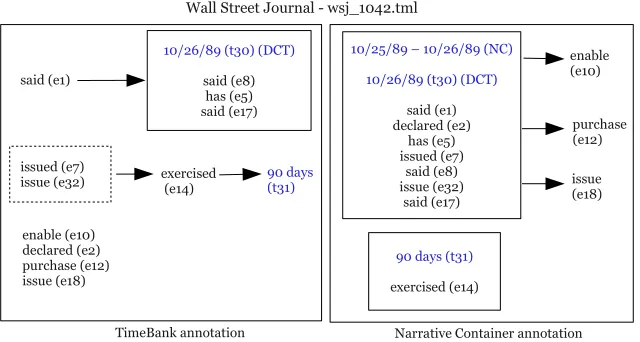
Figure 3: Visual depictions of the TLINK annotations in TimeBank and with the Narrative Container annotations. Solid lines indicate events and times in the box have IS INCLUDED relationships with the timex at the top, and dotted lines indicate events that were given IDENTITY relationships
When looking at the kappa scores for the tempo-ral anchor, it should be noted that these scores do not always accurately reflect the level of agreement between annotators. Because of the lack of variabil-ity, Fleiss’ Kappa will interpret any article where an annotator only linked events to the NC received neg-ative agreement scores. These values have been left in the tables as data points, but it should be noted that these annotations are entirely valid—some ar-ticles in TimeBank contain no temporal information other than the document creation time (and by exten-sion, the narrative container), making it only natural for the annotators to annotate events only in rela-tion to the narrative container. The average Fleiss’ Kappa scores for the temporal anchors was .74, with a maximum of 1 and a minimum of -.04.
6.4 Informativeness in NC Annotation
As we previously described, Narrative Containers are theoretically more informative than Document Creation Times when trying to place unanchored events on a timeline. In practice, they are as infor-mative as we anticipated: compare the visualizations of TLINK annotations between TimeBank and the NC links in Figure 3. These were created from the file wsj 1042.tml, one that had complete agreement between annotators about both the size of the NC (one day before the DCT through the DCT) and all the temporal anchors and temporal relations.
Clearly, the NC task has resulted in a more in-formative annotation–all the events have at least one
constraint, and most have both left and right con-straints.
7 Conclusions and Future Work
Narrative Containers, Narrative Times, and Narra-tive Scopes are important tools for temporal annota-tion tasks. The analysis provided here clearly shows that annotating with an NC increases informative-ness, and that the concept is sufficiently intuitive for it to not add confusion to the already complicated task of temporal annotation. However, the work in this area is far from complete. In the future we in-tend to study where the left boundary of the NC should be placed for different genres and publica-tion frequencies. Another annotapublica-tion task must be performed, requiring a more comprehensive TLINK creation guideline, using both time and event-event links. Finally, the use of all three concepts for automated annotation tasks should be examined, as they may prove as useful to machines as they are to humans.
Acknowledgements
References
James Allen. 1984. Towards a general theory of action and time.Arificial Intelligence, 23:123–154.
Douglas Biber. 2009.Register, Genre, and Style. J. L. Fleiss. 1971. Measuring nominal scale
agree-ment among many raters. Psychological Bulletin, 76(5):378–382.
Matthias Gamer, Jim Lemon, and Ian Fellows Pus-pendra Singh ¡[email protected]¿, 2010. irr: Various Coefficients of Interrater Reliability and Agreement. R package version 0.83.
Nancy Ide and Harry Bunt. 2010. Anatomy of annota-tion schemes: Mappings to graf. InIn Proceedings 4th Linguistic Annotation Workshop (LAW IV).
Nancy Ide. 2007. Annotation science: From theory to practice and use: Data structures for linguistics re-sources and applications. InIn Proceedings of the Bi-enniel GLDV Conference.
David Lee. 2001. Genres, registers, text types, domains, and styles: Clarifying the concepts and navigating a path through the bnc jungle. Language Learning & Technology, 5(3.3):37–72.
Eleni Miltsakaki, Rashmi Prasad, Aravind Joshi, and Bonnie Webber. 2004. The penn discourse treebank. InIn Proceedings of LREC 2004.
Massimo Poesio. 2004. Discourse annotation and se-mantic annotation in the gnome corpus. InIn Proceed-ings of the ACL Workshop on Discourse Annotation. Rashmi Prasad, Nikhil Dinesh, Alan Lee, Eleni
Milt-sakaki, Livio Robaldo, Aravind Joshi, and Bonnie Webber. 2008. The penn discourse treebank 2.0. In In Proceedings of the 6th International Conference on Language Resources and Evaluation (LREC 2008). James Pustejovsky, Patrick Hanks, Roser Saur`ı, Andrew
See, Robert Gaizauskas, Andrea Setzer, Dragomir Radev, Beth Sundheim, David Day, Lisa Ferro, and Marcia Lazo. 2003. The timebank corpus. In Dawn Archer, Paul Rayson, Andrew Wilson, and Tony McEnery, editors,Proceedings of the Corpus Linguis-tics 2003 conference, pages 647–656, Lancaster Uni-versity. UCREL.
James Pustejovsky, Robert Knippen, Jessica Littman, and Roser Saur´ı. 2005. Temporal and event information in natural language text. Language Resources and Eval-uation, 39:123–164, May.
R Team, 2009. R: A Language and Environment for Sta-tistical Computing. R Foundation for Statistical Com-puting, Vienna, Austria. ISBN 3-900051-07-0. Roser Saur´ı, Jessica Littman, Bob Knippen, Robert
Gaizauskas, Andrea Setzer, and James Pustejovsky, 2006. TimeML Annotation Guidelines, version 1.2.1 edition, January.
Carlota Smith. 2003. Modes of Discourse. Cambridge University Press, Cambridge, UK.