Refining the Design of a Contracting Finite-State Dependency Parser
Anssi Yli-Jyr¨a and Jussi Piitulainen and Atro Voutilainen
The Department of Modern Languages PO Box 3
00014 University of Helsinki
{anssi.yli-jyra,jussi.piitulainen,atro.voutilainen}@helsinki.fi
Abstract
This work complements a parallel paper of a new finite-state dependency parser archi-tecture (Yli-Jyr¨a, 2012) by a proposal for a linguistically elaborated morphology-syntax interface and its finite-state implementation. The proposed interface extends Gaifman’s (1965) classical dependency rule formalism by separating lexical word forms and morpho-logical categories from syntactic categories. The separation lets the linguist take advantage of the morphological features in order to re-duce the number of dependency rules and to make them lexically selective. In addition, the relative functional specificity of parse trees gives rise to a measure of parse quality. By fil-tering worse parses out from the parse forest using finite-state techniques, the best parses are saved. Finally, we present a synthesis of
strict grammar parsing and robust text pars-ing by connectpars-ing fragmental parses into trees
with additional linear successor links.
1 Introduction
Finite-state dependency parsing aims to combine de-pendency syntax and finite-state automata into a sin-gle elegant system. Deterministic systems such as (Elworthy, 2000) are fast but susceptible to garden-path type errors although some ambiguity is encoded in the output. Some other systems such as (Oflazer, 2003; Yli-Jyr¨a, 2005) carry out full projective de-pendency parsing while being much slower, espe-cially if the syntactic ambiguity is high. In the worst case, the size of the minimal finite-state automa-ton storing the forest is exponentially larger than
the sentence: an 80-word sentence has potentially
1.1×1062unrooted unlabeled dependency trees that
are stored “compactly” into a finite-state lattice that requires at least2.4×1024states, see Table 4 in Yli-Jyr¨a (2012).
A truly compact representation of the parse forest is provided by an interesting new extended finite-state parsing architecture (Yli-Jyr¨a, 2012) that first recognizes the grammatical sentences in quadratic time and space if the nested dependencies are lim-ited by a constant (in cubic time if the length of the sentence limits the nesting). The new system (Yli-Jyr¨a, 2012) replaces the additive (Oflazer, 2003) and the intersecting (Yli-Jyr¨a, 2005) validation of depen-dency links with reductive validation that gradually contracts the dependencies until the whole tree has been reduced into a trivial one. The idea of the con-tractions is illustrated in Example 1. In practice, our parser operates on bracketed trees (i.e., strings), but the effect will be similar.
(1) a. time flies like an arrow
SUBJ ADVL
NOBJ
DET
b. time flies like an arrow
NOBJ
c. time flies like an arrow
Despite being non-deterministic and efficient, there are two important requirements that are not ful-filled by the core of the new architecture (Yli-Jyr¨a, 2012):
1. A mature finite-state dependency parser must be robust. The outputs should not be restricted to complete grammatical parses. For exam-ple, Oflazer (2003) builds fragmental parses but later drops those fragmental parses for which there are alternative parses with fewer frag-ments. However, his approach handles only gap-free bottom-up fragments and optimizes the number of fragments by a counting method whose capacity is limited.
2. Besides robustness, a wide-coverage parser should be able to assign reasonably well-motivated syntactic categories to every word in the input. This amounts to having a morpho-logical guesser and an adequate morphology-syntax interface. Most prior work trivializes the complexity of the interface, being compara-ble to Gaifman’s (1965) legacy formalism that is mathematically elegant but based on word-form lists. A good interface word-formalism is pro-vided, e.g., by Constraint Grammar parsers (Karlsson et al., 1995) where syntactic rules can refer to morphological features. Oflazer (2003) tests morphological features in compli-cated regular expressions. The state complexity of the combination of such expressions is, how-ever, a potential problem if many more rules would be added to the system.
This paper makes two main contributions:
1. It adapts Gaifman’s elegant formalism to the re-quirements of morphologically rich languages. With the adapted formalism, grammar writing becomes easier. However, efficient implemen-tation of the rule lookup becomes inherently trickier because testing several morphological conditions in parallel increases the size of the finite-state automata. Fortunately, the new for-malism comes with an efficient implementation that keeps the finite-state representation of the rule set as elegant as possible.
2. The paper introduces a linguistically motivated ranking for complete trees. According to it, a
tree is better than another tree if a larger propor-tion of its dependency links is motivated by the linguistic rules. In contrast to Oflazer (2003), our method counts the number of links needed to connect the fragments into a spanning tree. Moreover, since such additional links are in-deed included in the parses, the ranking method turns a grammar parser into a robust text parser.
The paper is structured as follows. The next section will give an overview of the new parser architecture. After it, we present the new morphology-syntax in-terface in Section 3 and the parse ranking method in Section 4. The paper ends with theoretical evalua-tion and discussion about the proposed formalism in Section 5.
2 The General Design
2.1 The Internal Linguistic Representation
We need to define a string-based representation for the structures that are processed by the parser. For this purpose, we encode the dependency trees and then augment the representation with morphological features.
Dependency brackets encode dependency links between pairs of tokens that are separated by an (im-plicit) token boundary. The four-token stringabcd has 12 distinct undirected unlabeled dependency bracketings a((()b)c)d, a((b())c)d, a(()b()c)d, a(()bc())d, a(()b)c()d, a(b(()c))d, a(b(c()))d, a(b()c())d, a(b())c()d, a()b(()c)d, a()b(c())d, a()b()c()d.1
The basic dependency brackets extend with labels such as in(LBL LBL)and directions such as in<LBL LBL\and in /LBL LBL>. Directed dependency links designate one of the linked words as the head and another as the dependent. The extended brackets let us encode a full dependency tree in a string format as indicated in (2).2 The dependent word of each
1Dependency bracketing differs clearly from binary
phrase-structure bracketings that put brackets around phrases: the
string abcdhas only five distinct bracketings ((ab)(cd)),
(((ab)c)d),((a(bc))d),(a((bc)d)), and(a(b(cd))). 2
The syntactic labels used in this paper are: AG=Agent,
by=Preposition ’by’ as a phrasal verb complement,
D=Determiner, EN=Past Participle, FP=Final Punctuation,
P=adjunctive preposition, PC=Preposition Complement,
link is indicated in trees with an arrowhead but in bracketing with an angle bracket.
(2) it
<S
was
S\ /FP/EN
inspired
EN> /AG
by
AG> /PC
the
<D
writings
D\PC> FP>
.
S EN G
PC
D
FP
In Table 1, the dependency bracketing is com-bined with a common textual format for morpho-logical analyses. In this format, the base forms are defined over the alphabet of orthographical symbols
[image:3.612.72.293.100.183.2]Ωwhereas the morphological symbols and syntactic categories are multi-character symbols that belong, respectively, to the alphabetsΠandΓ. In addition, there is a token boundary symbol#.
Table 1: One morpho-syntactic analysis of a sentence
1 i t PRON NOM SG3 <S #
2 b e V PAST SG13 S\ /FP /EN #
3 i n s p i r e EN EN> /AG #
4 b y PREP AG> /PC #
5 t h e DET SG/PL <D #
6 w r i t i n g N NOM PL D\ PC> #
7 . PUNCT FP> #
Depending on the type of the languages, one or-thographical word can be split into several parts such as the inflectional groups in Turkish (Oflazer, 2003). In this case, a separate word-initial token boundary can be used to separate such parts into lines of their own.
The current dependency bracketing captures pro-jective and weakly non-propro-jective (1-planar) trees only, but an extended encoding for 2-planar and multi-planar dependency trees seems feasible (Yli-Jyr¨a, 2012):
2.2 The Valid Trees
We are now going to define precisely the semantics of the syntactic grammar component using finite-state relations.
The finite-state languages will be defined over a finite alphabetΣand they include all finite subsets of
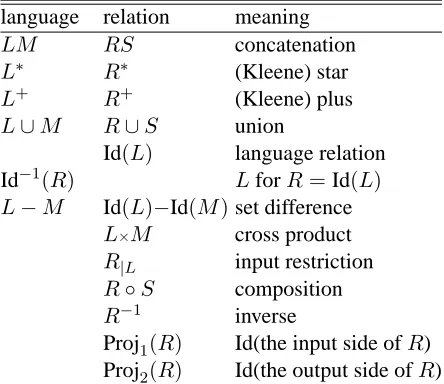
the universal languageΣ∗. The (binary) finite-state relations are defined over Σ∗ and include all finite subsets ofΣ∗×Σ∗. In addition, they are closed un-der the operations over finite-state languagesLand
[image:3.612.316.538.221.413.2] [image:3.612.67.300.364.437.2]M and finite-state relations R and S according to Table 2. The language relation Id(L) restricts the identity relation to a languageL. The composition of language relations corresponds to the intersection of their languages.
Table 2: The relevant closure properties
language relation meaning
LM RS concatenation
L∗ R∗ (Kleene) star
L+ R+ (Kleene) plus
L∪M R∪S union
Id(L) language relation Id−1(R) LforR=Id(L) L−M Id(L)−Id(M)set difference
L×M cross product
R|L input restriction
R◦S composition
R−1 inverse
Proj1(R) Id(the input side ofR) Proj2(R) Id(the output side ofR)
For notational convenience, the empty string is denoted by ǫ. A string xis identified with the sin-gleton set{x}.
The syntactic component of the grammar defines a set of parse strings where the bracketing is a valid dependency tree. In these parses, there is no mor-phological information. One way to express the set is to intersect a set of constraints as in (Yli-Jyr¨a, 2005). However, the contracting dependency parser expresses the Id relation of the set through a compo-sition of simple finite-state relations:
Synt=Proj1(Abst◦R| ◦{z...◦R}
t
◦Root), (1)
Root=Id(#). (2)
In (1), Abst is a relation that removes all non-syntactic information from the strings,
Abst= (Id(Γ)∪Id(#)∪Delete)∗, (3)
andR is a relation that performs one layer of con-tractions in dependency bracketing.
R= (Id(Γ)∪Id(#)∪Left∪Right)∗, (5)
Left={(<α#α\, ǫ)|<α, α\∈Γ}, (6)
Right={(/α#α>, ǫ)|/α, α>∈Γ}. (7)
The parameter tdetermines the maximum number of layers of dependency links in the validated brack-etings. The limit of Synt astapproaches∞is not necessarily a finite-state language, but it remains context-free because only projective trees are as-signed to the sentences.
2.3 The Big Picture
We are now ready to embed the contraction based grammar into the bigger picture.
Let x ∈ Ω∗ be an orthographical string to be parsed. Assume that it is segmented into ntokens. The stringx is parsed by composition of four rela-tions: the relation {(x, x)}, the lexical transducer (Morph), the morphology-syntax interface (Iface), and the syntactic validator Synn−1.
Parses(x) =Id(x)◦Morph◦Iface◦Synn−1. (8)
The language relation Proj2(Parses(x)) encodes the parse forest of the inputx.
In practice, the syntactic validator Synn−1 cannot
be compiled into a finite-state transducer due to its large state complexity. However, when each copy of the contracting transducer R in (1) is restricted by its admissible input-side language, a compact rep-resentation for the input-side restriction(Synn−1)|X
whereX =Proj2(Id(x)◦Morph◦Iface)is computed efficiently as described in (Yli-Jyr¨a, 2012).
3 The Grammar Formalism
In the parser, the linguistic knowledge is organized into Morph (the morphology) and Iface (the lexical-ized morphology-syntax interface), while Syn has mainly a technical role as a tree validator. Imple-menting the morphology-syntax interface is far from an easy task since it is actually the place that lexical-izes the whole syntax.
3.1 Gaifman’s Dependency Rules
Gaifman’s legacy notation (Gaifman, 1965; Hays, 1964) for dependency grammars assigns word forms
to a finite number of potential morpho-syntactic cat-egories that relate word forms to their syntactic func-tions. The words of particular categories are then related by dependency rules:
X0(Xp, . . . , X−1,*, X1, . . . , Xm). (9)
The rule (9) states that a word in categoryX0 is the
head of dependent words in categoriesXp, . . . , X−1
before it and words in categoriesX1, . . . , Xm after
it, in the given order. The rule expresses, in a cer-tain sense, the frame or the argument structure of the word. RuleX(*)indicates that the word in category Xcan occur without dependents.
In addition, there is a root rule *(X) that states
that a word in categoryXcan occur independently, that is, as the root of the sentence.
In the legacy notation, the distinction between complements and adjuncts is not made explicit, as both need to be listed as dependents. To compact the notation, we introduce optional dependents that will be indicated by categoriesXp?, . . . , X−1?and cat-egories X1?, . . . , Xm?. This extension potentially saves a large number of rules in cases where sev-eral dependents are actually adjuncts, some kinds of modifiers.3
3.2 The Decomposed Categories
In practice, atomic morpho-syntactic categories are often too coarse for morphological description but too refined for convenient description of syntactic frames. A practical description requires a more ex-pressive and flexible formalism.
In our new rule formalism, each morpho-syntactic categoryXis viewed as a combination of a morpho-logical category M (including the information on the lexical form of the word) and a syntactic cate-goryS. The morphological categoryM is a string of orthographical and morphological feature labels whileSis an atomic category label.
The morphological categoryM0and the syntactic
category S0 are specified for the head of each
de-pendency rule. Together, they specify the morpho-syntactic category (M0, S0). In contrast, the rule
specifies only the syntactic categoriesSp, . . . , S−1,
3Optional dependents may be a worthwhile extension even
and S1, . . . , Sm of the dependent words and thus
delegates the selection of the morphological cate-gories to the respective rules of the dependent words. The categories Sp, . . . , S−1, and S1, . . . , Sm may
again be marked optional with the question mark. The rules are separated according to the direction of the head dependency. Rules (10), (11) and (12) attach the head to the right, to the left, and in any di-rection, respectively. In addition, the syntactic cate-gory of the root is specified with a rule of the form (13).
→S0(Sp, . . . , S−1,*[M0], S1, . . . , Sm), (10)
←S0(Sp, . . . , S−1,*[M0], S1, . . . , Sm), (11)
S0(Sp, . . . , S−1,*[M0], S1, . . . , Sm), (12)
*(S0). (13)
The interpretations of rules (10) - (12) are similar to rule (9), but the rules are lexicalized and directed. The feature stringM0 ∈ (Ω∗%Ω∗∪Ω∗)Π∗ defines the relevant head word forms using the features pro-vided by Morph. The percent symbol (%) stands for the unspecified part of the lexical base form.
The use of the extended rule formalism is illus-trated in Table 3. According to the rules in the table, a phrase headed by preposition by has three uses: an adjunctive preposition (P), the complement of a phrasal verb (by), or the agent of a passive verb (AG). Note that the last two uses correspond to a fully lexi-calized rule where the morphological category spec-ifies the lexeme. The fourth rule illustrates how mor-phological features are combined in N NOM SG and then partly propagated to the atomic name of the syntactic category.
Table 3: Extended Gaifman rules
1 P (*[% PREP], PC) % prepos.
2 by (*[b y PREP], PC) % phrasal
3 AG (*[b y PREP], PC) % agent
4 sgS (D?, M?, *[% N NOM SG], M?) % noun
3.3 Making a Gaifman Grammar Robust
Dependency syntax describes complete trees where each node is described by one of the dependency rules. Sometimes, however, no complete tree for an input is induced by the linguistically motivated de-pendency rules. In these cases, only tree fragments
can be motivated by the linguistic knowledge. To glue the fragments together, we interpret the roots of fragments as linear successors – thus dependents – for the word that immediately precedes the frag-ment.
The link to a linear successor is indicated with a special category++having a default rule++(*). Since any word can act as a root of a fragment, every word is provided with this potential category. In addi-tion, there is, for every rule (12), an automatic rule ++(Sp, . . . , S−1,*[M], S1, . . . , Sm) that allows the roots of the fragments to have the corresponding de-pendents. Similar automatic rules are defined for the directed rules.
The category ++ is used to indicate dependent words that do not have any linguistically motivated syntactic function. The root rule *(++) states that this special category can act as the root of the whole dependency tree. In addition to the root function ex-pressed by that rule, an optional dependent ++? is appended to the end of every dependency rule. This connects fragments to their left contexts.
With the above extensions, all sentences will have at least one complete tree as a parse. A parse with some dependents of the type++are linguistically in-ferior to parses that do not have such dependents or have fewer of them. Removing such inferior analy-ses from the output of the parser is proposed in Sec-tion 4.
3.4 The Formal Semantics of the Interface
Let there be r dependency rules. For each rule i,
i∈ {1, ..., r}of type (10), let
Fi =M0, (14)
Gi =S−1\ . . . Sp\S0> /Sm.../S1, (15)
whereS−1\, . . . , Sp\, S0>,/Sm, . . . ,/S1 ∈ Γ. For each rule of type (11),S0>in (15) is replaced with <S0. Rules with optional dependents are expanded into subrules, and every undirected rule (12) splits into two directed subrules.
dependency rules.
Iface=Intro◦Chk, (16)
Intro= (Id(Ω∗Π∗)(ǫ×Γ∗)Id(#))∗, (17)
Chk=Proj1(Match◦Rules), (18)
Rules=Id(∪ri=1FiGi#)∗. (19)
Match= (Id(Ω∗)Mid Id(Ω∗)Tag∗ Id(#))∗ (20)
Mid=Id(ǫ)∪(Ω∗×%), (21)
Tag=Id(Π)∪(Π×ǫ). (22)
Iface is the composition of relations Intro and Chk. Relation Intro inserts dependency brackets between the morphological analysis of each token and the fol-lowing token boundary. Relation Chk verifies that the inserted brackets are supported by dependency rules that are represented by relation Rules.
In order to allow generalizations in the specifi-cation of morphological categories, the relation In-tro does not match dependency rules directly, but through a filter. This filter, Match, optionally re-places the middle part of each lexeme with%and ar-bitrary morphological feature labels with the empty string.
In addition to the dependency rules, we need to define the semantics of the root rules. LetHbe the set of the categories having a root rule. The category of the root word will be indicated in the dependency bracketing as an unmatched bracket. It is checked by relation Root =Id(H#)that replaces Root = Id(#) in the composition formulas (1) .
3.5 An Efficient Implementation
The definition of Iface gives rise to a naive parser implementation that is based on the formula
Parses(x) =MIx◦Chk◦Synn−1, (23)
MIx=Id(x)◦Morph◦Intro. (24)
The naive implementation is inefficient in practice. The main efficiency problem is that the state com-plexity of relation Chk can be exponential to the number of rules. To avoid this, we replace it with Chkx, a restriction of Chk. This restriction is
com-puted lazily when the input is known.
Parses(x) =MIx◦Chkx◦Synn−1, (25)
Chkx =Proj1(Matchx◦Rules) (26)
Matchx =Proj2(MIx)◦Match. (27)
In this improved method, the application of Iface de-mands only linear space according to the number of rules. This method is also fast to apply to the input, as far as the morphology-syntax interface is con-cerned. Meanwhile, one efficient implementation of Synn−1is already provided in (Yli-Jyr¨a, 2012).
4 The Most Specific Parse
The parsing method of (Yli-Jyr¨a, 2012) builds the parse forest efficiently using several transducers, but there is no guarantee that the whole set of parses could be extracted efficiently from the com-pact representation constructed during the recogni-tion phase. We will now assume, however, that the number of parses is, in practice, substantially smaller than in the theoretically possible worst case. Moreover, it is even more important to assume that the set of parses is compactly packed into a finite au-tomaton. These two assumptions let us proceed by refining the parse forest without using weights such as in (Yli-Jyr¨a, 2012).
In the following, we restrict the parse forest to those parses that have the smallest number of ’linear successor’ dependencies (++). The number of such dependencies is compared with a finite-state relation Cp⊆(Γ∪ {#})∗×(Γ∪ {#})∗constructed as follows:
Σ′ = Σ− {++>}, (28)
Cp=Mapi◦(Id(++>∗)(ǫ×++>)+)◦Map−i1, (29)
Mapi = (Id(++>)∪(Σ′×ǫ))∗. (30)
In practice, the reduction of the parse forest is pos-sible only if the parse forest Proj2(Parses(x))is rec-ognized by a sufficiently small finite-state automa-ton that can then be operated in Formula (33). The parses that minimize the number of ’linear succes-sor’ dependencies are obtained as the output of the relation Parses′(x).
Parses′(x) =MIx◦Chkx◦Tx,1, (31)
Tx,0 =Proj2(Parses(x)), (32)
Tx,1 =Tx,0−Proj2(Tx,0◦Cp◦Tx,0). (33)
5 Evaluation and Discussion
5.1 Elegance
We have retained most of the elegancy in the contracting finite-state dependency parser (Yli-Jyr¨a, 2012). The changes introduced in this paper are modular and implementable with standard opera-tions on finite-state transducers.
Our refined design for a parser can be imple-mented largely in similar lines as the general ap-proach (Yli-Jyr¨a, 2012) up to the point when the parses are extracted from the compact parse forest.
Parsing by arc contractions is closely related to the idea of reductions with restarting automata (Pl´atek et al., 2003).
5.2 Coverage
The representation of the parses can be extended to handle word-internal token boundaries, which facil-itates the adequate treatment of agglutinative lan-guages, cf. (Oflazer, 2003).
The limit for nested brackets is based on the psy-cholinguistic reality (Miller, 1956; Kornai and Tuza, 1992) and the observed tendency for short depen-dencies (Lin, 1995; Eisner and Smith, 2005) in nat-ural language.
The same general design can be used to produce non-projective dependency analyses as required by many European languages. The crossing dependen-cies can be assigned to two or more planes as sug-gested in (Yli-Jyr¨a, 2012). 2-planar bracketing al-ready achieves very high recall in practice (G´omez-Rodr´ıguez and Nivre, 2010).
5.3 Ambiguity Management
Oflazer (2003) uses the lenient composition opera-tion to compute the number of bottom-up fragments in incomplete parses. The current solution improves above this by supporting gapped fragments and un-restricted counting of the graph components.
Like in another extended finite-state approach (Oflazer, 2003), the ambiguity in the output of our parsing method can be reduced by removing parses with high total link length and by applying filters that enforce barrier constraints to the dependency links.
5.4 Computational Complexity
Thanks to dynamically applied finite-state opera-tions and the representation of feature combinaopera-tions as strings rather than regular languages, the depen-dency rules can be compiled quickly into the trans-ducers used by the parser. For example, the actual specifications of dependency rules are now com-piled into a linear-size finite-state transducer, Chk. The proposed implementation for the morphology-syntax interface is, thus, a significant improvement in comparison to the common approach that com-piles and combines replacement rules into a single transducer where the morphological conditions of the rules are potentially mixed in a combinatorial manner.
Although we have started to write an experimental grammar, we do not exactly know how many rules a mature grammar will contain. Lexicalization of the rules will increase the number of rules signifi-cantly. The number of syntactic categories will in-crease even more if complements are lexicalized.
5.5 Robustness
In case the grammar does not fully disambiguate or build a complete dependency structure, the parser should be able to build and produce a partial anal-ysis. (In interactive treebanking, it would be useful if an additional knowledge source, e.g. a human, can be used to provide additional information to help the parser carry on the analysis to a complete structure.) The current grammar system indeed assumes that it can build complete trees for all input sentences. This assumption is typical for all generative gram-mars, but seems to contradict the requirement of ro-bustness. To support robust parsing, we have now proposed a simple technique where partial analyses are connected into a tree with the “linear succes-sor” links. The designed parser tries its best to avoid these underspecific links, but uses the smallest pos-sible number of them to connect the partial analyses into a tree if more grammatical parses are not avail-able.
5.6 Future Work
sentence that contains many words. In the future, a more efficient method for finding the most spe-cific parse from the forest can be worked out us-ing weighted finite-state automata. Such a method would combine the approaches of the companion pa-per (Yli-Jyr¨a, 2012) and the current papa-per.
It seems interesting to study further how the speci-ficity reasoning and statistically learned weights could complement each other in order to find the best analyses. Moreover, the parser can be modified in such a way that debugging information is pro-duced. This could be very useful, especially when learning contractions that handle the crossing depen-dencies of non-projective trees.
A dependency parser should enable the building of multiple types of analyses, e.g. to account for syntactic and semantic dependencies. Also adding more structure to the syntactic categories could be useful.
6 Conclusions
The current theoretical work paves the way for a full parser implementation. The parser should be able to cope with large grammars to enable efficient devel-opment, testing and application cycles.
The current work has sketched an expressive and compact formalism and its efficient implementation for the morphology-syntax interface of the contract-ing dependency parser. In addition, the work has elaborated strategies that help to make the grammar more robust without sacrificing the optimal speci-ficity of the analysis.
Acknowledgments
The research has received funding from the Academy of Finland under the grant agreement # 128536 and the FIN-CLARIN project, and from the European Commission’s 7th Framework Program under the grant agreement # 238405 (CLARA).
References
Jason Eisner and Noah A. Smith. 2005. Parsing with soft and hard constraints on dependency length. In
Proceedings of the International Workshop on Parsing Technologies (IWPT), pages 30–41, Vancouver,
Octo-ber.
David Elworthy. 2000. A finite state parser with de-pendency structure output. In Proceedings of Sixth
In-ternational Workshop on Parsing Technologies (IWPT 2000, Trento, Italy, February 23-25. Institute for
Sci-entific and Technological Research.
Haim Gaifman. 1965. Dependency systems and phrase-structure systems. Information and Control,
8:304–37.
Carlos G´omez-Rodr´ıguez and Joakim Nivre. 2010. A transition-based parser for 2-planar dependency struc-tures. In Proceedings of the 48th Annual Meeting of
the Association for Computational Linguistics, pages
1492—-1501, Uppsala, Sweden, 11-16 July.
David G. Hays. 1964. Dependency theory: A formalism and some observations. Language, 40:511–525. Fred Karlsson, Atro Voutilainen, Juha Heikki¨a, and
Arto Anttila, editors. 1995. Constraint Grammar:
a Language-Independent System for Parsing Unre-stricted Text, volume 4 of Natural Language Process-ing. Mouton de Gruyter, Berlin and New York.
Andr´as Kornai and Zsolt Tuza. 1992. Narrowness, path-width, and their application in natural language pro-cessing. Discrete Applied Mathematics, 36:87–92. Dekang Lin. 1995. A dependency-based method for
evaluating broad-coverage parsers. In Proceedings
of the Fourteenth International Joint Conference on Artificial Intelligence, IJCAI 95, Montr´eal Qu´ebec, Canada, August 20-25, 1995, volume 2, pages 1420–
1425.
George A. Miller. 1956. The magical number seven, plus or minus two: Some limits on our capacity for processing information. Psychological Review,
63(2):343–355.
Kemal Oflazer. 2003. Dependency parsing with an ex-tended finite-state approach. Computational
Linguis-tics, 29(4):515–544.
Martin Pl´atek, Mark´eta Lopatkov´a, and Karel Oliva. 2003. Restarting automata: motivations and applica-tions. In M. Holzer, editor, Workshop ’Petrinetze’ and
13. Theorietag ’Formale Sprachen und Automaten’,
pages 90–96, Institut f¨ur Informatik, Technische Uni-versit¨at M¨unchen.
Anssi Yli-Jyr¨a. 2005. Approximating dependency grammars through intersection of star-free regular lan-guages. International Journal of Foundations of
Com-puter Science, 16(3).
Anssi Yli-Jyr¨a. 2012. On dependency analysis via con-tractions and weighted FSTs. In Diana Santos, Krister Lind´en, and Wanjiku Ng’ang’a, editors, Shall we Play