Practical Finite State Optimality Theory
Dale Gerdemann University of T¨ubingen [email protected]
Mans Hulden
University of the Basque Country IXA Group
IKERBASQUE, Basque Foundation for Science [email protected]
Abstract
Previous work for encoding Optimality The-ory grammars as finite-state transducers has included two prominent approaches: the so-called ‘counting’ method where constraint vi-olations are counted and filtered out to some set limit of approximability in a finite-state system, and the ‘matching’ method, where constraint violations in alternative strings are matched through violation alignment in order to remove suboptimal candidates. In this pa-per we extend the matching approach to show how not only markedness constraints, but also faithfulness constraints and the interaction of the two types of constraints can be captured by the matching method. This often produces exact and small FST representations for OT grammars which we illustrate with two practi-cal example grammars. We also provide a new proof of nonregularity of simple OT gram-mars.
1 Introduction
The possibility of representing Optimality Theory (OT) grammars (Prince and Smolensky, 1993) as computational models and finite-state transducers, in particular, has been widely studied since the in-ception of the theory itself. In particular, construct-ing an OT grammar step-by-step as the composition of a set of transducers, akin to rewrite rule com-position in (Kaplan and Kay, 1994), has offered the attractive possibility of simultaneously model-ing OT parsmodel-ing and generation as a natural conse-quence of the bidirectionality of finite-state trans-ducers. Two main approaches have received atten-tion as practical opatten-tions for implementing OT with finite-state transducers: that of Karttunen (1998) and Gerdemann and van Noord (2000).1 Both
ap-1Earlier finite-state approaches do exist, see e.g. Ellison
(1994) and Hammond (1997).
proaches model constraint interaction by construct-ing a GEN-transducer, which is subsequently com-posed with filtering transducers that mark violations of constraints, and remove suboptimal candidates— candidates that have received more violation marks than the optimal candidate, with the general tem-plate:
Grammar = Gen .o. MarkC1 .o. FilterC1 ... MarkCN .o. FilterCN
In Karttunen’s system, auxiliary ‘counting’ trans-ducers are created that first remove candidates with maximallykviolation marks for some fixedk, then k−1, and so on, until nothing can be removed
with-out emptying the candidate set, using a finite-state operation calledpriority union. Gerdemann and van Noord (2000) present a similar system that they call a ‘matching’ approach, but which does not rely on fixing a maximal number of distinguishable viola-tions k. The matching method is a procedure by which we can in many cases (though not always) distinguish between infinitely many violations in a finite-state system—something that is not possible when encoding OT by the alternative approach of counting violations.
In this paper our primary purpose is to both ex-tend and simplify this ‘matching’ method. We will include interaction of both markedness and faithfulness constraints (MAX, DEP, and IDENT violations)—going beyond both Karttunen (1998) and Gerdemann and van Noord (2000), where only markedness constraints were modeled. We shall also clarify the notation and markup used in the matching approach as well as present a set of generic trans-ducer templates for EVALby which modeling vary-ing OT grammars becomes a simple matter of mod-ifying the necessary constraint transducers and or-dering them correctly in a series of compositions.
We will first give a detailed explanation of the ‘matching’ approach in section 2—our encoding, notation, and tools differ somewhat from that of Gerdemann and van Noord (2000), although the core techniques are essentially alike. This is followed by an illustration of our encoding and method through a standard OT grammar example in section 3. In that section we also give examples of debugging OT grammars using standard finite state calculus meth-ods. In section 4 we also present an alternate en-coding of an OT account of prosody in Karttunen (2006) illustrating devices where GENis assumed to add metrical and stress markup in addition to chang-ing, insertchang-ing, or deleting segments. We also com-pare this grammar to both a non-OT grammar and an OT grammar of the same phenomenon described in Karttunen (2006). In section 5, we conclude with a brief discussion about the limitations of FST-based OT grammars in light of the method developed in this paper, as well as show a new proof of nonregu-larity of some very simple OT constraint systems.
1.1 Notation
All the examples discussed are implemented with the finite-state toolkit foma (Hulden, 2009b). The regular expressions are also compilable with the Xe-rox tools (Beesley and Karttunen, 2003), although some of the tests of properties of finite-state trans-ducers, crucial for debugging, are unavailable. The regular expression formalism used is summarized in table 1.
2 OT evaluation with matching
In order to clarify the main method used in this pa-per to model OT systems, we will briefly recapitu-late the ‘matching’ approach to filter out suboptimal candidates, or candidates with more violation marks in a string representation, developed in Gerdemann and van Noord (2000).2
2.1 Worsening
The fundamental technique behind the finite-state matching approach to OT is a device which we call ‘worsening’, used to filter out strings from a trans-ducer containing more occurrences of some desig-nated special symbol s (e.g. a violation marker),
2Also discussed in J¨ager (2002).
AB Concatenation
A|B Union
˜A Complement
? Any symbol in alphabet
% Escape symbol
[and] Grouping brackets
A:B Cross product
T.l Output projection of T
A -> B Rewrite A as B
A (->) B Optionally rewrite A as B
||C D Context specifier
[..] -> A Insert one instance of A
A -> B ... C Insert B and C around A
[image:2.612.334.519.56.214.2].#. End or beginning of string
Table 1: Regular expression notation infoma.
than some other candidate string in the same pool of strings. This method of transducer manipulation is perhaps best illustrated through a self-contained example.
Consider a simple morphological analyzer en-coded as an FST, say of English, that only adds morpheme-boundaries—+-symbols—to input
words, perhaps consulting a dictionary of affixes and stems. Some of the mappings of such a transducer could be ambiguous: for example, the words
decon-structionorincorporatecould be broken down in
two ways by such a morpheme analyzer:
de+construct+ion, which coincides with the orig-inal output in the morphology, and can now be used to knock out this suboptimal division. This process can be captured through:
AddBoundary = [?* 0:%+ ?*]+;
Worsen = Morphology .o. AddBoundary; Shortest = Morphology .o. ˜Worsen.l;
the effect of which is illustrated for the word
de-construction in figure 1. Here,AddBoundaryis
a transducer that adds at least one+-symbol to the
[image:3.612.84.271.303.459.2]input. TheWorsentransducer is simply the origi-nal transducer composed with the AddBoundary transducer. The Shortest morphology is then constructed by extracting the output projection of Worsen, and composing its negation with the orig-inal morphology.
Figure 1: Illustration of a worsening filter for morpheme boundaries.
2.2 Worsening in OT
The above ‘worsening’ maneuver is what the ‘matching’ approach to model OT syllabification is based upon. Evaluation of competing candidates with regard to a single OT constraint can be per-formed in the same manner. This, of course, pre-supposes that we are using transducers to mark con-straint violations in input strings, say by the sym-bol*. Gerdemann and van Noord (2000) illustrate this by constructing a GEN-transducer that syllabi-fies words,3and another set of transducers that mark
3Although using a much more complex set of markup
sym-bols than here.
violations of some constraint. Then, having a con-straint, NOCODA, implemented as a transducer that adds violation marks when syllables end in conso-nants, we can achieve the following sequence of markup by composition of GEN and NOCODA, for a particular example inputbebop:
The above transducers could be implemented very simply, by epenthesis replacement rules:
# Insert periods arbitrarily inside words Gen = [..] (->) %. || \.#. _ \.#. ; # Insert *-marks after C . or C .#. NoCoda = [..] -> %* || C+ [%. | .#.] _ ;
Naturally, at this point in the composition chain we would like to filter out the suboptimal candidates—that is, the ones with fewer violation marks, then remove the marks, and continue with the next constraint, until all constraints have been evaluated. The problem of filtering out the subopti-mal candidates is now analogous to the ‘worsening’ scenario above: we can create a ‘worsening’-filter automaton by adding violation marks to the entire set of candidates. In this example, the candidate
be.bop∗would produce a worse candidatebe∗.bop∗,
which (disregarding for the moment syllable bound-ary marks and the exact position of the violation) can be used to filter out the suboptimalbeb∗.op∗.
3 An OT grammar with faithfulness and markedness constraints
GEN to be able to perform arbitrary deletions (eli-sions), insertions (epentheses), and changes to the input. A GEN-FST that only performs this task (mapsΣ∗→Σ∗) on input strings is obviously fairly
easy to construct. However, we need to do more than this: we also need to keep track of which parts of the input have been modified by GEN in any way to later be able to pinpoint and mark faithfulness violations—places where GEN has manipulated the input—through an FST.
3.1 Encoding of GEN
Perhaps the simplest possible encoding that meets the above criteria is to have GEN not only change the input, but also mark each segment in its output with a marker whereby we can later distinguish how the input was changed. To do so, we perform the following markup:
• Every surface segment (output) is surrounded by brackets[. . .].
• Every input segment that was manipulated by GENis surrounded by parentheses(. . .).
For example, given the input a, GEN would pro-duce an infinite number of outputs, and among them:
[a] GENdid nothing (a)[] GENdeleted the a (a)[e] GENchanged theatoe
()[d](a)[i] GENinserted adand changedatoi ...
This type of generic GENcan be defined through:
Gen = S -> %( ... %) %[ (S) %] ,, S -> %[ ... %] ,, [..] (->) [%( %) %[ S %]]* ;
assuming here thatSrepresents the set of segments available.
3.2 Evaluation of faithfulness and markedness constraints
As an illustrative grammar, let us consider a standard OT example of word-final obstruent devoicing—as in Dutch or German—achieved through the interac-tion of faithfulness and markedness constraints. The constraints model the fact that underlyingly voiced
obstruents surface as devoiced in word-final posi-tion, as inpad →pat. A set of core constraints to illustrate this include:
• ∗VF: a markedness constraint that disallows fi-nal voiced obstruents.
• IDENTV: a faithfulness constraint that militates against change in voicing.
• VOP: a markedness constraint against voiced obstruents in general.
The interaction of these constraints to achieve de-voicing can be illustrated by the following tableau.4
bed ∗VF IDENTV VOP
+ bet * *
pet **!
bed *! **
ped *! * *
The tableau above represents a kind of shorthand often given in the linguistic literature where, for the sake of conciseness, higher-ranked faithfulness con-straints are omitted. For example, there is nothing preventing the candidatebedeto rank equally with
bet, were it not for an implicit high-ranked DEP -constraint disallowing epenthesis. As we are build-ing a complete computational model with an unre-stricted GEN, and no implicit assumptions, we need to add a few constraints not normally given when arguing about OT models. These include:
• DEP: a faithfulness constraint against epenthe-sis.
• MAX: a faithfulness constraint against dele-tion.
• IDENTPL: a faithfulness constraint against changes in place of articulation of segments. This is crucial to avoid e.g. batorbap being equally ranked withbetin the above example.5
4The illustration roughly follows (Kager, 1999), p. 42. 5Note that a generic higher-ranked IDENTwill not do,
Including these constraints explicitly allows us to rule out unwanted candidates that may otherwise rank equal with the candidate where word-final ob-struents are devoiced, as illustrated in the following:
bed DE
P
M
A
X
I
D
E
N
T
P
L
∗ V
F
I
D
E
N
T
V
V
O
P
+ bet * *
pet **!
bed *! **
ped *! * *
bat *! * *
bep *! * *
be *! *
bede *! **
Once we have settled for the representation of GEN, the basic faithfulness constraint markup transducers—whose job is to insert asterisks wher-ever violations occur—can be defined as follows:
Dep = [..] -> {*} || %( %) _ ; Max = [..] -> {*} || %[ %] _ ;
Ident = [..] -> {*} || %( S %) %[ S %] _ ;
That is, DEP inserts a *-symbol after ( ) -sequences, which is how GEN marks epenthesis. Likewise, MAX-violations are identified by the se-quence[ ], and IDENT-violations by a parenthesized segment followed by a bracketed segment. To define the remaining markup transducers, we shall take ad-vantage of some auxiliary template definitions, de-fined as functions:
def Surf(X) [X .o. [0:%[ ? 0:%]]*].l/ [ %( (S) %) | %[ %] ]; def Change(X,Y) [%( X %) %[ Y %]];
Here,Surf(X)in effect changes the languageX so that it can match every possible surface encod-ing produced by GEN; for example, a surface se-quence ab may look like[a][b], or [a](a)[b], etc., since it may spring from various different underly-ing forms. This is a useful auxiliary definition that will serve to identify markedness violations. Like-wise Change(X,Y) reflects the GEN representa-tion of changing a segment X to Yneeded to con-cisely identify changed segments. Using the above
we may now define the remaining violation markups needed.
CVOI = [b|d|g]; Voiced = [b|d|g|V]; Unvoiced = [p|t|k];
define VC Change(Voiced,Unvoiced) | Change(Unvoiced,Voiced); define Place Change(p,?-b)|Change(t,?-d)|
Change(k,?-g)|Change(b,?-p)| Change(d,?-t)|Change(g,?-k)| Change(a,?)|Change(e,?)| Change(i,?)|Change(o,?)| Change(u,?);
VF = [..] -> {*} || Surf(CVOI) _ .#. ; IdentV = [..] -> {*} || VC _ ; VOP = [..] -> {*} || Surf(CVOI) _ ; IdentPl = [..] -> {*} || Place _ ;
The final remaining element for a complete imple-mentation concerns the question of ‘worsening’ and its introduction into a chain of transducer composi-tion. To this end, we include a few more definitions:
AddViol = [?* 0:%* ?*]+;
Worsen = [Gen.i .o. Gen]/%* .o. AddViol; def Eval(X) X .o. ˜[X .o. Worsen].l .o. %*->0; Cleanup = %[|%] -> 0 .o. %( \%)* %) -> 0;
Here, AddViol is the basic worsening method discussed above whereby at least one violation mark is added. However, because GEN adds markup to the underlying forms, we need to be a bit more flex-ible in our worsening procedure when matching up violations. It may be the case that two different com-peting surface forms have the same underlying form, but the violation marks will not align correctly be-cause of interfering brackets. Given two competing candidates with a different number of violations, for example(a)[b]*and[a], we would like the latter to match the former after adding a violation mark since they both originate in the same underlying form a. The way to achieve this is toundothe effect of GEN, and then redo GEN in every possible configuration before adding the violation marks. The transducer Worsen, above, does this by a composition of the inverse GEN, followed by GEN, ignoring already ex-isting violations. For the above example, this leads to representations such as:
0 p t k a e i o u
1 b d g
2 g:0
4
d:0
5
b:0 p t k a e i o u
b d g g:0
d:0 b:0
3 0:k
[image:6.612.381.465.53.144.2]0:t 0:p
Figure 2: OT grammar for devoicing compiled into an FST.
We also define a Cleanup transducer that re-moves brackets and parts of the underlying form.
Now we are ready to compile the entire system into an FST. To apply only GEN and the first con-straint, for example, we can calculate:
Eval(Gen .o. Dep) .o. Cleanup;
and likewise the entire grammar can be calculated by:
Eval(Eval(Eval(Eval(Eval(Eval(
Gen .o. Dep) .o. Max) .o. IdentPl) .o. VF) .o. IdentV) .o. VOP) .o. Cleanup;
This yields an FST of 6 states and 31 transitions (see figure 2)—it can be ascertained that the FST indeed does represent a relation where word-final voiced obstruents are always devoiced.
3.3 Permutation of violations
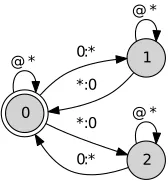
As mentioned in Gerdemann and van Noord (2000), there is an additional complication with the ‘worsening’-approach. It is not always the case that in the pool of competing candidates, the violation markers line up, which is a prerequisite for filtering out suboptimal ones by adding violations—although in the above grammar the violations do line up cor-rectly. However, for the vast majority of OT gram-mars, this can be remedied by inserting a violation-permuting transducer that moves violations markers around before worsening, to attempt to produce a correct alignment. Such a permuting transducer can be defined as in figure 3.
If the need for permutation arises, repeated per-mutations can be included as many times as war-ranted in the definition ofWorsen:
Figure 3: Violation permutation transducer.
Permute = [%*:0 ?* 0:%*|0:%* ?* %*:0]*/?; Worsen = [Gen.i .o. Gen]/%* .o.
Permute .o. ... .o. Permute .o. AddViol;
Knowing how many permutations are necessary for the transducer to be able to distinguish between any number of violations in a candidate pool is pos-sible as follows: we can can calculate for some con-straintConsNin a sequence of constraints,
Eval(Eval(Gen .o. Cons1) ... .o. ConsN) .o. ConsN .o. \%* -> 0;
Now, this yields a transducer that maps every un-derlying form to n asterisks, n being the number of violations with respect to ConsN in the candi-dates that have successfully survivedConsN. If this transducer represents a function (is single-valued), then we know that two candidates with a different number of violations have not survivedConsN, and that the worsening yielded the correct answer. Since the question of transducer functionality is known to be decidable (Blattner and Head, 1977), and an efficient algorithm is given in Hulden (2009a), which is included infoma(with the commandtest functional) we can address this question by cal-culating the above for each constraint, if necessary, and then permute the violation markers until the above transducer is functional.
3.4 Equivalence testing
[image:6.612.73.299.54.156.2]Karttunen (2006), among others, OT constraint de-bugging is an arduous task due to the sheer num-ber of unforeseen candidates. One of the advantages in encoding an OT grammar through the worsening approach is that we can produce an exact represen-tation of the grammar, which is not an approxima-tion bounded by the number of constraint violaapproxima-tions it can distinguish (as in Karttunen (1998)), or by the length of strings it can handle. This allows us to formally calculate, among other things, the equiva-lence of an OT grammar represented as an FST and some other transducer. For example, in the above grammar, the intention was to model end-of-word obstruent devoicing through optimality constraints. Another way to model the same thing would be to compile the replacement rule:
Rule = b -> p, d -> t, g -> k || _ .#. ;
The transducer resulting from this is shown in fig-ure 4.
0 @ k p t
1 b d g
2 b:p d:t g:k
@ k p t b d g
[image:7.612.102.271.359.411.2]b:p d:t g:k
Figure 4: Devoicing transducer compiled through a rule.
As is seen, the OT transducer (figure 2) and the rule transducer (figure 4) are not structurally identical. However, both transducers represent a function—i.e. for any given input, there is always a unique winning candidate. Although transducer equivalence is not testable by algorithm in the gen-eral case, it is decidable in the case where one of two transducers is functional. If this is the case it is sufficient to test that domain(τ1) =domain(τ2)and
thatτ2−1◦τ1 represents identity relations only. As
an algorithm to decide if a transducer is an identity transducer is also included infoma, it can be used to ascertain that the two above transducers are in fact identical, and that the linguistic generalization cap-tured by the OT constraints is correct:
regex Rule.i .o. Grammar; test identity
which indeed returns TRUE. For a small grammar, such as the devoicing grammar, determining the cor-rectness of the result by other means is certainly fea-sible. However, for more complex systems the abil-ity to test for equivalence becomes a valuable tool in analyzing constraint systems.
4 Variations on GEN: an OT grammar of
stress assignment
Most OT grammars that deal with phonological phe-nomena with faithfulness and markedness gram-mars are implementable through the approach given above, with minor variations according to what spe-cific constraints are used. In other domains, how-ever, in may be the case that GEN, as described above, needs modification. A case in point are gram-mars that mark prosody or perform syllabification that often take advantage of only markedness con-straints. In such cases, there is often no need for GEN to insert, change, and delete material if all faithfulness constraints are assumed to outrank all markedness constraints. Or alternatively, if the OT grammar is assumed to operate on a different stra-tum where no faithfulness constraints are present. However, GEN still needs to insert material into strings, such as stress marks or syllable boundaries.
To test the approach with a larger ‘real-world’ grammar we have reimplemented a Finnish stress assignment grammar, originally implemented through the counting approach of Karttunen (1998) in Karttunen (2006), following a description in Kiparsky (2003). The grammar itself contains nine constraints, and is intended to give a complete ac-count of stress placement in Finnish words. Without going into a line-by-line analysis of the grammar, the crucial main differences in this implementation to that of the previous sections are:
• GEN only inserts symbols( ) ‘ and ’ to mark feet and stress
• Violations need to be permuted inWorsento yield an exact representation
kainostelijat -> (ka´i.nos).(te‘.li).jat kalastelemme -> (ka´.las).te.(le‘m.me) kalasteleminen -> *(ka´.las).te.(le‘.mi).nen kalastelet -> (ka´.las).(te‘.let) kuningas -> (ku´.nin).gas
[image:8.612.72.298.54.137.2]strukturalismi -> (stru´k.tu).ra.(li‘s.mi) ergonomia -> (e´r.go).(no‘.mi).a matematiikka -> (ma´.te).ma.(ti‘ik.ka)
Figure 5: Example outputs of matching implementation of Finnish OT.
Compiling the entire grammar through the same procedure as above outputs a transducer with 134 states, and produces the same predictions as Kart-tunen’s counting OT grammar.6 As opposed to the
previous devoicing grammar, compiling the Finnish prosody grammar requires permutation of the viola-tion markers, although only one constraint requires it (STRESS-TO-WEIGHT, and in that case, compos-ingWorsenwith one round of permutation is suffi-cient for convergence).
Unlike the counting approach, the current ap-proach confers two significant advantages. The first is that we can compile the entire grammar into an FST that does not restrict the inputs in any way. That is, the final product is a stand-alone transducer that accepts as inputanysequence of any length of sym-bols in the Finnish alphabet, and produces an output where the sequence is syllabified, marked with feet, and primary and secondary stress placement (see fig-ure 5). The counting method, in order to compile at all, requires that the set of inputs be fixed to some very limited set of words, and that the maximum number of distinguishable violations (and indirectly word length) be fixed to somek.7 The second
ad-vantage is that, as mentioned before, we are able to formally compare the OT grammar (because it is not an approximation), to a rule-based grammar (FST) that purports to capture the same phenomena. For example, Karttunen (2006), apart from the count-ing OT implementation, also provides a rule-based account of Finnish stress, which he discovers to be distinct from an OT account by finding two words
6Including replicating errors in Kiparsky’s OT analysis
dis-covered by Karttunen, as seen in figure 5.
7Also, compiling the grammar is reasonably quick: 7.04s on
a 2.8MHz Intel Core 2, vs. 2.1s for a rewrite-rule-based account of the same phenomena.
where their respective predictions differ. However, by virtue of having an exact transducer, we can for-mally analyze the OT account together with the rule-based account to see if they differ in their predictions foranyinput, without having to first intuit a differ-ing example:
regex RuleGrammar.i .o. OTGrammar; test identity
Further, we can subject the two grammars to the usual finite-state calculus operations to gain possible insight into what kinds of words yield different pre-dictions with the two—something useful for linguis-tic debugging. Likewise, we can use similar tech-niques to analyze for redundancy in grammars. For example, we have assumed that the VOP-constraint plays no role in the above devoicing tableaux. Using finite-state calculus, we can prove it to be so for any input if the grammar is constructed with the method presented here.
5 Limits on FST implementation
We shall conclude the presentation here with a brief discussion of the limits of FST representability, even of simple OT grammars. Previous analyses have shown that OT systems are beyond the generative capacity of finite-state systems, under some assump-tions of what GEN looks like. For example, Frank and Satta (1998) present such a constraint system where GEN is taken to be defined through a trans-duction equivalent to:8
Gen = [a:b|b:a]* | [a|b]*;
That is, a relation whicheithermaps alla’s tob’s and vice versa, or leaves the input unchanged. Now, let us assume the presence of a single markedness constraint∗a, militating against the lettera. In that
case, given an input of the formata∗b∗the effective mapping of the entire system is one that is an identity relation if there are fewera’s thanb’s; otherwise the a’s andb’s are swapped. As is easily seen, this is not a regular relation.
One possible objection to this analysis of non-regularity is that linguistically GEN is usually as-sumed to perform any transformation to the input
whatsoever—not just limiting itself to a proper sub-set of Σ∗ → Σ∗. However, it is indeed the case
that even with a canonical GEN-function, some very simple OT systems fall outside the purview of finite-state expressibility, as we shall illustrate by a differ-ent example here.
5.1 A simple proof of OT nonregularity
Assume a grammar that has four very basic con-straints: IDENT, forbidding changes, DEP, for-bidding epenthesis, ∗ab, a markedness constraint
against the sequenceab, and MAX, forbidding dele-tion, ranked IDENT,DEP ∗ab MAX. We as-sume GENto be as general as possible—performing arbitrary deletions, insertions, and changes.
It is clear, as is illustrated in table 2, that for all in-puts of the formatanbmthe grammar in question de-scribes a relation that deletes all thea’s or all theb’s depending on which there are fewer instances of, i.e. anbm →anifm < n, andanbm →bm ifn < m. This can be shown by a simple pumping argument to not be realizable through an FST.
aaabb IDENT DEP ∗ab MAX
aaaaa *!*
aaacbb *!
aaabb *!
aaab *! *
bb ***!
[image:9.612.74.280.365.468.2]+ aaa **
Table 2: Illustrative tableau for a simple constraint sys-tem not capturable as a regular relation.
Implementing this constraint system with the methods presented here is an interesting exercise and serves to examine the behavior of the method.
We define GEN, DEP, MAX, and IDENT as be-fore, define a universal alphabet (excluding markup symbols), and the constraint∗ab naturally as:
S = ? - %( - %) - %[ - %] - %* ; NotAB = [..] -> {*} || Surf(a b) _ ;
Now, with one round of permutation of the viola-tion markers inWorsenas follows:
Worsen = [Gen.i .o. Gen]/{*} .o. AddViol .o. Permute;
we calculate
define Grammar Eval(Eval(Eval(Eval(
Gen .o. Ident) .o. Dep) .o. NotAB) .o. Max) .o. Cleanup;
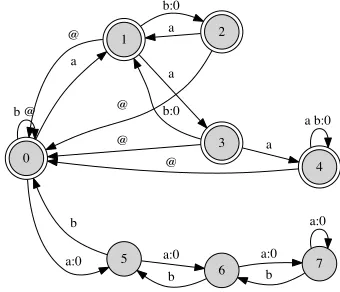
which produces an FST that cannot distinguish be-tween more than twoa’s or b’s in a string. While it correctly maps aab to aa and abb to bb, the tableau example of aaabb is mapped to both aaa
andbb. However, with one more round of permu-tation inWorsen, we produce an FST that can in-deed cover the example, mapping aaabb uniquely to bb, while failing with aaaabbb (see figure 6). This illustrates the approximation characteristic of the matching method: for some grammars (proba-bly most natural language grammars) the worsening approach will at some point of permutation of the vi-olation markers terminate and produce an exact FST representation of the grammar, while for some gram-mars such convergence will never happen. How-ever, if the permutation of markers terminates and produces a functional transducer when testing each violation as described above, the FST is guaranteed to be an exact representation.
0 b @
1 a
5 a:0
@ 2
b:0
3 a
@ a
@ b:0
4 a @
a b:0
b
6 a:0
b 7
a:0 b
[image:9.612.340.510.407.553.2]a:0
Figure 6: An non-regular OT approximation.
6 Conclusion
We have presented a practical method of implement-ing OT grammars as finite-state transducers. The ex-amples, definitions, and templates given should be sufficient and flexible enough to encode a wide vari-ety of OT grammars as FSTs. Although no method can encode all OT grammars as FSTs, the funda-mental advantage with the system outlined is that for a large majority of practical cases, an FST can be produced which is not an approximation that can only tell apart a limited number of violations. As has been noted elsewhere (e.g. Eisner (2000b,a)), some OT constraints, such as Generalized Align-ment constraints, are on the face of it not suitable for FST implementation. We may add to this that some very simple constraint systems, assuming a canonical GEN, and only using the most basic faith-fulness and markedness constraints, are likewise not encodable as regular relations, and seem to have the generative power to encode phenomena not found in natural language. However, for most practical purposes—and this includes modeling actual phe-nomena in phonology and morphology—the present approach offers a fruitful way to implement, ana-lyze, and debug OT grammars.
References
Beesley, K. R. and Karttunen, L. (2003).Finite State Morphology. CSLI Publications, Stanford, CA. Blattner, M. and Head, T. (1977). Single-valued
a-transducers.Journal of Computer and System Sci-ences, 15(3):328–353.
Eisner, J. (2000a). Directional constraint evaluation in optimality theory. In Proceedings of the 18th conference on Computational linguistics, pages 257–263. Association for Computational Linguis-tics.
Eisner, J. (2000b). Easy and hard constraint ranking in optimality theory. In Finite-state phonology: Proceedings of the 5th SIGPHON, pages 22–33. Ellison, T. M. (1994). Phonological derivation in
op-timality theory. InProceedings of COLING’94— Volume 2, pages 1007–1013.
Frank, R. and Satta, G. (1998). Optimality theory and the generative complexity of constraint viola-bility.Computational Linguistics, 24(2):307–315.
Gerdemann, D. and van Noord, G. (2000). Approx-imation and exactness in finite state optimality theory. InProceedings of the Fifth Workshop of the ACL Special Interest Group in Computational Phonology.
Hammond, M. (1997). Parsing syllables: Modeling OT computationally. Rutgers Optimality Archive (ROA), 222-1097.
Hulden, M. (2009a).Finite-state Machine Construc-tion Methods and Algorithms for Phonology and Morphology. PhD thesis, The University of Ari-zona.
Hulden, M. (2009b). Foma: a finite-state compiler and library. In EACL 2009 Proceedings, pages 29–32.
J¨ager, G. (2002). Gradient constraints in finite state OT: the unidirectional and the bidirectional case.
More than Words. A Festschrift for Dieter Wun-derlich, pages 299–325.
Kager, R. (1999). Optimality Theory. Cambridge University Press.
Kaplan, R. M. and Kay, M. (1994). Regular mod-els of phonological rule systems. Computational Linguistics, 20(3):331–378.
Karttunen, L. (1998). The proper treatment of op-timality theory in computational phonology. In
Finite-state Methods in Natural Language Pro-cessing.
Karttunen, L. (2006). The insufficiency of paper-and-pencil linguistics: the case of Finnish prosody. Rutgers Optimality Archive.
Kiparsky, P. (2003). Finnish noun inflection. Gener-ative approaches to Finnic linguistics. Stanford: CSLI.
Prince, A. and Smolensky, P. (1993). Optimality theory: Constraint interaction in generative gram-mar. ms. Rutgers University Cognitive Science Center.