Analysis of the Hindi Proposition Bank using Dependency Structure
Ashwini Vaidya Jinho D. Choi Martha Palmer Bhuvana Narasimhan Institute of Cognitive Science
University of Colorado at Boulder
{vaidyaa,choijd,mpalmer,narasimb}@colorado.edu
Abstract
This paper makes two contributions. First, we describe the Hindi Proposition Bank that con-tains annotations of predicate argument struc-tures of verb predicates. Unlike PropBanks in most other languages, the Hind PropBank is annotated on top of dependency structure, the Hindi Dependency Treebank. We explore the similarities between dependency and pred-icate argument structures, so the PropBank an-notation can be faster and more accurate. Sec-ond, we present a probabilistic rule-based sys-tem that maps syntactic dependents to seman-tic arguments. With simple rules, we classify about 47% of the entire PropBank arguments with over 90% confidence. These preliminary results are promising; they show how well these two frameworks are correlated. This can also be used to speed up our annotations.
1 Introduction
Proposition Bank (from now on, PropBank) is a cor-pus in which the arguments of each verb predicate are annotated with their semantic roles (Palmer et al., 2005). PropBank annotation has been carried out in several languages; most of them are annotated on top of Penn Treebank style phrase structure (Xue and Palmer, 2003; Palmer et al., 2008). However, a different grammatical analysis has been used for the Hindi PropBank annotation, dependency structure, which may be particularly suited for the analysis of flexible word order languages such as Hindi.
As a syntactic corpus, we use the Hindi Depen-dency Treebank (Bhatt et al., 2009). Using de-pendency structure has some advantages. First,
se-mantic arguments1 can be marked explicitly on the syntactic trees, so annotations of the predicate ar-gument structure can be more consistent with the dependency structure. Second, the Hindi Depen-dency Treebank provides a rich set of depenDepen-dency relations that capture the syntactic-semantic infor-mation. This facilitates mappings between syntac-tic dependents and semansyntac-tic arguments. A success-ful mapping would reduce the annotation effort, im-prove the inter-annotator agreement, and guide a full fledged semantic role labeling task.
In this paper, we briefly describe our annotation work on the Hindi PropBank, and suggest mappings between syntactic and semantic arguments based on linguistic intuitions. We also present a probabilistic rule-based system that uses three types of rules to arrive at mappings between syntactic and semantic arguments. Our experiments show some promising results; these mappings illustrate how well those two frameworks are correlated, and can also be used to speed up the PropBank annotation.
2 Description of the Hindi PropBank
2.1 Background
The Hindi PropBank is part of a multi-dimensional and multi-layered resource creation effort for the Hindi-Urdu language (Bhatt et al., 2009). This multi-layered corpus includes both dependency an-notation as well as lexical semantic information in the form of PropBank. The corpus also produces phrase structure representations in addition to
de-1The term ’semantic argument’ is used to indicate all num-bered arguments as well as modifiers in PropBank.
pendency structure. The Hindi Dependency Tree-bank has created an annotation scheme for Hindi by adapting labels from Panini’s Sanskrit gram-mar (also known as CPG: Computational Paninian Grammar; see Begum et al. (2008)). Previous work has demonstrated that the English PropBank tagset is quite similar to English dependency trees anno-tated with the Paninian labels (Vaidya et al., 2009). PropBank has also been mapped to other depen-dency schemes such as Functional Generative De-scription (Cinkova, 2006).
2.2 Hindi Dependency Treebank
The Hindi Dependency Treebank (HDT) includes morphological, part-of-speech and chunking infor-mation as well as dependency relations. These are represented in the Shakti Standard Format (SSF; see Bharati et al. (2007)). The dependency labels de-pict relations between chunks, which are “minimal phrases consisting of correlated, inseparable enti-ties” (Bharati et al., 2006), so they are not neces-sarily individual words. The annotation of chunks also assumes that intra-chunk dependencies can be extracted automatically (Husain et al., 2010).
The dependency tagset consists of about 43 labels, which can be grouped into three categories: depen-dency relation labels, modifier labels, and labels for non-dependencies (Bharati et al., 2009). PropBank is mainly concerned with those labels depicting de-pendencies in the domain of locality of verb predi-cates. The dependency relation labels are based on the notion of ‘karaka’, defined as “the role played by a participant in an action”. The karaka labels,k1-5, are centered around the verb’s meaning. There are other labels such asrt(purpose) ork7t(location) that are independent of the verb’s meaning.
2.3 Annotating the Hindi PropBank
The Hindi PropBank (HPB) contains the labeling of semantic roles, which are defined on a verb-by-verb basis. The description at the verb-specific level is fine-grained; e.g., ‘hitter’ and ‘hittee’. These verb-specific roles are then grouped into broader cate-gories using numbered arguments (ARG#). Each verb can also have modifiers not specific to the verb (ARGM*). The annotation process takes place in two stages: the creation of frameset files for individual verb types, and the annotation of predicate
argu-ment structures for each verb instance. As annota-tion tools, we use Cornerstone and Jubilee (Choi et al., 2010a; Choi et al., 2010b). The annotation is done on the HDT; following the dependency anno-tation, PropBank annotates each verb’s syntactic de-pendents as their semantic arguments at the chunk level. Chunked trees are conveniently displayed for annotators in Jubilee. PropBank annotations gener-ated in Jubilee can also be easily projected onto the SSF format of the original dependency trees.
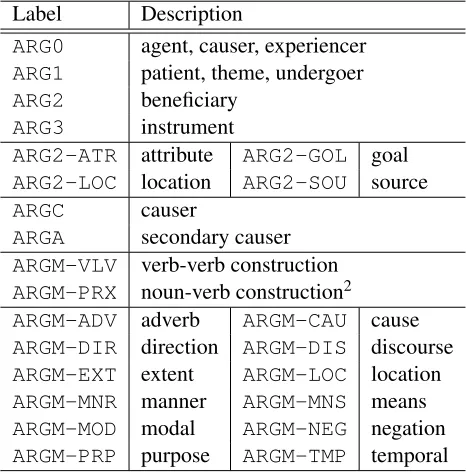
The HPB currently consists of 24 labels including both numbered arguments and modifiers (Table 1). In certain respects, the HPB labels make some dis-tinctions that are not made in some other language such as English. For instance, ARG2is subdivided into labels with function tags, in order to avoid
ARG2 from being semantically overloaded (Yi, 2007).ARGCandARGAmark the arguments of mor-phological causatives in Hindi, which is different from the ARG0 notion of ‘causer’. We also intro-duce two labels to represent the complex predicate constructions:ARGM-VLVandARGM-PRX.
Label Description
ARG0 agent, causer, experiencer
ARG1 patient, theme, undergoer
ARG2 beneficiary
ARG3 instrument
ARG2-ATR attribute ARG2-GOL goal
ARG2-LOC location ARG2-SOU source
ARGC causer
ARGA secondary causer
ARGM-VLV verb-verb construction
ARGM-PRX noun-verb construction2
ARGM-ADV adverb ARGM-CAU cause
ARGM-DIR direction ARGM-DIS discourse
ARGM-EXT extent ARGM-LOC location
ARGM-MNR manner ARGM-MNS means
ARGM-MOD modal ARGM-NEG negation
[image:2.612.313.546.366.603.2]ARGM-PRP purpose ARGM-TMP temporal
Table 1: Hindi PropBank labels.
2.4 Empty arguments in the Hindi PropBank
relative pronoun), pro (pro-drop argument), and
gap-pro(gapped argument). HPB annotates syn-tactic relations between its semantic roles, notably co-indexation of the empty argumentPROas well as
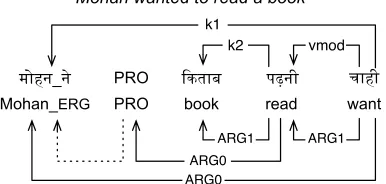
gap-pro. The example in Figure 1 shows that Mo-hanandPROare co-indexed; thus,Mohanbecomes
ARG0ofreadvia the empty argumentPRO. There is no dependency link betweenPROandreadbecause
PROis inserted only in the PropBank layer.
Mohan wanted to read a book
मोहन_% PRO ' ताबक चाही
Mohan_ERG
k1
vmod
ARG1
ARG0 ARG0
पढ़नी
PRO book read want
k2
[image:3.612.90.283.200.292.2]ARG1
Figure 1: Empty argument example. The upper and lower edges indicate HDT and HPB labels, respectively.
3 Comparisons between syntactic and semantic arguments
In this section, we describe the mappings between HDT and HPB labels based on our linguistic intu-itions. We show that there are several broad similar-ities between two tagsets. These mappings form the basis for our linguistically motivated rules in Sec-tion 4.2.3. In secSec-tion 5.5, we analyze whether the intuitions discussed in this section are borne out by the results of our probabilistic rule-based system.
3.1 Numbered arguments
The numbered arguments correspond to ARG0-3, including function tags associated with ARG2. In PropBank, ARG0 and ARG1 are conceived as framework-independent labels, closely associated with Dowty’s Proto-roles (Palmer et al., 2010). For instance,ARG0corresponds to the agent, causer, or experiencer, whether it is realized as the subject of an active construction or as the object of an adjunct (by phrase) of the corresponding passive. In this re-spect, ARG0and ARG1are very similar tok1 and
k2in HDT, which are annotated based on their se-mantic roles, not their grammatical relation. On the other hand, HDT treats the following sentences sim-ilarly, whereas PropBank does not:
• The boybrokethe window.
• The windowbroke.
The boyandthe windoware both consideredk1for HDT, whereas PropBank labelsthe boyasARG0and
The window as ARG1. The window is not consid-ered a primary causer as the verb is unaccusative for Propbank. For HDT, the notion of unaccusativity is not taken into consideration. This is an important distinction that needs to be considered while carry-ing out the mappcarry-ing.k1is thus ambiguous between
ARG0 and ARG1. Also, HDT makes a distinction between Experiencer subjects of certain verbs, label-ing them ask4a. As PropBank does not make such a distinction,k4amaps toARG0. The Experiencer subject information is included in the corresponding frameset files of the verbs. The mappings toARG0
andARG1would be accurate only if they make use of specific verb information. The mappings for other numbered arguments as well asARGCandARGAare given in Table 2.
HDT label HPB label
k1(karta);k4a(experiencer) Arg0
k2(karma) Arg1
k4(beneficiary) Arg2
k1s(attribute) Arg2-ATR
k5(source) Arg2-SOU
k2p(goal) Arg2-GOL
k3(instrument) Arg3
mk1(causer) ArgC
pk1(secondary causer) ArgA
Table 2: Mappings to the HPB numbered arguments.
Note that in HDT annotation practice, k3 andk5
tend to be interpreted in a broad fashion such that they map not only toARG3andARG2-SOU, but also toARGM-MNSandARGM-LOC(Vaidya and Husain, 2011). Hence, a one-to-one mapping for these la-bels is not possible. Furthermore, the occurrence of morphological causatives (ARGCandARGA) is fairly low so that we may not be able to test the accuracy of these mappings with the current data.
3.2 Modifiers
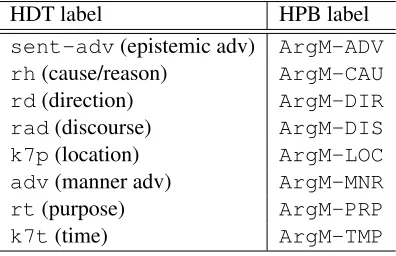
HDT labels and HPB modifiers. A problematic map-ping could be ARGM-MNR, which is quite coarse-grained in PropBank, applying not only to adverbs of manner, but also to infinitival adjunct clauses.
HDT label HPB label
sent-adv(epistemic adv) ArgM-ADV rh(cause/reason) ArgM-CAU
rd(direction) ArgM-DIR
rad(discourse) ArgM-DIS
k7p(location) ArgM-LOC
adv(manner adv) ArgM-MNR
rt(purpose) ArgM-PRP
[image:4.612.87.285.122.250.2]k7t(time) ArgM-TMP
Table 3: Mappings to the HPB modifiers.
3.3 Simple and complex predicates
HPB distinguishes annotations between simple and complex predicates. Simple predicates consist of only a single verb whereas complex predicates con-sist of a light verb and a pre-verbal element. The complex predicates are identified with a special label
ARGM-PRX (ARGument-PRedicating eXpresstion), which is being used for all light verb annotations in PropBank (Hwang et al., 2010). Figure 2 shows an example of the predicating noun mention anno-tated asARGM-PRX, used withcome. The predicat-ing noun also has its own argument, matter of, in-dicated with the HDT label r6-k1. The HDT has two labels,r6-k1andr6-k2, for the arguments of the predicating noun. Hence, the argument span for complex predicates includes not only direct depen-dents of the verb but also dependepen-dents of the noun.
स"नवाई_'_दौरान ब"धवार_को माम0_का ि 3ज _भी hearing_of_during Wed._of matter_of mention_to
k7t k7t
pof
ARGM-PRX
ARG1 ARGM-TMP
come आया r6-k1
ARGM-TMP
[image:4.612.335.516.238.326.2]During the hearing on Wednesday, the matter was mentioned
Figure 2: Complex predicate example.
The ARGM-PRX label usually overlaps with the HDT labelpof, indicating a ‘partofunits’ as
pre-verbal elements in complex predicates. However, in certain cases, HPB has its own analysis for noun-verb complex predicates. Hence, not all the nom-inals labeled pof are labeled as ARGM-PRX. In the example in Figure 3, the noun chunkimportant progressis not considered to be an ARGM-PRXby HPB (in this example, we have pragati hona; (lit) progess be; to progress). The nominal for PropBank is in factARG1 of the verb be, rather than a com-posite on the verb. Additional evidence for this is that neither the nominal nor the light verb seem to project arguments of their own.
Important progress has been made in this work
इस_काम_& 'ई_)
k7p
pof
ARG1 ARGM-LOC
मह+वप. /ण_1ग त4
this_work_LOC important_progress be_PRES
Figure 3: HDT vs. HPB on complex predicates.
4 Automatic mapping of HDT to HPB Mapping between syntactic and semantic structures has been attempted in other languages. The Penn English and Chinese Treebanks consist of several se-mantic roles (e.g., locative, temporal) annotated on top of Penn Treebank style phrase structure (Marcus et al., 1994; Xue and Palmer, 2009). The Chinese PropBank specifies mappings between syntactic and semantic arguments in frameset files (e.g., SBJ → ARG0) that can be used for automatic mapping (Xue and Palmer, 2003). However, these Chinese map-pings are limited to certain types of syntactic argu-ments (mostly subjects and objects). Moreover, se-mantic annotations on the Treebanks are done inde-pendently from PropBank annotations, which causes disagreement between the two structures.
[image:4.612.73.306.536.644.2]but to find a useful set of mappings that can speed up our annotation. These mappings will be applied to our future data as a pre-annotation stage, so that annotators do not need to annotate arguments that have already been automatically labeled by our sys-tem. Thus, it is important to find mappings with high precision and reasonably good recall.
In this section, we present a probabilistic rule-based system that identifies and classifies semantic arguments in the HPB using syntactic dependents in the HDT. This is still preliminary work; our system is expected to improve as we annotate more data and do more error analysis.
4.1 Argument identification
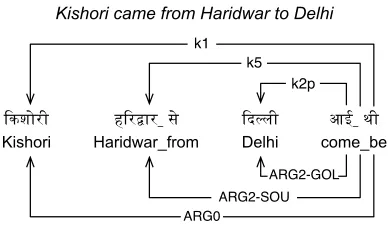
Identifying semantic arguments of each verb pred-icate is relatively easy given the dependency Tree-bank. For each verb predicate, we consider all syn-tactic dependents of the predicate as its semantic arguments (Figure 4). For complex predicates, we consider the syntactic dependents of both the verb and the predicating noun (cf. Section 3.3).
क
" शोरी ह र" (ार_ * " ,लीद आई_ थी Kishori Haridwar_from Delhi come_be
k1 k5
k2p
ARG2-GOL ARG2-SOU ARG0
[image:5.612.88.282.370.485.2]Kishori came from Haridwar to Delhi
Figure 4: Simple predicate example.
With our heuristics, we get a precision of 99.11%, a recall of 95.50%, and an F1-score of 97.27% for argument identification. Such a high precision is expected as the annotation guidelines for HDT and HPB generally follow the same principles of iden-tifying syntactic and semantic arguments of a verb. About 4.5% of semantic arguments are not identi-fied by our method. Table 4 shows distributions of the most frequent non-identified arguments.
Label Dist. Label Dist. Label Dist.
ARG0 3.21 ARG1 0.90 ARG2∗ 0.09
Table 4: Distributions of non-identified arguments caused by PropBank empty categories (in %).
Most of the non-identified argument are antecedents of PropBank empty arguments. As shown in Fig-ure 1, the PropBank empty argument has no depen-dency link to the verb predicate. Identifying such arguments requires a task of empty category reso-lution, which will be explored as future work. Fur-thermore, we do not try to identify PropBank empty arguments for now, which will also be explored later.
4.2 Argument classification
Given the identified semantic arguments, we classify their semantic roles. Argument classification is done by using three types of rules. Deterministic rules are heuristics that are straightforward given dependency structure. Empirically-derived rules are generated by measuring statistics of dependency features in as-sociation with semantic roles. Finally, linguistically-motivated rules are derived from our linguistic intu-itions. Each type of rule has its own strength; how to combine them is the art we need to explore.
4.2.1 Deterministic rule
Only one deterministic rule is used in our system. When an identified argument has apofdependency relation with its predicate, we classify the argu-ment as ARGM-PRX. This emphasizes the advan-tage of using our dependency structure: classifying
ARGM-PRX cannot be done automatically in most other languages where there is no information pro-vided for light verb constructions. This determin-istic rule is applied before any other type of rule. Therefore, we do not generate further rules to clas-sify theARGM-PRXlabel.
4.2.2 Empirically-derived rules
Three kinds of features are used for the generation of empirically-derived rules: predicate ID, predicate’s voice type, and argument’s dependency label. The predicate ID is either the lemma or the roleset ID
of the predicate. Predicate lemmas are already pro-vided in HDT. When we use predicate lemmas, we assume no manual annotation of PropBank. Thus, rules generated from predicate lemmas can be ap-plied to any future data without modification. When we use roleset ID’s, we assume that sense annota-tions are already done. PropBank includes anno-tations of coarse verb senses, called roleset ID’s,
senses (Palmer et al., 2005). A verb predicate can form several argument structures with respect to dif-ferent senses. Using rolesetID’s, we generate more fine-grained rules that are specific to those senses.
The predicate’s voice type is either ‘active’ or ‘passive’, also provided in HDT. There are not many instances of passive construction in our current data, which makes it difficult to generate rules general enough for future data. However, even with the lack of training instances, we find some advantage of us-ing the voice feature in our experiments. Finally, the argument’s dependency label is the dependency la-bel of an identified argument with respect to its pred-icate. This feature is straightforward for the case of simple predicates. For complex predicates, we use the dependency labels of arguments with respect to their syntactic heads, which can be pre-verbal ele-ments. Note that rules generated with complex pred-icates contain slightly different features for predicate lemmas as well; instead of using predicate lemmas, we use joined tags of the predicate lemmas and the lemmas of pre-verbal elements.
ID V Drel PBrel #
come a k1 ARG0 1
come a k5 ARG2-SOU 1
come a k2p ARG2-GOL 1
come mention a k7t ARGM-TMP 2
[image:6.612.320.533.447.549.2]come mention a r6-k1 ARG1 1
Table 5: Rules generated by the examples in Figures 4 and 2. The ID, V, and Drel columns show predicateID, predicate’s voice type, and argument’s dependency label. The PBrel col-umn shows the PropBank label of each argument. The # colcol-umn shows the total count of each feature tuple being associated with the PropBank label. ‘a’ stands for active voice.
Table 5 shows a set of rules generated by the exam-ples in Figures 4 (come) and 2 (come mention). No rule is generated forARGM-PRXbecause the label is already covered by our deterministic rule (Sec-tion 4.2.1). When roleset ID’s are used in place of the predicate ID, come and come mention are re-placed with A.03 and A.01, respectively. These rules can be formulated as a functionrulesuch that:
rule(id, v, drel) = arg maxiP(pbreli)
where P(pbreli) is a probability of the predicted
PropBank label pbreli, given a tuple of features
(id, v, drel). The probability is measured by es-timating a maximum likelihood of each PropBank label being associated with the feature tuple. For example, a feature tuple (come, active, k1) can be associated with two PropBank labels, ARG0 and
ARG1, with counts of 8 and 2, respectively. In this case, the maximum likelihoods ofARG0andARG1
being associated with the feature tuple is 0.8 and 0.2; thusrule(come, active,k1) =ARG0.
Since we do not want to apply rules with low con-fidence, we set a threshold toP(pbrel), so predic-tions with low probabilities can be filtered out. Find-ing the right threshold is a task of handlFind-ing the pre-cision/recall trade-off. For our experiments, we ran 10-fold cross-validation to find the best threshold.
4.2.3 Linguistically-motivated rules
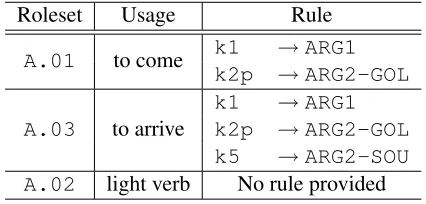
Linguistically-motivated rules are applied to argu-ments that the deterministic rule and empirically-derived rules cannot classify. These rules capture general correlations between syntactic and seman-tic arguments for each predicate, so they are not as fine-grained as empirically-derived rules, but can be helpful for predicates not seen in the training data. The rules are manually generated by our annota-tors and specified in frameset files. Table 6 shows linguistically-motivated rules for the predicate ‘A (come)’, specified in the frameset file, ‘A-v.xml’.3
Roleset Usage Rule
A.01 to come k1 →ARG1
k2p →ARG2-GOL
A.03 to arrive
k1 →ARG1
k2p →ARG2-GOL
k5 →ARG2-SOU
A.02 light verb No rule provided
Table 6: Rules for the predicate ‘A (come)’.
The predicate ‘A’ has three verb senses and each sense specifies a different set of rules. For instance, the first rule of A.01 maps a syntactic dependent with the dependency label k1 to a semantic ar-gument with the semantic label ARG1. Note that frameset files include rules only for numbered ar-guments. Most of these rules should already be in-cluded in the empirically-derived rules as we gain
3
more training data; however, for an early stage of annotation, these rules provide useful information.
5 Experiments
5.1 Corpus
All our experiments use a subset of the Hindi Depen-dency Treebank, distributed by the ICON’10 con-test (Husain et al., 2010). Our corpus contains about 32,300 word tokens and 2,005 verb predicates, in which 546 of them are complex predicates. Each verb predicate is annotated with a verse sense speci-fied in its corresponding frameset file. There are 160 frameset files created for the verb predicates. The number may seem small compared to the number of verb predicates. This is because we do not cre-ate separcre-ate frameset files for light verb construc-tions, which comprise about 27% of the predicate instances (see the example in Table 6).
All verb predicates are annotated with argument structures using PropBank labels. A total of 5,375 arguments are annotated. Since there is a relatively small set of data, we do not make a separate set for evaluations. Instead, we run 10-fold cross-validation to evaluate our rule-based system.
5.2 Evaluation of deterministic rule
First, we evaluate how well our deterministic rule classifies theARGM-PRXlabel. Using the determin-istic rule, we get a 94.46% precision and a 100% recall onARGM-PRX. The 100% recall is expected; the precision implies that about 5.5% of the time, light verb annotations in the HPB do not agree with the complex predicate annotations (pofrelation) in the HDT (cf. Section 3.3). More analysis needs to be done to improve the precision of this rule.
5.3 Evaluation of empirically-derived rules
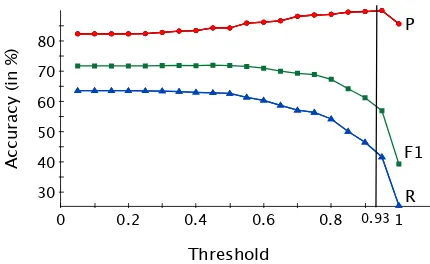
Next, we evaluate our empirically-derived rules with respect to the different thresholds set forP(pbreli). In general, the higher the threshold is, the higher and lower the precision and recall become, respec-tively. Figure 5 shows comparisons between preci-sion and recall with respect to different thresholds. Notice that a threshold of 1.0, meaning that using only rules with 100% confidence, does not give the highest precision. This is because the model with this high of a threshold overfits to the training data.
Rules that work well in the training data do not nec-essarily work as well on the test data.
0 0.2 0.4 0.6 0.8 1
30 40 50 60 70 80
Threshold
Accuracy
(in
%
)
R F1 P
[image:7.612.318.533.97.229.2]0.93
Figure 5: Accuracies achieved by the empirically derived rules using (lemma, voice, label) features. P, R, and F1 stand for precisions, recalls, and F1-scores, respectively.
We need to find a threshold that gives a high preci-sion (so annotators do not get confused by the au-tomatic output) while maintaining a good recall (so annotations can go faster). With a threshold of 0.93 using features (lemma, voice, dependency label), we get a precision of 90.37%, a recall of 44.52%, and an F1-score of 59.65%. Table 7 shows accuracies for all PropBank labels achieved by a threshold of 0.92 using roleset ID’s instead of predicate’s lem-mas. Although the overall precision stays about the same, we get a noticeable improvement in the over-all recover-all using rolesetID’s. Note that some labels are missing in Table 7. This is because either they do not occur in our current data (ARGC andARGA) or we have not started annotating them properly yet (ARGM-MODandARGM-NEG).
5.4 Evaluation of linguistically-motivated rules
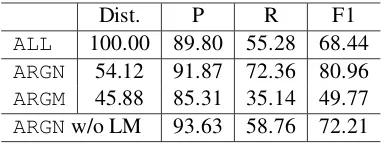
Finally, we evaluate the impact of the linguistically-motivated rules. Table 8 shows accuracies achieved by the linguistically motivated rules applied after the empirically derived rules. As expected, the linguis-tically motivated rules improve the recall of ARGN
Dist. P R F1
ALL 100.00 90.59 47.92 62.69
ARG0 17.50 95.83 67.27 79.05
ARG1 27.28 94.47 61.62 74.59
ARG2 3.42 81.48 37.93 51.76
ARG2-ATR 2.54 94.55 40.31 56.52
ARG2-GOL 1.61 64.29 21.95 32.73
ARG2-LOC 0.87 90.91 22.73 36.36
ARG2-SOU 0.83 78.26 42.86 55.38
ARG3 0.08 0.00 0.00 0.00
ARGM-ADV 3.50 31.82 3.93 7.00
ARGM-CAU 1.44 50.00 5.48 9.88
ARGM-DIR 0.43 100.00 18.18 30.77
ARGM-DIS 1.63 26.67 4.82 8.16
ARGM-EXT 1.42 0.00 0.00 0.00
ARGM-LOC 10.77 83.80 27.42 41.32
ARGM-MNR 6.00 57.14 9.18 15.82
ARGM-MNS 0.79 77.78 17.50 28.57
ARGM-PRP 2.15 65.52 17.43 27.54
ARGM-PRX 10.75 94.46 100.00 97.15
[image:8.612.72.298.57.342.2]ARGM-TMP 7.01 74.63 14.04 23.64
Table 7: Labeling accuracies achieved by the empirically de-rived rules using (rolesetID, voice, label) features and a thresh-old of 0.92. The accuracy forARGM-PRXis achieved by the deterministic rule. The Dist. column shows a distribution of each label.
Dist. P R F1
ALL 100.00 89.80 55.28 68.44
ARGN 54.12 91.87 72.36 80.96
ARGM 45.88 85.31 35.14 49.77
[image:8.612.72.297.59.345.2]ARGNw/o LM 93.63 58.76 72.21
Table 8: Labeling accuracies achieved by the linguistically motivated rules. TheARGNandARGMrows show statistics of all numbered arguments and modifiers combined, respectively. The ‘ARGNw/o LM’ row shows accuracies ofARGNachieved only by the empirically derived rules.
5.5 Error anlaysis
The precision and recall results forARG0andARG1, are better than expected, despite the complexity of the mapping (Section 3.1). This is because they oc-cur most often in the corpus, so enough rules can be extracted. The other numbered arguments are closely related to particular types of verbs (e.g., mo-tion verbs forARG2-GOL|SOU). Our linguistically motivated rules are more effective for these types of HPB labels. We would expect the modifiers to
be mapped independently of the verb, but our ex-periments show that the presence of the verb lemma feature enhances the performance of modifiers. Al-though section 3.2 expects one-to-one mappings for modifiers, it is not the case in practice.
We observe that the interpretation of labels in an-notation practice is important. For example, our sys-tem performs poorly forARGM-ADVbecause the la-bel is used for various sentential modifiers and can be mapped to as many as four HDT labels. On the other hand, HPB makes some fine-grained distinc-tions. For instance, means and causes are distin-guished usingARGM-CAUandARGM-MNSlabels, a distinction that HDT does not make. In the example in Figure 6, we find thataptitude withis assigned to
ARGM-MNS, but gets the cause labelrhin HDT.
Rajyapal can call upon any party with his aptitude
रा#यपाल
Rajyapal
अप(
his
व * +क_
-aptitude_with
क * सी_ भी
any_EMPH
पाट2_ को
party_DAT
ब5ला_ सकता_ 7
call_can_be
Figure 6: Means vs. cause example.
6 Conclusion and future work
We provide an analysis of the Hindi PropBank anno-tated on the Hindi Dependency Treebank. There is an interesting correlation between dependency and predicate argument structures. By analyzing the similarities between the two structures, we find rules that can be used for automatic mapping of syntactic and semantic arguments, and achieve over 90% con-fidence for almost half of the data. These rules will be applied to our future data, which will make the annotation faster and possibly more accurate.
We plan to use different sets of rules generated by different thresholds to see which rule set leads to the most effective annotation. We also plan to develop a statistical semantic role labeling system in Hindi, once we have enough training data. In addition, we will explore the possibility of using existing lexical resource such as WordNet (Narayan et al., 2002) to improve our system.
Acknowledgements
[image:8.612.90.282.419.491.2]References
Rafiya Begum, Samar Husain, Arun Dhwaj, Dipti Misra Sharma, Lakshmi Bai, and Rajeev Sangal. 2008. De-pendency annotation scheme for indian languages. In
In Proceedings of the 3rd International Joint Confer-ence on Natural Language Processing, IJCNLP’08. Akshar Bharati, Dipti Misra Sharma, Lakshmi Bai, and
Rajeev Sangal. 2006. AnnCorra: Guidelines for POS and Chunk Annotation for Indian Languages. Techni-cal report, IIIT Hyderabad.
Akshar Bharati, Rajeev Sangal, and Dipti Misra Sharma. 2007. Ssf: Shakti standard format guide. Technical report, IIIT Hyderabad.
Akshara Bharati, Dipti Misra Sharma, Samar Husain, Lakshmi Bai, Rafiya Begam, and Rajeev Sangal. 2009. Anncorra : Treebanks for indian languages, guidelines for annotating hindi treebank. Technical re-port, IIIT Hyderabad.
Archna Bhatia, Rajesh Bhatt, Bhuvana Narasimhan, Martha Palmer, Owen Rambow, Dipti Misra Sharma, Michael Tepper, Ashwini Vaidya, and Fei Xia. 2010. Empty categories in a hindi treebank. InProceedings of the 7th International Conference on Language Re-sources and Evaluation (LREC’10), pages 1863–1870. Rajesh Bhatt, Bhuvana Narasimhan, Martha Palmer, Owen Rambow, Dipti Sharma, and Fei Xia. 2009. A Multi-Representational and Multi-Layered Treebank for Hindi/Urdu. InIn the Proceedings of the Third Lin-guistic Annotation Workshop held in conjunction with ACL-IJCNLP 2009.
Jinho D. Choi, Claire Bonial, and Martha Palmer. 2010a. Propbank frameset annotation guidelines using a ded-icated editor, cornerstone. In Proceedings of the 7th International Conference on Language Resources and Evaluation, LREC’10, pages 3650–3653.
Jinho D. Choi, Claire Bonial, and Martha Palmer. 2010b. Propbank instance annotation guidelines using a ded-icated editor, jubilee. In Proceedings of the 7th In-ternational Conference on Language Resources and Evaluation, LREC’10, pages 1871–1875.
Silvie Cinkova. 2006. From PropBank to EngVALLEX: Adapting PropBank-Lexicon to the Valency Theory of Functional Generative Description. In Proceedings of the fifth International conference on Language Re-sources and Evaluation (LREC 2006), Genova, Italy. Eva Hajiˇcov´a and Ivona Kuˇcerov´a. 2002.
Argu-ment/valency structure in propbank, lcs database and prague dependency treebank: A comparative pi-lot study. In Proceedings of the 3rd International Conference on Language Resources and Evaluation, LREC’02, pages 846–851.
Samar Husain, Prashanth Mannem, Bharat Ram Ambati, and Phani Gadde. 2010. The ICON-2010 tools contest
on Indian language dependency parsing. In Proceed-ings of ICON-2010 Tools Contest on Indian Language Dependency Parsing, ICON’10, pages 1–8.
Jena D. Hwang, Archna Bhatia, Claire Bonial, Aous Mansouri, Ashwini Vaidya, Nianwen Xue, and Martha Palmer. 2010. PropBank Annotation of Multilingual Light Verb Constructions. InProceedings of the Lin-guistic Annotation Workshop at ACL 2010.
Mitchell Marcus, Grace Kim, Mary Ann Marcinkiewicz, Robert Macintyre, Ann Bies, Mark Ferguson, Karen Katz, and Britta Schasberger. 1994. The penn tree-bank: Annotating predicate argument structure. In
ARPA Human Language Technology Workshop, pages 114–119.
Dipak Narayan, Debasri Chakrabarti, Prabhakar Pande, and Pushpak Bhattacharyya. 2002. An experience in building the indo wordnet - a wordnet for hindi. InProceedings of the 1st International Conference on Global WordNet.
Martha Palmer, Daniel Gildea, and Paul Kingsbury. 2005. The proposition bank: An annotated corpus of semantic roles. Computational Linguistics, 31(1):71– 106.
Martha Palmer, Olga Babko-Malaya, Ann Bies, Mona Diab, Mohamed Maamouri, Aous Mansouri, and Wa-jdi Zaghouani. 2008. A pilot arabic propbank. In Pro-ceedings of the 6th International Language Resources and Evaluation, LREC’08, pages 28–30.
Martha Palmer, Daniel Gildea, and Nianwen Xue. 2010. Semantic role labeling. In Graeme Hirst, editor, Syn-thesis Lectures on Human Language Technologies. Morgan and Claypool.
Ashwini Vaidya and Samar Husain. 2011. A classifica-tion of dependencies in the Hindi/Urdu Treebank. In
Presented at the Workshop on South Asian Syntax and Semantics, Amherst, MA.
Ashwini Vaidya, Samar Husain, and Prashanth Mannem. 2009. A karaka based dependency scheme for En-glish. InProceedings of the CICLing-2009, Mexico City, Mexico.
Nianwen Xue and Martha Palmer. 2003. Annotating the propositions in the penn chinese treebank. In Proceed-ings of the 2nd SIGHAN workshop on Chinese lan-guage processing, SIGHAN’03, pages 47–54. Nianwen Xue and Martha Palmer. 2009. Adding
seman-tic roles to the chinese treebank. Natural Language Engineering, 15(1):143–172.