Building frame-based corpus on the basis of ontological domain knowledge
He Tan Institutionen f¨or
datavetenskap Link¨opings universitet
Sweden [email protected]
Rajaram Kaliyaperumal Institutionen f¨or medicinsk teknik Link¨opings universitet
Sweden rajka625
Nirupama Benis Institutionen f¨or medicinsk teknik Link¨opings universitet
Sweden
Abstract
Semantic Role Labeling (SRL) plays a key role in many NLP applications. The develop-ment of SRL systems for the biomedical do-main is frustrated by the lack of large dodo-main- domain-specific corpora that are labeled with seman-tic roles. Corpus development has been very expensive and time-consuming. In this paper we propose a method for building frame-based corpus on the basis of domain knowledge pro-vided by ontologies. We believe that ontolo-gies, as a structured and semantic represen-tation of domain knowledge, can instruct and ease the tasks in building the corpora. In the paper we present a corpus built by using the method. We compared it to BioFrameNet, and examined the gaps between the semantic clas-sification of the target words in the domain-specific corpus and in FrameNet and Prop-Bank/VerbNet.
1 Introduction
The sentence-level semantic analysis of text is con-cerned with the characterization of events, such as determining ”who” did ”what” to ”whom”, ”where”, ”when” and ”how”. It is believed to play a key role in NLP applications such as Information Extraction, Question Answering and Summarization. Seman-tic Role Labeling (SRL) is a process that, for each predicate in a sentence, indicates what semantic re-lations hold among the predicate and other sentence constituents that express the participants in the event (such as who and where). The relations are de-scribed by using a list of pre-defined possible se-mantic roles for that predicate (or class of
predi-cates). Recently, large corpora have been manually annotated with semantic roles in FrameNet (Fill-more et al., 2001) and PropBank (Palmer et al., 2005). With the advent of resources, SRL has be-come a well-defined task with a substantial body of work and comparative evaluation. Most of the work has been trained and evaluated on newswire text (see (M`arquez et al., 2008)).
Biomedical text considerably differs from the newswire text, both in the style of the written text and the predicates involved. Predicates in newswire text are typically verbs, biomedical text often prefers nominalizations, gerunds, and relational nouns (Kil-icoglu et al., 2010). Predicates like endocytosis,
exo-cytosis and translocate, though common in
biomed-ical text, are absent from both the FrameNet and PropBank data (Bethard et al., 2008). Predicates like block, generate and transform, have been used in biomedical documents with different semantic senses and require different number of semantic roles compared to FrameNet (Tan, 2010) and Prop-Bank (Wattarujeekrit et al., 2004). The development of SRL systems for the biomedical domain is frus-trated by the lack of large domain-specific corpora that are labeled with semantic roles.
The projects, PASBio (Wattarujeekrit et al., 2004), BioProp (Tsai et al., 2006) and BioFrameNet (Dolbey et al., 2006), have made efforts on building PropBank-like and FrameNet-like corpora for processing biomedical text. Up until recently, these corpora are relatively small. Further, no general methodology exists to sup-port domain-specific corpus construction. The difficulties include, how to discover and define
semantic frames together with associated semantic roles within the domain? how to collect and group domain-specific predicates to each semantic frame? and how to select example sentences from publi-cation databases, such as the PubMed/MEDLINE database containing over 20 million articles? In this paper, we propose that building frame-based lexicon for the domain can be strongly instructed by domain knowledge provided by ontologies. We believe that ontologies, as a structured and semantic representation of domain-specific knowledge, can instruct and ease all the above tasks.
The paper proceeds as follows: first we explain our method how ontological domain knowledge in-structs the main tasks in building a frame-based lexi-con. This is followed by the related work. In section 4, we present a ”study case” of the method. We built a frame Protein Transport containing text annotated with semantic roles. The construction is carried out completely under the supervision of the domain knowledge from the Gene Ontology (GO) (Ash-burner et al., 2000). We evaluated it to the frame
Protein transport in the BioFrameNet and examined
the gaps between the semantic classification of the target words in the domain-specific corpus and in FrameNet and PropBank/VerbNet. Finally, we con-clude our work.
2 The Method
The FrameNet project is the application of the the-ory of Frames Semantics (Fillmore et al., 1985) in computational lexicography. Frame semantics be-gins with the assumption that in order to understand the meanings of the words in a language, we must first have knowledge of the background and moti-vation for their existence in the language and for their use in discourse. The knowledge is provided by the conceptual structures, or semantic frames. In FrameNet, a semantic frame describes an event, a situation or a object, together with the participants (called frame elements (FE)) involved in it. A word evokes the frame, when its sense is based on the frame. The relations between frames include is-a,
using and subframe.
Ontology is a formal representation of knowledge of a domain of interest. It has concepts that represent sets or classes of entities within a domain. It defines
different types of relations among concepts. Intu-itively, ontological concepts and their relations can be used as the frame-semantic descriptions imposed on a lexicon.
A large number of ontologies have been devel-oped in the domain of biomedicine. Many of them contain concepts that comprehensively describe a certain domain of interest, such as GO. GO bi-ological process ontology, containing 20,368 con-cepts, provides the structured knowledge of biolog-ical processes that are recognized series of events or molecular functions. For example, the con-ceptGO:0015031 protein transportdefines the sce-nario, ”the directed movement of proteins into,
out of or within a cell, or between cells, by means of some agent such as a transporter or pore”. It is a subclass ofGO:0006810:transportand
GO:0045184:establishment of protein localization. The class has 177 descendant classes in is-a hierar-chies. A Protein Transport frame can be effectively described by using these classes and relations be-tween them.
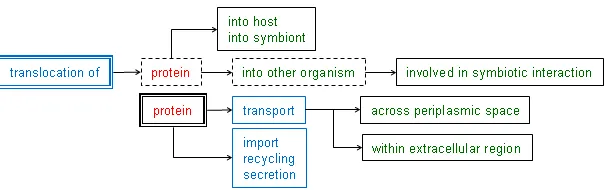
In many cases ontological terms can be seen as phrases that exhibit underlying compositional structures (McCray et al., 2002; Ogren et al., 2005). Figure 1 presents the compositional structures of 9 direct subclasses describing var-ious types of protein transport. They pro-vide thattranslocation, import, recycling,
secretionandtransportare the possible pred-icates, evoking the protein transport event. The more complex expressions, e.g. translocation of peptides or proteins into other organism involved in symbiotic interaction (GO:0051808), express par-ticipants involved in the event, i.e. the en-tity (peptides or proteins), destination (into other organism) and condition (involved in symbiotic interaction) of the event.
So far, we, using these classes and relations be-tween them, have partly defined the semantic frame
Protein Transport, decided the participants involved
Figure 1: A concise view of 9 GO terms describing Protein Transport. We use the modified finite state automaton (FSA) representation given in (Ogren et al., 2005). Any path that begins at a start state, represented by double solid borders, and ends in an end state, represented by a single solid border, corresponds to a term. The nodes with a dashed border are neither start states nor end states.
provided by ontologies, such as GO biological pro-cess ontology and molecular function ontology, and pathway ontologies, can instruct us in building large frame-based corpora for the domain.
We outline the aspects of how ontologies instruct building a frame-based corpus:
1. The structure and semantics of domain knowl-edge in ontologies constrain the frame tics analysis, i.e. decide the coverage of seman-tic frames and the relations between them;
2. Ontological terms can comprehensively de-scribe the characteristics of events/scenarios in the domain, so domain-specific semantic roles can be determined based on terms;
3. Ontological terms provide a list of domain-specific predicates, so the semantic senses of the predicates in the domain are determined;
4. The collection and selection of example sen-tences can be based on knowledge-based search engine for biomedical text.
3 Related Work
The PropBank project is to add a semantic layer on the Penn Treebank (Marcus et al., 1994). For each unique verb sense, a set of semantic roles is de-fined at its accompanying syntactic realizations. The VerbNet project (Kipper et al., 2000) systematically creates English verb entries in a lexicon with syntac-tic and semansyntac-tic information, referring to Levin verb classes. It made efforts to classify individual verbs in PropBank into VerbNet classes, based on patterns of usage (Kingsbury and Kipper, 2003).
The FrameNet project collects and analyzes the corpus (the British National Corpus) attestations of target words with semantic overlapping. The atttations are divided into semantic groups, noting es-pecially the semantic roles of each target words, and then these small groups are combined into frames.
Ontologies have been put under the spotlight for providing the framework for semantic representa-tion of textual informarepresenta-tion, and thus a basis for text mining systems (Spasic et al., 2005; Ashburner et al., 2008). Up to recently, TM systems mainly use ontologies as terminologies to recognize biomedical terms, by mapping terms occurring in text to con-cepts in ontologies, or use ontologies to guide and constrain analysis of NLP results, by populating on-tologies. In the latter case, ontologies are more ac-tively used as a structured and semantic representa-tion of domain knowledge.
The FrameNet project links Semantic Types (ST) of FrameNet to the Suggested Upper Merged Ontol-ogy (SUMO) classes (Scheffczyk et al., 2006). The main function of ST is to indicate the basic typing of fillers of semantic roles, e.g. ”Sentient” defined for the semantic role ”Cognizer” in the frame ”Cog-itation”. The goal of the work is to combine frame semantics in FrameNet and the formal world knowl-edge from SUMO, for improving FrameNet capabil-ity for deductive reasoning.
BioFrameNet is a domain-specific FrameNet ex-tension. Its intracellular protein transport frames are mapped to the Hunter Lab 1 knowledge base (HLKB) protein transport classes. The frame ele-ments are taken from HLKB slots. BioFrameNet
1
considered a collection of Gene References in Func-tion (GRIF) texts that are annotated by the HLKB protein transport classes in the knowledge base. Predicates are extracted from this collection of GRIF texts.
PASBio and BioProp are the projects that aim to produce definitions of Predicate Argument Structure (PAS) frames. They do not offer a direct linking of the predicates or their arguments to domain or general ontologies. PASBio used a model for a hy-pothetical signal transduction pathway of an ideal-ized cell, to motivate verb choices. BioProp anno-tated the arguments of 30 frequent biomedical verbs found in the GENIA corpus (Kim et al., 2003).
4 Case Study: Protein Transport Frame
In this section we present the frame Protein
Trans-port. The frame is built completely based on the
do-main knowledge provided by the piece of GO de-scribing the event. The core structure of the frame is the same as that of FrameNet. The description of the scenario evoked by the frame is provided, along with a list of the frame elements and their definitions. A list of lexical units (LUs) that evoke the frame is pro-vided. In addition, example sentences that contain at least one of the LUs, are given annotations us-ing definitions of the frame. The annotations follow FrameNet’s guidelines for lexicographic annotation, described in (Ruppenhofer et al., 2005).
4.1 The Frame
Resources. The description of the frame uses the
scenario defined in GO:0015031 protein transport
from the GO biological process ontology. It is a sub-class ofGO:0006810 transportandGO:0045184 es-tablishment of protein localization. The class has 177 descendant classes. A total of 581 class names and synonyms are collected for the study. In addition to that from GO concepts, synonyms are also gathered by querying the UMLS Metathesaurus (Schuyler et al., 1992).
Frame. The definition (see Table 1) follows the
definition ofGO:0015031 protein transport.
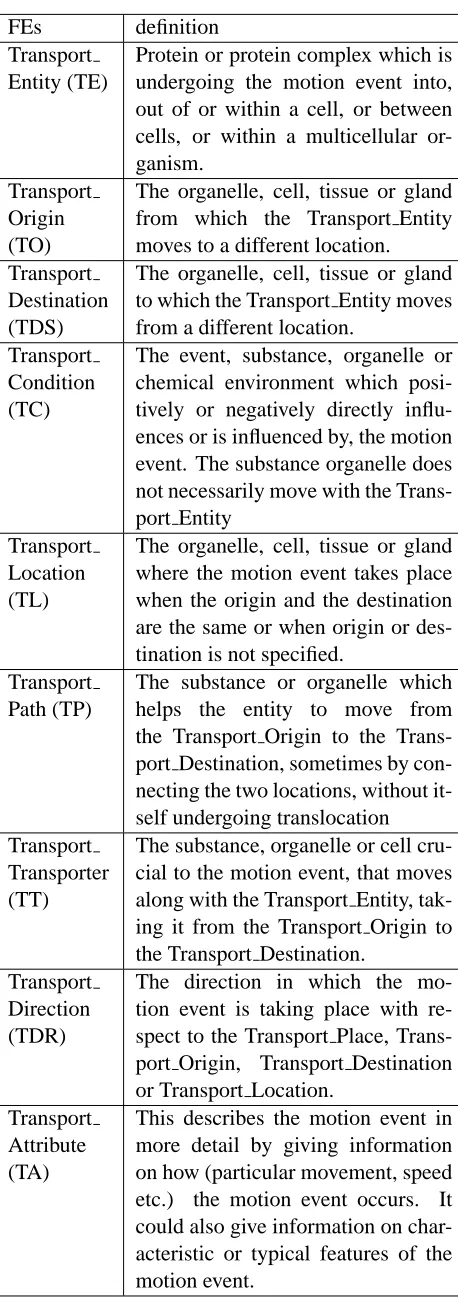
Frame Elements. By studying all the names and
synonyms (we call them ”term” in the paper), we defined all possible FEs for the frame (see Table 2). The first 4 FEs are considered as core FEs.
Ta-”This frame deals with the cellular process in which a protein or protein-complex, the
Trans-port Entity, moves from the TransTrans-port Origin to
a different location, the Transport Destination. Sometimes the Transport Origin and
Trans-port Destination are not specified or are the same
location. The Transport Entity undergoes di-rected movement into, out of or within a cell or between cells or within a multicellular organism. This activity could be aided or impeded by other substances, organelles or processes and could in-fluence other cellular processes.”
Table 1: The frame definition.
ble 3 gives the number of the GO terms that indi-cate the FEs. For instance, in the termGO:003295 B cell receptor transport within lipid bilayer,lipid bilayer is the location within which protein transport happens. The term GO:0072322 protein transport across periplasmic space describes the path along which protein transport occurs. The termGO:0043953 protein transport by the Tat com-plex specifies a molecule that carries protein dur-ing the movement. GO:0030970 retrograde pro-tein transport, ER to cytosol indicates the direc-tion (retrograde) of the movement. An attribute (SRP-independent) of the event is described in the term GO:0006620 SRP-independent protein-membrane targeting ER.
Predicates. All lexical units in the frame are
listed in Table 4. The first row gives the head of the GO terms (noun phrases). The number in the bracket indicates the number of GO terms with the head. If the verb derived from a head, can be used to describe the event that is expressed by the head, it is also included as a LU. GO terms, such as
re-lated and broader synonyms, may be not
consid-ered for collecting predicates. For example,fat body metabolism, a broad synonym ofGO:0015032 stor-age protein import into fat body, is not considered.
Example Sentences. The example sentences are
FEs definition Transport
Entity (TE)
Protein or protein complex which is undergoing the motion event into, out of or within a cell, or between cells, or within a multicellular or-ganism.
Transport Origin (TO)
The organelle, cell, tissue or gland from which the Transport Entity moves to a different location. Transport
Destination (TDS)
The organelle, cell, tissue or gland to which the Transport Entity moves from a different location.
Transport Condition (TC)
The event, substance, organelle or chemical environment which posi-tively or negaposi-tively directly influ-ences or is influenced by, the motion event. The substance organelle does not necessarily move with the Trans-port Entity
Transport Location (TL)
The organelle, cell, tissue or gland where the motion event takes place when the origin and the destination are the same or when origin or des-tination is not specified.
Transport Path (TP)
The substance or organelle which helps the entity to move from the Transport Origin to the Trans-port Destination, sometimes by con-necting the two locations, without it-self undergoing translocation Transport
Transporter (TT)
The substance, organelle or cell cru-cial to the motion event, that moves along with the Transport Entity, tak-ing it from the Transport Origin to the Transport Destination.
Transport Direction (TDR)
The direction in which the mo-tion event is taking place with re-spect to the Transport Place, Trans-port Origin, TransTrans-port Destination or Transport Location.
Transport Attribute (TA)
This describes the motion event in more detail by giving information on how (particular movement, speed etc.) the motion event occurs. It could also give information on char-acteristic or typical features of the motion event.
#T 578 50 159 95 41 27 6 2 1 FEs TE TO TDS TC TL TP TT TDR TA
Table 3: The number of the GO terms that describe the frame elements
the head of GO terms
delivery (1), egress (2), establishment of ... localization (19), exit (2), export (20), import (88), recycling (2), release (1), secretion (226), sorting (4), target-ing (68), trafficktarget-ing (1), translocation (76), transport (100), uptake (5)
LUs delivery.n, deliver.v, egress.n, estab-lishment of ... localization.n, exit.n, exit.v, export.n, export.v, import.n, im-port.v, recycling.n recycle.v, release.n, release.v, secretion.n, secrete.v, sort.v, sorting.n, target.v, targeting.n, translo-cation.n, translocate.v, transport.v, transport.n, trafficking.n, uptake.n
Table 4: The lexical units
[L.pneumophilaT ransport Origin|NP.Ext] [trans
-locatepredicate] [more than 100 effector
proteinsT ransport Entity|NP.Obj] [into host
cytoplasmT ransport Destination|PP[into].Dep]
[us-ing Dot/Icm T4BSST ransport P ath|VPing.Dep],
[modulating host cellular functionsT ransport
Condition|VPing.Dep] to establish a replicative
niche within host cells. (PMID: 20949065)
[image:5.612.74.303.49.703.2]LUs derived from one head, we acquired sentences by using the GO terms with the head. The query starts from using the most general GO terms. In the case that the number of query results is huge, more specific terms are used instead. Minimally, 10 sen-tences are gathered for each LU, if applicable. In cases when only specific GO terms are available and the number of query results is too small, we gener-alize the query term. For example, the lexical units,
release.nandrelease.v, are derived and only derived fromGO:0002001 renin secretion into blood stream’s synonymrenin release into blood stream. No query result returns for the GO term. The gen-eral term ”protein release” is used as the query term instead.
Table 5 shows an example sentence for the frame. For each sentence annotated, we mark the target LU, and collect and record syntactic and semantic infor-mation about the relevant frame’s FEs. For each FE, three types of annotation are gathered. The first layer is the identity of the specific FE. In cases when the FE is explicitly realized, phrase type (PT, for ex-ample NP) and grammatical function (GF) of the re-alization are annotated. The GFs describe the ways in which the constituents satisfy abstract grammati-cal requirements of the target word. In cases when the FE is omitted, the type of its null instantiation is recorded. These three layers for all of the annotated sentences, along with complete frame and FE de-scriptions are used in summarizing valence patterns for each annotated LU.
4.2 Evaluation
4.2.1 Compared to BioFrameNet
We compared this frame to the frame
Pro-tein transport in BioFrameNet 2. The frame in-volves the phenomenon of intracellular protein transport. BioFrameNet considered a collection of GRIF texts that describe various types of intracellu-lar protein transport phenomena. The GRIFs texts are annotated by HLKB protein transport classes. All the 5 HLKB protein transport classes are ar-ranged in is-a hierarchy. The description of the top level class protein transport is taken from the defini-tion ofGO:0015031 protein transportwhich is a
su-2
http://dolbey.us/BioFN/BioFN.zip (28-Mar-2009)
perclass ofGO:0006886 intracellular protein trans-port in GO. For the frame, BioFrameNet provides definitions for 4 FEs, including Transported entity,
Transport origin, Transport destination and Trans-port locations. The proposed FEs are taken from
the slot definitions in the HLKB classes.
Table 6 illustrates the difference between the LUs in the 2 frames. The LUs that are not included in our corpus, can be classified into two groups. The first group include the LUs
enter.v, redistribution.n, return.v, and
traffic.n. They or their nominals are absent from GO biological process ontology terms. The second group includes those appear in GO, but in the terms that are not included in descendants ofGO:0015031 protein transport.
The LUs, endocytosis.n, internaliza
-tion.n, recruitment.n, do not appear in the descendants of GO:0015031 protein transport, but appear in GO terms that indeed describe protein transport event. endocytosis is the head of 9 GO terms, among which 2 concepts indeed describe an endocytotic process of protein (e.g.GO:0070086 ubiquitin-dependent endocytosis). 3 GO terms have
internalization as the head. They all de-scribe protein transport event (e.g. GO:0031623 re-ceptor internalization). recruitment.noccurs in
GO:0046799 recruitment of helicase-primase com-plex to DNA lesions and GO:0046799 recruitment of 3’-end processing factors to RNA polymerase II holoenzyme complex, which describe the movement of protein complex to another macro molecule.
The LUs, efflux.n, entry.n, exo
-cytosis.n, migrate.n, mobilization.n,
move.v, movement.n, shuttle.n and
shuttling.v, appear in GO terms that are descendants of GO:0006810 transport. They are used to describe various kinds of transport events that protein is not involved in.
shift.n only occurs in GO:0003049 regula-tion of systemic arterial blood pressure by capillary fluid shift. capillary fluid shift describes a kind of transport event. relocation.n and
relocate.v only appear in GO:0009902 chloro-plast relocationwhich is considered as a kind of or-ganelle organization.
Example Sentences. The number of example
re-LUs only in Bio- Frame-Net
efflux.n, endocytosis.n, enter.v, en-try.n, exocytosis.n, internalization.n, migrate.v, mobilization.n, move.v, movement.n, recruitment.n, redistribu-tion.n, relocate.v, relocaredistribu-tion.n, return.v, shift.n, shuttle.v, shuttling.n, traffic.n LUs in
both corpus
delivery.n, exit.v, export.n, import.n, recycle.v, recycling.n, release.n, tar-geting.n, trafficking.n, translocate.v, translocation.n, transport.n, transport.v LUs
only in our corpus
[image:7.612.313.541.411.623.2]deliver.v, egress.n, establishment of ... localization.n, exit.n, export.v, import.v, release.v, secretion.n, secrete.v, sort.v, sorting.n, target.v, uptake.n
Table 6: The comparison of LUs in the 2 frames
lies on the existing collection of GRIFs in HLKB. The number of annotated sentences for each LU ranges from 1 to over 200. 207 GRIFs use the LU translocation.n, and 10 GRIFs use
transport.v.
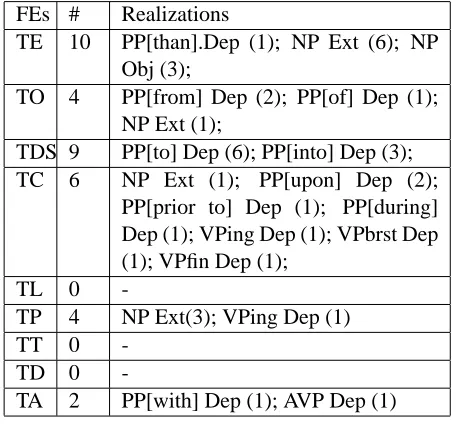
In our corpus, minimally for each LU 10 an-notated sentences are gathered, if applicable. Ta-bles 7 and 8 show the realizations of the FEs for the LUstranslocation.nandtranslocate.v. The second columns give the number of times that the FE is realized in the 10 sentences. The PT and GF layers and the number of times they occur are given in the last columns, in the format of PT GF (number of occurrences). There are differences be-tween the valence patterns of two corpus. We no-tice that example sentences in BioFrameNet mainly describe about protein. Although protein transport is described, different topics may be covered in the sentences in our corpus.
4.2.2 Predicates in FrameNet and
PropBank/VerbNet
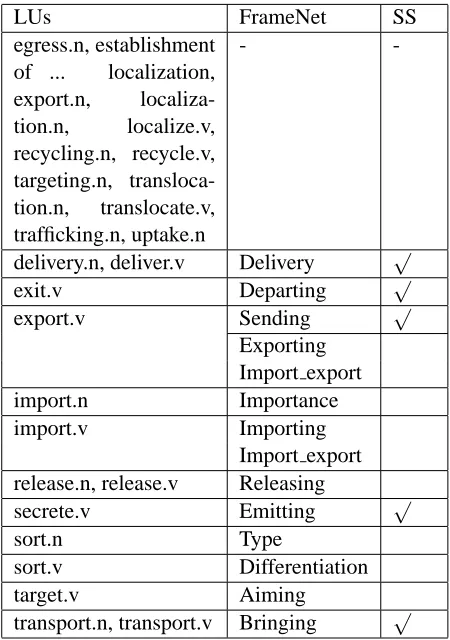
We examined the gaps between the semantic clas-sification of the LUs (or only verbs) in the frame, and in FrameNet and PropBank/VerbNet. Around half of the LUs from the frame are absent from FrameNet data. 5 LUs are used in describing protein transport event, with the same semantic sense as in FrameNet. We identified the FEs for Protein
Trans-port frame based on the domain knowledge. The
FEs # Realizations
TE 10 PP[of] Dep (6); NP Dep (3); Poss Gen (1);
TO 1 PP[from] Dep (1);
TDS 7 A Dep (2); PP[into] Dep (2); PP[to] Dep (3);
TC 6 NP Ext (5); NP dep (1); TL 2 PP[in] Dep (1); A Dep (1); TP 1 PP[across] Dep (1); TT 0
-TD 0
-TA 1 AJP Dep (1);
Table 7: FE realizations for annotations with
translocation.n
FEs # Realizations
TE 10 PP[than].Dep (1); NP Ext (6); NP Obj (3);
TO 4 PP[from] Dep (2); PP[of] Dep (1); NP Ext (1);
TDS 9 PP[to] Dep (6); PP[into] Dep (3); TC 6 NP Ext (1); PP[upon] Dep (2);
PP[prior to] Dep (1); PP[during] Dep (1); VPing Dep (1); VPbrst Dep (1); VPfin Dep (1);
TL 0
-TP 4 NP Ext(3); VPing Dep (1) TT 0
-TD 0
-TA 2 PP[with] Dep (1); AVP Dep (1)
Table 8: FE realizations for annotations with
LUs FrameNet SS egress.n, establishment
of ... localization, export.n, localiza-tion.n, localize.v, recycling.n, recycle.v, targeting.n, transloca-tion.n, translocate.v, trafficking.n, uptake.n
-
-delivery.n, deliver.v Delivery √
exit.v Departing √
export.v Sending √
Exporting Import export import.n Importance import.v Importing
Import export release.n, release.v Releasing
secrete.v Emitting √
sort.n Type
sort.v Differentiation
target.v Aiming
[image:8.612.73.298.53.373.2]transport.n, transport.v Bringing √
Table 9: Predicates in FrameNet: If the predicate is used with the same semantic sense as in the FrameNet’s frame, ”semantic sense (SS)” is checked.
number of FEs and their definitions are very differ-ent from FrameNet data. Other LUs are used with different semantic senses.
Except translocate, all verbs are included in PropBank data. Half of the verb senses have been classified into VerbNet classes. Only 3 verbs are used with the same sense as in describing protein transport event.
5 Conclusion
In this paper we propose a method for building frame-based corpus for the domain of biomedicine. The corpus construction relies on domain knowl-edge provided by ontologies. We believe that onto-logical domain knowledge can instruct us and ease the tasks in building the corpora. We built a cor-pus for transport event completely on basis of the piece of domain knowledge provided by GO
bio-verbs VerbNet PropBank
translocate -
-deliver, transport
send-11.1 with the same semantic sense secrete
-exit escape-51.1 with different release free-80.1 semantic sense sort classify-29.10
target confront-98 export,
import, localize, recycle
-Table 10: Verbs in PropBank/VerbNet
logical process ontology3. We compared the frame
Protein Transport to the frame Protein transport in
BioFrameNet, and examined the gaps between the semantic classification of the target words in the domain-specific corpus and in FrameNet and Prop-Bank/VerbNet.
In the future, we aim to extend the corpus to cover other biological events. GO ontologies will be the main resource to provide domain knowledge, but also other ontologies, such as pathway ontologies will be considered as important domain knowledge resources. The identification of frames and the rela-tions between frames are needed to be investigated. In addition, we will study the definition of STs in the domain corpus and their mappings to classes in top domain ontologies, such as BioTop (Beißwanger et al., 2008).
Acknowledgement
We acknowledge the financial support of the Center for Industrial Information Technology (CENIIT) and the foundation Stiftelsen Olle Engkvist Byggm¨astare.
References
Michael Ashburner, Catherine A. Ball, Judith A. Blake, David Botstein, Heather Butler, J. Michael Cherry, Al-lan P. Davis, Kara Dolinski, Selina S. Dwight, Janan
3
[image:8.612.312.540.53.233.2]T. Eppig, Midori A. Harris, David P. Hill, Laurie Issel-Tarver, Andrew Kasarskis, Suzanna Lewis, John C. Matese, Joel E. Richardson, Martin Ringwald, Gerald M. Rubin and Gavin Sherlock. 2000. Gene Ontology: tool for the unification of biology. Nature Genetics, 25:25-29.
Michael Ashburner, Ulf Leser and Dietrich Rebholz-Schuhmann (Eds.). 2008. Ontologies and Text Mining
for Life Sciences: Current Status and Future Perspec-tives. 24.03-28.03, Dagstuhl Seminar Proceedings.
Steven Bethard, Zhiyong Lu, James H Martin and Lawrence Hunter. 2008. Semantic Role Labeling for Protein Transport Predicates. BMC Bioinformatics,
9:277.
Elena Beißwanger, Stefan Schulz, Holger Stenzhorn and Udo Hahn. 2008. BioTop: An upper domain ontol-ogy for the life sciences: A description of its current structure, contents and interfaces to OBO ontologies.
Applied Ontology, 3(4):205-212.
Adress Doms and Michael Schroeder. 2005. GoP-ubMed: exploring PubMed with the Gene Ontology.
Nucleic Acids Research, 33:W783-786.
Andrew Dolbey, Michael Ellsworth and Jan Scheffczyk. 2006. BioFrameNet: A Domain-Specific FrameNet Extension with Links to Biomedical Ontologies. The
proceedings of KR-MED, 87-94.
Charles J. Fillmore. 1985. Frames and the semantics of understanding. Quaderni di Semantica, 6(2).
Charles J. Fillmore, Charles Wooters and Collin F. Baker. 2001. Building a Large Lexical Databank Which Pro-vides Deep Semantics. The Pacific Asian Conference
on Language, Information and Computation.
Halil Kilicoglu, Marcelo Fiszman, Graciela Rosemblat, Sean Marimpietri and Thomas C. Rindflesch. 2010. Arguments of nominals in semantic interpretation of biomedical text. Proceedings of the 2010 Work-shop on Biomedical Natural Language Processing (BioNLP’10).
Jin-Dong Kim, Tomoko Ohta, Yuka Teteisi and Jun’ichi Tsujii. 2003. GENIA corpus - a semantically an-notated corpus for bio-textmining. Bioinformatics.
19(suppl. 1):180-182.
Paul Kingsbury and Karin Kipper. Deriving Verb-Meaning Clusters from Syntactic Structure. Work-shop on Text Meaning, held in conjunction with HLT/NAACL 2003.
Karin Kipper, Hoa Trang Dang and Martha Palmer. 2000. Class-Based Construction of a Verb Lexicon.
AAAI-2000 Seventeenth National Conference on Artificial Intelligence.
Mitchell Marcus, Grace Kim, Mary Ann Marcinkiewicz, Robert MacIntyre, Ann Bies, Mark Ferguson, Karen
Katz and Britta Schasberger. 1994. The Penn Tree-bank: annotating predicate argument structure. In
Pro-ceedings of the workshop on Human Language Tech-nology (HLT ’94).
Alexa T. McCray, Allen C. Browne and Olivier Boden-reider. 2002. The Lexical Properties of the Gene On-tology (GO). Proceedings of AMIA Symposium , 504-508.
Llu´ıs M`arquez, Xavier Carreras, Kenneth C. Litkowski and Suzanne Stevenson. 2008. Semantic role label-ing: an introduction to the special issue.
Computa-tional Linguistics, 34(2).
Philip V. Ogren, K. Bretonnel Cohen and Lawrence Hunter. 2005. Implications of compositionality in the gene ontology for its curation and usage. Pacific
Sym-posium on Biocomputing, 10:174-185.
Martha Palmer, Daniel Gildea and Paul Kingsbury. 2005. The Proposition Bank: an annotated corpus of seman-tic roles. Computational Linguisseman-tics, 31:71-105. Josef Ruppenhofer, Michael Ellsworth, Miriam R. L.
Petruck, Christopher R. Johnson and Jan Scheffczyk. 2005. ICSI. FrameNet II: Extended Theory and Prac-tice.
Irena Spasic, Sophia Ananiadou, John McNaught and Anand Kumar. 2005. Text mining and ontologies in biomedicine: making sense of raw text. Briefings in
Bioinformatics, 6(3):239-251.
Jan Scheffczyk, Adam Pease and Michael Ellsworth. 2006. Linking FrameNet to the SUMO Ontology.
In-ternational Conference on Formal Ontology in Infor-mation Systems (FOIS 2006).
Peri L. Schuyler, William T. Hole, Mark S. Tuttle and David D. Sherertz. 1992. The UMLS Metathe-saurus: representing different views of biomedical concepts. Bulletin of the Medical Library Association, 81(2):217-22.
He Tan. 2010. A study on the relation between linguistics-oriented and domain-specific semantics.
Proceedings of the 3rd International Workshop on Se-mantic Web Applications and Tools for the Life Sci-ences.
Richard Tzong-Han Tsai, Wen-Chi Chou, Ying-Shan Su, Yu-Chun Lin, Cheng-Lung Sung, Hong-Jie Dai, Irene Tzu-Hsuan Yeh, Wei Ku, Ting-Yi Sung and Wen-Lian Hsu. 2006. BIOSMILE: adapting semantic role label-ing for biomedical verbs: an exponential model cou-pled with automatically generated template features.
Proceedings of the 2005 Workshop on Biomedical Nat-ural Language Processing (BioNLP’06).
Tuangthong Wattarujeekrit, Parantu K Shah and Nigel Collier. 2004. PASBio: predicate-argument structures for event extraction in molecular biology. BMC