Probabilistic Type Theory for Incremental Dialogue Processing
Julian Hough and Matthew Purver
Cognitive Science Research Group
School of Electronic Engineering and Computer Science Queen Mary University of London
{j.hough,m.purver}@qmul.ac.uk
Abstract
We present an adaptation of recent work on probabilistic Type Theory with Records (Cooper et al., 2014) for the purposes of modelling the incremental semantic pro-cessing of dialogue participants. After presenting the formalism and dialogue framework, we show how probabilistic TTR type judgements can be integrated into the inference system of an incremen-tal dialogue system, and discuss how this could be used to guide parsing and dia-logue management decisions.
1 Introduction
While classical type theory has been the predomi-nant mathematical framework in natural language semantics for many years (Montague, 1974, in-ter alia), it is only recently that probabilistic type theory has been discussed for this purpose. Sim-ilarly, type-theoretic representations have been used within dialogue models (Ginzburg, 2012); and probabilistic modelling is common in dia-logue systems (Williams and Young, 2007, inter alia), but combinations of the two remain scarce. Here, we attempt to make this connection, taking (Cooper et al., 2014)’s probabilistic Type Theory with Records (TTR) as our principal point of de-parture, with the aim of modelling incremental in-ference in dialogue.
To our knowledge there has been no practi-cal integration of probabilistic type-theoretic in-ference into a dialogue system so far; here we dis-cuss computationally efficient methods for imple-mentation in an extant incremental dialogue sys-tem. This paper demonstrates their efficacy in sim-ple referential communication domains, but we ar-gue the methods could be extended to larger do-mains and additionally used for on-line learning in future work.
2 Previous Work
Type Theory with Records (TTR) (Betarte and Tasistro, 1998; Cooper, 2005) is a rich type the-ory which has become widely used in dialogue models, including information state models for a variety of phenomena such as clarification re-quests (Ginzburg, 2012; Cooper, 2012) and non-sentential fragments (Fern´andez, 2006). It has also been shown to be useful for incremental semantic parsing (Purver et al., 2011), incremental genera-tion (Hough and Purver, 2012), and recently for grammar induction (Eshghi et al., 2013).
While the technical details will be given in sec-tion 3, the central judgement in type theorys ∶ T (that a given object s is of type T) is extended in TTR so that s can be a (potentially complex)
record and T can be a record type – e.g. scould represent a dialogue gameboard state andT could be a dialogue gameboard state type (Ginzburg, 2012; Cooper, 2012). As TTR is highly flexible with a rich type system, variants have been con-sidered with types corresponding to real-number-valued perceptual judgements used in conjunction with linguistic context, such as visual perceptual information (Larsson, 2011; Dobnik et al., 2012), demonstrating its potential for embodied learning systems. The possibility of integration of per-ceptron learning (Larsson, 2011) and naive Bayes classifiers (Cooper et al., 2014) into TTR show how linguistic processing and probabilistic con-ceptual inference can be treated in a uniform way within the same representation system.
Probabilistic TTR as described by Cooper et al. (2014) replaces the categorical s ∶ T judgement with the real number valued p(s ∶ T) = vwhere
v ∈[0,1]. The authors show how standard proba-bility theoretic and Bayesian equations can be ap-plied to TTR judgements and how an agent might learn from experience in a simple classification game. The agent is presented with instances of
a situation and it learns with each round by updat-ing its set of probabilistic type judgements to best predict the type of object in focus — in this case updating the probability judgement that something is an apple given its observed colour and shape
p(s ∶ Tapple ∣ s ∶ TShp, s ∶ TCol) where Shp ∈
{shp1, shp2} and Col ∈ {col1, col2}. From a cognitive modelling perspective, these judgements can be viewed as probabilistic perceptual informa-tion derived from learning. We use similar meth-ods in our toy domain, but show how prior judge-ments could be constructed efficiently, and how classifications can be made without exhaustive it-eration through individual type classifiers.
There has also been significant experimental work on simple referential communication games in psycholinguistics, computational and formal modelling. In terms of production and genera-tion, Levelt (1989) discusses speaker strategies for generating referring expressions in a simple object naming game. He showed how speakers use informationally redundant features of the ob-jects, violating Grice’s Maxim of Quantity. In natural language generation (NLG), referring ex-pression generation (REG) has been widely stud-ied (see (Krahmer and Van Deemter, 2012) for a comprehensive survey). The incremental algo-rithm (IA) (Dale and Reiter, 1995) is an iterative feature selection procedure for descriptions of ob-jects based on computing the distractor set of ref-erents that each adjective in a referring expression could cause to be inferred. More recently Frank and Goodman (2012) present a Bayesian model of optimising referring expressions based on sur-prisal, the information-theoretic measure of how much descriptions reduce uncertainty about their intended referent, a measure which they claim cor-relates strongly to human judgements.
The element of the referring expression do-main we discuss here is incremental processing. There is evidence from (Brennan and Schober, 2001)’s experiments that people reason at an in-credibly time-critical level from linguistic infor-mation. They demonstrated self-repair can speed up semantic processing (or at least object refer-ence) in such games, where an incorrect object being partly vocalized and then repaired in the instructions (e.g. “the yell-, uh, purple square”) yields quicker response times from the onset of the target (“purple”) than in the case of the flu-ent instructions (“the purple square”). This
exam-ple will be addressed in section 5. First we will set out the framework in which we want to model such processing.
3 Probabilistic TTR in an incremental
dialogue framework
In TTR (Cooper, 2005; Cooper, 2012), the princi-pal logical form of interest is the record type (‘RT’ from here), consisting of sequences of fields of the form [l ∶ T] containing a label l and a type T.1 RTs can be witnessed (i.e. judged as inhabited) by records of that type, where a record is a set of label-value pairs[l = v]. The central type judge-ment in TTR that a record s is of (record) type
R, i.e. s ∶ R, can be made from the component type judgements of individual fields; e.g. the one-field record[l = v]is of type[l ∶ T]just in case
vis of typeT. This is generalisable to records and RTs with multiple fields: a recordsis of RTR if
sincludes fields with labels matching those occur-ring in the fields ofR, such that all fields inRare matched, and all matched fields in smust have a value belonging to the type of the corresponding field inR. Thus it is possible forsto have more fields than R and for s ∶ R to still hold, but not vice-versa: s∶Rcannot hold ifRhas more fields thans.
R1 ∶⎡⎢⎢⎢⎢⎢⎢⎢
⎢⎣
l1 ∶ T1
l2 ∶ T2
l3 ∶ T3(l1)
⎤⎥⎥⎥ ⎥⎥⎥⎥
⎥⎦ R2 ∶[
l1 ∶ T1
l2 ∶ T2′ ] R3 ∶[]
Figure 1: Example TTR record types
Fields can have values representing predicate types (ptypes), such asT3 in Figure 1, and conse-quently fields can be dependent on fields preced-ing them (i.e. higher) in the RT, e.g.l1is bound in the predicate type fieldl3, sol3 depends onl1.
Subtypes, meets and joins A relation between RTs we wish to explore is ⊑ (‘is a subtype of’), which can be defined for RTs in terms of fields as simply: R1 ⊑ R2 if for all fields[l ∶ T2]inR2,
R1contains[l ∶ T1]whereT1 ⊑T2. In Figure 1, both R1 ⊑ R3 and R2 ⊑ R3; and R1 ⊑ R2 iff
T2 ⊑ T2′. The transitive nature of this relation (if
R1⊑R2andR2 ⊑R3 thenR1 ⊑R3) can be used effectively for type-theoretic inference.
1
We also assume the existence of manifest (sin-gleton) types, e.g. Ta, the type of which only ais a member. Here, we write manifest RT fields such as[l ∶ Ta]whereTa⊑T using the syntactic sugar
[l=a ∶ T]. The subtype relation effectively allows
progressive instantiation of fields (as addition of fields to R leads toR′ where R′ ⊑ R), which is practically useful for an incremental dialogue sys-tem as we will explain.
We can also define meet and join types of two or more RTs. The representation of the meet type of two RTs R1 and R2 is the result of a merge operation (Larsson, 2010), which in simple terms here can be seen as union of fields. A meet type is also equivalent to the extraction of a maxi-mal common subtype, an operation we will call
MaxSub(Ri..Rn):2
ifR1=[ l1 ∶ T1
l2 ∶ T2 ]andR2=[
l2 ∶ T2
l3 ∶ T3 ]
R1∧R2=⎡⎢⎢⎢
⎢⎢⎢⎢ ⎣
l1 ∶ T1
l2 ∶ T2
l3 ∶ T3
⎤⎥⎥⎥ ⎥⎥⎥⎥ ⎦
=MaxSub(R1, R2)
R1 and R2 here are common supertypes of the resultingR1∧R2. On the other hand, the join of two RTsR1 and R2, the type R1∨R2 cannot be represented by field intersection. It is defined in terms of type checking, in that s ∶ R1 ∨ R2 iff
s ∶ R1 ors∶ R2. It follows that ifR1 ⊑ R2 then
s∶R1∧R2iffs∶R1, ands∶R1∨R2iffs∶R2. While technically the maximally common su-pertype of R1 and R2 is the join type R1 ∨R2, here we introduce the maximally common simple (non disjunctive) supertype of two RTsR1andR2 as field intersection:
ifR1=[ l1 ∶ T1
l2 ∶ T2 ]andR2=[
l2 ∶ T2
l3 ∶ T3 ]
MaxSuper(R1, R2)=[ l2 ∶ T2 ]
We will explore the usefulness of this new op-eration in terms of RT lattices in sec. 4.
3.1 Probabilistic TTR
We follow Cooper et al. (2014)’s recent extension of TTR to include probabilistic type judgements of the formp(s∶R)=vwherev∈[0,1], i.e. the real valued judgement that a recordsis of RTR. Here
2
Here we concern ourselves with simple examples that avoid label-type clashes between two RTs (i.e. whereR1 con-tainsl1∶T1andR2containsl1∶T2); in these cases the op-erations are more complex than field concatenation/sharing.
we use probabilistic TTR to model a common psy-cholinguistic experimental set up in section 5. We repeat some of Cooper et al.’s calculations here for exposition, but demonstrate efficient graphical methods for generating and incrementally retriev-ing probabilities in section 4.
Cooper et al. (2014) define the probability of the meet and join types of two RTs as follows:
p(s∶R1∧R2)=p(s∶R1)p(s∶R2∣s∶R1)
p(s∶R1∨R2)=p(s∶R1)+p(s∶R2)−p(s∶R1∧R2)
(1)
It is practically useful, as we will describe be-low, that the join probability can be computed in terms of the meet. Also, there are equivalences be-tween meets, joins and subtypes in terms of type judgements as described above, in that assuming ifR1⊑R2thenp(s∶R2∣s∶R1)=1, we have:
ifR1⊑R2
p(s∶R1∧R2)=p(s∶R1)
p(s∶R1∨R2)=p(s∶R2)
p(s∶R1)≤p(s∶R2)
(2)
The conditional probability of a record being of typeR2given it is of typeR1 is:
p(s∶R2∣s∶R1)=p(s
∶R1∧s∶R2)
p(s∶R1) (3)
We return to an explanation for these classical probability equations holding within probabilistic TTR in section 4.
Learning and storing probabilistic judgements When dealing with referring expression games, or indeed any language game, we need a way of stor-ing perceptual experience. In probabilistic TTR this can be achieved by positing a judgement setJ in which an agent stores probabilistic type judge-ments.3 We refer to the sum of the value of proba-bilistic judgements that a situation has been judged to be of typeRiwithinJ as∥Ri∥J and the sum of all probabilistic judgements inJ simply asP(J); thus the prior probability that anything is of type
Ri under the set of judgements J is ∥RP(J)i∥J. The
conditional probability p(s ∶ R1 ∣ s ∶ R2) un-der J can be reformulated in terms of these sets of judgements:
pJ(s∶R1∣s∶R2)={
∥R1∧R2∥J
∥R2∥J iff ∥R2∥J≠0
0 otherwise (4)
3
where the sample spaces∥R1∧R2∥J and∥R2∥J constitute the observations of the agent so far. J can have new judgements added to it during learn-ing. We return to this after introducing the incre-mental semantics needed to interface therewith.
3.2 DS-TTR and the DyLan dialogue system
In order to permit type-theoretic inference in a dialogue system, we need to provide suitable TTR representations for utterances and the cur-rent pragmatic situation from a parser, dialogue manager and generator as instantaneously and ac-curately as possible. For this purpose we use an incremental framework DS-TTR (Eshghi et al., 2013; Purver et al., 2011) which integrates TTR representations with the inherently incre-mental grammar formalism Dynamic Syntax (DS) (Kempson et al., 2001).
♢, T y(t),⎡⎢⎢⎢⎢⎢⎢⎢
⎢⎢⎢ ⎣
x=john ∶ e
e=arrive ∶ es
p=subj(e,x) ∶ t
head=p ∶ t
⎤⎥⎥⎥ ⎥⎥⎥⎥ ⎥⎥⎥ ⎦
T y(e), [ x=john ∶ e
head=x ∶ e ]
T y(e→t),
λr∶[ head ∶ e ].
⎡⎢⎢⎢ ⎢⎢⎢⎢ ⎢⎢⎢ ⎣
x=r.head ∶ e
e=arrive ∶ es
p=subj(e,x) ∶ t
head=p ∶ t
⎤⎥⎥⎥ ⎥⎥⎥⎥ ⎥⎥⎥ ⎦
Figure 2: DS-TTR tree
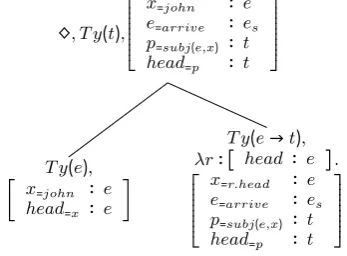
DS produces an incrementally specified, partial logical tree as words are parsed/generated; follow-ing Purver et al. (2011), DS tree nodes are dec-orated not with simple atomic formulae but with RTs, and corresponding lambda abstracts repre-senting functions of type RT → RT (e.g. λr∶
[l1 ∶ T1].[l2=r.l1 ∶ T1] where r.l1 is a path
ex-pression referring to the label l1 inr) – see Fig-ure 2. Using the idea of manifestness of fields as mentioned above, we have a natural represen-tation for underspecification of leaf node content, e.g. [x ∶ e]is unmanifest whereas [x=john ∶ e]
4
is manifest and the latter is a subtype of the for-mer. Functional application can apply incremen-tally, allowing a RT at the root node to be com-piled for any partial tree, which is incrementally further specified as parsing proceeds (Hough and Purver, 2012). Within a given parse path, due to
4
This is syntactic sugar for[x∶ejohn]and the = sign is
not the same semantically as that in a record.
DS-TTR’s monotonicity, each maximal RT of the tree’s root node is a subtype of the parser’s previ-ous maximal output.
Following (Eshghi et al., 2013), DS-TTR tree nodes include a field headin all RTs which cor-responds to the DS tree node type. We also as-sume a neo-Davidsonian representation of predi-cates, with fields corresponding to an event term and to each semantic role; this allows all available semantic information to be specified incrementally in a strict subtyping relation (e.g. providing the
subj()field when subject but not object has been parsed) – see Figure 2.
We implement DS-TTR parsing and genera-tion mechanisms in the DyLandialogue system5 within Jindigo (Skantze and Hjalmarsson, 2010), a Java-based implementation of the incremental unit (IU) framework of (Schlangen and Skantze, 2009). In this framework, each module has input and output IUs which can beadded as edges tween vertices in module buffer graphs, and be-come committed should the appropriate condi-tions be fulfilled, a notion which becomes im-portant in light of hypothesis change and repair situations. Dependency relations between differ-ent graphs within and between modules can be specified by groundedIn links (see (Schlangen and Skantze, 2009) for details).
[image:4.595.105.279.327.455.2]The DyLan interpreter module (Purver et al., 2011) uses Sato (2011)’s insight that the context of DS parsing can be characterized in terms of a Di-rected Acyclic Graph (DAG) with trees for nodes and DS actions for edges. The module’s state is characterized by three linked graphs as shown in Figure 3:
• input: a time-linear word graph posted by the ASR module, consisting of word hypothesis edge IUs between verticesWn
• processing: the internal DS parsing DAG, which adds parse state edge IUs between ver-ticesSngroundedIn the corresponding word
hypothesis edge IU
• output: a concept graph consisting of domain concept IUs (RTs) as edges between vertices
Cn, groundedIn the corresponding path in the DS parsing DAG
Here, our interest is principally in the parser out-put, to support incremental inference; a DS-TTR generator is also included which uses RTs as goal concepts (Hough and Purver, 2012) and uses the
5
same parse graph as the interpreter to allow self-monitoring and compound contributions, but we omit the details here.
Figure 3: Normal incremental parsing in Dylan
4 Order theoretic and graphical methods
for probabilistic TTR
RT lattices to encode domain knowledge To support efficient inference inDyLan, we represent dialogue domain concepts via partially ordered sets (posets) of RT judgements, following similar insights used in inducing DS-TTR actions (Eshghi et al., 2013). A poset has several advantages over an unordered list of un-decomposed record types: the possibility of incremental type-checking; in-creased speed of type-checking, particularly for pairs of/multiple type judgements; immediate use of type judgements to guide system decisions; in-ference from negation; and the inclusion of learn-ing within a domain. We leave the final challenge for future work, but discuss the others here.
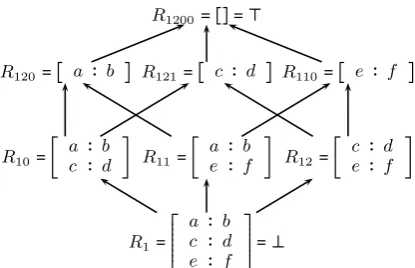
We can construct a poset of type judgements for any single RT by decomposing it into its con-stituent supertype judgements in a record type
tice. Representationally, as per set-theoretic
lat-tices, this can be visualised as a Hasse diagram such as Figure 4, however here the ordering arrows show⊑(‘subtype of’) relations from descendant to ancestor nodes.
To characterize an RT lattice G ordered by ⊑, we adapt Knuth (2005)’s description of lattices in line with standard order theory: for a pair of RT elementsRx andRy, their lower bound is the set of all Rz ∈ Gsuch thatRz ⊑ Rx and Rz ⊑ Ry. In the event that a unique greatest lower bound ex-ists, this is their meet, which inGhappily corre-sponds to the TTR meet typeRx∧Ry. Dually, if their unique least upper bound exists, this is their
R1200=[]=⊤
R120=[ a ∶ b ] R121=[ c ∶ d ] R110=[ e ∶ f ]
R10=[ a ∶ b
c ∶ d ] R11=[
a ∶ b
e ∶ f ] R12=[
c ∶ d
e ∶ f ]
R1 =⎡⎢⎢⎢
⎢⎢⎢⎢ ⎣
a ∶ b
c ∶ d
e ∶ f
⎤⎥⎥⎥ ⎥⎥⎥⎥ ⎦
=⊥
Figure 4: Record Type lattice ordered by the sub-type relation
join and in TTR terms isMaxSuper(Rx, Ry)but not necessarily their join type Rx ∨ Ry as here we concern ourselves with simple RTs. One el-ement covers another if it is a direct successor to it in the subtype ordering relation hierarchy. G has a greatest element (⊤) and least element (⊥), with the atoms being the elements that cover ⊥; in Figure 4 if R1 is viewed as ⊥, the atoms are
R{10,11,12}. An RT element Rx has a
comple-ment if there is a unique elecomple-ment ¬Rx such that
MaxSuper(Rx,¬Rx) = ⊤ and Rx ∧ ¬Rx = ⊥ (the lattice in Figure 4 is complemented as this holds for every element).
Graphically, the join of two elements can be found by following the connecting edges upward until they first converge on a single RT, giving us
MaxSuper(R10, R12)=R121in Figure 4, and the meet can be found by following the lines down-ward until they connect to give their meet type, i.e.R10∧R12=R1.
If we consider R1 to be a domain concept in a dialogue system, we can see how its RT lattice
G can be used for incremental inference. As in-crementally specified RTs become available from the interpreter they are matched to those inG to determine how far down towards the final domain conceptR1 our current state allows us to be. Dif-ferent sequences of words/utterances lead to dif-ferent paths. However, any practical dialogue sys-tem must entertain more than one possible domain concept as an outcome; Gmust therefore contain multiple possible final concepts, constituting its atoms, each with several possible dialogue move sequences, which correspond to possible down-ward paths – e.g. see the structure of Figure 5. Our aim here is to associate each RT inGwith a probabilistic judgement.
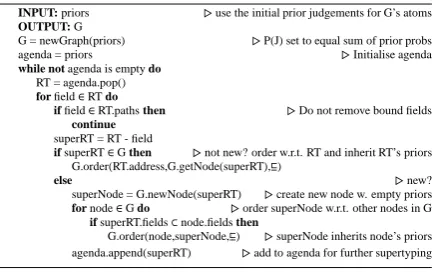
[image:5.595.80.290.111.252.2]lattice G of all possible simple domain RTs and their prior probabilistic judgements, initialised by the disjunction of possible final state judgements (the priors),6 along with the absurdity ⊥, stipu-lated a priori as the least element with probability 0 and the meet type of the atomic priors. The al-gorithm recursively removes one field from the RT being processed at a time (except fields referenced in a remaining dependent ptype field), then orders the new supertype RT inGappropriately.
Each node inG contains its RTRi and a sum of probability judgements{∥Rk∥J +..+∥Rn∥J} corresponding to the probabilities of the priors it stands in a supertype relation to. These sums are propagated up from child to parent node as it is constructed. It terminates when all simple maxi-mal supertypes7 have been processed, leaving the maximally common supertype as⊤(possibly the empty type [ ]), associated with the entire proba-bility massP(J), which constitutes the denomina-tor to all judgements- given this, only the numer-ator of equation ∥RP(J)i∥J needs to be stored at each node.
Algorithm 1 Probabilistic TTR record type lattice construction algorithm
INPUT: priors ▷use the initial prior judgements for G’s atoms
OUTPUT: G
G = newGraph(priors) ▷P(J) set to equal sum of prior probs
agenda = priors ▷Initialise agenda
while not agenda is empty do
RT = agenda.pop()
for field∈RT do
if field∈RT.paths then ▷Do not remove bound fields
continue
superRT = RT - field
if superRT∈G then ▷not new? order w.r.t. RT and inherit RT’s priors G.order(RT.address,G.getNode(superRT),⊑)
else ▷new?
superNode = G.newNode(superRT) ▷create new node w. empty priors
for node∈G do ▷order superNode w.r.t. other nodes in G
if superRT.fields⊂node.fields then
G.order(node,superNode,⊑) ▷superNode inherits node’s priors agenda.append(superRT) ▷add to agenda for further supertyping
Direct inference from the lattice To explain how our approach models incremental inference, we assume Brennan and Schober (2001)’s experi-mental referring game domain described in section 2: three distinct domain situation RTsR1,R2and
R3correspond to a purple square, a yellow square and a yellow circle, respectively.
The RT latticeGconstructed initially upon ob-servation of the game (by instructor or instructee) shown in Figure 5 uses a uniform distribution for
6
Although the priors’ disjunctive probability sums to 1 af-terGis constructed, i.e. in Figure 5∥R1∥J+∥PR2∥J(J)+∥R3∥J =1,
the real values initially assigned to them need not sum to unity, as they form the atoms ofG(see (Knuth, 2005)).
7
Note that it does not generate the join types but maximal common supertypes defined by field intersection.
the three disjunctive final situations. Each node shows an RT Ri on the left and the derivation of its prior probability pJ(Ri) that any game situa-tion record will be of typeRi on the right, purely in terms of the relevant priors and the global de-nominatorP(J).
Gcan be searched to make inferences in light of partial information from an ongoing utterance. We model inference as predicting the likelihood of relevant type judgements Ry ∈ G of a situa-tions, given the judgements∶Rx we have so far. To do this we use conditional probability judge-ments following Knuth’s work on distributive lat-tices, using the⊑relation to give a choice function:
pJ(s∶Ry∣s∶Rx)=⎧⎪⎪⎪⎪⎨⎪
⎪⎪⎪ ⎩
1 ifRx⊑Ry
0 ifRx∧Ry=⊥
p otherwise, where0≤p≤1
(5)
The third case is the degree of inclusion ofRy inRx, and can be calculated using the conditional probability calculation (4) in sec. 3. For nega-tive RTs, a lattice generated from Algorithm 1 will be distributive but not guaranteed to be comple-mented, however we can still derive pJ(s ∶ Ry ∣
s∶ ¬Rx)by obtainingpJ(s∶Ry)inGmodulo the probability mass ofRxand that of its subtypes:
pJ(s∶Ry∣s∶ ¬Rx)={0
ifRy⊑Rx
pJ(s∶Ry)−pJ(s∶Rx∧Ry)
pJ(s∶⊤)−pJ(s∶Rx) otherwise
(6)
The subtype relations and atomic, join and meet types’ probabilities required for (1) - (6) can be calculated efficiently through graphical search al-gorithms by characterising G as a DAG: the re-verse direction of the subtype ordering edges can be viewed as reachability edges, making ⊤ the source and⊥the sink. With this characterisation, ifRxis reachable fromRythenRx⊑Ry.
[image:6.595.74.294.413.549.2]In DAG terms, the probability of the meet of two RTsRxand Ry can be found at their highest common descendant node – e.g. pJ(R4 ∧R5) in Figure 5 can be found as 13 directly atR1. Note if
Rxis reachable fromRy, i.e. Rx ⊑ Ry, then due to the equivalences listed in (2),pJ(Rx∧Ry)can be found directly atRx. If the meet of two nodes is⊥(e.g. R4 andR3 in Figure 5), then their meet probability is 0 aspJ(⊥)=0.
lat-PRIORS:
∥R1∥J=13
∥R2∥J=1
3 ∥R3∥J=1
3
R8=[x∶ind] ∥R1∥J+∥R2∥J+∥R3∥J P(J) =⊤=1
R4=[x ∶ind
shpsq∶square(x) ]
∥R1∥J+∥R2∥J
P(J) R5=[x ∶ind
colp∶purple(x) ]
∥R1∥J
P(J) R6=[x ∶ind
coly ∶yellow(x) ]
∥R2∥J+∥R3∥J
P(J) R7=[x ∶ind
shpc∶circle(x) ]
∥R3∥J P(J)
R1=⎡⎢⎢⎢⎢⎢⎢⎢
⎣
x ∶ind colp ∶purple(x) shpsq ∶square(x) ⎤⎥⎥⎥ ⎥⎥⎥⎥ ⎦
∥R1∥J
P(J) R2=⎡⎢⎢⎢⎢⎢⎢⎢
⎣
x ∶ind coly ∶yellow(x) shpsq ∶square(x) ⎤⎥⎥⎥ ⎥⎥⎥⎥ ⎦
∥R2∥J
P(J) R3=⎡⎢⎢⎢⎢⎢⎢⎢
⎣
x ∶ind coly ∶yellow(x) shpc ∶circle(x)
⎤⎥⎥⎥ ⎥⎥⎥⎥ ⎦
∥R3∥J P(J)
[image:7.595.55.534.57.236.2]R0=⊥=0
Figure 5: Record type lattice with initial uniform prior probablities
tices (Knuth, 2005).8 As regards efficiency, worst case complexity for finding the meet probability at the common descendant of Rx andRy is a linear
O(m+n)wheremandnare the number of edges in the downward (possibly forked) pathsRx → ⊥ andRy → ⊥.9
5 Simulating incremental inference and
self-repair processing
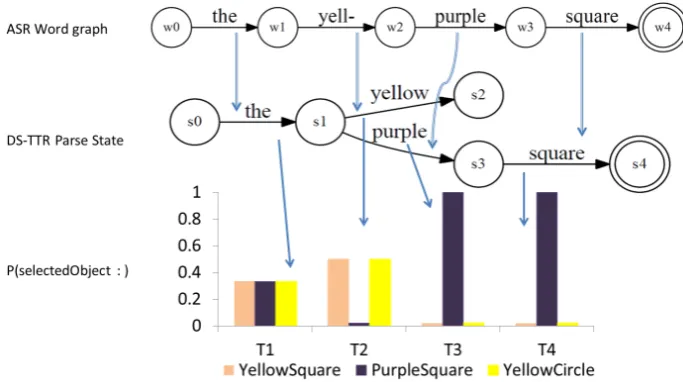
Interpretation in DyLan and its interface to the RT latticeGfollows evidence that dialogue agents parse self-repairs efficiently and that repaired di-alogue content (reparanda) is given special sta-tus but not removed from the discourse context. To model Brennan and Schober (2001)’s findings of disfluent spoken instructions speeding up ob-ject recognition (see section 2), we demonstrate a self-repair parse in Figure 6 for “The yell-, uh, purple square” in the simple game of predicting the final situation from{R1, R2, R3}continuously given the type judgements made so far. We de-scribe the stages T1-T4 in terms of the current word being processed- see Figure 6:
At T1:‘the’ the interpreter will not yield a sub-type checkable inGso we can only condition on
R8 (⊤), giving us pJ(s ∶ Ri ∣ s ∶ R8) = 1 3 for
i ∈ {1,2,3}, equivalent to the priors. At T2:
8
The search for the meet probability is generalisable to conjunctive types by searching for the conjuncts’ highest common descendant. The join probability is generalisable to the disjunctive probability of multiple types, used, albeit pro-gramatically, in Algorithm 1 for calculating a node’s proba-bility from its child nodes.
9
While we do not give details here, simple graphical search algorithms for conjunctive and disjunctive multiple types are linear in the number of conjuncts and disjuncts, sav-ing considerable time in comparison to the algebraic calcula-tions of the sum and product rules for distributive lattices.
‘yell-’, the best partial word hypothesis is now “yellow”;10the interpreter therefore outputs an RT which matches the type judgements∶R6(i.e. that the object is a yellow object). Taking this judge-ment as the conditioning evidence using function (5) we get pJ(s ∶ R1 ∣ s ∶ R6) = 0 and us-ing (4) we get pJ(s ∶ R2 ∣ s ∶ R6) = 0.5 and
pJ(s ∶ R3 ∣ s ∶ R6) = 0.5 (see the schematic probability distribution at stage T2 in Figure 6 for the three objects). The meet type probabilities required for the conditional probabilities can be found graphically as described above.
At T3:‘uh purple’, low probability in the in-terpreter output causes a self-repair to be recog-nised, enforcing backtracking on the parse graph which informally operates as follows (see Hough and Purver (2012)) :
Self-repair:
IF from parsing wordW the edgeSEnis in-sufficiently likely to be constructed from ver-tex Sn OR IF there is no sufficiently likely judgementp(s∶Rx)forRx ∈G
THEN parse wordW from vertex Sn−1. IF
successful adda new edge to the top path, without removing anycommitted edges be-ginning atSn−1; ELSE setn=n−1and repeat.
This algorithm is consistent with a local model for self-repair backtracking found in corpora (Shriberg and Stolcke, 1998; Hough and Purver, 2013). As regards inference inG, upon detection of a self-repair that revokess∶R6, the type judge-ments∶ ¬R6, i.e. that this is not a yellow object,
10
Figure 6: Incremental DS-TTR self-repair parsing. Inter-graph groundedIn links go top to bottom.
is immediately available as conditioning evidence. Using (6) our distribution of RT judgements now shifts: pJ(s ∶ R1 ∣ s ∶ ¬R6) = 1, pJ(s ∶ R2 ∣
s ∶ ¬R6) = 0 andpJ(s ∶ R3 ∣ s ∶ ¬R6)= 0 be-fore “purple” has been parsed – thus providing a probabilistic explanation for increased subsequent processing speed. Finally at T4: ‘square’ given
pJ(s∶R1∣s∶R1)= 1 andR1∧R2 =R1∧R3 =⊥, the distribution remains unchanged.
The system’s processing models how listen-ers reason about the revocation itself rather than predicting the outcome through positive evidence alone, in line with (Brennan and Schober, 2001)’s results.
6 Extensions
Dialogue and self-repair in the wild To move towards domain-generality, generating the lattice of all possible dialogue situations for interesting domains is computationally intractable. We in-tend instead to consider incrementally occurring
issues that can be modelled as questions
(Lars-son, 2002). Given one or more issues manifest in the dialogue at any time, it is plausible to gener-ate small lattices dynamically to estimgener-ate possible answers, and also assign a real-valued relevance measure to questions that can be asked to resolve the issues. We are exploring how this could be implemented using the inquiry calculus (Knuth, 2005), which defines information theoretic rele-vance in terms of a probabilistic question lattice, and furthermore how this could be used to model the cause of self-repair as a time critical trade-off between relevance and accuracy.
Learning in a dialogue While not our focus here, lattice G’s probabilities can be updated through observations after its initial construction. If a reference game is played over several rounds, the choice of referring expression can change based on mutually salient functions from words to situations- see e.g. (DeVault and Stone, 2009). Our currently frequentist approach to learning is: given an observation of an existing RTRiis made with probabilityv, then∥Ri∥J, the overall denom-inator P(J) , and the nodes in the upward path fromRi to⊤are incremented byv. The approach could be converted to Bayesian update learning by using the prior probabilities inGfor calculatingv before it is added. Furthermore, observations can be added toGthat include novel RTs: due to the DAG structure of G, their subtype ordering and probability effects can be integrated efficiently.
7 Conclusion
We have discussed efficient methods for construct-ing probabilistic TTR domain concept lattices or-dered by the subtype relation and their use in incremental dialogue frameworks, demonstrating their efficacy for realistic self-repair processing. We wish to explore inclusion of join types, the scalability of RT lattices to other domains and their learning capacity in future work.
Acknowledgements
References
G. Betarte and A. Tasistro. 1998. Extension of Martin-L¨of type theory with record types and subtyping. In G. Sambin and J. Smith, editors, 25 Years of
Con-structive Type Theory. Oxford University Press.
S. Brennan and M. Schober. 2001. How listeners compensate for disfluencies in spontaneous speech.
Journal of Memory and Language, 44(2):274–296.
R. Cooper, S. Dobnik, S. Lappin, and S. Larsson. 2014. A probabilistic rich type theory for semantic inter-pretation. In Proceedings of the EACL Workshop
on Type Theory and Natural Language Semantics (TTNLS).
R. Cooper. 2005. Records and record types in se-mantic theory. Journal of Logic and Computation, 15(2):99–112.
R. Cooper. 2012. Type theory and semantics in flux. In R. Kempson, N. Asher, and T. Fernando, edi-tors, Handbook of the Philosophy of Science, vol-ume 14: Philosophy of Linguistics, pages 271–323. North Holland.
R. Dale and E. Reiter. 1995. Computational interpreta-tions of the gricean maxims in the generation of re-ferring expressions. Cognitive Science, 19(2):233– 263.
D. DeVault and M. Stone. 2009. Learning to interpret utterances using dialogue history. In Proceedings of
the 12th Conference of the European Chapter of the Association for Computational Linguistics (EACL).
S. Dobnik, R. Cooper, and S. Larsson. 2012. Mod-elling language, action, and perception in type the-ory with records. In Proceedings of the 7th
Inter-national Workshop on Constraint Solving and Lan-guage Processing (CSLP12).
A. Eshghi, J. Hough, and M. Purver. 2013. Incre-mental grammar induction from child-directed di-alogue utterances. In Proceedings of the 4th
An-nual Workshop on Cognitive Modeling and Compu-tational Linguistics (CMCL).
R. Fern´andez. 2006. Non-Sentential Utterances in
Di-alogue: Classification, Resolution and Use. Ph.D.
thesis, King’s College London, University of Lon-don.
M. C. Frank and N. D. Goodman. 2012. Predicting pragmatic reasoning in language games. Science, 336(6084):998–998.
J. Ginzburg. 2012. The Interactive Stance: Meaning
for Conversation. Oxford University Press.
J. Hough and M. Purver. 2012. Processing self-repairs in an incremental type-theoretic dialogue system. In
Proceedings of the 16th SemDial Workshop on the Semantics and Pragmatics of Dialogue (SeineDial).
J. Hough and M. Purver. 2013. Modelling expectation in the self-repair processing of annotat-, um, listen-ers. In Proceedings of the 17th SemDial Workshop
on the Semantics and Pragmatics of Dialogue (Di-alDam).
R. Kempson, W. Meyer-Viol, and D. Gabbay. 2001.
Dynamic Syntax: The Flow of Language Under-standing. Blackwell.
K. H. Knuth. 2005. Lattice duality: The origin of prob-ability and entropy. Neurocomputing, 67:245–274.
E. Krahmer and K. Van Deemter. 2012. Computa-tional generation of referring expressions: A survey.
Computational Linguistics, 38(1):173–218.
S. Larsson. 2002. Issue-based Dialogue Management. Ph.D. thesis, G¨oteborg University. Also published as Gothenburg Monographs in Linguistics 21.
S. Larsson. 2010. Accommodating innovative mean-ing in dialogue. Proc. of Londial, SemDial
Work-shop, pages 83–90.
S. Larsson. 2011. The TTR perceptron: Dynamic perceptual meanings and semantic coordination. In
Proceedings of the 15th Workshop on the Semantics and Pragmatics of Dialogue (SemDial 2011 - Los Angelogue).
W. Levelt. 1989. Speaking: From Intention to
Articu-lation. MIT Press.
R. Montague. 1974. Formal Philosophy: Selected
Pa-pers of Richard Montague. Yale University Press.
M. Purver, A. Eshghi, and J. Hough. 2011. Incremen-tal semantic construction in a dialogue system. In J. Bos and S. Pulman, editors, Proceedings of the
9th International Conference on Computational Se-mantics.
Y. Sato. 2011. Local ambiguity, search strate-gies and parsing in Dynamic Syntax. In E. Gre-goromichelaki, R. Kempson, and C. Howes, editors,
The Dynamics of Lexical Interfaces. CSLI
Publica-tions.
D. Schlangen and G. Skantze. 2009. A general, ab-stract model of incremental dialogue processing. In
Proceedings of the 12th Conference of the European Chapter of the ACL (EACL 2009).
E. Shriberg and A. Stolcke. 1998. How far do speakers back up in repairs? A quantitative model. In
Pro-ceedings of the International Conference on Spoken Language Processing.
G. Skantze and A. Hjalmarsson. 2010. Towards incre-mental speech generation in dialogue systems. In
Proceedings of the SIGDIAL 2010 Conference.
J. Williams and S. Young. 2007. Scaling POMDPs for spoken dialog management. IEEE Transac-tions on Audio, Speech, and Language Processing,