Building a Japanese Corpus of Temporal-Causal-Discourse Structures
Based on SDRT for Extracting Causal Relations
Kimi Kaneko1 Daisuke Bekki1,2,3
1 Ochanomizu University, Tokyo, Japan 2National Institute of Informatics, Tokyo, Japan
3CREST, Japan Science and Technology Agency, Saitama, Japan
{kaneko.kimi | bekki}@is.ocha.ac.jp
Abstract
This paper proposes a methodology for generating specialized Japanese data sets for the extraction of causal relations, in which temporal, causal and discourse re-lations at both the fact level and the epis-temic level, are annotated. We applied our methodology to a number of text frag-ments taken from the Balanced Corpus of Contemporary Written Japanese. We eval-uated the feasibility of our methodology in terms of agreement and frequencies, and discussed the results of the analysis.
1 Introduction
In recent years, considerable attention has been paid to deep semantic processing. Many studies (Betherd et al., 2008), (Inui et al., 2007), (Inui et al., 2003), (Riaz and Girju, 2013) have been recently conducted on deep semantic processing, and causal relation extraction (CRE) is one of the specific tasks in deep semantic processing. Re-search on CRE is still developing and there are many obstacles that must be overcome.
Inui et al. (2003) acquired cause and effect pairs from text, where the antecedent events were taken as causes and consequent events were taken as effects based on Japanese keywords such as kara and node. In (1), for example, the an-tecedentame-ga hutta(‘it rained’) and the conse-quent mizutamari-ga dekita (‘puddles emerged’) are acquired as a pair of cause and effect.
(1) Ame-ga
rain-NOMhutta-fall-past-nodebecause
mizutamari-ga
puddles-NOMdekita.emerge-past
‘Because it rained, puddles emerged.’ However, antecedents are not always causes or reasons for consequents in Japanese, as illustrated by the following example.
(2) Zinsinziko-ga injury.accident-NOM okita-kara
happen-past-becausedensya-gatrains-NOM tiensita
delay-pastto-iu-wake-dewanai.it.is.not.the.case.that
‘It is not the case that the trains were delayed because an injury accident hap-pened.’
In example (2), the antecedentzinsinziko-ga okita (‘an injury accident happened’) is not the cause of the consequent densya-ga tiensita (‘the trains were delayed’). Though in such sentences that contain causal expressions there are no causal re-lations between antecedents and consequents, in existing studies each sentence containing a causal expression was extracted as knowledge represent-ing cause and effect, such as in (Inui et al., 2003). It is difficult for computers to auto-recognize and exclude such cases.
In this paper, we report on the analysis of nec-essary information for acquiring more accurate cause-effect knowledge and propose a methodol-ogy for creating a Japanese corpus for CRE. First, we introduce previous studies and describe infor-mation that should be used to annotate data sets. Next, we describe our methodology based on Seg-mented Discourse Representation Theory (SDRT) (Asher et al., 2003). Finally, we evaluate the va-lidity of our methodology in terms of agreement and frequency, and analyze the results.
2 Previous Studies
In this section, we introduce previous studies on annotation of temporal, causal and other types of relations and present a linguistic analysis of tem-poral and causal relations.
Betherd et al. (2008) generated English data sets annotated with temporal and causal relations and analyzed interactions between the two types of
relations. In addition, these specialized data sets were evaluated in terms of agreement and accu-racy. Relations were classified into two causal cat-egories (CAUSAL, NO-REL) and three temporal categories (BEFORE, AFTER, NO-REL). In re-gard to the evaluation, Betherdet al. pointed out that the classification was coarse-grained, and that reanalysis would have to be performed with more fine-grained relations.
Inui et al. (2005) characterized causal expres-sions in Japanese text and built Japanese corpus with tagged causal relations. However, usages such as that illustrated in (2) and interactions be-tween temporal relations and causal relations were not analyzed.
Tamura (2012) linguistically analyzed temporal and causal relations and pointed out that in rea-son/purpose constructions in Japanese, the event time indicated by the tense sometimes contradicts the actual event time, and that the information nec-essary to recognize the order between events lies in the choice of thefact and theepistemic levels (we will come back to these notions in the sec-tion 3.4), and the explicit or implicit meaning of a sentence in the causal expressions in Japanese. Furthermore, some causal expressions in Japanese are free from the absolute and relative tense sys-tems, and both the past and non-past forms can be freely used in main and subordinate clauses (Chin, 1984) (an example is given in the next section). In other words, temporal relations are not always re-solved earlier than causal relations, and therefore we should resolve temporal relations and causal relations simultaneously.
Asheret al. (2003) proposed SDRT in order to account for cases where discourse relations affect the truth condition of sentences. Because tempo-ral relations constrain causal relations, the explicit or implicit meaning of a sentences and the epis-temic level information affects preceding and fol-lowing temporal relations in causal expressions in Japanese, recognition also affects causal relations. Therefore, the annotation of both causal relations and discourse relations in corpora is expected to be useful for CRE. Moreover, which characteristics (such as tense, actual event time, time when the event is recognized, meaning and structure of the sentence and causal relations) will serve as input and which of them will serve as output depends on the time and place. Therefore, we should also take into account discourse relations together with
tem-poral and causal relations. We can create special-ized data sets for evaluating these types of infor-mation together by annotating text with discourse, temporal and causal relations.
However, discourse relations of SDRT are not distributed into discourse relations and temporal relations, and as a result the classification of labels becomes unnecessarily complex. Therefore, it is necessary to rearrange discourse relations as in the following example.
(3) Inu-wa
dog-NOMniwa-ogarden-ACCkakemawatta.run-past Neko-wa
cat-NOMkotatukotatsu-de.heater-LOC marukunatte-ita.
be.curled.up-past
‘The dog ran in the garden. The cat was curled up in thekotatsuheater.’
This pair of sentences is an antithesis, so we an-notate it with the “Contrast” label in SDRT. On the other hand, the situation described in the first sen-tence overlaps with that of the second sensen-tence, so we annotate this pair of sentences with the “Back-ground” label as well. Though there are many cases in which we can annotate a sentence with discourse relations in this way, dividing temporal relations from discourse relations as in this study allows us to avoid overlapping discourse relations. This study was performed with the aim to rear-range SDRT according to discourse relations, tem-poral relations and causal relations separately, and we generated specialized data sets according to our methodology. In addition, occasionally it is necessary to handle the actual event time and the time when the event was recognized individually. An example is given below.
(4) Asu
tomorrowtesuto-gaexam-NOM aru-node,
take.place-nonpast-because,kyoo-watoday-TOP benkyoo-suru-koto-ni
to.study-DAT sita.decide-past
‘Because there will be an exam tomorrow, I decided to study today.
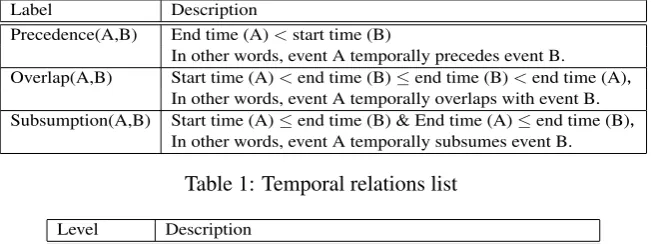
Label Description
Precedence(A,B) End time (A)<start time (B)
In other words, event A temporally precedes event B.
Overlap(A,B) Start time (A)<end time (B)≤end time (B)<end time (A), In other words, event A temporally overlaps with event B. Subsumption(A,B) Start time (A)≤end time (B) & End time (A)≤end time (B),
[image:3.595.138.464.63.185.2]In other words, event A temporally subsumes event B.
Table 1: Temporal relations list
Level Description
Cause(A,B) The event in A and the event in B are in a causal relation.
Table 2: Causal relation
event time or the time when the event was recog-nized depends on the circumstances. Therefore, we decided to annotate text at the fact and epis-temic levels in parallel to account for such a dis-tinction.
3 Methodology
We extended and refined SDRT and developed our own methodology for annotating main and subor-dinate clauses, phrases located between main and subordinate clauses (e.g., continuative conjuncts in Japanese), two consecutive sentences and two adjoining nodes with a discourse relation. We also defined our own method for annotating proposi-tions with causal and temporal relaproposi-tions. The re-sult of tagging example (5a) is shown in (5b).
(5) a. Kaze-ga
wind-NOMhuita.blow-pastHarigami-gaposter-NOM hagare,
come.off-pasttonda.flow-past
‘The wind blew. A poster came off and flew away.’
b. [Precedence(π1,π3),Explanation(π1,π3), Cause(π1,π3)],
[Precedence(π2,π4), Explanation(π2,π4), Cause(π2,π4)]
π2π1Kaze-ga huita.
π4π3Harigami-ga hagare, tonda.
The remainder of this section is structured as fol-lows. Sections 3.1 and 3.2 deal with temporal and causal relations, respectively. Section 3.3 covers discourse relations, and Section 3.4 describes the fact level and the epistemic level.
3.1 Temporal Relations
We consider the following three temporal relations (Table 1). We assume that they represent the rela-tions between two events in proposirela-tions and indi-cate a start time and an end time. In addition, we also assume that (start time ofe)≤(end time ofe) for all events. Based on this, the temporal place-ment of each two events is limited to the three re-lations in Table 1.
In this regard, Japanese non-past predicates occasionally express habitually repeating events, which have to be distinguished from events occur-ring later than the reference point. In this paper, in annotating the scope of the repetition, habitually repeating events are described as in the following example.
(6) a. Taiin-go,
After.retirement{park-ACCkouen-o hasiru}repeat
to.run yoo-ni-site-iru.have.a.custom
‘After retiring, I have a custom to{run in the park}repeat.’
b. {supootu-inryo-o
Sports.drink-ACCnonda-ato,drink-past-after kouen-o
park-ACChasirurun }repeat yoo-ni-site-iru.
have.a.custom
‘I have a custom that{I run in the park after having a sports drink}repeat.’
3.2 Causal Relations
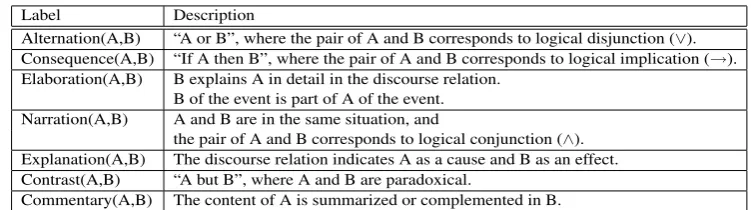
Label Description
Alternation(A,B) “A or B”, where the pair of A and B corresponds to logical disjunction (∨). Consequence(A,B) “If A then B”, where the pair of A and B corresponds to logical implication (→). Elaboration(A,B) B explains A in detail in the discourse relation.
B of the event is part of A of the event. Narration(A,B) A and B are in the same situation, and
the pair of A and B corresponds to logical conjunction (∧). Explanation(A,B) The discourse relation indicates A as a cause and B as an effect. Contrast(A,B) “A but B”, where A and B are paradoxical.
[image:4.595.110.486.60.165.2]Commentary(A,B) The content of A is summarized or complemented in B.
Table 3: Discourse relations list SDRT Our methodology Rules Alternation(A,B) Alternation(A,B) NA Consequence(A,B) Consequence(A,B) NA
Elaboration(A,B) Elaboration(A,B) ∀A,B (Elaboration(A,B)→Subsumption (A,B))
Narration(A,B) Precedence(A,B)∧Narration(A,B) NA
Background(A,B) Subsumption(A,B)∧Narration(A,B) NA
Result(A,B) Explanation(A,B)
Explanation(A,B) Cause(A,B) ∀A,B (Cause(A,B)→Temp rel(A,B))1
Contrast(A,B) Contrast(A,B) NA Commentary(A,B) Commentary(A,B) NA
Table 4: Correspondence between SDRT and our methodology
of causation in finer detail than (Betherd et al., 2008).
3.3 Discourse Relations
We consider the following discourse relations based on SDRT (Table 3). There are also relations that impose limitations on temporal and causal re-lations (Table 4). The way temporal, causal and discourse relations affect each other is described below together with their correspondence to the relations in SDRT. Bold-faced entries represent relations integrated in SDRT in our study.
Such limitations on temporal relations provides in-formation for making a decision in terms of tem-poral order and cause/effect in the “de-tensed” sentence structure2 (Chin, 1984) in Japanese. An example is given below.
(7) Kinoo
yesterdayanna-nithat.muchtaberu-eat-past-karabecause,
kyoo
todayonaka-gastomach-NOMitakuache-cont natta-nda.
become-noda
2Temp rel(A,B)≡
Precedence(A,B)∨Overlap(A,B)∨Subsumption(A,B) 3According to (Chin, 1984), “de-tensed” is a relation whereby the phrase has lost the meaning contributed by tense, namely, the logical aspect of the semantic relation between an antecedent and a consequent has eliminated the aspect tem-poral relation between them.
‘Because you ate that much yesterday, you have a stomachache today.’
(7) [Precedence(π1,π3),Explanation(π1,π3), Cause(π1,π3)],
[Precedence(π2,π4),Explanation(π2,π4), Cause(π2,π4)]
π2π1Kinoo anna-ni taberu-kara,
π4π3kyoo onaka-ga itaku natta-nda.
This is a sentence where the subordinate clause is in non-past tense and the main clause is in past tense. Then, we may mistakenly interpret the event in the subordinate clause as occurring after the event of the main clause. However, we can de-termine that in fact it occurredbeforethe event in the main clause based on the rule imposed by the “Cause” relation.
3.4 Fact Level and Epistemic Level
A fact level proposition refers to an event and its states, while an epistemic level proposition refers to speaker’srecognizingevent of a described event. In Japanese, the latter form is often marked by the suffix noda that attaches to all kinds of predicates (which may also be omitted). Both overt and covertnodaintroduce embedded struc-tures, and we annotate them in such a way that a fact level proposition is embedded in an epistemic level proposition.
represents the time that an event takes place, while the tense in the latter represents the time that the speakerrecognizesthe event.
This distinction between the two types of propo-sitions is carried over to the distinction between the fact level and the epistemic level causal rela-tions. We annotate the former by the tag “Cause” and the latter by the tag “Explanation”.
In Japanese, a causal marker such as node (a continuation form ofnoda) andkaraare both used in the fact level and the epistemic level. The fact level causality is a causal relation between the two events, while the epistemic level causality is a causal relation between the tworecognizingevents of the two events mentioned. Therefore, in the causal construction, it happens that the precedence relations between the subordinate and the matrix clauses in the fact level and the epistemic level do not coincide, as in the following example.
(8) Kesa
this.morningnani-monothing-NOM hoodoo-sare-nakatta-node, report-passive-NEG.past-because, kinoo-wa
yesterday-TOPmebosiinotable ziken-waevents-NOM nakatta-noda.
be-NEG-noda
‘Because nothing was reported this morn-ing, there were no notable event yester-day.’
[Precedence(π3,π1),Explanation(π3,π1), Cause(π3,π1)],
[Precedence(π2,π4), Explanation(π2,π4), Cause(π2,π4)]
π2π1Kesa nani-mo
hoodoo-sare-nakatta-node,π4π3kinoo-wa mebosii
ziken-wa nakatta-noda.
The temporal relation at the fact level is that π3
precedes π1. By contrast, that at the epistemic level is that π2 precedes π4. By describing the relation betweenπ1andπ3 and that betweenπ2
andπ4separately, we can reproduce the relation-ship at both levels.
3.5 Merits
We defined our methodology for annotating text fragments at both the fact and epistemic levels in parallel with temporal, causal and discourse re-lations. Therefore, we can generate specialized
data sets that enable estimating the causality in the fact and epistemic levels by various cues (such as known causal relations, truth condition, conjunc-tions and temporal relaconjunc-tions between sentences or clauses).
In addition, we can say that causal expressions without causation are not in a causal relation (and vice versa) by annotating text with both discourse and causal relations.
4 Results
We applied our methodology to 66 sentences from the Balanced Corpus of Contemporary Written Japanese (BCCWJ) (Maekawa, 2008). The sen-tences were decomposed by one annotator, and la-bels were assigned to the decomposed segments by two annotators. During labeling, we used the labels presented in Section 3. Our methodology was developed based on 96 segments (38 sen-tences), and by using the other 100 segments (28 sentences), we evaluated the inter-annotator agree-ment as well as the frequencies of decomposition and times of annotation. The agreement for 196 segments generated from 28 sentences amounted to 0.68 and was computed as follows (the kappa coefficient for them amounted to 0.79).
Agreement=Agreed labels/T otal labels
[image:5.595.332.499.539.729.2]Analyzing more segments in actual text and proving our methodology can lead to further im-provement in terms of agreement.
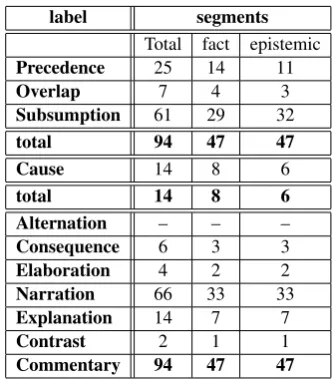
Table 5 shows the distribution of labels into seg-ments in our study.
label segments Total fact epistemic Precedence 25 14 11 Overlap 7 4 3 Subsumption 61 29 32 total 94 47 47 Cause 14 8 6 total 14 8 6 Alternation – – – Consequence 6 3 3 Elaboration 4 2 2 Narration 66 33 33 Explanation 14 7 7 Contrast 2 1 1 Commentary 94 47 47
We can see from Table 5 that “Narration” was the most frequent one, while “Alternation” never appeared. As s result, we can assume that frequent relations will be separated from non-frequent rela-tions. So far, all the relations are either frequent or non-frequent. We should re-analyze the data with more samples again.
When the methodology was applied to 28 sen-tences, a total of 100 and an average of 3.57 ments were derived. This is the number of seg-ments at both the fact and epistemic levels. With-out dividing the fact and epistemic levels, an aver-age of 1.79 segments were derived.
On average, 11 segments per hour were tagged in our study. Although we should evaluate the va-lidity after having computed the average decom-position times, it is assumed that our methodology is valid when focusing only on labeling.
5 Discussion
We analyzed errors in this annotation exercise. The annotators often found difficulties in judging temporal relations in the following two cases: (1) the case where it was difficult to determine the scope of the segments pairing and (2) the case where formalization of lexical meaning is difficult. In regard to the first case, how to divide seg-ments sometimes affects temporal relations. In the following example, consider the temporal relation between the first and the second sentences.
(9) Marason-ni
marathon-DATsyutuzyoo-sita.participate-past. sonohi-wa
that.day-TOP6zi-ni6:00-atkisyoo-si,get.up-past, 10zi-ni
10:00-attotyoo-karaMetropolitan.Government-from syuppatu-site,
leave-past, 12zi-ni12:00-at kansoo-sita.
finish.running-past.
‘I participated in marathon. I got up at 6:00 on that day and left the Metropolitan Government at 10:00 and finished running at 12:00.’
When we focus on the first segment of the sec-ond sentnce (‘I got up at 6:00’), its relation to the first sentence appears to be “Precedence”. How-ever, if we consider the second and the third seg-ments as the same segment, their relation to the first sentence appears to be “Subsumption”.
Therefore, we should establish clear criteria for the segmentation. Although we currently adopts a criterion that we chose smaller segment in unclear cases, there still remain 9 unclear cases (tempo-ral:5, discourse:4).
One of the reason why Kappa coefficient marks relatively high score is that we only compare the labels and ignore the difference in the segmenta-tions. Criteria for deciding the segment scope in paring segments will improve our methodology.
The second case is exemplified by the tempo-ral relation between the subordinate clause and the main clause in the following sentence.
(10) Migawari-no
scapegoat-GENtomo-ofriend-ACC sukuu-tame-ni
to.save hasiru-noda.run-noda.
‘I run to save my friend who is my scape-goat.’
If we consider that the saving event only spans over the very moment of saving, the relation be-tween the clauses appears to be “Precedence”. However, if we consider that running event is a part of thesavingevent, the relation between the clauses is “Subsumption”.
Thus, judging lexical meaning with respect to when events start and end involves some difficul-ties and they yield delicate cases in judging tem-poral relations.
These problems are mutually related, and the first problem arises when the components of a lex-ical meaning are displayed explicitly in the sen-tence, and the second problem arises when they are implicit.
6 Conclusions
We analyzed and proposed our methodology based on SDRT for building a more precise Japanese corpus for CRE. In addition, we annotated 196 segments (66 sentences) in BCCWJ with tempo-ral relations, discourse relations, causal relations and fact level and epistemic level propositions and evaluated the annotations of 100 segments (28 sen-tences) in terms of agreement, frequencies and times for decompositions. We reported and an-alyzed the result and discussed problems of our methodology.
References
Asher N. and Lascaridas A. 2003. Logics of Con-versation: Studies in Natural Language Processing. Cambridge University Press, Cambridge, UK. Bethard S., Corvey W. and Kilingenstein S. 2008.
Building a Corpus of Temporal Causal Structure. LREC 2008, Marrakech, Morocco.
Chin M. 1984. Tense of the predicates for clauses of compound statement binded by conjunctive parti-cle -”Suru-Ga” and ”Shita-Ga”, ”Suru-Node” and ”Shita-Node” etc.-. Language Teaching Research Article.
Inui T., Inui K. and Matsumoto Y. 2005. Acquir-ing Causal Knowledge from Text UsAcquir-ing the Con-nective Marker Tame. ACM Transactions on Asian Language Information Processing (ACM-TALIP), Vol.4, Issue 4, Special Issue on Recent Advances in Information Processing and Access for Japanese, 435–474.
Inui T., Inui K. and Matsumoto Y. 2003. What Kinds and Amounts of Causal Knowledge Can Be Aquired from Text by Using Connective Markers as Clues. The 6th International Conference on Discovery Sci-ence (DS-2003), 180–193.
Inui T., Takamura H. and Okumura M. 2007. Latent Variable Models for Causal Knowledge Acquisition.
Alexander Gelbukh(Ed.), Computational Linguistics and Intelligent Text Processing, Lecture Notes in Computer Science, 4393:85–96.
Maekawa K. 2008. Balanced Corpus of Contemporary Written Japanese. In Proceedings of the 6th Work-shop on Asian Language Resources (ALR), 101―
102.
Riaz M. and Girju R. 2013. Toward a Bet-ter Understanding of Causality between Verbal Events:Extraction and Analysis of the Causal Power of Verb-Verb Associations. In Proceedings of the SIGDIAL 2013 Conference, Metz, France 21–30. Tamura S. 2012. Causal relations and epistemic