Munich Personal RePEc Archive
Sparse Linear Models and l1Regularized
2SLS with High-Dimensional Endogenous
Regressors and Instruments
Zhu, Ying
University of California, Berkeley
20 July 2015
Sparse Linear Models and
l
1−
Regularized 2SLS with
High-Dimensional Endogenous Regressors and Instruments
∗Ying Zhu
This revision: July, 2015 (First draft: August, 2013)
[email protected]. Tel: 406-465-0498.
Abstract
We explore the validity of the 2-stage least squares estimator withl1−regularization in both stages, for linear models where the numbers of endogenous regressors in the main equation and instruments in the first-stage equations can exceed the sample size, and the regression co-efficients belong to lq− “balls” for q ∈ [0,1], covering both exact and approximate sparsity
cases. Standard high-level assumptions on the Gram matrix forl2−consistency require careful verifications in the two-stage procedure, for which we provide detailed analysis. We establish finite-sample bounds and conditions for our estimator to achievel2−consistency and variable-selection consistency. Practical guidance for choosing the regularization parameters is provided.
JEL Classification: C13, C31, C36
Keywords: High-dimensional statistics; Lasso; sparse linear models; endogeneity; two-stage es-timation
1
Introduction
The objective of this paper is consistent estimation and selection of regression coefficients in models with a large number of endogenous regressors. We consider the linear model
Yi=XiTβ∗+ǫi = p
X
j=1
Xijβj∗+ǫi, i= 1, ..., n (1)
whereǫi is a zero-mean random error possibly correlated withXi and β∗ is an unknown vector of
parameters of our main interests. Thejth component ofβ∗ is denoted byβj∗.Thejthcomponent of
Xi isendogenousifE(Xijǫi)6= 0 andexogenous ifE(Xijǫi) = 0. Without loss of generality, we will assume all regressors are endogenous throughout the rest of this paper for notational convenience (a modification to allow mix of endogenous and exogenous regressors is straightforward.). When
∗I thank James Powell, Martin Wainwright, and Demian Pouzo for useful discussions and comments. I am
endogenous regressors are present, the classical least squares estimator will be inconsistent for β∗
(i.e., ˆβOLS 9p β∗) even when the dimension p of β∗ is small relative to the sample size n. The
two-stage least squares (2SLS) estimation plays an important role in accounting for endogeneity that comes from individual choice or market equilibrium (e.g., Wooldridge, 2002), and is based on the following “first-stage” equations for the components of Xi,
Xij =ZijTπ∗j +ηij = dj
X
l=1
Zijlπjl∗ +ηij, i= 1, ...., n, j = 1, ..., p. (2)
For each j = 1, ..., p,Zij is a dj ×1 vector of instrumental variables, and ηij a zero-mean random
error which is uncorrelated withZij, andπj∗ is an unknown vector of nuisance parameters. We will refer to the equation in (1) as the main equation (or second-stage equation) and the equations in (2) as the first-stage equations. Without loss of generality, the assumption E(Zijǫi) = E(Zijηij) = 0
for all j = 1, ..., p and E(Zijηij′) = 0 for all j 6= j ′
implies a triangular simultaneous equations model structure.
High dimensionality arises in (1) and (2) when the dimension p of β∗ is large relative to the sample size n (namely, p ≍ n or evenp ≫ n) or when the dimension dj of π∗j is large relative to
the sample size n (namely, dj ≍ n or dj ≫ n) for at least one j. This paper concerns the case
wherep≫nanddj ≪n, or the case where p≫nanddj ≫n, and β∗ andπ∗j (forj= 1, ..., p) are
“sparse” in a way to be defined in Section 2. The analysis for the casep≍norp≫nis useful, for example, when we have the model Yi =f(Xi) +ǫi whereǫi∼ N(0, σ2),E(ǫi|Xi)6= 0 for alli, and f(·) is an unknown function of interest and can be approximated by linear combinations of some set of basis functions, i.e.,f(Xi) =Ppj=1βjφj(Xi).
An empirical example of the case p ≍ n or p ≫ n concerns the estimation of network or community influence. For example, Manresa (2014) looks at how a firm’s production output is influenced by the investment of other firms. As a future extension, she suggests an alternative model that looks at the network influence in terms of the output of the other firms rather than their investment:
Yit=αi+XitTθ+
X
j∈{1,...,n}, j6=i
βjiYjt+ǫit
fori= 1, ..., nand t= 1, ..., T, where Xit denotes a vector of exogenous regressors specific to firm i at period t (e.g., investment), and αi is the fixed effect of firm i. Notice that Yjt, the output of other firms enters the right-hand-side of the equations above as additional regressors andβji’s, j = 1, ..., n, and j 6= i are interpreted as the network influence arising from firm j’s output on firm i’s output. Furthermore, the influence on firm i from firm j is allowed to differ from the influence on firm j from firm i. Endogeneity arises from the simultaneity of the output variables when cov(ǫit, ǫjt)6= 0 (e.g., presence of unobserved network characteristics that are common to all
firms’ output). As a result, the number of endogenous regressors in the model above is of the order
O(n), which exceeds the number of periods T in the application considered by Manresa (2014). In the literature on high-dimensional sparse linear regression models, a great deal of attention has been given to the l1−penalized least squares. In particular, the Lasso is the most studied
2012; etc.). Variable selection when the dimension of the problem is larger than the sample size has also been studied in the likelihood method setting with penalty functions other than thel1−norm
(see, e.g., Fan and Li, 2001; Fan and Lv, 2011; Fan and Liao, 2014). Lecture notes by Koltchinskii (2011), as well as recent books by Bühlmann and van de Geer (2011) and Wainwright (2015) have given a more comprehensive introduction to high-dimensional statistics.
Recently, thesel1−penalized techniques have been applied in a number of econometrics papers.
Caner (2009) studies a Lasso-type GMM estimator. Rosenbaum and Tsybakov (2010) study the high-dimensional errors-in-variables problem where the non-random regressors are observed with additive error and they present an application to hedge fund portfolio replication. Belloni, Chen, Chernozhukov, and Hansen (2012) estimate the optimal instruments using the Lasso and in an em-pirical example dealing with the effect of judicial eminent domain decisions on economic outcomes, they find the Lasso-based instrumental variable estimator outperforms an intuitive benchmark. Fan, Lv, and Li (2011) review the literature on sparse high-dimensional econometric models and also cover other regularization methods for several models including the vector autoregressive model for measuring the effects of monetary policy, panel data model for forecasting home price, and volatility matrix estimation in finance.
For the triangular simultaneous equations structure (1) and (2), the case where dj ≫ n for at least one j but p ≪ n has been considered by Belloni and Chernozhukov (2011b), where they showed the instruments selected by the Lasso technique in the first-stage regression can produce an efficient estimator with a small bias at the same time. In the case where p ≫ n and dj ≪ n
for all j, we can obtain the fitted regressors by a standard least squares estimation on each of the first-stage equations separately as usual and then apply the Lasso using these fitted regressors in the second-stage regression. Similarly, in the case where p ≫ n and dj ≫ n for all j, we can
obtain the fitted regressors by performing a regression with the Lasso on each of the first-stage equations separately and then apply another Lasso estimation using these fitted regressors in the second-stage.
Compared to existing 2SLS techniques which either limit the number of regressors entering the first-stage equations or the second-stage equation or both, our two-stage estimation procedures with
l1−regularization in both stages are more flexible and particularly powerful for applications in which
In terms of analyzing the statistical properties, the extension from models with a few endoge-nous regressors to models with many endogeendoge-nous regressors (p ≫ n) in the context of triangular simultaneous equations (1) and (2) for the two-stage estimation is not obvious. This paper aims to explore the validity of these two-step estimators in the high-dimensional sparse setting. An-other contribution of this paper is to introduce analysis that is suitable for showing estimation consistency of the two-step type high-dimensional estimators. When endogeneity is absent from model (1), there is a well-developed theory on what conditions on the design matrixX∈Rn×p are
sufficient for an l1−regularized estimator to consistently estimate β∗. In some situations one can
impose these conditions directly as an assumption on the underlying design matrix. However, when employing a regularized 2SLS estimator in the context of triangular simultaneous linear equation models in the high-dimensional setting, namely, (1) and (2), there is no guarantee that the random matrix XˆTnXˆ (with ˆX obtained from regressing X on the instrumental variables) would automat-ically satisfy these previously established conditions for estimation consistency. To the best of our knowledge, previous literature has not dealt with this issue. This paper explicitly shows that these conditions indeed hold for XˆTnXˆ with high probability under appropriate conditions. It also establishes the sample size required for XˆTnXˆ to satisfy these conditions.
We begin in Section 2 with model assumptions imposed on (1) and (2). The high-dimensional 2SLS procedure and its theoretical properties are established in Section 3, where practical guidance for choosing the regularization parameter is also provided. Section 4 presents simulation results and compares the various practical choices of the regularization parameters. Section 5 concludes this paper and discusses future extensions. The main proofs are collected in Appendices A and B. Additional supplementary materials are included in:
https://sites.google.com/site/yingzhu1215/home/HD2SLS_Supplement.pdf.
Notation. For the convenience of the reader, we summarize here notations to be used through-out this paper. The lq−norm of a vector v ∈ m ×1 is denoted by |v|q, 1 ≤ q ≤ ∞ where
|v|q := (Pmi=1|vi|q)1/q when 1 ≤ q < ∞ and |v|q := maxi=1,...,m|vi| when q = ∞. For a matrix A ∈ Rm×m, write |A|∞ := maxi,j|aij| to be the elementwise l∞−norm of A. The l2−operator
norm, or spectral norm of the matrix A corresponds to its maximum singular value: it is defined as ||A||2 := supv∈Sm−1|Av|2, where Sm−1 = {v ∈ Rm| |v|2 = 1}. The l∞ matrix norm
(maxi-mum absolute row sum) of A is denoted by ||A||∞ := maxiPj|aij| (note the difference between
|A|∞ and ||A||∞). For a square matrix A, denote its minimum eigenvalue and maximum eigen-value by λmin(A) and λmax(A), respectively. For functions f(n) and g(n), write f(n) % g(n) to
mean that f(n) ≥ cg(n) for a universal constant c ∈ (0,∞) and similarly, f(n) - g(n) to mean that f(n) ≤ c′g(n) for a universal constant c′ ∈ (0,∞); f(n) ≍ g(n) when f(n) % g(n) and
f(n) - g(n) hold simultaneously. For some integer s ∈ {1,2, ..., m}, the l0−ball of “radius” s is given by Bm
0 (s) := {v ∈ Rm| |v|0 ≤ s} where |v|0 := Pmi=11{vi 6= 0}. Similarly, the l2−ball of
radius r is given by Bm
2 (r) :={v ∈Rm| |v|2 ≤ r}. Also, write K(s, m, r) :=Bm0 (s)∩Bm2 (r) and
K2(s, m, r) := K(s, m, r)×K(s, m, r). For a vector v ∈ Rp, let J(v) = {j ∈ {1, ..., p} |vj 6= 0}
be its support, i.e., the set of indices corresponding to its non-zero componentsvj. The cardinality
of a set J ⊆ {1, ..., p} is denoted by |J|. Denote max{a, b} by a∨b and min{a, b} by a∧b. As a general rule for the proofs, c constants denote generic positive constants that are independent of
2
Model assumptions
Throughout the rest of this paper, the following assumptions are imposed on the model (1) and (2).
Assumption 2.1: The data {Yi, Xi, Zi}ni=1 are independent with finite second moments; for
all j= 1, ..., p and i= 1, ..., n,E(Zijǫi) =E(Zijηij) =0and E(Zijηij′) =0for all j6=j ′
.
Assumption 2.2 (Sparsity): The coefficient vector β∗ ∈Rp belongs to the lq
2−“balls” Bpq2(Rq2)
for a “radius” of Rq2 and some q2 ∈ [0,1], where the lq−“balls” of “radius” R for q ∈ [0,1] are defined by
Bpq(R) :=
β ∈R
p| |β|q q =
p
X
j=1
|βj|q≤R
for q∈(0,1],
Bp0(R) := β ∈R
p| |β|
0 =
p
X
j=1
1{βj 6= 0} ≤R
forq = 0.
Forj= 1, ..., p, the coefficient vector πj∗∈Rdj belongs to thel
q1j−“balls”B
dj
q1j(Rq1j) for a “radius” of Rq1j and some q1j ∈[0,1], where B
dj
q1j(Rq1j) is defined in a similar fashion as above. For nota-tional simplicity,dj =d,q1j =q1, and Rq1j =Rq1 for all j= 1, ..., p.
Remark. Assumption 2.2 requires the coefficient vectors to be “sparse” and formalizes the spar-sity condition by considering the lq−“balls” Bp
q(Rq) of “radius” Rq where q ∈ [0,1] (see, e.g., Ye
and Zhang, 2010; Raskutti, Wainwright, and Yu, 2011; Negahban, Ravikumar, Wainwright, and Yu, 2012; this notion is also used for the Bridge estimator considered in Huang, Horowitz, and Ma, 2008). For example, the exact sparsity on β∗ corresponds to the case of q = q2 = 0 with
Rq2 = k2, which says that β∗ has at most k2 non-zero components. In the more general setting
q2 ∈ (0,1], membership in Bqp2(Rq2) has various interpretations and one of them involves how
quickly the ordered coefficients decay according to the hyperharmonic series. Whenq2 ∈[0,1),the setBp
q2(Rq2) is non-convex and thel1−ball is theclosest convex approximation of these non-convex
sets. In terms of estimation procedure design, the idea of approximating non-convex problems with their closest convex member (so called “convex relaxation”) as in the Lasso provides a tremendous computational advantage. In the rest of our analysis, we set the “radius” Rq2 =
Pp j=1
β∗jq2 when
q2 ∈(0,1] andRq2 =k2 whenq2= 0. The growth conditions on (n, d, p, Rq1, Rq2) will be specified
in Sections 3.1 and 3.2 when theoretical results are presented.
Assumption 2.3 (Restricted Identifiability): For a subset S ⊆ {1,2, ..., p} and all non-zero ∆∈C(S;q2, c∗)∩Sδ where
for some universal constantc∗ >1 (with ∆Sdenoting the vector inRpthat has the same coordinates
as ∆ on S and zero coordinates on the complement Sc ofS), and
Sδ:={∆∈Rp : |∆|
2 ≥δ},
the matrix ΣX∗=E
h
X∗TX∗
n
i
satisfies
∆TΣX∗∆
|∆|22 ≥κ2 >0,
with parameters (q2, δ, κ2), where X∗ := (Z1π∗1, ..., Zjπ∗j, ..., Zpπp∗). For j = 1, ..., p, the matrix
ΣZj = E
ZT jZj
n
satisfies a similar restricted eigenvalue condition with parameters (q1, δj, κ1) for
a subset Sj ⊆ {1,2, ..., d}. The choices ofδ,δj, andS,Sj will be specified in Section 3.1.
Remarks. The following discussion is in regard to the RE condition on EhX∗TX∗
n
i
imposed by
Assumption 2.3 (similar argument can be made forE
ZT jZj
n
). Whenβ∗ is exactly sparse (namely,
q2 = 0), we can take δ = 0 and choose S = J(β∗) (recalling J(β∗) denotes the support of β∗),
which reduces the set C(S;q2, c∗)∩Sδ to the following cone:
C(J(β∗); 0, c∗) :=n∆∈Rp : |∆J(β∗)c|1 ≤c∗|∆J(β∗)|1
o
.
Let us first consider a simple case whereX∗is observed. The sample analog of Assumption 2.3 over the cone C(J(β∗); 0, c∗) is the so-called restricted eigenvalue (RE) condition on the Gram matrix
X∗TX∗
n , studied in Bickel, et. al. (2009), Meinshausen and Yu (2009), Raskutti, et al. (2010),
Bühlmann and van de Geer (2011), Loh and Wainwright (2012), Negahban, et. al. (2012), etc. When β∗ is approximately sparse (namely, q2 ∈(0,1]), in sharp contrast to the exact sparsity
case, the set C(S;q2, c∗) is no longer a cone but rather contains a ball centered at the origin.
Consequently, it is never possible to ensure that |X∗∆|22
n is bounded from below for all vectors ∆ in
the setC(S;q2, c∗) (see Negahban, et. al., 2012 for a geometric illustration of this issue). Therefore,
in order to obtain a general applicable theory, it is crucial to further restrict the setC(S;q2, c∗) for
q2 ∈(0,1] by intersecting it with the setSδ:={∆∈Rp : |∆|2≥δ}. Provided the parameterδ and
the set S are properly defined, the intersection C(S;q2, c∗)∩Sδ excludes many “flat” directions
(with eigenvalues of 0) in the space for the case of q2 ∈ (0,1]. To the best of our knowledge,
the necessity of this additional setSδ, essential for the approximately sparse case of q2 ∈(0,1], is
first recognized explicitly in Negahban, et. al. (2012). We use this idea to derive a general upper bound on thel2−error of the high-dimensional 2SLS estimator whenβ∗ andπj∗ (j= 1, ..., p) satisfy
Assumption 2.2, which covers a spectrum of sparsity cases (exact and approximate).
In our problem, X∗ is unknown and needs to be estimated. When applying the l1−regularized 2SLS procedure to estimate β∗, there is no guarantee that the random matrix XˆTnXˆ (where ˆX is the estimate of X∗ = hZ1π∗1, ..., Zpπp∗i) would automatically satisfy these previously established conditions for estimation consistency. This paper provides results that imply the RE condition holds for XˆTnXˆ with high probability provided Assumption 2.3 is satisfied for a sub-Gaussian matrix
unknownX∗ is replaced with its estimate ˆXand the expectation is replaced with a sample average.
3
High-dimensional 2SLS estimation
For notational simplicity, in the main theoretical results presented below, we assume the regime of interest is p ≥n. The modification to allow p < n is trivial. For the first-stage regression, we consider the following procedure:
ˆ
πj ∈argminπj∈Rd 1
2n|Xj −Zjπj|
2 2+λn,j
d
X
l=1
ˆ
σZjl|πjl| (3)
for j = 1, ..., p and l = 1, ..., d, where ˆσZjl =q1nPni=1Zijl2 . Denote the fitted regressors using the
first-stage estimates by ˆXj := Zjπˆj for j = 1, ..., p, and ˆX =
ˆ
X1, ...,Xˆp
. For the second-stage regression, we consider
ˆ
βH2SLS ∈argminβ∈Rp 1
2n|Y −Xβˆ |
2 2+λn
p
X
j=1
ˆ
σX∗
j|βj|, (4)
where ˆσX∗
j =
q 1
n
Pn
i=1Xˆij2 forj= 1, ..., p.
Remark. Upon solving (3), post-Lasso strategies such as thresholding or post-OLS-Lasso (which performs an OLS with the regressors in the estimated support set J(ˆπj) to obtain ˆπjOLS for j = 1, ..., p) may be used before (4). In the third step, we apply the Lasso to estimate the main equation parameters with these fitted regressors based on the second-stage post-Lasso estimates. This type of procedure is in the similar spirit as the those in literature (see, e.g., Candès and Tao, 2007; Belloni and Chernozhukov, 2013).
We begin with Sections 3.1 and 3.2 by emphasizing the theoretical guarantees on parameter es-timation and variable selection of ˆβH2SLS, respectively. Note that these two sections do not deal
with practical guidance for choosing the regularization parameters, which is the focus of Section 3.3, where we discuss two existing model-free criteria in literature for regularized estimation and then propose feasible counterparts of the theoretical choices of the regularization parameters from Section 3.1. In the simulation experiments (Section 4), we compare the various practical choices of the regularization parameters provided in Section 3.3.
3.1 Theoretical guarantees on the estimation of parameters
The first main result (Theorem 3.1) exhibits the non-asymptotic bound for|βˆH2SLS−β∗|2, which
establishes sufficient conditions forl2−consistency of ˆβH2SLS. This result requires some regularity conditions, which use the following definition of sub-Gaussian matrices based on Vershynin (2012) and similar to Loh and Wainwright (2012).
Definition 3.1(Sub-Gaussian variables and matrices). A random variableXwith meanµ=E[X]
is sub-Gaussian if there is a positive number ρ such that supγ≥1γ−12 (E|X|γ) 1
matrix A ∈ Rn×p is sub-Gaussian with parameters (ΣA, ρ2
A) where ΣA = E
h
ATA
n
i
, if each row
Ai ∈Rp is sampled independently from a distribution, and for any unit vectoru∈Rp, the random
variableuTATi is sub-Gaussian with parameter at most ρ2A.
Remark. The sub-Gaussian assumption says that the variables need to be drawn from dis-tributions with well-behaved tails like Gaussian. In contrast to the Gaussian assumption, sub-Gaussian variables constitute a more general family of distributions. In particular, one can show that ρ=Cσ=CpE[X2] when X is a zero-mean Gaussian random variable, andρ =Ca−a
2 when
X is a zero-mean random variable supported on some interval [a, a], where C > 0 is a universal constant (see, e.g., Wainwright, 2015).
Assumption 3.1: The error terms ǫ and ηj for j = 1, ..., p are zero-mean sub-Gaussian
vec-tors with parameters ρ2ǫ and ρ2ηj, respectively; ρη2 = maxjρ2ηj. The random matrix Zj ∈ R
n×d is
sub-Gaussian with parameters (ΣZj, ρ
2
Z) for j = 1, ..., p.
Assumption 3.2: For every j = 1, ..., p, Xj∗ := Zjπj∗. The matrix X∗ ∈ Rn×p is sub-Gaussian
with parameters (ΣX∗, ρ2X∗) where the jth column ofX∗ isXj∗.
Remark. Assumptions 3.1 and 3.2 are common in the literature (see, e.g., Loh and Wainwright, 2012; Negahban, et. al 2012; Rosenbaum and Tsybakov, 2013). In fact, the second part of Assump-tion 3.1 on Zj ∈Rn×d being sub-Gaussian for allj implies that Zjπ∗j =Xj∗ is also sub-Gaussian.
Therefore, the conditions that X∗ ∈ Rn×p is a sub-Gaussian matrix with parameters (ΣX∗, ρ2
X∗)
where the jth column of X∗ is Xj∗(Assumption 3.2) is a mild extension.
To state the following results, we need to introduce some definitions. First, Let
T0 = max{|β∗|1T1, ρX∗ρη|β∗|1T2, ρX∗ρǫT2}, (5)
T1 = c1¯
κ
1 2
1R
1 2
q1
κ1−
q1 2
1
s
ρ2Zρ2
η
log(d∨p)
n
1−q1 2
, (6)
T2 = c2 s
logp
n . (7)
We postpone the discussion of a practical procedure for setting the unknown parameters and constants in T0 until Section 3.3.
Also, recall in Section 2 the sets we introduced,
C(S;q2, c∗) := {∆∈Rp : |∆Sc|1 ≤c∗|∆S|1+ (c∗+ 1)|β∗
Sc|1},
C(Sj;q1, c∗) := n∆∈Rd : |∆Sc j|1≤c
∗|∆
Sj|1+ (c∗+ 1)|πj,S∗ c j|1
o
,
forj= 1, ..., p, and some universal constantc∗ >1, and the spherical sets
Sδ: = {∆∈Rp : |∆|
2≥δ},
Sδ
j : =
n
∆∈Rd : |∆|
2≥δj o
and the intersectionsC(S;q2, c∗)∩Sδ andC(Sj;q1, c∗)∩Sδ
j. Whenβ∗ andπ∗j are approximately sparse (namely, q2, q1 ∈ (0,1]), we choose S in C(S;q2, c∗) and Sj in C(Sj;q1, c∗) to be the
following subsets
Sτ := nj∈ {1,2, ..., p} : βj∗> τo,
Sτj :=
n
l∈ {1,2, ..., d} : πjl∗> τjo,
with the parameterτ = cc∗∗+1−1κT0
2 andτj =c0 q
ρ2 Zρ2η
log(d∨p) n
κ1 , respectively (recall the parameterκ1 and
κ2 defined in Assumption 2.3, Section 2). When β∗ and πj∗ are exactly sparse (namely, q2, q1 =
0), we set δ = δj = τ = τj = 0 and choose S = J(β∗), Sj = J(πj∗), which reduces the sets
C(S;q2, c∗)∩Sδ andC(Sj;q1, c∗)∩Sδ
j, respectively, to the following cones:
C(J(β∗); 0, c∗) := n∆∈Rp : |∆J(β∗)c|1 ≤c∗|∆J(β∗)|1
o
,
C(J(πj∗); 0, c∗) := n∆∈Rd : |∆J(π∗
j)c|1 ≤c
∗|∆ J(π∗
j)|1
o
.
The first main theorem provides an upper bound on βˆH2SLS−β∗
2 when the first- and second-stage estimations concern the programs in (3) and (4), respectively. This result concerns the case wherep≥n,d≥n, and β∗ and π∗j (forj = 1, ..., p) satisfy Assumption 2.2. Before presenting the main theorem, we provide the following lemma to ensure that the regressors are well-behaved.
Lemma 3.1: If {Zi}ni=1 are independent with finite second moment σZ2jl = E
1
n
Pn i=1Zijl2
for
j= 1, ..., p andl= 1, ..., d, then,
P
max
j, l
σˆZjl−σZjl≤ 1
2σZ
≥1−O(exp(−n)),
where ˆσZ2
jl =
1
n
Pn
i=1Zijl2 and σ2Z = maxj,lσZ2jl. Furthermore, suppose Assumptions 2.1, 3.1, 3.2, and the part related to the first-stage equations in Assumption 2.2 hold. For j = 1, ..., p and some universal constant c∗ > 1, let Assumption 2.3 hold over the restricted sets C(J(πj∗); 0, c∗) for the exact sparsity case q1 = 0 with Rq1 = k1, and over C(Sτj;q1, c∗) ∩Sδj, where δj =
c′κ−1+
q1 2
1 R
1 2
q1 q
ρ2
Zρ2ηlog(d∨p)
n
1−q1 2
(for a sufficiently small constantc′ >0) andτj =c0 q
ρ2 Zρ2ηlog(
d∨p) n
κ1 ,
for the approximate sparsity case (q1 ∈ (0,1]). Also, for all vectors ∆ in these restricted sets,
∆TΣ Zj∆
|∆|22 ≤
¯
κ1, forj = 1, ..., p. If n≥c
′′
R
2 2−q1
q1 log(d∨p) for some sufficiently large constantc
′′
>0 that depends onκ1, and the first-stage regularization parametersλn,j satisfy
λn,j =c0 s
ρ2Zρ2
η
log(d∨p)
n , (8)
for all j= 1, ..., p, then,
P
max
j=1,...,p
σˆ2X∗
j −σ
2
X∗
j
≤σX∗T1
≥1−O
1
d∨p
where ˆσ2X∗
j =
1
n
Pn
i=1Xˆij2,σ2X∗ = maxjσ2X∗
j, and σ
2
X∗
j =
E1
n
Pn i=1Xij∗2
.
Remark. The first part of Lemma 3.1 is implied by Lemma B.1 and the second part is proved in Section A.2. We assume in the following that the regressors Zj are normalized such that
ˆ
σZjl ≤ 1 (j = 1, ..., p and l = 1, ..., d), σZ = 1, and ˆXj are normalized such that ˆσX∗ :=
maxj=1,...,p
q 1
n
Pn
i=1Xˆij2 ≤1, σX∗ = 1, in Lemma 3.1.
Theorem 3.1: Let the first-stage regularization parametersλn,j satisfy (8) forj= 1, ..., p, and the
second-stage regularization parameter λn satisfies
λn= c∗+ 1
c∗−1T0 (9)
for some universal constant c∗ > 1, with T0 defined in (5). Suppose: (i) Assumptions 2.1, 2.2,
3.1, and 3.2 hold; (ii) Assumption 2.3 holds over the restricted sets C(J(β∗); 0, c∗), for the exact
sparsity case q2 = 0 with Rq2 =k2, and overC(Sτ;q2, c∗)∩Sδ whereδ =c3κ
−1+q2 2
2 R
1 2
q2T
1−q2 2
0 and
τ = cc∗∗+1−1κT0
2, for the approximate sparsity case (q2 ∈ (0,1]); (iii) Assumption 2.3 concerning the
first-stage matrices ΣZj =E
ZT jZj
n
forj= 1, ..., p holds according to the specifications in Lemma
3.1; (iv) for all vectors ∆ in the restricted sets subject to those defined in Lemma 3.1, ∆ TΣ
Zj∆
|∆|22 ≤
¯
κ1, forj= 1, ..., p; (v) for some constant c4 >0 that depends onκ2, the condition
c4Rq2τ−
q2 logp
n ∨ T1
≤1 (10)
holds withT1 defined in (6). Then,
|βˆH2SLS−β∗|2 ≤
cR
1 2
q2
κ1−
q2 2
2
T1−
q2 2
0 (11)
with probability at least 1−O1p, wherec > c3 >0 are some universal constants.
Remarks
The proof for Theorem 3.1 is provided in Sections A.1-A.3. If R
1 2 q2
κ1−
q2 2 2
T1−
q2 2
0 → 0 as n→ ∞, then
ˆ
βH2SLS is l2−consistent for β∗. If ηij’s, ǫi’s, Zijl’s, and Xij∗’s are independent Gaussian random
variables, thenρη =Cση =Cmaxj
q
E[1
n
Pn
i=1ηij2], ρǫ =Cσǫ =C
q
E[1
n
Pn
i=1ǫ2i], ρZ =CσZ =C,
and ρX∗=CσX∗ =C, whereC >0 is a universal constant. The term
q
ρ2Zρ2
ηlog(nd∨p) in (6),T1, as
well as in (8), the condition for λn,j (which contrasts with
q
ρ2Zρ2
ηlognd for the Lasso estimation in
a single equation problem) comes from the union bound
P
max
j=1,...,p
n1ZjTηj
∞≤ t
≥1−O exp
−nt2 ρ2Zρ2
η ∧
−nt ρZρη
!
+ logd+ logp
!!
by setting t ≍
q
ρ2
Zρ2ηlog(d∨p)
n to ensure the tail probability of the order O
1
d∨p
(the notation
|n1ZjTηj|∞ := maxl=1,...,d|n1ZjlTηj|). So, we set the first-stage regularization parameters λn,j = c∗+1
c∗−1t=c0
q
ρ2
Zρ2ηlog(d∨p)
n for allj= 1, ..., pto take into account the fact that there arependogenous
regressors in the main equation and hence,p regressions to perform in the first-stage. The termT1
in (6) provides a sharp upper bound on the first-stage prediction error
max
j=1,...,p
v u u t1
n n
X
i=1
(Zijπˆj −Zijπj∗)2
when πj∗ (for allj = 1, ..., p) satisfies a sparsity condition as in Assumption 2.2.
The factor|β∗|1 that appears in the first two terms of (5) and therefore the choice ofλn in (9),
as well as the upper bound on|βˆH2SLS−β∗|2, is related to the fact that the second-stage procedure
(4) plugs in the first-stage estimates ˆXj = Zjπˆj as the surrogate of the unknown Xj∗ = Zjπ∗j.
Indeed, our simulation results suggest that the amount of regularization needed for (4) to perform well in both estimation and selection increases with |β∗|1. Other surrogate-type Lasso estimators such as the ones in Rosenbaum and Tsybakov (2013) and Zhu (2014) also involve the factor|β∗|1.
For the case of approximately sparse β∗ with q2 ∈ (0,1], the rate cR
1 2 q2
κ1−
q2 2 2
T1−
q2 2
0 in (11) can be
interpreted as follows. Suppose only the tops2 components of β∗ in absolute values are estimated.
The fast decay imposed by the lq2− “balls” assumption on β∗ implies that the remaining p−s2
components have relatively smaller effects, so we can view the rate forq2∈(0,1] intuitively as one
that would be achieved if we were to choose k2 = s2 = κR−qq22 2
T−q2
0 for an exactly sparse problem
withq2= 0, which would yield the rate c
√s
2
κ2 T0 = cR
1 2 q2
κ1−
q2 2 2
T1−
q2 2
0 .
With the conditions (in Theorem 3.1) imposed on the triangular structure (1) and (2), the upper bound (11) on |βˆH2SLS −β∗|2 and the growth requirement (10) on (n, d, p, Rq1, Rq2) are sharp.
Let us consider some simpler cases of Theorem 3.1. First, suppose ρη = 0 so the upper bound in
Theorem 3.1 reduces to|βˆH2SLS−β∗|2 ≤ cR
1 2 q2
κ1−
q2 2 2
q
ρ2
X∗ρ2ǫlogp
n
1−q2 2
, which is the minimax-optimal
rate of the Lasso for the usual high-dimensional linear regression model (1) withE(Xiǫi) =0 and
β∗ satisfies a sparsity condition as in Assumption 2.2 (see, Raskutti, Wainwright, and Yu, 2011).
Moreover, if β∗ is exactly sparse (q2 = 0), then |βˆH2SLS−β∗|2 ≤ κc
2 q
ρ2
X∗ρ2ǫk2logp
n
, the well-known optimal rate of the Lasso for the usual exactly sparse high-dimensional linear regression model (1) withE(Xiǫi) =0.
Now, suppose ρη 6= 0, and β∗, πj∗ (j = 1, ..., p) are exactly sparse (q2 =q1 = 0). Theorem 3.1 implies that, if the second-stage regularization parameter λn satisfies λn = c
∗+1
c∗−1T0 with T0 in (5)
taking the following form
T0 = max c1|β∗|1
¯
κ
1 2
1
κ1
s
ρ2Zρ2
η
k1log(d∨p)
n , c2|β ∗|
1 s
ρ2X∗ρ2ηlogp
n , c2
s
ρ2X∗ρ2ǫlogp
n
then, we have
|βˆH2SLS−β∗|2 ≤ c
√
k2
κ2 T0 (13)
with probability at least 1−O1p. If ρη 6= 0, d ≥ p, k1 ≥ 1, and |β∗|1 = O(1), then aside
from factors involvingρZ,ρη, ¯κ1,κ1, and κ2, (13) is of the orderO √
k2
|β∗|1qk1logd
n
, which
differs from the optimal first-stage Lasso rate qk1logd
n by
√
k2|β∗|1. Just as the role √k2 plays in
the typical rate qk2logp
n ≍
√
k2λn = c
′√
k2t (where XnTǫ
∞ = O(t)) for the usual exactly sparse
high-dimensional linear regression model (1) withE(Xiǫi) =0, the factor√k2 appears in the rate
for|βˆH2SLS−β∗|2. The presence of the factor|β∗|1 is explained above.
Condition (10) in Assumption (v) of Theorem 3.1 ensures that with high probability, XˆTnXˆ satisfies the RE condition over the restricted sets subject to those in Theorem 3.1. This result is formalized in the following corollary.
Corollary 3.1: If λn,j (j = 1, ..., p) satisfy (8) and λn satisfies (9), under Assumptions (i)-(v) in Theorem 3.1, for some universal constantc′ >0,
∆TXˆTXˆ∆
n|∆|22
≥c′κ2
with probability at least 1−Op1 ∨d
for all non-zero ∆ in the restricted sets subject to those in Theorem 3.1.
Remark. When β∗ and πj∗ (j = 1, ..., p) are exactly sparse, condition (10) implies that n %
k1k22log(d∨p). When
πˆj−π∗j
2 is of the same orderO( q
k1log(d∨p)
n ) for allj= 1, ..., p, the scaling O k1k22log(d∨p)
on nrequired for XˆTnXˆ to satisfy the RE condition for the case of exactly sparse
β∗ and π∗j (j = 1, ..., p) is attained and cannot be improved under the conditions of Theorem 3.1. Note that, if πˆj−πj∗
2 = 0 for “most” j’s (which is possible if the number of coefficients with values 0 included in ˆπj is “small”), then it is possible to reduce the scaling O(k1k22log(d∨p)) to
O(k1k2log(d∨p)) in condition (10) for the case of exactly sparse β∗ and πj∗ (j = 1, ..., p). This
result is stated in the following Theorem (Theorem 3.2), which requires additional assumptions as below.
Assumption 3.3: For everyj= 1, ..., p,Wj :=Zjvj wherevj ∈K(c0k1, d, R) :=Bd0(c0k1)∩Bd2(R)
and R = 2 maxj=1,...,p
πj∗
2. The matrix W ∈ R
n×p is sub-Gaussian with parameters (Σ
W, ρ2W)
where the jth column ofW isWj. For all suchW’s, the matrix E
h
WTW
n
i
satisfies
∆TEhW T W n
i ∆
|∆|22 ≥
κW >0 for all non-zero ∆ ∈ C(J(β∗); 0, c∗) (the constant c0 is defined in the following
assump-tion.).
Assumption 3.4: For every j = 1, ..., p, |J(ˆπj)| ≤ c0k1 with probability at least 1−O
1
d∨p
Remark. Assumption 3.4 can be interpreted as an exact sparsity constraint on the first-stage estimate ˆπj forj = 1, ..., p, in terms of the l0−“ball”,
Bd0(c0k1) :=
(
ˆ
πj ∈Rd| d
X
l=1
1{πˆjl6= 0} ≤c0k1 )
forj = 1, ..., p. In the simplest case where the dimension of πj∗ is fixed and small relative to nfor all j = 1, ..., p (e.g., in the empirical example discussed in Section 1, each endogenous regressor, firmj’s output, is instrumented with an exogenous variable, firmj’s investment), Assumption 3.4 is satisfied trivially. Ford≥n, it holds under the bounded “sparse eigenvalue condition” (e.g., Bickel, et. al, 2009; Belloni and Chernozhukov, 2013), which is sufficient for the sparsity of ˆπj to be of the
orderk1 (the sparsity ofπj∗ when it is exactly sparse). With sufficient “separation” requirement on
minl∈J(π∗
j)|π
∗
jl|, Assumption 3.4 also holds for the thresholded ˆπj which removes false inclusions of
elements that are outside the support ofπj∗. The termOd1 ∨p
in the probability guarantee again comes from the application of a union bound which takes into account the fact that there are p
endogenous regressors in the main equation and hence,p regressions to perform in the first-stage.
Theorem 3.2: Suppose Assumptions 2.1, 3.1, 3.3, and 3.4 hold. Also, assume: (i) β∗ and πj∗
(j = 1, ..., p) are exactly sparse with at most k2 and k1 non-zero coefficients, respectively; (ii)
Assumption 2.3 holds over the restricted sets C(J(β∗); 0, c∗) and C(J(πj∗); 0, c∗) (j = 1, ..., p), respectively, for the exact sparsity case q2 = 0 with Rq2 = k2 and q1 = 0 with Rq1 = k1. If
n≥c0k1k2log(p∨d) for some sufficiently large constantc0 >0, then, ∆
TXˆTXˆ∆
n|∆|22 ≥
c′κ2 with proba-bility at least 1−Op1
∨d
, for a constantc′ >0 and all non-zero ∆ inC(J(β∗); 0, c∗). Consequently, ifλn,j satisfies (8) andλn= c
∗+1
c∗−1T0 forT0 defined in (12), and for all vectors ∆ inC(J(π∗j); 0, c∗),
∆TΣ Zj∆
|∆|22 ≤
¯
κ1,j = 1, ..., p, then, with probability at least 1−O1p, (13) withκ2 replaced by κW
holds.
Remark. The proof for Theorem 3.2 is provided in Section A.4. Under Assumption 3.4, for the case of exactly sparse β∗ and π∗j (j = 1, ..., p), Theorem 3.2 requires k1k2logd
n =O(1) (in
con-trast with k1k22logd
n =O(1) required by Theorem 3.1) to ensure that
ˆ
XTXˆ
n satisfies the RE condition
overC(J(β∗); 0, c∗) with high probability.
3.2 Variable-selection for exactly sparse β∗
This section addresses the question of variable selection when β∗ is exactly sparse (q2 = 0). The
property P[J( ˆβH2SLS) = J(β∗)] → 1 is referred to as variable-selection consistency. We present
3.2.1 Variable-selection consistency with thresholding
Theorem 3.3: Suppose the assumptions in Lemma 3.1 hold and c′k2 logp
n ∨ T1
≤ 1 for some sufficiently large constant c′ >0. Assume: (i) β∗ is exactly sparse with at mostk2 non-zero
coeffi-cients; (ii) Assumption 2.3 holds over the restricted sets C(J(β∗); 0, c∗) for the exact sparsity case
q2 = 0 withRq2 =k2. If the regularization parametersλn,j (j = 1, ..., p) satisfy (8),λnsatisfies (9), and minj∈J(β∗)|βj∗|> c
√ k2
κ2 λn=B, then, J( ˆβH2SLS) ⊇J(β∗) with probability at least 1−O
1
p
.
Moreover, let the thresholded estimator ¯βj = ˆβj,H2SLS1nβˆj,H2SLS
> B1
o
for j = 1, ..., p and
B1 > B. If minj∈J(β∗)|βj∗|> B1, then, J( ¯β)⊆J(β∗).
Remark. The proof for Theorem 3.3 is provided in Section A.5. Theorem 3.3 is analogous to results in literature (e.g., Meinshausen and Yu, 2009; Belloni and Chernozhukov, 2011a). The first claim says as long as the minimum value of|βj∗|overj ∈J(β∗) is not too small, then the two-stage Lasso does not falsely exclude elements that are in the support of β∗ with high probability. The second claim says that with a stronger condition on minj∈J(β∗)|βj∗|, additional thresholding can
remove false inclusions of elements that are outside the support of β∗.
3.2.2 Variable-selection consistency with “incoherence condition”
Under additional assumptions, it is possible for ˆβH2SLS to achieve perfect selection without thresh-olding, as we will see in the following result.
Theorem 3.4: Suppose the assumptions in Lemma 3.1 hold and c′k2T1 ≤ 1, n ≥ c′′k23logp, for some sufficiently large constant c′, c′′ > 0. Assume: (i) β∗ is exactly sparse with at most k2
non-zero coefficients; (ii)
E
h
XJ∗T(β∗)cXJ∗(β∗)
i h
E(X∗T
J(β∗)XJ∗(β∗))
i−1
∞
= 1−φ (14)
for someφ∈(0,1]. If the regularization parameters λn,j satisfies (8) and
λn=
2−(¯(¯cc−−2)1)φ(¯c−1)
(¯c−2−ς)φ T0 (15)
for some universal constant ¯c > 2 and any small number ς > 0, with T0 defined in (5), then,
with probability at least 1−O1p: (a) program (4) has a unique optimal solution ˆβH2SLS; (b)
J( ˆβH2SLS)⊆J(β∗); (c)
|βˆH2SLS,J(β∗)−β∗H2SLS,J(β∗)|∞≤λn
(¯c−2−ς)φ
2− (¯(¯cc−−2)1)φ(¯c−1)+ 1
Xˆ
T
J(β∗)XˆJ(β∗)
n
−1
∞
where, for some constant c0 >1,
Xˆ
T
J(β∗)XˆJ(β∗)
n
−1
∞
≤ c0
√
k2
λminEh1
nXJ∗T(β∗)XJ∗(β∗)
i; (16)
(d) if minj∈J(β∗)|βj∗|> B2, then, J( ˆβH2SLS)⊇J(β∗). As a consequence, J( ˆβH2SLS) =J(β∗).
Remark. The main proof for Theorem 3.4 is provided in Section A.6. Theorem 3.4 shows that under a population “incoherence condition” (14) similar to Wainwright (2009), we have
J( ˆβH2SLS) ⊆ J(β∗) with high probability. The “incoherence condition” is a refined version of
the “irrepresentable condition” by Zhao and Yu (2006) and the “neighborhood stability condition” by Meinshausen and Bühlmann (2006). Bühlmann and van de Geer (2011) shows this type of con-ditions is sufficient and “essentially necessary” for the Lasso to correctly excludes elements that are outside the support ofβ∗with high probability. If each row ofX∗ ∈Rn×pis sampled independently
from N(0,ΣX∗) with the Toeplitz covariance matrix
ΣX∗ =
1 ̺X∗ ̺2X∗ · · · ̺pX−∗1
̺X∗ 1 ̺X∗ · · · ̺p−2
X∗
̺2X∗ ̺X∗ 1 · · · ̺pX−∗3
..
. ... ... . .. ...
̺Xp−∗1 ̺Xp−∗2 · · · ̺X∗ 1
,
condition (14) is satisfied (see, e.g., Wainwright, 2009); moreover, evidence from our numerical integration suggests thatφ= 1−̺X∗. The correlations between explanatory variables of agents of
various proximity in a network or community can be naturally interpreted by the Toeplitz structure. For example, in the empirical example discussed in Section 1, firms that are “closer” might share more similarities in terms of production levels and the correlation between two firms’ production levels decays geometrically in the degree of their “closeness”. Note that the second-stage regular-ization parameter λn in (15) increases as the parameter φ decreases. Higher dependence between
the components Xij∗ with j ∈ J(β∗) and X∗
ij′ with j
′
∈ J(β∗)c leads to higher penalty level in (15); consequently, in order to ensure variable-selection consistency, the choice in (15) is generally greater than the choice in (9), which concerns parameter estimation and does not need to account for the correlation between the regressors. However, when the components of Xi∗ are independent of each other so that φ= 1, and as long as ¯c >2 (ς >0) in (15) is sufficiently large (respectively, sufficiently small) andc∗>1 in (9) is sufficiently large, then (15) and (9) are approximately equal.
Imperfect variable selection and post-penalized procedures
The variable selection consistency of ˆβH2SLS is a desirable property; not only it guarantees the
If the interest is only the sparsity of ˆβH2SLS, the bounded “sparse eigenvalue condition” (e.g.,
Bickel, et. al, 2009; Belloni and Chernozhukov 2011a, 2013) is sufficient for the number of additional unnecessary components selected by ˆβH2SLS to be of the order k2. “Sparse eigenvalue conditions” are also useful for analyzing a post ˆβH2SLS estimator similar to Belloni and Chernozhukov (2011a,
2013), which may attain a rate no slower than ˆβH2SLS. If the interest is post-selection inference,
it is possible to build another type of post procedure which uses ˆβH2SLS as an initial estimate to
construct confidence intervals for individual coefficients and linear combinations of several of them (similar to Zhang and Zhang, 2013). Given that our focus here is the validity of the traditional 2SLS estimator with the l1−regularization in both stages under high-dimensional scenarios, these
aforementioned post strategies are beyond the scope of this paper but they are definitely worthwhile exploring in future research.
3.3 Choosing the regularization parameters
Because of the complex structure of model (1) and (2) and the nature of our two-stage estimation, existing adaptive methods (e.g., Antoniadis, 2010; Sun and Zhang, 2010, 2012; Belloni, et al., 2011; Gautier and Tsybakov, 2014; etc.) for setting the second-stage regularization parameterλn are less
useful as they only have to deal with one unknown parameter related to the size of noise in a single linear regression model. As we have seen in (9), the choice of our λn depends on several unknown
parameters: ρX∗,ρǫ,|β∗|1,ρZ,ρη, ¯κ1,κ1, andRq1. Data-driven regularization parameter selection
with theoretical guarantee turns out to be a particular challenge for the problem of our interest. In the following, we discuss two model-free criteria for choosing the regularization parameters in literature and also propose a feasible counterpart of the theoretical choice of the regularization parameter in (9). We then compare in our simulation experiments (Section 4) the amount of regularization imposed by these model-free criteria with the feasible counterpart of the theoretical choice.
performed to obtain ˆβt(λm) and ˆYt(λm) =Xβˆt(λm). Form= 1, ..., M, Lim and Yu then form
ES(λm) := Var( ˆd Y(λ
m))
Y¯ˆ(λm)2 n
= L
n−L
1
Z2(λm) (17)
where
d
Var( ˆY(λm)) := 1
T T
X
t=1
Yˆt(λm)−Yˆ¯(λm)2
n, (18)
Z2(λm) :=
¯ ˆ
Y(λm)
q
n−L
L Var( ˆd Y(λm))
|w|2n:= n1Pni=1w2i,Yˆ¯(λm) := T1 PTt=1Yˆt(λm). Note that (18) is proportional to the average pairwise squared Euclidean distance:
A(λm) := 1
T
2
!X
t6=t′
Yˆt(λm)−Yˆt′(λm)
2
n. (19)
They further point out that ES (17) is in fact the reciprocal of a test statistic for testing H0 :
Xβ∗ = 0. To deal with the high noise situation where ES may not have a well-defined minimum, Lim and Yu suggest the combined ESCV criterion: Choose λm such that it minimizes ES(λm) over all m and Ppj=1σˆXj
βˆj(λm)
(ˆσXj =
q 1
n
Pn
i=1Xij2 and ˆβj(λm) is the Lasso estimate based
on λm using the entire sample) is no greater than the one resulting from the optimal CV choice. They recommend a grid-search algorithm to find a local minimum of ES as often done for CV. Consequently, the ESCV enjoys a similar computational advantage to that of the CV and they both work well in the parallel computing paradigm.
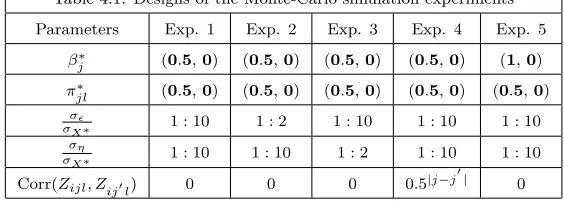
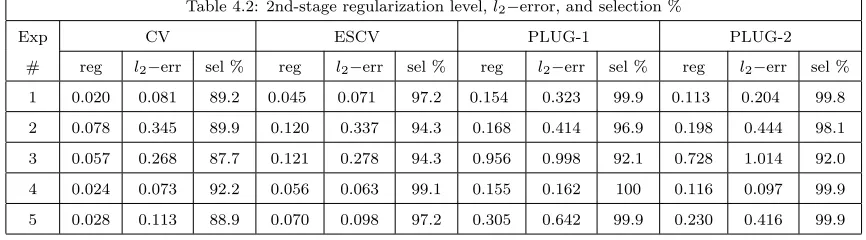
To test the applicability of the model-free criteria discussed above in our problem, we simu-late data sets with various model structures in Section 4 and apply either the Lasso+CV or the Lasso+ESCV in both (3) and (4). An estimate ˆβ of β∗ is a function of λmj
n,j
p
j=1 and λ
m n where mj = 1, ..., M for j = 1, ..., p, and m = 1, ..., M. Ideally, the best λmn should be selected as the
optimum that minimizes the CV or the ESCV criterion over all combinationshλmn,(λmj
n,j) p j=1
i
. This procedure, however, is computationally expensive when p is large as the number of combinations scales asMp. Instead, we use the heuristic which selects λmn only as the optimum that minimizes
the CV or the ESCV criterion over combinations
λmn,(λm
∗
j
n,j) p j=1
whereλm
∗
j
n,j is the optimum choice
for estimating the jth equation in the first-stage. We then compare such λmn := λmn∗ with the feasible (plug-in) counterpart of the theoretical choice in (9).
To construct the feasible (plug-in) counterpart of (9), instead of trying to deal with all the unknown parameters and constant c1 in T1 (6) (which bounds the first-stage prediction error
maxj=1,...,p
q 1
n
Pn