Modular resource development and diagnostic evaluation framework for
fast NLP system improvement
Ga¨el de Chalendar, Damien Nouvel
CEA, LIST, Multilingual Multimedia Knowledge Engineering Laboratory, F-92265 Fontenay-aux-Roses, France.
{Gael.de-Chalendar,Damien.Nouvel}@cea.fr
Abstract
Natural Language Processing systems are large-scale softwares, whose development in-volves many man-years of work, in terms of both coding and resource development. Given a dictionary of 110k lemmas, a few hundred syntactic analysis rules, 20k ngrams matrices and other resources, what will be the impact on a syntactic analyzer of adding a new pos-sible category to a given verb? What will be the consequences of a new syntactic rules ad-dition? Any modification may imply, besides what was expected, unforeseeable side-effects and the complexity of the system makes it dif-ficult to guess the overall impact of even small changes. We present here a framework de-signed to effectively and iteratively improve the accuracy of our linguistic analyzer LIMA by iterative refinements of its linguistic re-sources. These improvements are continu-ously assessed by evaluating the analyzer per-formance against a reference corpus. Our first results show that this framework is really help-ful towards this goal.
1 Introduction
1.1 The evaluation framework
In Natural Language Processing (NLP), robustness and reliability of linguistic analyzers becomes an everyday more addressed issue, given the increas-ing size of resources and the amount of code im-plied by the implementation of such systems. Be-yond choosing a sound technology, one must now have efficients and user-friendly tools around the system itself, for evaluating its accuracy. As shown
by (Chatzichrisafis et al., 2008), where developers receive daily reports of system’s performance for improving their system, systematic evaluation with regression testing has shown to be gainful to accel-erate grammar engineering.
Evaluation campaigns, where several participants evaluate their system’s performance on a specific task against other systems, are a good mean to search for directions in which a system may be able to improve its performance. Often, these evaluation campaigns also give possibility for participants to run their analyzer on test data and retrieve evalua-tion results. In this context, parsers authors may rely on evaluation campaigns to provide performance re-sults, but they should also be able to continuously evaluate and improve their analyzers between evalu-ation campaigns. We aim at providing such a generic evaluation tool, using evaluation data to assess sys-tems accuracy, this software will be referenced as the “Benchmarking Tool”.
Approaches concerning Natural Language Pro-cessing involve everyday more and more resource data for analyzing texts. These resources have grown enough (in terms of volume and diversity), that it now becomes a challenge to manipulate them, even for experienced users. Moreover, it is needed to have non-developers being able to work on these resources: it is necessary to develop accessible tools through intuitive graphical user interfaces. Such a resource editing GUI tool represent the second part of our contribution, called the “Resource Tool”.
The overall picture is to build a diagnostic frame-work enabling a language specialist, such as a lin-guist, to status, almost in real-time, how
tions impact our analyzer on as much test data as possible. For analyzers, each resource may have an effect on the final accuracy of the analysis. It is of-ten needed to iterate over tests before understanding what resource, what part of the code needs to be im-proved. This is especially the case with grammar engineering, where it is difficult to predict the con-sequences of modifying a single rule. Ideally, our framework would allow the manipulator to slightly alter a resource, trigger an evaluation and, almost in-stantaneously, view results and interpret them. With this framework, we expect a large acceleration in the process of improving our analyzer.
In the remaining of this introduction, we will describe our analyzer and Passage, a collabora-tive project including an evaluation campaign and the production of a reference treebank for French through a voting procedure. Section 2 will describe our evaluation framework; its architecture, its two main modules and our first results using it. Section 3 describes some related works. We conclude in sec-tion 4 by describing the next steps of our work.
1.2 The LIMA linguistic analyzer
Our linguistic analyzer LIMA (LIc2m Multilingual Analyzer, (Besancon and de Chalendar, 2005)), is implemented as a pipeline of independent modules applied successively on a text. It implements a de-pendency grammar (Kahane, 2000) in the sense that produced analysis are exclusively represented as bi-nary dependency relations between tokens.
The analyzer includes, among other modules, a tokenizer segmenting the text based on punctuation marks, a part of speech tagger, short and long dis-tance dependencies extractors based on finite-state automata defined by contextualized rules. The latter rules express successions of categories, augmented with constraints (on words inflexion, existence of other dependencies, etc.). The analyzer also in-cludes modules to find idiomatic expressions and named entities that, once recognized, are merged into a single token, thus allowing grammar rules to apply on those. Furthermore, modules may be spe-cialized in processing language-specific phenomena, e.g. Chinese tokenization, German compounds, etc. Currently, the analyzer is able to process more or less deeply ten languages, including English, Span-ish, Chinese, Arab, French and German.
1.3 The Passage Project
Our work is part of the Passage project (Clergerie et al., 2008b). The objectives of this project are twofold. Firstly, it organizes two evaluation cam-paigns of syntactic analyzers (around 15 participat-ing systems) for the French language. Secondly, it aims at producing a large scale reference treebank for French by merging the output of all the partic-ipating parsers, using a Rover (Recognizer Output Voting Error Reduction) (Fiscus, 1997) approach.
Within this project, syntactic annotations are pro-duced in a common format, rich enough to represent all necessary linguistic features and simple enough to allow participating parsers (using very different parsing approaches) to represent their analysis in this format. It is an evolution of the EASy cam-paign format, mixing simple non recursive chunks and dependency relations between chunks or tokens. It respects two proposed ISO specifications: MAF (ISO 24611) and SynAF (ISO 24615). The chunks and dependencies types are issued from the ISO data category registry, DCR1, currently using the French
language section names. The syntactic analysis of a corpus in the Passage format provides information about:
• Segmentation of the corpus into sentences
• Segmentation of sentences into forms
• Non-recursive typed (listed in Table 1) chunks embedding forms
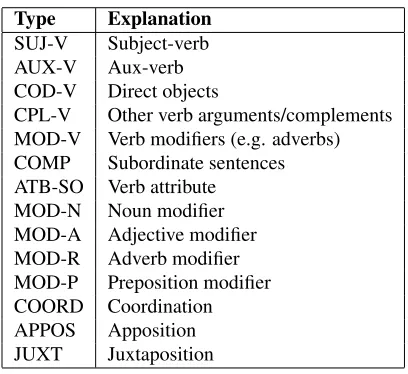
• Labeled typed (listed in Table 2) dependencies that are anchored by either forms or chunks
Type Explanation
GN Nominal Chunk NV Verbal Kernel GA Adjectival Chunk GR Adverbial Chunk GP Prepositional Chunk
[image:2.612.313.516.545.629.2]PV Prepositional non-tensed Verbal Kernel Table 1: Chunks types
Within the EASy project, parsers have been eval-uated against a reference, which itself was a small subset of the available corpora. The reference was
Type Explanation
SUJ-V Subject-verb AUX-V Aux-verb COD-V Direct objects
CPL-V Other verb arguments/complements MOD-V Verb modifiers (e.g. adverbs) COMP Subordinate sentences ATB-SO Verb attribute
[image:3.612.71.275.57.244.2]MOD-N Noun modifier MOD-A Adjective modifier MOD-R Adverb modifier MOD-P Preposition modifier COORD Coordination APPOS Apposition JUXT Juxtaposition
Table 2: Dependencies types
created by human annotation of random sentences within the corpora. Thus, once this evaluation cam-paign had been finished, the annotated corpora ref-erence was released for participants to test and im-prove their parser. Currently, we use this reference for benchmarking our analyzer.
1.4 Metrics for parsing evaluation
We are constantly recalled that evaluation metrics and methodologies evolve and are subject to intense research and innovation (Carroll et al., 2002). Dis-cussing these metrics is not in the scope of this pa-per, we only need to be able to work out as many metrics as possible on the entire corpus or on any part of it. The evaluation is supposed, for each doc-ument dand for each type (of chunk or of depen-dency) twithin all types setT, to return following counts:
• Number of items found and correct -f c(d, t)
• Number of items found -f(d, t)
• Number of items correct -c(d, t)
With this approach, we are able to compute com-mon Information Retrieval (IR) metrics (Rijsbergen, 1979): precision, recall, f-measure. We also intro-duce a new metric that gives us indications about what types are the most lowering overall perfor-mance, called “Type error ratio”:
f(d, t) +c(d, t)−2.f c(d, t)
Pt∈T
f(d, t) +c(d, t)−2.f c(d, t) (1)
This metric counts the number of errors and misses for a given type reported to the total number of errors and misses. It allows us to quantify how much an improvement on a given type will improve the overall score. In our case, scores are computed for chunks on the one hand, and for dependencies on the other hand. For instance, we have notices that GN errors represent 34.6% of the chunks errors, whereas PV only represent 2.2%: we are thus much more interested in improving detection of GN than PV regarding current evaluation campaign.
2 The evaluation framework 2.1 Architecture
We need our framework to be portable and to be im-plemented using an agile approach: each new ver-sion should be fully functional while adding some more features. It also must be user-friendly, allow-ing to easily add eye-candy features. Consequently, we have chosen to implement these tools in C++, using the Qt 4.5 library2. This library satisfies our
requirements and will allow to rely on stable and open source (LGPL) tools, making it feasible for us to possibly deliver our framework as a free software. This approach allows us to quickly deliver work-ing software while continuously testwork-ing and devel-oping it. Iterations of this process are still occurring but the current version, with its core functions, al-ready succeeded in running benchmarks and in be-ginning the improvement of our linguistic resources while regularly delivering upgraded versions of our framework. First results of this work will be pre-sented below in this paper.
The open architecture we have chosen implies to use externals tools, for analysis and evaluation on the one hand, for compiling and installing resources on the other hand. These tools may then be con-sidered as black boxes, being externals commands called with convenient parameters. In particular, the Benchmarking Tool relies on two commands: the analyzer command, receiving input file as a param-eter and producing the analyzed file, the evaluation command, receiving the analyzed file and the ref-erence file as parameters and outputting counts of found, correct, found and correct items for each di-mension. This allows, for example, to replace our
analyzer with another one, by just wrapping the lat-ter in a thin conversion layer to convert its inputs and its outputs.
2.2 Benchmarking Tool
[image:4.612.97.270.269.373.2]The Benchmarking Tool, which architecture is de-picted in Figure 1, is responsible of executing anal-ysis and evaluation on pairs of data and reference files, using commands stored in benchmarking con-figuration. For each pair of files, the registered anal-ysis command is executed followed by the evalua-tion one. In our case, those commands apply to the task of annotating files for syntactic chunks and de-pendencies.
Figure 1: Benchmarking Tool data flow
We may consider the type of chunks and depen-dencies as dimensions of an evaluation. To a certain extent, these may be associated to linguistics phe-nomena which are tested, as proposed within the TSNLP project (Balkan et al., 1994) or, more re-cently, for Q/A systems by (Paiva et al., 2008). But in these projects, focus is also made on the evalua-tion tool, where we do not implement the evaluaevalua-tion tool but rely on an external program to provide ac-curacy of analysis.
The pairs of data and reference files are inserted inside a structure implemented as a pipeline, which may be modified (adding, removing, reordering units) with common GUI interfaces. After creation of the pipeline, the user may trigger a benchmark-ing (progress is shown by colorbenchmark-ing pipeline units), which may be suspended, resumed or restarted at any moment. For note, the current version of the framework uses the local machine’s processors to analyze pipeline units in parallel, but we intend to distribute the analyzes on the available nodes of a cluster soon. As soon as results are received, tables and graphics are updated on screen within a view
showing previous and current results for each eval-uated dimension. To refine diagnosis, the user may choose what dimensions are displayed, what met-rics should be computed, and what pipeline units are used. Finally, any evaluation may be deleted if the corresponding modification did not increase perfor-mance and should be reverted.
Upon demand, the tool saves current benchmark-ing configuration and results as an XML file. Con-versely, it loads a pipeline and results from file, so as to resume or switch between evaluations. The parsed output of the evaluator tool is recorded for each pipeline unit and for each dimension, so that metrics based on those quantities are computed for each pipeline unity or for the overall corpus. Be-sides, the date and a user comment for each evalua-tion are also saved for these records. Writing com-ments has proved to be very helpful to keep track of what changes have been made on code, linguistic resources, configuration, parameters, etc.
As an example within the Passage project, run-ning evaluation with the Benchmarking Tool al-lowed us to notice that we had difficulties in rec-ognizing verb-auxiliary dependencies. Considering previous results, we detected that this issue appeared after having introduced a set of idioms concerning pronominal verbs. Unit testing showed that the anal-ysis of past perfect progressive for pronominal verbs was buggy. Patching the code gave us a 10 points f-measure gain for AUX-V dimension and 0.3 for all dependencies dimensions (AUX-V having a 2.6% global error rate within dependencies). Thus, bench-marking results have been saved with appropriate comment and other improvements or deficiencies could be examined.
With these features, the tool offers the possibility to have an overall view on evaluation results and on their evolution across time, given multiple data, di-mensions of analysis and computed metrics. There-fore, it helps us, without any complex manipulation, to get a visual report on what implication on evalu-ation results has a modificevalu-ation to the analysis pro-cess. Furthermore, those tests allow to search for errors in resources as well as in code, so as to find how to enrich our linguistic resources or to identify deficiencies in our code.
Figure 2: Chunks (CONSTS), dependencies (RELS), nominal chunks (GN) and direct objects dependencies (COD V) f-measure results evolution through 4 evaluations on a 24 files corpus
results. The central table shows the measures corsponding to 4 successive evaluations, displaying re-sults for the dimensions selected on the top most part (check-boxes). The right-hand side shows graph-ically the same data, successive evaluations being displayed as its abscissa and measures as its ordi-nate.
2.3 Resource Tool
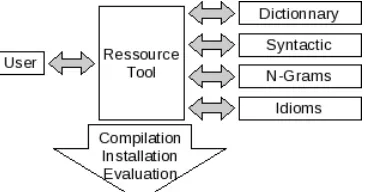
The Resource Tool, which modular design is de-picted in Figure 3, aims at making resources edit-ing accessible for people who have neither a deep knowledge of the system internals nor computer pro-gramming skills. Enriching our resources implies having people, either specialized in linguistics or in testing to interact with the resources, even if not ac-customed to our specific storage format for each re-source.
In its current version, the Resource Tool allow to edit the following resources:
• Dictionary: items and their categories
• Syntactic rules: syntactic dependency detection
Figure 3: Resource Tool modular design
• Part-of-speech tagger learning corpus: tagged examples ofngramsdisambiguation matrices
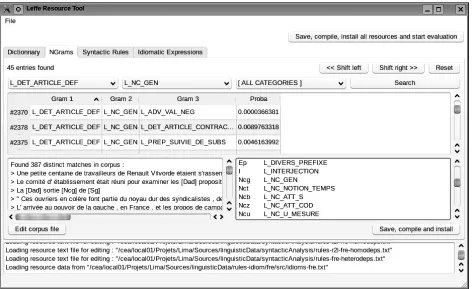
[image:5.612.335.518.386.482.2]ba-Figure 4: Viewing and editing disambiguation matrices: probabilities and examples for articles followed by nouns
sic in terms of edition capacities. Dictionary has a dedicated interface for editing words and their cat-egories, but ngrams, syntactic rules and idioms re-sources may yet only be changed through a basic text editor.
Figure 4 shows the resource tool interface for the annotated corpus that allows to build part-of-speech disambiguation matrices. The top most tabs allow to switch between resources among editable ones. The data table shows the computed 3-grams (from our own tag set). The left part text field shows a list of sentences, where occurrences of the ngrams selected in the above table appear. The right part text field shows correspondences between two tag sets. Eventually, the “Edit corpus file” button opens an editor for the user to add sentences or to modify sentences in the tagged corpus.
The Resource Tool and the Benchmarking Tool communicate together through two signals: on the one hand when resources are installed, the Resource Tool may trigger an evaluation in the Benchmarking Tool, on the other hand when the evaluation has fin-ished, the Resource Tool is notified and warns the user. Being aware of their respective status, we also
warn the user for dangerous operations, like when trying to install resources while a benchmarking is still running, or when quitting the application before last benchmark is finished.
While these two applications are connected to be aware of benchmarking and resource installation sta-tus, no more interaction has been implemented for the moment to link evaluation and resource edition together. We have considered implementing a fea-ture making possible to automatically do unit testing resource modifications, but, from our point of view, this has to be implemented with following restric-tions: the Benchmarking Tool should remain generic (modifying configuration and resources should not be part of the tool) ; amount of required disk space should remain minimal (only differences between evaluations should be stored).
2.4 Preliminary results
[image:6.612.73.545.59.348.2]Chunks Dependencies Modifications
F P R F P R
72.6 72.0 73.2 45.9 54.2 39.8 Initial evaluation
76.3 76.2 76.3 47.5 56.1 41.1 Code reengineering / debugging 76.7 76.7 76.7 47.6 56.2 41.3 New set of syntactic rules
[image:7.612.125.488.60.144.2]76.9 76.9 76.9 47.8 56.7 41.4 Specified preposition detection rules
Table 3: Benchmarking results, f-measure (F), precision (P), recall (R)
measures are relevant for improving the quality of analysis produced by our parser.
We applied our resource improvement methodol-ogy on a small annotated corpus of approximately 80.000 words, delivered after the EASy campaign, among 27 thematic files. For information, the whole process (analysis and evaluation for each file) is 5 minutes long on a bi-processor: this allows the soft-ware to be used intensively on a personal computer. Results in Table 3 show that the use of our frame-work already allowed us to introduce modifications of the linguistic resources with the Resource Tool; these changes lead to a slight improvement of the overall score of the system.
First, we obtained confirmation that some code reengineering and some debugging was required. These tasks, associated with iterative evaluation, have allowed us to detect parts of the code which did not give entire satisfaction, especially in the step transforming output from our analyzer to the ex-pected Passage format. We also found a bug within the evaluation scripts, which, once corrected, forced to restart evaluation measures from the beginning: this shows the importance of having a stable en-vironment apart analyzer (evaluation process, valid data and reference file). These results show that iter-ating over time and saving history may help to reveal potential weaknesses of the code and to detect what goes wrong.
Secondly, these tools where well-suited for eval-uating the impact of a new set of syntactic rules, for which we did not have opportunities to do pre-cise evaluation before. For this set of 20 rules, we systematically tried each rule separately, then kept the combination of the rules increasing scores. This improvement may appear as minimal, but these rules where written in the context of an ongoing work on our grammar. It gave an intuitive idea that this approach is not a dead-end and may be further
explored. Besides, methodologies have been sug-gested to test the impact of each rule in the entire set of rules by systematically testing combinations of rules. But, currently, this is beyond our goal.
Finally, we also introduced some “syntactic sugar”, by grouping some expressions within rules, and successfully obtained insurance that these mod-ification did not lower scores. This is an important result for us in the sense that we ensure that the same set of rules expressed differently (with rules more concise thus more readable) do not introduce regres-sions.
3 Related works
We have previously described the test suite proach, along with the TSNLP project. This ap-proach was concerned with identifying and system-atically testing linguistic phenomena. As a conclu-sion of TSNLP, (Oepen et al., 1998) points out the necessity “to assess the impact of individual contri-butions, regularly evaluate the quality of the overall grammar, and compare it to previous versions”. This project thus showed how positive it is to identify de-ficiencies and improve grammars by iterating tests over time. This is the goal we intend to reach with our framework.
Close to our Benchmarking Tool, some projects aim at building frameworks for text analysis, an-notation and evaluation, which projects encourage people to use a common architecture, as openNLP or GATE. Those may also be used for benchmark-ing and evaluation tasks (Cunnbenchmark-ingham et al., 2002) as part of their process. But, while these frame-work often provide evaluation and regression test-ing tools, they are rarely well-suited for only imple-menting specific diagnostic tasks. We would appre-ciate that such frameworks focusing on evaluating, benchmarking and diagnosing, as generic as possi-ble across IR tasks, become more widely availapossi-ble. If our Benchmarking Tool appears to be appropri-ate for other systems evaluations, we will consider making it available for the IR community.
4 Conclusions and future work
From our first use of the framework, we are con-vinced of the importance of diagnostic for acceler-ating the improvement of our analyzer, by making linguistic resources accessible and by iterating tests and comparing results obtained over time. We also concluded that this generic framework would be use-ful in other tasks, such as Information Retrieval. Es-pecially, image retrieval is a very active and growing field of research, and we currently consider apply-ing the Benchmarkapply-ing Tool for acceleratapply-ing the im-provement of the image retrieval system developed in our laboratory (Joint et al., 2004).
This work also emphasizes the great distinc-tion between performance evaluadistinc-tion and diagnos-tic evaluation. In our case, the association of the Benchmarking Tool and the Resource Tool used in conjunction with unit and regression testings helps to identify what part of the analysis process is con-cerned and, for grammar engineering, what rule or set of rules have to be questioned in order to improve the overall system performance.
Future directions of our work include the paral-lelization of the analysis on a cluster, so as to re-trieve evaluation results as quickly as possible. This should allow us to use evaluation results from a larger annotated corpus. We also intend to focus on visualization of results for better identification and interpretation of errors, in order to access directly er-roneous analysis and involved resources. A second
development iteration will include the development of more user friendly resources editors.
We also plan to work on automatic syntactic rules inference, based on previous work in our laboratory (Embarek and Ferret, 2008). For this goal, contin-uous benchmarking will be even more important as the system will rely on experts tuning parameters for learning rules, the syntactic rules themselves being not necessarily edited nor viewable for the expert.
Acknowledgments
This work was partly funded by the French National Research Agency (ANR), MDCA program 2006.
References
Lorna Balkan, Klaus Netterz, Doug Arnold, Siety Meijer, 1994. Test Suites for Natural Language Processing.
Proceedings of the Language Engineering Convention (LEC’94), 17–22.
William A Baumgartner, Kevin Bretonnel Cohen, Lawrence Hunter, 2008. An open-source framework for large-scale, flexible evaluation of biomedical text mining systems. Journal of Biomedical Discovery and Collaboration 2008, Vol. 3, pp 1.
Romaric Besanc¸on, Ga¨el de Chalendar, 2005.
L’analyseur syntaxique de LIMA dans la campagne d’valuation EASY. Actes des Ateliers de la 12e Con-frence annuelle sur le Traitement Automatique des Langues Naturelles (TALN 2005), Vol. 2, pp 21. John Carroll, Anette Frank, Dekang Lin, Detlef Prescher,
Hans Uszkoreit, 2002. Proceedings of the workshop beyond parseval - toward improved evaluation mea-sures for parsing systems. Proceedings of the 3rd International Conference on Language Resources and Evaluation (LREC’02).
Nikos Chatzichrisafis, Dick Crouch, Tracy Holloway King, Rowan Nairn, Manny Rayner, Marianne Santa-holma, 2007. Regression Testing For Grammar-Based Systems. Proceedings of the GEAF07 Workshop, pp 128–143.
Eric V. de la Clergerie, Olivier Hamon, Djamel Mostefa, Christelle Ayache, Patrick Paroubek, Anne Vilnat, 2008. PASSAGE: from French Parser Evaluation to Large Sized Treebank. Proceedings of the Sixth International Language Resources and Evaluation (LREC’08).
annotations for French. In Proceedings of the interna-tional workshop on Automated Syntactic Annotations for Interoperable Language Resources, Hong-Kong. Hamish Cunningham, Diana Maynard, Kalina
Bontcheva, Valentin Tablan, 2002. GATE: A framework and graphical development environment for robust NLP tools and applications. Proceedings of the 40th Anniversary Meeting of the ACL, 2002. Mehdi Embarek, Olivier Ferret, 2008.Learning patterns
for building resources about semantic relations in the medical domain. 6th Conference on Language Re-sources and Evaluation (LREC’08), Marrakech, Mo-rocco.
Jonathan G. Fiscus, 1997. A Post-Processing System to Yield Reduced Word Error Rates: Recognizer Output Voting Error Reduction (ROVER). Proceedings IEEE Workshop on Automatic Speech Recognition and Un-derstanding (ASRU97), pp 347–352.
Magali Joint, Pierre-Alain Moellic, Patrick Hede, Pas-cal Adam, 2004. PIRIA: a general tool for indexing, search, and retrieval of multimedia content. Proceed-ings of SPIE, Vol. 5298, 116 (2004), San Jose, CA, USA.
Sylvain Kahane, 2000. Les grammaires de dpendance.
Traitement Automatique des Langues, Vol. 41. Stephan Oepen, Daniel P. Flickinger, 1998.Towards
sys-tematic grammar profiling. Test suite technology ten years after. Special Issue on Evaluation 12, 411–436. Valeria de Paiva, Tracy Holloway King, 2008.
Design-ing Testsuites for Grammar-based Systems in Appli-cations. Proceedings of the GEAF08 Workshop, pp 49–56.
Patrick Paroubek, Isabelle Robba, Anne Vilnat, Christelle Ayache, 2006. Data, Annotations and Measures in EASY, the Evaluation Campaign for Parsers of French.
5th Conference on Language Resources and Evalua-tion (LREC’06), Genoa, Italy.