Exploring graph structure for detection of reliability zones within synonym
resources: Experiment with the
Gene Ontology
Thierry Hamon
LIPN – UMR 7030 Universit´e Paris 13 – CNRS
99 av. J-B Cl´ement F-93430 Villetaneuse, France
Natalia Grabar
Centre de Recherche des Cordeliers Universit´e Paris Descartes, UMR S 872
INSERM, U872 HEGP AP-HP, 20 rue Leblanc
Paris, France
Abstract
Computing the semantic similarity between terms relies on existence and usage of seman-tic resources. However, these resources, often composed of equivalent units, or synonyms, must be first analyzed and weighted in or-der to define within them the reliability zones where the semantic cohesiveness is stronger. We propose an original method for acquisition of elementary synonyms based on exploitation of structured terminologies, analysis of syn-tactic structure of complex (multi-unit) terms and their compositionality. The acquired syn-onyms are then profiled thanks to endogenous lexical and linguistic indicators (other types of relations, lexical inclusions, productivity), which are automatically inferred within the same terminologies. Additionally, synonymy relations are observed within graph, and its structure is analyzed. Particularly, we ex-plore the usefulness of the graph theory no-tions such as connected component, clique, density, bridge, articulation vertex, and cen-trality of vertices.
1 Introduction
In various tasks and applications of natural language processing and of biomedical informatics (i.e., query expansions, information retrieval, text mining, infor-mation extraction or terminology matching), it is im-portant to be able to decide whether two terms (i.e.,
acetone anabolism andacetone biosynthesis, repli-cation of mitochondrial DNA and mtDNA replica-tion) convey the same or different meaning. This is particularly important for deciphering and comput-ing semantic similarity between words and terms.
Lexicon of specific resources (synonym, morpho-logical or orthographic variants) can be used for de-tection of semantic similarity. However, depend-ing on languages and domains, such resources are not equally well described. Morphological descrip-tion is the most complete for both general (Bur-nage, 1990; Hathout et al., 2001) and biomedical (NLM, 2007; Schulz et al., 1999; Zweigenbaum et al., 2003) languages. But the situation is not as successful at the semantic level: little synonym re-sources can be found. If WordNet (Fellbaum, 1998) proposes general language synonym relations for English, the corresponding resources for other lan-guages are not freely available. Moreover, the ini-tiative for fitting WordNet to the biomedical area (Smith and Fellbaum, 2004) seems to have been abandoned, although there is a huge need for this kind of resources.
In our previous work, we proposed to use the ex-isting biomedical terminologies (i.e.,Gene Ontology
(Gene Ontology Consortium, 2001), Snomed (Cˆot´e et al., 1997), UMLS (NLM, 2007)), wich provide complex terms, and to acquire from them lexical re-sources of synonyms. Indeed, the use of complex biomedical terms seems to be less suitable and gen-eralizable as compared to lexical resources (Poprat et al., 2008). Within the biological area, we pro-posed to exploit theGene Ontology(GO), and more specifically to exploit compositional structure of its terms (Hamon and Grabar, 2008). However, with the acquisition of synonymy we faced two prob-lems: (1) contextual character of these relations (Cruse, 1986), i.e., two terms or words are con-sidered as synonyms if they can occur within the
same context, which makes this relation more or less broad depending on the usage; (2) ability of automatic tools to detect and characterize these re-lations, i.e., two terms or words taken out of their context can convey different relations than the one expected. Because we aim at acquiring synonymy resources which could be used by various applica-tions and on various corpora, we need to profile them and possibly to detect the reliability zones. We pro-posed to do this profiling through lexical and lin-guistic indicators generated within the same termi-nology (Grabar et al., 2008), such as productivity, cooccurence with other types of relations (is-a,
part-of) and with lexical inclusion. These indi-cators on reliability zones will be used for defining the synonymity degree of terms and for preparing the validation of the acquired synonym resources. In the current work, we continue profiling the acquired synonyms, but rely on the form of the graph built from pairs of synonyms. We exploit for this some notions of the graph theory (Diestel, 2005). In the following of this paper, we first present our mate-rial (sec. 2) and methods (sec. 3), we then present and discuss results (sec. 4) and conclude with some perspectives (sec. 5).
2 Material
We use theGene Ontology(GO) as the original re-source from which synonym lexicon (or elementary synonym relations) are induced. The goal of theGO
is to produce a structured, common, controlled vo-cabulary for describing the roles of genes and their products in any organism. GO terms convey three types of biological meanings: biological processes, molecular functions and cellular components. Terms are structured through four types of relationships: subsumption is-a, meronymy part-of, syn-onymy and regulates. The version, we used in the current work, was downloaded in February 20081. It provides 26,057 concepts and their 79,994
terms. When we create pairs of terms, which we ex-ploit with our methods, we obtain 260,399 is-a, 29,573part-ofand 459,834 synonymy relations. There are very fewregulatesrelations, therefore we don’t exploit them in our work.
1Our previous work has been performed with an anterior version of theGO.
3 Methods
GO terms present compositional structure, like within the concept GO:0009073, where composi-tionality can be observed through the substitution of one of the components (underlined):
aromatic amino acid family biosynthesis aromatic amino acid family anabolism aromatic amino acid family formation aromatic amino acid family synthesis
Compositionality of the GO terms has been ex-ploited previously, for instance (Verspoor et al., 2003) propose to derive simple graphs from relations between complex GO terms, (Mungall, 2004) ex-ploits the compositionality as a mean for consistency checking of theGO, (Ogren et al., 2005) use it for enriching theGOwith missing synonym terms. We propose to exploit the compositionality for induction of synonym lexical resources (i.e.,biosynthesis, an-abolism,formation,synthesisin the given example). While the cited works are based on the string match-ing withinGOterms, our approach aims at exploit-ing the syntactic analysis of terms, which makes it independent from the graphical form of the analyzed terms (like examples on fig. 1). Our method has sev-eral steps: linguistic preprocessing of theGOterms (sec. 3.1), induction of elementary semantic lexi-con (sec. 3.2), and then the profiling the synonymy lexicon through the lexical and linguistic indicators (sec. 3.3), and through the analysis of connected components built from the induced synonym pairs (sec. 3.4). Steps 3.1 to 3.3 have been already de-scribed in our previous work: we mention here the main notions for the sake of clarity.
3.1 Preprocessing theGOterms: Ogmios NLP platform
The aim of terminology preprocessing step is to provide syntactic analysis of terms for computing their syntactic dependency relations. We use the
Ogmiosplatform2and perform: segmentation into
words and sentences; POS-tagging and lemmatiza-tion (Schmid, 1994); and syntactic analysis3.
Syn-tactic dependencies between term components are
2http://search.cpan.org/∼thhamon/Alvis-NLPPlatform/ 3http://search.cpan.org/
component
expansion head component
replication mtDNA
component expansion head
component
[image:3.612.120.493.56.118.2]mitochondrial DNA replication (of)
Figure 1: Parsing tree of the termsreplication of mitochondrial DNAandmtDNA replication.
computed according to assigned POS tags and shal-low parsing rules. Each term is considered as a syn-tactic binary tree composed of two elements: head component and expansion component. For instance,
replicationis the head component of the two terms analyzed on figure 1.
3.2 Acquiring the elementary semantic relations
The notion of compositionality assumes that the meaning of a complex expression is fully deter-mined by its syntactic structure, the meaning of its parts and the composition function (Partee, 1984). On the basis of syntactically analysed terms, we ap-ply a set of compositional rules: if the meaningM
of two complex termsA rel BandA0rel B, where A is its head and B its expansion components, is given as following:
M(A rel B) =f(M(A),M(B),M(rel))
M(A0rel B) =f(M(A0),M(B),M(rel))
for a given composition functionf, ifA rel B and
A0rel Bare complex synonym terms and ifB
com-ponents are identical (such as acetone within ace-tone catabolism andacetone breakdown), then the synonymy relation between components A and A0
{catabolism,breakdown}can be induced. The
mod-ification is also accepted on expansion component
B: from terms replication of mitochondrial DNA
andmtDNA replication(fig. 1), we can induce syn-onymy between mitochondrial DNA and mtDNA. Finally, the modification is also accepted for both components A rel B and A0 rel B0, such as in
nicotinamide adenine dinucleotide catabolism and
NAD breakdown, where one pair,i.e. {catabolism, breakdown}, can be known from previously
pro-cessed synonyms and allow to induce the new pair
{nicotinamide adenine dinucleotide, NAD}. The method is recursive and each induced elementary
synonym relation can then be propagated in order to induce new elementary relations, which allows to generate a more exhaustive lexicon of synonyms.
This method is not specific to the synonymy. As it works at the syntactic level of terms, it there-fore can be applied to other relationships: relation-ship between elementary terms is inherited from the relationship between complex terms. If we ex-ploit complex terms related with part-of rela-tions and if the compositionality rules can be ap-plied, then we can induce elementarypart-of re-lations. For instance, complex terms cerebral cor-tex development GO:0021987 and cerebral cortex regionalization GO:0021796 have a part-of re-lation between them, and we can induce the elemen-tary part-of relation between their components
development andregionalization. Similarly, on the basis of twoGOterms that haveis-arelation be-tween them,cell activationGO:0001775 and astro-cyte activationGO:0048143, we can induce the ele-mentaryis-arelation betweencellandastrocyte.
3.3 Exploiting lexical and linguistic indicators
Several endogenously generated indicators are used for profiling the induced lexicon of synonyms:
• Elementaryis-arelations;
• Elementarypart-ofrelations;
• Lexical inclusion: terms within each induced synonymy pair are controlled for the lexical in-clusion. If the test is positive, like in {DNA binding,binding}, this would suggest that the analyzed terms may convey a hierarchical rela-tion: indeed, lexical subsumption marks often a hierarchical subsumption (Kleiber and Tamba, 1990), which can be eitheris-aorpart-of
relations;
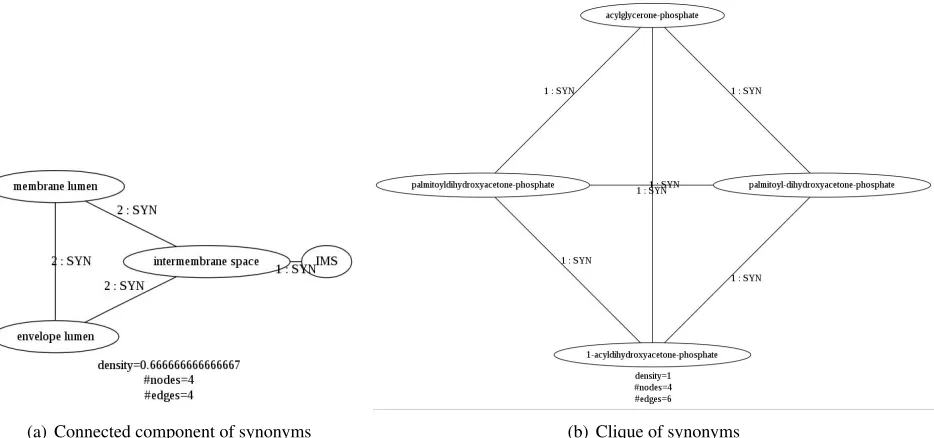
(a) Connected component of synonyms (b) Clique of synonyms
Figure 2: Connected components formed with pairs of elementary synonym relations.
binding} and {cell, lymphocyte} are inferred from only one original pair of GOsynonyms, while the pair {T-cell, T-lymphocyte} is sup-ported by eight originalGOsynonym pairs.
Factors that would weaken synonymy relations and make them less reliable are their co-occurrence with lexical inclusions,is-aorpart-ofrelations, and their low productivity.
3.4 Exploiting the graph theory notions
Pairs of induced synonyms are observed through the connected components they form: lexical entries are
nodes or vertices and relations between them are
edges or paths. For instance, connected component 2(a) contains four pairs of synonyms: {membrane lumen, envelope lumen}, {membrane lumen, in-termembrane space}, {envelope lumen, intermem-brane space}and{intermembrane space,IMS}. On
each edge, we projected information associated with the relation corresponding to this edge. For instance,
{membrane lumen, intermembrane space} relation
is labelled as synonymySY N and shows 2 as
pro-ductivity value (it has been acquired from two origi-nal pairs of synonyms withinGO). If other relation-ships (IN CL, P AR, HIER) are associated to a
given synonymy relation, they are also indicated to-gether with their productivity.
As a matter of fact, figure 2 presents two typical examples of connected components we can obtain (in these examples, both of them have four nodes):
• Connected component(fig. 2(a)) is a graph in which any two vertices are connected to each other by edges. Connected components have not orphan vertices, which would remain not connected to any other vertex.
• Clique, also called block (fig. 2(b)) is a par-ticular case of connected components: clique is a maximally connected component. In such graphs, all the vertices are interconnected be-tween them.
We propose to exploit four more notions of the graph theory, which we assume can be useful for further profiling of the acquired synonymy relations:
fig-ures, we indicate their density, together with the number of vertices and edges).
• Bridge is defined as an edge which
re-moval would increase the number of nected components. For instance, within con-nected component 2(a), removing the edge
{intermembrane space,IMS}would lead to the creation of two new connected components:
(1)single-vertex componentIMS, and(2) con-nected component with three vertices inter-membrane space, membrane lumen and enve-lope lumen. Consequentlyarticulation vertices
are defined as vertices which removal would in-crease the number of connected components. At figure 2(a), the articulation vertex is inter-membrane space.
• Thecentrality of a vertexis defined as the num-ber of shortest paths passing through it. For in-stance, on figure 2(a), intermembrane space’s centrality is 4, while the centrality of other ver-tices is null.
4 Results and Discussion
4.1 Acquiring the elementary synonymy relations and their lexical and linguistic profiling
79 994GOterms have been fully analyzed through the Ogmios platform. Compositional rules (sec. 3.2) have been applied and allowed to induce 9,085 se-mantic relations among which: 3,019 synonyms, 3,243 is-a and 1,205 part-of. 876 lexical in-clusions have discovered within all these elementary pairs. 2,533 synonymy pairs are free of the lexical profiling indicators. However, 486 synonymy rela-tions (16%) cooccur with other relarela-tions, and the de-tails of this cooccurrence is showed in table 1. We can observe for instance that 142 synonym pairs are also labelled asis-arelations, and 34 aspart-of
relations. Productivity of the induced synonyms is between 1 and 422 original complexGOterms.
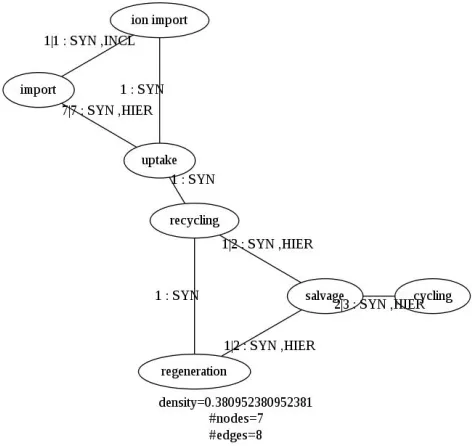
Connected component on figure 3 illustrates coocurrence of synonymy relations with other types of relations: the pair {import, ion import} shows
synonym and inclusion relations; the pair{import,
[image:5.612.314.550.56.279.2]uptake} shows synonym and hierarchical relations, both acquired on seven original pairs ofGOterms.
Figure 3: Connected component where synonymy rela-tions cooccur with other relarela-tions.
Synonymy and other relations Number
syno∩is-a 142
syno∩par 34
syno∩incl 309
syno∩par∩is-a 14
syno∩incl∩is-a\par 40 syno∩incl∩par\is-a 2
syno∩incl∩is-a∩par 1
Table 1: Number of synonymy relations which cooccur with other relations (is-a,part-ofand lexical inclu-sionsincl).
4.2 Analysing the induced synonym pairs through the graph theory
Figure 4: Connected component with three bridges:{ion homeostasis,homeostasis},{homeostasis,regulation}and
{cell cycle control,regulation}.
0.0467 and 1 (in case of cliques). Among the 104 connected components, which are not cliques, we detected 249 bridges: 0 to 35 depending on con-nected components. In order to propose a general approach exploiting graph theory notions for syn-onym profiling we analyse the structure of three rep-resentative connected components.
Density of the connected component 2(a) is 0.67. It contains one bridge: {intermembrane space, IMS}. This edge corresponds to the acronym and its expanded form, which can cause its contextual char-acter. Moreover,intermembrane spaceis the central node of this connected component.
Connected component 3 (density=0.38) contains two bridges {uptake, recycling} and {salvage, cy-cling}, and three articulation vertices uptake, re-cicling and salvage with the measures of central-ity 16, 18 and 10 respectively. Indeed, the
major-ity of shortest paths pass by uptake and recicling
nodes. Otherwise, edges around the salvage ver-tex are weakened because of the cooccurrence of synonymy and hierarchical relations. As we have already noticed, the edge {import, uptake} shows
the cooccurrence of synonymy and hierarchical re-lations, but its productivity is rather high (seven for each relation), which stregthens this edge.
Finally, connected component 4 (density=0.33) contains three bridges{ion homeostasis, homeosta-sis},{homeostasis,regulation}and{cell cycle con-trol,regulation}and three articulation vertices: reg-ulation,cell cycle controlandhomeostasiswith the measures of centrality 52, 37 and 16 respectively. The bridge{ion homeostasis,homeostasis}is
From the analyzed examples, we can see that the graph theory may have several implications on pro-filing of synonyms. However, these implications must still be formalized and, possibly, expressed as a single reliability indicator, alone or combined with the lexical and linguistic clues.
First, within a connected component, with a given number of nodes, higher the number of edges, higher will be its density and closer it will be to a clique (fig. 2(b)). Consequently, within a clique, the se-mantic cohesion is more strong. Indeed, in these cases, terms are far more strongly related between them. But when the density value decreases the se-mantic cohesiveness of connected components de-creases as well. In other words, density is an indi-cation on the semantic cohesiveness between terms within connected components. As for bridges, we assume that they indicate breaking points within connected components, such as{cell cycle control, regulation} within figure 4. The weak character of these points can increased when the synonymy relation co-occurs with other relationships (is-a,
part-of, lexical inclusion). Consequently, re-moval of bridges can create connected components with higher density and therefore with stronger syn-onymy relations. Finally, the centrality of vertices measure may be useful for identification of poly-semic words or terms.
The connected components analysis can also in-dicate the missing relations. For instance, if a con-nected component, which is not a clique, has no bridges but its density is not maximal, this would indicate that it misses some correct synonymy rela-tions which can be easily induced.
5 Conclusion and Perspectives
In this paper, we propose an original method for inducing synonym lexicon from structured termi-nologies. This method exploits the compositional-ity principle and three rules based on syntactic de-pendency analysis of terms. More specifically, we explore various indicators for profiling the acquired synonym relations, which is motivated by the fact that synonymy is a contextual relation and its va-lidity and universality is not guaranteed. We as-sume the semantic cohesiveness of synonymy rela-tions should be qualified and quantified. Thus, we
propose several indicators for profiling the inferred synonymy relations and for detecting possible weak and strong points. First, lexical and linguistic clues are generated endogenously within the same termi-nology: other types of elementary semantic relations (is-a andpart-of), lexical inclusions and pro-ductivity of the acquired semantic relations. Then, more specifically, this work is dedicated to explor-ing of the usefulness of notions of the graph the-ory. We propose to study the form and specificities of connected components formed by synonymy re-lations. We exploited the following notions from the graph theory: distinction between connected com-ponents and cliques, their density, bridges and artic-ulation vertices within connected components, and the centrality of their vertices. We observed that the lexical indicators as well as connected components characteristics are helpful for profiling the acquired synonymy relations. These clues are intended to be used for preparing the validation of this lexicon by experts and also for its weighting in order to con-trol and guarantee the specificity of lexicon during its use by automatic tools.
Currently, we study separately the endogeneous lexical indicators, and the characteristics of the con-nected components. However, in the future, these two types of clues should be combined. For this, these indicators should be modelized in order to pro-vide a weight of each edge. This weight can be used for profiling of connected component through the detection of strong and weak points. Notice that the current version of theGraphpackage can-not take into account this additional information on edges and should be modified. Another perspective is the better exploitation of theGene Ontologyand taking into account the nature of synonymy relations as they are labelled by thier creators: exact, broad,
narroworrelated. Additionnally, for a more precise profiling, the four relationships ofGO (synonymy,
is-a, part-ofandregulates) can be cross-validated, while currently, we perform the validation of synonymy relations throughis-aandpart-of
terms and even other relations between GO terms and terms from corpora can be detected. As noticed, this method can be applied to other terminologies and languages as far as structured terminological re-sources and NLP tools exist. For instance, within the context of search of clinical documents, we suc-cessfully tested this method on the French part of the UMLS (Grabar et al., 2009). From a more ontolog-ical perspective, our method can be used for consis-tency checking of a terminologies, like in (Mungall, 2004). Moreover, as this method performs syntactic analysis of terms and their decomposition into se-mantically independent components, it can be used for the transformation of a pre-coordinated terminol-ogy into a post-coordinated one.
References
G. Burnage. 1990. CELEX - A Guide for Users. Centre for Lexical Information, University of Nijmegen. Roger A. Cˆot´e, Louise Brochu, and Lyne Cabana, 1997.
SNOMED Internationale – R´epertoire d’anatomie
pathologique. Secr´etariat francophone international
de nomenclature m´edicale, Sherbrooke, Qu´ebec. David A. Cruse. 1986. Lexical Semantics. Cambridge
University Press, Cambridge.
Reinhard Diestel. 2005. Graph Theory. Springer-Verlag Heidelberg, New-York.
Christian Fellbaum. 1998. A semantic network of en-glish: the mother of all WordNets. Computers and Hu-manities. EuroWordNet: a multilingual database with
lexical semantic network, 32(2-3):209–220.
Gene Ontology Consortium. 2001. Creating the Gene Ontology resource: design and implementation.
Genome Research, 11:1425–1433.
Natalia Grabar, Marie-Christine Jaulent, and Thierry Ha-mon. 2008. Combination of endogenous clues for profiling inferred semantic relations: experiments with gene ontology. InJAMIA (AMIA 2008), pages 252–6, Washington, USA.
Natalia Grabar, Paul-Christophe Varoutas, Philippe Rizand, Alain Livartowski, and Thierry Hamon. 2009. Automatic acquisition of synonym ressources and as-sessment of their impact on the enhanced search in ehrs.Methods of Information in Medicine, 48(2):149– 154. PMID 19283312.
Thierry Hamon and Natalia Grabar. 2008. Acquisition of elementary synonym relations from biological struc-tured terminology. InComputational Linguistics and Intelligent Text Processing (5th International
Confer-ence on NLP, 2006), number 4919 in LNCS, pages 40–
51. Springer.
Nabil Hathout, Fiammetta Namer, and Georgette Dal. 2001. An experimental constructional database: the MorTAL project. In P. Boucher, editor,Morphology book. Cascadilla Press, Cambridge, MA.
WT Hole and S Srinivasan. 2000. Discovering missed synonymy in a large concept-oriented metathesaurus.
InAMIA 2000, pages 354–8.
Georges Kleiber and Ir`ene Tamba. 1990. L’hyperonymie revisit´ee : inclusion et hi´erarchie. Langages, 98:7– 32, juin. L’hyponymie et l’hyperonymie (dir. Marie-Franc¸oise Mortureux).
CJ Mungall. 2004. Obol: integrating language and meaning in bio-ontologies. Comparative and
Func-tional Genomics, 5(6-7):509–520.
NLM, 2007. UMLS Knowledge Sources Manual. Na-tional Library of Medicine, Bethesda, Maryland. www.nlm.nih.gov/research/umls/.
PV Ogren, KB Cohen, and L Hunter. 2005. Implica-tions of compositionality in the Gene Ontology for its curation and usage. InPacific Symposium of
Biocom-puting, pages 174–185.
Barbara H Partee, 1984. Compositionality. F Landman and F Veltman.
Michael Poprat, Elena Beisswanger, and Udo Hahn. 2008. Building a biowordnet using wordnet data struc-tures and wordnet’s software infrastructure - a failure story. InACL 2008 workshop ”Software Engineering, Testing, and Quality Assurance for Natural Language
Processing”, pages 31–9.
Helmut Schmid. 1994. Probabilistic part-of-speech tag-ging using decision trees. InProceedings of the In-ternational Conference on New Methods in Language
Processing, pages 44–49, Manchester, UK.
Stefan Schulz, Martin Romacker, Pius Franz, Albrecht Zaiss, Rdiger Klar, and Udo Hahn. 1999. Towards a multilingual morpheme thesaurus for medical free-text retrieval. InMedical Informatics in Europe (MIE). Barry Smith and Christian Fellbaum. 2004. Medical
wordnet: a new methodology for the construction and validation of information. In Proc of 20th CoLing, pages 371–382, Geneva, Switzerland.
Cornelia M Verspoor, Cliff Joslyn, and George J Papcun. 2003. The gene ontology as a source of lexical seman-tic knowledge for a biological natural language pro-cessing application. InSIGIR workshop on Text
Anal-ysis and Search for Bioinformatics, pages 51–56.
Pierre Zweigenbaum, Robert Baud, Anita Burgun, Fi-ammetta Namer, ´Eric Jarrousse, Natalia Grabar, Patrick Ruch, Franck Le Duff, Benot Thirion, and St´efan Darmoni. 2003. Towards a Unified Medical Lexicon for French. InMedical Informatics in Europe