A Generalised Hybrid Architecture for NLP
Alistair Willis Department of Computing
The Open University, Milton Keynes, UK [email protected]
Hui Yang
Department of Computing The Open University,
Milton Keynes, UK [email protected]
Anne De Roeck Department of Computing
The Open University, Milton Keynes, UK [email protected]
Abstract
Many tasks in natural language process-ing require that sentences be classified from a set of discrete interpretations. In these cases, there appear to be great benefits in using hybrid systems which apply multiple analyses to the test cases. In this paper, we examine a general principle for building hy-brid systems, based on combining the re-sults of several, high precision heuristics. By generalising the results of systems for sentiment analysis and ambiguity recogni-tion, we argue that if correctly combined, multiple techniques classify better than sin-gle techniques. More importantly, the com-bined techniques can be used in tasks where no single classification is appropriate.
1 Introduction
The success of hybrid NLP systems has demon-strated that complex linguistic phenomena and tasks can be successfully addressed using a com-bination of techniques. At the same time, it is clear from the NLP literature, that the perfor-mance of any specific technique is highly depen-dent on the characteristics of the data. Thus, a specific technique which performs well on one dataset might perform very differently on another, even on similar tasks, and even if the two datasets are taken from the same domain. Also, it is possi-ble that the properties affecting the effectiveness of a particular technique may vary within a single document (De Roeck, 2007).
As a result of this, for many important NLP applications there is no single technique which is clearly to be preferred. For example, recent approaches to the task of anaphora resolution include syntactic analyses (Haghighi and Klein,
2009), Maximum Entropy models (Charniak and Elsner, 2009) and Support Vector Machines (Yang et al., 2006; Versley et al., 2008). The perfor-mance of each of these techniques varies depend-ing upon the particular choice of traindepend-ing and test data.
This state of affairs provides a particular op-portunity for hybrid system development. The overall performance of an NLP system depends on complex interactions between the various phe-nomena exhibited by the text under analysis, and the success of a given technique can be sensitive to the different properties of that text. In partic-ular, the text’s or document’s properties are not generally known until the document comes to be analysed. Therefore, there is a need for systems which are able toadapt to different text styles at the point of analysis, and select the most appropri-ate combination of techniques for the individual cases. This should lead to hybridising techniques which are robust or adaptive in the face of varying textual styles and properties.
We present a generalisation of two hybridi-sation techniques first described in Yang et al. (2012) and Chantree et al. (2006). Each uses hybrid techniques in a detection task: the first is emotion detection from suicide notes, the second is detecting nocuous ambiguity in requirements documents. The distinguishing characteristic of both tasks is that a successful solution needs to accommodate uncertainty in the outcome. The generalised methodology described here is partic-ularly suited to such tasks, where as well as se-lecting between possible solutions, there is a need to identify a class of instances where no single so-lution is most appropriate.
2 Hybridisation as a Solution to Classification Tasks
The methodology described in this paper pro-poses hybrid systems as a solution to NLP tasks which attempt to determine an appropriate inter-pretation from a set of discrete alternatives, in par-ticular where no one outcome is clearly prefer-able. One such task is nocuous ambiguity detec-tion. For example, in sentence (1), the pronounhe could refer toBill,Johnor toJohn’s father.
(1) When Bill met John’s father, he was pleased.
Here, there are three possible antecedents forhe, and it does not follow that all human readers would agree on a common interpretation of the anaphor. For example, readers might divide be-tween interpretinghe asBillor asJohn’s father. Or perhaps a majority of readers feel that the sentence is sufficiently ambiguous that they can-not decide on the intended interpretation. These are cases of nocuous ambiguity(Chantree et al., 2006), where a group of readers do not interpret a piece of text in the same way, and may be unaware that the misunderstanding has even arisen.
Similarly, as a classification task, sentiment analysis for sentences or fragments may need to accommodate instances where multiple senti-ments can be identified, or possibly none at all. Example (2) contains evidence of both guiltand love:
(2) Darling wife, — I’m sorry for everything.
Hybrid solutions are particularly suited to such tasks, in contrast to approaches which use a single technique to select between possible alternatives. The hybrid methodology proposed in this paper approaches such tasks in two stages:
1. Define and apply a set of heuristics, where each heuristic captures an aspect of the phe-nomenon and estimates the likelihood of a particular interpretation.
2. Apply a combination function to either com-bine or select between the values contributed by the individual heuristics to obtain better overall system performance.
The model makes certain assumptions about the design of heuristics. They can draw on a mul-titude of techniques such as a set of selection fea-tures based on domain knowledge, linguistic anal-ysis and statistical models. Each heuristic is a
partial descriptorof an aspect of a particular phe-nomenon and is intended as an “expert”, whose opinion competes against the opinion offered by other heuristics. Heuristics may or may not be in-dependent. The crucial aspect is that each of the heuristics should seek to maximise precision or complement the performance of another heuristic. The purpose of step 2 is to maximise the contri-bution of each heuristic for optimal performance of the overall system. Experimental results anal-ysed below show that selecting an appropriate mode of combination helps accommodate dif-ferences between datasets and can introduce ad-ditional robustness to the overall system. The experimental results also show that appropriate combination of the contribution of high precision heuristics significantly increases recall.
For the tasks under investigation here, it proves possible to select combination functions that al-low the system to identify behaviour beyond clas-sifying the subject text into a single category. Be-cause the individual heuristics arepartial descrip-tions of the whole language model of the text, it is possible to reason about the interaction of these partial descriptions, and identify cases where ei-ther none, or many, of the potential interpretations of the text are possible. The systems use either a machine learning technique or a voting strategies to combine the individual heuristics.
In sections 3 and 4, we explore how the pre-viously proposed solutions can be classed as in-stances of the proposed hybridisation model.
3 Case study: Sentiment Analysis
Following Pang et al. (2002) and the release of the polarity 2.0 dataset, it is common for sentiment analysis tasks to attempt to classify text segments as either of positive or negative sentiment. The task has been extended to allow sentences to be annotated as displaying both positive and negative sentiment (Wilson et al., 2009) or indicating the degree of intensity (Thelwall et al., 2010).
each text fragment.
In fact, several of the proposed sentiments were identified using keyword recognition alone, so the hybrid framework was applied only to recognise the sentimentsThankfulness, Love, Guilt, Hope-lessness, Information and Instruction; instances of the other sentiments were too sparse to be reli-ably classified with the hybrid system. A keyword cue list of 984 terms was manually constructed from the training data based on their frequency in the annotated set; no other public emotion lexicon was used. This cue list was used both to recognise the sparse sentiments, and as input to the CRF.
3.1 Architecture
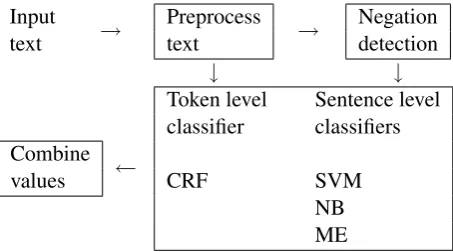
An overview of the architecture is shown in figure 1. Heuristics are used which operate at the word level (Conditional Random Fields), and at the sentence level (Support Vector Machine, Naive Bayes and Maximum Entropy). These are com-bined using a voting strategy that selects the most appropriate combination of methods in each case.
Input
text →
Preprocess
text →
Negation detection
↓ ↓
Combine values ←
Token level Sentence level classifier classifiers
CRF SVM
[image:3.595.302.520.154.296.2]NB ME
Figure 1: Architecture for sentiment classification task
The text is preprocessed using the tokeniser, POS tagger and chunker from the Genia tagger, and parsed using the Stanford dependency parser. This information, along with a negation recog-niser, is used to generate training vectors for the heuristics. Negation is known to have a major ef-fect on sentiment interpretation (Jia et al., 2009).
3.2 Sentiment recognition heuristics
The system uses a total of four classifiers for each of the emotions to be recognised. The only token-level classification was carried out using CRFs (Lafferty et al., 2001) which have been success-fully used on Named Entity Recognition tasks. However, both token- and phrase-level recogni-tion are necessary to capture cases where sen-tences convey more than one sentiment. The
CRF-based classifiers were trained to recognise each of the main emotions based on the main key-word cues and the surrounding context. The CRF is trained on the set of features shown in figure 2, and implemented using CRF++1.
Feature Description
Words word, lemma, POS tag, phrase chunk tag
Context 2 previous words and 2 following words with lemma, POS tags and chunk tags
Syntax Dependency relation label and the lemma of the governer word in focus
Semantics Is it negated?
Figure 2: Features used for CRF classifier
Three sentence-level classifiers were trained for each emotion, those being Naive Bayes and Maximum Entropy learners implemented by the MALLET toolkit2, and a Support Vector Machine model implemented using SVM light3 with the linear kernel. In each case, the learners were trained using a feature vector using the two fea-ture vectors as shown in figure 3.
Feature vector Description Words word lemmas
Semantics negation terms identified by the negative term lexicon, and cue terms from the emo-tion term lexicon
Figure 3: Features used for sentence-level classifiers
A classifier was built for each of the main emo-tions under study. For each of the six emoemo-tions, four learners were trained to identify whether the text contains an instance of that emotion. That is, an instance of text receives 6 groups of results, and each group contains 4 results obtained from different classifiers estimating whether one par-ticular emotion occurs. The combination func-tion predicts the final sentiment(s) exhibited by the sentence.
1
http://crfpp.sourceforge.net/ 2
[image:3.595.65.292.379.505.2]3.3 Combination function
To combine the outputs of the heuristics, Yang et al. (2012) use a voting model. Three different combination methods are investigated:
Any If a sentence is identified as an emotion in-stance by any one of the ML-based models, it is considered a true instance of that emotion.
Majority If a sentence is identified as an emotion instance by two or more of the ML-based models, it is considered a true instance of that emotion.
Combined If a sentence is identified as an emo-tion instance by two or more of the ML-based models or it is identified as an emo-tion instance by the ML-based model with the best precision for that emotion, it is con-sidered a true instance of that emotion.
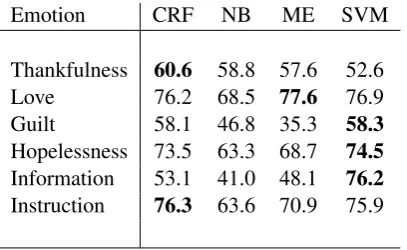
This combined measure reflects the intuition that where an individual heuristic is reliable for a particular phenomenon, then that heuristic’s vote should be awarded a greater weight. The preci-sion scores of the individual heuristics is shown in table 1, where the heuristic with the best preci-sion for that emotion is highlighted.
Emotion CRF NB ME SVM
Thankfulness 60.6 58.8 57.6 52.6 Love 76.2 68.5 77.6 76.9 Guilt 58.1 46.8 35.3 58.3
Hopelessness 73.5 63.3 68.7 74.5
Information 53.1 41.0 48.1 76.2
[image:4.595.80.284.464.589.2]Instruction 76.3 63.6 70.9 75.9
Table 1: Precision scores (%) for individual heuristics
3.4 Results
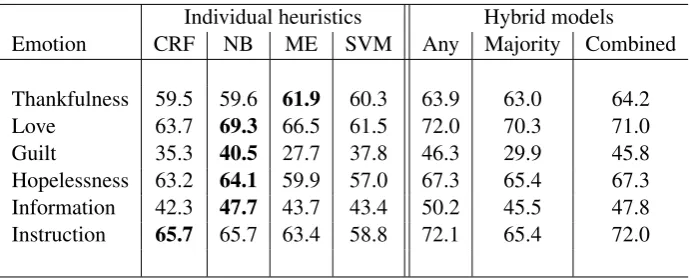
Table 2 reports the system performance on 6 emo-tions by both individual and combined heuristics. In each case, the best performer among the four individual heuristics is highlighted. As can be seen from the table, theAny combinator and the Combined combinators both outperform each of the individual classifiers. This supports the hy-pothesis that hybrid systems work better overall.
3.5 Additional comments
The overall performance improvement obtained by combining the individual measures raises the question of how the individual elements interact. Table 3 shows the performance of the combined systems on the different emotion classes. For each emotion, the highest precision, recall and f-measure is highlighted.
As we would have expected, the Any strategy has the highest recall in all cases, while the Major-ity strategy, with the highest bar for acceptance, has the highest precision for most cases. The AnyandCombinedmeasures appear to be broadly comparable: for the measures we have used, it ap-pears that the precision of the individual classi-fiers is sufficiently high that the combination pro-cess of improving recall does not impact exces-sively on the overall precision.
A further point of interest is that table 2 demon-strates that the Naive Bayes classifier often re-turns the highest f-score of the individual classi-fiers, even though it never has the best precision (table 1). This supports our thesis that a success-ful hybrid system can be built from multiple clas-sifiers with high precision, rather than focussing on single classifiers which have the best individ-ual performance (theCombined strategy favours the highest precision heuristic).
4 Nocuous ambiguity detection
It is a cornerstone of NLP that all text contains a high number of potentially ambiguous words or constructs. Only some of those will lead to misun-derstandings, where two (or more) participants in a text-mediated interchange will interpret the text in different, and incompatible ways, without real-ising that this is the case. This is defined as nocu-ous ambiguity (Willis et al., 2008), in contrast to innocuous ambiguity, where the text is interpreted in the same way by different readers, even if that text supports different possible analyses.
ambigu-Individual heuristics Hybrid models Emotion CRF NB ME SVM Any Majority Combined
Thankfulness 59.5 59.6 61.9 60.3 63.9 63.0 64.2 Love 63.7 69.3 66.5 61.5 72.0 70.3 71.0 Guilt 35.3 40.5 27.7 37.8 46.3 29.9 45.8 Hopelessness 63.2 64.1 59.9 57.0 67.3 65.4 67.3 Information 42.3 47.7 43.7 43.4 50.2 45.5 47.8 Instruction 65.7 65.7 63.4 58.8 72.1 65.4 72.0
Table 2: F-scores (%) for individual and combined heuristics (sentiment analysis)
Any Majority Combined
P R F P R F P R F
Thankfulness 52.6 81.6 63.9 60.6 65.7 63.0 55.0 77.1 64.2
Love 68.7 75.6 72.0 77.9 64.0 70.3 74.6 67.7 71.0 Guilt 46.6 46.2 46.3 50.0 21.4 29.9 50.5 41.9 45.8 Hopelessness 64.1 70.8 67.3 80.3 55.2 65.4 66.3 68.4 67.3
[image:5.595.123.469.70.209.2]Information 40.9 64.9 50.2 49.9 41.8 45.5 45.2 50.7 47.8 Instruction 68.5 76.1 72.1 80.8 54.9 65.4 70.3 73.7 72.0
Table 3: Precision, recall and F-scores (%) for the combined systems (sentiment analysis)
ous text in requirements, but toidentifywhere in-stances of text might display nocuous ambiguity.
These systems demonstrate how, for hybrid systems, the correct choice of combination func-tion is crucial to how the individual heuristics work together to optimise overall system perfor-mance.
4.1 Nocuous Ambiguity: Coordination
Chantree et al. (2006) focus on coordination at-tachment ambiguity, which occurs when a mod-ifier can attach to one or more conjuncts of a coordinated phrase. For example, in sentence (3), readers may divide over whether the modi-fiershortattaches to bothbooksandpapers(wide scope), or only tobooks(narrow scope).
(3) I read some short books and papers.
In each case, the coordination involves a near conjunct, (books in (3)), a far conjunct, (papers) and a modifier (short). The modifier might also be a PP, or an adverb in the case where a VP con-tains the conjunction. In disambiguation, the task would be to identify the correct scope of the mod-ifier (i.e. which of two possible bracketings is the correct one). For nocuous ambiguity detection,
the task is to identify to what extent people inter-pret the text in the same way, and to flag the in-stance as nocuous if they diverge relative to some threshold.
4.1.1 The dataset
17 human judgements were collected for each of 138 instances of sentences exhibiting coor-dination ambiguity drawn from a collection of software requirements documents. The majority of cases (118 instances) were noun compounds, with some adjective and some preposition modi-fiers (36 and 18 instances respectively). Partici-pants were asked to choose between wide scope or narrow scope modifier attachment, or to indi-cate that they experienced the example as ambigu-ous. Each instance is assigned acertaintyfor wide and narrow scope modification reflecting the dis-tribution of judgements. For instance, if 12 judges favoured wide scope for some instance, 3 judges favoured narrow scope and 1 judge thought the instance ambiguous, then the certainty for wide scope is 71% (12/17), and the certainty for nar-row scope is 18% (3/17).
A key concept in nocuous ambiguity is that of anambiguity threshold,τ. For someτ:
of the text, then the ambiguity isinnocuous,
• otherwise the ambiguity isnocuous.
So forτ = 70%, at least 70% of the judges must agree on an interpretation. Clearly, the higherτ is set, the more agreement is required, and the greater the number of examples which will be considered nocuous.
4.1.2 Selectional heuristics
A series of heuristics was developed, each cap-turing information that would lead to a preference for either wide or narrow scope modifier attach-ment. Examples from Chantree et al. (2006) pro-pose seven heuristics, including the following:
Co-ordination Matching If the head words of the two conjuncts are frequently co-ordinated, this is taken to predict wide modifier scope.
Distributional Similarity If the head words of the two conjuncts have high distributional similarity (Lee, 1999), this is taken to pre-dict wide modifier scope.
Collocation Frequency If the head word of the near conjunct has a higher collocation with the modifier than the far conjunct, this is taken to predict narrow modifier scope.
Morphology If the conjunct headwords have similar morphological markers, this is taken to predict wide modifier scope (Okumura and Muraki, 1994).
As with the sentiment recognition heuristics (section 3.2), each predicts one interpretation of the sentence with high precision, but potentially low recall. Recall of thesystem is improved by combining the heuristics, as described in the next section. Note that for the first three of these heuristics, Chantree et al. (2006) use the British National Corpus4, accessed via the Sketch Engine (Kilgarriff et al., 2004), although a domain spe-cific corpus could potentially be constructed.
4.1.3 Combining the heuristics
Chantree et al. (2006) combine the heuristics using the logistic regression algorithms contained in the WEKA machine learning package (Witten and Frank, 2005). The regression algorithm was
4http://www.natcorp.ox.ac.uk/
trained against the training data so that the text was interpreted as nocuouseitherif there was ev-idence for both wide and narrow modifier scope orif there was no evidence for either.
This system performed reasonably for mid-range ambiguity thresholds (around50% < τ <
80%; for high and low thresholds, naive base-lines give very high accuracy). However, in sub-sequent work, Yang et al. (2010b) have demon-strated that by combining the results in a similar way, but using the LogitBoost algorithm, signifi-cant improvements can be gained over the logis-tic regression approach. Their paper suggests that LogitBoost provides an improvement in accuracy of up to 21% in the range of interest forτ over that of logistic regression.
We believe that this improvement reflects that LogitBoost handles interacting variables better than logistic regression, which assumes a linear relationship between individual variables. This supports our hybridisation method, which as-sumes that the individual heuristics can interact. In these cases, the heuristics bring into play dif-ferent types of information (some structural, some distributional, some morphological) where each relies on partial information and favours one par-ticular outcome over another. It would be unusual to find strong evidence of both wide and narrow scope modifier attachment from a single heuristic and the effect of one heuristic can modulate, or enhance the effect of another. This is supported by Chantree et al.’s (2006) observation that although some of the proposed heuristics (such as the mor-phology heuristic) perform poorly on their own, their inclusion in the regression model does im-prove the overall performance of the system
To conclude, comparing the results of Chantree et al. (2006) and Yang et al. (2010b) demonstrates that the technique of combining individual, high precision heuristics is a successful one. However, the combination function needs careful consider-ation, and can have as large an effect on the final results as the choice of the heuristics themselves.
4.2 Nocuous Ambiguity: Anaphora
three potential antecedents (italicised).
(4) The procedureshall convertthe 24 bit image toan 8 bit image, then display it in a dynamic window.
As with the coordination task, the aim is to identify nocuous ambiguity, rather than attempt to disambiguate the sentence.
4.2.1 The dataset
The data set used for the anaphora task con-sisted of 200 sentences collected from require-ments docurequire-ments which contained a third person pronoun and multiple possible antecedents. Each instance was judged by at least 13 people.
The concept of ambiguity threshold,τ, remains central to nocuous ambiguity for anaphora. The definition remains the same as in section 4.1.1, so that an anaphor displays innocuous ambiguity if there is an antecedent that at leastτ judges agree on, and nocuous ambiguity otherwise. So if, say, 75% of the judges consideredan 8 bit image to be the correct antecedent in (4), then the sentence would display nocuous ambiguity at τ = 80%, but innocuous ambiguity atτ = 70%.
For innocuous cases, the potential antecedent NP with certainty of at least τ is tagged as Y, and all other NPs are tagged as N. Fornocuous cases, potential antecedents withτ greater than 0 are tagged as Q (questionable), or are tagged N otherwise (τ = 0, ie. unselected).
4.2.2 Selectional Heuristics
The approach to this task uses only one selec-tion funcselec-tion (Naive Bayes), but uses the output to support two different voting strategies. Twelve heuristics (described fully in Yang et al. (2010a)) fall broadly into three types which signal the like-lihood that the NP is a possible antecedent:
linguistic such as whether the potential an-tecedent is a definite or indefinite NP
contextual such as the potential antecedent’s re-cency, and
statistical such as collocation frequencies.
To treat a sentence, the classifier is applied to each of the potential antecedents and assigns a pair of values: the first is the predicted class of the antecedent (Y,NorQ), and the second is the associated probability of that classification.
Given a list of class assignments to potential an-tecedents with associated probabilities, a weak positive threshold, WY, and a weak negative threshold,WN:
ifthe list of potential antecedents contains: one Y, no Q, one or more N
or
no Y, one Q, one or more N but noweak negatives
or
onestrong positiveY , any number of Q or N
then
the ambiguity is INNOCUOUS
else
the ambiguity is NOCUOUS
where a classification Y is strong positive if its associated probability is greater thanWY, and a classificationN isweak negativeif its associated probability is smaller thanWN.
Figure 4: Combination function for nocuous anaphora detection with weak thresholds
4.2.3 The combination function
As suggested previously, the choice of com-bination function can strongly affect the system performance, even on the same set of selectional heuristics. Yang et al. (2010a) demonstrate two different combination functions which exploit the selectional heuristics in different ways. Both combination functions use a voting strategy.
The first voting strategy states that a sentence exhibits innocuous ambiguity if either:
• there is a single antecedent labelledY, and all others are labelledN, or
• there is a single antecedent labelled Q, and all others are labelledN.
Model without Model with weak thresholds weak thresholds
τ P R F P R F
0.50 27.2 55.0 45.7 24.1 95.0 59.7
0.60 33.9 67.5 56.3 30.9 97.5 68.1
0.70 45.1 76.2 66.9 43.9 98.4 78.8
0.80 58.0 85.0 77.7 56.1 97.9 85.5
0.90 69.1 88.6 83.9 67.4 98.4 90.1
[image:8.595.71.293.71.195.2]1.0 82.2 95.0 92.1 82.0 99.4 95.3
Table 4: Precision, Recall and f-measure (%) for the two combination functions (anaphora)
Task Selectional heuristics
Combination functions Sentiment CRF Voting
analysis NB - any
SVM - majority
ME - combined
Nocuous 3 distributional logistic ambiguity metrics regression
(coordin-ation) 4 others LogitBoost
Nocuous NB Voting
ambiguity
(anaphora) Voting
(+ threshold)
Table 5: Hybridisation approaches used
The performance of the two voting strategies is shown in table 4. It is clear that the improved overall performance of the strategy with weak thresholds is due to the improvedrecallwhen the functions are combined; the precision is compa-rable in both cases. Again, this shows the desired combinatorial behaviour; a combination of high precision heuristics can yield good overall results.
5 Conclusion
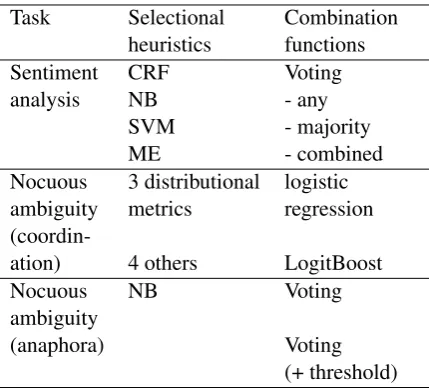
The hybridised systems we have considered are summarised in table 5. This examination suggests that hybridisation can be a powerful technique for classifying linguistic phenomena. However, there is currently little guidance on principles regarding hybrid system design. The studies here show that there is room for more systematic study of the de-sign principles underlying hybridisation, and for investigating systematic methodologies.
This small scale study suggests several prin-ciples. First, the sentiment analysis study has
shown that a set of heuristics and a suitable com-bination function can outperform the best individ-ually performing heuristic or technique. In partic-ular, our results suggest that hybrid systems of the kind described here are most valuable when there is significant interaction between the various lin-guistic phenomena present in the text. This occurs both with nocuous ambiguity (where competition between the different interpretations creates dis-agreement overall), and with sentiment analysis (where a sentence can convey multiple emotions). As a result, hybridisation is particularly power-ful where there are multiple competing factors, or where it is unclear whether there is sufficient evi-dence for a particular classification.
Second, successful hybrid systems can be built using multiple heuristics, even if each of the heuristics has low recall on its own. Our case studies show that with the correct choice of hy-bridisation functions, high precision heuristics can be combined to give good overall recall while maintaining acceptable overall precision.
Finally, the mode of combination matters. The voting system is successful in the sentiment anal-ysis task, where different outcomes are not exclu-sive (the presence ofguilt does not preclude the presence of love). On the other hand, the log-itBoost combinator is appropriate when the dif-ferent interpretations are exclusive (narrow modi-fier scope does preclude wide scope). Here, logit-Boost can be interpreted as conveying the degree of uncertainty among the alternatives. The coor-dination ambiguity case demonstrates that the in-dividual heuristics do not need to be independent, but if the method of combining them assumes in-dependence, the benefits of hybridisation will be lost (logistic regression compared to LogitBoost). This analysis has highlighted the interplay be-tween task, heuristics and combinator. Currently, the nature of this interplay is not well understood, and we believe that there is scope for investigating the broader range of hybrid systems that might be applied to different tasks.
Acknowledgments
[image:8.595.73.288.237.431.2]References
Francis Chantree, Bashar Nuseibeh, Anne De Roeck, and Alistair Willis. 2006. Identifying nocuous ambiguities in natural language requirements. In Proceedings of 14th IEEE International Require-ments Engineering conference (RE’06), Minneapo-lis/St Paul, Minnesota, USA, September.
Eugene Charniak and Micha Elsner. 2009. EM works for pronoun anaphora resolution. InProceedings of the 12th Conference of the European Chapter of the Association for Computational Linguistics (EACL ’09), pages 148–156.
Anne De Roeck. 2007. The role of data in NLP: The case for dataset profiling. In Nicolas Nicolov, Ruslan Mitkov, and Galia Angelova, editors, Re-cent Advances in Natural Language Processing IV, volume 292 ofCurrent Issues in Linguistic Theory, pages 259–266. John Benjamin Publishing Com-pany, Amsterdam.
Aria Haghighi and Dan Klein. 2009. Simple coref-erence resolution with rich syntactic and semantic features. InProceedings of the 2009 Conference on Empirical Methods in Natural Language Process-ing, pages 1152–1161, Singapore, August.
Lifeng Jia, Clement Yu, and Weiyi Meng. 2009. The effect of negation on sentiment analysis and retrieval effectiveness. In The 18th ACM Confer-ence on Information and Knowledge Management (CIKM’09), Hong Kong, China, November. Adam Kilgarriff, Pavel Rychly, Pavel Smrz, and David
Tugwell. 2004. The sketch engine. Technical Re-port ITRI-04-08, University of Brighton.
John Lafferty, Andrew McCallum, and Fernando Pereira. 2001. Conditional random fields: Prob-abilistic models for segmenting and labeling se-quence data. In Proceedings of the International Conference on Machine Learning (ICML-2001), pages 282–289.
Lillian Lee. 1999. Measures of distributional simi-larity. InProceedings of the 37th Annual Meeting of the Association for Computational Linguistics, pages 25–32, College Park, Maryland, USA, June. Association for Computational Linguistics. Akitoshi Okumura and Kazunori Muraki. 1994.
Sym-metric pattern matching analysis for english coor-dinate structures. In Proceedings of the 4th Con-ference on Applied Natural Language Processing, pages 41–46.
Bo Pang, Lillian Lee, and Shivakumar Vaithyanathan. 2002. Thumbs up? Sentiment classification using machine learning techniques. InProceedings of the Conference on Empirical Methods in Natural Lan-guage Processing, pages 79–86, Philadelphia, July. John P. Pestian, Pawel Matykiewicz, Michelle Linn-Gust, Brett South, Ozlem Uzuner, Jan Wiebe, K. Bretonnel Cohen, John Hurdle, and Christopher Brew. 2012. Sentiment analysis of suicide notes:
A shared task. Biomedical Informatics Insights, 5(Suppl 1):3–16.
Mike Thelwall, Kevan Buckley, Georgios Paltoglou, Di Cai, and Arvid Kappas. 2010. Sentiment in short strength detection informal text. Journal of the American Society for Information Science & Technology, 61(12):2544–2558, December. Yannick Versley, Alessandro Moschitti, Massimo
Poe-sio, and Xiaofeng Yang. 2008. Coreference sys-tems based on kernels methods. In Proceedings of the 22nd International Conference on Compu-tational Linguistics (Coling 2008), pages 961–968, Manchester, August.
Alistair Willis, Francis Chantree, and Anne DeRoeck. 2008. Automatic identification of nocuous ambigu-ity. Research on Language and Computation, 6(3-4):355–374, December.
Theresa Wilson, Janyce Wiebe, and Paul Hoffmann. 2009. Recognizing contextual polarity: An explo-ration of features for phrase-level sentiment analy-sis.Computational Linguistics, 35(3):399–433. Ian H. Witten and Eibe Frank. 2005. Data mining:
Practical machine learning tools and techniques. Morgan Kaufmann, 2nd edition.
Xiaofeng Yang, Jian Su, and Chew Lim Tan. 2006. Kernel-based pronoun resolution with structured syntactic knowledge. InProceedings of the 21st In-ternational Conference on Computational Linguis-tics and 44th Annual Meeting of the ACL, pages 41– 48, Sydney, July.
Hui Yang, Anne De Roeck, Vincenzo Gervasi, Al-istair Willis, and Bashar Nuseibeh. 2010a. Ex-tending nocuous ambiguity analysis for anaphora in natural language requirements. In18th Interna-tional IEEE Requirements Engineering Conference (RE’10), Sydney, Australia, Oct.
Hui Yang, Anne De Roeck, Alistair Willis, and Bashar Nuseibeh. 2010b. A methodology for automatic identification of nocuous ambiguity. In23rd Inter-national Conference on Computational Linguistics (COLING 2010), Beijing, China.