Generation for Grammar Engineering
Claire Gardent CNRS, LORIA, UMR 7503 Vandoeuvre-l`es-Nancy, F-54000, France
German Kruszewski Inria, LORIA, UMR 7503 Villers-l`es-Nancy, F-54600, France [email protected]
Abstract
While in Computer Science, grammar engi-neering has led to the development of various tools for checking grammar coherence, com-pletion, under- and over-generation, in Natu-ral Langage Processing, most approaches de-veloped to improve a grammar have focused on detecting under-generation and to a much lesser extent, over-generation. We argue that generation can be exploited to address other issues that are relevant to grammar engineer-ing such as in particular, detectengineer-ing grammar incompleteness, identifying sources of over-generation and analysing the linguistic cover-age of the grammar. We present an algorithm that implements these functionalities and we report on experiments using this algorithm to analyse a Feature-Based Lexicalised Tree Ad-joining Grammar consisting of roughly 1500 elementary trees.
1 Introduction
Grammar engineering, the task of developing large scale computational grammars, is known to be er-ror prone. As the grammar grows, the interactions between the rules and the lexicon become increas-ingly complex and the generative power of the gram-mar becomes increasingly difficult for the gramgram-mar writer to predict.
While in Computer Science, grammar engineer-ing has led to the development of various tools for checking grammar coherence, completion, under-and over-generation (Klint et al., 2005), in Natu-ral Langage Processing, most approaches developed to improve a grammar have focused on detecting
under-generation (that is cases where the grammar and/or the lexicon fails to provide an analysis for a given, grammatical, input) and to a lesser degree over-generation.
In this paper, we argue that generation can be ex-ploited to address other issues that are relevant to grammar engineering. In particular, we claim that it can be used to:
• Check grammar completeness: for each gram-mar rule, is it possible to derive a syntactically complete tree ? That is, can each grammar rule be used to derive a constituent.
• Analyse generation and over-generation: given some time/recursion upper bounds, what does the grammar generate? How much of the out-put is over-generation? Which linguistic con-structions present in a language are covered by the grammar?
We present a generation algorithm called GRADE
(GRAmmar DEbugger) that permits addressing these issues. In essence, this algorithm implements a top-down grammar traversal guided with semantic constraints and controlled by various parameteris-able constraints designed to ensure termination and linguistic control.
The GRADEalgorithm can be applied to any
gen-erative grammar i.e., any grammar which uses a start symbol and a set of production rules to gen-erate the sentences of the language described by that grammar. We present both an abstract descrip-tion of this algorithm and a concrete implementadescrip-tion which takes advantage of Definite Clause Grammars
to implement grammar traversal. We then present the results of several experiments where we use the GRADE algorithm to examine the output of SEM
-TAG, a Feature-Based Lexicalised Tree Adjoining Grammar (FB-LTAG) for French.
The paper is structured as follows. Section 2 summarises related work. Section 3 presents the GRADE algorithm. Section 4 introduces the
gram-mar used for testing and describes an implementa-tion of GRADE for FB-LTAG. Section 5 presents the results obtained by applying the GRADE
algo-rithm to SEMTAG. We show that it helps (i) to detect sources of grammar incompleteness (i.e., rules that do not lead to a complete derivation) and (ii) to iden-tify overgeneration and analyse linguistic coverage. Section 6 concludes.
2 Related Work
Two main approaches have so far been used to im-prove grammars: treebank-based evaluation and er-ror mining techniques. We briefly review this work focusing first, on approaches that are based on pars-ing and second, on those that exploit generation.
Debugging Grammars using Parsing Over the last two decades, Treebank-Based evaluation has be-come the standard way of evaluating parsers and grammars. In this framework (Black et al., 1991), the output of a parser is evaluated on a set of sen-tences that have been manually annotated with their syntactic parses. Whenever the parse tree produced by the parser differs from the manual annotation, the difference can be traced back to the parser (timeout, disambiguation component), the grammar and/or to the lexicon. Conversely, if the parser fails to re-turn an output, undergeneration can be traced back to missing or erroneous information in the grammar or/and in the lexicon.
While it has supported the development of ro-bust, large coverage parsers, treebank based evalu-ation is limited to the set of syntactic constructions and lexical items present in the treebank. It also fails to directly identify the most likely source of parsing failures. To bypass these limitations, error
mining techniques have been proposed which
per-mit detecting grammar and lexicon errors by pars-ing large quantities of data (van Noord, 2004; Sagot and de la Clergerie, 2006; de Kok et al., 2009). The
output of this parsing process is then divided into two sets of parsed and unparsed sentences which are used to compute the “suspicion rate” of n-grams of word forms, lemmas or part of speech tags whereby the suspicion rate of an item indicates how likely a given item is to cause parsing to fail. Error mining was shown to successfully help detect errors in the lexicon and to a lesser degree in the grammar.
Debugging Grammars using Generation Most of the work on treebank-based evaluation and error mining target undergeneration using parsing. Re-cently however, some work has been done which ex-ploits generation and more specifically, surface real-isation to detect both under- and over-generation.
Both (Callaway, 2003) and the Surface Realisa-tion (SR) task organised by the GeneraRealisa-tion Chal-lenge (Belz et al., 2011) evaluate the output of sur-face realisers on a set of inputs derived from the Penn Treebank. As with parsing, these approaches permit detecting under-generation in that an input for which the surface realiser fails to produce a sentence points to shortcomings either in the sur-face realisation algorithm or in the grammar/lexicon. The approach also permits detecting overgeneration in that a low BLEU score points to these inputs for which the realiser produced a sentence that is markedly different from the expected answer.
gener-ate a sentence) and rarely occur in surface realisa-tion success. In this way, they can identify subtrees in the input that are predominantly associated with generation failure.
In sum, tree-bank based evaluation permits de-tecting over- and under-generation while error min-ing techniques permits identifymin-ing sources of er-rors; Treebank-based evaluation requires a refer-ence corpus while error mining techniques require a way to sort good from bad ouput; and in all cases, generation-based grammar debugging requires input to be provided (while for parsing, textual input is freely available).
Discussion The main difference between the GRADE approach and both error mining and tree-bank based evaluation is that GRADE is grammar based. No other input is required for the GRADE
algorithm to work than the grammar1. Whereas
ex-isting approaches identify errors by processing large amounts of data, GRADEidentifies errors by travers-ing the grammar. In other words, while other ap-proaches assess the coverage of a parser or a genera-tor on a given set of input data, GRADEpermits sys-tematically assessing the linguistic coverage and the precision of the constructs described by the grammar independently of any input data.
Currently, the output of GRADEneeds to be
man-ually examined and the sources of error manman-ually identified. Providing an automatic means of sorting GRADE’s output into good and bad sentences is
de-veloped however, it could be combined with error mining techniques so as to facilitate interpretation.
3 The GraDE Algorithm
How can we explore the quirks and corners of a grammar to detect inconsistencies and incorrect out-put?
In essence, the GRADEalgorithm performs a
top-down grammar traversal and outputs the sentences generated by this traversal. It is grammar neutral in that it can be applied to any generative grammar i.e., any grammar which includes a start symbol and a set of production rules. Starting from the string con-sisting of the start symbol, the GRADE algorithm
recursively applies grammar rules replacing one
oc-1Although some semantic input is possible.
currence of its left-hand side in the string by its right-hand side until a string that contains neither the start symbol nor designated nonterminal symbols is pro-duced.
Since NL grammars describe infinite sets of sen-tences however, some means must be provided to control the search and output sets of sentences that are linguistically interesting. Therefore, the GRADE
algorithm is controlled by several user-defined pa-rameters designed to address termination (Given that NL grammars usually describe an infinite set of sen-tences, how can we limit sentence generation to avoid non termination?), linguistic control (How can we control sentence generation so that the sentences produced cover linguistic variations that the linguist is interested in ?) and readibility (How can we con-strain sentence generation in such a way that the out-put sentences are meaningful sentences rather than just grammatical ones?).
3.1 Ensuring termination
To ensure termination, GRADEsupports three
user-defined control parameters which can be used simul-taneously or in isolation namely: a time out parame-ter; a restriction on the number and type of recursive rules allowed in any derivation; and a restriction on the depth of the derivation tree.
Each of these restrictions is implemented as a re-striction on the grammar traversal process as fol-lows.
Time out. The process halts when the time bound is reached.
Derivation Depth. A counter is used to keep track of the depth of the derivation tree and either halts (if no other rule applies) or backtracks whenever the set depth is reached.
3.2 Linguistic Coverage and Output Readibility
GRADEprovides several ways of controlling the lin-guistic coverage and the readibility of the output sentences.
Modifiers. As we shall show in Section 5, the re-cursivity constraints mentioned in the previous sec-tion can be used to constrain the type and the number of modifiers present in the output.
Root Rule. Second, the “root rule” i.e., the rule that is used to expand the start symbol can be con-strained in several ways. The user can specify which rule should be used; which features should label the lhs of that rule; which subcategorisation type it should model; and whether or not it is a recursive rule. For instance, given the FB-LTAG we are using, by specifying the root rule to be used, we can strain the generated sentences to be sentences con-taining an intransitive verb in the active voice com-bining with a canonical nominal subject. If we only specify the subcategorisation type of the root rule e.g., transitive, we can ensure that the main verb of the generated sentences is a transitive verb; And if we only constrain the features of the root rule to in-dicative mode and active voice, then we allow for the generation of any sentence whose main verb is in the indicative mode and active voice.
Input Semantics. Third, in those cases where the grammar is a reversible grammar associating sen-tences with both a syntactic structure and a seman-tic representation, the content of the generated sen-tences can be controlled by providing GRADEwith
an input semantics. Whenever a core semantics is specified, only rules whose semantics includes one or more literal(s) in the core semantics can be used. Determiner rules however are selected inde-pendent of their semantics. In this way, it is possi-ble to constrain the output sentences to verbalise a given meaning without having to specify their full semantics (the semantic representations used in re-versible grammars are often intricate representations
which are difficult to specify manually) and while allowing for morphological variations (tense, num-ber, mode and aspect can be left unspecified and will be informed by the calls to the lexicon embedded in the DCG rules) as well as variations on determin-ers2. For instance, the core semantics{run(E M), man(M)} is contained in, and therefore will gen-erate, the flat semantics for the sentences The man
runs, The man ran, A man runs, A man ran, This man runs, My man runs, etc..
4 Implementation
In the previous section, we provided an abstract de-scription of the GRADEalgorithm. We now describe an implementation of that algorithm tailored for FB-LTAGs equipped with a unification-based composi-tional semantics. We start by describing the gram-mar used (SEMTAG), we then summarise the
im-plementation of GRADEfor FB-LTAG.
4.1 SemTAG
For our experiments, we use the FB-LTAG described in (Crabb´e, 2005; Gardent, 2008). This grammar, called SEMTAG, integrates a unification-based
se-mantics and can be used both for parsing and for generation. It covers the core constructs for non verbal constituents and most of the verbal construc-tions for French. The semantic representaconstruc-tions built are MRSs (Minimal Recursion Semantic representa-tions, (Copestake et al., 2001)).
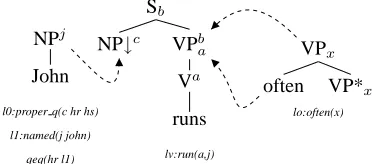
More specifically, a tree adjoining grammar (TAG) is a tuplehΣ, N, I, A, SiwithΣa set of ter-minals, N a set of non-terminals, I a finite set of initial trees,A a finite set of auxiliary trees, andS a distinguished non-terminal (S ∈ N). Initial trees are trees whose leaves are labeled with substitution nodes (marked with a downarrow) or terminal cate-gories3. Auxiliary trees are distinguished by a foot node (marked with a star) whose category must be the same as that of the root node.
2The rules whose semantics is not checked during derivation
are specified as a parameter of the system and can be modified at will e.g., to include adverbs or auxiliaries. Here we choosed to restrict underspecification to determiners.
3Due to space limitation we here give a very sketchy
Two tree-composition operations are used to com-bine trees: substitution and adjunction. Substitu-tion inserts a tree onto a substituSubstitu-tion node of some other tree while adjunction inserts an auxiliary tree into a tree. In a Feature-Based Lexicalised TAG (FB-LTAG), tree nodes are furthermore decorated with two feature structures (called top and bottom) which are unified during derivation; and each tree is anchored with a lexical item. Figure 1 shows an example toy FB-LTAG with unification semantics.
NPj
John
l0:proper q(c hr hs) l1:named(j john)
qeq(hr l1)
Sb
NP↓c VPb a
Va
runs
lv:run(a,j)
VPx
often VP*x
lo:often(x)
[image:5.612.85.274.206.288.2]⇒l0:proper q(c hr hs) l1:named(j john), qeq(hr, l1), lv:run(a,j), lv:often(a)
Figure 1: MRS for “John often runs”
4.2 GraDe for FB-LTAG
The basic FB-LTAG implementation of GRADE is described in detail in (Gardent et al., 2011; Gar-dent et al., 2010). In brief, this implementation takes advantage of the top-down, left-to-right, gram-mar traversal implemented in Definite Clause Gram-mars by translating the FB-LTAG to a DCG. In the DCG formalism, a grammar is represented as a set of Prolog clauses and Prolog’s query mechanism pro-vides a built-in top-down, depth-first, traversal of the grammar. In addition, the DCG formalism allows arbitrary Prolog goals to be inserted into a rule. To implement a controlled, top-down grammar traver-sal of SEMTAG, we simply convert SEMTAGto a Definite Clause Grammar (DCG) wherein arbitrary Prolog calls are used both to ground derivations with lexical items and to control Prolog’s grammar traver-sal so as to respect the user defined constraints on recursion and on linguistic coverage. In addition, we extended the approach to handle semantic straints (i.e., to allow for an input semantic to con-strain the traversal) as discussed in Section 3. That is, for a subset of the grammar rules, a rule will only be applied if its semantics subsumes a literal in the input semantics.
For more details, on the FB-LTAG implementa-tion of the GRADEalgorithm and of the conversion from FB-LTAG to DCG, we refer the reader to (Gar-dent et al., 2011; Gar(Gar-dent et al., 2010).
5 Grammar Analysis
Depending on which control parameters are used, the GRADE algorithm can be used to explore the grammar from different viewpoints. In what fol-lows, we show that it can be used to check grammar completeness (Can all rules in the grammar be used so as to derive a constituent?); to inspect the vari-ous possible realisations of syntactic functors and of their arguments (e.g., Are all possible syntactic real-isations of the verb and of its arguments generated and correct?); to explore the interactions between basic clauses and modifiers; and to zoom in on the morphological and syntactic variants of a given core semantics (e.g., Does the grammar correctly account for all such variants ?).
5.1 Checking for Grammar Completeness
We first use GRADE to check, for each grammar rule, whether it can be used to derive a complete constituent i.e., whether a derivation can be found such that all leaves of the derivation tree are ter-minals (words). Can all trees anchored by a verb for instance, be completed to build a syntactically complete clause? Trees that cannot yield a complete constituent points to gaps or inconsistencies in the grammar.
To perform this check, we run the GRADE
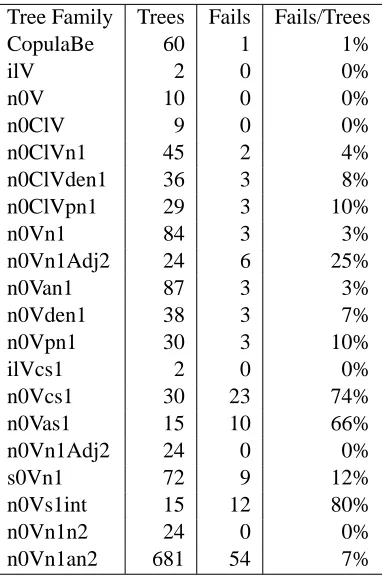
algo-rithm on verb rules, allowing for up to 1 adjunc-tion on either a noun, a verb or a verb phrase and halting when either a derivation has been found or all possible rule combinations have been tried. Ta-ble 1 shows the results per verb family4. As can be seen, there are strong differences between the fam-ilies with e.g., 80% of the trees failing to yield a derivation in the n0Vs1int (Verbs with interrogative sentential complement) family against 0% in the ilV
4
Tree Family Trees Fails Fails/Trees
CopulaBe 60 1 1%
ilV 2 0 0%
n0V 10 0 0%
n0ClV 9 0 0%
n0ClVn1 45 2 4%
n0ClVden1 36 3 8%
n0ClVpn1 29 3 10%
n0Vn1 84 3 3%
n0Vn1Adj2 24 6 25%
n0Van1 87 3 3%
n0Vden1 38 3 7%
n0Vpn1 30 3 10%
ilVcs1 2 0 0%
n0Vcs1 30 23 74%
n0Vas1 15 10 66%
n0Vn1Adj2 24 0 0%
s0Vn1 72 9 12%
n0Vs1int 15 12 80%
n0Vn1n2 24 0 0%
[image:6.612.91.282.53.341.2]n0Vn1an2 681 54 7%
Table 1: Checking for Gaps in the Grammar
(impersonal with expletive subject, “it rains”) and the n0V (intransitive, “Tammy sings”). In total, ap-proximatively 10% (135/1317) of the grammar rules cannot yield a derivation.
5.2 Functor/Argument Dependencies
To check grammar completeness, we need only find one derivation for any given tree. To assess the de-gree to which the grammar correctly generates all possible realisations associated with a given syn-tactic functor however, all realisations generated by the grammar need to be produced. To restrict the output to sentences illustrating functor/argument de-pendencies (no modifiers), we constrain adjunction to the minimum required by each functor. In most cases, this boils down to setting the adjunction coun-ters to null for all categories. One exception are verbs taking a sentential argument which require one S adjunction. We also allow for one N-adjunction and one V-adjunction to allow for determiners and the inverted subject clitic (t’il). In addition, the lex-icon is restricted to avoid lexical or morphological variants.
We show below some of the well-formed sen-tences output by GRADE for the n0V (intransitive verbs) family.
Elle chante (She sings), La tatou chante-t’elle? (Does the armadillo sing? ), La tatou chante (The armadillo sings ), La tatou qui chante (The armadillo which
sings ), Chacun chante -t’il (Does every-one sing? ), Chacun chante (Everyone
sings ), Quand chante chacun? (When
does everyone sing? ), Quand chante la
tatou? (When does the armadillo sing? ) Quand chante quel tatou? (When does
which armadillo sing? ), Quand chante
Tammy? (When does Tammy sing? ), Chante-t’elle? (Does she sing? ) Chante -t’il? (Does he sing? ), Chante! (Sing! ), Quel tatou chante ? (Which armadillo
sing? ), Quel tatou qui chante ..? (Which armadillo who sings ..? ) Tammy
chante-t’elle? (Does Tammy sing? ), Tammy chante (Tammy sings ), une tatou qui chante chante (An armadillo which sings
sings ), C’est une tatou qui chante (It is an armadillo which sings ), ...
The call on this family returned 55 distinct MRSs and 65 distinct sentences of which only 28 were cor-rect. Some of the incorrect cases are shown below. They illustrate the four main sources of overgener-ation. The agreement between the inverted subject clitic and the subject fails to be enforced (a); the in-verted nominal subject fails to require a verb in the indicative mode (b); the inverted subject clitic fails to be disallowed in embedded clauses (c); the inter-rogative determiner quel fails to constrain its nomi-nal head to be a noun (d,e).
(a) Chacun chante-t’elle? (Everyone
sings?) (b) Chant´ee chacun? (Sung every-one?) (c) La tatou qui chante-t’elle? (The armadillo which does she sing?) (d) Quel
chacun chante ? (Which everyone sings?) (e) quel tammy chante ? (Which Tammy
sings?)
5.3 Interactions with Modifiers
explore the interactions between e.g., basic clauses and modification5. Allowing for N-adjunctions for instance, will produce sentences including determin-ers and adjectives. Similarly, allowing for V ad-junction will permit for auxiliaries and adverbs to be used; and allowing for VP or S adjunctions will licence the use of raising verbs and verbs subcate-gorising for sentential argument.
We queried GRADEfor derivations rooted in n0V (intransitive verbs) and with alternatively, 1N, 2N, 1V and 1VP adjunction. Again a restricted lexicon was used to avoid structurally equivalent but lexi-cally distinct variants. The following table shows the number of sentences output for each query.
0 1S 1VP 1V 1N 2N
36 170 111 65 132 638
As the examples below show, the generated sen-tences unveil two further shortcomings in the gram-mar: the inverted subject clitic fails to be constrained to occur directly after the verb (1) and the order and compatibility of determiners are unrestricted (2).
(1) a. Semble-t’il chanter? / * Semble chanter t’il? (Does he seems to sing?)
b. Chante-t’il dans Paris? / * Chante dans Paris-t’il? (Does he sing in Paris?)
c. Chante-t’il beaucoup? / * Chante beaucoup-t’il? (Does he sing a lot?) d. Veut-t’il que Tammy chante? / * Veut que
Tammy chante-t’il? (Does he want that
Tammy sings?
(2) * Un quel tatou, *Quel cette tatou, Ma quelle tatou (Un which armadillo, Which this
ar-madillo, My which armadillo)
5.4 Inspecting Coverage and Correctness
In the previous sections, GRADE was used to gen-erate MRSs and sentences ex nihilo. As mentioned above however, a core semantics can be used to re-strict the set of output sentences to sentences whose MRS include this core semantics. This is useful for
5
Recall that in FB-LTAG, adjunction is the operation which permits applying recursive rules (i.e., auxiliary trees). Hence allowing for adjunctions amounts to allowing for modification with the exception already noted above of certain verbs subcat-egorising for sentential arguments.
Tree Family MRS Sent. S/MRS
ilV 7 52 7.4
n0V 65 161 2.4
n0ClV 30 62 2.0
n0ClVn1 20 25 1.25
n0ClVden1 10 15 1.5 n0ClVpn1 40 63 1.57
n0Vn1 20 110 5.5
n0Van1 30 100 3.33
n0Vden1 5 15 3.00
n0Vpn1 25 76 3.04
ilVcs1 1 1 1.00
n0Vcs1 200 660 3.3
n0Vas1 35 120 3.42
n0Vn1Adj2 10 15 1.5
s0Vn1 4 24 6.00
n0Vn1n2 10 48 4.80
[image:7.612.343.510.53.274.2]n0Vn1an2 5 45 9.00
Table 2: Producing Variants
instance, to systematically inspect all variations out-put by the grammar on a given inout-put. These varia-tions include all morphological variavaria-tions supported by the lexicon (number, tense, mode variations) and the syntactic variations supported by the grammar for the same MRSs (e.g., active/passive). It also in-cludes the variations supported by GRADE in that some rules are not checked for semantic compati-bility thereby allowing for additional materials to be added. In effect, GRADEallows for the inclusion of arbitrary determiners and auxiliaries.
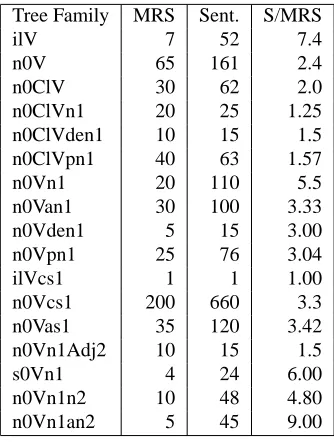
Table 2 shows the number of MRSs and sen-tences output for each verb family given a match-ing core semantics and a morphological lexicon in-cluding verbs in all simple tenses (3rd person only) and nouns in singular and plural6. The ratioS/Mof sentences on MRSs produced by one GRADE call shows how the underspecified core semantics per-mits exploring a larger number of sentences ated by the grammar than could be done by gener-ating from fully specified MRSs. For the n0Vn1an2 class, for instance, the GRADEcall permits ing 9 times more sentences in average than generat-ing from a sgenerat-ingle MRS.
6
6 Conclusion
When using a grammar for generation, it is essen-tial, not only that it has coverage (that it does not undergenerate) but also that it be precise (that it does not overgenerate). Nonetheless, relatively lit-tle work has been done on how to detect overgener-ation. In this paper, we presented an algorithm and a methodology to explore the sentences generated by a grammar; we described an implementation of this algorithm based on DCGs (GRADE ); and we illustrated its impact by applying it to an existing grammar. We showed that GRADE could be used to explore a grammar from different viewpoints: to find gaps or inconsistencies in the rule system; to systematically analyse the grammar account of func-tor/argument dependencies; to explore the interac-tion between base construcinterac-tions and modifiers; and to verify the completeness and correctness of syn-tactic and morphological variants.
There are many directions in which to pursue this research. One issue is efficiency. Unsurpris-ingly, the computational complexity of GRADE is formidable. For the experiments reported here, run-times are fair (a few seconds to a few minutes de-pending on how much output is required and on the size of the grammar and of the lexicon). As the com-plexity of the generated sentences and the size of the lexicons grow, however, it is clear that runtimes will become unpractical. We are currently using YAP Prolog tabling mechanism for storing intermediate results. It would be interesting however to compare this with the standard tabulating algorithms used for parsing and surface realisation.
Another interesting issue is that of the interac-tion between GRADE and error mining. As
men-tioned in Section 2, GRADEcould be usefully com-plemented by error mining techniques as a means to automatically identify the most probable causes of errors highlighted by GRADEand thereby of im-proving the grammar. To support such an integration however, some means must be provided of sorting GRADE’s output into “good” and “bad” output i.e., into sentences that are grammatical and sentences that are over-generated by the grammar. We plan to investigate whether language models could be used to identify those sentences that are most probably incorrect. In a first step, simple and highly
con-strained input would be used to generate from the grammar and the lexicon a set of correct sentences using GRADE. Next these sentences would be used
to train a language model which could be used to detect incorrect sentences produced by GRADE on more complex, less constrained input.
Other issues we are currently pursueing are the use of GRADE (i) for automating the creation of grammar exercises for learners of french and (ii) for creating a bank of MRSs to be used for the evalua-tion and comparison of data-to-text generators. The various degrees of under-specification supported by GRADEpermit producing either many sentences out of few input (e.g., generate all basic clauses whose verb is of a given subcategorisation type as illus-trated in Section 5.2); or fewer sentences out a more constrained input (e.g., producing all syntactic and morphological variants verbalising a given input se-mantics). We are currently exploring how seman-tically constrained GRADE calls permit producing variants of a given meaning; and how these vari-ants can be used to automatically construct gram-mar exercises which illustrate the distinct syntac-tic and morphological configurations to be acquired by second language learners. In contrast, more un-derspecified GRADE calls can be used to automat-ically build a bank of semantic representations and their associated sentences which could form the ba-sis for an evaluation of data-to-text surface realis-ers. The semantics input to GRADE are simplified representations of MRSs. During grammar traver-sal, GRADE reconstructs not only a sentence and its associated syntactic tree but also its full MRS. As a result, it is possible to produce a generation bank which, like the Redwook Bank, groups to-gether MRSs and the sentences verbalising these MRSs. This bank however would reflect the tic coverage of the grammar rather than the linguis-tic constructions present in the corpus parsed to pro-duce the MRS. It would thus provide an alternative way to test the linguistic coverage of existing surface realisers.
Acknowledgments
References
Anja Belz, Michael White, Dominic Espinosa, Eric Kow, Deirdre Hogan, and Amanda Stent. 2011. The first surface realisation shared task: Overview and evalua-tion results. In Proc. of the 13th European Workshop
on Natural Language Generation.
E. Black, S. Abney, D. Flickinger, C. Gdaniec, R. Gr-ishman, P. Harrison, D. Hindle, Ingria R., F. Jelinek, J. Klavans, M. Liberman, M. Marcus, S. Roukos, B. Santorini, and T. Strzalkowski. 1991. A proce-dure for quantitatively comparing the syntactic cov-erage of english grammars. In Proceedings of the
DARPA Speech and Natural Language Workshop,
page 306311.
Charles B. Callaway. 2003. Evaluating coverage for large symbolic NLG grammars. In 18th IJCAI, pages 811–817, Aug.
Ann Copestake, Alex Lascarides, and Dan Flickinger. 2001. An algebra for semantic construction in constraint-based grammars. In Proceedings of the
39th Annual Meeting of the Association for Compu-tational Linguistics, Toulouse, France.
Benoit Crabb´e. 2005. Reprsentation informatique de
grammaires d’arbres fortement lexicalis´ees : le cas de la grammaire d’arbres adjoints. Ph.D. thesis, Nancy
University.
Dani¨el de Kok, Jianqiang Ma, and Gertjan van Noord. 2009. A generalized method for iterative error mining in parsing results. In ACL2009 Workshop Grammar
Engineering Across Frameworks (GEAF), Singapore.
Claire Gardent and Eric Kow. 2007. Spotting overgener-ation suspect. In 11th European Workshop on Natural
Language Generation (ENLG).
Claire Gardent and Shashi Narayan. 2012. Error mining on dependency trees. In Proceedings of ACL.
Claire Gardent, Benjamin Gottesman, and Laura Perez-Beltrachini. 2010. Benchmarking surface realisers. In
COLING 2010 (Poster Session), Beijing, China.
Claire Gardent, Benjamin Gottesman, and Laura Perez-Beltrachini. 2011. Using regular tree grammar to enhance surface realisation. Natural Language En-gineerin, 17:185–201. Special Issue on Finite State
Methods and Models in Natural Language Processing. Claire Gardent. 2008. Integrating a unification-based semantics in a large scale lexicalised tree adjoining grammar for french. In COLING’08, Manchester, UK. Paul Klint, Ralf L¨ammel, and Chris Verhoef. 2005. Toward an engineering discipline for grammarware.
ACM Transactions on Software Engineering Method-ology, 14(3):331–380.
Benoit Sagot and Eric de la Clergerie. 2006. Error min-ing in parsmin-ing results. In ACL, editor, Proceedmin-ings of
the ACL 2006, pages 329–336, Morristown, NJ, USA.
Gertjan van Noord. 2004. Error mining for wide-coverage grammar engineering. In ACL, editor,
Pro-ceedings of the ACL 2004, pages 446–454,
Morris-town, NJ, USA.
K. Vijay-Shanker and Aravind Joshi. 1988. Feature Structures Based Tree Adjoining Grammars.