Saturnino Luz
School of Computer Science and Statistics Trinity College Dublin
Dublin 2, Ireland [email protected]
1
Restructuring multimodal interaction data
for browsing and search
Saturnino Luz Trinity College Dublin
CONTENTS
1.1 Introduction . . . 3
1.2 Recording and analysis of multimodal communication in collaborative tasks . . . 7
1.2.1 Requirements and fieldwork . . . 7
1.2.2 Corpora and meeting browsers . . . 9
1.2.3 Issues and open questions . . . 10
1.3 Modelling interaction . . . 11
1.3.1 A linked time-based model . . . 13
1.4 Case Studies . . . 16
1.4.1 Recording and browsing artefact-based interaction . . . 17
1.4.2 Structuring medical team meetings . . . 18
1.5 Conclusion . . . 23
1.6 Glossary . . . 24
This paper presents recent work on techniques for indexing and structuring recordings of interactive activities, such as collaborative editing, computer-mediated and computer-assisted meetings, and presentations. A unifying ar-chitecture is presented which encompasses modality translation (e.g. speech recognition and image analysis) as well as the underlying recording under a single linked time-based model. This model is illustrated through case studies and implemented prototypes, which support remote multiparty collaboration and co-located recorded meetings. Requirements and the issues they pose for the design of this kind of systems are discussed.
1.1
Introduction
Consider a remote collaboration between two people who were given the task of organising a final-year weekend trip for staff and students. The trip planners communicated through a dedicated audio conferencing system which included
a real-time audio channel, a text chat channel, and a shared editor on which the participants could write as well as highlight and point to objects such as sentences and paragraphs while talking [41]. During the meeting, the par-ticipants used the shared surface as a common note book where they could jot down their thoughts and options considered (or to be considered), record decisions and “action points”, share references to external data (such as URLs containing useful resources), and so on. The excerpt in Table 1.1 is an exam-ple of a typical text that remained on the shared editor once the meeting was concluded.
TABLE 1.1
Traces of textual interaction on a shared (synchronous) text editor.
t1. Organisation of Final-Year/Staff Week-end
t2. How much will it cost per person... 124
t3. budget of 3000 from the student union
t4. maybe charge people more?
t5. travel 1500
t6. hotel 6120
t7. sat night :1375
t8. Saturday afternoon (Greyhound racing) - 825
t9. total 9820 - 3000 = 6820 / 55 = 124
t10. Booking Hotel...
t11. The [X] clube hotel - 240 for double
t12. 4400 for students
.. .
t13. Information about the week-end...Weekend in Kilkenny City
t14. Travel by hired bus
t15. Staying in [Y] Hotel.
t16. Saturday afternoon’s activities: Visit Castle and then go
Grey-hound racing!
t17. Saturday night: [Z]’s Steak & Ale House, traditional cuisine and
music!
t18. Total cost- 124 per person (subsidised by the student union)
producing a structured meeting minutes was probably not the intention of the participants, a certain amount of structure remains and can be identified
in the text. It seems clear, for instance, that the text up to line t12 was
used during the decision making phase of the meeting, where options were
considered, discussed, and in some cases rejected. From line t13 on1, the text
seems to record the final decisions made, costs etc.
In meetings that are recorded for review at a later time, such as the meeting from which the above text has been extracted, there is a possibility of enhanc-ing the textual structure by listenenhanc-ing to the recorded audio and watchenhanc-ing the video or alternatively, if video is not available, some form of visual playback of relevant actions such as pointing and adding text to the shared surface. Since these complementary modalities are essentially rendered through time-based media, the text can be easily linked to them if the actions that produce and
modify it are time stamped. Line t8 of the text fragment in Table 1.1, for
instance, was modified and pointed at while the participants discussed en-tertainment options for Saturday afternoon. The audio recorded during (or around) these typing and pointing actions contained the dialogue shown in Table 1.2.
Having listened to the audio, a person reviewing the meeting record would arguably gain an understanding of why greyhound racing made it into the programme, how the programme was decided, how much it will cost, what other options were considered (the abbey, which did not appear in the final textual record but was later referred to by B, who stated that a visit to it would have been her preferred option), and so on.
This fairly obvious combination of media for recording and reviewing meet-ings has been the basis for most approaches to automatic meeting record cre-ation and access found in the literature [46, 58]. In fact, the idea of “anchoring” the content of transient conversations to permanent textual objects has also been suggested by qualitative observational studies in human-computer inter-action [43, 60] and exploited in early applications that attempted to structure conversations temporally around documents, from text chat [14] to real-time audio [57, 40]. The timeline has proven a powerful metaphor for access to multimedia records [49], and enhanced methods of meeting browsing usually take the timeline as a basis on which more sophisticated indexing methods based on modality translation can build [18, 47].
However, for all its intuitive appeal, the timeline may lead to inefficient access to content. To illustrate this point, let us take a closer look at the decision to go to greyhound racing on Saturday, and the statement that the
total cost for the night would be 1375 (line s11, in the excerpts above). It is
not immediately clear from the text and speech transcripts why it is that,
1Note, however, that the actual text log for this meeting contains a considerable amount
of text between what is identified here as lines t12 and t13. This intervening text has
TABLE 1.2
Dialogue produced while line t8of Table 1.1 was being referred to through
deictic gestures or modified.
s1. A: we have hm two options for the Saturday afternoon... so we’ve
got, like, the greyhound racing... or there is kind of this abbey...
s2. B: hmm
s3. A [reading]: “It is regarded as one of the most interesting Cistercian
ruins... offers a unique insight into the lives of the monks because many of its domestic arrangements are still recognisable”...
s4. A: it is 10 per person to wander around there
s5. B: and how much is the greyhound racing?
s6. A: 15 per person
s7. B: I wonder, could we give people a choice? or would that
compli-cate matters.
s8. A and B: [discuss the options]
.. .
s9. B [returning to the text after a few minutes]: OK
s10. A: that’s gonna cost 825, is that ok?
s11. B: ok. So Saturday is going to be... 1375
in line s11, B concludes that the cost will be 1375, rather than 825. A closer
look at the timestamps (not shown in the transcripts) reveals that changes in the text referring to the greyhound racing overlapped with a segment of the dialogue which in turn overlapped with text modification and pointing events
in line t17. These text actions partially overlapped with a discussion about
dinner arrangements that took place several minutes earlier. One can hence conclude that the cost of dinner accounts for the difference.
Although there is a clear relationship between the text and the audio streams, sequentiality only reveals this relationship up to a point. Thus, a browsing interface consisting of a timeline representing speech turns annotated with text, whether extracted from segments of the text record that overlap temporally with the speech or text generated through automatic speech recog-nition would be of limited use in identifying the sort of relationship described in the previous example.
of multiparty communication and collaboration. This model implies a restruc-turing of such records and often results in the clustering together of segments located far apart in the original linear structure of the data. Instantiations of this model are illustrated through two case studies on information access in multimedia meeting records.
1.2
Recording and analysis of multimodal
communica-tion in collaborative tasks
Once restricted to denoting face-to-face interaction, the word “meeting” has, with the spread of information and communication technologies, taken a much broader meaning. It now generally refers to any form of multiparty interaction mediated through video, audio, synchronous text (including collaborative edit-ing, text chat etc) or, as is most often the case, a combination of these commu-nication media. Technological developments have also encouraged recording of meetings for analysis and information retrieval [58, 9]. In both face-to-face (co-located) and remote meetings, it is now possible to capture a wide variety of information exchanged through different communication modalities. This abundance of data, however, needs to be properly indexed if it is to be useful in review and retrieval contexts.
Initial research on automatic indexing of time-based media focused on modality translation[52], that is, on translating content originally encoded in transient and sequential form (i.e. audio and video) into a parallel and persis-tent presentation [30, 51]. Text, key frames, and other static conpersis-tent generated through modality translation may then be used in conjunction with exist-ing retrieval techniques to create a form of content-based indexexist-ing. The role time naturally plays in structuring data recorded during meetings, lectures and other such presentations is crucial to these approaches. Thus, content extracted from the audio track through speech recognition, for instance, may provide valuable links into video content. The temporal structure of these data also suggests visualisation and retrieval interfaces that emphasise sequential access, enriching the basic playback metaphor with media and domain spe-cific improvements, such as skimming [3], parsing with compressed data [63], generation of visual summaries [51], text tagging [8], dialogue act annotation [54], and other techniques [46].
1.2.1
Requirements and fieldwork
notion ofsalvagingcontent as “an active process of sense-making” which may encompass browsing and retrieval but goes beyond these activities. Salvaging content involves sorting through the artefacts manipulated and produced dur-ing the meetdur-ing, and the activities performed by the participants, in order to reassemble them so as to make the meeting record more accessible to “poten-tial consumers” of its content [43].
It is assumed that this salvaging activity is targeted at particular kinds of consumers and therefore may vary considerably in terms of its goals, from producing short summaries (minutes) to explaining the reasons behind the decision making as illustrated in our earlier example. It is also assumed that salvagers would have been aided by tools designed specifically for the purpose of recording and relating activities and artefacts. While the study reported in [43] mainly aimed at studying this salvaging activity as done manually by humans, the prospect of automating the process of identification of key activities, events and artefacts in the multimedia record of a meeting, and allowing the content consumers themselves to specify the goals of the content (re)structuring process has motivated much work on meeting analysis and browsing [9].
Following this line of work, Whittaker et al. [60] conducted ethnographic studies to investigate how meeting participants make records. They
cate-gorised such records aspublicor private, and identified several shortcomings
of existing meeting browsers in supporting the production of both types of records. Shortcomings in support for public records relate to the focus on in-dividual meetings (i.e. the lack of ways to link a meeting record to another) and the mismatch between the output produced by automatic speech recog-nition and the formality requirements commonly associated to public records such as minutes, which have archival and sometimes legal implications. From the perspective of private records, the authors note that existing browsers fall short in terms of support for extraction of personal actions, focusing instead on low level annotation such as speech turns and key events such as slide changes.
au-thors proposed an interesting framework for retrieval anchored on visual cues anchored on those items they found to be more easily recalled.
1.2.2
Corpora and meeting browsers
Popescu-Belis et al. [46] summarise the findings of a number of studies (obser-vational, questionnaire- or interview-based, and laboratory-based) aimed at eliciting requirements. They highlight the importance of topic lists [4],
sum-maries, and observations of interest which formed part of a proposedbrowser
evaluation test[59].
These studies aimed at understanding the goals, tasks and needs of po-tential users of meeting browsers and happened in connection with research projects focused on meeting technologies. These efforts include the ICSI Meet-ing Recorder project [27], the European funded AMI/AMIDA projects [48], the ISL Meeting Room project [11], the M4 project [42], VACE-II [12] and the ECOMMET project [29, 37]. These projects have produced a wealth of recorded meeting data and, together with the NIST Meeting Corpus [21], have helped lay the foundations for automatic analysis of meeting contents. In ad-dition to producing corpora, these projects contributed to advancing the state of the art in a number of technologies deemed necessary to satisfy some of the needs identified through fieldwork and user studies.
In order to be able to index recorded audio content according to speaker,
for instance, a necessary first step isspeech diarisation(who said what). Speech
diarisation is usually performed through change detection with the Bayesian information criterion [13] followed by clustering of audio feature vectors. The best performing techniques employ Gaussian mixture models as emission prob-abilities for continuous density Hidden Markov Models [1]. While diarisation can still be rather error prone, specially in noisy environments, great advances have been made in this area [18, 55],
segmentation that avoids speech recognition input altogether is presented in [37] and tested in the ECOMMET and in the AMI corpora [36].
Large vocabulary continuous speech recognition (LVCSR) is nevertheless generally regarded as an essential component of any meeting record indexing system, as a source of input features to topic segmentation as described above, as a source of keywords for annotation of audio segments and video sequences [30, 8, 46], and as general transcripts for browsing and information retrieval [58, 48].
In some cases, summaries of the transcription may be more effective as an aid to meeting browsing [62] than simple annotation by keywords. An addition, other high level functions can arguably only be performed if LVCSR attains a minimum level of accuracy. Stolcke et al. [54], for instance, propose a
system that attempts to recognisedialogue acts(i.e. to group utterances into
classes such as statements, yes-no-question, wh-question, quotation, etc) in
spontaneous speech. However, the best accuracy achieved by their system was only 65% for automatically recognised words, compared to a chance baseline accuracy of 35%.
Other techniques for recognising high-level events identifiable in meetings, and regarded as useful in the creation of personal records [60] have also been proposed. Hsueh and Moore propose a method for detecting decision points in a discussion [23]. In a similar vein, Dielmann and Renals employ dynamic Bayesian networks to segment and categorise dialogue acts [17], according to the annotation scheme used by the AMI project. Despite relatively good performance in segmentation, classification error for dialogue acts is still quite high for this challenging task.
As regards the visual modality, techniques developed for browsing of video data such as highlight extraction, static key frame selection, shot boundary de-tection, and other methods that combine various source modalities (e.g. high motion and pitch for detection of discussion activities) [53]. Such combina-tions have been employed with some success in identifying significant meeting actions. In [42], for instance, a technique that uses low-level audio and visual features (speech activity, energy, pitch and speech rate, face and hand blob) is employed to characterise a meeting as a continuous sequence of high-level meeting group actions (monologue, presentation, discussion, etc) using Hidden Markov Models.
1.2.3
Issues and open questions
Despite the fact that recording a vast range of information from several com-munication modalities is well within current technological capabilities, that the analytic methods reviewed in this section are improving and that in some cases they have reached a level of maturity which permits their use in practical multimedia browsing systems, these technologies still have a long way to go before all communication modalities can be properly accounted for.
ofgrounding, a core phenomenon in human dialogue. Grounding is the process of updating the shared information needed for dialogue participants to coor-dinate and maintain their communication activity [15]. Sometimes grounding
is explicit, as in utterance s11 where “ok” signals agreement and confirms
that both participants know the cost, which then become part of their
com-mon ground. Most often, however, the process is managed either (a) through
backchannels, as in when B utters “hmm”, in s2 to signal to A that she is
listening and has understood his utterance s1, or (b) implicitly, as in when B
simply initiates a relevant next turn in s5 by asking a question. While these
are examples of positive feedback (evidence that one has been heard and un-derstood), negative feedback is also common. The example shown in Table 1.3, which was extracted from the meeting quoted above, illustrates how explicit negative evidence can be presented as part of the grounding process.
TABLE 1.3
Dialogue illustrative of the used of negative evidence in grounding.
s12. A: should we work out how much that costs, then?
s13. B: —so far?
s14. A: yes. [...]
s15. A: ... so... 24 rooms, that would be... like... 48 people? [pause]
s16. B: 55?
s17. A: yeah, 55.
B utters s13 in order to indicate that she has not quite understood A’s
suggestion, and later utters s16to indicate disagreement with A’s figure (s15),
which is uttered as a question (a “try marker”, followed by a short pause) which invites A to confirm or correct the information just given.
A proper treatment of grounding is important for indexing of multimedia records of dialogues and meetings because grounding activities are good indi-cators of segments of a dialogue where indexable terms (keywords), such as references and verbatim descriptions [15, pp 227–230] are uttered and resolved. The shortcomings of automatic speech transcription for this kind of task are evidenced by the fact that transcription alone will fail to identify patterns
such as the try marker-correction exchange in s15-s16or positive confirmation
1.3
Modelling interaction
The requirements and issues discussed suggest that, in addition to technologies capable of capturing and analysing interaction data such as speech, gestures, facial expressions, text editing etc, one needs to be able to integrate these capabilities under a unified information structure.
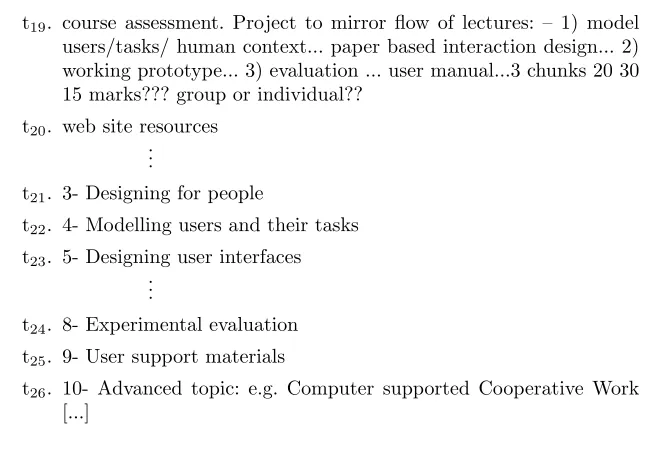
[image:12.612.152.481.404.630.2]The timeline provides a natural structure for interaction data. However, as we have seen, additional structure is needed in order to link activities that are discontinuous on the sequential record but are semantically connected. These connections often have a hierarchical structure, as illustrated by the following fragment of a remote meeting of three participants who are planning a HCI course (see Tables 1.5 and 1.4). The participants collaboratively write a course syllabus on a shared whiteboard. The shared surface of this whiteboard is also the focus of deictic gestures that are visible to all participants and thus serve to identify parts of the text as referents which form part the participants’ common ground. The text produced (also part of the participants common ground) includes the excerpt shown in Table 1.4.
TABLE 1.4
Text written on a shared editor as part of a course design meeting.
t19. course assessment. Project to mirror flow of lectures: – 1) model
users/tasks/ human context... paper based interaction design... 2) working prototype... 3) evaluation ... user manual...3 chunks 20 30 15 marks??? group or individual??
t20. web site resources
.. .
t21. 3- Designing for people
t22. 4- Modelling users and their tasks
t23. 5- Designing user interfaces
.. .
t24. 8- Experimental evaluation
t25. 9- User support materials
t26. 10- Advanced topic: e.g. Computer supported Cooperative Work
[...]
Line t26 was edited, highlighted or pointed at 14 distinct and
discontinu-ous time time intervals. Presumably, the speech exchanged at each of these
the exchange s18-s19, between participants C and D (Table 1.5). Utterance s18
overlaps in time with the pointing gestures that target t21, t22 and t23. The
first of these text objects, for instance, is active at another 12 time intervals scattered over the duration of the meeting. They will therefore overlap with other speech segments that will contain, for instance, information about high-level course organisation which is not shown in the text, such as the speech
turn s20, in Table 1.5.
TABLE 1.5
Dialogue from the course design meeting.
s18. C: well, but I mean... specially for someone like me who has done
CSCW work it would be nice to have CSCW there, but we also have to consider how much we will be teaching in these parts [points to
t21, t22 and t23].
s19. D: I think the for this type of introduction to HCI course it is good
to have a pointer to advanced topics [writes on t20]
.. .
s20. D: this group here [highlights t22and t23] deals with a kind of
con-textual and human side of things. These three lectures are hmm... kind of a chunk as are these two [points at two other lines of text].
These kinds of linkage structures are common in multimodal interaction and can be exploited for information browsing and retrieval. In [39] a basic model was introduced which related chunks of text to speech segments at two elementary levels: temporal proximity and co-occurrence of key words. This model, however, does not extend beyond timestamping and basic LVCSR out-put, and therefore cannot accommodate richer data sources and automatically extracted features. In the following section, an alternative is presented which arguably captures the above discussed requirements in a more comprehensive manner.
1.3.1
A linked time-based model
The elementary entities in the framework proposed here are (a) interaction events, (b) contentsegmentsand (c) timeintervals.
fire alarm may go off during the meeting, for example. Such types of events will only be addressed indirectly via actions performed by the participants in response to the event (e.g. a participant shouts “Fire!”).
Segments are sets of results (traces) of interaction events which contain indexable information. At the most basic level, the minimally indexable con-tent of an interaction event is the record of the very fact that it occurred (e.g. participant A was speaking at a certain point in time). Segments may consist of permanent and predominantly static content or transient and pre-dominantly dynamic content. The first group includes textual and graphic segments such as words, sentences, paragraphs, icons, images, drawings etc. The second group includes vocalisations, sounds, gestures, video sequences etc. Super-segments can often be identified by means of clustering and classifica-tion methods. Thus in text and speech one can attempt to segment according to topics [50, 24, 5, 22], tasks [37] activities [16] etc. Speech can also be seg-mented according vocalisations to turns, speech act sequence patterns [61] an so on.
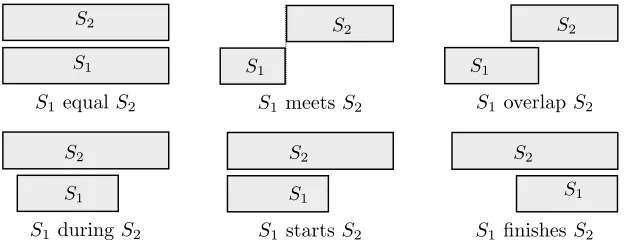
Time intervals can be regarded as anchor points to which information ex-tracted from different media sources are linked through the interaction events that produced that information. Of particular interest are the following tem-poral logic relations [2] between the time intervals associated with two
seg-ments:equal (e), meets (m),overlaps (o),during (d), starts (s), and finishes
(f). These relations are depicted in Figure 1.1. They are the subset of the
possible 13 basic interval relations (and 213 possible indefinite interval
rela-tions [33]) that encompass continuity and concurrency. We take these to be the basis for relating the contents of two segments. Note that the segments in question may come from any of the media source.
S1 equalS2 S1 meetsS2 S1overlapS2
[image:14.612.155.468.455.579.2]S1 duringS2 S1 startsS2 S1 finishesS2
FIGURE 1.1
Time relations of co-occurrence between segments S1 and S2 spanning the
time intervals represented by the respective rectangles.
Content segments can be linked to time intervals by means oftimestamps.
A timestamp is an annotation of a time interval [a, b] on a content segment.
We will represent the set of timestamps of a segment by means of a function
τ:S →℘(R2), so thatτ(S
to Si ∈ S took place (e.g. the intervals in which any participant points at a
paragraph of text). A segment made up exclusively of transient events such as speech or gestures has a single timestamp corresponding to the duration of the event(s) that produced the segment. Temporal links between segments can then be defined as follows:
Definition 1 Temporal link: a segment S1 is temporally linked to a segment
S2, written S1LS2, if there is at least one pair of intervals i1 ∈ τ(Si) and i2 ∈ τ(S2) such that i1Ri2 where R is one of the temporal relations listed
above (e, m, o, d, s, or f) or m1, the inverse relation of m. R is symmetric
and irreflexive.
Given a strategy for individuating segments and the above defined link relation one can proceed to define a meta-structure for a multimedia record of an interactive activity as a graph.
Definition 2 Atemporal interaction graphis a tuple(S,L)whereS is a set of segments extracted from a multimedia record andLis a set of pairs(Si, Sj)
such thatSi, Sj ∈ S andSiLSj.
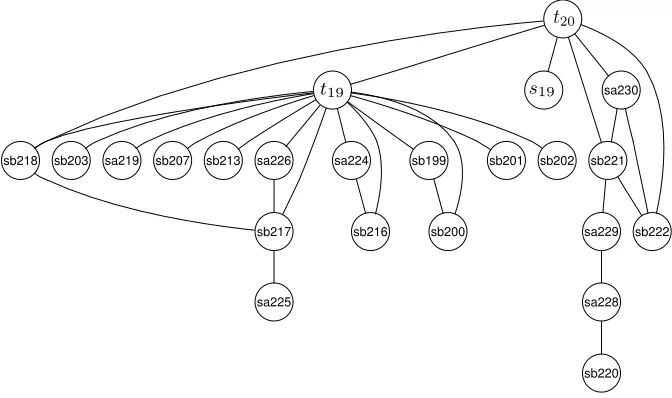
The definitions above do not specify what constitutes a segment or how specifically those segments are time stamped. Our aim here is simply to set out a general framework into which different segmentation and timing tech-niques can be incorporated and tested. A simple example should help illustrate this point. The setting is the one in which the course planning example was recorded. Participants were remotely located and communicated through an networked audio tool and a shared (virtual) editor/whiteboard. Speech seg-ments were individuated through simple adaptive average-energy analysis of separate streams of the speech signal (each participant wore a lapel micro-phone, which generated individual speech streams and obviated the need for speaker diarisation [7]). Straightforward synchronisation ensured that each segment was properly time stamped with respect to text events. Text seg-ments were defined as chunks of text enclosed by paragraph-marking bound-aries (similar to “boxes” in TEX [32]) and time stamped through monitoring of the participants’ activities on the shared editor. Figure 1.2 shows the a temporal interaction graph constructed from the recorded interaction data
for text chunk t20of the course syllabus discussion fragment presented above
(Table 1.4. Note the connection with the text labelled t19 in Table 1.4 as well
as the connection to speech turn s19, from Table 1.5.
One can promptly observe that t19 is linked to a number of speech
seg-ments both directly (adjacently in the graph) and indirectly (connected by a path of more than one edge). Since it extends beyond the node
neigh-bourhood of the segment under consideration (in this case text segment t19),
sb218
sa230
sb221
sb222 sb199
sb200
sb201 sb202 sb203 sa219 sb207 sb213 sa224
sb216 sa226
sb217 sa229
sa225 sa228
[image:16.612.142.478.135.334.2]sb220
FIGURE 1.2
Temporal interaction graph for segment t20, from the example given in
Ta-ble 1.4, showing its connections to t19 and s19 as well as other (arbitrarily
labelled) segments.
thus would appear to an observer who scanned the recording sequentially (e.g. by playing back a video) to be semantically unrelated. This underlying structure may therefore help to produce more useful summaries than the cur-rent transcription-summarisation approaches adopted for instance by “meet-ing browsers structured around main topics [...] or action items” [46]. Sum-marisation techniques that gather facts scattered in the time-based media in order to reassemble the relevant discussions, rationales, counter-arguments be-hind a decision or action item would come closer to automating the activity of content salvaging which, as we have seen, meets important requirements of the tasks of reviewing and reporting based on multimedia meeting records [43]. In addition to browsing, the graph structure may also be useful for retrieval. Al-gorithms for extraction of keywords related to a target segment [8, 56] could, for instance, extend the set of candidate words to include words in each of the segments reachable from the target in its temporal interaction subgraph and use link analysis to rank these words [31]. The temporal link structure may also be naturally complemented by spatial context analysis for records that include still images or video sequences [44, 45].
1.4
Case Studies
Two different cases of meeting activities are investigated: one based on meet-ings recorded in our laboratory (including both normal work meetmeet-ings among members of the research group and scenario-based meetings) using tools specif-ically implemented for this purpose [8, 7], and another based on “real-world” meetings held regularly at a busy teaching hospital [29].
1.4.1
Recording and browsing artefact-based interaction
The goal of this study was to investigate the semantic relationships between the contents of interaction events on orthogonal modalities (visual and audi-tory) as delivered by different media. A dedicated software environment was implemented to support remote meetings and enable multiparty real-time au-dio communication, text interaction through a shared editor, and gestures (pointing, highlighting, circling) performed on the text. The effect of a partic-ipant’s gestures on his remote collaborator’s screen is represented in the system though a colour-coded overlay that remained visible long enough to attract the collaborator’s attention [7]. Thus, the multimedia record comprises three types of data: permanent visual data (text), transient auditory data (speech, audio), and transient visual data (gestures).
A total of 31 meetings were recorded. The data contain a basic form of segmentation provided by the recording environment: audio was automatically segmented into talk spurts and text was segmented into paragraph chunks, as mentioned in the preceding section.
Meeting browsers were then built whose design drew on two different ap-proaches to structuring the browsing activity. The first was based on the idea
of identifying segments of the record which exhibit the greatest levels of
in-terleaving between text and speech streams and within speech streams [35], and highlighting these segments on the timeline [38]. This approach provided higher-level segmentation by clustering together talk spurts and text chunks in the regions of high interleaving but such groupings were restricted to contigu-ous regions of the recording. User trials of the browsing prototype suggested that users explored the record non-sequentially, alternating between reading and listening to the recorded speech. This observation motivated the develop-ment of the second meeting browser [10], which was based on the “neighbour-hoods” model presented in [39] for structuring and presenting information.
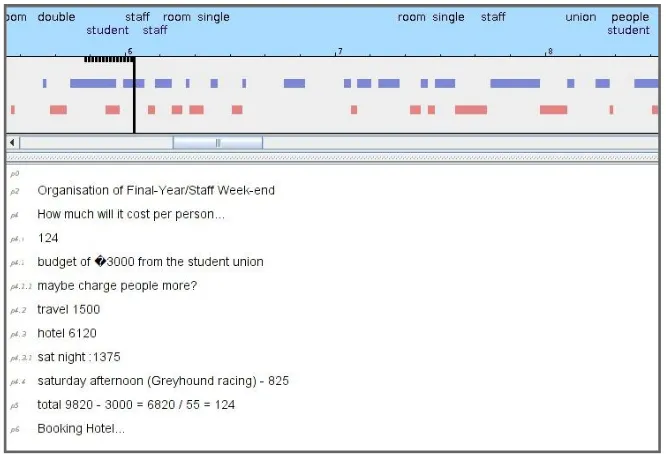
(bottom panel in Figure 1.3). The browser structured these data as a tree which encoded text-speech segment links implicitly defined according to ac-tion timestamps. Automatic speech recogniac-tion was also performed but the output was deemed too inaccurate to be read as running text. Instead, these imperfect transcripts were time stamped and used to augment the text seg-ments temporally linked to them for the purpose of keyword extraction. The keywords extracted in this manner were used to annotate the timeline (top panel in Figure 1.3) thus providing an index into the audio record. Keyword-based search was also available on the interface, as a separate component.
As can be gleaned from this brief description, the information structur-ing approach employed by this browser can be readily accommodated by the model described in Section 1.3.1. Definition 1 is general enough to cover both text and speech segments. In the specific case of the neighbourhood browser, the definition could be further specialised to reflect the text-speech linking
patterns by making the relationL=Lt∪Lsa union of a relationLt⊆ T × S
linking text segments (in T) to speech segments to a relation Ls ⊆ S × T
where Ls and Lt are not required to be reflexive. The temporal interaction
graph could then be constrained to having a tree structure by defining a partial
order onL.
Furthermore, the model could be used to extend that approach in a number of useful ways. First of all, the temporal graph could be used to produce dynamic summaries adapted to different contexts. Selection of a text segment, for instance, would cause the entire subgraph for this segment to be produced and displayed on the user interface. This could take the form of highlights on the text component and on the timeline panel which the user would be able to select for closer inspection, thus updating the subgraph. Keyword extraction and the search function could also be improved by link analysis techniques as mentioned above. Finally, static textual topic summaries could be generated by combining information from the different segments in the temporal interaction graph. Unlike the topic summaries generated by most meeting browsers, summaries based on the model presented here would not be constrained to encompassing only data from adjacent segments.
FIGURE 1.3
Main user interface components of a speech-centric meeting browser.
1.4.2
Structuring medical team meetings
Nearly all meeting corpora available to researchers, including the corpus de-scribed in Section 1.4.1, have been gathered in laboratory, either under con-trolled conditions with meeting participants recruited as experiment partic-ipants [48, 11] or under naturalistic conditions but in meetings among re-searchers [27]. While data gathered under such conditions are necessary and useful to researchers since they allow for standardised comparisons among dif-ferent research efforts on multimedia indexing, machine learning algorithms, natural language processing techniques and other quantitative methods, these data offer little information to guide the use of these methods in realistic application situations.
broadcast to the meeting. The majority of participants were co-located at the main hospital but the teleconferencing equipment was always used for im-age presentation and display of patient data even when there were no remote participants connected to the system. When remote participants joined the meeting, outgoing video data were captured through the picture-in-a-picture view that was displayed on a TV monitor during the conferences. A second high-end camcorder mounted on a tripod was placed at the back of the room and captured participants’ gestures, direction of gaze and activities (e.g. note taking) in addition to audio, through a directional microphone. Two wall-mounted cardioid condenser boundary microphones were also used to capture the speech stream. These media streams were synchronised and annotated with a dedicated media annotation tool.
As in the previous examples of meeting data, interaction and interleave between and within modalities was found to be ubiquitous in medical team meetings. Participants of different specialities (radiologists, pathologists, on-cologists, surgeons, nurses) gather in these meetings to present evidence and discuss patient cases. Therefore it is common for some specialities (notably radiologists and pathologists) to augment the description of their findings by images [28, 19]. Others interact with text by taking personal notes or updating the patient sheet which is sometimes visible to the entire group on the tele-conferencing system’s screen. There is empirical evidence (from studies using laboratory collected corpora) that personal notes can be an effective aid to the creation of meeting summaries [6]. These facts suggest that it makes good sense to gather synchronised data from different modalities also in medical meetings.
Due to the high levels of noise in the speech record, the basic segmentation unit adopted in the analysis of these meetings was not talk spurts as in the
previous case, but ratherdialogue statesdefined in terms ofvocalisationevents.
These states are defined in [37] as follows:
• Vocalisation: the event that a speaker “has the floor”. A speaker takes the floor when he begins speaking to the exclusion of everyone else and speak uninterruptedly without pause for at least 1 second. The vocalisation ends when a silence, another individual vocalisation or a group vocalisation begins. Talk spurts shorter than 1 second are incorporated into the main speaker’s vocalisation.
• Group vocalisation: the event that occurs when an individual has fallen silent and two or more individuals are speaking together. The group vo-calisation ends when any individual is again speaking alone, or a period of silence begins. Individual speaker identities are lost when a group vo-calisation state is entered.
– apause: a silence between two vocalisations by the same participant, – a switching pause: a silence between two vocalisations by different
participants,
– agroup pause: a silence between two group vocalisations, or
– a group switching pause: a silence between a group vocalisation and an individual vocalisation.
The temporal interaction graph in this case also included the speaker’s
(medical) role as symbolic information. The structure of these vocalisations
augmented with role information has proved quite effective at segmenting medical team meetings into high-level topics. A Bayesian approach based on these structures alone, without transcribed speech, has been shown [37] to match the levels of accuracy obtained by other state-of-the-art topic segmen-tation algorithms that use transcribed speech (among other features) in their data representations [24].
In brief, this approach consists in defining vocalisation events in terms of neighbouring vocalisations and their speaker labels, as in equation
equa-tion (1.1), whereViis a nominal variable denoting the speaker role (or a pause
type or group speech, in the cases of silences and vocalisations by more than
one speaker, respectively) andLi is a continuous variable for the duration of
the speech (or silence) interval.
s= (V0, L0, V−1, L−1. . . , V−n, L−n, V1, L1. . . , Vn, Ln) (1.1)
Segmentation can then be implemented as a classification learning task to
identify instancessto be marked as boundary dialogue states that start new
topics. The approach successfully adopted in [36, 37] combined the conditional probabilities for the nominal variables into multinomial models and modelled the continuous variables Gaussian kernels. In the full model, the probabili-ties to be estimated are simplified through Bayes’ rule and the conditional independence assumption to:
P(b|S=s) ∝ P(V0=v0, . . . , Ln=ln|b)
=
n
Y
i=1
P(Vi=vi|b)P(Li=li|b) (1.2)
where S denotes a random variable ranging over the vector representation
of vocalisation events, as defined in equation (1.1). In its simplest form, a classification decision employing a maximum a posteriori criterion will mark
as a topic (patient case discussion) boundary all vocalisations s such that
P(b|S=s)≥P(¬b|S=s).
Another application of these linked time-based data structures is in sup-porting automatic categorisation of patient case discussions. Patient case discussions are higher level segments of medical team meetings and can be
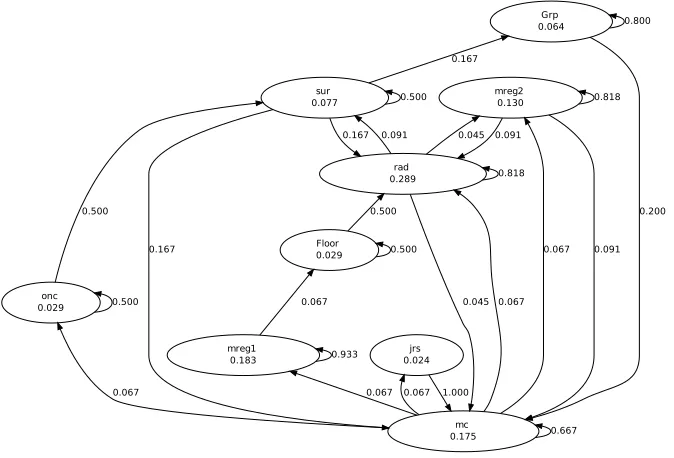
Once such case discussion segments are identified, they can be represented as vocalisation graphsthrough the temporal links of vocalisation event segments. These graphs encode patterns of speech duration and transitions between vo-calisation events which can be quantified and normalised for comparison. A typical vocalisation graph is shown in Figure 1.4, where the node labels corre-spond to the participant’s role (e.g. ’sur’ for surgeon, ’rad’ for radiologist, and so on) or to a general vocalisation event (e.g. ’Group’ for group vocalisation, ’Floor’ for silence, and so on).
In this representation, each patient case discussion is represented as a
directed graph G = (V, E) where V is a set of vertices or nodes and E a
binary relation onV. Elements ofV are labelled by pairs (s, p(s)) representing
the probability ps that the dialogue is in state s (e.g. a vocalisation or a
silence) at any given instant. Edges are labelled by conditional probabilities.
A probability p(t|s) labelling an edge corresponds to the likelihood that a
dialogue statet(the terminal vertex) immediately follows dialogue states(the
initial vertex). Thus, in Figure 1.4, the numbers labelling nodes correspond to the steady state probabilities for those nodes.
[image:22.612.143.480.351.580.2]mc 0.175 0.667 mreg1 0.183 0.067 rad 0.289 0.067 mreg2 0.130 0.067 jrs 0.024 0.067 onc 0.029 0.067 0.933 Floor 0.029 0.067 0.500 0.500 0.045 0.818 0.045 sur 0.077 0.091 0.091 0.091 0.818 0.167 0.167 0.500 Grp 0.064 0.167 1.000 0.500 0.500 0.200 0.800 FIGURE 1.4
Vocalisation graph for a patient case discussion extracted from a medical team meeting.
phase all training instances were converted into vocalisation graphs and stored in the database. In the classification phase, given a new instance to classify,
the algorithm selected from the database the k= 5 instances nearest to the
unlabelled instance by graph similarity and took a vote among those instances. The majority class label was then assigned to the test instance.
In summary, the linked time-based model successfully characterises speech interactions at medical team meetings for purposes of topic segmentation and classification of patient case discussions. In principle, the vocalisation struc-tures employed in these tasks could be augmented with gesture, image and text data and further acoustic features extracted from this type of meeting records, given appropriate data capture conditions. The proposed model can accommodate such extensions straightforwardly. Gesture and image events can be characterised as temporally linked segments in the same way as speech and text segments, in terms of Definition 1 and incorporated into an expanded temporal interaction graph. We are currently working on implementing and testing some of these extensions.
1.5
Conclusion
The need to combine complementary information coming from different me-dia and sources in order to meet the challenges of multimeme-dia information retrieval has been generally acknowledged in the literature [26]. Few applica-tions illustrate this need better than those that aim to provide support for browsing and retrieving information from meeting records. The difficulties in these tasks stem not only from the divergent nature of the media and modali-ties involved, some of which result in parallel and permanent modes of access while others constrain the user to sequential and transient access to the con-tent, but also from the lack of flexibility of existing systems to accommodate diverse sets of requirements.
account for the semantic aspects of multimedia records of communication and collaboration.
So far the design of meeting browsing systems has been mainly driven by the capabilities of their modality translation and event analysis modules which are presented to the user through familiar time (in speech-centric systems) or
space (in document-centric systems) interface metaphors. This paper
sug-gested that such metaphors may limit the system designer’s as well as the user’s ability to find richer contextual and semantic relations in the recorded media. This is particularly unsatisfactory given the new trends in data gath-ering technology. As ubiquitous sensors, processing devices, and methods for event detection, emotion recognition, improved speech processing, facial ex-pression recognition and contextual information fusion begin to offer greater possibilities for creating truly rich records of human-human interaction this design perspective may be ripe for a rethink.
1.6
Glossary
Content salvaging: the activity of sorting through the artefacts manipu-lated and produced during a meeting and the activities performed by its participants in order to reassemble these contents so as to make the meeting record more accessible.
Grounding: the process of establishing common ground, that is, of estab-lishing a set of mutual knowledge, assumptions and beliefs that underpins communication.
Meeting browsing: the activity of visualising multimedia meeting record-ings and finding information of interest in such recordrecord-ings.
Modality translation: the process of rendering an output modality into another. Examples include rendering speech into text by an automatic speech recognition system, text into speech by a speech synthesiser, video into key-frames etc.
Multimedia meeting record: a digital recording of a meeting consisting minimally of a time-based data stream, typically speech, and a space-based data stream, typically text.
Temporal link: A relation between two media segments (e.g. two vocalisa-tions, a vocalisation and a text segment etc) that meet or co-occur in time.
Temporal interaction graph: A graph that encodes the temporal links of a multiparty interaction.
Time-based media: (or continuous media) a class of media for which time is the main structuring element. Data conveyed through time-based media are generally of a transient and parallel nature. Examples include: audio and video.
Vocalisation: a period of talk by a speaker (or group of speakers speaking together).
[1] J. Ajmera and C. Wooters. A robust speaker clustering algorithm. In Proceedings of the IEEE Workshop on Automatic Speech Recognition and Understanding, ASRU’03, pages 411–416, St. Thomas, Virgin Islands, Nov. 2003. IEEE Press.
[2] J. F. Allen. Towards a general theory of action and time. Artificial
Intelligence, 23:225–255, July 1984.
[3] B. Arons. SpeechSkimmer: Interactively skimming recorded speech. In Proceedings of UIST’93: ACM Symposium on User Interface Software Technology, pages 187–196, Atlanta, GA, Nov. 1993. ACM Press.
[4] S. Banerjee, C. Rose, and A. I. Rudnicky. The necessity of a meeting recording and playback system, and the benefit of topic-level annotations
to meeting browsing. In Proceedings of the 10th International
Confer-ence on Human-Computer Interaction (INTERACT’05), pages 643–656, Rome, Italy, Sept. 2005. Springer.
[5] D. M. Blei and P. J. Moreno. Topic segmentation with an aspect hidden
Markov model. In SIGIR ’01: Proceedings of the 24th annual
interna-tional ACM SIGIR conference on Research and development in informa-tion retrieval, pages 343–348, New York, NY, USA, Sept. 2001. ACM.
[6] A. Bothin and P. Clough. Participants personal note-taking in meetings
and its value for automatic meeting summarisation. Information
Tech-nology and Management, 13(1):39–57, Mar. 2012.
[7] M.-M. Bouamrane, D. King, S. Luz, and M. Masoodian. A framework for collaborative writing with recording and post-meeting retrieval
capabili-ties.IEEE Distributed Systems Online, page 6pp, Nov. 2004. Special issue
on the 6th International Workshop on Collaborative Editing Systems.
[8] M.-M. Bouamrane and S. Luz. Navigating multimodal meeting recordings with the meeting miner. In G. P. Henrik Legind Larsen, D. Ortiz-Arroyo,
T. Andreasen, and H. Christiansen, editors, Flexible Query Answering
Systems: 7th International Conference, FQAS 2006, volume 4027 of Lec-ture Notes in Artificial Intelligence, pages 356–367, Milan. Italy, June 2006. Springer.
[9] M.-M. Bouamrane and S. Luz. Meeting browsing. Multimedia Systems, 12(4–5):439–457, 2007.
[10] M.-M. Bouamrane and S. Luz. Uncovering non-verbal semantic aspects of collaborative meetings: iterative design and evaluation of the meeting
miner. Signal, Image and Video Processing, 2(4):337–353, 2008.
[11] S. Burger, V. MacLaren, and H. Yu. The ISL meeting corpus: The impact
of meeting type on speech style. InSeventh International Conference on
Spoken Language Processing (ICSLP), pages 301–304, Denver, CO, Sept. 2002.
[12] L. Chen, R. Rose, Y. Qiao, I. Kimbara, F. Parrill, H. Welji, T. Han, J. Tu, Z. Huang, M. Harper, F. Quek, Y. Xiong, D. McNeill, R. Tuttle, and T. Huang. VACE multimodal meeting corpus. In S. Renals and
S. Bengio, editors,Proceedings of Machine Learning for Multimodal
In-teraction (MLMI), volume 3869 of Lecture Notes in Computer Science, pages 40–51, Bethesda, MD, May 2006. Springer.
[13] S. Chen and P. Gopalakrishnan. Speaker, environment and channel
change detection and clustering via the bayesian information criterion. In Proc. of DARPA Broadcast News Transcription and Understanding Workshop, pages 127–132, Herndon, VA, Feb. 1998.
[14] E. F. Churchill, J. Trevor, S. Bly, L. Nelson, and D. Cubranic. Anchored
Conversations: chatting in the context of a document. In Proceedings
of the CHI 2000 Conference on Human Factors in Computing Systems, pages 454–461, The Hague, The Netherlands, Apr. 2000. ACM Press.
[15] H. H. Clark and S. E. Brennan. Grounding in communication.
Perspec-tives on socially shared cognition, 13(1991):127–149, 1991.
[16] A. Dielmann and S. Renals. Automatic meeting segmentation using
dy-namic Bayesian networks.IEEE Transactions on Multimedia, 9(1):25–36,
2007.
[17] A. Dielmann and S. Renals. Recognition of dialogue acts in multiparty
meetings using a switching dbn. IEEE Transactions on Audio, Speech,
and Language Processing, 16(7):1303–1314, 2008.
[18] J. G. Fiscus, J. Ajot, and J. S. Garofolo. The rich transcription 2007
meeting recognition evaluation. InMultimodal Technologies for
Percep-tion of Humans, pages 3–34, Baltimore, MD, May 2008. Springer.
[20] M. Galley, K. R. McKeown, E. Fosler-Lussier, and H. Jing. Discourse segmentation of multi-party conversation. In E. Hinrichs and D. Roth,
editors, Proceedings of the 41st Annual Meeting of the Association for
Computational Linguistics, pages 562–569, Sapporo, Japan, July 2003.
[21] J. Garofolo, C. Laprun, M. Michel, V. Stanford, and E. Tabassi. The
NIST meeting room pilot corpus. InProc. 4th Intl. Conf. on Language
Resources and Evaluation (LREC), pages 1411–1414, Lisbon, Portugal, May 2004. ELRA.
[22] M. A. Hearst. TextTiling: segmenting text into multi-paragraph subtopic
passages. Computational Linguistics, 23(1):33–64, 1997.
[23] P.-Y. Hsueh and J. D. Moore. Automatic decision detection in meet-ing speech. In A. Popescu-Belis, S. Renals, and H. Bourlard, editors, Machine Learning for Multimodal Interaction (MLMI ’07), volume 4892 of Lecture Notes in Computer Science, pages 168–179. Springer, Brno, Czech Republic, June 2007.
[24] P.-Y. Hsueh and J. D. Moore. Combining multiple knowledge sources for
dialogue segmentation in multimedia archives. InProceedings of the 45th
Annual Meeting of the ACL, pages 1016–1023, Prague, Czech Republic, June 2007. Association for Computational Linguistics.
[25] A. Jaimes, K. Omura, T. Nagamine, and K. Hirata. Memory cues for
meeting video retrieval. InProceedings of the the 1st ACM workshop on
Continuous archival and retrieval of personal experiences, CARPE’04, pages 74–85, New York, NY, USA, Oct. 2004. ACM.
[26] R. Jain. Multimedia information retrieval: watershed events. In
Proceed-ing of the 1st ACM International Conference on Multimedia Information Retrieval, pages 229–236, Vancouver, BC, Canada, Oct. 2008.
[27] A. Janin, D. Baron, J. Edwards, D. Ellis, D. Gelbart, N. Morgan, B. Pe-skin, T. Pfau, E. Shriberg, A. Stolcke, and C. Wooters. The ICSI meeting
corpus. InIEEE International Conference on Acoustics, Speech, and
Sig-nal Processing, 2003. Proceedings. (ICASSP ’03), volume 1, pages 364– 367, Hong Kong, China, Apr. 2003.
[28] B. Kane and S. Luz. Information sharing at multidisciplinary
medi-cal team meetings. Group Decision and Negotiation, 20:437–464, 2011.
Springer.
[29] B. Kane, S. Luz, and S. Jing. Capturing multimodal interaction at
med-ical meetings in a hospital setting: Opportunities and challenges. In
[30] R. Kazman, R. Al-Halimi, W. Hunt, and M. Mantey. Four paradigms for
indexing video conferences. IEEE Multimedia, 3(1):63–73, 1996.
[31] D. Kelleher and S. Luz. Automatic hypertext keyphrase detection. In
L. P. Kaelbling and A. Saffiotti, editors,Proceedings of the Nineteenth
In-ternational Joint Conference on Artificial Intelligence, pages 1608–1609, Edinburgh, Scotland, July 2005. IJCAI.
[32] D. E. Knuth. The TeXbook. Addison-Wesley, 1986.
[33] M. Li, Y. Sun, and H. Sheng. Temporal relations in multimedia
sys-tems. Computers & Graphics, 21(3):315–320, 1997. Computer Graphics
in China.
[34] Y. Liu, E. Shriberg, A. Stolcke, D. Hillard, M. Ostendorf, and M. Harper. Enriching speech recognition with automatic detection of sentence
bound-aries and disfluencies. IEEE Transactions on Audio, Speech, and
Lan-guage Processing, 14(5):1526–1540, Sept. 2006.
[35] S. Luz. Interleave factor and multimedia information visualisation. In
H. Sharp, P. Chalk, J. LePeuple, and J. Rosbottom, editors,Proceedings
of Human Computer Interaction 2002, volume 2, pages 142–146, London, Sept. 2002.
[36] S. Luz. Locating case discussion segments in recorded medical team
meetings. In Proceedings of the ACM Multimedia Workshop on
Search-ing Spontaneous Conversational Speech (SSCS’09), pages 21–30, Beijing, China, Oct. 2009. ACM Press.
[37] S. Luz. The non-verbal structure of patient case discussions in
multi-disciplinary medical team meetings. ACM Transactions on Information
Systems, 30(3):article 17, Aug. 2012.
[38] S. Luz and M. Masoodian. A mobile system for non-linear access to
time-based data. InProceedings of Advanced Visual Interfaces AVI’04, pages
454–457. ACM Press, May 2004.
[39] S. Luz and M. Masoodian. A model for meeting content storage and
retrieval. In Y.-P. P. Chen, editor, 11th International Conference on
Multi-Media Modeling (MMM 2005), pages 392–398, Melbourne, Aus-tralia, Jan. 2005. IEEE Computer Society.
[40] S. Luz and D. M. Roy. Meeting browser: A system for visualising and
accessing audio in multicast meetings. InProceedings of the International
Workshop on Multimedia Signal Processing, pages 489–494, Copenhagen, Denmark, Sept. 1999. IEEE Signal Processing Society.
P. Isa´ıas and M. B. Nunes, editors,Proceedings of WWW/Internet 2005, volume 1, pages 323–330, Lisbon, Portugal, Oct. 2005.
[42] I. McCowan, D. Gatica-Perez, S. Bengio, G. Lathoud, M. Barnard, and
D. Zhang. Automatic analysis of multimodal group actions in
meet-ings. IEEE Transactions on Pattern Analysis and Machine Intelligence,
27(3):305–317, Mar. 2005.
[43] T. P. Moran, L. Palen, S. Harrison, P. Chiu, D. Kimber, S. Minneman, W. van Melle, and P. Zellweger. “I’ll get that off the audio”: A case study
of salvaging multimedia meeting records. InProceedings of ACM CHI 97
Conference on Human Factors in Computing Systems, volume 1, pages 202–209, San Jose, CA, May 1997. ACM.
[44] P. Mylonas. Understanding how visual context influences multimedia content analysis problems. In I. Maglogiannis, V. Plagianakos, and I.
Vla-havas, editors,Artificial Intelligence: Theories and Applications, volume
7297 ofLecture Notes in Computer Science, pages 361–368. Springer, May
2012.
[45] P. Mylonas, E. Spyrou, Y. Avrithis, and S. Kollias. Using visual context
and region semantics for high-level concept detection.IEEE Transactions
on Multimedia, 11(2):229–243, Feb. 2009.
[46] A. Popescu-Belis, D. Lalanne, and H. Bourlard. Finding information in
multimedia meeting records. MultiMedia, IEEE, 19(2):48–57, Feb. 2012.
[47] S. Renals. Recognition and understanding of meetings. InHuman
Lan-guage Technologies: Conference of the North American Chapter of the Association of Computational Linguistics, Proceedings, pages 1–9, Los Angeles, CA, June 2010. ACL Press.
[48] S. Renals, T. Hain, and H. Bourlard. Recognition and understanding
of meetings: The AMI and AMIDA projects. In Proc. IEEE Workshop
on Automatic Speech Recognition and Understanding (ASRU ’07), pages 238–247, Kyoto, Japan, Dec. 2007. IEEE.
[49] D. M. Roy and S. Luz. Audio meeting history tool: Interactive
graphi-cal user-support for virtual audio meetings. InProceedings of the ESCA
Tutorial and Research Workshop (ETRW) on Accessing information in spoken audio, pages 107–110, Cambridge, Apr. 1999. Cambridge Univer-sity.
[50] E. Shriberg, A. Stolcke, D. Hakkani-T¨ur, and G. T¨ur. Prosody-based
automatic segmentation of speech into sentences and topics.Speech
com-munication, 32(1-2):127–154, Sept. 2000.
3rd European Summer School on Information Retrieval, volume 1980 of Lecture Notes in Computer Science, pages 93–110, Varenna, Italy, Sept. 2001. Springer-Verlag.
[52] J. R. Smith. Universal multimedia access. Proc. SPIE, Multimedia
Sys-tems and Applications, 4209(III):21–32, Mar. 2001.
[53] C. G. M. Snoek and M. Worring. Multimodal video indexing: A review
of the state-of-the-art. Multimedia Tools and Applications, 25(1):5–35,
Jan. 2005.
[54] A. Stolcke, K. Ries, N. Coccaro, E. Shriberg, R. Bates, D. Jurafsky, P. Taylor, R. Martin, C. V. Ess-Dykema, and M. Meteer. Dialogue act modeling for automatic tagging and recognition of conversational speech. Computational Linguistics, 26(3):339–373, Sept. 2000.
[55] S. E. Tranter and D. A. Reynolds. An overview of automatic speaker
diarization systems.IEEE Transactions on Audio, Speech, and Language
Processing, 14(5):1557–1565, Sept. 2006.
[56] G. Tur, A. Stolcke, L. Voss, S. Peters, D. Hakkani-Tur, J. Dowding,
B. Favre, R. Fernndez, M. Frampton, and M. Frandsen. The CALO
meeting assistant system.Audio, Speech, and Language Processing, IEEE
Transactions on, 18(6):1601–1611, Aug. 2010.
[57] A. Waibel, M. Bett, M. Finke, and R. Stiefelhagen. Meeting browser:
Tracking and summarizing meetings. In D. E. M. Penrose, editor,
Pro-ceedings of the Broadcast News Transcription and Understanding
Work-shop, pages 281–286, Lansdowne, VA, Feb. 1998. Morgan Kaufmann.
[58] A. Waibel, M. Brett, F. Metze, K. Ries, T. Schaaf, T. Schultz, H. Soltau, H. Yu, and K. Zechner. Advances in automatic meeting record creation
and access. In Proceedings of the IEEE International Conference on
Acoustics, Speech and Signal Processing, volume 1, pages 597–600, Pitts-burgh, PA, May 2001. IEEE Press.
[59] P. Wellner, M. Flynn, S. Tucker, and S. Whittaker. A meeting browser
evaluation test. In CHI ’05 Extended abstracts on Human factors in
computing systems, pages 2021–2024, New York, NY, May 2005. ACM Press.
[60] S. Whittaker, R. Laban, and S. Tucker. Analysing meeting records: An
ethnographic study and technological implications. In S. Renals and
S. Bengio, editors,Machine Learning for Multimodal Interaction, volume
3869 of Lecture Notes in Computer Science, pages 101–113. Springer,
Bethesda, MD, May 2006.
[61] Z. Yu, Z. Yu, X. Zhou, C. Becker, and Y. Nakamura. Tree-based mining
for discovering patterns of human interaction in meetings. IEEE
[62] K. Zechner and A. Waibel. DiaSumm: flexible summarization of
sponta-neous dialogues in unrestricted domains. InProceedings of the 18th
Con-ference on Computational linguistics, pages 968–974, Hong Kong, China, Oct. 2000. ACL.
[63] H. Zhang, C. Low, and S. Smoliar. Video parsing and browsing using
compressed data. Multimedia Tools and Applications, 1:89–111, Mar.
AMI/AMIDA, 9, 10
Bayesian information criterion, 9
collaborative writing, see shared
edi-tor content
dynamic, 14 salvaging, 8, 16, 24 segmentation, 13 static, 14
dialogue, 11
dialogue acts, 10, 14
ECOMMET, 9, 10 emotion
recognition, 24 ethnography, 7, 8 events, 13
gestures, 13 speech, 13 writing, 13
facial expressions, 11, 24 recognition, 24
Gaussian mixture models, 9 gestures, 11, 12, 17
deictic, 12
grounding, 11, 12, 23, 24
HCI, 5, 12
Hidden Markov models, 9, 10
human-computer interaction, 5, see
also HCI
ICSI Meeting Recorder, 9 indexing
content-based, 7 information retrieval
from meetings, 8, 10 interleaving
text and speech, 17 ISL meeting room, 9
k nearest neighbour, 23 keyword
extraction, 16, 18
LVCSR, 10, see also speech
recogni-tion, 13
M4, 9 media
annotation, 20 audio, 4, 5, 7 continuous, 25 space-based, 24 speech, 6 static, 23, 24 synchronised, 20 text, 4–7
time-based, 5, 7, 16, 23, 25 video, 7
medical team meetings, 17, 19, 20 patient case discussion, 22 meeting
records, 3, 23
meeting browsers, 9, 17, 18, 24 meetings, 5, 7
automatic analysis, 9 browsers, 9, 17, 18, 24
document-centric, 18, 24 speech-centric, 17, 18, 24 browsing, 5, 8–10, 16, 24 corpora, 9, 19
medical team, 17, 19, 20 case discussions, 22
multimedia recording of, 5, 16, 24 scenario-based, 17
modalities auditory, 17 complementary, 5 orthogonal, 17 speech, 6, 17 visual, 17
modality translation, 3, 5, 7, 24 model, 3, 12
neighbourhoods, 17 time based, 3 time-based, 13 multimedia, 5
multiparty interaction, 7, 23
non-verbal communication, 20
patient case discussion, 22
qualitative studies, 8
segmentation, 6, 9, 10, 14, 21, 23 audio, 6, 17
speech, 15 text, 6, 15 topic, 14, 21 video, 6 semantic, 15, 23 sense making, 8 shared editor, 4, 15, 17 speech
diarisation, 9
recognition, 3, 6, 9, 18 summarisation, 16 transcription, 16 speech diarisation, 9
speech recognition, 3, 6, see also
LVCSR, 9, 18 inaccuracy, 18 summarisation, 18 dynamic, 18 graph-based, 18 speech, 16 topic, 18 teleconferencing, 19
temporal interaction graph, 15, 16, 18, 21, 25
temporal link, 15, 18, 24 temporal logic, 14 timeline, 5, 6, 17 timestamping, 13 timestamps, 14, 18 topic
segmentation, 14, 21 summarisation, 18
VACE-II, 9 video, 6–8
in meetings, 7, 8 segmentation, 6 teleconferencing, 19 vocalisation, 11, 14, 20, 22, 25